Ewan Mason
Boss man at Mase
Replay available
Join us for a great event!
Automated transcript · Written by software from the replay's audio. It can mishear names and figures; the replay is the record.
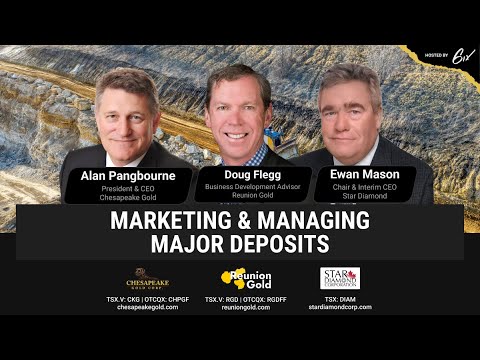
0:08 Hello everyone and thank you for joining today's discussion about ounces and carats in the ground, marketing and managing major deposits. Originally, we did have Reunion Gold's Doug Flagg scheduled, but he was experiencing some technical difficulties today. So unfortunately, it would just be the 2, or fortunately, it would just be the 2 gentlemen with me today, Alan Pangborn and Ewan Mason. If you have any questions related to the discussion at hand, please ask it in the Q&A tab on the right-hand side of your screen, and I'll try my best to incorporate it into the conversation. Please no company-specific questions, but if you want to talk to any of the companies speaking today, please private message me in the chat. I'll be happy to coordinate with the respective teams. So why don't we start with a brief 1 and 2 minute introduction. Alan, why don't we start with you? Just please provide an overview of your flagship asset and what stage of development your project is in.
0:58 Hi, and Thanks for the invite today, Carl. Yeah, so our company, Chesapeake Gold, we have a very large logo-grade gold-silver deposit in Durango, Mexico. It's over 20 million ounces of gold and another 480 million ounces of silver.
1:18 It's been known for quite a long time. It was drilled out some time ago. A PFS was done in 2013 and then again in 2016. We took over about 2 years ago with a different concept where we're looking at the higher grade core in the middle as a starter project for a project that we could do without having to maybe bring in a major to help sponsor it because of the very high capital that was required. It would have been a 500,000 ounce a year producer which is massive in its own right. But it's not something that we believe we could finance and retain any sort of ownership. So maybe a royalty stream or something. So very large deposit, different approach. Thank you. And Ewan, why don't you talk about Star Diamond and the scale of your project?
2:07 Well, thanks, Todd. Thanks for inviting me. It sounds like Alan and I have a fair bit in common with respect to our assets. We have the largest undeveloped diamond deposit on the planet. We've been working on it for close to 25 years and almost spent 1 billion dollars on it, trying to get it to the mining stage. Our 75% partner Rio Tinto, who was the last guy to take a kick at a can, have decided that they are no longer going to develop diamond mines. And despite having a very upbeat view of the technical aspects of the project,
2:38 have decided to move on. So we are currently trying to get that interest back from them and once again, try and move it forward ourselves. Thank you. Now, the opportunity in large deposits is rather obvious, so I want to direct the conversation to what challenges a company might face in marketing and managing a large deposit. And one of the main factors is just because it's a large deposit does not mean it's economical, given the commodity's underlying price or the deposit's complexity. Now, Alan, as a metallurgist, perhaps you can answer this question given you have worked on large projects throughout your career. With these big deposits, you require big checks like you stated, Do strategic investors typically shy away or are hesitant about large but complicated projects that might require an innovative approach to extract the metal efficiently and economically?
3:28 Oh, look, it depends on so many factors. And I'm sure you can add to this as well with his experience with Rio. You know, strategic investors, in my opinion, can be a bit of a double edged sword. Depends on who they are. Some of them are very well known for what they want and why they come into a project. And my experience in the copper industry is the Japanese smelters at one stage, they would take a strategic position without management. And they were basically looking for a material offtake. And you saw that as well with the Koreans and others. Sometimes you see some rather interesting joint ventures like BHP and Rio in the same asset.
4:13 You sort of go, well, why would they do that?
4:16 Sometimes it's because of the size of the check. You offset your risk a bit. But there are all sorts of factors that come into the deposit. Some deposits, they're large. The grades are low. And the only way they're economic is with this massive capital injection, which a junior company can't do. So very many, many different factors. Is it recoverable? What's the process? Are there contaminants in it? Do you want to smelt her as a strategic partner? Is there a marketing partner who can market your product better, like Glencore and some of these other concentrate marketing guys, there are just thousands of things that in-country experience related to location and politics.
5:13 Do you want a partner who's, in our case, in Mexico and has worked in Mexico forever or somewhere else. The list goes on and on and on. Doug, nice to see your powers back on here. I hope it's working fine. But before I bring it to you, do you have any further comments to the question I asked Alan?
5:38 Well, you know, with a large deposit, you have got 10 times the uncertainty with the investor base. For instance, we have to move 2 billion tons of overburden before we even get to the Kimberlite. And this has been one of our largest problems because this creates pit stability issues and et cetera, things that we've had to spend decades working out. And clearly, if you can't get to the ore quickly, you can't get payback. And so we've had scenarios where it was going to take us 3 to 4 years just to wipe out the overburden. And now we've got it down to, if we do the right pit first, maybe a year and a half, but 150 meters of overburden is quite a stick. And so this is something we've had trouble with. We think we've got it cornered with a pit stability, but we'll see.
6:25 Thank you. And I just been noticed by my coworker that Doug is still here. He's just on audio in the background. So Doug, why don't you
6:35 talk about your project and the size of your project and give a little quick 1 to 2 minute pitch about Reunion Gold and I'll circle you into this conversation. Thank you. Yeah, our project is still in the, I would call it advanced exploration stage in Guyana, a very good jurisdiction for mining. In fact, just moved from one of the worst countries in the Fraser Institute survey to, I think it was 21st or 22nd in the world.
7:07 And it's gonna be open pit, high grade, the initial metallurgy is good, and it's got good size potential. So it's got all of those things that you would like to see in a deposit and a deposit that could have significant size over the fullness of time. Thank you. And we were just talking about finance and projects of this size. And maybe I'll just prompt us to the group, but start with you, Doug. Is there a general blueprint to progressively financing these projects to ensure a material increase in shareholder value? I mean, I think there is, there's, you know, the private equity groups, some of them will come in early and fund equity with the promise of potentially doing debt down the road.
8:03 Same with the streamers. And I think for the bigger slash better projects, they're proportionally easier to fund because there's not a lot of them out there that have both size and good quality, i.e. High grades, good metallurgy, good countries, all those, no significant air on them. So if you have a project like that, it's much easier to finance. And absolutely, you can finance it sort of a bit at a time.
8:42 And Alan, any further comment or any secret sauce to ensuring shareholder value? I think some of it, a lot of it, depends on who are you targeting as your investors. Because it's not just, is our project great and everybody's going to come and invest in it. Certain investors look for certain things. And you have some investors that are large ounce in the ground investors. You have others that are more interested as it moves into development. There are others that won't even touch it until it's running. Some of the majors won't buy you until you've proved it works. And I've actually had one of them tell me that.
9:26 So the secret sauce, I'm not sure there's a secret sauce. I think It's more understanding who your target investor base is and making sure you work towards them and maybe not waste too much time and effort on things that you already know they're not really interested in that sort of investment. And so, you know, you focus on them first and then as the project moves forward, other investors come in and the type of investor will change over time. And Ewan, any further comments? Well, it's hard to say too much intelligent about this because we've been at it for so long. We've had 3 joint venture partners and all kinds of different investors.
10:11 So I would say, though, that we've changed our focus quite a bit about what sort of investor we're looking for. We started in February by showing off the bling, showing the cut diamonds, of which we have over 160,000 of them, and looking for a new investor that's after the bling, because clearly the mining investor is sitting in the shadows or is hibernating somewhere. Yeah, and you've also said multiple times, you and that this project would greatly benefit Saskatchewan as a province. People tend to have a poor view of the mining industry or perhaps that's changing, but the reality is that the mining industry is a great driver of economic activity. These projects require big workforces. So how do local governments pursue your large projects and what unique challenges are you facing if any at all?
10:57 Well, the governments have been on site from the beginning. They want the mine up and running yesterday. The problem has been, of course, getting the money to do that. And when you're looking at an operation that's going to result in a 3km wide open pit, you're talking about, I would say, earthscaping. And there is a little bit of reluctance, I think, both locally and possibly nationally to building this mine. But we've developed, you know, certain routes along the ESG channel that show this to be 0 emission now. So, you know, you just have to move and you have to juggle a little bit to get this done. And I'm hoping that we'll get this new forward fairly shortly. And just to piggyback off that question with the on the ESG front, with these large projects are you finding any further challenges from the ESG perspective? More of an emphasis on the environment and social, I'm referring to, such as permitting, et cetera?
11:57 Well, you know, 10 years ago, never a word was uttered about that subject. But now it's pretty much everything. It's so important now that our partner Rio Tinto commissioned a study, University of Saskatchewan or University of Alberta, to determine the carbon capture abilities of Kimberlite rock, which is loaded with aluminum and came out with some great results. So this is actually driving, I think Rio Tinto's way forward and it's certainly gonna be a driver on this mine when it gets built because it will be 0 emission. Thank you. And all you gentlemen have been in the industry for quite some time. So Doug, do you have any further collaboration or on the progression of ESG and these larger projects specifically? Sure, I mean, there's no question that it's a focus for us. We're a bit earlier stage in our project, but we see that it's something that we have to address. We've hired a consultant to do an audit and work with us to move forward on programs. We have some social programs
13:06 that we're doing, but we need to start to flesh that out. And one of our focuses is looking at different forms of trying to make the mine as environmentally friendly as possible. For example, run a river power option. We're looking at the potential to use some of our waste as aggregates, et cetera, and then re-forestation and other types of programs to minimize our environmental footprint as much as possible. Thank you. And Alan, anything further on the ESG front?
13:55 I think it's, and I think some of the listeners may have heard me say this before, I think there's a realization that you've got to get it right from day 1 that may not have been there 10, 20 years ago. And you've also got to start at the center of where you are and work out. You know, there's been many, many mistakes made around the industry over the years where they haven't done that. And it's caused later problems where You couldn't get your mind permitted because your neighbors didn't want it. You know, not in my backyard, it became such a problem, it was never going to happen. So I think there's a realization and the approach is changing and has been changing for quite some time.
14:46 I was fortunate enough to work in a mine that had done it very well where our relationships with the local community were very good and they helped us convince the local government, then the local government helped us with the provincial government, provincial government and the local government and the local community and us all go to the capital city and talk to the federal government. And that approach gives you more support. It gives you more possibility of getting through an ever-increasing and ever more complex System to get your approvals at the end. And I think there's also a realization that you've got to be so so careful with those initial agreements you make with the local communities
15:35 because They have a memory and they're not going anywhere So the geologists that made the first commitment that he was going to turn this into a beautiful wonderful place to live and you're all going to have free power and free communications and free everything else, that ain't going away. And you're going to be living with that for the next 20, 30, 40 years. So I think it's more of a, we are learning, we have to take a more holistic approach with all start at the core and work your way out rather than going to Mexico city in our case or Bogota or wherever the capital is and trying the you know the boss comes and tells the local community what they've got to do. It's not going to work.
16:26 For sure. And it never has.
16:29 And are you seeing any further interest from your inner circles or strategic investors or any investors talking about like having a preference over underground versus open pit operations like from a risk perspective underground is typically higher but I'm just wondering what these net 0 goals and this further realization of if open pits are becoming less attractive. Is that to me, Cal? I'll leave it open, but go ahead, you and why don't you kick it off? I mean, obviously out of sight, out of mind is a good thing, But in our case, you could mine our deposits underground if you wanted to. I'm just not sure it would be economic at the scale that it needs to have for such a large project.
17:15 But there are ways to mitigate those impacts, and we're doing that. And from our standpoint, because it's been on the planning books for so long, pretty much covered every aspect of it off. And we're going to be using a lot of the overburden aggregate. We are going to be using the kinder light as carbon capture. So there are a lot of steps taken now that nobody would have dreamed of 10 years ago. I'd like to add to that as well. It's open pits. It all comes back to economics. But as you said, there's things you can do or there's processes that you can use, whether it's underground versus open pit, or even on the processing side, heat bleaching versus smelters that have different impacts and different total carbon impacts. And so if you look at our project, for instance, switching from an autoclave project to a smaller and heap leach focus project, we can reduce 90% of the energy requirements, 90% of the water requirements, and there's no tailings dam because you never produce tailings.
18:24 And on top of that, you reduce the capital costs as well. And so there are things that we can do, and you're starting to see those changes happen.
18:33 In the copper industry, we used to only leach oxides. Then we worked out how to leach secondary sulfides. Now there are people that are saying they can leach chalcopyrite. That drives it to an open pit. But the flip side is I don't need massive amount of energy. I don't need massive amount of water. And I don't build these massive tailings dams, which have got a really bad reputation around the world because they end up going down rivers if you don't care. And so there's a whole risk reward equation in there as well that's beyond just the scar of an open pit. Yeah. Thank you. Doug, do you have any further comment on this?
19:18 Yeah, I would add a couple of things. I think, as Alan said, the economics often of an open pit are more attractive. But offsetting that is some, I would call, I think it goes jurisdiction by jurisdiction. Some jurisdictions don't find open pits as palatable as others. So I think it really kind of depends where you are. Certainly in Guyana, we haven't found pushback on an open pit situation. And we certainly haven't found it being an impediment to, let's call it, third party interest in the project.
20:07 So I just, I think it depends on the pit itself and the jurisdiction, you know, how big it is. A lot of the factors that Alan talked about, you know, in terms of how palatable an open pit situation would be. Thank you. And with these large projects, you don't just have a project and it becomes a mine, there's a lot of steps along the way. And you kind of need a unique skill set to have in terms of operating on a large mining operation. But when looking at management teams with earlier stage projects, should experience operating a mine be near the top? Or why don't we kick it off with you, Alan? It's an interesting question, because I think initially if you're an exploration company you contract in the engineering services you need to do your PEA, your resource assessment whatever what your skill set really needs to be is how to find it, where is it, what do I do with it when I start drilling into it.
21:08 That changes over time. You know in my experience for instance I never really got involved in exploration projects. I would come in after they knew where it was and then go, okay, can this be a mine? And what does it look like? What's the scale going to be? And do the equivalent of like that PEA or PFS stage and then move it forward. And then you see the entire management and sometimes the board as well, change over time as you move closer and
21:39 closer and closer to becoming a producer, if that's your goal, right? The alternative is you get it to a point somebody buys you and they bring their own development operations management team in and they already have those skill sets. So it really depends what your overall long-term plan is but either way you see this transition operating is very very different building is very very different to finding it. So what do you look for? What's top of your list for management? Me? Yes. Given our stage at the moment where we are on this development metallurgical stage, it's really the support that can drive that piece, key piece forward and then take it into the development stage.
22:34 And that's how I suspect our management, well not suspect, I know that's how our management team will change over time towards a more delivery focused management team with the support functions that are required and understanding what we have to look like when we get into operations is important because then you wind that back and say okay I need HR systems, I need accounting systems, I need all of these other systems and processes in place before we hit the mad panic of build and start up and operate. And so we're working on getting some of that stuff all sorted out earlier so that we don't have to try and fix it later. Thank you. And Ewan, what about you for potential investors?
23:25 What do you as an individual look for in a management team? Well, Having seen a lot of stories that worked and a lot that didn't, I can tell you the number 1 requirement is the ability to promote your project. You need to be able to tell the story and you need to be able to raise funds at the back of that. And that of course assumes you have some kind of project that makes sense in the long run. There's plenty of time to get operating guys on board. Exploration is a whole different business than operations and it can sometimes take decades to put together a project as is our case And so you wouldn't even need to think about having operating guys you can hire But to be able to tell the story and to raise the financing is in my mind 98% of the game if you can't do that you're dead in the water Now isn't there a shortage of these high caliber talented people to help assist in these projects though?
24:24 How do you find the right team? Is it a network? Having the right network? Well, You know, it's an intrinsic characteristic of a person. They have to actually have that get up and go stuff, right? And I'm not going to comment on where that's coming from today. But I can tell you, there are a number of people in this business who have that get up and go and it's gone quite well for a whole slew of them. So it's not rare, it's just that some people don't see it and they get bogged down in the details and they should be out there telling the story and raising money, raising finance. Thank you. And Doug, do you have further comment on the transition from exploration to development in terms of management teams?
25:08 Sure, I mean, we're actually going through that as we speak. I mean, we saw the need, we were moving toward a significant maiden resource estimate or what we think will be a significant maiden resource estimate in mid-year this year. And given what we think the economic parameters, the favorable economic parameters of this project will be, we felt that there was an opportunity here to start to fast track the engineering side. So in terms of talent, we managed to bring Rick House, former CEO of Dundee Precious Metals out of retirement. And part of the reason was that, you know, he found the project attractive enough that he wanted something he wanted to be associated with.
25:59 So we were able to, after it took us quite a while, but we eventually convinced him to come on board. And then in terms of hiring the next layer of engineering management, he has contacts that he knew and was able to bring, you know, Keith on board to help us out as well. So, that's kind of how we did it along with the hiring G-Mining Services to basically take the project right from resource through PA, PFS, feasibility, construction, and commissioning. So as a small junior company that's making the transition from exploration to development or moving in that direction, we can now credibly show that that's something we can do. So it was a little bit of this and a little bit of that, that allowed us to kind of acquire
27:01 the talent that we'd need to move this project forward. Thank you. And I'll leave this open to the group, but you hear individuals like Rick Rue saying, swing for the fences, look for those big deposits, but are there any red flags either in the management teams or the large projects themselves for that matter, in which it might cause you to stop your due diligence prematurely if they don't meet some particular skill sets or the project has some particular flaws? I'm open to anyone to answer.
27:30 I think, you know, the biggest impediment to the potential impediment to the big projects is a large capex and potentially a low return. And then you get into a situation where perhaps you need to look at a phased approach, more bite-sized capital requirements. And maybe as Alan suggested, you start off with a heap leach or something initially, and then you use that to bootstrap up like back in the old days rather than starting with a kind of a Bigger billion dollar project which is much more difficult to finance Yeah, I'd add to that I mean you and mentioned, you know, he originally they had a 2 billion ton pre-strip.
28:23 What's interesting with these large projects is a lot of people have never even seen them. And so when you get into those sorts of numbers, you know I was fortunate enough to work on a couple of when I was with BHP the the problems or the issues Aren't what you think they are when you've got a project that's moving 1 million tons a day or more There's there's all sorts of issues just people You know 1 project I worked on we peaked 8000 people on site Every day you got a freedom. You've got a move them Imagine the size of the sewage treatment plant you've got to have. Things you don't even think about.
29:15 And I think that's where some of the junior companies who try to build these larger projects come unstuck by themselves, because you don't know what you don't know. Now, it was a huge eye-opener for me when I moved from a smaller project, smaller for BHP, into one of their mega projects, the issues that came up had nothing to do with the resource, had nothing to do with the engineering. It was all of this miscellaneous stuff around the outside that people hadn't even thought of in some cases. When you look at where projects go wrong, Doug mentioned the capital cost and the low IRR.
30:05 Maybe it should not actually be built. But unfortunately, when you're a single company, that's your future. Single-mind company, that's your future. When you go inside of a bigger company, they have multiple options. And so you actually do compete for capital on an IRR and an MPB basis and the ability to actually build it. In a single asset company, sometimes that capital number is a killer. And there is so much pressure to push it down, and you then see over time, all of these single asset big bills go pear-shaped. That's what you've got to be looking for. You've got to understand why is the capital the lowest in its peer group and the production is going to be the highest in its peer group and its operating costs are going to be lowest in its peer group. That is probably the biggest red flag when you're looking at some of these projects.
31:09 If your operating costs and your capital are the lowest in the peer group, but it's still going to work. Maybe I've looked at too many of them, but I don't believe it. Any further comments there, Euan? Well, that's totally the case and that's bang on because that's your lifeblood when you're a junior mining company. If you have a low IRR and it's low-grade and everything's low, it is better to maybe just forget about it and move on. Our situation is quite different, quite the opposite. We have a very high-value deposit. We just have to get to it first. And originally that did damage the economics, but we went back, took a few more looks at it and Rio's come out and presented us with an 85-year mine life. So we know it works. We just have to rearrange the ducks a little bit so we can raise money, hopefully not from mining companies because they take too long to do things, but raise the money and build the mine.
32:06 Thank you. Alan, you touched on an interesting topic with the one asset type company versus 1 with multiple projects. Is the diversification of having multiple the best route to remove volatility in your stock or should investors, I'm trying to say, consider a 1 asset stock? And we'll start with you on that one, Alan. Again, If you've got the right investment proposal for them, why not? Yeah, if, as Ewan said, if you've got a high IRR, high MPV project that makes sense, that is credible, which we believe we have with this new approach. Once we can show technically that technology works and we're getting the results that we need to get, and we've already put out our proof of concept, so that doesn't scare me, and we're borrowing the whole concept from a different part of the mining industry.
33:04 You know, yeah, why not? You can be a single mine mining company and turn yourself into a multiple mine mining company. It's not the easiest way to do it, but it is a viable alternative. And many, many companies have done it, sometimes on the back of 1 very large project at the beginning. And they found a way, as Doug mentioned, to find a way how to bootstrap it. I think that's the other thing that the industry may have forgotten. If you look back at all of these mega projects that still exist around the world, whether that's Escondido, whether it's Barrick and the Carlin mines, whether it's any of these large, large mining operations, Kennecock, or the old Kennecock, Bingham Canyon, they never started anywhere near the size they are today.
33:58 You know, Escondido took 20 years to get to move 1 million tons a day. Morenci got there after I don't know how many years. So that approach used to be start a little mine, get it up, get it running, show that it works, then expand, then expand, then expand. And it's also easier to raise money for an expansion because you've now got a track record and you can show, yes, the technology works. Yes, we can do it. Yes, we can deliver it. Yes, we've got the team. Yes, we've got some stable cashflow. We need some additional funding to build the expansion. It becomes a lot easier and a lot cheaper rather than the big bang.
34:45 Yeah, because the big bang, the risk profile is so much worse Any further comments on that Doug do you have anything to mention there And you're on mute, by the way, if you're speaking. Sorry. Unmuted. You're live now. There you go. I don't know. I have challenges just getting unmuted. It's a big mining project. But yeah, no, listen, I agree with what Alan is saying on all of that.
35:33 I mean, there's a lot of projects out there that are great projects that will advance and there's others that are struggling and don't, will just be difficult to fund and put into production. And I think investors, you can usually tell by the multiple they're trading at, kind of what the investor's point of view. And I think over time that's becoming even more pronounced in the markets, looking at valuations. There's companies with high valuations that enable them to advance the project, and there's companies with valuations that are to the point where raising money is too dilutive for them. So it really does come down to the quality, size, returns, et cetera, of the project.
36:28 Thank you. And I'll keep it on with you here, Doug, for the follow-up here. And that's all the questions I have for today. So I just want to wrap it up. We talked about all the challenges, but why don't we gentlemen talk about the opportunities your company has to the potential investor here today that might be considering your company. And again, we're gonna start with you, Doug. Yeah, listen, I think if you do have a project that could potentially be a tier 1 project with good returns and high rates of production, in our case, it's a gold project. If you can produce $300,000 or greater than $300,000 a year with a 12-year mine life, I mean, there's not a lot of projects and a project with a good return and low ASIC, there's not a lot of projects out there.
37:16 So you're going to be able to attract capital and potentially attract third party interest to drive it forward. And I think, you know, those are the types of situations that investors are looking at and that the larger gold companies are looking at as well. So if you can manage to find yourself in one of those situations, I mean, that's a good place to be. Thank you. And Ewan, why should a potential investor consider Star Diamond? Well, like I mentioned, the largest undeveloped diamond deposit in the world with Type 2A diamonds, which are incredibly rare and very valuable. In addition to that, while we're negotiating getting the 75 percent back to Rio Tinto loans, We dusted off our project to Northern Alberta called Buffalo Hills Joint Venture and had a diamond analysis done there. And lo and behold, if we didn't turn up some very rare yellow diamonds that are type 2a as well.
38:12 And that deposit has dozens of Kimberlite pipes. The difference is most of them are at surface, not covered by 150 litres of overburden. So we're going to turn some of our attention to that, see if we can do a small program, see if we can turn up some big carat diamonds and have an exit ramp in case we don't get things done the way we want it at $4 a coin. Thank you. And Alan, on to you. I guess our pitch to the investors is quite simple. We know where the deposit is. It is absolutely massive. It is one of the largest undeveloped gold and silver deposits in the world. And I'd stress gold and silver. 480 million ounces of silver makes it one of the largest silver deposits. 20 million ounces of gold makes it one of the largest gold deposits. You put the 2 together, and it is massive.
39:03 What we've brought to the table is a viable, credible, alternative route that gives us a high IRR, high MPV, start a project to get us going that we can do without having to bring in a strategic or a major shareholder that would dilute everybody else out. So that's our key pitch. The technology is working. We've put out the proof of concept and we're working on getting the numbers to support the BFS. Perfect. Thank you all for tuning in today. Thank you, gentlemen, for the awesome discussion. If you tuned in late, this recording will be available on six.com in the later days, So keep an eye out for that. But thank you gentlemen for your time. I appreciate it.
Follow Chesapeake Gold Corp. into a list and get an email when it puts out news.
Follow Reunion Gold into a list and get an email when it puts out news.
Follow Star Diamond Corporation into a list and get an email when it puts out news.
Boss man at Mase
Corporate Development at Reunion Gold