Transcript
Automated transcript · Written by software from the replay's audio. It can mishear names and figures; the replay is the record.
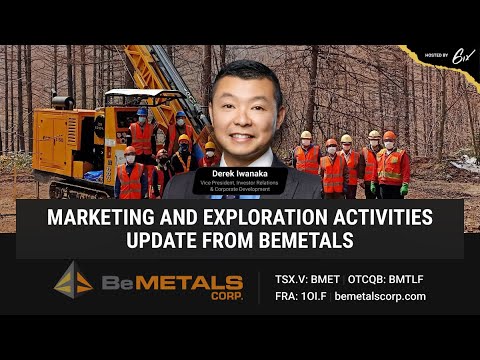
0:07 Hello everyone and welcome to B Metals Live Investment Summit today hosted by 6. I'm pleased to introduce our speaker for today, Derek Iwanaka, Vice President of Investor Relations and Corporate Development at Bmetals. Derek's gonna walk us through a company presentation and after we'll be taking live questions. Remember that you can submit your questions using the Q&A panel found on the right-hand side of your screen at any time during today's presentation. And as always, this event is being recorded and will be available to watch on six.com afterwards in the coming days. Without further ado, Derek, the show is yours.
0:38 Thanks, Gaham, and thanks everybody for joining us today for the live webinar. And if you can't catch the live webinar, Hopefully you can take a look at the replay. I'm going to have a really short update today. I really just want to recap kind of the latest marketing that we've done and to be quite honest we haven't done a ton of marketing this year. Partially because of Omicron at the beginning of the year, and also just we haven't had a huge amount of news flow. But I like to say that that is starting to change. We are drilling as of we announced in April, we are drilling in Japan. And I'm going to give you a little update on how that is going. And then also, we should be starting up a drill program in Zambia at our Copper Exploration Project at our Pangani property. So we should start to see increased news flow.
1:31 In tandem with that, we are going to do some more marketing. So let's just get into it. I'll show you just some of the highlights that we've been working on. And then if you have any questions at the end, feel free to ask away. We may be making some forward-looking statements, so I'll just show you that. And if you want to read that, you can read it at your leisure on our website. And for any of you that are following Six's emails or ourselves, you probably have seen this picture. Yeah, literally we went traveling around the world last month, we went to Cape Towns first, then we went and attended the one-to-one mining investment conference, which is pretty much geared towards all sorts of investors.
2:22 Interesting event because you're literally are 1 to 1 sitting with one other person, usually maybe 2, but typically you're just meeting somebody so you can look them in the eye and see what their thoughts are both ways, whether you're an investor or from our side, speaking to the investor and seeing what they really want to find out about us. So it was great. I mean, we met with a number of different investors ranging from high net worth individuals to funds to private equity companies, stockbrokers, portfolio managers, traders, and major mining companies. So it was a broad range of investors that we met. In general, I would say that the feedback was pretty good. I can give you a little bit more detail on that as I would say that from the high net worth individuals, I'd say we got probably the most traction.
3:18 Quite a number of them like what we're doing in Japan. So that was good to see. On the other side, what I can say is we also saw some of the traders finding more interest in our South Mountain property, which is in Idaho. That's the polymetallic carbonate replacement deposit. And then on the other side, institutions right now, at least the ones that we met down in Cape Town are largely, I would say, looking for something either more advanced or larger scale or with just a larger market cap and unfortunately right now our market cap is for us anyways is only around 31 million dollars Canadian so a little too early for those guys to get into it. But for the high net worth individuals, retail investors and brokers, I did see some interest from those people.
4:10 So hopefully we'll see that translate into the stock over time here. From Cape Town, we went to the Frankfurt and Zurich luncheons, which we did. And those were primarily with high net worth individuals that were arranged for us by our friend Karl Heinz Hale. Good meetings. We met with a number of interesting investors in both Frankfurt and in Zurich. I guess in total we probably met close to 40 investors and a really broad range of questions. Again, they like what we're doing. I think in Japan, Japan is a bit of a new area for exploration, at least from a Western standpoint.
4:57 And that has kind of captured the interest of those investors. And part of that is because of the team that we have involved. We have B2 Gold as a backer here. You also have Newmont and Barrick that are investing in Japan via 2 junior mining companies. So you're definitely seeing interest in Japan. It's a very underexplored region of the world with super high-grade. It hosts the Hishikari highest-grade Gold mine in the world right now that has produced for the last over 30 years with a head grade of 30 to 40 grands per tonne. So there's not too many mines in the world that can boast those types of numbers. So that has captured people's attention. We followed that all up with some Zoom calls. So we didn't actually meet a lot of people in person in London just because it seems as though that is the way to do meetings now in London. So even though we were physically in London, we ended up doing a bunch of Zoom calls with various institutions, portfolio managers.
6:00 I think the calls went well. Again, Japan is a place of interest and because of the team and the pedigree of our, I think our backers, there was definitely some interest there. Now for us, we have to deliver some results. So I'll get into that a little bit further, but really that's what it's going to come down to. At least right now we have eyeballs coming back onto the story. I know it's been very quiet on the trading front, but I think that now that we have more people looking at the stock. If we can deliver some decent results, hopefully you see a reaction. And then upcoming here, actually just in a couple days, I'm going to be heading over to Toronto for the largest mining conference in the world, which is the PDAC. That will be held in Toronto at the Metro Convention Centre there.
6:50 If anybody is in town or is going to be at the conference and would like to meet, please come down. We'll be at booth 3047. I'd be happy to answer any questions you have or just to shake your hand and meet you so you can actually see who we are. Our CEO, John Wilton, will also be on hand. And if you're not planning to attend the conference, but you are planning to be in Toronto and would still like to meet, just ping me. You can email me at info at B Metals Corp dot com. I'd be happy to meet up with you or at least have a call at the very minimum. And then lastly, coming up for this month, we will be doing another update webinar. I think it'll be sometime late June, we haven't actually scheduled it yet. If it's not by late June, we could do it early July. But the idea is that we want to keep everybody informed as much as possible.
7:44 I basically gave this same presentation and giving you right now to our board yesterday. So that's an update on what we're doing from the marketing standpoint. We will be meeting with a number of the brokerages in Toronto and then also in Vancouver over the coming weeks here. So that's the update on the marketing front. Just a look at what we're doing overall. As you might recall, we are based here in Vancouver, although I'm in my home today. We have the South Mountain property, which is the high-grade polymetallic, primarily Zinc, but it does have a good Copper component and then Silver and Gold as well. So really good deposit, albeit small right now.
8:33 The goal there really is to turn that into a mine. We currently have a resource of collectively about 1 million tonnes of resource, which we probably need to get to about 2 million tonnes. And then I think that that would be substantial enough for us to build a mine plant and a mine around. So that's the goal with the South Mountain property. For Pangeni in Zambia, that is in the Western extension of the Zambian Copper Belt, really high-grade Gold, sorry, Copper mines, not too far from us. If you look at Ivanhok's Kamoakakula project up in the DRC, that's along the same belt. It's not on the Zambian side of the belt, but it is on the same belt that we're basically exploring on. So it's elephant country. I mean, if you find something there, it tends to be very large.
9:26 And then Japan, that's our most recent acquisition. The Kazengold project, don't be fooled. It actually is a portfolio of 5 different projects, all low-grade, sorry, low-epithermal type of targets, which are really exciting, tend to be high-grade. And we've had some really good experience with high-grade epithermal deposits, primarily in Russia with our, when I was with Bima Gold, we had our cupol deposit, which was then taken over by Kinross and subsequently has been bought by the Russians again. And the Julieta mine, which is also in Far East Russia, which Bima Gold at the time constructed and put into production in Far East Russia. And that was also a low epithermal gold mine.
10:13 So that's the overview of the projects that we're working with. Let's dig in a little closer into the Kazan Gold project. As I said, that's a portfolio of 5 projects in Japan. I guess a little bit different from maybe some of our peers is we have, I think, some projects that we chose because we thought that they could be mines relatively easy. Some of them have been past producing projects. They do have past production background on them. The Konami project and Todoloki were both past producers on the property and we are doing further exploration on them.
11:00 That's the premise why we chose some of those properties or why they were chosen. Those were actually chosen by some of the B2 Gold geologists.
11:11 We are going to focus in on the Kato project right now, which we are drilling on. We just started our first exploration drill program there. It's a 1500m program. We budgeted CAD$2M for that. What really attracted us to the project is the grade. Historically speaking, in the 1990s, the Japanese state entity called MMAJ did an exploration program in the 1990s. These ellipsoids here in the red just indicate where those drill holes were in terms of depth, 314 to 332 metres, which basically gives you an interval of 17.5 metres of 8.15 g per tonne.
12:04 The second hole, which was from 258.85 meters to 277.5 meters, that's an 18.65 meter interval of 5 grounds per ton. So very economic types of grades and intervals, we need to replicate those types of numbers. And that's what we're looking for here at the capital project. So we actually just reached the target depth right now. So here's kind of a cartoon sketch that we have of the deposit. So this is, it's a cross section. So basically think of it as looking at a loaf of bread and you've cut through that slice of bread and now you're looking into that bread.
12:49 So if you're looking into it and you can see there's numbers of holes that are coming through that slice of bread, think of it as not all these holes are on 1 plane, think of them as a multiple plane. So even though it looks like they're all converging on one place, they're actually not. Some of them might be further ahead on the page. Some of them might be further behind on the page. So All those have basically just been added to this composite diagram. The bottom line really is that we need to hit that target depth. From that target depth, which we currently are at, that's 230 to about 280 meters. We are looking for some more of that high grade mineralization. We're currently at the current target depth.
13:39 We are sending out samples as we speak. Those samples are going to be assayed in the Philippines at Intertek. The turnaround time there is we should have those results, at least initial results coming out by July. So stay tuned for that. We should have results coming out within the next month.
14:00 Moving on to our project in Zambia, this is that Pengeni project, which is, you're looking for large scale tier 1 deposits here. So we're looking along the Zambian Copper belt. Here is a look at Zambia and if you look at this kind of dotted line here, this is what the belt kind of outline looks like. So as you can see it kind of starts from the east with mines like Beluba, Mofalira, Nankana, Nenchanga. Those are all, now albeit old, but those are world-class Copper deposits. You have Rio Tinto, Barrick, 1st Quantum, Anglo American, all of these majors are operating in the area or exploring in the area. First Quantum has their Kansanshi and Sentinel mine.
14:55 And as some of you may have seen, they just announced that they're going to be investing another $1.5 billion for expansion of their smelters. So obviously a lot of interest in Zambia. I think with the new leader, HH, that is coming to power, it seems to be more pro-business in Zambia. And when I was just down at the mining in Daba in Cape Town last month, I did see that sentiment definitely improving down there. Quite a lot of talk about how things are getting more business friendly for, especially for mining companies like ourselves. So all good news from that front. What we're doing here is we're looking under sand cover. So if you look kind of from, I would say about this line to the West, tends to be covered by fairly thick sand cover. So it makes it really difficult for somebody to actually just stumble upon a deposit.
15:53 There's not that outcrop that you might see in Canada, where you can stumble upon some high grade Copper, gold or silver that's on the surface. You will not see that really in this area. It's all covered by sand. But fortunately for us is we have relatively thin sand cover on our properties. It's averaging about 25 meters of thickness and we are exploring there. We're having some really good results so far. We really just need to vector into where some of this hopefully higher grade mineralization is coming from. We also have JOGMEC, which is a Japanese state entity that is helping us fund this project. So far, they've invested about $1.7 million into the project. So they've funded the expiration program for the last year and a half or so.
16:41 And going forward, they're going to be covering about 27.8%. That's a pro rata share of the expiration expenses for this property. So we get better bang for the buck is basically what it boils down to. Here's just an overview of kind of the targets that we have on the property. We've spent a fair bit of time on this D prospect here in the north. And then also last year, we had some really interesting results coming from the Q target. I'm not going to go through all these drill results we had in the last 3 years because it really kind of gets interesting, I think, as of last year. Last year, we intersected 2 holes in the D section and then in the Q section, we intersected 0.62% Copper over 4m.
17:34 The grades themselves, maybe not something to write home about, but those grades are what basically the Sentinel deposit that 1st Quantum is operating, 130km to the North East of us. And that's the kind of grade, actually it's higher grade than what Lewana Barracks, Lewana Copper Mine is producing at right now. So the grades are decent. What we need is those intervals to be larger. Hopefully, 10, 15, 20 meters or 25 meters is where we need to see those intersections get up to. But what's been most interesting is that we are hitting contangent rocks. Contangent rocks are the same type of rocks that Ivanhoe, for example, their Kamoa Kukulamite is hosted in that same type of basement rock that we are seeing.
18:29 We're also seeing Chalcopyrite and Kainite. Those 2 minerals don't tend to be in a relationship together. It's uncommon. And we are seeing that same relationship here on our property, kyanite and chalcopyrite. I don't have a photo of it on this slide presentation, but if you'd like to see it, I can send 1 to you. But basically, that's the same type of relationship that 1st Quantum is seeing at their Sentinel mine. So, we're seeing the right rocks, we're seeing the right minerals, or their indicator minerals for some sort of deposit to be here. We're going to follow all this up. We're going to start off drilling in about 2-weeks here in Zambia.
19:16 There's a lot of smoke. Hopefully, there's going to be a fire somewhere hidden under here. So that's basically the update from the project level. Taking a look at the price chart here has been a painful experience for me for the last year and a half, probably now. But for those of you who haven't invested yet, this is the opportunity. I mean, we're trading at near a 52-week low, not far from the low that we hit during the pandemic or the start of the pandemic in 2020. So we're basically at kind of panic levels right now. And yet we have acquired the gold projects in Japan or further along and we're finding lots of smoke in Zambia.
20:06 So we're much further along. We have some great shareholders, some institutions like Fidelity and Sun Valley Gold that are in the stock. So we have all this and yet we're trading at near 52-week low. So that's the opportunity. I mean, we are cashed up right now. We got about $5M. Our market cap is only $31M and we're backed by B2 Gold. So that's kind of the overview. I see that Cam has a couple of questions. Cam, do you want to come online and ask those? Absolutely. Now that we're entering the Q&A, I'd like to remind everyone in the audience that if you do have any questions, please ask them using the Q and A chat found on the right hand side of your screen.
20:52 Yeah. And Derek, a couple of questions, you know, what drill results you were just talking about this, but I'd love to hear your input, what drill results are you most excited to see this year?
21:06 Either of those projects. If we have some success out of Japan, it could be a company changer. If we find a multi-million ounce gold deposit in Japan, it'd be the first major deposit really since the Hishikari gold mine in the 80s. So that could be extremely exciting. I mean, there has been very, very little exploration since World War II in Japan, but historically speaking there have been multiple multi-million ounce deposits exploited in Japan. You don't really hear about them from the Western perspective. So that could be really interesting. But If we found something in Zambia, as I said, they tend to be tier 1 Copper deposits. You're an elephant country. If you find something there, it can be really large. It'd probably be too large for us to exploit ourselves. We'd probably have to bring in another joint venture partner. Now Jogmech is already involved with that project, but it would require a lot of capital probably to get something into production there. So we would probably have to bring in some other partners for that. So, you know, Either of those could be really interesting.
22:18 On a more near-term basis, I did talk about our South Mountain property in Idaho, but I would say if we could have some success with the exploration there,
22:31 and hypothetically, we could double the resource, which is our target there, then we could have a mine in relatively short order. I mean, we could have a mine there in a couple of years time. So that could also be quite interesting. So, you know, we have all these different aspects to us, which could all deliver value quite quickly and quite easily. It's just really the luck of the job. Absolutely. And what you were talking about was specific to Japan actually leads into my next question a little bit. But Do you think that investors properly realize the opportunity that you argue Japan represents? It's really tough to say. It's a good question, Ken, because there really hasn't been a major discovery in Japan since Hishikate in the 1980s. So you've had over 40 years basically of very little exploration. And of course, hence there hasn't really been any major discoveries found there. So it's tough for anybody to really properly value what that's worth.
23:33 But I can tell you a couple of things. One is that in Japan, actually the Hishikari Gold Mine itself, it doesn't have a mill on site. So it has very low environmental impact. So it's basically just an underground mine. You have a conveyor that's basically bringing out ore and it's sorted by some ladies usually. They're sorting the ore because it's such high grade. You can just basically sort it out by hand. And then they're sending that ore to the Japanese copper smelters as flux to get rid of the slag in their smelters. So you don't require, in that case, at least, you don't require a large mill. You don't have all those large-scale CAPEX types of infrastructure that a typical mine might see. And from my understanding, there is still ample capacity to take on more of that type of high-grade ore to be used as flux.
24:37 That's something that could be really interesting if we could do that. That could be easy Gold production with very low environmental footprint and very low capex. So, you know, when you think of Japan, most people think, well, how are you ever going to permit a mine when it's so highly and densely populated? Well, if you're in Hokkaido, where we are, It's actually very, very sparsely populated. And John is over there right now, our CEO, and he can testify to that. I mean, I've been to Hokkaido as well. It is not a densely populated area that you might think Japan typically is. Now, down in Kyushu, there are more people, but again, the Hishikari gold mine is down in Kyushu in the southern island of Japan and that's operating for the last, almost 40 years now.
25:27 Okay. Yeah, absolutely. Thank you. Another question we received, what's the ultimate strategy for your portfolio projects? Yeah, that's a good question. So there's a number of ways that this could work out. Some people see this as a positive, some people see this as a negative that we have a relatively diversified portfolio. What could happen, I'm not saying this is exactly going to happen, but let's just say we have a discovery in Zambia and it's large scale. We would probably bring in some sort of partner. And at that point, if that were to be the main focus for B Metals, we may just focus on that property and divest of the other ones.
26:14 If we say had, instead of that, we had discovery in Japan, and that became the main focus, then at that point we may look to joint venture out or spin out some of the other properties. So Ultimately, I don't think that we're going to carry forward with all 3 of these projects going to production ourselves, but we may have some sort of toehold in them, whether it's a Royalty or some minority interest in those. So ultimately, I would say that we're going to move forward with probably one of those projects and not necessarily all of them. But as an investor, you get effectively 3 kicks of the can. You have 3 opportunities of exploration success with 1 tiny stock that's valued at 17.5 cents right now.
27:06 Fair enough. Absolutely. Another question we received just asking if you could run through the timeline for upcoming potential catalysts again for us. Sure. So first I would say that we will start up drilling in Zambia. That should be in the next couple of weeks. But probably the more interesting news is going to be what those drilling results look like from Japan. That should be sometime in July. And then followed by most likely start-up of drilling in Idaho. That's probably going to be early fall. And around that time, we'll probably start to see some of the drilling results coming out of Zambia as well. So we should have relatively steady news flow every month kind of for the next, up until the end of the year.
27:59 We should start to see more results coming out of Zambia probably in the fourth quarter of this year. And then potentially if we're drilling by early fall in Idaho, we probably could have results by the end of the year or early next year for for South Mountain. So we should have pretty steady news flow kind of from the summer up right until the end of next year, end of this year or into early next year. Okay and you've you know gone over this I think a couple times But the last question we have currently is, what project is the most attractive at this point for you?
28:40 That's a tough one, but I would say that probably Japan exploration is probably the most exotic, it's the kind of biggest unknown right now. And also because they tend to be high-grade, you could add a resource there fairly quickly with not a huge amount of drilling. If you had a whole large Gold Copper port for you, it would take probably years of drilling to delineate the deposit. But in this case, it wouldn't take a lot of holes in Japan to develop a resource there fairly quickly. And you could wrap around a model on that and put economics on it. So that's probably the most interesting at the very moment, but that could change with results coming from any of those projects.
29:30 Oh fair enough. Listen Derek, I want to thank you for coming on today and running us through this presentation and also the Q&A, of course. I'd also like to thank everyone who submitted questions. If you didn't get a chance to ask a question or if you think of 1 after 1, you can get in contact with the team. Their website is www.bmetalscorp.com. You can find information to get in contact with them there. As I said earlier, this recording will be available in the coming days on six.com. But Derek, I'd like to hand things back to you for some final words before we wrap up. Cam, thank you so much for having me on and you know for anybody who's watching if you have any questions, please I encourage you to just either give me a call or send me an email or if you have any comments about these types of webinars that we're doing, feel free
30:19 to post your comments and if you if we if you want to see something or more of something or a little bit less of something, I encourage you to to write a comment either to us privately or or publicly on our either our social channels whether it be on Twitter, Facebook or LinkedIn.