Replay available
Air Liquide (Euronext:AI) Q2 2026 Earnings Call
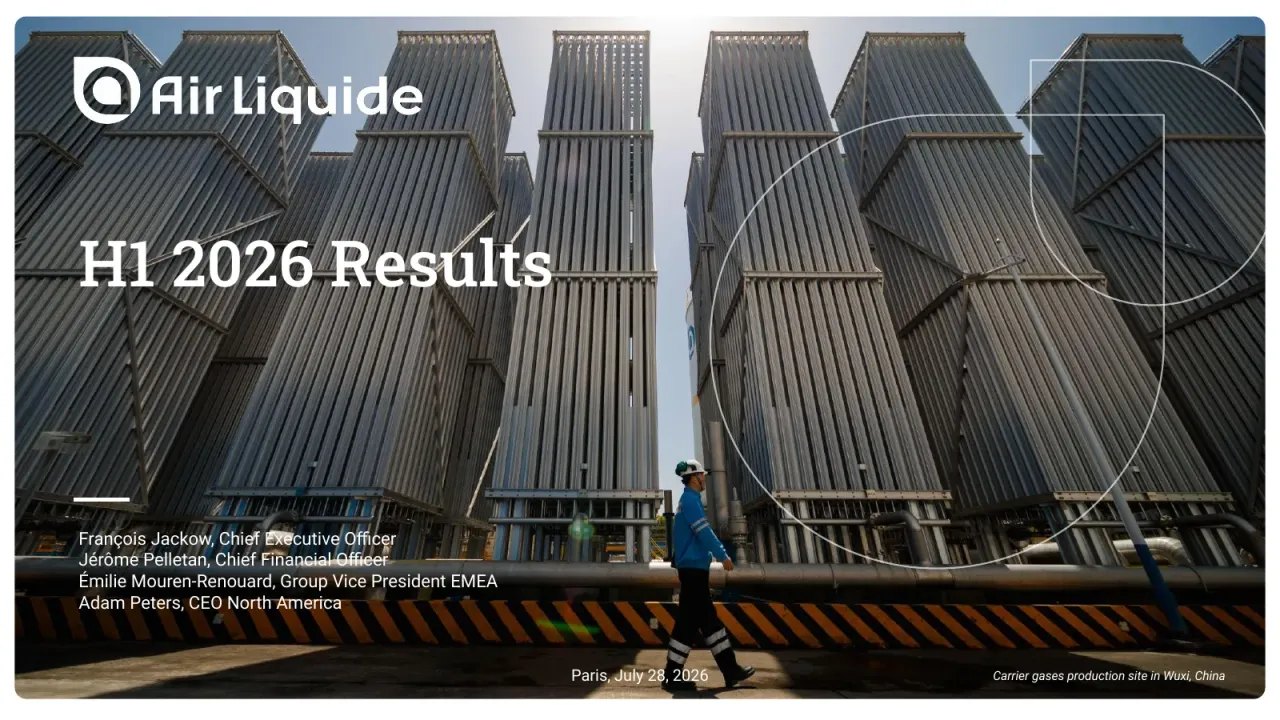
Air Liquide (Euronext:AI) Q2 2026 earnings call, held 2026-07-28. Watch the replay and read the transcript on 6ix.
- Company
- Air Liquide SA (EURONEXT:AI)
- Period
- Q2 2026 earnings call
- Date
- Tue, Jul 28, 2026, 5:00 AM ET
- Replay
- Watch the replay on this page · 57 min
- Results news release
- H1 2026 Results: with an acceleration in the second quarter, Air Liquide combines growth with continuous performance improvement · Tue, Jul 28, 2026
On 6ix: 6ix.com/event/lair-liquide-ord-aiquf-q2-2026-earnings-call
Replay
Transcript
Automated transcript · Written by software from the replay's audio. It can mishear names and figures; the replay is the record.
0:00 Good morning, ladies and gentlemen, and welcome to the AIQUFELD First Half twenty twenty six Results Conference Call. All participants are currently in listen mode only until we conduct a question and answer session and instructions will be given at that time. I will now hand over to the AIQUFELD team. Please begin your meeting and I will be standing by. Good morning, everyone. This is Corde Rodrigues, Head of Investor Relations. Thank you very much for attending the call today. Francois Jacob and Jerome Belton will present the first half twenty twenty six performance. For the Q and A session, we will be joined by Emily Moren Grenoire and Adam Peters, both VP overseeing respectively EMEA and North America.
0:46 Adam is on the phone with us from The US. For our next events, we look forward to welcoming you to our Digital Capital Markets Day on October 5. Let me now hand you over to Francois. Thank you, Oud, and good morning, everyone. It is my pleasure to share Liquide's operational highlights for the first half of twenty twenty six. Against this demonstrates its resilience, delivering sustained growth and strong financial performance. Partially, while driving robust execution today, we continue to secure our long term growth trajectory through a record volume of new project signings.
1:39 Let's start with slide three. Our first half results clearly reaffirm the structural trends of our business model. Comparable sales growth increased to 3.5% in the second quarter, lending above expectations and representing a pickup compared to the 1.9% in the first quarter. This positive momentum was primarily driven by strong underlying performance across both booming electronics and improving industrial merchants. Overall, sales growth in the second quarter reached 5.2% excluding FX and energy bolstered by the successful and speedy integration of DIG Airgas in January.
2:34 This strong top line performance validates our proven ability to drive growth both organically and through highly disciplined acquisitions in core geographies. At plus 110 basis points, margin progression is well on track with all levers of our transformation program contributing. Recurring net profit reached double digit growth, up 10%. Cash flow remained strong, up plus 8%, both excluding currency impact. Our recurring ROCE stands at plus 11% in spite of increased investments, which demonstrates our disciplined capital allocation and improved performance.
3:25 Our strong cash flow and balance sheet give us the firepower to continue to invest in the long term. Indeed, the first half of twenty twenty six is marked by record high signings, driven by an exceptional momentum in electronics and several major projects in large industries. This drives our backlog of signed projects under execution to another record of €6,000,000,000 up versus €5,500,000,000 in Q1 twenty twenty six. Combined with our active M and A strategy, this directly secures our future growth. Our ESG KPIs remain firmly on track with a few noticeable progresses this semester.
4:18 One is a startup of two renewable electricity sourcing contracts in Segunta in South Africa. As of now, close to 50% of these contracted sourcing has already started up, aligned with the objective to reduce the group CO2 emissions by more than 30% in one of the largest industrial gases production sites in the world by 2031. So in summary, in the first half of twenty twenty six, despite the macroeconomic conditions, we have not only successfully delivered simultaneously on growth and profitability, but also prepare the next phase of growth.
5:03 This is truly the inherent strength of Air Liquide. Now on slide four. Liquide remains intensely focused driving strong margin expansion across our three main levers. We reached accelerated industrial merchant pricing of plus 5.2% in Q2, successfully addressing inflation through smart pricing management. We delivered also almost €300,000,000 of operational efficiencies in H1 through continuous improvement and executing, and that's very important, our structural transformation program. We pursued active, accretive portfolio management to optimize our footprint and increase our local density.
5:56 We are successfully executing our rigorous margin expansion plan, delivering, as you see, clear and measurable results. Moving now to slide five. We are driving an exceptional momentum in electronics, signing new projects and strengthening our number one leadership position. In fact, in just the first six months of 2026, our electronics project decisions reached over €1,000,000,000 If you think about it, that's 1.5 times of our total for all 2025. The momentum is supported by a diverse mix of projects and geographies, almost all driven by artificial intelligence needs.
6:49 Looking at the various projects on the slide. Following our acquisition of DIG, Airgas in Korea, we further leveraged our global relationship with key players like SK INIX with project wins both in The US and in South Korea. In The U. S, we secured three large scale projects during the first half, representing a total investment of over $480,000,000 all dedicated to advanced chips with leading semiconductor manufacturers. Meanwhile, in Asia, our project signings achieved outstanding momentum, totaling more than €550,000,000 These wins reinforce our global market leadership and give us strong visibility on long term profitable growth.
7:46 On slide six, we're catching the growth in Large Industries with the signing of three major projects in the first half. They expand our presence in The US and directly support U. S. Industrial reshoring. In large industries in The U. S, we are investing $350,000,000 under a new long term agreement to supply air gases to Hyundai POSCO in Louisiana for their landmark low carbon steel plants. This new infrastructure directly supports the development of critical domestic and low carbon materials. It also enables our customer international expansion while actively contributing to the reshoring of American industry.
8:37 In Texas also, we strengthened our long term partnership with OXEA Chemicals by expanding our production capabilities at their Bay City site. This strategic $200,000,000 investment involves the construction of a new highly efficient plant to produce low carbon syngas and hydrogen. This project will reduce the group's CO2 emissions by 64,000 tons while providing also additional capacity. This project, and that's important, underscores our technological leadership to capture profitable growth in a key US industrial basin while supporting climate objectives.
9:26 Finally, in Kazakhstan, we have entered into a new long term agreement with Sileno to supply nitrogen to their upcoming polyethylene facility. Through this €70,000,000 investment, we will own and operate two state of the art energy efficient nitrogen production units. This project consolidates our presence in this strategic industrial basis, allowing us to capture strong operational synergies and also support a key regional petrochemical hub. You have to keep in mind that these major large industries wins demonstrate our relevance and differentiation across a broad number of strategic and structural growth areas.
10:17 To conclude, on slide seven, Airlix's performance in H1 demonstrates operational and strategic execution on all counts. First, our results show strong growth despite the challenging context, along with great progress on our margin expansion roadmap. Also, our active M and A strategy continues. We were able to close our landmark DIG Airgas transaction ahead of schedule. We look forward now to the growth this will continue to provide to the group. Finally, backed by a record level of project signings, securing future growth, we are very well positioned to sustain our long term growth profile.
11:05 In a nutshell, I'd like to say that we are executing today and preparing for tomorrow. I thank you for your attention. I will now turn over to Jerome to detail the financials. Jerome, please. Thanks, Francois, good morning, everyone. Turning to Page nine, I will now go through our financial performance in more detail. So for the second quarter of twenty twenty six, group sales delivered strong comparable growth at plus 5.2% excluding NRE pass through and currency effect and including the scope effect from the DIG Airgas acquisition net of the biogas divestiture. On the comparable basis, growth stood at plus 3.5% landing above expectations and representing a strong pickup over our first quarter performance at plus 1.9%.
11:56 I will briefly call out engineering and technologies reaching $420,000,000 in H1, up plus 4.6% on a comp basis and plus 8.8% in Q2. This increase is explained by the finalization of several unit construction for third party customers in engineering and construction. So looking at the first half overall, group established sales increased by plus 0.8%. Our reported top line was impacted by currency headwinds at minus 3.6%, which were only partially offset by the plus 0.1% positive energy impact. Additionally, the strategic acquisition of BHLG gas, net of our biogas divestiture, contributed a positive scope effect at plus 1.7% during this period. Consequently, total comparable growth for the first half of the year ended at a solid plus 2.6%.
12:48 So now moving to page 10, showing all our regions are growing. In Americas, growth remained at the same high levels seen in Q1. And in Asia, delivered sequential growth led by material pickup in activity. EMEA has also seen a modest increase in growth versus last quarter. From a business line standpoint, the growth increase in Q2 was driven by strong electronic sales and an improved industrial merchant performance. Healthcare continued steady contribution and airlines remained mixed. We have created, as you see, a balanced portfolio across business lines and geographies that provide inherent operational resilience, proving again its value throughout every stage of market cycles. Let us now provide you with more granularity on the activity in our main geographies in Q2 twenty twenty six. I am on page 11.
13:39 Indeed, we sustained high growth in The Americas at plus 5% on a comp basis. Large industry sales in The Americas were again led by strong activity in The US. This increase was driven by contribution from new project startup and ramp ups alongside high demand across our Gulf Coast pipeline network, especially from both chemical and refining customers in reaction to the development in The Middle East. In merchants, sales were driven by an increased pricing effect at plus 6.7%. Volumes were up slightly excluding impacts of the global helium shortage. Solid bulk gas activity was supported by a pickup in liquid argon notable for the space industry, while construction benefited from ongoing momentum in data center build outs.
14:28 Healthcare growth in The Americas continued high level. And finally, electronics saw strong progression of advanced materials and specialty materials offset by lower equipment and installation sales. Sales in EMEA are grown, by continued positive health care activity and an improved I'm In large industry, customer demand remained low, driven by weak cogen sales and low activity in The Middle East, partially offset by growing hydrogen sales to support robust activity in refining. Within Merchant, our pricing action increased to plus 3.1%, demonstrating our ability to proactively counter growing inflationary pressures. Volumes were slightly up excluding the impact of the global helium shortage.
15:14 Finally, healthcare delivered sustained growth at plus 4% supported by solid medical gadgets pricing and home healthcare activities. Activity in Asia now was boosted by a surge in electronics, further amplified by our DIG R Gas acquisition. In large industry, the activity remained mixed with hydrogen sales growth in Korea not fully offsetting low activity in the regions. Q2 Merchant sales grew at plus 2.1% or plus 3.4% when you exclude the helium in the weeds. Pricing demonstrated a positive sequential trend, improving from negative 0.4% in the first quarter to positive plus 1.4% in Q2. Notably, sales growth in China increased and in Q2 propelled by strong demand across on-site package gas and bulk gases, while performance across the rest of Asia remained more mixed.
16:06 In electronics, we delivered strong momentum and this performance was driven by a very strong demand for carrier gases and advanced materials alongside the roll off of prior year equipment and installations compliance. Turning now to page 12, I would like to give a quick update on our operations in The Middle East. As you know, the region, of course, remained volatile. However, our local team is safe and doing an outstanding job to supply our customers and our assets remain fully intact and operational. The global helium supply chain remains a point of attention. Production on Qatar has restarted at limited capacity. And we are utilizing road transport for our helium isocontainer, which helps ease global supply pressure.
16:53 Of course, we are continuing to keep on adapting to a fast changing environment. Future results have demonstrated, again, the resilience of the supply chain. We're effectively managing the situation to minimize the impact on both our customers and our financials. As for the potential outcomes, the last few months have proven us right, and we expect the coming months to confirm this trend even more strongly. I will now comment on our Q2 activity by business line. I am on Page 13. We are seeing an acceleration in merchant at plus 4% with pricing strengthening to plus 5%. The negative delta is volume, which were attributed to the helium shortage. Excluding this impact, merchant volume increased notably construction and utility sector in The Americas, bolstered by digital infrastructure and data center development, technology in Asia and pharmaceutical in Europe.
17:46 In large industry, we record a high volume in The US offsetting low projects in Europe and soft demand in The Middle East, while activity in Asia remained mixed. Turning to page 14. Following the rollout of challenging prior year equipment and installation comp year over year, growth in our electronic business has accelerated to plus 10% in Q2. The key drivers of this performance is of course carrier gas startup and ramp up, mainly in China and Taiwan, alongside broad based momentum in advanced materials. Top line results were boosted by one of South Korean customers putting Q3 order forward following the successful legal and IT merger of the company DIG R Gas and Air Kick Korea. But even normalized for this, the underlying electronics cost is very robust at plus 8%, a truly excellent operational performance.
18:38 Finally, SKR remained a consistent contributor to our growth this quarter. Performance in medical gases was anchored by a premium value based commercial model in Obalacare, in home healthcare, so it sustained growth in our patient base successfully offset the impact of strategic divestiture completed in Europe impacting the period. Now moving on margin discussion, Page 15. As Francois highlighted earlier, our transformation initiatives are yielding structural benefits on our margin improvement levers of delivery. In the first half of the year at the group level, we delivered a plus 110 basis point expansion excluding energy pass through as well as the PPI impact of the AGR Gas acquisition. Keeping the PPI impact, the improvement remained very strong at plus 100 bps.
19:26 Adivisions by our result, we remain intensely focused on cost discipline with personnel costs down minus 1.6%, purchase minus 1.5% and other expenses up plus 3% on a per budget basis. Depreciation was up plus 3%, reflecting the startup of our new production unit. Let us now review our ongoing margin improvement plan execution in more detail. First, turning to pricing in merchant. Persistent inflationary pressure continued to drive our pricing action, with Q2 pricing reaching plus 5%. Our primary focus is on cost discipline and actively managing the price to cost spread to drive margin expansion. Second, efficiency reached a record high €299,000,000 representing a plus 4% increase over the elevated baseline of last year.
20:19 Those substantial gains were driven by the seamless execution of group transformation initiatives globally. Third, we continue to pursue active portfolio management. As a reminder, closing the AIG Airgas early in Q1 give us the full year of benefits. Integration is moving fast, creating even more value than we expected. Beyond this, we are pursuing disciplined bolt on acquisition to drive local density while actively pruning our portfolio to ensure capital goes where it yields the highest return. Moving on to review our P and L in more detail, and I am on page 17. Non recurring operating income and expense accounting for minus €123,000,000 in the first half of twenty twenty six, mainly due to costs related to the acquisition of DIG Argive in South Korea and the restructuring costs linked to our transformation plan.
21:14 Net financial costs stood at EUR $210,000,000 for the first half of twenty twenty six. This includes a net debt cost of €149,000,000 up 27% compared to the first half of twenty twenty five. This increase is very much primarily driven by the financing structure put in place for our VHL acquisition in South Korea. This impact was partially offset by a reduction of the factoring cost with almost the end of factoring program in H1. Our effective tax rate stand at 26.4%, higher than the 25% in H1 twenty twenty five, mainly because of non deductible costs linked to the DIG acquisition. Net profit is up plus 1.2% as published and plus 6.5% when you exclude the currency impact.
22:01 The recurring net profit group shares stood at €1,900,000,000 up plus 4.4 as per reach, and a very strong plus 10% on a constant currency basis. On page 18 now, our robust cash flow generation and strong balance sheet allowed us to finance dividend, CapEx, and also the DIG acquisition. Our net debt is at 13,900,000,000 end of June twenty twenty six, marking a plus $5,500,000,000 increase from December 2025, following the financing of the DIG acquisition, the payment of $2,200,000,000 in dividends in May, 1,800,000,000 of industry and investment, and the halting of the factoring programs are gearing as this increased to 45% adjusted for the dividend payment seasonality effect.
22:50 It is indeed worth mentioning that working capital requirement increased by $1,400,000,000 in the first half of twenty twenty six compared to year end 2025. But it is key to note that excluding factoring, the underlying operational increase was held at just €400,000,000 Indeed, our decision to halt factoring program in H1 for cost effectiveness naturally added more than €1,000,000,000 to trade receivables. Next, let us now turn to page 19. Recurring return on capital employed stood at 11%, which is quite stable compared to the first half of twenty twenty five despite the dilutive impact of the acceleration in investment. Moving to page 20, we'll now review our main investment KPI.
23:36 We're at an all time fine industrial investment decision in H1 twenty twenty six at €2,900,000,000 up plus 26% year over year. These decisions include above €1,000,000,000 of electronic carrier gases that Francois discussed earlier, as well as major large industry projects in U. S. Steel and chemicals. Our investment backlog reached an unprecedented €6,000,000,000 an increase of plus 30% year over year, very much and well balanced across electronics and large industry with strong regional and project diversity. While upcoming Q4 startup will naturally draw down our backlog, a strong pipeline of new deals will help to replenish it, giving us a strong and high visibility in our midterm growth.
24:29 Our twelve months portfolio investment opportunity reached EUR4.8 billion plus 17% higher year over year at the end of June twenty twenty six despite a record EUR2.9 billion of investment decision during the first half. That are, of course, moving into the backlog. That demonstrates the strong momentum we're seeing in new project development. The pipeline remains highly diversified, comprising nearly 80 distinct projects. Electronic has now emerged as the primary driver, accounting for approximately 50% of the portfolio. The total portfolio of opportunities also including opportunities this time beyond twelve months is stable and exceeds €10,000,000,000 So on page 21, concluding the financial review, we confirm again our guidance for 2026 and 2027, cumulating as a plus five sixty bps margin improvement over a six year period. Thank you very much for your attention.
25:32 And I guess we'll now begin the Q and A session. Thank Thank you. We will now take our first question. And this is from Alex Sloane from Barclays. Please go ahead. Yes. Hi, morning. Thanks for taking the questions. Two from me, please. Firstly, around helium. So Industrial Merchant delivered improved Q2 growth really helped by pricing and China recovery you've called out. I mean, that looks like it's despite a kind of a low single digit helium related volume headwind in Europe and The Americas.
26:31 In your expectation for the H2 group growth to be similar or slightly better than H1, are you assuming a similar drag from helium availability? And should we be concerned this becomes a limiting factor on electronics growth? Are we still some ways off that given storage? And I guess more broadly, just thinking about your similar or slightly better comment on that second half outlook, would Q2 delivery adjusted for the order phasing in electronics be a broadly sustainable run rate for H2 expectations? Thank you. Thank you very much, Alex, and good morning.
27:18 So the first question on helium, As you know very well, I mean, Qatar source was quite a significant source of helium globally for all the industry. On top of that, what we have seen in Q2 is some restriction coming from Russia for the products which was going to China especially and some restriction also coming out of China. So the market was getting more tense, I would say. On the positive news is that the production from Qatar has restarted at a reduced rate, but we have been able to secure some volume from this source.
28:07 So that's again very positive news. Our expectation is that this will continue and will limit basically the impact of helium on our sales for the second part of the year. We have, of course, to be extremely cautious about the outlook for this part because we see that the situation is quite fluid, even if what we see and what we hear is quite positive as we speak. I mean, the helium production is still working and again should contribute. That's of course on top of our existing infrastructure with the cavern that we are using very successfully and also the multiple other sources that we have today and that we have activated, again, to limit overall the helium impact for the second part of the year.
29:06 Speaking of the impact on electronics customer, I think that was part of your question. Overall, we manage the supply of our electronics customer for helium. As you know, we have a long term contract and we have the capabilities to supply their requirement. So we have committed and we have been able to deliver the volume. So it's in no means a limitation to the business we are doing with the electronics for helium but also for the rest of the portfolio. So again, strong resilience of the group in spite of the adverse conditions that we do expect to improve. For the electronics itself, you have seen that clearly there was an acceleration in the second quarter.
30:00 This is a result of two things. The first one is we see less and less the impact of the very high E and I equipment and installation sales that we had in the previous quarters, which was to some extent masking the organic growth of electronics. That's one. The second part is the fact that electronics is picking up and it's picking up because of the contribution of the investment that we have done previously for carrier gases. And it's clearly, I mean, delivering. And also, and that's very positive news, the very strong sales that we have been enjoying for the advanced material, the proprietary molecules of Liquide, which is clearly picking up in the second quarter. So we see that some customers are catching up a little bit with advanced purchase.
30:58 So there may be a little bit of this effect on the advanced material. But all in all, we do expect electronics to remain in the range of 8%, maybe 9% for the rest of the year. So again, very strong electronics. It's a good news. And I think it's a good sign also that the investment and the position of the group is delivering. Thank you. Thank you. We'll now take the next question. This is from Alejandro Vigil from Santander. Please go ahead. Yes, good morning. Thank you for taking my questions. The first one is about your OpEx plan, the efficiencies you have achieved, the EUR 300,000,000 in the first half. If you can elaborate about the outlook for the coming quarters, particularly in EMEA, is that probably the growth profile of this business is this division is lower than the other divisions?
31:58 And the second question is about the net debt. You explained this factoring in the first half. Which are your expectations for the full year in terms of net debt and the evolution of net debt in the second half of the year, please? You. Helier, hello, good morning, and thank you very much for your two questions. Jerome, please can you answer the two questions? Of course. Thank you very much, Alejandro. So we'll go through your two questions, of course. So as it relates to the efficiency, you're right, the efficiency has been very strong in H1 to nearly €300,000,000 It's plus 4% versus last year. Basically, this whole transformation is multiple. We are continuing our transformation of the company as we have been doing in the last years.
32:46 And when you look at the different buckets, there is basically three different buckets that explain these acceleration of those efficiencies. First, there is an operational efficiencies. We are accelerating on the transformation of the industrial operation, the creation of the group, the industrial operation direction is helping accelerating into the process and to the global utilization. We have multiple projects ongoing using more and more artificial intelligence to make our assets more effective. So we are doing that. And we are entertaining a very good return as for now. And this, of course, will continue because we are very much at the right time doing and accelerating on that. That's the first bucket. The second bucket is, of course, procurement.
33:36 Procurement is delivering, and it's continuing. We have a global procurement organization, which has totally shifted in terms of gear, in terms of accelerating all those products with a strong acceleration in the deliveries. And the last point is the cost structuring impact and the PEC efficiencies that also are part of these these efficiencies. I would say this will continue to precipitate in the second part of the year. Now to come back on the factoring, so you're right, there is a factoring impact, which explains a little bit more than $1,000,000,000 slightly less than $1,100,000,000 in the net debt, I would say, the next evolution during the first half year.
34:24 This, you know, disfactoring program comes from a long time at the period of the gas accretion nearly ten years ago. It was an optimization program at that time, but it's not anymore. When we saw the impact of the data cost that we pay for factoring and the receivables compared to our net debt cost, which is today at close to 3%, clearly did not make sense to continue. It was a lack of optimization. And when you see already the impact during the first part of the year, you see that the cost of the debt has decreased by minus 7%. When you exclude, of course, the one off impact of the Argyle integration, the one off cost that we have. But when you exclude that and compare like for like compared to last year, we have a minus 7% of decreasing cost of financing, which is purely the impact of moving and to get out of the spectrum.
35:22 So this is very good and very strong optimization that our balance sheet can permit. So we have decided to do that. It was purely making sense on the cost effectiveness standpoint. Now the impact on H2 is quite easy. We are in the first part of the year, I would say, stop those programs. So you will have also the impact in the second part of the year. But the major part has been there. We're just finalizing maybe a few hundreds of factoring remaining, but the biggest part has been already accounted for in the balance sheet in the first part of the year. That's it. Thank you very much, Jerome. Thank you. We'll now take our next question.
36:08 This is from John Campbell, Bank of America. Please go ahead. Yes. Hi, good morning. Two questions, if I can. So if I look at your first half margin improvements, you've delivered definitely on your 100 basis point target. But I noticed perhaps with an unusually strong performance in The Americas, you've delivered over 200 basis points year on year. I think you qualified that stating that it had some help from some sort of favorable exceptional item. It'd be very helpful if you could elaborate on what exactly was that item and perhaps what was the quantum? Second quick question, you've unveiled three major electronics projects basically in July alone. I guess the natural question is how do you feel about this pipeline of future opportunities?
36:55 I guess the implication from your twelve month opportunity set is you actually see sort of a larger opportunity than you said in Q1, but perhaps maybe elaborate on the regions where you see these biggest opportunities. And then maybe a very quick one as well. Should we consider maybe that the gas intensity of these new semiconductors is structurally higher, should that support electronics volumes? Thank you. Thank you very much, John, for those very good questions. Margin, Jerome, and I will talk about the electronics projects. Thank you very much, John, again for your question. So margin in Americas has increased significantly. You're right, plus 200 bps versus H125 excluding energy. So basically we have two or three big items. First, merchant, large industry and healthcare activity contributed to the margin improvement for efficiencies and price increase, particularly in I'm and also efficiency also generating in electronics and a large industry benefited also some specific items that help. So that explains very much the bulk of these increases. As you said, it's very significant in The Americas.
38:08 Thank you very much. Jean, you're asking how do we feel about the electronics project. I would say very good, very, very good actually, because we have a very strong position, a very strong footprint, and an offer which is recognized, trusted by the leading customers. So we had, in fact, signed 1.5 times all what we signed in 2025 for electronics already in the first part of the year. So very good momentum. You are asking region by region. Maybe we will start with The US and I will ask Adam to say a few comments on what he sees in The U. S. On electronics project, and I'll come back to the rest of the world. Adam?
38:57 Yes. Thank you, Francois. And John, thanks for the question. So we've had a very productive quarter in The U. S. In terms of new project signings across the board, but particularly in electronics. As you've noted, we've signed three big new contracts for Carrier Gases, and we see that momentum continuing. So we have very active ongoing discussions with all of the major players in terms of expansions or new projects going on in The U. S. And feel like we're continuing to win our fair share of those projects. And we see that continuing as the AI trends continue to go forward and expansions are continuing in the same way. Maybe last point I would make is in terms of gas intensity. You're right, the gas intensity is higher when you look at these new fabs that are supporting advanced chips for high bandwidth memory or for the logic needed for AI.
39:52 And this is just a benefit, I would say, from the technology portfolio that we have, the efficient nitrogen generators that we have and across the entire fleet of what we do for carrier gas supply. Thank you very much, Adam. For the rest of the world, it's mostly Asia, where we are also very well positioned. So if we go through some of the key countries, we see again a very strong momentum. I would say Japan is waking up to some extent. We see that there is a very strong support from the government and the key players investment there. We are the only global international gas company to be there. We had some successful signing there, and there may be more to come. Taiwan is, of course, extremely dynamic, concentrating a lot of investment for the most advanced chips especially.
40:56 And there again, we are well positioned. Korea, of course, thanks to the DIG acquisition, now we are well positioned to meet the needs of the leading memory players especially. You have seen tremendous, tremendous announcement by the key players with several new campuses, mega campuses being announced. You have seen that we have been successful in securing some of the existing business. And there is an acceleration in the requirement, really a race for speed in this area. And finally, China, where we have a number one position also for the electronics, which is very, very dynamic in terms of needs for the silicon industry with a good development.
41:55 So when we combine all that, we see that there's a lot of green lights in this. Thanks to our business model and what our customers are telling us, we are quite confident that this will continue for some time, again meeting the needs of the digital world in general and more specifically the needs of AI clearly. So good momentum and very good position of the book. Thank you. That's very helpful. Thank you. The next question comes from Chetan Udeshi from JPMorgan.
42:45 Had two Francois, you talked about electronics growth continuing at the rate of maybe 8%, 9% in H2. And I'm just curious because when I look at the semiconductor CapEx increase that we are seeing this year and forecasted for next year, it's close to 25%. Like, what limits Liquide from seeing that level of growth in your electronics business? Because I think Adam was referring to increasing content for gases in newer generation chips. I would have thought, you know, you should be growing at least in line with the CapEx growth, if not even higher. So why are we not seeing of course, percent, 9% growth is not bad, but I'm just curious why can't we see something similar to 25% growth that we see in the CapEx spending on semis today and probably also most likely next year based on the forecast.
43:42 The second question, I was just intrigued by the very sort of high difference between the pricing increase in Americas in Q1, which was almost 7%, so in Q2 in merchant, whereas Europe was just around 3%. It seems volume momentum is not necessarily much different between the two regions. Both are up slightly excluding helium. So just curious what explains that big gap in terms of pricing in Americas versus Europe and how sustainable that is you think overall? Thank you. Thank you very much, Chetan. So maybe we'll talk about the pricing first and I will ask Adam to speak about what we see in The U. S. And mainly what we see in Europe in terms of pricing.
44:32 And then I'll come back to your interesting question on electronics for sure. Adam? Yes. Thank you, Francois. And thanks, Chetan. So when you look at pricing, and we've talked about this in other quarters, I really believe that what we have in our Liquide is a very strong methodology, tools, systems, incentives in place to drive pricing in the right way. And what we want to do is take obviously into consideration the inflationary impacts that we see and make sure that what we are able to do is accretive to our margins. And I believe that this is across the board. This is not just a U. S. Approach, it's really a group wide approach that Air Liquide has systematically put in place. And so obviously the impacts of tariffs and alike inflation can be somewhat regional in nature. And I think that also drives a difference in terms of the price impacts that exist from one region to the next. So definitely have a strong momentum in pricing in industrial merchant and in healthcare as well in The U.
45:39 S. And I think it really just speaks to those tools and processes in place to continue that going forward. And I would expect that to continue in the same way in the future. Thank you, Adam. And of course, it relates also to the inflation level and the cost increase, which maybe is higher in The U. S. And in Europe. Emile, what do you think? Yes, absolutely. Morning, everyone. Pricing in Europe, I would say, in merchant and mega is strong and has stepped up sequentially. So we've been proactive in increasing prices in anticipation of any cost increase due to the Middle East crisis and due to inflation and inflationary pressure in general. And overall pricing was ahead of the cost curve, leading to a good pass through, which is what we want.
46:29 So we've accelerated in Q2 in pricing in Europe. We have all the right formulas in bulk to reflect the energy piece. We know they are effective in PG also. We know the drill. We reacted fast, increasing the pricing to face the inflation, and it's different from one geography to the next. So overall, say for Europe, we continue to have a very good dynamic in pricing management. Thank you very much. So to come back to your question, Chetan, on why don't we see in the last quarter the growth of the electronics business similar to the growth of the CapEx in electronics being 25%. I think the main reason is we are not talking about the same thing at the same time.
47:21 So what is being captured with the CapEx of the electronics in the silicon industry is investment in new fab. As a matter of fact, our growth in terms of investment for the new fab is not 25%, it's 146% for the first semester. Because that's really what we invest more for this business. So we are much ahead of the industry and that's also showing how successful we are in gaining market share and how well we are positioned. So that's what we see today. And what we need to look at is how much we invest. Today, percent of our backlog is electronics.
48:07 Almost 50% of our portfolio of projects in the next project that we can sign in the next twelve months is electronics. So that's really what we see. What we report in the quarter are the current sales, which reflect basically the production of the current fab. So it's normal, it's following the trend, it's growing, but at the pace of the new investment. So the new investment that we are doing here will contribute in two, three, four years depending on the size. So be a little bit patient. You will see this, I mean, exponentially growing as the CapEx that we are putting on the ground is delivering product for the customer.
48:56 Hope it's clear. It's just a lag between when your projects are signed and when you actually start to commence delivery. Yes, again, maybe repeat what I say. Here you are talking about investment of the customer. Our investment is much higher. So of course you need to see the plant online to see the sales. You'll get more about this on CMD so maybe we'll do one more time over that. Thank you. Thank you very much, Stephane. Thanks a lot. Have a good day. Next please. Thank you. Next question is from Jean Luc Romain from CICCIB. Please go ahead. Good morning. My question relates to hydrogen.
49:44 My understanding is refiners in Europe would like to buy more green hydrogen and you are building new capacity like normally. Can you update us on the regulations and the EU regulations and their translation in French laws? Are they fast enough to start rapidly these productions or are they still lagging behind the industrials? Good morning, Jean Luc. Thank you very much for your question. I think Emilie, who is a specialist of the European regulation on cytogen can probably give you some answer. Emily, please. Okay. Well, good morning Jean Luc. So in terms of the need for green hydrogen in Europe, we continue to see a good momentum. So you mentioned our electrolyzer in Normandy.
50:40 So in terms of what is in the backlog, in terms of electrolyzers, it's a project under execution and everything is going as per the plan. Remember, our electrolyzer in Normandy will start up this year and is fully loaded. So in terms of regulation, things are moving. Reg three regulation in Europe is being transposed step by step in all the different countries. Of course, this is key as the mandates defined by the regulation being transposed in the different countries is what triggers such an interest for green hydrogen from our refiners and our customers. And overall, would say, going as per the plan, we have several in execution and we are really clearly the number one player in green hydrogen in Europe, with also our strong technological partnership with Siemens Energy to manufacture those dam electrolyzers.
51:42 Thank you very much, Emile. And overall, we see that the regulation is going in the right direction. There are more actually refiner on-site being converted to low carbon hydrogen. So again, I think the leadership position that we have taken in Europe is paying off. So thank you very much, Emine. Next question, please. Thank you. We'll now take the next question. This is from James Hooper from Bernstein. Please go ahead. Hi, good morning and thank you for taking my questions. First question is around the backlog. Are we approaching peak backlog at the moment? In the management report, called start ups so far in 2026 relatively limited.
52:33 So I guess from Q4 with Normandy and others that you'd expect some of these projects to start coming out. But are you expecting win rates therefore elsewhere in the business to cover for some of these outflows? And then secondly, also on projects, we've seen the press and others show some very, very large numbers in the about semiconductor investments that you've that you've referenced, Francois, but the AIQUFID projects that you've signed have been kind of low 100 millions of CapEx. Is this do you think these size of projects is going to increase over time? Or is there anything strategically where you prefer executing on smaller projects? I think some of the press have linked your competitors to much larger electronics contracts, for example.
53:28 Thank you. James, good morning and thank you very much for your two good questions. Regarding the backlog, I think as you pointed out, I mean, project come and goes. So there are some significant projects that will come out in Q3 and Q4. So that will decrease the backlog. But all in all, given the pace of the new project, we do expect this to remain more or less flat. We have to be careful with the backlog from one quarter to another one, which is very important is to look at the pipeline of the project. I think the team has said it's very, very strong today, probably the highest in the history of the group. So we are not worried about, I would say, quarter by quarter variation of the backlog. Again, very strong trend and good pipeline of projects to be signed soon.
54:18 Beginning what you mentioned about the electronic, I think it's a very good point. You see that in what we showed, there are several projects which are what we would call today mid sized, large sized projects. It's not the extra large projects. First, we like it very much in terms of the diversification of the opportunities and the risk, the global footprint, the synergy we can find, the selectivity we can use on those different projects, and the fact that we can also support our customer wherever they are. So we like the portfolio of projects.
55:05 Again, I think in the current environment, it's probably making a project more resilient and probably to some extent also more profitable. This being said, we see that there is an acceleration of the very, very large projects. So we may in the future position ourselves on some of those very large projects. Again, if they make sense, if they are strategic for us, if we can find the right profitability. One thing that I did not mention, of course, is that in this environment, this gives us the opportunity to pick what we consider the best project where we can create most of the value for the group and for Ayaliti. So we do expect some larger projects even to come online and maybe we will pick up some of those.
55:57 Thank you. Thank you very much. Thank you. We have no further questions at this time, so I will now hand back to the CEO for closing remarks. Thank you. All right. Thank you very much. I think this concludes our session today. Thank you very much for all your questions. I would like maybe to wrap up with some words. We, I believe, clearly delivered another very strong performance in this first half, while and I think it's very important positioning ourselves for future growth through key project wins. In spite of the environment, we clearly stay the course. Thank you again for your attention. I look forward to seeing all of you at our virtual Capital Markets Day on October 5.
56:51 In the meantime, I wish all of you an enjoyable summer break if you take one. Thank you very much. Please take care. Thank you. This concludes today's conference call. Thank you for participating and you may now disconnect. Speakers, please stand by.
Follow Air Liquide SA into a list and get an email when it puts out news.
Latest news releases
- Euronext:AI — Share buyback · Fri, Oct 30, 2026
- Euronext:AI — Q3 2026: Air Liquide accelerates, driven by sales growth and the launch of its strategic plan · Thu, Oct 29, 2026
Companies on this call
More from Air Liquide SA
- Jul 28, 2026 Air Liquide (Euronext:AI) Q2 2026 Earnings Call
- Apr 28, 2026 Air Liquide (Euronext:AI) Q1 2026 Earnings Call
- Feb 20, 2026 Air Liquide (Euronext:AI) Q4 2025 Earnings Call
- Oct 28, 2025 Air Liquide (Euronext:AI) Q3 2025 Earnings Call
- Jul 29, 2025 Air Liquide (Euronext:AI) Q2 2025 Earnings Call
- Apr 24, 2025 Air Liquide (Euronext:AI) Q1 2025 Earnings Call