Transcript
Automated transcript · Written by software from the replay's audio. It can mishear names and figures; the replay is the record.
0:08 Hello everyone and welcome to Power Nickel's live event. I'm pleased to introduce our speakers for today, Terry Lynch, CEO and Ken Williamson, VP of Exploration. They'll provide a quick update on the company's recent press release, including the discovery of their new high-grade Copper, Palladium, Platinum, Gold, Silver zone. And afterwards, we'll be answering questions. You can submit the questions in the chat at any point during the conversation
0:33 and we'll address them at the end. As always, the summit is being recorded and will be available on six.com to watch afterwards. So without further ado, I'll hand things over to Terry to kick things off. Hey, thanks Kyle, appreciate it. Hello everyone, hope everyone's having a great day. A bit of a cold, chipper morning here in Toronto. So I'm over at the Red Cloud Conference and just finished a presentation there and had to race back to get here to talk to you guys. So it's good timing. I'm gonna just remind you on a few key points about our company and then we'll get into the expiration stuff in more detail with Ken. But it's interesting, obviously our claim, best nickel investment on the planet is a pretty bold claim.
1:23 How do we make such a bold claim? So the major thing that we do, if we could leap ahead a couple of slides here, Ken, to the comparables page. One more, one more. Yeah, is, you know, I look at investment from the perspective of asymmetric risk. I think everyone should. It's like, what am I risking versus what potentially is my return? So I don't wanna risk a lot, but I wanna potentially make a lot. So, you know, the, so our whole assertion, you know, for Power Nickel is that, you know, when we look at high grade nickel sulfide, and that's what we're comparing ourselves to, so we're not looking at Canada Nickel or Giga Metals or FPX. Those are different animals.
2:09 I don't really have the skill set to talk about them. I think there'll be 1 or maybe 2 of them built. These are very big projects, big cap backs, you know, moderate returns. We'll take a lot of government and industry money to get them going. But I think some of them do. And when they get done, I think they make a lot of money and they're good investments, too. But, you know, generally speaking, historically in mining, higher IRRs are what really drives the mine development. And I would say that, you know, we're gonna have a, you know, exceptionally good high IRR project, and that will mean it will become a mine. And when things become mines, you make money. So relatively speaking, when we compare ourselves to our peers, I look at market cap per unit of nickel in the ground.
2:55 And in that case, we're the cheapest, the lowest price, best value, if you would, relative to our peers. And I think it's going to grow because of our exploration program, which we're going to get into. So next slide, Ken. The other thing that I think that's very different about Power Nickel relative to our peers is our peers are generally miners. They're finding a project and they're hoping to have somebody effectively buy it. And to the most part, that's the process. We're actually probably gonna go the other way. We've actually gone out and found an industry partner that would look to actually, you know, you know, collectively put up the capital stack and build the thing and then operate it. So why is that sort of an edge for us? Well, it really is an edge because the money in nickel is in the refining, not in the mining.
3:49 As an example, there's nothing but dark news these days about nickel, but as an investor, I would say one key thing to keep in mind. Generally, the most money you make as an investor is when you go from bad to less bad. So in nickel, I'm saying it's about as bad as it can be out there, and we're moving to less bad because actually the underlying fundamentals of nickel are still robust. You would think from the news headlines that nickel demand was going down. It's actually rising at double digit rates, okay? And there's a lot of fundamental growth underneath nickel, especially class 1 nickel in North America. And what you're gonna understand is there's a lot of different nickel markets. So there's Indonesian nickel in the Far East and what happens with them in China, that really doesn't impact a North American class 1 nickel project like Power Nickel as much as the market would have you think. So, what you see from having Samsung make that investment commitment for Canada Nickel is that despite, they could tap into Indonesia Nickel, they're making a serious, like a $20 million equity investment, $110 million joint venture investment, like a billion dollar sales contract for Canada Nickel, and that's still not fully funded yet. But I mean that was a big, you know, vote of confidence. I think that project but also vote of confidence for class 1 nickel in North America.
5:13 So I think if you're a class 1 nickel project in North America, you're going to get especially high and we will have, then, then that's going to be make an exceptional investment opportunity. Now, CV Mar, who's our, you know, you know, investor, and they're funding a factory a 7 and a half million dollar feasibility program that about 2 thirds of the way funded in that We'll have our first benchmark results out from CVMirror in just a short while. And basically what they do is they're a nickel refiner, right? So they wanna take our ore body and they wanna make nickel products. They're amongst the world leaders in nickel powders. Nickel powder, as an example, is getting $80,000 a ton.
5:58 LME nickel is around, I don't know, it's probably around 15,000 now. I didn't look at it this morning, I can't remember exactly, but it's a big difference and it doesn't cost you any work. It's like $5,000 to go from 1 to the other. So it's huge to be in the refining side of the business. Now, if you're not a refiner, there is no hope for miners to get there unless you partner, because it's a very complicated business, has a very specific skill set. And generally speaking, Glencore, Valley, and Rio Tinto, BHP, Wailu, the big boys, they're not sharing. They're buying the nickel miners and they're making this money themselves and that's what their business model is and God bless them. Now for us, our opportunity was that we became aware of CVMR and their approach, they've got 18 plants around the world, they're joint ventures. So this would be another approach to doing a joint venture to build a mine and a refinery to go to finish products. The interesting thing about doing that is there's several ways to win in that circumstance.
7:04 First way to win is better recoveries. So when we make a condensate, we're making a condensate, which we'll see in the 43-101 in a second, you make a condensate to fit right now the current smelters that are, you know, proximous to us in North America that we can ship to. So we're sort of living by how they need to get a nickel concentrate. It's best for them, it's not best for us. So we recover 70%, which is okay, but you know, obviously you're leaving 30% of the nickel on the ground that that hurts with CVMR We'd expect to get you know upwards of 90% recoveries So that's a significant like 30% increase across the board on your revenue side of things So that's a big plus The other thing with the condensate process is iron, which is in our ore body, iron is about 12% of the ore body.
7:55 The nickel is associated with iron. Quite often that's quite common in massive sulfides. So that's a waste product, the iron, in the condensate process. But with the CVMR process, they would make iron powders, so it's a paying process. So all of a sudden,
8:10 we're looking at this and saying, conservatively, we're gonna get 2 and a half to 3 times LME pricing for our project if we partner with these guys, if the feasibility study works out. So that's the big win there. And we're, you know, obviously CVMR is confident enough that it is working out, that they've moved beyond the benchmark studies, which will come out shortly. And they're now into the next stage, which is the prototype, which will come out in sort of mid-May. So we're feeling very bullish that this is all gonna work out and the feasibility studies will show a very high economic rate of return. Next slide, please. Of course, in the mining sector, nothing starts unless you have a deposit, okay? You gotta have a grade and tonnage, as they say. So we started, we posted 7.2 million tons. 2 things that we just posted this in December, you know, the, which is, you know, ideally you'd like to have posted this in January, but you know, you post it when you get it done.
9:17 And so basically 70% of that's indicated, so that's high confidence factor, 30% of it is inferred. You'll note that the inferred is getting better grade at depth and that's not uncommon. That's sort of how nickel rolls, just because the nickel associated with iron is quite heavy, so it'll drop down the stack. What's interesting about our project is that generally speaking, most of the resources around 300 meters deep, that's quite unusual for nickel. Usually nickel's quite a bit deeper. And we think that while we're having a number, a series of shallow deposits, we think we can take advantage of, we think there's probably going to be something even greater at depth. And that's one of the sort of the asymmetric upsides you've got with power nickel. Next slide, please. When we were exploring this last winter, one of our last holes we did at the end of the year was our geological team, Ken and his team, they basically identified this ultramagnetic target to the northeast, almost towards the end of our land claim.
10:20 We call it Wildcat. And we saw a visible expression of the ultramarine rocket surface. And we thought, okay, there's an EM anomaly here, let's take a shot. And we took a small, 100 meter hole and took a plunge. And at 60 meters, we hit this tremendous intersection of about 8 meters of 1-ounce PGMs. That was exciting for a couple of reasons. 1, obviously that's a bonanza-grade hole, That's just tremendous rock for that size. 2, it means that this area potentially still charged 5 and a half kilometers away. That's very exciting news. And, you know, when we've talked to industry partners about this, I mean, the head of exploration at Rio Tinto said, well, that's a phenomenal result for you because that's what happens with the big nickel PGMs like Norilsk, et cetera. You'll get something cooking at depth and these fireballs of high-grade PGMs get fired up top and then they land and they're quite close to the surface.
11:22 So that's really good sign. So that was super exciting for us explorationally to see that. And as a result, we thought, well, we're onto something big here at Power Nickel, and this is a big land package, potentially a big resource. So next slide, Ken. So we basically thought, what's the best way scientifically to de-risk this and attack this? So we had become aware of this new technology called ambient noise tomography, and it's basically a super sensitive seismic, and these things to the right are called geodes. They basically get put on the ground, and they send a sound pulse down about 2,000 meters into the earth, comes back as a sound map, and then they correlate these sound maps and they have algorithms that basically compare that with the other scientific data you've got. So obviously your drilling data, your downhole EM, your airborne EM, your gravity, your IP, your magnetics. You can pull all this data together and start to make better intelligence of it.
12:24 So what we get is more sort of almost like a 3D visualization at depth, and you get great lithographic control. So this is basically going to help us, we believe, optimize our drilling program going forward. Like everything in mining, nothing is perfect. We're not going to hit 100% because we've got this. What we're going to do is basically drill, we think, more efficiently. We're going to get to our discoveries quicker, and we're super stoked about what this has taught us. So I'm going to shortly pass this over to Ken. One more slide. So this approach, when we were analyzing it, we found that the ultramagnetic rock, which you know, the ambient noise measures velocity of the rock. So it turns out everything on earth has a velocity. I didn't know this, but now I do, and now you do. So the ultramagnetic has a 4,300 meters a second, and what we noticed, or what fleet noticed in their survey and analysis of the survey was that when it dropped off to 3,600 to 3,750 this is where the massive and semi-massive sulfites were deposited almost on a one-for-one basis at our deposit.
13:35 So that became a bit of a signature for Ken and the team to sort of say, okay, where is this ant signature located in our survey radius, okay? And then let's start to hunt in those areas. So without further ado, I'm gonna turn it over to our chief hunter, our main man of the sky. Ken, why don't you talk us through the exploration program we're currently working on using this tech? Absolutely. Oh, well, I'm gonna use a little bit the PowerPoint presentation or the slideshow here. And then, if you allow me, I will jump live into our leapfrog model and be able to show exactly where we're at as of this morning.
14:23 So as Thierry was mentioning the survey that was conducted on the property did help us out quite a bit visualizing what's happening at depth. Nesteri was explaining the velocity map or velocity model that we're obtaining, in my own words, is related to the rock densities. And we know that density contrast can be observed and measured, I guess, from that technology. So What we ended up doing is running that survey and identifying very good targets that would share the same ANT signature as what was observed at NISQ Main. NISQ main. So in a nutshell, we came up with 4 targets that we've labeled Ant 1 through 4, just labeling clockwise, I guess, around the clock here.
15:31 But all of those targets would share one way or the other similarities to the signature we did observe at Ant. So other things that we see on that particular image is not only the targets, but we kinda see some different planes and lines that were designed here. That's the Littow structural component also of the study. The Ant Survey not only allows us to visualize in 3D what's going on in terms of potential targets and things, but overall it gives us a really good view of the entirety of
16:18 the deposit in terms of structural blocks being there and displacement and calculations we can make like this. So it's really really good science And at the end of the day, if we look at that a little closer,
16:37 what we had defined were those 4 targets and if we look at that in a long view, looking north almost north-northwest, in a sideway, that's the top portion here that's called the long view so we'd see where NISQ main is related to surface and how deep it goes that's about 500 meters down and then the location of those ANT targets relative to the NISQ main target so the one thing we'll see combining the 2 images the plan view at the bottom and that long view up top, is we'll recognize here major faults that were interpreted from the ANT survey itself, defining the structural domains and what we believe is from the offset we interpret on the along those faults we've moved the entire domain say in a in this case down and west and down and east for instance to predict where the targets or the NISQ main lens offset could be. Now we're testing this so far we've drilled 1 hole in ANT 3 about there where the cursor is. We're currently testing ANT4,
18:09 and the idea here is very high level exploration. We initially will want to punch 1 hole into each of them 2 targets about to be completed with this one and the idea is to have a first look because really there's no data at all in in this area here So the idea is to have a first look at depth. What do we see? What do we get? And if we're lucky, we'll log on directly
18:39 to something really good there. That remains to be seen. But Whatever is happening, this is going to be very good scientific knowledge acquired in the sense that the data and knowledge will be passed on back to the fleet team, who's going to be in a better position to reanalyze their own survey and constraining it better with geological information that is coming from that drilling. You can see this as a first pass, refining the model and the interpretation, and we'll get back to those areas a little later.
19:25 We currently have 2 drills running. One of them is finishing off I was mentioning drilling that initial and for target the other rig is on wildcat and we'll get a little bit more detail on that I'm gonna finish with the the punchline I guess so 1 rig is on wildcat. We'll see details of that very shortly And the the one rig that is on ant for right now the plan In a few days, I would say will be to move it back in this area here and we have a drill program set up to be drilling Ant 1 and 2 at the same time with 1 drill hole. So in plan view we'll be setting up the drill about where the cursor is
20:22 and we'll punch through ant one little closer to surface and ant 2 at a significantly greater depth about where the the cursor is is the the plan here Ant 2 was my favorite target of all time the reason is probably because we have a lot more information in this area as compared to information we had on the West side. So speculations and interpretation and predictions, I guess, in this part of the world are slightly more precise or better educated than what it is on the West side. I'm very
21:08 intrigued by what we will discover. As a reminder, the expectation is as simple as finding the offset equivalent of the NISQ main lands that we have here, which from the last drill holes we add to the east, continuity seems to be there, but grade is lowering down quite a bit and we see some sort of a shift in the the geology so it is expected actually that the the lands would kind of follow the same offset observed in the lithology model. So on that what I'm gonna do I'll just turn off all of this here and go back to the real system So it's a little uglier than the PDF presentation here, but at least what I'm going to show you here guys is the complete story.
22:14 So As I was mentioning, we've drilled a first drill hole in ANT3, which is that yellow panel here. You can see PN24043
22:28 drilled there. Assays are pending on that one. And then that panel here, ANT4, that's the current drill hole that we have. We're not yet through the target area on that one. So now if we were to spin this around a little bit, as you will see is this particular hole here. Let me just clean up this thing a little bit. I know, I'll keep it on. So as you can see in the background here following my cursor is that second last hole, I guess we've done to the West.
23:18 We did intercept
23:22 the target so to speak in terms of geology. We've confirmed that the the right rock types were there and all of this obviously allows us to update and increase the level of confidence of our model as we go. And this current hole as you can see it's just about to hit the target there. We decided to drill it this one from south to north to test an EM anomaly that was on top near surface in this area. So we'll keep you guys posted when we get new news to release about that. So and as I was mentioning, the next plan will be to drill this hole here, permit number 22, which is that blue line punching through ANT2 target block in yellow here, about at that location.
24:26 And it will be following up, I guess, In a down dip way, some mineralization that we had intercepted in 2020. That would be back in 2022. As you can see, it's a fairly huge step out. Each square on screen are 200 meters grid.
24:51 So we'll be drilling like 400 meters below something like that. That little hit that we had. The expectation here is that the top part was lower grade because the main land switch shits where all of that cluster of assay points is located that the main target actually would sink down quite a bit and that is interpreted basically from the ANT data that we have to play with and if I display that on screen for you that is the the model that we have to play with. So spinning this slowly, and now we're looking at this to the south, from north to south now.
25:47 And what we will observe is in this area here, we can see it's slightly orangey color. It means that there's a, well, we can visualize it as a little hole sinking down there. And that to us is the ant signature like level so what we're trying to do is to we were drilling up top as you can see it's slightly in here shallower in terms of depth seems to be sinking down and that old number 22 which is right there will be targeting deeper in this area here we're very very hopeful that the that the theory is correct on that one.
26:35 So that gives us an overview for the NISQ main area, so to speak. Now if we move 5 kilometers to the northeast, Here's the current Situation that we have at Wildcat We've recently
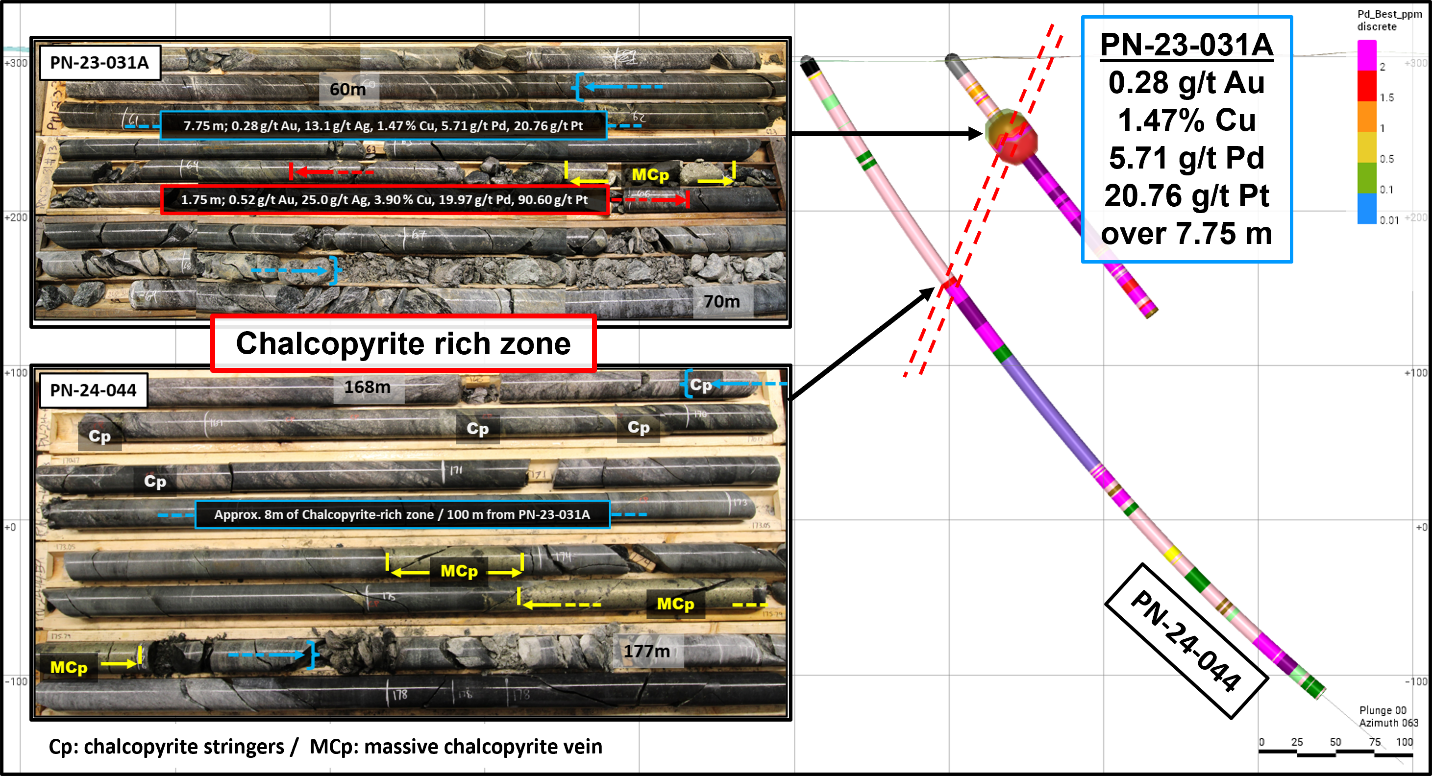
26:55 published Press release showing really nice pictures Coming from all 44. Just that big long one here. I explain why we Decided to push push it a lot deeper than this like this But you can see that little CP Intercept here that means calcopyrite basically so in the press release we've presented we can visually calculate that there is about 3 times as much massive sulfides that were observed in O44 as compared to the Discovery Hole which was 31A
27:39 with that 7 meter of plus 1 ounce material thing. So we do anticipate getting really good grade variant interesting intercept on that 1 Now the follow-up was to be Why is it not there The follow-up hole which I can't see on screen was drilled in this area here so we'll just pretend that this... No it's not even that one since somewhere in between in here I have distance I don't understand why it's not displayed but believe me there's a recent all that we've drilled in this area here now based on this all we decided to go back closer to the initial fence where we've discovered those PGMs reason being and I'm not gonna lie here let's say the the results that we've seen in here were less interesting than what we were anticipating.
28:57 But the reality is if you look at the scale again, that's a 150 meter grid. So we were being very, very aggressive and ultra-optimistic here by drilling 200m away from that spectacular hit. And mind you, the goal here was if we do lock on to the same kind of stuff we just define 200 meters which is if we for the old timers like me it's 600 feet distance It's a huge distance for an iGrade pod, isn't it? So that was very, very optimistic. It didn't come back as good as what I would like to, but it came back with knowledge that we didn't have.
29:50 So for instance, we're now in a position where initially the the target we were looking for was sitting right along that purple surface, which is the ultramafic contact against the the felsic intrusives that are on top in here so you can see the yellow versus purple so that surface is right at there and the the massive sulfides in those 2 holes is located right at the contact. So when we've drilled here was interesting, but not as much. Now looking better at the data with what we've realized at one point in this there is no real PGMs anywhere else along those holes sorry I'm just trying to find my point set here there's no real PGMs I'm just gonna put palladium back at the contact for this hole but there is a sniff of palladium and platinum further down the hole. So now it's very simple three-point exercise that I've done here by connecting the the first discovery hole with the massive sulfide observed in that O44, connecting that with that third point and defining a red panel which I'm thinking could perhaps be a structure
31:23 and if we look in a plan view slightly tilted so we look down dip the orientation of such structure is not really far off from interpreted structures
31:36 that we've interpreted at NISQ. So if the geometry is consistent what we see at Wildcat compared to NISQ, well the possibility of that PGM material being somewhat associated to a structure would make sense. So what we decided to do to test properly the area is to get back to that same
32:03 collar location. We'll be reusing the same pad so less trouble for permitting and things like that. We've designed so far 4 shorter holes, 2 on the east side and 2 others slightly longer on the west side to actually test a smaller volume but much more constrained around where good sulfides were intercepted so far. So it may seem like very very closely spaced. Now let's do a little blowout here to make things a little bit more realistic in terms of size. Each square here is 50 meter. So 50 meter it's an 150 feet in my old days.
32:54 If I recall, high-grade zone at Gold Corp, multi-ounce gold veins were maximum being 150 feet literally in terms of size but those things were shooting down for a kilometer down like was was more rod shapes rather than panel shape targets so Because it's PGMs, because it's so high-grade, perhaps we are facing a situation that is somewhat similar in the sense that the very high-grade mineralization could perhaps be related to a structural control against the ultramafic contacts and potential structures creating probably dilate dilancy dilate dilate extension trouble with that word an extensional environment where those fluids could have been sucked in and creating such an high-grade pod. So to test all possibilities we'll be drilling those 4 holes.
34:09 We're currently drilling this first one on the top right and then following that we'll be probably drilling the the shallow one to the west And then we'll take a little step back for about half hour, analyze the data, redo a three-point exercise here to define a geometry and then keep going. So I guess the strategy is reverted back to what it should have been, closer to where the intercept is and will expand as we go rather than shooting large trying to discover the you know the PGE target of the world here well we'll be modest a little bit more here and get closer and expand that thing.
35:08 Now that being said, that is 1 target that we've already locked on. In terms of geophysics and other geological information we have around this area, there is an EM anomaly that sits nearby this wonderful hit that we have. And on the same EM mag map I think I have it here actually we do have 2 other EM anomalies that showed up I guess in those particular location as well as further down so it seems that there is some sort of a trend connecting those EM anomalies together and we're yet to define What is the relationship between EM anomalies like this one and spectacular PGEs like we have in the holes?
36:10 Is it the same thing happening and repeating itself around those 2 other EM anomalies? That is also something we will be testing after defining a decent volume in this particular for this particular target so I'm expecting when it's time to get off from get out of that area because it's going to be too warm outside at one point drills can't be sitting in swamps and lakes so we'll have to move away potentially in a few weeks from now and I'll probably will want to at least test 1 of them or both of them before we move out so we can get excited for when we come back. At least we would know if that is worth it or not, and then better be planning the upcoming drilling program accordingly.
37:13 We won't leave this area without knowing, so to speak. Knowing, so to speak. So Ken, on the, you know, it's very interesting, obviously, you know, the good PGM hits and following that up and putting together a resource there, that'll be interesting. And the, we also went deeper there, you know again sort of like we did with Ant 3 and in 4 where we're also looking at You know Maybe the massive sulfide being deeper in terms of the the nickel side of the things And what are your thoughts on that? Yeah, absolutely. Well, again, that is the ANT survey block for Wildcat. And as you can see, it's not connected as of yet. We need to decide if we will run a bigger survey to encompass the whole thing here but one of them whole yeah absolutely was pushed further down and again that that will be a good demonstration of how the ANT survey and technology can be useful for us.
38:20 So here's the deal I've just cut a section here through the hole so along the hole and through the ANT data So again what we're looking here is velocities in meters per second. You have the scale here at the right side and what we're looking for is not necessarily a particular color like a color that would define a unit or a color that would define a target what we're looking for is contrast like sharp breaks from 1 color to the other so In here for instance we can easily recognize that the and actually I'm looking at this guys as 3 domains so I've color-coded them in blue and red that would be the top portion We're not too interested about this one.
39:20 The deeper 1 colored more in the shades of pink, that's the uncertainty area. We kind of know stuff is going on but it's getting towards the bottom of the model, such that the level of confidence kind of decreases as we get deeper and deeper, which is totally normal. And that middle block here is, I believe, where we see the most things happening. So we were to actually drill this particular hole and stop it you know shortly after hitting the the massive sulfides that we've seen. I'll show you guys a few pictures in just a few minutes here.
40:06 Totally forgot about that. But then decided to push that a lot further. Well, almost 3 times the the proposed length. Why? Well, we wanted to test a couple more things so while being there why not you know doing a better job so the one thing that was happening here I'm just gonna put back again the that particular EM anomaly target here there is those EM anomalies and if I go back to the the full tilt image we'll also see a small anomaly here, like a bullseye thing to the south. So there was a whole, and there's still a whole plan to be testing that MAG anomaly there.
41:00 But if I go back to the section view here that we have, what we wanted to do was to actually test, perhaps, that anomaly deeper down and see to what it could be related to. Now combined with that, we also had some mapping that was done and realized by the team we have upsite. The GeoVector management team that does fantastic work for us up there had mapped several outcrops that were available during summertime obviously, and of those outcrops, one of them here on surface was showing some ultramafic intrusions, etc.
41:54 So the prediction that is from the ANT survey was clearly showing that from this outcrop here the anticipated dip on their surface would be like following the cursor somehow. So please in your head hide this hole. The only thing we had to play with was those outcrops on surface and the ant survey. So we decided to punch that hole or push it a little further to actually test the idea and confirming actually that the ant serving this particular case matches almost perfectly with the geology that we're observing in here and what do we see actually in more detail is that green domain that seems to be related or appears to be directly related to the ultramafic domain and then when we hit that break that velocity contrast from green to yellow that's where we're entering the the tonal light or the the felsic intrusion sequence and Once we hit that sharp contrast again from yellow to orange That's where we actually enter that south turn domain where we start seeing again ultramafic rocks and
43:24 mafic intrusions and other types of volcanics to the south. So it is I believe a good example of 2 things. 1 a good example that I believe we were trying to do the best job as we can here at spending the money in the ground. Every opportunity we have to kill 2 birds with 1 stone will do. And secondly, it demonstrates very well, I think, how the ANT survey can be useful for us in areas where we have absolutely no data, at least we can do educated, guessed and predict, you know, the dip of them structures and et cetera, et cetera.
44:13 And I think, you know, as I sit back here as an investor and watching it and thinking, you know, what's the intelligence? What have we done here? You know, we identified through the answer of these 4 targets. And then our approach on all of them is basically to, you know, we're taking, you know, a target to pierce each one of these things. We're trying to get as much geological information we can from that initial drill hole. Obviously, we hope to strike it in the first hole, but it is obviously exploration. So, you know, that's one of your hopes. But the plan is basically pretty simple. You drill the hole, hopefully you hit it. If you don't hit it, then you put the downhole EM in there and then you basically, the downhole EM will basically track down, hopefully, the magnetics, which is where the iron and probably the nickel is.
45:10 So each of these things has basically got an approach to sort of do 1 hole in each of the 4 target areas, and then follow that up with the downhole EM. And then based on that, then we'd have a more refined drilling program for each of these sectors to pursue the exploitation of hopefully the massive sulfides. And that's sort of the primary thing is we are a nickel company, there's a nickel thing we're looking after. And of course, the PGM hits, those are the bonuses. And those things happen on the super large nickel PGM deposits like Narelsk where you have big mass of sulfides developing often quite deep, often 500 meters to 2 kilometers deep. And then the PGM pockets like the one we hit in Wildcat and hit again are these little fireballs that are tossed up from the cooking at depth up top where we're picking up, in this case, 60 meters.
46:20 And then, obviously, that enhances your value proposition by hopefully locking in a million ounces of PGM. So that just helps the overall economic perspective. But that's sort of the drilling philosophy we've got in terms of advancing the science, confirming the science, and then iterating with the science. So all this data that we get, it's all good data because it helps to refine the model so that we ultimately can get to more massive sulfide nickel deposits quicker and get them on the books. So that's really what we're trying to do. And we're probably about 15 minutes left of the thing. Maybe we should this juncture of the exploration story take some questions.
47:12 And I think, Ken, you've done a great job of sort of explaining, you know, what the outlook is and how we're approaching things. And maybe, you know, I see there's some questions on the... Maybe, yeah, why don't you go through what the pretty pictures look like and then we'll get into the questions. Yeah, absolutely, Terry. It's a good idea of answering questions and stuff. My conclusion was to be that image. Actually, we have side by side here, sorry for the bad montage, but side by side the leapfrog model with those assays that those balls would correspond to the numbers we have on that upper slide. Massive sulphide, massive chalcopyrite actually was seen in that small interval and what grades actually is the entire thing with decimated chalcopyrite and stringers outside of the massive chalcopyrite interval.
48:14 Now The bottom picture is that new hole. Assays are pending, we have no values, but it's approximately 8 meters long interval, equivalent to the one up top. But in this case, look at the amount of massive chalcopyrite that was observed. So visually it's 3 times the length. So if we got those numbers up top with that kind of a length, you could speculate for what the results will be for all 44. So we'll keep you guys posted Thank you, Terry for for that. I'm done. I think okay cool. So just looking at some of the questions rock He's asking Wildcat is near the end of your claim.
49:06 Are you looking at trying to extend the claims further? Yeah, you know what? There's no open claim ground around us. I mean, the good news is that as we go further north, it's owned by Critical Elements, which is a significant shareholder in the company and they're a partner in this project as well. They have 20% interest. So to the extent we think it goes out there, I think we could obviously work something out with critical, you know, as it makes sense. So there's that. D. Chippen is asking, was the plan to comprehensively look at Ant 3 first before moving on? Did you move on the other ants due to the results of the first drill on Ant 3? No, I mean, basically, our plan was to drill a hole in each of these.
49:53 We basically have a commitment to follow up with a fleet next summer with a broader program to connect the dots, so to speak, and also to look deeper. But obviously before we did that, we wanted to sort of test the results really by getting an understanding of each of these targets first. So that's why we decided to do 1 through 4 sequentially. And as I said, if we hit it, great, you know, obviously we'll be following that up for sure. If we didn't hit it in the first, you know, spot in a new expiration zone, then the plan was to, you know, put the downhole EM in place so we can start to vector in from there.
50:40 Because basically, one of the challenges with downhole EM is that if you have a hit that's got nickel sulfide, you know, your downhole EM is really not gonna help you because you're gonna find your own nickel sulfide that you've already got. So you need to have, if you have a hole that doesn't have the massive sulfide, then it serves the purpose of being where you can sort of use the downhole EM. So we think we're by the end of this program with victories and defeats, we'll have a very comprehensive view of what each of these 4 sectors look like and how to go at the exploration for them for their massive sulphide potential. The one thing we're confident of is that this is the best set of exploration holes we've ever done.
51:27 Nickel sulphides come in pods. We found the one pod, NIST main, it's highly likely we're gonna find other pods. And this is the most cost effective way to go at it. Let's see what else we got here for questions. EBE Consultants, great presentation or false brittle or ductile? It's more ductile unless there is some veining in there then you would expect more semi brittle semi ductile kind of behavior but the the deformation is not a brittle type deformation it's deep-seated stuff like we're in a fairly high metamorphic facies too.
52:21 So do not expect like brittle stuff too, too much. Okay, and he says, what were the exact geological units encountered at depth in hole 44 and evidence of faulting structures? In hole 44 we're talking of Wildcat up there. So what we did intersect here was, well, the summary log would tell us a tonalite, and then an ultramafic sequence, and then more tonalite, and then another sequence, thinner this time, of the same peridotite and donite, and then some more dikes and tonalite further down. So the one intriguing thing is we can see at Wildcat some sort of an alternating peridotite-dunite, peridotite-dunite type thing.
53:26 On surface it's been mapped like almost backward to what we have at NISQ main. And I mean NISQ main typically with it peridotite and then dunite below. In some case here we seem to be hitting the ultramafic sequence upside down like punching through doneight first and then periodite after I didn't really want to get to that today but just a few words on generally speaking the we're interpreting here locally from the data we have we're also in parallel working at defining the the regional kind of context on that and is there or not like major or regional scale folding perhaps on the property that has not been integrated yet in our modeling or in our thoughts, I guess, and things like that. So there are a few local things that we are yet to understand. That's normal, I think.
54:45 But please be reassured that, you know, whatever piece of information we have, we look at it. If it fits the old thing, good. But if it doesn't, it becomes a trigger for us to look at what's going on. What's the more global interpretation? That's why I was referring earlier that the ENT survey, we have 1 block at NISQ Main, a smaller block at Wildcat. We're contemplating running a much bigger, wider survey to encompass the whole thing perhaps at one point and better understand what we see locally. So another question was asking about, you know, with respect to recent financing, do we have enough money for our 2024 plans?
55:40 You know what? You never have enough money. You know, the the just because it's, you know, you as you make discoveries, you want to follow them up and add resources. So it's inevitable that we'll be raising more money as we go forward this year, when exactly, you know, we'll be told in the market. But, you know, we've got a lot of good news coming with the CVMR benchmark stuff that's coming out. There's a spin out that's happening. It's a lot of good news coming. We just had a major research announcement this week where Hennan Partners, arguably the best investment bank for junior nickels based in London, They just launched a coverage this Monday.
56:33 I was over in London doing some meetings with them and had some great response. And I think that'll be all very supportive to us as we go forward. Al Folk asks, can you give us an idea, future timing of the next assay releases, stuff like that? So I'm guessing, you know, with when we came back in mid-January, So typically I've found that the assays take between 8 to 12 weeks. Some take 8, some take 12. There's no seems to be no rhyme or reason to timing on it. So I would say basically from this round of drilling, let's say I would expect to start to get results back February, March, sort of in April, April sort of starting in April going forward.
57:28 And then I would think every couple of weeks, your 2 or 3 weeks in April, we'll start to get results from the current drilling program that's going on. So, let's see if there's any other questions. Are there mesioscopic evidence of folding structures in drill cores? I'd say yes. Some small scale folds are observed in the core. But you know, I haven't honestly logged the core myself so look that picture and stuff which is not the same at all but we have 1 well all the geos at GeoVector are really good, one of them, Eric, as mentioned many, many times, you know, folding, stratigraphic top, trying to determine that, blah, blah, blah, blah, blah, blah. So we're kind of investigating really, really hard on that one.
58:41 I'm really well aware that this could have you know not bad, but major consequences on the interpretation we have. Should we define that it's folded and stratigraphy is reversed in places and stuff, it may have impact on our exploration strategy for sure. So A couple of last questions and then we'll have to go. The question about the 43-101, when will we look to update that? We'd look to update the 43-101 probably in Q4 so we can get the fall drilling in, the winter drilling in, possibly some summer drilling in, so that we would probably in Q4, look for an update.
59:33 And we had a 200% improvement last year and would be, you know, that's our objective to at least do something similar this year. So we think, you know, right now we're, you know, 7.2 million tons. You know, I think we think that this thing, you know, I mean, historically Ultramafics in Canada, Lin Lake 22 million tons, Voisey Bay, 140 million tons. We think we could certainly be in that range. And, you know, And then if there's something deeper, who knows? You know, that's like when I talked at the outset about us being the best nickel investor on the planet, I'm talking about the asymmetric nature of the risk here. We're trading at a fraction of what we currently have already discovered and posted relative to our peers and the whole sector is down. Like I mean, you can buy the whole nickel sector now and people forget the best money you make in mining is when you buy like at the maximum peak of depression, like the negativity in nickels probably is as bad as it's ever gonna be. And you go from bad, really bad to less bad. That's when you make really good money investing. I think we're we're about to go from bad to less bad and then eventually we'll get to good.
1:00:45 But, you know, I think that's an important point to keep in mind. And then last comment was on the, what progress are we making in the naked short selling? So we'll see, we're about to roll out our offering circle on our spin out of our copper gold assets. That'll be in a private company that will, you'll only get those really nice, exciting sort of, company that used to be trading almost at the same value as we are today. You'll only get that if you have evidence, i.e. You have a DRS proving you own Power Nickel stock. And we'll be providing this information to our investors so that they have plenty of time to make sure that their brokers do in fact have the stock in the system. Because that's what happens in naked short selling, is you'll have stock on your brokerage statement, but they won't have it in the house.
1:01:42 They will not have collected it, or they will have loaned it out. So what we're gonna do is, with this spin out, that will force them, we believe, because there's no way they can paper this over. The only group that can give you this, you know, private share in the, in this, you know, in our Pan American Gold Equities, which has got the great Chile and BC projects that we've got that are pretty exciting. We'll probably should have a separate talk about that at some point. You'll have to have the proof of ownership that you'll prove to our transfer agent that in fact, you do have the DRS, you do have the certificate and then you get the dividend. So that will be a real litmus test on the short selling from a micro perspective for Power Nickel. From a macro perspective, we're turning up the heat on the Save Canadian Mining stuff.
1:02:31 I'm just going to be sending today a letter to the Deputy Prime Minister on this whole problem. A number of other people are doing the same. You know, so there's a, you know, globally, the South Koreans are probably the world leader in it. They've banned short selling and they're talking about putting bankers in jail and that's what should happen here too. So I think the heat is on, these naked chorters and they're undoubtedly due, they have caused most of the casualty in our market is in no small part in respect to their malfeasance. So I think that's Kyle, I think we're probably coming to the end.
1:03:18 Is there any further questions? I think we pretty much wrapped it up. I think we appreciate it. We can end it there, Terry. Great presentation, Ken and Terry. Excellent job. And thank you all for attending and asking the questions. It was great, great conversations as usual with the PowerNecro team here. I guess the only thing I would add is that this is being recorded. So if you did come in a little late, It will be available on YouTube either today or tomorrow. So just keep an eye out if you did come in a little late. Stop on, try and reach out to the team. They're obviously at PDAC if you're attending. But thanks guys for the great presentation. Really appreciate it. All right. Thank you. There was one last question in there and I just saw it and I do want to address it. The question was, you know, do you maintain a good relationship with the Cree of Namaska? And the answer is yes.
1:04:12 You know, we're, you know, basically all of our drillers stay at the Creon Lodge in Namaska. Our drilling company is part-owned by the Cree. We're trying to do everything we can to partner with them. We fully respect what they're doing. They're certainly the most progressive First Nations group in the country really in respect to mining and their outlook on mining. So we're blessed to be able to be working with the James Bay Cree and looking forward to a long and fulfilling relationship with them. So Kyle, without any further ado, thank you all for listening and I look forward to talking to you in the future. Cheers for now.