Suraj Nebhani
Equity Research Analyst, Citi
Replay available
Infratil (NZX:IFT) reported Q2 2027 results on this call. Replay available.
On 6ix: 6ix.com/event/infratil-limited-iftax-q2-2027-earnings-call
Automated transcript · Written by software from the replay's audio. It can mishear names and figures; the replay is the record.
0:00 Thank you for standing by and welcome to the Infratil HY27 results conference call. All participants are in a list only mode. There will be a presentation followed by a question and answer session. If you wish to ask a question, you'll need to press the star key followed by the number one on your telephone keypad. I would now like to hand the conference over to Jason Boyes, CEO. Please go ahead.
0:24 Good morning everyone. I'm Jason Boyes, the Chief Executive of Infratil. here to present Infratil's half-year results for the period end of 30 September 2026. I'm joined by Andrew Carroll as usual though now in his new role as Chief Operating Officer. Morning Andy.
0:41 Morning.
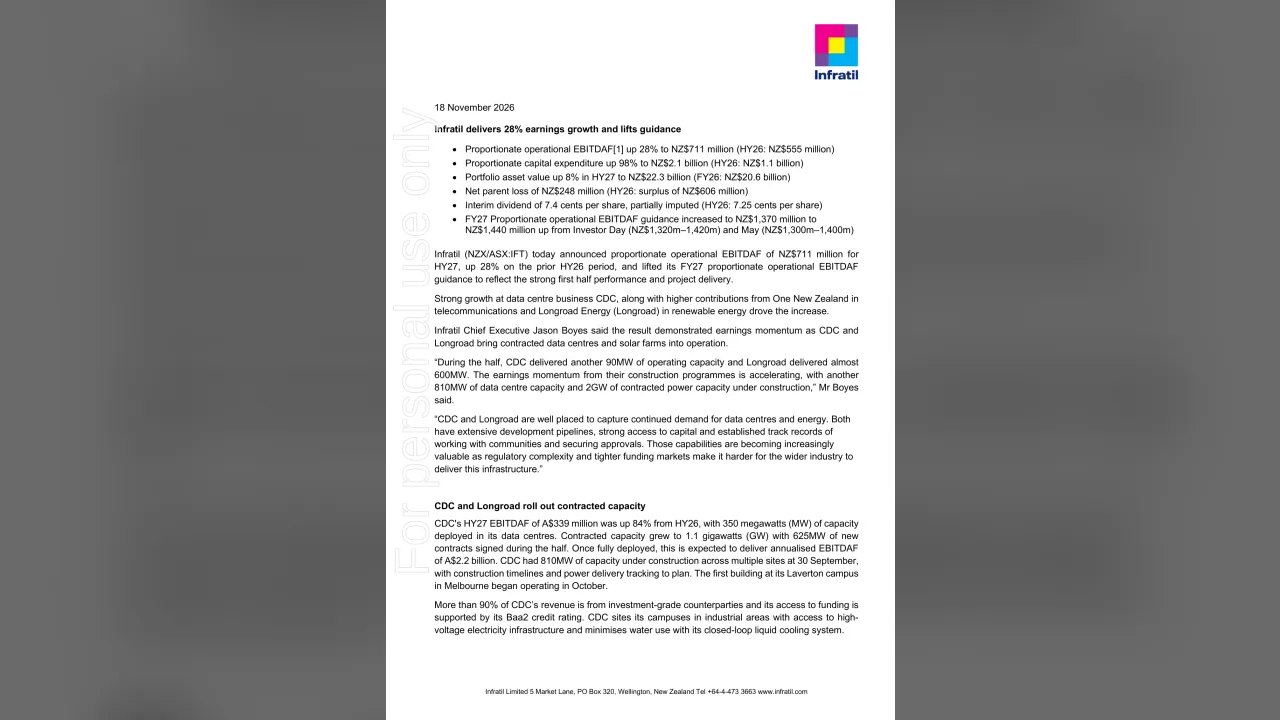
0:42 And we're also joined by Matthew Ross for the first time as our Chief Financial Officer although already well known to you all I'm sure. Morning Matt. Morning Jason. Like the man said we're going to run through the presentation released to the NZX and ASX this morning and as usual there'll be time for questions at the end. Let's get going. Let's go to highlights first on slide four. I won't go through all these, but the key message we want to get across is that it's a strong half overall, meaning we're lifting group guidance by $50 million at the bottom end and $20 million at the top end, the new range here at the top of the screen. The key drivers were strong project delivery by CDC and Long Road and a strong half from 1NZ. CDC added 90 megawatts of now billing customer capacity giving them confidence to lift their guidance for the year as well.
1:30 Long Road completed 600 megawatts of new capacity and those are all contracted when we build them remember so their revenue coming through from those projects in this half as well. Important to remember, both businesses have much larger backlogs of contractor capacity and construction programs underway to fulfil them, which will underpin Infratool's earnings growth over the next few years. As I said, one indeed had a strong half, which Andy will talk to in a minute. Some other updates noted here that we'll touch on later in the presentation, but for now I'll hand over to you, Matt, for some financial highlights. Thanks, Jason.
2:04 This is the first of our financial slides, so I'll just get to the headlines initially. As you can see, proportionate operational EBITDAP, which is our key metric for monitoring operating performance, was up for the six months to $711 million. That was 28% up on the prior period. And as Jason touched on in the introduction, CDC, 1NZ and Long Road led that growth. In the top chart, you can see that CDC's contribution has more than doubled in the period. Proportionate capital expenditure was $2.1 billion, almost double the spend of the prior year as well. That primarily reflects the build-out at CDC and Long Road, where we've seen demand pulling that investment forward.
2:54 That acceleration actually kicked off around about this time last year, and importantly, that is being deployed into contracted growth. Our portfolio asset value, so the total fair value of our assets rose by 8% to $22.3 billion in the period and that equates to about $17.94 per share after we take into account management fees. That is 10% up since March. On the back of this result we've been able to declare a half year dividend of 7.4 cents per share which is up 2.1% and continues our track record of being able to grow the dividend. So taking these numbers together it's pleasing to see that demand that Jason touched on for the physical infrastructure that is being driven by the AI rollout is now showing up in our results.
3:53 So we'll recover earnings, asset values and funding later on, but back to Jason for now.
3:59 Thanks, Matt. Let's talk through the portfolio companies, which you can see here, including our strong positions in data centre and energy. And then let's talk about CDC. A big step up in EBITDAF as contract capacity has been delivered as I said with that enormous backlog and construction program continuing with delivery really ramping in FY29 as we show on the graph on the right here. Across the sector there's been a lot of focus on financing and CBC's investment grade credit rating and the reasons for it remain a big differentiator with over 90% of its customers investment grade or higher and Long Lease Terms, as we show on the bottom right here. CDC is one of only a few data centre operators globally with this sort of credit rating. And remember what we said at the results in May, the rating incorporated the capex and funding needed to deliver our customer contracts, so it looked ahead.
4:57 CDC has raised over $4 billion of the financing needed for their construction programme, including another $1.4 billion since 30 September across multiple international capital markets. That financing program is proceeding to plan, including their targeted cost of funding, around $0.60 on average, as David said earlier yesterday. That gives them a strong liquidity position today. If we look ahead, the number one focus for CDC today remains on delivering that construction program, which continues to track to plan with a bit under 20% of that planned capex now spent for the 810 megawatts under construction. Good progress on their development milestones, including the first tranche of Building 1 at Laverton in Melbourne, and some cross-control means CDC is increasing its guidance for this year again by 20 million at the top and bottom ends.
5:52 CapEx guidance increased with some delivery timing changes, but overall CapEx per megawatt remains the same as we noted above in that kind of mid-teens ex-land. Looking further ahead, Demand remains very strong across multiple customer segments and CBC remains well positioned to win further contracts as deliverable capacity becomes available. They're actively building out their pipeline of possible projects. as shown here, following a huge contracting year. We continue to feel good about our active contracting discussions, although timing remains notoriously difficult to pinpoint. And as I've said in earlier presentations, we expect large blocks of new capacity to become available from 2029 onwards. CDC is working really hard with the local communities where they have active proposals to earn the right to build data centres there by explaining how CDC's building and approach are different to try and address their concerns and to ensure the local communities directly benefit from CDC being there. Lastly on CDC, we're awaiting new government regulations like everyone, and while we need to see the detail in general, we feel a higher bar will play the CDC's existing strengths as an experienced, scaled, sustainability and locally focused operator.
7:08 Turning now to Long Road Energy. A good heart, delivering two projects on time as those are front, 600 megawatts. and their contribution to earnings come through. They are on track to reach their target projects entering construction this year of 1.6 gigawatts with our Utah solar project not peaked away and the remaining projects at an adjusted stage. Huge project, Amagosta, 2.8 gigs enormous, progressed nicely too, including towards the literary approvals we have flagged, and that comes with a vast majority of Long Road's 3.1 gigawatt contracted backlog for 2027 onwards. Look ahead on slide 12. Demand remains strong and we retain the target to double our operating capacity, 14 gigawatts, by the end of 2029.
8:05 Long-run has made steady progress on its own data centre strategy. We talked about it yesterday. Nothing announceable today, but we still think this is very prospective and are happy with the progress here. As Long Road showed at our investor day in September, that growth requires some more equity, and that capital has been launched recently. It takes some time to complete, but I'm not expecting equity to be diluted as part of that, as I mentioned then. If you look on the next slide, that shows that end-of-the-decade target, and getting in-flight projects all across the US. Before we go off renewables, turning to our energy investments, Contact and CDC continue to progress their Stratford projects here in New Zealand.
8:52 But elsewhere, as I've said before, development would have lagged the US, meaning we've refocused Gurren and Galilee's teams and projects quite recently to a smaller number of larger projects targeting the end of the decade, like we've been talking about with Mint for some time. We like diversifying our exposure renewable energy theme globally like this but need to be more patient than the US. Here in Zanda project is I think a bit stuck as dialogue between Indonesia and Singapore can use but they have other projects that focus on interim as well. So with that it's you Andy for 1NZ.
9:31 Thank you. This has been a good first for Thibut DEF up 29 million. As we've noted in the slide, there is chameleon in that result to adjust for a sum of non-recurring intellectual property sale together with some cost timing benefits recognised in the third half. Mobile continues to strengthen in higher value in MVNO segments and underpinning that 1NZ brand is performing well which is especially helpful with signs of improving market demand is one measure of brand position 1NZ has reached number one in terms of non-customer consideration which is an important leading indicator of future trading profits.
10:22 TopX is flat, the usual mix of very good work offsetting inflationary headwinds and legacy cost escalation. As I noted there is a bit of a benefit happening in the first half. There continues to be very good progress on the IT transformation which remains on track. The quality of work the team has done on the broader IPAC is reflected in part on that IP sale that relates to the new network form that the team is standing in. There is other interest in them as well, so that is useful validation of the very high quality work the team is completing there.
11:09 Aeon Fiber continues to do well with a new trans-TESMA bandwidth service launched, and the hyperscaler contract we've mentioned previously is firmly on track to go live. In the outlook slide, a couple of quick points. Firstly, we expect mule distributions to be consistent with 26, so don't read anything of the differences at the half year. We've tightened guidance with EBIT-DASH narrowed to 610 to 640 and we've also narrowed the CAPEX range 240 to 260. The medium term TAG that we've talked to about many times, they run changed.
11:54 Thanks Jason.
11:56 So to you Danette. So turning to Wellington Airport, yeah I would described this as a resilient return, what most people would consider a pretty challenging operating environment. EBITDA was broadly flat period on period and the margin at 73% held. That's a really solid outcome given passenger numbers were down around 8%. It's not a surprise to anyone that this is primarily down to a reduction in airline capacity in response to the higher aviation fuel prices. Importantly for the airport, strong commercial execution and continuation of their different cost management picked up most of the slack from the lower passenger numbers.
12:42 So looking ahead, we're continuing to phase investment carefully while progressing the northern departure lounge upgrade, the baggage handling system and our southern seawall project. and really from an innings perspective we'll be focusing on keeping a lid on costs while working with airlines to essentially get that capacity back. Pleasingly we've been able to keep our FY27 EBITDA guidance at 130 million to 140 million and that's despite the softer passenger numbers. If we kind of move on to the next slide please, we've got KO Data. So CA Data is our UK data centre platform and the headline is that the portfolio is now 99% contracted with the Greenfield pipeline advancing.
13:31 The actual half year result was flat. This largely reflects the mobilisation and operating costs running ahead of the revenue ramp up that we're expecting to see kicking off shortly. As I mentioned, the portfolio is 99% contracted. approximately 55 megawatts of contracted capacity and that will include capacity at Kalon 3 which is our London data centre site adding 17.6 megawatts from early 2027. So on the outlook for this business land and power in London remains scarce so that does restrict new supply and should underpin pricing and development returns. Against that backdrop we are progressing two projects that are near to Greenfield sites in Manchester and West London. We have early stage works underway at both sites and customer discussions are active including with Hyperscale.
14:32 So pass back to you Jason for healthcare.
14:36 So last but certainly not least our healthcare or diagnostic imaging businesses. In New Zealand, the business has made some good progress on the performance improvement program we talked about in May to cope with ongoing variability and outsourcing from the public system in some new entrant competition. They are starting to see the benefit of that program come through but still a flat earnings outcome for the half. Guidance is maintained but tracking towards the bottom half probably as the program continues to roll out over the second half of this year. and Australia with Qscan down a little on last year with a good revenue performance offset by cost pressures, unfortunately, which the team is focused on though. Also, more fortunately, a big win in Brisbane in the last month with a large new hospital contract to be onboarded by the end of the financial year.
15:29 We've talked before about looking to sell this investment given its relative size in our portfolio. It is a high quality business and team and there is good interest to buy it, but it's going to take longer as the teamwork through these things I've just run through. Very last, Anytime Radiology, the tally radiology business spun out of our bricks and mortar businesses, now up and running and winning incremental revenue, which is good. Now over to you Matt on the group financial performance.
15:57 Thanks, Jason. So starting with the statutory result, we recorded a net parent loss for the period of $248 million up there on the slide. This reflects a $256 million accounting provision for incentive fees after CDC's higher equity valuation. So that final fee will depend on our year-end valuations and also an offsetting negative accrual that we'll carry forward from the prior year Offsetting that valuation growth, we expect to see associate earnings picking up in future periods, which is the way the accounting works for CDC's data centre assets. Proportionate EBITDA, as we've touched on, was 711 million.
16:45 This was a really strong result. That was up 156 million from the prior year, or 28%. The waterfall on this chart shows where that came from. CDC added 105 million, 1NZ 29 million and Long Road 15 million doing the majority of the heavy lifting there. That has largely come on through CDC and Long Road as they've had operational sites and build capacity increasing over the period. Infratil's own investment during the period was $410 million. The majority of that went into Long Road Energy with continued investment also across our renewables platform and Clear Vision as well. Proportionate development spend, which does mirror some of that, this is the spend of our renewables platforms, was up 4% to $33 million in the period and that was split broadly across Gurren Energy, Galileo and Mint.
17:44 and that reflects focus progression on their own development pipelines. Just moving forward to the valuation update, as I touched on at the outset, our total portfolio asset value rose to $22.3 billion in the period. That was up $1.7 billion. There are a few different moving parts in that and that also includes the $410 million of our own investment as noted on the previous slide. CDC was the big driver, up $2.4 billion. This largely reflected the 555 megawatt contract as well as a larger development pipeline during the period. It's worthwhile noting, though, that higher risk-free rates and a higher forward yield curve have provided a rather material offset to some of that uplift as well.
18:34 Long Road's underlying value fell by US$198 million during the period, again the primary driver for that was a rise in base rates which in the long road valuation were up 80 basis points during the period with a corresponding impact flowing through to their project discount rates. This was offset and you can see that in the chart there with the net reduction of 39 million by continued progress in their refreshed near term development plan and further investment from Infratil during the period too. Qscan was down 91 million that largely reflects a distribution in the first part of the year which was 46 million dollars received in April but also a higher discount rate applied by the valuer and obviously the reflection of the recent trading performance.
19:29 Right at the tail end of that chart there you'll see divested assets that reflects the 5% contact energy partial sell down of our stake in May and also the proceeds coming in from our 40 south sale in April. On to the next slide, funding. So we continue to broaden both the sources and the markets that we're looking at from a funding perspective and are doing that from a real position of strength. As at 30 September, we had 1.4 billion of available liquidity to support our portfolio growth. That was up from 1.1 billion in March, and net debt was 3.1 billion, which saw our loan-to-value ratio at 14.2%, down from 15.4 in March. We expect our loan-to-value ratio to stay around the mid-teens over the medium term, and the flexibility of our funding model will support that.
20:29 Part of that is our S&P BBB Plus stable credit rating, which we received late last year. And that helps us keep our funding costs down. It's really opening up a wider range of capital sources available to Infratil. This obviously matters given the recent funding market volatility, which has reinforced the value of that investment grade profile that we have. Lastly, building on that, we intend to lodge a PDS on 20 November for a capital bond offer, which in part will refinance our IFT 280s that mature in December. This is the next step in growing our capital bond program, which supports growth options within our portfolio and our rating metrics as well.
21:17 So moving on to guidance, so it's really pleasing we've been able to lift our FY27 guidance again. We lifted guidance by a small amount at our investor day and we're now uplifting our proportionate operational EBITDA guidance to 1.37 billion to 1.44 billion and that was up from 1.32 to 1.42 at investor day. This reflects the strong first half which we've talked about this morning and our confidence in the outlook for the second half. Notably by business CDC moves up to Aussie dollars $730 million to $770 million from $710 to $750 reflecting again our increased confidence in their delivery across the second half.
22:10 One New Zealand's narrowed their range at the bottom end, and we've revised QSCAN down to 75 to 85 million. Long Road RHC in Viet and Wellington Airport are unchanged, and finally our proportional capex guidance rises to 4.15 billion to 4.45 million, sorry, billion. And again, that is mainly the accelerated development at CDC, where our guidance on that part of the business has increased as well. Importantly, this reflects the faster development activity rather than cost escalation. And finally, on the dividend, we've declared an interim dividend of 7.4 cents per share. That's up 2.1% on the prior period.
23:03 with 1.2 cents of imputation credits attached. The record date is 2 December with a payment date of 21 December and the dividend reinvestment plan will be available at a 2% discount. Just a reminder, elections need to be in by 3 December to participate in that. You can see the full timetable on the slide in front of you. So that completes the financial section. I'll now hand back to Jason.
23:32 Thanks, Matt. Nice work. Good to see the previous CFO handed on the same dividend policy to you there. Good to see us maintaining that. A few things before we go to questions on portfolio outlook and strategy. So on strategy, no change here to the strategy we outlined at our investor day in September with the refinement that we're focusing in the near term on opportunities in and around our data centre and energy businesses where we see the strongest demand. We still see strong AI related demand driving growth in power and data centres around the world and where our businesses are. Even if globally some forecasts of the speed of growth are moderating as uptake of AI takes time around the world.
24:21 We see other headwinds for these sectors like higher regulatory requirements and more discerning lenders and customers actually favouring our scaled established operators CBC and Longroad, while demand remains strong. You can see this nuance reflected in the first strategic objective. If I look at the medium term strategic objectives we've talked about for a couple of years now, you can see that near term focus in and around our existing businesses and that we continue to scan for new sectors over the medium term. The other objectives are on track, although as I said before Q-scan is going to take longer As we said in May, we're planning other divestments of relatively smaller scale assets. There's no hurry here. These are medium-term objectives, just sensible reallocation of capital over time.
25:12 On sustainability, we've continued to improve our GRIS scores, which we've been reporting for some time, including a perfect score from Wellington Airport for this year. Congratulations team. Our FY26 ESD data book is out now too on our website. So to sum up and look ahead, our strong half overall we think with good performances across our big three assets, CDC, 1EV and Long Road. Reminder, CDC and Long Road Energy have large contracted backlogs that are now focused on delivering that will continue to drive earnings growth with high visibility out to the end of the decade. They are both well positioned to continue to win more contracts. as scale developers with strong track records of delivery, funding flexibility, and focus on social license in a continuing strong demand environment.
26:04 Infertil also has strong funding flexibility, as Matt said, to support them to continue to pursue attractive adjacent opportunities across our platforms and over the medium term, new sectors to continue to create shareholder value. So that's the end of the presentation. We might go to some questions, please, Operator. Thank you. If you do wish to ask a question, please press star then 1 on your telephone and wait for your name to be announced. If you wish to cancel your request, please press star 2. And if you are on a speakerphone, please pick up your handset before asking your question. Your first question comes from Eric Choi at Barron Showy. Please go ahead.
26:45 Good morning, guys. Sorry. Could I please wrap in 5-3 on the CDC? Would you prefer them one by one or all at once?
26:53 At once. Morning, Eric. Okay.
26:56 Hey, hey Jason. Okay, so I'll give them all at once then. So the first one's just on regulation. Can we confirm a large part of that 550 megawatts operating going to 1100 megawatts contracted relates to Laverton and Marsden Park? And if so, can we confirm if full DA approvals have been obtained and whether there's any need for overhead power cabling? The second question is then on returns. If I look at your ASIC accounts, it sort of suggests $8 to $9 billion to date spent on assets. Maybe there's another $8 to $9 billion of CapEx to build up 16 to 17 billion total spend versus 2,200 of contracted EBITDA. Therefore, I'm sort of getting a CDC yield on cost of about 13%.
27:43 That was the second one, sorry. And then just the last one, sorry. Just on independent valuations, I just wonder if you've got any early sense of how the experts are going to factor change in regulation and demand trends. I presume it could be higher discount rates, so I'm just wondering if it's still around 50%. on that CDC evaluation, which is great, because I think you called that out before, Jason. Sorry about that.
28:05 Thanks. We wrote them down furiously here. Maybe I'll take the first one, you take the second one, I'll take the last one. So on the majority of the bill to fulfill the contract did correct Sliverton and Marsden Park. Those have all their data development approvals in place. I think there is a live one for Marsden, but that's for an expansion. If people are wondering about That one I checked it in the last week or so, but that's my recollection. On the power lines, obviously it's a lot of focus. There's no overhead, actually. Those are all transmission cut-ins and undergrounded lines, which has been the way the sites have been designed over all of that. And they're all going through industrial areas, as we've talked about in the past as well. So hopefully that covers that one for you.
28:58 On returns, do you want to cover that, Matt?
29:01 Yeah, thanks, Chase. Thanks, Eric. Yeah, my quick maths without having kind of read back through the ASIC accounts, that is probably the number that has been spent and reconciles kind of back to what our average cost to build is. Yeah, we've been pretty consistent on that number for a long time and obviously as we've scaled up, we've been able to manage that cost Then it's what has been spent on delivery, and I think David Collins, the CDC CFO, touched on that in the yesterday, which was around about 20% at the time of the current capacity under construction. So those return metrics are broadly online. Remember we're targeting that mid-teens.
29:45 Yeah, so it looks about right to us, Eric. And then on the independent value, you might have perspective. I don't think we do know. I think we know from history that they do look at comps. We might have talked about that in past calls, Eric, and so they'll be looking across the listed market and see what's happening there. as a guide. They'll also go site by site in much more detail than we would publicly, so they'll have the benefit of that, but I think the overall market context should end up in the valuation in some way.
30:18 I don't know if you have any other... Yeah, they read the same news that we do, so they'll be interested in this, and they have a very detailed look through to what's happening and great access to the business, so I expect they'll be asking those questions and should get confidence in the results of those answers.
30:37 The other thing they get a look at, just to finish, would be the other land that we have that we don't disclose in our pipeline yet. So to the extent, you know, megawatts are fungible, they can see what a Plan B and Plan C would look like, which we'll factor in as well. But I think the comps we've talked about before are definitely an input. Hopefully that covers all three.
30:59 Very helpful. Thanks, Jason. Thanks for that. Thank you. Your next question comes from Phil Campbell at UBS. Please go ahead. Phil, your line is now live. You may be muted. Can you hear me now?
31:30 Loud and clear. Sorry about that, Ken. Are you good? I thought I'd figured out how to unmute my line by now. Just a couple of questions from me. I just noticed in the States a couple of results recently with Corweave and iRent, obviously they're more neo-clouds, but there seems to be a trend of like customer prepayments. I'm just wondering if that's something you're seeing in Australia or that's something that might occur in Australia, just given that tightness you're seeing in that market?
31:56 Yeah, I mean, I think that's a lot to do with financeability, which is a huge focus for the whole industry. So if you're sub-investment grade, then sometimes the way to square the circle can be these prepayment ideas. We have seen it in London, haven't we, Matt? But I think it would depend on the solution. I think the trend is global, but I don't think, you know, for an investment-grade pilot at CDC... dealing with an investment grade counterparty that's necessarily going to be needed to make it work. I would say they're probably specific to the Irene and Corwee circumstances.
32:38 Yeah, yeah, I understand. The other one was I think in the past you talked a little bit about a medium term objective of becoming kind of cash flow self-sufficient. I was just wondering if you kind of update us on that and I suppose... In relation to that, I was just wondering if, you know, with the shareholders on CDC, is there any like agreed distribution policy? Because obviously to get that self-sufficiency, I think you do require CDC to start paying some dividends at some point.
33:03 Yeah, which is what we've talked about. Matt, do you want to talk about how we're tracking?
33:06 Yeah, we actually did hit that metric for the half year. So... That does reflect that we get more of our distributions from our port codes in the front end of the year. So I think we'll be slightly under at the end of the FY27 financial year but certainly in the medium term that is kind of starting to hit from next financial year and that's really driven off the back of the distributions that we do expect to see coming through from CDC.
33:40 and then on CDC from a government and then from CDC distributions from a governance perspective there is between shareholders the kind of default is distribution but that is obviously being talked about at the board where Infratil has the majority now so that's something that Infratil has good line of sight on but equally CDC's growth is good as well so it's an active discussion. Our planning incorporates some more distributions but also significant reinvestment as well and we think we've struck the right balance there but it requires constant monitoring.
34:25 Okay, great. Maybe just one last one. Just given what's kind of happened with Next DC and the M3 situation, I'm just wondering if you can make any comments about what you kind of think that might have in terms of implications for the industry and possibly CDC?
34:42 I'd prefer not to talk about another operator. I think we're seeing it in the maybe where Eric was coming out in terms of market multiples which will then all track across to independent valuations but I think Greg would point to how CDC's approach is has always been and he would say continues to be differentiated, which is serving us well in those big sites I talked about where we were able to provision for underground lines, for example, from the get-go. So I think it's important probably to look under the hood of project by project rather than assume as a sweeping statement that the whole industry or even all of a particular company's sites should be treated equally.
35:34 The last point I think on this that I think about is do we have enough depth in our pipeline that if there is an outcome on you know obviously a longer dated development site that we didn't anticipate that we've got flexibility to pivot to other sites if we need to to meet the demand and so that's something as I talked about I think CDC's done a good job topping up land in the background and there are options we have that we haven't talked about and that aren't in the valuation so for example Stratford is not in the valuation for CDC yet so it gives you a bit of buffer as well as another way that we think about managing that
36:14 Yep, no, that's great. Awesome. Thanks, Jeff.
36:16 Okay. Cheers. Thank you. Your next question comes from Roger Samuel with Jefferies Australia. Please go ahead.
36:27 Hi, morning team. I've got a few questions as well. Go for it. The first one is based on the debt and liquidity position of IHT. I can see that the loan-to-value ratio stepped down to 14% in the half, which is great, but there was a capital bonds equity credit of $100 million, and I'm just wondering how much more can you access this equity credit going forward? and maybe just a second part of the question is how much do you anticipate to spend on the long road capital raise?
37:06 Great, sure. You can cover both of those maybe, Matt.
37:09 Yeah, sure. So yeah, so we do, we issued our first capital bond. As I noted, we're looking to raise another one. Those products are helpful from the ratings and metrics We do have more headroom to issue more debt in those instruments. I think equally we'll be looking to diversify our funding sources as well, which really gives the backdrop of a pretty tight debt market out there.
37:45 Do you recall what the max percentage of those capital bonds is?
37:48 Not off the top of my head. It's often in the order of 15 to 20%. I mean it will vary rating agency by rating agency and the nature of the instrument.
37:58 So plenty of headroom I think. That's right, plenty of headroom.
38:01 Yeah, so and I think as the Long Road team touched on at our investor day in their presentation, they've kicked off a capital raise at the moment for somewhere between $750,000 especially up to a billion dollars. I think what's important to note is that that's really a kind of three to, well it's probably about a three year funding plan for them as well so it's not kind of one big lick of capital. Earlier this year we made a commitment to invest another $300,000. I think we've got about $200 million left of that commitment which again gives them a pretty big pathway and then they're essentially looking to kind of raise their funding for the back end of next calendar year and then the kind of two year period after that.
38:49 Yeah, so we'd be about half of the $750,000 but drawn over three years I think, Ruj. Yeah.
38:55 which is probably consistent with what our investment into Long Road has been for the last couple of years as well.
39:00 Yeah, the run rate's the same. The sort of equity per megawatts is more or less the same.
39:06 Okay, alright. Dan, and just on the long road as well, is there any potential changes to the regulation, in particular the one big beautiful bill given the result of the midterm election with the blue wave win? Do you anticipate any changes to that and the potential impact on attached credits?
39:26 Yeah, yeah, I haven't heard it and it's probably not that urgent to be honest relative to other priorities. for the new Democrat leadership because the OBV doesn't run out till 2030. So maybe that'll be a post next election priority. But I think early on, the early signs are tariffs and enhanced oversight seem to be close to the top of the pile than this one. But there's plenty of time.
39:54 Yep, yep, okay, maybe just one last one, quick one, different one, and that, how much was the non-recurring benefit from the sale of the IP in the half?
40:08 Yep, thanks, Roger, we're not going to get into specifics. It's commercially sensitive, as you might understand. Okay, got it, thank you.
40:18 Thanks, Roger. Thank you. Your next question comes from Ben Crozier, Foresight Bar. Please go ahead.
40:28 Morning guys. If we just look at this question on CDC, like if we look at operating and under construction megawatts is about 250 megawatts above what's contracted and it has been about that same delta for the last sort of six months. Have you got a sort of timing indication of when that could be contracted or do you sort of use that as sort of a Plan B or C as you talk to around if there's some shambles around other build plans at Martin Park and Leviton.
40:53 I think we've been talking about those contracts for a while. It's been in the main. They're quite hard to predict but we feel pretty good about the conversation. To be honest, for example, at the full year I would have expected that in this half and then we're still working away on it. To give you a little bit of colour, you know, depending on the delivery date, people's technology choice changes, so then the design changes, so there is unfortunately a bit of an iterative process until a pin gets put in a contract. So the best I can say is we still feel good about contracting them additionally, as you said.
41:34 And then the second one, just if you look through the next two huge campuses for CDC, Kemp's Creek and Grigadoo, there's obviously some competing sites in those regions that are of similar size. How do you look at where CDC is in terms of getting access to the power in terms of its grid connections? Is it sorted or are we still in discussions or where are they at?
41:53 Now those are all still part of the development program for those sites. We feel good about them so they get screened as to where we would be in the queue in the merit order and whether we would get there. We are seeing some more speculative demand come out of the system in places as well so it becomes quite dynamic and it's actually very similar to what you do at Long Road. Look at the other calls on power and kind of probability weight whether they'll actually get there but it's still definitely a different element game. None of those things are in the bag and the key is as I said to have other sites that you're working on in parallel that you could bring forward if a particular site falls back. On those two sites we do feel good about getting them connected though but not in the bag.
42:47 maybe last one on long road so we'll see a big last six weeks of the year for the team there with 700 megawatts still to hit the financial close like where are those projects and sort of are they got PPA signed is it waiting for the grid connection canoe or is it financing or what's sort of left to get those over the line yeah they've to give you good sense of why we say advanced so all but one of them has the PPA signed which we wouldn't do unless we had um all of the other kind of development milestones uh
43:16 in a very good spot. The last one is in kind of late stage negotiations and they're actually one of the simpler ones. So, you know, they feel confident, we feel confident we'll get there. Could that last one slip by a month or two like we have in the past and the calendar year target has become, you know, January, February? Maybe, but at this stage we're feeling okay. That's all for me. Thank you. Great. Thanks, Ben. Thank you. Your next question comes from Owen Birrell at RBC. Please go ahead.
43:54 Morning guys. I just want to follow up on some of Roger's questions around the, I guess, the cap raise and the funding of Long Road. You said sort of 750 mil to a billion dollar US cap raise over the next three to four years, I think you sort of mentioned.
44:09 Yeah, basically.
44:10 If we look at If we look at your, call it 43.5% interest in that, you mentioned that you're not going to dilute InfraTools exposure there. We're looking at something like 500 to 700 mil New Zealand, I think is the equity contribution that you'll need to put in to keep that interest constant. I'm just writing that a lot of these assets are still very much in development and your funding goes capital contributions with and so on and so forth and so forth and so forth and so forth and so forth and so forth and so forth
45:10 Yeah so that's why we've got that sort of clear medium term target to cover our head co objects and interests in year distributions out of the businesses which over that time period three or four years we would expect essentially to grow out of CDC. It won't necessarily all be borrowing as well. In fact, I doubt it. Over that time period, we've got the divestment program as well, Owen, which would more than cover that. So I would treat it more as bridging, to be honest, but our target and how we plan is to cover the in-year costs from in-year distributions.
45:52 And so what you're saying is that's probably coming from some of the other assets rather than one word? Yes.
45:58 Yeah, yeah, exactly.
45:59 It'll take some more time before it starts to contribute back to the group.
46:01 Yeah, yeah, exactly. And at Investor Day, I would like to be certain to be honest, it's an open negotiation with the team, but at Investor Day, I think Pete indicated that about 10 to 12 gigawatts, they would be self-funding. So towards the back end of that period, you know, we're getting towards 14, that's when you should start seeing distributions come back as well, which I think is important.
46:24 And going back to just the infrastructure investment that I sort of mentioned there, sort of that and so on and so forth and so forth and so forth and so forth and so forth and so forth and so forth and so forth and so forth and so forth
46:56 which is ongoing, will fund a lot of that as well. Yeah.
47:01 The bond program is kind of... And just on that, can you scan, you know, we've been waiting, we've waited for that one to go through. Can you give us a bit of an update as to what's, I guess, holding up that transaction? And given we've seen some pretty poor results out of Qscan and the guidance downgrades and the valuation downgrades there, you know, are the... Is the price in question again, or is it just some sort of regulatory hold-up?
47:33 No, it's not a regulatory hold-up. I appreciate the question, Owen, and it's a fair one. Hopefully it was clear from the presentation as I ran through it that they've had this cost pressure, which they would prefer not to have had, which has meant that their in-year performance hasn't been where they wanted it to be. they have also had this major win which is a double digit EBITDA contributor that is worth landing before the end of the year, end of the financial year as well. So we feel confident about the quality and ongoing value of the business with the initiatives in place to deal with the cost point but also with this new win that we don't see an issue with the business itself but the sales process obviously when these things are happening live in any sales process it will mean that that will run longer so I appreciate the point you make at the start but I do think it's a high quality business high quality team as demonstrated by that win and the interest in it is still as strong as it was at the start but we do need to let the team work through these two points before we can push ahead.
48:44 I would say it goes longer.
48:47 Yeah, can I say something? I mean, we haven't disclosed the price on the Keystand sale. I mean, there's a few numbers being bandied around in the press. Is there, from our perspective, should we think that there's upside risk or downside risk to that price?
48:59 we haven't disclosed one so yeah yeah we wouldn't disclose the price I mean but we do disclose independent valuations so that's the way that that's certainly when everybody comes into a process that's the starting point right now and we're disclosing to valuers where we're getting to in the conversations and in more detail than we're able to do publicly the operating cadence of the business so it's not a bad yardstick understood thank you very much thanks Thank you. Your next question comes from Paul Mason at E&P. Please go ahead.
49:36 Hey, guys, just a couple from me. I was just wondering if you could give some colour across, like, say, the major portfolio assets, so CDC, 1NZ, Long Road, whether there's any, like, major debt maturities in the next two years that are coming up that we should have on our radar for, like, you know, thinking about long-year interest rates and stuff like that.
49:54 Oh, yeah. Do you want to give that again, Matt?
49:59 Yep, and I might need to come back to you on that. What we've done in our pack is that we've tried to, in our detailed metrics, give a pretty good breakdown of what the level of debt and the current levels of maturity are. We've seen actually CDC in market since our result getting pretty good spreads on the debt that they're issuing today as well. So we're pretty confident in the ability to continue to raise debt at our current spreads. And all of our businesses, we manage the maturity profile pretty carefully. We do that right across the portfolio as well.
50:44 We have a portfolio view of maturities to make sure that we're not overexposed at any one maturity period as well. There's nothing kind of, you know, that's concerning and certainly no cliff edges coming up.
50:58 I think CDC might have an 8 or 900 next year that they'll be in the market for now but the way to think about it is it's overlaid with swaps which I think across the group are at about 80 or 90 now and that drops down to 60% hedged across the group over the next three years so it won't necessarily have an immediate impact on interest costs. Do you have any insight on to one what the next maturity is?
51:24 Recently completed a refi so that's all good.
51:27 and nothing much coming up at Long Road. The thing with Long Road though is it's project financing as we close projects and that's obviously a live rate. So every year we're, or every quarter probably, we're picking up new facilities but they're all built into the projects. Nothing major at the end.
51:44 Okay, great. So the second one, just on CDC and the build costs that you guys are quoting, I'm just interested, some of the other operators that are working in Australia, starting to quote, falling building costs because of build to suit. And particularly with AI, the density is going up a lot. And we've heard some of the hyperscalers are even sort of not using much in their data halls anymore and things like that. So going on with CDC in that regard, are you guys sticking to like a 2N, we design it our way sort of approach? Or are you actually maybe going to see that number come down in the growth?
52:24 Yeah. that is definitely an average across and remember we're building in New Zealand as well which is a bit higher and then there is I think even Greg talked about that when we announced the 555 that expected to be inside it and on that particular build and I think that is because of exactly what you say in each build for each big contract is different and certainly for some new configurations you'll come in inside that. A lot of the time that ends up in the rent anyway so your cost or whatever metric you like, the IRR is when we use doesn't necessarily change a lot but obviously helps with cash flow and funding.
53:11 I would say when we do build we do try to, even though it's a build to suit we would try and make sure the building envelope Provision for piping and cooling is as flexible as possible so we can shift to configuration. So we're probably still spending a little bit more to ensure the building has, in most cases, certainly all the ones we're building now, have a kind of more long-term life. We haven't got to a specific build to suit that is super tightly designed to someone yet. So there'll be a little bit there. Yeah.
53:44 The last one for me was just on Long Road and the data center strategy. There's been a bit of news about Nevada's moratoriums in part of the state. I think Arizona's looking at stuff like that. Texas has obviously seen a large amount of noise. Does that actually affect your strategy or because you're sort of bringing power, will that mean that you just can bypass altogether? What's the dynamic for Long Road there?
54:10 Yeah, this is how we talked about a lot of the... there is quite a diverse pipeline and so two of the near term ones are in Utah which is not affected so in some ways Issues elsewhere will be a net benefit from those. Two of the others were in Texas. One is on an existing solar farm site, so it's probably less of an issue for the solutions we're talking about there. The other was actually kind of pointed to 2030 anyway, so it's probably not affected in the near term. Maybe it ends up being a benefit for the projects that are in areas that aren't. are affected by these regulations. But I even saw news this morning that some Texas approvals were coming through, so it's a pretty dynamic situation.
54:55 We'll see. It gives you a sense of exactly where we were talking about, you know, about five gigawatts. We're pretty well placed, I think. Thank you. Thanks for those questions. Thank you. Your next question comes from Stephen Hudson at Macquarie Securities. Please go ahead.
55:14 Hi Jay, Sandy and Matt. Just a couple of quick ones from me. Just one on New Zealand. We don't hear too much about New Zealand anymore, but the Stratford DC. I understand the resource consent's sort of in and it sounds as if it's progressing pretty well. You're going to need $1.5 billion in the SPV for that. Because the New Zealand entity sits outside of the rated entity, can that SPV just be pretty much funded through debt?
55:42 Okay. could be, depends on the underlying contract and so forth, but yeah there's a project finance version of it that doesn't require anywhere near that sort of equity number. Do you get what I mean? Got you, so just assume very little equity. Yeah, yeah, it's definitely not one and a half billion. It would, you know, one version of that as a more project financed build would be more manageable. Got you.
56:11 And then just CDC, I know you've spoken a lot about it, but your current all-in debt cost for CDC is still sitting around about 6%, is that right? Yeah. Notwithstanding all of the volatility in the funding market. That's right.
56:25 Yep.
56:26 Yes. Yep. Last one. Matt, you touched on the parent cash flow position. You're in the sort of the black there, which is great, for the half at least. Your holdco debt capacity, I think, is sort of nudging $900 million on my calculations. What sort of scope, what sort of timing should we think about for the $1.4 billion I think that's probably about right.
57:14 These processes just take time. I think what's important to reflect on is that there are a lot of different pathways to bring through those divestment numbers. and we talked about a billion and the ability to go to another billion which I think is probably the 1.4 that you're referencing so I think that's probably a pretty good timeline. We would obviously want to have some done inside that window as well. We wouldn't want them all landing in 24 months time.
57:51 And Jase, maybe just one for you on Long Road. We've got a We're seeing an increasingly crowded table when we think about interconnect discussions or EPC discussions or OEM discussions in renewable space. If someone were to come along with a big check through this external energy raise process, is there a plausible scenario where you exit Longwood?
58:19 always for every asset for every asset it'll be quite interesting actually obviously it's been an interesting space but with the kind of blue wave I think and once we get through maybe the Anthropic IPO or Warrior of the Spaces is going to get to what the sentiment around energy is I would expect it to be kind of improving it's really sort of a matter of timing whether it improves enough through this capital raise period or whether someone's willing to go earlier on that. But anyway, for all assets, we're definitely open.
59:00 Sorry, I'll just sneak in one more. Andy, just on the $20 million non-referring, I understand you can't break that down more, but was that included in your original guidance or is that a factor in the most recent recounts?
59:16 The IP sale wasn't included in the original guidance.
59:23 Okay, that's useful. Thanks, James. Thanks, Stephen. Do we have any more questions? Yes, thank you. The next question comes from Suraj Nibhani from Sydney.
59:38 Please go ahead. Thank you. Just a couple of quick ones from me. Firstly, on the long road capital raising that was alluded to at the investor day, can I just check what's the latest on that? When is that raising planned to happen?
59:53 I think we would not expect to have, and as launched as reported, we're not going to have an answer until next year on that, first half of next year.
1:00:08 Okay, thank you Jason. And the other quick one was probably on interest rates again. It's key to understand that it seems like it could become a bigger issue, but at the same time, you know, like when we were speaking at the investor, the interest rates were still rising. It seems like we've sort of at least reached a bit of a top and pulled back a little bit. There's still a big gap between where the risk-free rates are sitting in the valuations versus where the spot rates are. In your discussions with the valuers, how are you thinking about that gap? Do you feel like There's more potential for downside on interest rates, I guess on valuations to the interest rates.
1:00:54 I understand. Yeah, Matt, do you want to talk to that?
1:00:57 Yeah, most of, some of the valuers kind of take more of a spot approach. So we've certainly seen that in the long road valuation. But a lot of the valuers actually take a longer term view on what those risk-free rates are. which actually reflects the reality that the value of these businesses don't bounce up and down. I guess our guess is as good as yours about what the outlook for interest rates from here are. Certainly when we look at the kind of half year that's just been, it was a material impact or headwind to valuation. So I think that a good chunk of that has come through but as you've noted If you look at the spot rates on some of those valuations, they're not kind of what is in those valuations today.
1:01:49 It's a good startle to hear, maybe something we can think about for disclosure. Often there's a forward curve and we're showing the long-term rate in the valuation assumptions rather than showing over what period they're assuming it descends. to kind of a long run macro view. So maybe that's something we can take away. I still think it is one of the bigger headwinds for these contracted revenue businesses. So you get the downside if you're contracted, so you get the downside protection, but on the other hand, you're a bit vulnerable to interest rates.
1:02:24 Yeah, just one final one for you, Jason. On the CDC and maybe more broadly on the data center team, We've seen, I guess, a few wake-ups in the last couple of months. If you were to just go back to the drawing board and think about your strategy, is there anything that's concerning, I guess, in terms of what's happened over the last few months or do you see that as more the industry finding its feet and maybe the long-term trajectory is just the same?
1:02:58 Oh, I think the long-term trajectory is still quite strong. I think, you know, even if you look at some of the more bullish forecasts, right, even if you took 20% off them, you're still talking about enormous, enormous growth. And actually, maybe the higher proportion of it shifting towards hyperscale, which is probably like a positive in some ways for us as an investor in CBC. and Long Road. So I think on balance we feel very positive about it that we're building things that are difficult to build and we're good at it in an environment where there continues to be strong demand. I think we'll just have to, with the new technology and pace of rollout and all these things being uncertain, I think we will just have to put up with variability and the kind of long-term forecast and the kind of near-term forecast but the long-term still feels quite strong to me. If I had a magic wand with the portfolio I would love to have some shorter duration exposure to be honest to deal with that interest rate point you started on and that's something that's you know occupying a lot of our time on how we could bring that into what we have or what we could add. 1NG is not bad and Wellington Airfield gives you a bit but you're still subject to a New Zealand macro environment so Yeah, that's probably the main thought on our mind at the moment, to be honest.
1:04:23 I understand. No, thanks for that. I really appreciate it.
1:04:27 Great. Thank you. Your next question comes from Nick Harris at Morgan's Financial. Please go ahead.
1:04:36 Thanks. Good morning, Jason, Andy, and Matt. I've just got really three sort of social license questions. I'll just throw them all out in one go. Yeah. Excellent. Thanks. Just with respect to the broader implications from the US midterms, question one is, has that accelerated inbounds for CDC, both our cloud and LLMs, given what's going on there? Question two was just, do you think those midterms actually act as a, potentially act as a tailwind or headwind for Long Road doing some sort of US renewable energy cloud GPU deal? And then my third question is, Take a breath. It was just for KO. Does the fact that the UK is sort of lagging the rest of the world in terms of its status and immaturity, does that mean it's potentially an opportunity for them to leap in scale if you can get access to power?
1:05:27 And I know that's a big if, but just curious, positioning-wise. Thank you.
1:05:35 I haven't heard accelerated inbounds, I did wonder myself actually, but I think we're quite engaged already across the new term pipeline that we talked about earlier and some of those big chunks of capacity coming in in 29, like I say, so hopefully they've got new impetus for the reasons you outlined. I agree. On Long Road, it could accelerate. If you're in a state that doesn't have an issue, that is a pick in your favor. And as I said before, Utah does look quite good. The other area I think is quite interesting is these smaller modular data centers that you can deploy without approvals into existing or purpose-built new solar and battery systems.
1:06:21 and so on and so forth. and the power that is often curtailed, whether we can roll that out. So, yeah, from a mid-term perspective, I think that gives you a sense of where I think Long Road's well positioned. I mean, Kay, do you want to cover that, Matt? That's a good point.
1:06:51 Yeah, I mean, I think it's a starting point that, you know, more broadly, the UK and Europe, you know, can't lag forever. And we've seen the UK government, you know, be quite proactive with its AI strategy and and you know is looking to kind of support the industry you know and then on the other hand you have a kind of scarcity of land and power and you really need to be cost competitive on power you know in construction costs to pick up these global workloads certainly what we're seeing across the two greenfield sites and there are kind of more sites that KO is looking at as well but the prospective sites that we would hope to kind of kick off construction and I think the RFS dates are 28 and 29 have pretty strong demand from multiple parties and multiple parties within the demand stack as well.
1:07:52 Yeah, maybe it does come right.
1:07:58 Thanks very much. There's always a silver lining somewhere.
1:08:00 Yeah, exactly. Any other questions? Thank you. That does conclude our question and answer session so I'd like to hand back for some closing remarks.
1:08:13 Fantastic. Well thanks everybody for all the questions and the interest. Hopefully that was helpful. I look forward to catching up with some of you on the road in the next week or so. Thanks again.
Follow Infratil Limited into a list and get an email when it puts out news.
Equity Research Analyst, Citi
Equity Research Analyst, Forsyth Barr
Equity Research Analyst, Macquarie Securities
Equity Research Analyst, Morgans Financial
Chief Financial Officer, Infratil
Equity Research Analyst, UBS
Equity Research Analyst, E&P Financial Group
Chief Operating Officer, Infratil
Chief Executive Officer, Infratil
Equity Research Analyst, Barrenjoey
Equity Research Analyst, Jefferies Australia
Equity Research Analyst, RBC