Replay available
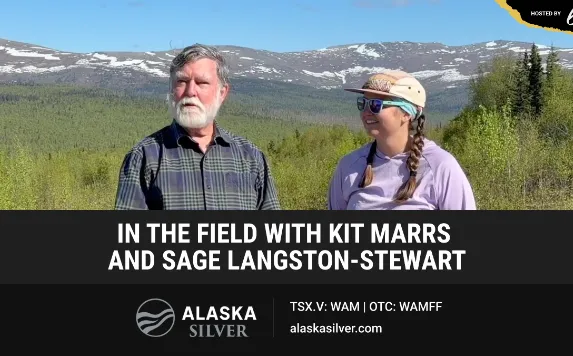
In The Field With Kit Marrs And Sage Langston-Stewart
Join us in the field with Kit Marrs and Sage Langston-Stewart while they are on the ground at the the Illinois Creek – Waterpump Creek project.
- Company
- Alaska Silver Corp (TSXV:WAM)
- Date
- Wed, Jun 24, 2026, 11:30 AM ET
- Replay
- Watch the replay on this page · 17 min
- Results news release
- Alaska Silver Announces Shareholder Meeting Results and Summer Exploration Program Update · Mon, Jun 22, 2026
On 6ix: 6ix.com/event/in-the-field-with-kit-marrs-and-sage-langston-stewart
Replay
Transcript
Automated transcript · Written by software from the replay's audio. It can mishear names and figures; the replay is the record.
0:00 Good morning, good afternoon, or good evening, depending on where in the world you're signing in from. I'm very excited to present a recorded interview from Alaska Silver CEO Kip Mars and Principal Geologist Sage Langston Stewart. They're on the ground at Illinois Creek Water Pump Creek answering our questions, always exciting to be able to talk to the team, while they're on the ground. I will say while this is a recording, I still encourage you to use the chat function at the bottom of your screen during today's event. I'll pass on any questions you have to the team at Alaska Silver and they'll be able to get back to you as soon as possible. There's also a request meeting button at the bottom of your screen. You can press that at any point during today's event, and I'll make sure to get you connected with the team there. But without further ado, let's get into the pro team. Hey, Romeo, it's Kit, John, Bill Mundell from Illinois Creek, live at Illinois Creek. So I just wanted to say hello at the start of our interview and before Bill Mundell, our drilling supervisor, takes off down to the camp. Wanted to introduce Bill on our farm right there and behind him are our custom drill rigs from Multi-Powered in Kelowna and the Mecanines Drill Flute that Bill just drove up a few minutes ago. So, thanks for maintaining all the equipment.
1:09 Looks like it's bright shiny blue. Is that right? You bet. We got them all nice and cleaned up. It's been the last season. Just doing some pre-season maintenance. Make sure everything's gonna run good and get us a bunch of core this year. So Kitt, you're standing on ground. You first worked all the way back in 1981 as a project geologist for Anaconda. What's it like being back out here decades later with 2 drills turning? It's great to be back. Been here many times since 1981, but this season is particularly an exciting one. We have our fully funded program, our 2 high-performance drill rigs. One is right behind us right now and crews will be arriving in the next few days and it's really a satisfying feeling to know that we're really moving this project ahead in 2026.
1:58 This is being called the most aggressive storm program in the company's history. For someone falling from their desk, what does that actually look like on the ground right now? It would be exciting if you're here. We have drills going. We have a number of crews in the field, Sage Langton-Stewart, who's standing here with me. Our principal geologist has a really a full technical crew for the first time in a number of years and so there'll be geologists working, drills going, we'll have a number of Consultants coming in doing our off-site studies, environmental baseline, et cetera. So it's really a good year. And Sage, she'll be doing all the technical work. How does it feel? It's great. It's exciting to have boots on the ground, especially after all this planning this last winter.
2:46 So it's really exciting to be here, to be getting our tents, our core shock set up and have crews out on the out on the ground already. So it's exciting. Now, Kit, you're mobilizing a record freight load to the airstrip, something north of 100,000 pounds of gear, new excavator, additional fuel storage, the works. Talk me through what it takes to stand up to an operation like this in this part of Alaska. Well, it actually takes months of planning. We've been planning this project since last October, November, had a planning meeting in December with our whole crew to lay out the front work and We have all kinds of coordination Bringing in some heavy equipment new excavator Drill rods things like that with the vented air cargo. We bring in a c-130 Hercules The strip over here was originally built, it started in 1981, it was a lot shorter and smaller than it is now.
3:41 But now we can bring it 4,400 feet and we bring in a C-130 with 40, 50,000 pounds of freight. So that takes a lot of logistics. And then on the geology side, Sage, my stewardess, makes me her principal geologist. A lot of work putting together, and this year we have a great crew putting together. Yeah, absolutely. Yeah, we've got a great team on the ground here and we'll be getting a lot of supplies in here so we'll have a couple of 3C130s, an excavator, a bulldozer, fuel tanks, What else? A couple of other things coming in so it's gonna be an exciting year and our airstrip here is nice and dry and we've been working hard to keep good maintenance of it so we're excited to get some flights in this next week. Now Sage, Waterpump Creek is the high-grade silver heart of the district where a lot of the resource sits today. What's the main objective for you guys there this season? Yeah, so this season we're excited to go back to Water Pump Creek. We'll be putting the first couple holes in the Water Pump Creek North Zone and then we'll transition over to the Water Pump Creek South Zone and continue to chase for the mineralization on the south side of the fault there. So we're really excited about testing some targets there. We have some new geophysics from 2024 actually from Skytime, which was funded from the Alaska DGGS, as well as the Earth MRI project, which was a huge state survey that was really, really impactful for our exploration efforts here. So that's given us a little bit more insights and we're excited to go test some new hypotheses over at Water Pump Creek, both Water Pump
5:13 Creek North and Water Pump Creek South. Silver Sage was a blind discovery last year. Nothing showing its surface until your team went looking. What convinced you that it was worth chasing? Silver Sage was an exciting zone. I had run the soil lines for it in 2021 or 2022 and there were some weekly anomalous soils down there. This last year we had an interesting year. We had the time and some geos to go out and do some trenching, which led us to the Silver Sage Zone. So a little bit of soil geochemistry anomalies, a little bit of boulders on the surface with some salacious breccias that seemed similar to what we've seen at Warm Springs. Additionally, we didn't have any data in that area of the district. And so, you know, in order to overall improve our geologic map and our district zonation, we needed some data over in that area.
6:03 And so we went poking around and ended up finding some galena right on surface in the in the Silver Sage Zone. Yeah and that's I would like to compliment Sage on that discovery. It really shows initiative and how a good Exploration Geologist puts together many different pieces of data for many years and then comes up with a plan. And in this case, it was astoundingly successful. And now we have really a third zone we're looking at that we hope to develop into a new resource. So that'll be great. Thanks, Kent. Welcome. You're describing Illinois Creek District as 2 separate CRD porphyry centers. Why is this important? So the Illinois Creek and Water Pump Creek system is 1 system in the Illinois Creek District.
6:48 And with the help of the SkyTAM data from 2024, we were able to see this large scale geophysical structure. So Illinois Creek and Water Pump Creek are 2 CRD, carbonate replacement deposits, associated with the same intrusive source, the same porphyry source. 10 miles away we have the Round Top system. So the Round Top system is a porphyry that was drilled by Kent here in 2016 to 2019, but there's CRD potential outside from that. There's the hubs and spokes. Round Top is the hub. So over there we have the hub, and we're looking for our TG and TG North targets, our CRD targets, which are the spokes. Versus over here at Illinois Creek, we have an unknown hub, but we have our Water Pump Creek, Illinois Creek, Silver Sage, Warm Springs. Those are all of our spokes, our octopus arms, over here at the Illinois Creek system.
7:41 So Round Top is 1 system. Illinois Creek is another system. And there's a whole lot of potential between the 2 of these in this major CRD bill. And that really brings us back to Dr. Peter McGaughan, his big picture analysis of carbon replacement deposits. One of his key takeaways and checkpoints is, are you on Main Street, such as early deposits he worked on in Chihuahua. There are multiple deposits. So before Water Pump Creek and Illinois Creek were really identified and described as a carbonate replacement deposit, there are no known CRDs in this part of Alaska. So we are now showing that there are 2 centers in the Illinois Creek District, 1 at Illinois Creek, 1 north of us at Round Top, and That is just shows that we fit into Peter's model that we're really on Main Street and this is really a true district.
8:37 Multiple discoveries have been made and multiple discoveries still will be made. And that's really one of the key takeaways. We have a lot of work to do but we've accomplished a lot so far. Some folks might not know the project carries a gallium credit, really significant, alongside the silver, gold, lead and zinc. Gallium's become really a flashpoint in the critical minerals conversation. How much weight are you putting on that piece and how should investors think about it? Gallium was almost unheard of by most people and a lot of geologists 3, 4 years ago. But once the critical minerals and supply chain problems that the US is facing became front and center, both politically and just economically. Gallium was named number 1 on the U.S.
9:23 Critical mineral list. There's a lot of reasons for that, but it has very important applications of electronics and active radar displays that are widely used by the U.S. Military. So as a result of that, we had already been drilling most of the resource at Water Pump Creek. We collected a number of what we call composite samples to do our zinc and lead concentrates studying the metal urchin recovery. So we already had some large samples from multiple droles representative of the deposit, and we analyzed those for gallium. It turns out we have some pretty significant gallium numbers. And in the concentrate, we found that gallium is part of sphalerite, so it follows our zinc concentrate. And reported values that are done by ALS, our lab in Kamloops in British Columbia. So these are bona fide tests through metallurgical testing. They're not just grab samples from the surface.
10:22 And showing that we have probably around 120 parts per million gallium. And we now have worked with a world-class refiner in Japan and know that the gallium can be extracted. So the value, it's very important from a permitting standpoint, a critical mineral standpoint. And once we learn more about testing and recovery of gallium, we'll put an economic factor on it. But right now it's very important to make this deposit and this project high on the critical minnows list. So it's a great benefit. Now for both of you looking forward, people following along throughout the summer, What are the moments to watch for as results start coming back? All righty, so we've got our geologists already on site on the ground. So we're doing soil sampling, we'll be doing some trenching and some backpack drilling here pretty quickly. And currently that is happening. And then we'll have our excellent drill crew coming in, first crew on the 10th, June 10th, and then second crew on June 13th. And the rigs will start spinning maybe even that same day. Then we'll get it processed over in the core shock as quickly as we can and get it shipped off to our lab. And then at that point it'll be 6 to 8 weeks or however long it takes for the lab to get us our assays back and we'll be off to the races.
11:38 Yeah, I'd like to point out we are pretty unique from a junior explorer pre-development company. We own all our own equipment. Our nice drills in the background there came from Multipower in Kelowna. And very importantly, we've had the same drilling contractor work for drilling. We've been with us since 2016 when we started up at Round Top. Many of our drillers have been back 4 or 5, even 6 years. A lot of continuity and that enables us to have a very efficiently run program. So it's a great start. We've got some great equipment, a great team led by Sage and I really look forward to some exciting results this summer. Kit, I'll end with you. You spent a big chunk of your career on this district. Standing here, kind of looking at it now, what keeps you coming back?
12:27 Really keeps me coming back is the excitement of discovery. So this area was discovered in 1980-81 by Anaconda Copper Company. First discovery was actually browntop which is an important copper. It's about 10-12 miles to the northeast from us. That same summer, same crew discovered the Illinois Creek gossan, which is about 4 miles to my right. Illinois Creek became a producing mine in the 1990s. And really one of the earmarks of Illinois Creek is this is really a district. It's just not 1 deposit. In fact, the third discovery that doesn't get much notoriety lately, we want to start working on it again in the future, and that's the Hawker Gold Deposit, which is right over the hill with snow behind me. It's about 6 miles to the north.
13:18 High grade gold vein, intercepts of 6 grams of drilling, surface samples of well over an ounce per ton. That's something that we've had in our back pocket that we just want to continue working on. So really it's been a couple years ago we called this a new discovery that was 40 years in the making and that's really been a long history. I started the working here in the 80s and very importantly we've had a team that's been going through for a number of years, starting back then, Nate Brewer, who's one of our directors, was the geologist that discovered Water Pump Creek. So Water Pump Creek is right behind Sage and I. It's only about a mile due north right off the end of the runway.
14:05 And that's an example of blind discovery that took a lot of geology and now is one of our very important resources. But that's a lot of years and as we move along we've brought in and started with a new team led by Sage who's standing next to me here. Sage you've been with us about 6 years I think or 7. I think this is my seventh year. Seventh year so that's great and it's example of really been very successful and very pleased to bring in new blood, new expertise, new thinking, and better handle on new technologies. And Sage, you've been working here a long time. What's your view of excitement of working at Adela Night Creek? Well, really just marrying you the exciting part is all the potential here and all the discovery. I mean, there's not very many places you can go out and dig a trench and find glenorail on surface, right?
15:02 So that's, that's really, really exciting. It's been so fun watching things grow and develop in the last you know 7 years and starting a water pump creek and progressing making the Silver Sage discovery this last year. Every year it's like I go to bed at night at camp and I can hardly sleep because I'm so excited to see what the drill corps looks like in the morning. And yeah, it's a fun and exciting time and lots of discoveries to be had. We have a great team and I mean look at, this is a wonderful place to spend the summer. So I love it. It's great. It really is and we've had a great team we've built up over the years and mentioned Sage is now in her seventh year with us. Nate Brewer I mentioned before is a great mentor. Spent many years working here.
15:48 Joe Pekenbrock is our chief exploration officer. Joe was out here working in 2002 when the Illinois Creek Mine was just finishing and going into reclamation. And they actually stake the ground we're standing on, on snowshoes 1 year. So, and then later on, brought in a good friend of mine from Tucson, Dr. Peter McGough. We went to the University of Arizona together. And that's an example, we've been able to build a team of really world-class geologists and the future of this project is standing right here next to me so good luck. Thank you. Awesome. Well, Kent and Sage, thanks so much for joining me from site. And for everybody who watched this recording, thank you. Again, please do use the request meeting button at the bottom, but also hope you got your questions in. If you think of a perfect one to ask right after the event ends, I'll make sure it gets to the Alaska Silver team. But honestly, more than anything, thanks so much for joining us.
Follow Alaska Silver Corp into a list and get an email when it puts out news.
Latest news releases
- TSXV:WAM — Alaska Silver Completes Record-Breaking 2026 Drill Program at Illinois Creek · Thu, Oct 8, 2026
- TSXV:WAM — Alaska Silver Announces Transition of Aaron Schutt to CEO · Thu, Oct 1, 2026
Companies on this call
More from Alaska Silver Corp
- Jul 08, 2026 Commodities Outlook H2 2026
- Jun 24, 2026 In The Field With Kit Marrs And Sage Langston-Stewart
- Jun 15, 2026 A Fireside Chat With Kit Marrs and Aaron Schutt
- Feb 06, 2026 Inside Metal Market Turbulence
- Feb 05, 2026 The Next Wave of Critical Minerals
- Jan 20, 2026 Alaska Silver Cuts High-Grade Silver Zinc At Waterpump Creek & Silver Sage