Transcript
Automated transcript · Written by software from the replay's audio. It can mishear names and figures; the replay is the record.
0:07 Hello everyone and welcome to the Nevada Lithium live event hosted by 6. I'm pleased to introduce our speakers for today, Stephen Rechler, the CEO, and Jeff Wilson, VP Exploration. They'll be discussing the potential impacts and benefits of the hydraulic borehole mining method proposed for Bonnie Clare. And after that, we will be accepting questions. As a reminder, you can submit your questions in the chat at any point during the presentation. And as always, this event is being recorded and will be available to watch shortly afterwards. So without further ado, Steve, I'd like to pass things back over to you here so you can start. That's super.
0:40 Thanks, Max. Thanks to everybody for taking the time and joining us this afternoon. Yeah, yesterday morning, hopefully you saw we did a news release, a technical news release, about what we found, basically the conclusions for a borehole mining study that we got in, and also our plans to update a PEA. What are we doing at Bonnie Clare? I want to take a step back. I'm going to describe what we released, of course, in more detail. And Jeff Wilson, who is our VP of Exploration and Structural Geologist, PhD in geology, He's here for all the details. But I want to take a step back and put this into sort of the context of what we're doing and also in the context of things that I've been hearing from people over the course of the past 3, 3 and a half months as I've been marketing. I was out in Vancouver earlier in the year. Then I was at PDAC.
1:33 Recently got back from Zurich. So it was a pretty wide swath of people. And what I can tell you is that investors have really been, until very recently, concentrating on what the spot price of lithium is doing. I also have been feeling a lot of questions along the lines of, you know, what exactly are you doing? So the point in saying all this is, you know, clearly what we are doing at Bonny Clare isn't resonating enough yet. So I'm going to keep doing this kind of thing more and more. It's I talk to you where I just take a step back for 2, 2 and a half minutes. And I think it's going to help everybody, not only who's invested, but also new newcomers to the story. And I think we are starting to get a lot more newcomers. So Remembering that, you know, Bonnie Clare is a massive lithium resource, 2 and a half hours northwest of Las Vegas, Nevada, right? Best mining jurisdiction in the world.
2:25 This is not a brine opportunity right yet. This is also not an open pit endeavor because our mineralization is too low to get into it with an open pit. It's not a hard rock type of an endeavor, right? We have a different type of geology. And this is one of the things that I think still is not quite understood by most people. Again, if you think about how the lithium supply has evolved over the course of decades, you've got your brines, those are the salars in South America, let's say essentially, keep them there. Then you've had this evolution of the hard rock starting to come through. You see a lot of that in Australia right now. And that's where you take something that maybe has a percent percent and a half 2 percent and you concentrate it get a higher lithium concentration so you can ship it somewhere and you upgrade that to a pure battery carbonate or lithium hydroxide, something like that. Those became necessary as the EV started to come along.
3:23 And of course, we have what I call the third generation of lithium projects. Now, you'll hear them referred to as the clays. That's sort of the nomenclature to encompass all of them. It doesn't describe them all perfectly but that's fine. But they're essentially sedimentary deposits. You'll hear our Australian friends often call them evaporitic, same sort of thing. And these you really see in Nevada. You see them in Mexico as well, but Nevada, where they're very, very expansive, bulk tonnage, but a lower grade than what you see previously. Now, what I want to do is make a further distinction again with what we're trying to do at Bonnie Claire. Since our material is not a clay in the sense of the clay is not wrapped around the lithium, we don't burn our way through it with sulfuric acid to liberate the lithium, what we have is basically lithium that's small in size, clay-sized, which are small in comparison to the surrounding rock. So I use this as my handy-dandy reference where in our mineralization the lithium is green and the surrounding material, the ping-pong balls, is higher, basically larger stuff that we don't want and we throw it away. We size it out and get rid of it and then we can basically liberate the lithium using a different type of flow sheet than you will see for example at Thacker Pass. We don't use sulfur.
4:44 Our mineralization Not only is it different like that, it's different from a lot of what you're seeing in Nevada is that it's deeper. So the open pits that you're going to see start essentially at surface going down to, I don't know, it could be 5,600 feet, perhaps a little deeper. But in our case, The mineralization which we have in our reserve does start in some, pardon me, in our resources, very important difference in our resource, starts close to surface but extends down to depth. When I say depth, we're now drilling at 2,500 feet, 2,800 feet. And what we've been finding as we go deeper is that the grade of our mineralization is starting to increase dramatically and we're getting very very wide intercepts in this case from top to bottom you know of 500,600 feet of material that's much higher grade than what our overall resource is.
5:37 So the way I would like people to think about it is you know it's a sandwich on its side the top piece of bread is essentially lower grade resource on Bonnie Clare. The center of the sandwich is sandstone, so it's called the meat of the sandwich, but in this case the meat is not what you want because there really isn't any lithium in it. But then you get down below the meat and you're in the second piece of bread at the bottom and that piece of bread looks like it's going to be thicker than the top piece and it's going to have a higher grade of lithium than what we've seen at the top. Okay. So what do we release with essentially our borehole mining report that occurred yesterday morning? The borehole mining method is something that was proposed first in our PEA that could get us quickly down to the depths where that high-grade material is.
6:25 And we wouldn't need to have an open pit. Not that I think an open pit would necessarily work because it is too deep. But it has ESG advantages in that you don't have the surface expression of an open pit. So that's great. What this latest report did is, in our minds, confirmed that not only can we get down to those depths that we thought before, where let's just say we were talking about starting somewhere under 1200 feet and then getting down to say 2000 feet. Well, now what the Kinley report, which is what we just got, came out and said, hey, look, we're gonna concentrate on this area from say 1500 feet to 2500 feet, where it looks like you've got a sweet spot of this mineralization. And they saw no reason from a technical perspective or an economic perspective, because they ran some basic models.
7:12 There's no reason for us not to think that we can get down there and access this high-grade mineralization. What does this do from a net present value perspective? Obviously, the quicker you get to higher-grade mineralization, the more valuable the cash flows are, because they're occurring in the near future as opposed to in the far future. So that is going to be a very, very important part of what we're going to be doing, speaking about a little bit now, which is updating the PEA. You think it's going to have some very positive ramifications for the economics. Now, the way we were previously thinking about borehole mining, I'll step back in a second. This is the high tech visual aid, was that you would start at the surface, you would come down, get below say the barren material, and you would start into this area from the bottom and work your way up by rotating a high pressure water jet. And the material inside this cylinder is very, very soft. Okay, this stuff that you would think of something that at 2500 foot depth, it'd be very, very hard, you couldn't do anything with it.
8:12 Not the case of Bonnie Clare, very soft, It basically crumbles, you hit it with water, it still continues to crumble. It all aggregates down at the bottom and you suck it right back up out of the same drill, drill stem and you send it to the plant. Remember, another very important part about Bonnie Clare and the overall design of what's going on is that Bonnie Clare is going to produce a finished battery product, 32,000 tons a year of lithium carbonate. That's different than a concentrate that's got to go someplace else, whether or not it's China, Quebec or whatever. And of course, we've always been talking about the fact that we don't want us to go anywhere else, because we want to be able to take advantage of the fact that we're you, we have a US project, and that any of that lithium coming out to go to car companies that wanted to take their US tax credits.
9:00 Now, the way that it was going to be in the old way again, now we're looking at this from above, is you would have these cylinders and after you finish a cylinder you'd fill it back up with tailings and essentially you would fill this up, so that's the material you didn't want, the ping pong balls that I described earlier, maybe cement, fill this up solidly, and you move on to the next thing. What's changed? Well, what the idea that the engineers have said is because the material is essentially so soft, we think it's going to move. It's essentially going to collapse. So how can we best address this? How can we do this in the most economic way and use basically the proper, the characteristics of the ground, the mineralization to our advantage? So here's the thought. We're going to come in from the side.
9:46 This is supposed to be a directional well. And just say it's going to offset up the surface somewhere. I don't know if you can see exactly, but call it. It's going to be about 300 feet off center. And down at the bottom, you're going to drill sort of this void. This is going to be your starting position. This is the production well, okay? Everything that we drill out of the mineralization is going to go up this chute and then out to the plant. While that's there, then we're going to start coming in like this and using those water jet wells that we had talked about before. They're essentially the same as what I described to you earlier except for the fact is that the latest thoughts because of the studies that have been done not only by Kinley but they did in concert with bar engineering, they did it with GRE who are people who are updating our PEA going forward, they're using all of the information that they got from some of the drilling we've done, other studies, et cetera, and they think this material is gonna essentially cave in. So instead of our having to fill it in, we're basically gonna drill something in here and wait for the sides and for things above to come in and we will continue to access them through this going out. Now there is obviously uncertainty as to how many of these wells are going to be needed.
11:01 You could drill a well and you could get a void this big, but you could drill it and you get it this big. And obviously the more of these we have, right, the fewer wells we're gonna have to drill. All that needs to be determined, but essentially they made some beginning assumptions in the Kinley report and you can see it. And again, it's a rather dry technical report, but conceptually, I hope that you understand what we're talking about. The biggest thing that comes out of this to me as the CEO, who's a non-technical guy, is they're very, very confident that we can get down to 2,500 feet to get to that high-grade stuff and frankly get even further. The reason that's important is because if you go back say 6 weeks or 8 weeks to our latest news releases about the drilling results, you'll see that we've essentially we think confirmed that there's a high-grade blanket, a very high-grade blanket of mineralization right down at the bottom of the sediments in Bonny Clare. So this is at say 2,500 feet, though we still saw high grade mineralization at 2,800 feet when we had stepped back, if you think back, a couple of wells.
12:05 We were doing some extra science to see about the potential for brine. We went all the way to basement. But the last well that we drilled ended in high-grade mineralization at 2,500 feet. To me, the implication is that the material is still going down. Now we're not at the center of the basin where we would expect all this to sort of level out and we would see, I think, maximum intercepts. That's just my way of thinking about it. But the point is there does not seem to be any technological reason why we can't get down there. It may cost a little bit more obviously to go a few more hundred feet, but it seems like all that material is going to be accessible. So we're very, very confident about what this borehole mining technique represents. You've heard me talk about it in reference that, you know, CAMCO uses it at Scar Lake. Part of that still remains true with the water jets rotating. A lot of this has to do with the way in which the material gets to the surface.
13:00 It's, you know, hydraulic airlift. It's the kind of thing that's done in deep sea dredging.
13:06 So if you break this apart into pieces it's used in a lot of different places however as a whole this technique has never been used on the scale that we would be talking about it at Bonnie Claire And that will become more fully apparent as we update the PEA. However, I'm very confident that all these pieces will work well. Now, one of the things I'd just like to tie this back to is now we know, we're very, very confident that we can access this material. The latest drilling results that we had, right, which showed this basically blanket of much higher grade mineralization down at the bottom. Well, that material is open in 3 directions, right? So we ended and we had 2 pierce points with our last 2 holes essentially confirmed, hey, yeah, we've got a trend here.
13:52 Well, what do we want to do? I'm not sure exactly what we are going to do. And that's what our technical guys are all working on. But I know what we don't want to do. And that's a concept called sterilization, I just bring forward here, which means we don't want to after the fact find that, hey, we put our plant over the thickest creeds of lithium at Bonnie Clare, or we didn't quite go far enough in one direction or not. Now there's not going to be a perfect answer to this. Obviously if money and time were unlimited you would just you know drill every 10 feet and find out exactly what it looks like. Nobody has that you know potential you just obviously can't do that. But the point is we're going to be taking a little bit of time here to basically step back and even though we thought we
14:36 were going sort of in one direction with a focus in 1 area I want to make real sure that as we plans, let's just call the for what we're going to d of 2024. We're making the make sure that we're not So I would say in the course of the next, I don't know, 4 or 5 weeks, something like that, we'll be telling everybody what our media plans are in terms of the fieldwork. And what again, what we don't want to do is sterilize anything because before I used to describe, you know, Bonnie Clare is that we had a tiger by the tail. Well, we've got a beast and a half right now. And I want to make sure that we are, you know, we're basically evaluating this correctly. So if it takes a little bit longer, so be it. In the meantime, what are we going to do? We're going to take all the knowledge that we've taken from the borehole mining report from Kinley, all the advanced metallurgical work that Hazen has done for us. Remember, we proved a year ago that we could do battery grade lithium carbonate.
15:36 All of that information can be used, go into an updated PEA. The fact that we, even though we've had lithium prices do this massive round trip, there's consensus that lithium prices at $13,400 lithium, where our PEA was done 2 years ago or so, there's no way that that is the incentive price necessary to bring additional supply in. So I'm fairly confident that we could get a higher lithium price put in there, bring essentially all this kind of information.
16:07 Probably most importantly, is the information that we learned from our last sets of holds over the course of the last 2 years where we had this higher grade mineralization. Those holds were not incorporated into the first shot at our PEA 2 years ago, because obviously we hadn't drilled them. There are some implications there. And we think that they're going to be pretty significant. I'm not an engineer, And I certainly have seen too many people go out in the limb and say, it's going to be X. And we don't know yet. That's up to the engineers. But I'm pretty confident from what we've been
16:38 finding that there's going to be some very positive impacts coming out of it. So all of this to wrap it up and say, in the short term, on our way towards PFS, which we still want to finish as quickly as possible, but if you can take, if you can take sort of my, I'm splitting hairs here, but not as quickly as possible as I wanted to before because of this high-grade mineralization and what the impact of this updated PEA might be. I wanna get that done, but first let's get the updated PEA done. Let's call that early summertime coming out, maybe late spring, some kind of thing like, and make sure that we're progressing the correct way towards the PFS. All of this is very, very positive for the project.
17:23 And I hope that taking a couple of minutes here just to sort of back up again, what are we doing? Why are we doing it this way?
17:30 Is helping people evaluate the value proposition. Because again, I understand sentiment is, you know, it seems to be getting better, but people are still focused on short-term lithium prices and car sales, et cetera. I always go back to the profound mismatch between supply and demand of lithium 345 years out, which is where we want to be, because that's when we're talking about production again 2030, somewhere in there. That's what's important to us. Our market cap is 30 million Canadian. We have from the last best guess we have, a project worth 1 and a half billion US, and we think probably gonna get better when we put all these factors in, I think that's a pretty profound value proposition. So enough of the CEO Non-Technical Speak right now.
18:18 I wanna bring Jeff in here for a couple of minutes just to talk about some of the aspects that he found intriguing from basically a technical person's perspective. And then basically let's just open it up to questions while you have both of us here to answer them. So Max, if you could bring Jeff in, that'd be great. Yeah, thanks very much, Stephen. I think you've pretty much covered most of it. So I'll be brief here. I guess what we have at Bonny Clare, from my perspective, we have a sedimentary basin with sub-horizontal layers of volcanoclastic sediments.
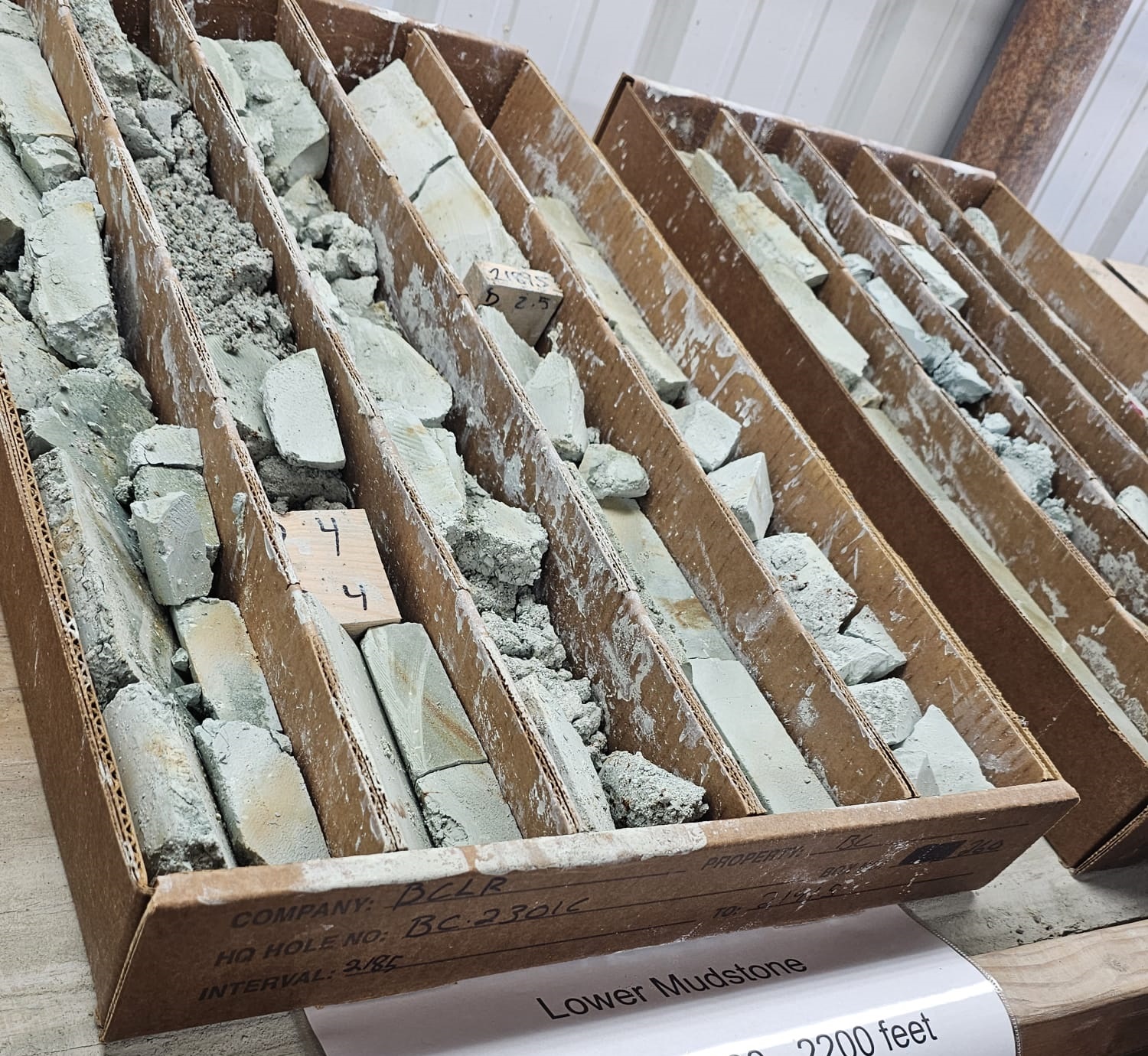
18:58 And for a large part of that basin is mineralized with lithium. We have this kind of low grade mineralization, what we'd call low grade, a thousand PPM between the surface and about 400 feet, 500 feet. And then we have a barren sandstone down to, you know, 1500, 1300, 1500 feet. And then we have this high-grade mineralization contained within a clay stone, which is different from a lot of other deposits in that the clay is disseminated, sorry, the lithium is disseminated within a very fine-grained volcanic elastic matrix Very fine-grained not encapsulated by By clay so it's sitting either as free lithium ions or simple lithium salts within this very fine-grained matrix.
19:53 We have about a thousand feet of 3000 ppm, including about 6,700 feet of 4000 ppm material, and smaller intervals of 5000 ppm material, sub-horizontal, and we've been drilling through it.
20:11 Because of the semi-consolidated nature of that sediment, it doesn't provide ideal conditions for underground mining. So our external engineers, GRE, and Terri Lane, our project manager, has suggested that this hydraulic borehole mining might be a solution to that. And in the existing PEA, she used assumptions. We've gone back and done a lot of work with Kenley Exploration, which is the number 1 company that deals with this. And they've come back with the first set of numbers
20:55 which we've published in this press release. And it seems to be pretty positive. Kenley is confident that we can get down to this mining depth of 1500 to 2500 feet looking at this high-grade mineralisation with an operating cost of $14.28 per tonne, based on a continuous mining rate of 100 tonnes per hour.
21:25 And we have aimed historically at 30,000 kilos per year. Tonnes per year, I think, right? Tonnes per year, sorry. And it's likely that's going to be higher given the grades that we are pursuing. So yeah, most of this will be incorporated into the PEA, which we're expecting in June. And you know, one thing, let me just tag on before we do the questions, Max. You know, again, as a layman, one of the things that struck me about this is that the emphasis it's sort of when I think about the nature of this or the or the emphasis of What we thought about
22:10 the the jet boring or the hydraulic borehole mining whatever you want to call it method The the one of ways I think emphasis has changed is to me. It was more about okay It's the actual water that's doing the you know Basically the the the erosion of the material that then lets us pump, again, everything back up. We're bringing the dirt back up, right? This is, again, not in situ. We're not just trying to bring back fluids, we want to actually bring the slurry back up. Now the emphasis to me, I just really think about it more like a block caving, like sort of a variational block caving. I remember I was, you know, we're Freeport, the Grasberg, right, the big open pit in Papua New Guinea. And then underneath, they got had even higher grade material, and they started block caving it there. And, but what's different about this, I think it's very elegant, is that you don't, you know, necessarily have to install this huge infrastructure underneath the area that you want to mine out.
23:05 There you would literally go down below and the stuff would start caving in from above. Here you're talking about accessing from above and getting it to cave in. So I'm very, very excited about it. I just think that this is gonna be very beneficial, powerfully optimistic for getting this material out of the ground in a very, very ESG friendly way. And I can tell you that's very, very important to the car companies. So I think the emphasis changed a little bit again the depths in terms of getting this stuff up to the top it just became sort of a
23:40 An equation in terms of power from everything that I could deal if we could throw enough power at it and the value of that ore was great enough, then obviously you can bring it up. So I was very, very heartened by that. Anyway, enough of this. Go ahead, Max. Do we have anybody who wants to know anything? Absolutely. Thanks to you and Dwight for taking us through the next visuals and discussion. So I've got quite a number of questions here. Let's get started right from the top. So assuming the board is cavern underground, or the cavern, the more slurry needed create a depth of does this potentially slow uptake? Does it potentially slow what?
24:20 I'm still not getting the word is up to uptake. The From a layman's term, I don't think so. I think you're creating a vacuum by using that production well over at the side, my understanding is that by using a hydraulic airlift, you're actually creating a vacuum, which is helping to assist that material up towards the surface. Jeff, I don't know if you thought about this kind of question. I think it's still early days to wonder too much about that. But I don't get the impression that the report indicates that it'll be fairly continuous production, that these jetbores will be working their way down or up. You've got this central area at the bottom, which is connected to the production well. And so the material will gather within that and be lifted up to the surface.
25:16 It's designed to be a fairly continuous process.
25:19 Okay, now hopefully Jay that answers your question. Yeah, it's not. I'll just email it, obviously. Well, we can flesh that out more if we need to. Yeah, sounds good. How would the recently disclosed $14.28 per ton, production costs compared to the previously disclosed $6,000 per ton OPEX? What's the difference in these metrics? Have costs risen or decreased? I think that the mine, I think for the actual mining in the PEA, I think it was $9 a ton. I have to double check because I often talk about, frankly, the reagent costs. So I've been mixing up. But the costs went up. I do know that. There's no doubt about it. But of course, I think what The real thrust is going to be if the cost went up per unit basis, how much more lithium are you bringing up? Because we're talking about a ton of material into the plant. That's going to be one of the very interesting things that comes out of the PEA, in my opinion.
26:15 But I do know the cost went up. I think it was I think it's from 9 to 4 9 to the new number. It was a 14 or 16. Yeah.
26:23 Okay. You know, updating the PEA with this new info is very important for the company and for investors. The only negative is delaying the PFS. Wording has now changed to sometime 2025.
26:36 We see what delays are doing to other OTC miners and they are all getting the reputation of providing never ending promises. When can you commit to say this is enough? So as he says, time kills all deals. So he's wondering when that's coming with BFS. Well, I would just say, frankly, this is what you have to understand about resource development is dynamic. And I'm not gonna throw stones at any of the other companies because I can tell you, It's a double-edged sword, right? We can't tell you everything that's going on.
27:05 All we can say is at every point in time, we're trying to make the best decisions. What I think is very, very important at this point in time though now is, let's just take it and say, well, we're just gonna go right on with our previous path towards PFS. No matter what, hell or high water, we're going to do whatever needs to be done, get it done at the end of 2024 or beginning in 2025. Well, what if we start to do some drilling and all of a sudden, you know, we throw one more hole that's outside of the trend of what we've been doing and we find even higher grade material. And this is sort of goes back to the concept of sterilization. So, you know, you could end up basically building a mine in the wrong area. And that's the kind of thing you might not know for a while. But once you finally get to that, that's a horrible problem to have. So there are a lot of questions that come like this. This is where I think your faith in management has to come through. I think we've been very, very transparent about everything that we're doing, about why we're doing it, why, if we come to a point in time where we should change direction, and I'm not saying a massive change in direction. However, I'm saying I think it would be, I don't think it would be optimal if we just blindly kept going ahead to do something as quickly as possible. Now, does that mean PFS is going to be Q1 2024 or Q2 2024 or still towards the end of
28:27 pardon me, that's all 2025 or in 2024. That's the kind of stuff we just don't know. There's a lot of stuff that has to go on beforehand. And again each one of those things is dynamic. All I'm saying is that you know from the perspective of the company the technical teams everybody we think the best thing that we could do at this point in time is get that updated PEA out as quickly as we can, see what it tells us, and then get back, again, all this information could potentially go right into that PFS. So I'm not sure that necessarily it's gonna delay us a whole lot of time. I'm just saying from my perspective, I think the emphasis is shifted a little bit more right now. And it's just a consequence of the great stuff that we found. And if I can just add to that from a technical perspective, at the end of the day, if you go from a PEA to a pre-feasibility study, we need to upgrade the resource from inferred to indicated.
29:23 And assuming we have the money, we can go right ahead and drill, but you need the money to drill to move forward, whichever way you cut it. Yeah, a good follow-up to that is, good follow-up question here is, when exactly will your resources get upgraded to measure and indicate? We've expected that in the PEA, right?
29:49 We're going to update the resource in the new PEA, but the material that's above 2000, you might get some indicated in that, but the real pay dirt is 1500 to 2500. And we've only got a couple of holes below 2000. And that's where we're seeing the really high grades. And that will be inferred. So I would say we have to investigate that more fully because that's, you know, that's the most economic material. Yeah, so there's another question here that's, I guess actually I'll divide it into 2 parts because the person is saying that LAC is a clay peer to you guys, but from what I understand, it's different, right? The Clay, the situation there.
30:36 They're asking about the CapEx increase for Lacks project for 700 million to 3 billion. So maybe you could address that and how it's different for you guys compared to that? Yeah, in terms of the money, well, first of all, when we update the PEA, we're gonna have a different CapEx estimate. So from that starting point, we really don't know. Our old CapEx estimate, frankly, is probably gonna be a different kind of an operation and what we see going forward. In terms of what's changed at last, I honestly haven't been paying close enough attention to say anything really terribly coherent about it. I mean, I know that they're burning sulfur, right, to create sulfuric acid up there. It's a totally different animal as to what's going on up there. However, all that being said, folks, it's an inflationary environment out there, not only for everybody sitting in their living rooms.
31:27 In the mining area, things are just getting, it's very, very expensive. And that's something that is gonna have to be reflected obviously in these projects going forward. It's one of those reasons I also think that lithium prices are gonna need to rise to basically make it economic for people to get this stuff out of the ground. But, you know, they're definitely gonna be CapEx increases for us as well as everybody else. Not a surprise.
31:55 A double question here that I'll combine from 2 questions. So you mentioned that there's a possibility of refilling the voids made with this method with concrete. Will this be factored in as Opex and also where will the tailings be going since you can't put them back underground? Well, so from my perspective and then I'll let Jeff understand, you know, obviously give his right So we don't we're not going to backfill. So the tailings, I think that is going to be a change. I would anticipate that we're going to have tailings on top. Now, to me, the question is, and we don't know the answer right now, is going to be these voids that are created under the ground, you know, are they going to basically stop when we hit the sandstone in the middle? Will that act as a barrier, sort of like the crown pillar, or will they subside eventually all the way to the surface? And if that happens, will that be in 15 years or 150 years?
32:50 I mean, these are all questions that have to be figured out. But again, from my layman's perspective, with the tailings that we'll have up there, eventually, they could go back in if there is subsidence to basically go back and take care of that subsidence, but that would be from the top down rather than through a re-injection of tailings and a concrete mixture, which is the way that it was thought we were gonna do this, you know, in the previous version of the Kinley model. Yeah, from a technical perspective, I think the jury is still open on that. The original model envisaged pumping them back down, and it kind of assumed relatively stable wall conditions. I think as we move along, it's becoming clearer that the mineralised layer is going to behave in a more plastic fashion.
33:41 How much more plastic, we don't know yet, and that will be one of the questions to look at in the proposed pilot to be done. And that will really investigate how this behaves underground. I don't believe it. And that's something we have to investigate. Turns out to be relatively coherent. We can pump it down. If it's more plastic, then we have to just do dry stack killings on the surface. Okay. Thank you. Can you speak about the search for brine? Sure, I mean, right now you saw, well, not right now. Previously, we had drilled a hole down to the basement to do some scientific work and essentially look and see if there were any brine producing areas.
34:36 And that was I think 2 holes again. I think it was the first hole that we had done or perhaps it was the last one of last year, can't recall. But that That was not specifically targeted for brine. What we have done is run a seismic survey, 2D seismic survey over about 8%, I think it was 8% of the property, looking for structures, because again, sort of the thought is, what controls brine in this area? Because the water at Bonny and Clare is very alkaline. It's like a pH of 11. So it's not acidic enough to dissolve the sediments, put them into brine suspension. So the idea is that by finding a structure, which we did, So again, imagine, you know, underground 4,000 or 5,000 feet, whatever. There's an upheaval that runs from north to south and actually goes all the way up to Albemarle's Silver Peak. We think it's the same structure.
35:27 That creates fractures in the ground that over time, right, not over weeks, is over whatever, millions of years, allowed essentially drainage water, rainwater, which is more acidic, to get in there. And of course, up at Albemarle, I believe, they also have hot springs, which I don't think that we have, but it's that controlling function from that big structure that we think potentially is going to give us some good targets for brine. Now, that's not the primary focus right now. Those would be very deep wells. But we were very encouraged about the potential to keep looking for brine. But again, right now, the emphasis we think is on this massive sedimentary package that we have established economics with, that we are more advanced with. But the optionality at Bonny Clare is tremendous. Again, I've often described this as, in my mind, sort of a three-legged stool.
36:15 You've got this material that's closer to surface called 1000 ppm, whatever. And we haven't explored all over the surface by any stretch of the imagination. Remember, the footprint of this entire thing is, is bigger than the size of Manhattan Island. Now we have this massive sweet spot of an open in 3 directions carpet of high-grade mineralization that we certainly can't turn our backs on. We've got to investigate that more. And then we have the third leg, which is brine, which I think would happen probably in an entirely different area at a greater depth. So we haven't done anything more with the brine since the latest news results but we certainly haven't forgotten about it. I think from my perspective that we still have a possibility for it. It's a big basin. I think in the resource area that we've identified, I don't think there's any chance in our resource area.
37:08 We have a lot of calcite in the system that keeps the pH up and so it prevents the precipitation of lithium into solution. I think it might still be there depending on the localized geology elsewhere in the basin. But to me, it's kind of a nice add on, but to me, the main focus should be on adding value to the company through the drill bit, looking at the resource we've already identified. Yeah, and I would agree. In the resource area that we're talking about right now, it didn't look to me like that's going to be something that's going to be a great place for Brine. But the point is, we've got this massive property. So I don't think it's over. Okay. And a question here about what are the different options for financing the PFS?
37:59 Well, for PFS, you know, obviously, at some point, we'll be talking more about this to the market. We've got warrants that are outstanding. We've got very, very strong shareholders who are essentially standing in the wings waiting for what we think our needs are, et cetera. For PFS, We think at this point in time we're going to need to do a borehole mining test. I've been so that's an actual field test. You know I've always been throwing out the 8 to 10 million US type of a number. I think 10 million is still probably a good estimate. We're looking at ways to defray those costs or share those costs with other companies. I've often talked about, or I always talk about the fact I'm constantly talking to OEMs about getting some accretive money, looking to sell offtake, et cetera. This is all part of the dynamic environment that I continue to talk about.
38:47 So, you know, in the end, we're gonna have to raise money to continue. We want to do that in the best terms that we can for shareholders. We're not prepared to, you know, share what we're gonna do right at this second. We still have money in the bank and work that we can do. I think we just released our financials a couple of weeks ago. But, you know, for the advanced work to keep going forward and to finish things out, we'll be definitely looking to raise funds. But I think we have a number of different options. Perfect. This next one is a little bit technical and a little longer question from Pat Harris, Harris Exploration Drilling. So he's saying, having drilled with 4 different methods at Bonny Clair, I remember the original mud rotary drilling chip sampling return values high enough to justify mine, but later core drilling suggested much higher values. Why?
39:35 And then he's saying because the lithium was coming out of the samples and going into suspension, this bodes well for hydraulic mining. That's a good point, Jeff. You want to take it? But I agree with that. I mean, I think in general, with a variety of different deposit types, you can get a difference in grade from RC or mud rotary through to diamond. We certainly have seen that. We're losing maybe as much as 50% of the grade from from my rotary and RC to diamond and Yeah, I think that's because you've got this very fine-grained disseminated lithium that is easily liberated from the from the host rock. And I think that certainly speaks to the well to the hydraulic mining.
40:27 Perfect. So that is all for the questions that we have for today. So thank you both for taking us through the updates in the Q&A session. I also want to thank everyone who submitted their questions. And as always, today's recording will be available to watch shortly afterwards, so look out for that. And before we wrap up, just passing things back over to you, Steve, for closing remarks. All right, super. Obviously, thanks to everybody. I always try to end by reemphasizing what I think our value proposition is. You know, this company in its current form with 100% of Bonnie Clare's is relatively unknown, very, very unknown. And that was confirmed to me again by my recent marketing again from everywhere from Vancouver over to Toronto and then over to Zurich. So we are continuing to get the word out about it. But in its most basic form you know we're at a 30 million dollar market cap. We already have a monster of a resource. We have all of these things that point to things getting even better, notwithstanding lithium prices, which thankfully appear to be stabilizing.
41:27 But to me, this is why you get involved with the junior resource space. You invest to try to get outsized returns. And obviously there's always going to be a wall of worry to essentially ascend. It's no different in lithium than to me it is in gold or anything else. I look at all the positives. I look at our jurisdiction. I look at the size. I look at the estimates of the economics coming in. All of these kinds of things point to a very, very robust base case. And to me, that's what value investing, and I do consider this to be value investing, is you say, OK, look, I know there's value there. It may take some time to manifest itself, but over time, all these fundamentals, including again, in its most basic form, global lithium supply and demand, and maybe they don't sell every car at the end of this month or next month. But when you see the the penetration rates that have been occurring if they're anywhere close to what they have been or what they're predicting the world's going to need every pound of lithium you can get. I think we're in a great position to provide it.
42:28 I think we're going to add a tremendous amount of value to shareholders. You know as I said obviously we don't want to break any promises. That's why I try not to make any promises. And we may have some give and take in terms of schedules, things like that. But understand, we're also thinking outside the box. We've got a lot of people with a lot of different experience in different areas are looking at this and there's one thing they're concentrating on and that's how do we maximize the value for shareholders? So with that, I'll end it as always, send emails over. We can try to flesh out any additional detail that you need. Hopefully you're all shareholders. If you're not, please join us. We think there's a great road ahead. And I'll end it there. Thanks, Max. Thanks again to everyone for participating. And I hope you