Ed Hutchinson
Chief Executive Officer, Henry Boot PLC
Replay available
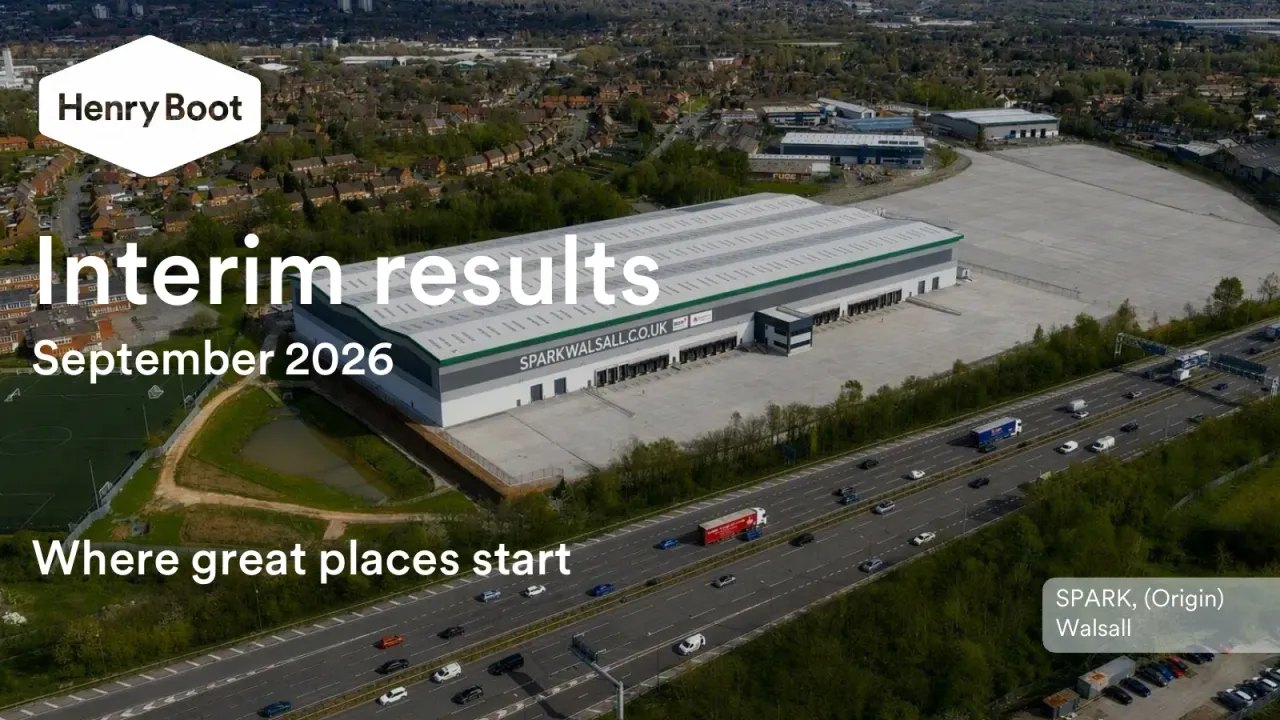
Henry Boot (LSE:BOOT) Q2 2026 earnings call, held 2026-09-22. Watch the replay and read the transcript on 6ix.
On 6ix: 6ix.com/event/henry-boot-plc-boot-q2-2026-earnings-call
Automated transcript · Written by software from the replay's audio. It can mishear names and figures; the replay is the record.
0:00 So I'm Ed Hutchinson and I am delighted to be sat here fairly new in post as the Chief Executive Officer of Henry Boot. Now for those of you that don't know me, I've been with the group about 20 years, just over 20 years. I became a director of HPD in 2012 and went on to We asked to be the MD in 2018. Most latterly, I've been the interim MD of Stonebridge Homes from the end of last year through to about middle of this year. Now, notwithstanding my longevity with the business, my remit from the board is to come in and make a difference. That's exactly what I intend to do.
0:47 So Henry Boot has a rich and a full history. This year is our 140th year anniversary. I can count on just two hands how many people have had the privilege of being sat where I'm sat. My immediate focus is to lead us through these challenging market conditions and then to define a vision and a strategy for the business that capitalises on the clear strengths that we possess. So my initial impressions since being enrolled. They've only reinforced my confidence in the group's long-term prospects. Henry Boot is a well-established business with a strong track record of delivery. Spearheaded by our market-leading land promotion business, Hallam Land, we've got a high-quality portfolio of more than 200 sites across the country that would be extremely difficult to replicate.
1:43 HBD has a proven ability to deliver high quality developments supported by strong partnerships across both the public and the private sector. We have commenced an improvement plan for Stonebridge Homes but we know we need to go further and we recognise that we cannot rely on a market recovery to improve our performance. Having spent a considerable amount of time getting around the business and speaking to our teams over the past couple of months, I am in no doubt we have a highly capable people with the skills, experience, passion and relationships needed to deliver our schemes and create value. So a business review is already underway and a refreshed strategy together with the associated medium-term objectives which will flow from it will be presented in early 2027.
2:40 In the meantime I'm going to take you through our near-term priorities in a bit of detail on this slide. Now the key aim here is to bring about a laser focus around how we can turn the dial of the business over the next six to twelve months. Being clear on what our near-term priorities are, which are as much about what we are pausing or stopping as it is what we are doing, will help bring about a more unified pace across the business and move us through into more stable conditions next year. So, our near-term priorities are, number one, unlock and crystallise value. We'll do this by accelerating planning commissions and converting consents into sales in Hallam Land, leasing and selling completed developments in HBD, and converting the Stonebridge Homes order book into completions, driving profitability and returns.
3:34 Number two, we're going to reduce our borrowings. We'll apply stronger cost and capital discipline, prioritise only the best opportunities and use partnerships to grow our development programme without providing all the capital ourselves, thus strengthening the balance sheet and providing capacity for distributions and reinvestment. And finally, we will improve our operational efficiency. We will simplify how we operate, speed up decision making and share expertise and resources across the group, creating a higher quality business for long term value creation. OK, I'm going to just hand over to Darren now and he's going to talk through the financial review. Thank you, Ed, and good morning, everyone.
4:20 I think given the challenging market backdrop we see ourselves with, it is nonetheless disappointing to report that our financial performance is below our expectations. Group revenue decreased by 19% to just below 81 million, reflecting lower transactional activity across all of our markets. At the operating profit level we made a £3.9 million loss driven by weaker trading performance and a reduction in the value of our wholly owned investment property portfolio. Gearing increased to 33% and I'll take you through the movement in net debt shortly but we do expect gearing to reduce towards the end of the year as we complete a number of planned disposals during the second half.
5:13 Given the increasing gearing and our second half waiting, we've taken the decision to not pay an interim dividend and we will consider the dividend again once our full year results are known. Looking at revenue and operating profit on an individual business level, the chart on the left of this slide sets out a year-on-year revenue bridge showing the component parts of the movement in revenue. You can see from the chart that both revenue from land promotion and property investment have declined. Home building revenue increased, reflecting a higher number of private versus affordable completions and the sale of land at Carlton.
6:00 The end of the road link contract was the principal driver of the reduction in construction revenues. The chart on the right then shows a similar bridge for operating profit. It's clear this bridge that the main driver of the reduction in operating profit is land promotion with smaller movements across property development and home building. This lower profitability was partially offset by central cost savings delivered through our Future Ways of Working programme and a decision to not award our people bonuses in respect of the 2026 year. Turning now to cash flow and net debt, the chart on this slide sets out the key components of the movement in net debt in the period.
6:49 Starting on the left, the cash outflow from operations totalled nearly £14 million as operating returns were not sufficient to cover interest, tax and dividend payments. Investment property generated a net cash inflow of £8 million, largely reflecting the profitable disposal of a retail asset in Warminster. Inventories generated a further net inflow of £4 million. While we continued to invest selectively across the business to bring forward future sales opportunities, particularly within Hallam land, this was more than offset by a reduction of almost £9 million in land and work in progress at Stonebridge Homes.
7:36 As previously mentioned, we purchased a further 12.5% of Stonebridge for £5 million. We also continued to grow our Origin joint venture. The growth was largely funded by profits from land disposals into the JV, resulting in a modest net investment of £3 million. Other working capital represented a net outflow of £14 million and this was primarily driven by land sales to house builders on deferred payment terms. As a result, we ended the period with net debt of £133 million. Turning to the balance sheet, underlying asset value per share, which excludes the pension surplus, decreased by 4% to just under £3 per share, reflecting the 4 pence per share impact of acquiring a further interest in Stonebridge, together with payment of the 2025 dividend and the retained losses at the half year.
8:45 Post-period end, we agreed terms to increase our existing bank facility to £165 million until 31 December. This provides additional financial flexibility as we progress targeted sales through the remainder of the year. Our lending group remains supportive and discussions are continuing regarding amendments to the full-year covenant requirements should they be required. I think it's fair to say our balance sheet remains asset backed. Our inventories are all tangible assets, be they through property development, strategic land, or land in work in progress for delivering new homes. And Ed's got a slide later in the deck that will take you through giving you a bit more colour and detail to that.
9:43 Just looking at the sales progress we've completed, exchanged or reserved 71% of budgeted sales with the market consensus profit before tax at £9.7 million. To be clear this is not turnover but achieved property sales which offers us visibility for our full year performance. Completed sales of £61 million to date rises to £114 million including exchanged disposals and completions post period end. If we then include reserved sales we get to £144 million and the 71% of our expected full year forecast. A further 59 million of sales are then required to reach our target of 203 million with the majority split between Hallam Land who have over 1700 plots under offer and HBD who also have several sales under offer.
10:43 However we are mindful that we are operating in a more challenging environment than last year where at this point we had secured 176 million of sales equivalent to 80% of the previous year's forecast versus the 71% this year and we remained mindful that Hallam and HBD have a number of transactions to complete to achieve this. I'll now hand you back to Ed.
11:12 Thank you Darren. Okay so we'll go through a quick run-through on the operational review starting with Stonebridge. I want to be straightforward about the outlook. With a slower sales rate, bill cost inflation of around 4% and site and legacy extension costs, we expect Stonebridge to report an operating loss in 2026. We completed 72 units in the first half with completions this year being second half weighted. The private average selling price was up at £431,000 with incentives stable so pricing is held through half one. The main pressure felt by the business has been on volume. Our net private reservation rate was 0.38 reflecting higher mortgage rates through the second quarter.
12:01 The Own Land Bank now stands at nearly 1,450 plots and we're applying a clearer land strategy going forward and a more disciplined approach to future acquisitions. The forward order book currently stands at 30 million. So we've been clear that performance here has to improve and this slide updates you on our restart plan to get there. First, we've reset the leadership team with a new managing director, Warren Thompson, joining us later this year. The aim is to continue to professionalise the business and bring it properly into the group so it operates the same standards and benefits from the same oversight as the rest of our operations. Second, we are investing in our people and our systems, supported by our group function teams. That investment is targeted squarely at sales capability and customer experience, the two areas where improvement converts most directly into performance.
12:56 Third is about operational efficiency. Better data quality and closer alignment across procurement, build programmes and sales means improved oversight, tighter control of costs and decisions taken from a single reliable picture of the business. and fourth a clearer and more disciplined land strategy. In practice that means matching site scale much more carefully to our premium homes product. I'm going to flip back to Darren now and then I will close by summing up HBD's performance before I wrap up the presentation. Thanks Ed. So I'm going to go over Hallam Land who sold 556 plots in the period. This was affected by major house builders shifting their land strategies which has slowed our sales activity. Our five-year average plot sales are now running at over 2,700 plots per annum.
13:54 Gross profit per plot was almost £11,000 in the first half of the year and this does remain in line with our five-year average at around £10,000 per plot. The two transactions in the period were 416 plots at Biggleswade sold to Persimmon and 140 plots at Thorpe Willoughby sold to Vistri resulting in an average ungeared IRR Thank you very much. We have invested £11 million in the pipeline and to date have submitted nearly 3,400 plots into planning so far this year. We also remain on track to submittal a total of 10,000 during the full year.
14:53 We continue to manage one of the largest strategic land portfolios in the country with now nearly 108,000 plots. Following the government's revision to the NPPF we saw in 2025, we have seen positive changes to the planning system which have significantly increased our ability to secure outline consents and this is shown clearly by the chart in the top right on this slide. During the period we secured planning for over 600 plots, taking the total number of plots with planning to almost 9,100. Again, as the chart in the top right shows and consistent with recent years, we expect to secure planning on a materially higher number of plots in the second half.
15:41 We have a further 21,000 plots awaiting determination and in this supportive planning environment we expect our stock of consented plots to increase further building the store of value within our portfolio. As we move forward our focus is on continuing to secure planning permissions and increasing sales whilst continuing to grow the portfolio at a modest level. With the balance of freehold and promotion agreements, we can manage capital investment appropriately between risk and reward, taking advantage of the right time in the cycle when acquiring freehold land, which is much more capital intensive. Just on this slide I just wanted to spend a minute on the Biggers Wade transaction as it provides a good illustration of how our land promotion model works in practice.
16:37 Hallam Land entered into a planning promotion agreement on this 105 acre site back in 2017. 43 acres were allocated in Central Bedfordshire Council's local plan when it was adopted in July 2021. From there it was a complex planning process but outline consent was secured on appeal in November 2025. With this consent in place we were able to sell 416 plots to Persimmon, the transaction generating an ungeared internal rate of return of 16.3% per annum. Just looking at the value in the portfolio with our portfolio all held at cost there is no gain on securing planning recognised until the land is sold.
17:32 This continues to reflect a significant uplifting value not recognised within our balance sheet which we have tried to quantify here. We've included a table in the appendix showing the results if we vary these assumptions, but based on the recently achieved average gross profit per plot of £10,000, the 9,000 plots we have with planning have the potential to deliver a gross profit of £91 million over the short term. In addition to this, we have almost 21,000 plots awaiting determination. That significantly de-risks almost 30% of our total land bank and has the potential to deliver a further £214 million of gross profit over the short to medium term.
18:25 Including sites with an allocation in the local plan, we have £433 million of gross profit progressing in the planning system. The full portfolio over time has the potential to deliver over a billion pounds of gross profit and as previously we are presenting an illustrative net present value for this of 230 million or 170 pence per share equivalent to an uplift in NAV of 57%. On that I shall hand you back to Ed.
19:01 Thanks Darren. Okay, so turning to HBD, our property investment and development arm. Our committed development programme has grown to £161 million, with HBD's share of that standing at £113 million. Almost 80% of that is already pre-let or under offer. Golden Valley Phase 1 is the biggest addition, adding £95 million GDV, all of which is fully funded, and I'll provide a bit more detail on Golden Valley on the next slide. Origin which is currently developing three INL schemes at 56 million is on programme and budget and if you include the other three initial schemes we developed last year is now 66% leased or under offer with rents ahead of business plan.
19:48 We will remain selective in building up our committed programme but as I'll explain again shortly we have significant near-term optionality from our £1.4 billion development pipeline. And finally, just to confirm, the investment portfolio delivered a total return of 2.5%, which was in line with the CBRE index. So just picking out Golden Valley, this is an excellent example of us progressing a long-held opportunity and turning it into value. Phase 1 of the £1 billion Cheltenham mixed-use scheme is forward funded and work has now commenced on site. It includes IDEA and ROOTA together with supporting infrastructure.
20:33 IDEA is 68% pre-let or under offer with strong interest in the remaining space. Phase two will follow and that comprises two buildings known as input and output and they will provide a further 188,000 square foot alongside consent for up to 443 homes where residential partner marketing is underway. The profile and learnings gained through Golden Valley means that HBD are well placed to do more in the innovation sector. And together with our secure development opportunity at Duxford, it provides a springboard for HBD to secure further opportunities of a similar nature. So just extracting out some of the schemes we have secured in our future pipeline.
21:22 Just pick out there. So we've got Wakefield Hub where we have consent for further 600,000 square foot across four units with our partner York Court and we're targeting a start on site in the near future. Freeport 36, we have planning secured for five and a half million square foot industrial and manufacturing park in partnership with St John's College Cambridge. We already have strong occupier interests and we're aiming for a start on site later this year. and as just trailed, AVTECH Duxford. Planning has been submitted here in partnership with Imperial War Museum for a 430,000 square foot campus near Cambridge. The use for the scheme will be focused on low and zero carbon aircraft technology. So in terms of outlook, Darren trailed this slide a little earlier.
22:17 We believe this makes for a very strong investment case and highlights the diverse and significant embedded value across the business. We have nearly 540 million pounds of investment property and inventory value. Land promotion totals circa 160 million including 93 million of planning promotion agreements and just short of 60 million of freehold land. In property investment and development, which is the largest segment at around £227 million, we have £84 million investments, £33 million in origin and £112 million in developments. And finally, home building accounts for £148 million, of which £86 million is invested in land. In summary, we expect a better second half performance, supported by land sales that have slipped from half one into half two. It's about timing rather than lost value.
23:15 Market conditions remain challenging, with the trend of transaction volumes likely to stay subdued for the rest of the year. But we shall adopt a laser-sharp focus on progressing our near-term priorities. Unlock and crystallise value, reduce borrowings, operational efficiency. We will not prioritise short term performance at the expense of future returns or sell good assets in a way that risks future performance. The longer term fundamentals for Henry Boot remain attractive. We have a strong pipeline and the discipline to convert it as conditions improve. Thank you very much for your time.
24:09 Morning, thanks very much for the presentation. It's Tom Musson at Berenberg. Can you just give us a bit more colour for the demand for land at the moment? How many serious bids is a typical site getting and how's that evolved recently and I guess how are offers holding up in terms of price and payment terms?
24:35 So, yeah, demand for land is subdued. If we look at performance so far in 2026 compared to 24 and 25, it's definitely dropped off. Now, having said that, there are lots of factors at play. There are some opportunities in Hallam Land's portfolio where we know we still have very, very strong interest. Some parts of the country that interest has dropped off a little bit. So what we are absolutely concentrating on is to, as Darren talked through, we need to keep making hay while the sun shines in terms of this window that's open to us in terms of planning. Get as many applications as we can into the system. We've just been running as fast as we can now probably for two years on that to make sure that we are locking in that store of value in the future.
25:29 Thank you. Then just second question on the dividend. Appreciate the reasons for deferring the decision are very clear. Should we take from this that the existing policy of staying progressive is effectively over and so that's sort of under review with everything else or is there a way we can understand today what decides the future payout? I'll pick that one up. I think clearly at the moment, given the challenging markets we are in, it's just very difficult and challenging to see how performance is going to be into the future and medium term. Clearly, if we can see that we are starting to generate those sales and recover the cash and bring down the debt, then we would be much more comfortable about making the decision to turn the dividend back on.
26:18 When we do so I think we'll need to see in particular what our full year performance looks like to determine whether we're going to restore the full year expectation as we had it or whether reset the dividend to a new different appropriate level. I think once we get there however our desire would be to get back to a position where we can have a progressive dividend.
26:52 Morning, Ocean Gizzy, Pamela Libram. Probably one for Ed. You've been with the business a while, you've delivered some fantastic projects over the time. Could you perhaps, when you look back, or perhaps you don't look, perhaps it's golden value, pre-empting the answer, but which projects within HBD do you actually feel, actually that's the model that we want to follow and really grab hold of and deliver over and over again? Yeah.
27:24 The project I pick out is Tekka Aberdeen. We were selected, HBD was selected as Aberdeen City Council's development partner through a competitive process in 2014 and we had lots of challenges to get from being selected to Get into a point where we could go unconditional in the agreement and commence works on site. So people possibly know the scheme was, it was an arena, exhibition centre, hotels, right next to the airport in Aberdeen. I think it was a really good example of what Henry Boot I believe does very well working with multiple stakeholders listening to what stakeholders needs are and working out solutions to meet those needs.
28:16 Good example again of a public-private partnership. We have a rich history of public-private partnerships and possibly with the advent of devolution this could be an area that we look to pick up more within HBD particularly but we will work through that as part of our review of strategy and we'll be able to talk to you about that in the spring. Just to add to that, I think Aberdeen was a very special project for us in a real flagship and HPD have had a number of those. We've had the York Chocolate Works and now, as you mentioned, we're entering into Golden Valley with Cheltenham Local Authority. for me there's also a sub-sector of that which is very important to HPD which is the bread and butter and it's sites like the one that Ed started on when he joined us those 22 years ago which was Markham Vale and Markham Vale has been delivering for us consistently for 22 years which is just phenomenal it's not going to change the world it's not like those big flagships and so on and so forth.
29:40 Thank you, Edwin. Clyde Lewis at Peel Hunt. I think I've got three, if I may. I'll do one at a time. Ed, you talk about in your last bullet there in your introduction about creating a simpler group. And you also talk more closely about aligning the activities. I suppose where I sit, Hallam and Housebuilding, there's obviously a degree of alignment fairly clear there, albeit today I'm not sure too much of Hallam's land has gone into Stonebridge, but that's another debate. But how do you create that simpler group without cleaving property or HBD one side and housing the other side? Is there another route?
30:22 I think it starts with... Look, we have to set what the vision and the strategy for the business is, and we will do that over the next few months. A big part of us being able to deliver the strategy is looking at our own internal resource, our own skills. And if I look at across the business, we've got a fairly large team of highly skilled people, and those skills can cross over into the different businesses. So if simply, and look, as an example, Hallam Land could secure a consent and as part of their contract in selling to House Builder A, they have to deliver some infrastructure works. Hallam Land don't, within their team, have any skills and expertise for overseeing procurement and delivery of infrastructure works.
31:10 HBD do. Similarly, HBD are looking at, or have been looking in the past, at trying to gain positions on strategic employment land. Yet the specialists for doing that are sat in Hallam Land. So as we move through this next period, we're going to be doing a bit of a skills audit and looking at we need to make sure the people with the right skills are put to work in the right areas for the benefit of Henry Boot. Don't get excited about it, it's early days, but we've literally just signed an agreement where Hallam Land and HBD are collaborating to look at a scheme that has the potential of being a data centre.
31:54 The second one was on Stonebridge profitability. I suppose I'm looking for a sort of a route map for how the business will get back to making not just a decent margin but a decent ROE. I mean, you know, you look at the WIP and the land investment and to get to a 10% post-tax return on that, there's obviously a steep hill to climb for the business. You've indicated new MDs coming in so there's a process there and a change in the land you're buying. Is that going to be enough? Do you think you're currently efficient enough in terms of I suppose the bill process in terms of sort of costs as well as then obviously the selling that you've highlighted in terms of boosting that?
32:41 So I'll start by saying I believe we can make improvements in every area of that business. And I say that having spent seven months there myself, early part of this year. But let's start with the land. We took a decision a few years ago, we wanted to scale up Stonebridge Homes. And We believe the market would be our friend to help us achieve that. Unfortunately, and I'm not going to just talk about what's gone, but unfortunately the market didn't play how we wanted it to play. So we have some legacy issues to deal with and that's what we are dealing with, but moving forwards, I think we have a clearer understanding now of what Stonebridge is all about, what their USP is, and that is higher-end homes.
33:32 Mentioned earlier in the presentation, the average sales price in the first half of this year, £431,000, and most of those homes are in the northeast of England. We need to make sure that our land strategy We're building on sites where we believe there is a sufficient depth of customer for that product. And it might be, we've not got there yet, but it might be that the sweet spot for Stonebridge Homes is sites that are say 50 to 80 units rather than sites that are 200 plus units. and that way we can I think be more we can probably get more bang for our buck in terms of outlay of cash for land we can have a higher number of sales outlets right now we have seven live sales outlets and if you look at how much money we have out in land we could probably do with that number being a bit higher So for the outlay of cash we have on land we have to increase the number of sales outlets which will increase volume and we need to make sure we're building in the parts of the country where people are going to buy our product.
34:36 Last one's on probably Hallam, so probably more coming towards Darren. You're not the only ones obviously going hell for leather in terms of getting planning applications in. Everybody's doing it because there has been a certain amount of encouragement from the government to do so. Clearly there's various bottlenecks as we're so used to seeing. If the taps are properly open, is there not a danger that the market is flooded with more land for sale than there has been for the last, I don't know, maybe 10, maybe 15, maybe even 20 years, and that actually then it becomes very much a buyer's market rather than the seller's market that we've seen, and that £10,500, £11,000 that you were making is actually sort of eaten into?
35:24 There's always that possibility, but I'd start by saying if you look at the kind of average IRR we've just been quoted, it's very healthy and we still make good money even if our average gross profit per plot is... and so on. Thank you very much. on the balance sheet having taken advantage of a half decent planning environment and we will have been amongst everybody else and land is always going to be a scarce supply and we never really saw it impacted to a great degree in that way.
36:38 Alastair Stewart from Progressive Equity Research. Two or three questions on Stonebridge. It was interesting to hear you, Ed, saying that you're considering smaller sites. And I'll start off by asking, the ASP went up 10%. Was that like for like or was there a change make, a change mix?
37:09 The quite sharp increase on ASP is we have sold, by the time we get to the end of this year hopefully, we'll have sold 36 homes at our site in Morpeth and the average sales price there on that site alone is over £500,000. So that has skewed the numbers and again because we haven't got as many sales outlets as we would like, You have one site that performs that way. It does skew the numbers a little bit. That ASP is also the blended between private and social. And quite a lot of our social for this year, I want to say, started coming through now, but it was post period end.
37:46 Correct.
37:47 And would you consider, on one hand... Reducing the ASPs going forward, you mentioned the term depth of customer. With expensive homes, frankly, in the Northeast, you've not got the same depth of customer. Yet sites with 200 plus units, you're trying to emulate a volume house builder that has lower average selling prices or probably a broad range. Which direction will the dynamic go?
38:27 So again, I'll be able to give you a better answer in the spring on this. I believe our average sales price will probably come down. Not because we're trying to reduce the quality of our product, but I think we will be looking at sites where we will be Introducing more of a blend of house types. So we will have two beds up to five beds. Whereas I think historically we've majored on four or five beds, which obviously pushes the average sales price up. And I think we need that because it gives us more optionality. So that's the first point. The second point, you know, Do we want to be competing with the big PLCs on 200 plus plot sites? Probably not. Now, do I think there's a place for maybe having through at any point in time, having one big site that we could be building on for five, six years?
39:19 Yes, I do. But we've got to be very, very thoughtful about that mix of land.
39:24 Can you do some land swaps for instance with chunks of your 200?
39:29 We could indeed and we have actually completed on sales of two parcels of land on sites we're still building on to two of the PLCs already this year.
39:42 And finally, just out of interest, your Golden Valley site development, They seem to have techie type names. Are they mainly for people or for companies in the cyber security space? Are you building from the Cheltenham factor?
40:12 Cyber security innovation is absolutely at the heart and centre of that scheme. We can't name a name at the moment, but that's how I would respond to your question. As I mentioned, we are 68% already pre-let. We've got just a couple of questions that have come in. Is there any update on progress at Ireland and Manchester?
40:55 So, we continue to market the space at Ireland. We are two-thirds let. We're hopeful that – we have constant inquiries. We believe we're at the top of the list if there are any inquiries out there for prime space in Manchester. People possibly already know we did set new headline rent for Manchester when we did the letting at the end of last year at £48 a foot. So, no material news to talk of, but we're constantly fielding inquiries. Thanks. And then there's one for you, Darren. Could you please expand on some numbers for legacy issues and how you're valuing these compared to the industry? Yeah, I think that in particular relates to Stonebridge where we are facing, as Ed's outlined, a number of challenges that includes inflation, prolongation of site delivery and to some extent legacy costs.
41:53 Clearly we are reviewing all of those as we go and we become aware of them and we're making appropriate provision in the accounts for those. We also have introduced this year an additional contingency to cover those that we may not yet know about in the accounts and that probably amounts for around a third of the forecast full year loss that Stonebridge are going to be looking to deliver. Great, thank you. There's no more questions online, so I'll just hand back to Ed for closing remarks.
42:30 Yeah, well look, thanks again everyone for your time. I'll sort of finish by repeating something I've already said. New into this role, longevity with the business but absolutely I aim to make a difference and that is the remit from the board. So we're looking forward to getting stuck into refreshing our strategy and then I similarly look forward to being able to talk to you all about that in the spring.
Follow Henry Boot PLC into a list and get an email when it puts out news.
Chief Executive Officer, Henry Boot PLC
Analyst, Berenberg
Analyst, Ocean Gizzy
Analyst, Peel Hunt
Analyst, Progressive Equity Research