Bronwyn Knight
CEO at GRIT REAL ESTATE INCOME GROUP LIMITED
Replay available
FY24 Results hosted by Grit Real Estate Income Group (LSE:GR1T) on Investor Meet Company, held 2024-10-31.
On 6ix: 6ix.com/event/grit-real-estate-income-group-limited-gr1t-fy24-results
Automated transcript · Written by software from the replay's audio. It can mishear names and figures; the replay is the record.
0:00 Good morning, ladies and gentlemen. Welcome to the GRIT REAL ESTATE INCOME GROUP LIMITED Full Year Results for 2024. Throughout this presentation, investors will be in listen only mode. Questions are encouraged and can be submitted at any time using the Q and A tab situated on the right hand corner of your screen.
0:18 The company may not be in a position to answer every question received during the meeting itself. However, the company can review your questions submitted today, and we'll publish responses where it's appropriate to do so. Before we begin, we'd like to submit the following poll, and I'm sure the company will be most grateful for your participation. I'd now like to hand over to CEO, Bromin Knight. Good morning. Good morning, and thank you, Mark, and thank you to everybody for dialing into our results today. So before we can reflect and go through where we are from the 06/30/2024, we think it's important to take a moment to reflect on the last ten years. So where have we been in the last ten years of the business? This earmarks our ten year pioneering impact across our African continent.
1:04 What have we achieved? We have achieved somewhat circa $10,000,000,000 worth of assets. We have set global benchmarks. We have been award winning with an award winning team, multi sector, multi geographic, and this business has been about impact. Let's start on looking at where we are today, where we sit from a results perspective for the 06/30/2024. Some fundamental key highlights to focus on, some significant impacts that took place for this financial year. The acquisition of GREA and the full consolidation of the development business at APDM, which whilst put pressure on the June results has been a significant impact and significant milestone for this business on where we see the vision of this business going.
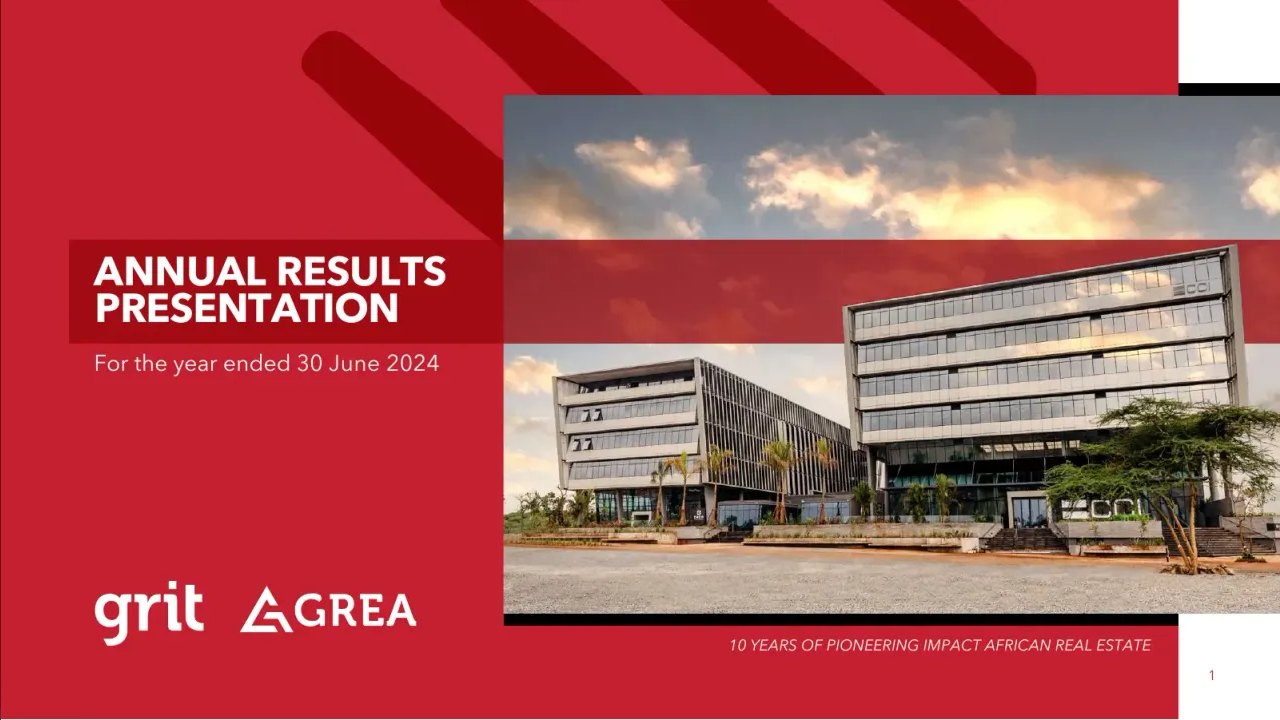
2:00 We have seen significant impact on our capital raising initiatives, including introducing DFIs like the IFC to the business. The actual operational assets have performed and this will be focused on as part of the results today. Gareth will touch on the significant impact that has been done on the cost optimization, administrative costs of the business today. And as you'll see from this picture, we have developed one of the most global standard BPO spaces in Africa and actually globally under the ambience of the INCO completion in May of this year. But, yes, there have been headwinds, and, yes, there have been challenges.
2:48 And how do we summarize where we've seen these challenges? And not only the challenges or the headwinds, but what are we doing about them both as management and board. We have seen finance costs continue to rise. We have seen the impact of higher finance costs for longer. This has had a significant impact on earnings. We have managed to settle and pay a first half distribution of $0.15 but due to the impact of earnings due to finance costs, we have not declared a second half distribution.
3:21 We have seen impact on net asset value on assets of what we define as non core assets, and we will take you through the presentation today. And then there has been what you will see today under the ambience of the emphasis of matter on the audit report. We have seen a significant delay of over twelve months protracted regulatory processes on the capital raise of GR1T the impact of the 48.5. However, I stand here today being very happy to announce that what you see under the ambience of the emphasis of matter, as of a couple of days ago, we have now fully received the South African Reserve Bank approval. We have now approval to flow these funds.
4:08 The deal is now unconditional, and we will see the receipt of these funds in the up and coming days. So that matter has now been settled whilst it's had a significant impact. What have we, as a management team and board, done whilst we have seen these headwinds, these bumps in the road. We have continued to manage our assets significantly well and this is demonstrated by the NOI performance of just under 8% growth. We have raised significant capital and as I've mentioned I'm very proud to announce the closure of the rights issuance and the capital flow. We have raised significant capital over $116,000,000 over this financial year.
4:57 We have received strong financier support, not only for waivers of covenants in relation to the June 2024 year, but we have also seen waivers of covenants for the up and coming eighteen months. Financiers have come to support this board and management team, allowing us to settle a couple of key matters: interest rates to settle hedges to be implemented, which Gareth will take you through today valuations to settle administrative cost savings to be bedded down asset disposals and reduction of debt. But to date, every single financier through our family of partnerships has supported us.
5:42 The asset recycling program is a key fundamental aspect to what we have achieved thus far and I will take you through what we have disposed of $160,000,000 to date and our targets going forward. Garrett will touch on the significant cost optimization cost control and he will take you through what impact this has had for the business. Through Greg's presentation, you will see under the acquisition and consolidation of GREA we have significant pipeline that we have got under our core asset class into the future. So let's touch on our property portfolio and where we have seen significant performance.
6:27 As a reminder to the audience, we are multi geographic, multi asset class across the African Continent. We have still secured over 94% hard currencies, we have just over 15% exposure to American Embassy paper, and we have extended our whale substantially over this period, which will be demonstrated by the significant leasing activity. If you look at the leasing activity that we have gone through and the significant leasing activity onto the next slide, you would have seen through this particular significant leasing activity and let me touch on the vacancies first. Sorry, apologies.
7:12 Let me touch on the vacancies first. So if you will look at financial year end, since financial year end, we have now completed and had full take up almost full take up of our INCOME building under the Ambient
7:26 or the GROUP portfolio. Gareth will touch on the impact of VDE, but with these two particular properties our vacancy rate sits only at circa 6%. And this signifies what our asset management team has been done from a leasing perspective. The leasing perspective, as you will see, is that we have secured material leases with American Embassy for seven years. In Ethiopia, we have extended leases with the U. S. Embassy and UK Embassies. We have secured 86% tenant retention on the actual property portfolio and extended WAIL to just over five years on the portfolio.
8:09 I did touch on part of our significant progress underway that asset disposals of non core assets are a key fundamental process or significant milestone that we have achieved and will continue to achieve. If you look at this, we have closed circa $160,000,000 of asset disposals, non core assets on the portfolio of now merging GREA into GRIT from a consolidation perspective, core assets which Greg will touch on today industrial, diplomatic housing to American Embassy, data centers, BPOs. What we're defining as non core is retail and hospitality. We have made two announcements to the market already on the disposal of our Temase Luxe resort and the disposal of our Artemis Kurpip hospital back to the operator.
9:03 Our revised target is CAD200 million. To date we have already secured CAD75 million of the 200,000,000 into asset disposals. The importance of asset disposals to the audience today is those proceeds will be used to reduce debt. Gareth will take you to the importance of the reduction of debt and our LTV targets going forward. The other significant progress as we've made as a management team and board is that we have agreed to a strategic partnership to outsource our asset property management and facilities management on the administrative side. Why have we done this? This partnership will create economies of scale across Africa, it will create simplification for our team, and you will see as an investor significant cost reduction, circa over $1,000,000 per annum to our bottom line.
10:02 What will our focus then be? Our focus will be on strategic leasing. All of our strategic tenants, global conglomerates that you see in our portfolio today, asset management as we have seen under the asset management capability of this team and development management under the ambience of our acquisition of our development management business, APDM, during the last financial year.
10:30 One of the things that we have highlighted historically is the importance of simplification.
10:36 Where are we sitting from this strategy? We have simplified the business from the GR1T consolidation and APDM consolidation. These businesses now are a material subsidiary of the group. Simplified reporting is very, very key back to our investors. This allows us to further optimize costs as Gareth will take us through today, ensuring that substructures are now formed and operational. The ability on the substructure creation is to be able to raise specialized funding for specialized assets for specialized teams, as Greg will take us through today. So on that note, I would like to welcome up Greg Pearson, the MD of GREA and APDM, to take us through the performance of firstly, GREA and secondly, to take us through the performance of the substructures.
11:30 Welcome, Greg. Thank you, Ronnen, and good morning all. So maybe just to go through some of the highlights that have been achieved in 2024. As mentioned, the consolidation of GR1T to GRIT. GRIT increasing their stake from 20% to 53.3%. This has an impact on the group in that we have significant cost savings and synergies that will be achieved. Again, Gareth will touch on that during his presentation.
12:09 I think the positive of this or we know the positive of this is that due to the development returns that we have achieved over the last five years circa 10.5% yields or 16% IRRs, we can see a significant increase in the income for the group as well. I think a major point to touch on is this recapitalization. It's been super important for us to get this right. We have worked very closely with the PIC team to make sure that we've been able to achieve the $100,000,000 rights issue, which as Bronwyn mentioned, we are very proud to announce. I think what this does as well is it gets us back into the focus of development. There will be projects launched in the very near future, the pipeline of which is super exciting.
12:58 And again, this will enhance the earnings of the group.
13:03 I think to touch on the execution and strong execution that we have had through the last five years and maybe more significantly in the last twelve months. I'm going to touch on Enyo, the project in Kenya, a significant milestone for the group. This was completed in May 2024. This was completed ahead of schedule and under budget. The value that this added for the client, for Kenya as a country and for the BPO space in Africa was a huge achievement to everyone involved.
13:40 On the next slide, we will be talking through a video and showing you illustrating the development that we have done and give you an idea of what was being able to construct in Kenya. With the partnership of Tachi City and CCI, we've been able to achieve a milestone that hasn't been yet done in Africa. This is the most sophisticated BPO call center on our continent and has made close on 7,500 new jobs. We will run through the video now so you can get an idea of the development. GREAL was the developer of the 26,000 square meter bespoke building.
14:25 This building has been developed in two towers. This was for CCI for a BPO call center and is one of the most advanced call centers in Kenya, if not Africa. GRIT is the actual developer of INCO. GRIT is through property management, facilities
14:42 management, asset management, is the manager of the INCO assets. And a fundamental component of our vision statement is family of partnerships. We cannot deliver and develop real estate without our fundamental partners and relationships. GREA are the leading real estate investors and top structure developers in Sub Saharan Africa, and we like to see ourselves as the leading city builders in the region. INCOME GROUP LIMITED really transformational for us. We were looking for really, really high quality infrastructure premises in an environment that's suitable for a super high growth outsourcing company, and we needed that to be close to where our employees are, and Tattoo City is perfect. Through our partnership with CCI and Rendeavor, we've been able to understand exactly what the clients' needs are, understanding what the SCZ benefits are, also working with someone like CCI that are super entrepreneurial, understand their business, and understand their client's needs.
15:44 We've been able to tailor make a solution. It's really exciting for CCI to be able to be in an EDGE certified building. Environmental factors are really important to us, and it's particularly important that our people have got a great experience when they come to work, and this building is a perfect example of that. The timelines that we delivered this project in was the first of its kind in Africa. From start of construction to having our first phase operational was as quick as eight months, and total build on this was less than twenty two months. This project was out the norm. If you look, the development team was entirely women. We also worked very closely with the Build Her, so we had 34 women in construction. If you look at the architecture, we've used an internationally renowned architecture to come up with a look and feel. But what we have to marry to impact is financial return. Under the GRIT two point o strategy, we saw significant development fees, project fees, asset management fees generated back up to GRIT
16:47 Group. We were able to deliver this project 8% below budget, below the time frame that we had to deliver this project. This is gonna be the hub for BPO for the entire region. Just having a building of this quality and this size sends a very strong message. Thank you. As you can see, we're very proud of the asset. And to further cement this, the asset has received multiple awards namely the IFC Edge Champion Award, the IPA mixed use development, the API based mixed use development in Africa.
17:42 Maybe just to touch on a few stats, on this building. As you saw in the video, we have got EDGE certification, for this building. We've also used an NGO by the name of Build Her. Build Her has been very integral with regards to the developments that we have done within Kenya, where we use women that have been previously disadvantaged to come into the construction industry, and we use them on our sites. Most of the women that are placed on our sites have actually got full time employment thereafter. Another big one to emphasize on is the amount of local job creation. This building now hosts circa 7,600 new jobs that weren't previously here in Kenya.
18:28 So the amounts of inflow of FDI and the exports of human capital is also awesome for a country like Kenya. As mentioned before, this building is anchored by CCI,
18:41 a partnership, that we have not just in Kenya, but across Africa as well, working closely with, Rendeavour and CCI in the other countries like, Ghana, Ethiopia and DRC. Maybe some of the stats as well. The GRIT 2.0 strategy has come across loud and clear in this development. We earned over $2,000,000 worth of fees through the asset manager on this development of a project cost of around $35,000,000 and our latest valuation close on $50,000,000 So again, the return to the group has been a good achievement. So maybe touching on some of the substructures that Bronwyn had mentioned earlier, the first one being Bora Africa.
19:33 We were very proud to announce the partnership with IFC, and IFC actually injecting $16,000,000 into the substructure. This is going to be focused
19:45 specifically on light industrial and ICT related projects. So the BPOs and the data center digital infrastructure that we have within our pipeline. To this, we've got a great relationship with African data centers, ADC. We have completed some data centers already in the likes of Nigeria and soon to be Kenya. We have other partners as well with regards to Vodafone and American Towers. So this has become a very specialist sector that we are focusing on. Bora Africa will then be very well poised in that light industrial space and giving us a much needed increase in the light industrial sector.
20:34 Moving on to DH Africa. This has been a core strategy of ours since we have launched GREA. There is a partnership that is formed with Verdant Ventures. If you want more detail on this, there was a note that was released a few weeks back from GRIT detailing further detail or giving further details on this partnership. I think to touch on a few of the benefits that will come through for GRIT, for GROUP and for GR1T is the extension of the whale. The leases that we sign with the embassies are long term, therefore will have a direct impact with regards to our whale. They are 100% U. S. Dollar receipted and invoiced, so therefore increasing The U. S. Dollar income.
21:22 And obviously, exposure to low risk. We're trying to mitigate as much risk in Africa as possible. And having tenants of this nature does exactly that for us. The ability to capture the development fee through this process is also prevalent. We've seen this come through in the previous projects and again talking back to the GRIT 2.0 strategy. Will then DH Africa then will be the specialized platform for diplomatic across Africa. We have seen the likes of the UK embassy and other embassies that we have got good relationships with coming into the same fold of the developments that we are creating. The pipeline of this is great. We have announced projects in Mali and Ghana in the very near future. And there is a further pipeline and strategy to increase this in the near future as well.
22:20 On that note, I think this gives a great summary of where we are at GR1T. The pipeline is very buoyant. We have specific focus with regards to Bora on the light industrial and ICT. We have specific focus with regards to diplomatic, and we know exactly what our core strategy is. So if you see GREA and what has been achieved on the development side through the last five to six years, there is going to be more of the same, more developments and the pipeline which we've been able to secure will be announced in the very near future. On that note, Gareth is going to be touching on the key financials of 2024 and the cost savings that we've been able to do through the consolidation as well. Thank you, Gareth.
23:11 Thank you, Greg. Now for the numbers. Good day, ladies and gentlemen. My name is Gareth Snehagher and I'm excited and honored to be the new CFO of the business. I've had around six months to get my feet under the desk and on top of the numbers. By the way, you might notice that I stutter. So if you hear me getting stuck on a word, it's just a stuttering block. The word will come out eventually. There is no denying that the numbers are soft. However, management's interventions are already showing signs of positive traction. That bodes well for future growth in the years ahead. The review period was characterized by the following: We achieved a 10.7 IFRS growth in NII, driven by strong property performance, as mentioned by Bronwyn.
23:58 We successfully controlled costs, reducing spending to 1.85% of income producing assets from 2.42% in the prior year, with further reductions expected in this financial year coming. But these efforts were negated by external factors, mainly the higher and for longer than anticipated interest rates that increased finance costs by 33% year on year. As a result, no second half dividend was declared with an annual dividend of C1.5 dollars for the year. The consolidation of GR1T and APDN had a one off impact on the key performance indicators adding an additional overlay to the results which I will unpack in the next few slides. The review period saw the Ipranav impacted predominantly by increased finance costs, valuation pressures on mainly non core assets as referenced in the next few slides and the effect of the GRIA consolidation and the financial entries thereof.
25:03 The portfolio performed exceptionally well despite macroeconomic challenges. NII for the year increased 7.9% on a proportional basis and on a like for like proportional basis by 11.8. The high interest rate environment and macroeconomic challenges in operating markets impacted property valuations. This resulting in an overall 3.8% decline after the consolidation of GREA. A few points to note. The fair value of the light industrial sector was mainly impacted by the Orbit complex in Kenya, this with a lower occupancy rate. In addition and referencing back to Bronwyn's comments on the vacancy, VDE is one of the main contributors to the increased vacancy sorry to the decreased vacancy and the valuation impact due to the reduced occupancy of the units.
26:03 In summary, Eneo had a 1.43% impact and VDE a 2.9% impact. On the positive front, as demonstrated by Bronwyn, the other sectors are performing very well with healthy progress in leasing activity with quality multinational tenants and rent escalations affected in the year. It is key to note that GRIT's proportionate share of the total property portfolio increased by 11.1%. This primarily driven by the consolidation of GRIA and property acquired through the step up from joint venture of the DH1 subsidiary. What is pleasing is that the impact of GRIT 2.0 is starting to show in the numbers. This is backed by strong income growth of our core focused sectors.
26:58 Previously, in Bronwyn's progress underway slide, she mentioned our considerable cost control activities and the execution thereof. Following from this, you will see the firm steps we have taken. Firstly, we achieved cost savings by optimizing group functions and synergies following the GREA acquisition. We also achieved further savings through salary and fee reductions for our senior staff and board members. These resolute actions dramatically reduced admin costs down from 2.42% to 1.85% of income producing assets in FY 2024. In dollar terms this represents a saving of $4,600,000 from $22,600,000 down to 17.9 Our target is to reduce admin costs further to 1.25 in FY 2025.
27:52 This will result in additional cost savings north of $4,000,000 per annum with a medium term target of 1% of income producing assets. You will notice in the table at the bottom the debt impact of the consolidation of GRIT and APDM. The consolidation of GRIT and the delays in its recapitalization has led to the debt balance growing from $396,000,000 to $491,000,000 The larger debt quantum also relates to projects being at more advanced stages of development at the time of consolidation. This resulted in the LTV increasing to 53.2% at financial year end, which as Bronwyn mentioned was foreseen and the requisite consents and waivers have been obtained from our lenders.
28:46 As you can see in the graph, we expect to reduce our leverage to 47.2 upon receipt of GRIA's equity recapitalization, which is imminent. So that's a significant portion of that being paid down towards debt. Finally, the GREAT assets are expected to annualize in the current financial year supporting the natural recovery of the RCR in the group. As mentioned before, cost of funding and finance costs were the main drivers of the soft results. Higher interest rates particularly SOFR dramatically impacted our cost of funding raising our weighted average cost of debt by 2% year on year. Additionally, a number of hedges matured during the review period and were replaced at higher cap rates.
29:35 For instance, a $100,000,000 hedge with a cap of 1.85% was replaced with a new 4.75% cap rate resulting in an additional 3% increase purely on this hedge that was effective. Increased RCF facilities at higher rates further impacted our debt costs. Final consideration is that the GRIA debt consolidated this year is structurally 1% higher than GRIT's weighted average cost of debt and herein lies an opportunity to refinance back to the GRIT levels in the medium term. In hindsight, although our hedging was effective, we were impacted by too many maturities in one period.
30:22 We have adjusted our hedging strategy now targeting 75% of our floating rate risk to be hedged at all times. We will however stagger these hedges to avoid material bullet maturities. Note that we do not speculate on interest rates. Our hedges are there to protect our positions and provide cash flow certainty. Currently 55% of our group debt is hedged, but we will phase in additional hedges as the interest rates decrease to reach the target of 75%. This slide just shows the impact of the SOFA interest rate changes on our average debt costs. It is pertinent to note that if interest rates drop by 200 basis points as the market predicts, we anticipate a 1.5% reduction in the weighted average cost of debt which will save us approximately $7,300,000 annually.
31:20 This is material. So how do we improve? Our medium term strategy includes four key deliverables: one, execute on disposal of low yielding assets two, reduce the quantum of debt three, refinance the remaining debt at more competitive rates to lower the average debt costs And four, recycle capital into developments that yield above 10.5% to improve NRR and returns to shareholders. To illustrate this very simply, we need to get the asset yields, which is the orange line, to continue tracking up and reduce the cost of debt, the blue line, to shift down.
32:07 The GRIT 2.0 strategy has already delivered encouraging results as shown by Greg and Bronwyn, improving the asset yield line with the trend expected to gain momentum and continue. Although the disposal of non key asset remains key, the weighted average expiry of our debt is currently at two point seven years. So within the next eighteen month cycle we have an opportunity to refinance with a better financial risk profile and business metrics to support a lower finance cost. My role is to ensure that the strategic operational interventions approved by the board reflect and are tracked in our key reporting metrics. Translating our strategic goals into the numbers you will note that firstly we are targeting asset yields of circa 9% and we need to achieve a 2% accretive spread over our cost of funding.
33:03 Secondly, we aim to lower our debt levels sorry, with a medium term LTV target of between 3540%, whilst growing NAV by between 47% on the portfolio annually through the GROUP model. I wish to reiterate that everything we do in this business is considered against this targeted returns model. I will now hand you back to Bronwyn for her closing statements. Thank you. Thank you, Gareth, and thank you for that really good summation of the results. So in conclusion, to the audience today, and just to thank you for dialing in, to just leave you some with some key pertinent themes that we as a board and management team are ensuring that are delivered and we are currently delivering on under progress underway.
34:11 Strong sustainable operations making sure that our real estate continues to perform as it is. As we have already seen in the results today, we have seen strong NOI growth of just under 8% and strong leasing activity, strong property fundamentals, shrink to grow, simplify and consolidate the additional disposal target of circa $200,000,000 of which $75,000,000 has been achieved thus far The ability to take that capital and to what Gareth mentioned today to reduce debt and significantly renegotiate our debt going forward, therefore reducing finance costs into the future.
35:03 The further saving of over $1,000,000 with the strategic partnership of outsourcing our administrative facilities management and property management. Focus as a team on asset management and development management under the ambient of what Greg and his team has done already under Grier. Gareth has alluded to already the significant reduction in administrative costs and we see the June 2025 target even further improving that. The importance of a deleveraged balance sheet. Gareth has taken you through what our hedging strategy will be into the future. We know this will significantly impact the finance costs going forward.
35:52 The short term targets for June 2025 of the LTV of 45% and focus, as I've mentioned already, on the disposal strategy. I want to further reiterate under this point and actually have a level of thanks to our family of partnerships and our financiers who have significantly assisted this business and have worked alongside the management team and board to create the ability for us in the next eighteen months to achieve what you see here today. And finally, the leveraging and further enhancing of our capital partners as you have seen already to date the IFC, the Public Investment Corporation and the GPF of South Africa.
36:42 A final mention on this point and just to reiterate that we have now successfully closed the rights issuance. The $48,000,000 is unconditional. It has now had full SARB and National Treasury approval and the funds will flow imminently. I want to thank everybody on this particular point. I want to thank our audience. I want to thank our investors. I want to thank the many people that continue to support this business and where we are going from a vision perspective. We know, as a management team and board, we have laid the foundation now and into the future for the next ten years of success. And on that point, and with a further thanks and gratitude, I'd like to hand over to questions.
37:33 That's great, Bromin, Greg, Gareth, thank you very much indeed for updating investors this morning. Ladies and gentlemen, please do continue to submit your questions just using the Q and A tab situated on the right hand corner of the screen. Just take a couple of moments and those questions will come through to the presenters. But just while the company takes a few moments to view your questions submitted already, I'd just like to remind you that recording of this presentation along with a copy of slides and the published Q and A can be accessed via your Investor Meet company dashboard. Bromwyn, as you can see, you've had a number of questions from investors throughout your presentation and a number received ahead of today's meeting. So thank you to everybody for your engagement. Mornay, if I may just hand back to you to moderate us through the Q and A, and then I'll pick up from you at the end. Thanks. Thank you very much, Mark. Yes, there were quite a few questions that came through so far. We'll try and categorize these under various themes to get through all of them.
38:20 The first question, Bronwyn, and I know Greg touched on it in his presentation as well, relates to the GRIT 2.0 strategy. The investor is asking, is GRIT 2.0 a realistic strategy? And when can we start seeing financial results to start turning positive? Yeah, thanks, Monet. And I think the first part of the question is, is it realistic? I think definitively, yes. We obviously are really seeing the GRIT 2.0 strategy come to fruition, firstly. And, yes, to the point, I think just to note that the GREA consolidation and the impact of the GREA and development management business was only completed in the June 2024 year. Okay? So that's a that's a one noting point. Where we see the opportunity now going forward is the ability to deleverage through our asset disposal strategy and to deleverage, as I mentioned, of non core assets.
39:14 Monet, the GRIT 2.0 strategy is effectively focusing on core asset classes. Classes. We've demonstrated already as a management team the ability to deliver on disposals. So what do we see? We see the delivering of disposals, we see the reduction of the debt. To Gareth's point, we see the significant impact thereof and the refinancing ability of the GROUP balance sheet to significantly impact the finance cost line in the business, which will allow us in the medium term through recapitalization of GROUP and the significant support of GROUP through both PIC and GPF to be able to develop yield and enhancing developments. You'll see through the developments on INCO this was completed at a development yield of over 10% which is significantly enhancing on the bottom line return.
40:01 So when GR1T has the ability now to redevelop and develop going into the future that will have a significant return one on net asset value growth in the business and secondly on earnings. Fantastic. Thank you very much for that detailed feedback, Bronwyn. Just in line with risk, a follow-up to that question is how do you assess and manage the risks associated with divesting from existing assets and then acquiring new ones in a dynamic market environment? So I think let's look at the strategy again and let's look at GRIT 2.0 strategy. So from that perspective, we've identified non core assets, Monet, as I've mentioned. Those non core assets and where we have seen a huge amount of pressure both on earnings and in our valuations.
40:48 Retail specifically has had a massive pressure on the business over the last ten years, okay. So we've taken the view as a board and management to disinvest As we have mentioned already, we have successfully done so of exiting those assets that are putting pressure on the business. Okay? We then see the focus on what we define as core assets. I like to classify core assets as what I see as long term infrastructure type assets, and this is the success thus far of GROUP and into the future. BPOs, long dated leases over ten years, data centers, American Embassy Paper, industrial, health care. These assets, Monet, have been developed already. GR1T has a track record of $400,000,000 worth of assets already developed across the continent.
41:38 They are the most significant developer in Africa. So the ability to leverage off that platform now as we fully consolidate it and control the business and be able to leverage off them and their development into what we define as core assets where we see the most resilient performance going forward into the future. Thanks. Thank you very much, Bronwyn. A question around the impact of the financial covenants this year. What are the specific actions that you are taking? And how do these actions align with the broader strategy that you've described just now? So as is mentioned through the presentation, and obviously, Gareth alluded to what's happening, so why have we seen financial covenant pressure? Let's start there. Okay. So we saw financial covenant pressure over financial year end because the recapitalization had not come through. I've mentioned that very clearly today that that's now settled.
42:31 So the recapitalization of circa $100,000,000 a significant amount of that was coming in to reduce debt. Okay. So that was a short term headwind. That has now been successfully closed. Why have we seen further interest cover impact or ICR impact? We've seen it because finance costs continue to remain high. We've seen it because earnings have been impacted by renegotiation of leases. So we have worked very closely with our financiers to let them work with us on our portfolio, understanding what the impact is today, which I've just alluded to now, continuingly higher interest rate costs, earnings impact on what we've seen from a valuation perspective. And we have modeled where the recovery takes place into the future, the progress underway.
43:21 So our financiers have worked, as I mentioned, Monet, in my presentation, to not just provide waivers and support for the 06/30/2024 results, but to provide the same level of support for the next eighteen months. Because we see what we have shown today, all of those items coming to fruition and our ability to execute on that. And already we have now closed the capital raise, which has a material impact on those covenants in a positive way. Thanks. Thank you, Bronwyn. Stepping onto the suspension of dividends in the second half of this financial year, how does the board plan to address shareholder expectations for income returns in the near term and what triggers might lead to dividend resumption? So Monet, just going back to looking at this very simply. At the end of the day, we are a real estate business and we have a simple operation.
44:10 Ultimately, as I've demonstrated, our property portfolio earnings have improved. Okay. We've also demonstrated through Gareth that we had significant admin cost optimization reduction. The line item that has materially impacted this business, Monet, is finance costs. Okay. And the continuation of increased finance costs in this business. So how do we remedy that? We remedy it through the following strategies. We reduce debt. Okay? How do we reduce debt? We reduce debt through two components. Asset disposals, we've demonstrated that already, and we have two asset disposals under the way. We we reduced it by second component, capital recapitalization, which we have demonstrated now the closure of the $48,000,000.
44:55 So the debt reduction is absolutely paramount to that. Okay? So just from where where does how where do finance costs recover? We reduce debt. We then renegotiate the margins, which is obviously absolutely critical. We replace debt. So we are in discussions with DFIs by much cheaper funding. And as Gareth alluded to, GREA's cost of funding is 1% higher. We have the ability now through the consolidation to refinance costs. Okay? So refinance those facilities. So how do we how do we get back to dividends? We get back to dividends by making sure that our finance costs are optimized and reduced into the future. And all of those strategies which I've demonstrated and Gareth and Greg have alluded to today will put us in a position to reduce costs and reduce finance costs and then allow us to resume dividends in the medium term.
45:48 Thanks. Thank you very much. Sticking to debt, please can you explain once again the debt maturity? Wasn't the sustainability linked debt sorry, the sustainability linked deal only done recently? So what are we able to when are we able to refinance that? And what ability do you have to do that? And what will the costs be involved in that? Do you want to touch on that Gareth? Sure. No problem. Thank you. So as I mentioned in my presentation, we're currently sitting at a 2.7 debt maturity, and support from our lenders has been given for an eighteen month period. I think there's a near term period where we need to reduce the debt, okay, which will then impact the business metrics and the risk profile as mentioned by Bronwyn.
46:43 That's a significant opportunity for us to look at refinancing that debt under better conditions and it's a significant portion of the portfolio back debt. So I think we are perfectly positioned currently now. I wouldn't want to enter that strategy right now until we have executed on the two point o strategy, number one. And number two, this the additional strategies of applying the date, it will take time to show in the numbers. You know? So typically a twelve month cycle, you need this. And then the third thing to note is that it is a long negotiation. It's not something that can be done overnight. So I think following from the significant interactions that we've had with the bankers and the financiers now, I think we are adequately poised to move into that spread.
47:40 Thanks. Thank you, Gareth. This is a disposal question. Can you please comment on whether you're getting fair value on the disposals? And what is liquidity in the market that you're experiencing? So, Mune, that is a great question because I think one of the challenges that we face across the African continent is, to your point, liquidity. There are a number of private equity funds that have historically battled to exit assets. We've seen some very interesting deals in relation to that of late. But, you know, in relation to that is we have already demonstrated $160,000,000 worth of asset disposals. Those have all been predominantly close to net asset value. Okay? The two transactions that you see that we've already announced to the market, both Tomasa and the hospital project, are close to net asset value.
48:31 Why are we able to achieve that and not others? I think they're strategic assets. They are very strategic for the areas that they're in. The hospital project is being disposed back to operator. The Tomasa Hotel is being disposed back to one of the largest operators across the Mauritius itself. So we have seen success. So when we see challenges, we probably see challenges more around timing, okay? It takes much longer to dispose of assets in emerging markets like the African Continent than you would ordinarily see in other markets. So it's managing that timing. And that's why when I speak about the bank support, not only for today, but for eighteen months into the future, is that's the strategy that we're working alongside them. And, obviously, Chad, also just going through what Gareth had mentioned now, just around this further debt, we are in the market for much longer dated debt. Okay? We are in discussions with the DFIs already around ten to twenty year money. Okay? So ideally, into the future, we would like to see the replacement of certain debt with these DFI sort of DFIs which is going to extend our tenure of debt to that level.
49:43 Thanks. Thank you, Bronwyn. A couple of questions for Greg is GRIT had an interesting change in its top 10 tenant mix with the U. S. Embassy coming in. How long is the runway for embassy developments? Do you only do embassy accommodation or embassies? What is the kind of pipeline that you're looking at? Perfect. Thank you, Monet. There's actually a very big runway with embassies specific for Africa. And the reason why I say that is Africa is made up of 54 different countries, everyone with their own nuance and culture. We do look at residents specifically, but we we actually look at any real estate requirements that these embassies or governmental clients require.
50:32 So we have got from warehousing, we have got go downs, we have got accommodation, we've got offices. So it varies on country by country basis. If you look at our immediate pipeline, our immediate pipeline of projects that are committed are over $350,000,000 And the runway for that is probably a 10x of that over the next fifteen years. So we do think we've got a huge runway with it. If we continue to deliver for the clients and add value, We believe we are adding value because the amounts of projects that we're getting through other government entities as well is increasing on a daily basis. Thanks. Thank you very much. And on NEO, I mean, it's well known that data centers call centers have had a huge or the influx in demand for data centers and call centers has had a huge positive effect on demand for office space. But what do you see the impact of artificial intelligence on this trend going forward? Great question.
51:36 So AI has been something that a lot of people have been scared about. We see it as something that we've had to embrace. We've been working very closely with CCI. We've done our own research and papers. But more to that, we've been working with the University of Germany. We were recently at a conference in Kenya where we brought out the top leading professors in this node to come and talk about AI. Now every single call is logged and registered through the BPO space, and you get critiqued on the way that the call was handled. What we have seen is AI has actually brought forward the need for actual call operators to sit in a space and take calls. The reason for this is EQ.
52:26 And also AI gets you to the point a lot quicker than human intervention does. But when you get to a point, the human EQ needs to come in and move it forward. Further to this, there was a directive launched from The U. S. That they wanted to move 1,500,000 jobs to Africa. So this is something that we're working very, very closely with. Ambassador Meg Whitman in Kenya has been a key part of this working with Rendeavor and CCI, hence why you've seen such an influx with BPO specifically into that Kenya space. So yes, no one really knows where AI is going. Where we see it in the short term is it's enhancing the BPO growth. Where we see it in the medium term is there's still more than 3,000,000 to 4,000,000 jobs that need to be placed in the near to mid term.
53:19 Thanks. Thank you very much, Greg. Bronwyn, the one more question that comes through is GRIT share prices dropped significantly during the last five years. What will the board consider in terms of realizing value? Would share buybacks be an option instead of further investments into GRIT projects? Yeah. Thanks, Monet. So I think basically, I mean, we have known and we know what the impact on the share price has been. So and we need to look at the factors under the ambience of that. So I think one of the important components is the ability to get back to dividends, which we think is a very key component of the share price recovery. We have looked at components of buying back shares and what the impact of that will look like. I think we need to remember what I said earlier, which is shrink before we grow.
54:08 It is the board strategy and management strategy to take actually cash on disposals to reduce debt. Our belief is that if we reduce debt significantly through the strategies which we have detailed today and ability to go back into significant earnings and the ability to distribute. We believe as board and management that will have a more significant impact on the share price going forward. So that is the strategy. So I think for purposes of developments and projects, GREA will have the ability to recapitalize itself. What I mean by that, it has DFI support at substructure level where GRIT doesn't have to participate even though we get the benefit of the assets, the consolidation, and the fees. So we don't have to put our capital in.
54:56 Greg and his team have the ability to access that funding. That is why we created the substructures. And in the short to medium term, our asset disposal strategy will be the reduction of debt. Fantastic. Thanks. Thank you very much. Ladies and gentlemen, that then concludes our Q and A session. I would like to thank the presenters, for their input. And if you have any additional questions, please don't hesitate to reach out to us. Mark, I'll now hand back to you. That's great. Thank you. And thank you again to all the presenters this morning. Can I please ask investors not to close this session as we are now automatically redirect you for the opportunity to provide your feedback in order the management team can better understand your views and expectations? This will only take a few moments to complete, but I'm sure it'll be greatly valued by the company. On behalf of the management team of GRIT REAL ESTATE INCOME GROUP LIMITED, we'd like to thank you for attending today's presentation, and enjoy the rest of your day. Thank you.
Follow Grit Real Estate Income Group Limited into a list and get an email when it puts out news.
CEO at GRIT REAL ESTATE INCOME GROUP LIMITED
CFO at GRIT REAL ESTATE INCOME GROUP LIMITED
Group MD/CEO of GREA at GRIT REAL ESTATE INCOME GROUP LIMITED