Karl Staubo
CEO
Replay available
Golar LNG (NASDAQ:GLNG) Q4 2024 earnings call, held 2025-02-27. Watch the replay and read the transcript on 6ix.
On 6ix: 6ix.com/event/golar-lng-limited-glng-q4-2024-earnings-call
Automated transcript · Written by software from the replay's audio. It can mishear names and figures; the replay is the record.
0:01 Welcome to the GOLA LNG Limited 4Q 2024 presentation. After the slide presentation by CEO Karl Fredrik Staubo and CFO Eduardo Maranhao, there will be a question and answer session. Information on how to ask a question will be provided then. At this time, all participants are in listen-only mode. I will now pass you over to Karl Fredrik Staubo. Karl, please go ahead.
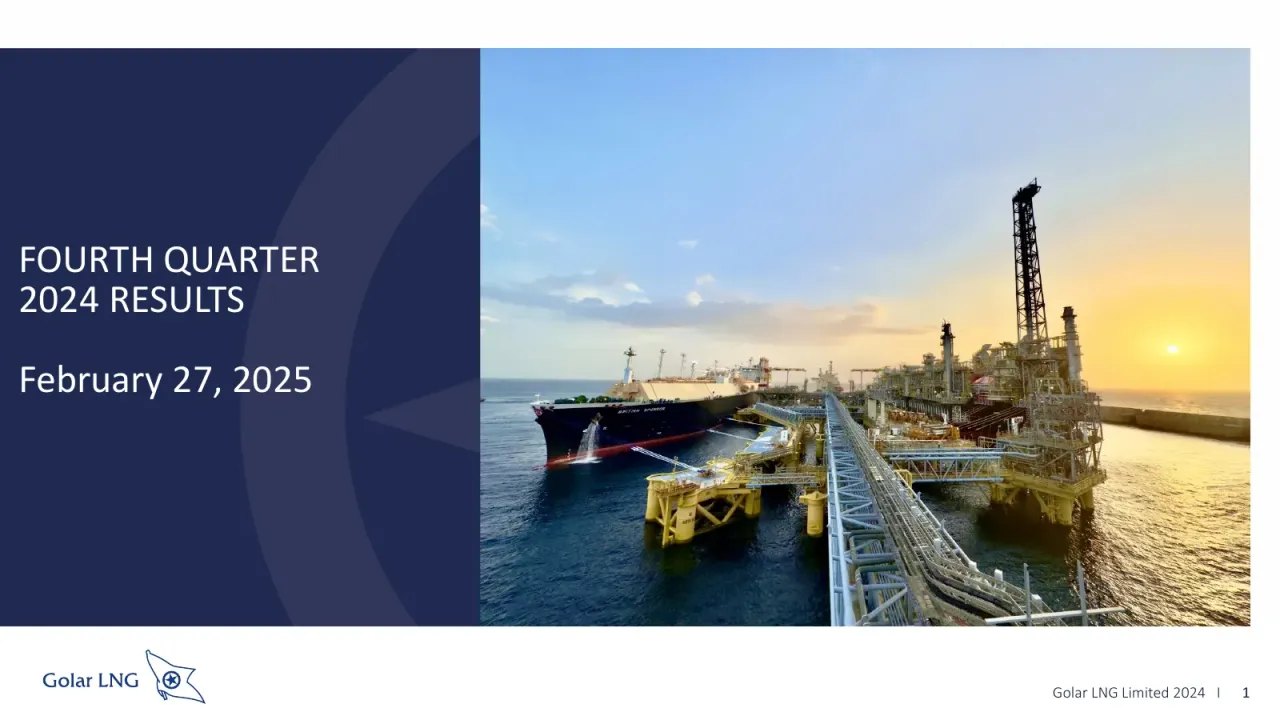
0:27 Thank you, operator, and welcome to GOLA LNG Q4 earnings results presentation. My name is Karl Staubo. I'm the CEO of GoalR LNG, and I'm accompanied today by our CFO, Eduardo Maranhao. We're happy to be dialing in from Buenos Aires, where we've been meeting with our coming partners for the FOMG healing. Before we get into the presentation, please note the forward-looking statements on slide two. We start at slide three and an overview of GoalR today. During the quarter, we finalized our transition into pure FLNG company through the sale of Avenir LNG and Golar Arctic. The sale of Arctic marks the end of Golar's 50-year presence in the LNG shipping market.
1:18 Our assets now include the Hilly, which is currently under a contract for Perenco Offshore Cameroon until contract expiry in July 2026. Thereafter, the vessel will be redeployed here to Argentina for a 20-year contract, establishing Argentina as an LNG exporter. The GIMMI is currently under commissioning to start a 20-year contract for BP offshore Senegal and Mauritania. The LNG carrier Fuji was delivered to CNC Raffles Shipyard in Yangtze, China during the quarter, and the conversion of the Mark II FLNG is progressing according to schedule. Inclusive of the HILI re-contract here in Argentina, our EBITDA backlog stands at 11 billion before commodity exposure.
2:09 We expect our backlog to continue to increase and provide further earnings visibility once the March 2 FLNG secure a long-term target. Turning to slide four. We continue to focus on capital allocation towards FLNGs and agreed to acquire all remaining minority interest in the FLNG Hille during the quarter. On Christmas Eve, we announced that we acquired approximately 8% of the total vessel capacity from Seatrium Shipyard and Blacking Beach. We paid $90 million for the shareholding, of which $30 million in assumed debt and $60 million of equity.
2:55 The equity portion matches that of the sale of our non-core investments in Avenir LNG and the Golar Arctic. Both were sold with a total cash equity proceeds of 63 million. The transactions will have several positive contributions to Golar including immediate cash flow accretion, increased earnings visibility through the backlog, reduced volatility of earnings, due to the long term infrastructure cash flow profile of FLNG projects versus more volatile and shorter dated cash flows of LNG shipping. This is also an important exit from LNG shipping after 50 years of operations and a concentration on strengthening our market leading FLNG presence.
3:45 That leads us to slide five where we remain the largest FLNG owner and operator controlling a total liquefaction capacity of 8.6 million tons per annum. Golar is the only proven provider of FLNG as a service, providing charters with natural gas liquefaction without requiring any ownership to the gas reserves. The advantage of this business model to our potential charters includes time to market, outsourcing of engineering, no capital commitments to the Charter until they receive cash flow from production and access to Golar's market leading operational uptime.
4:31 We expect to continue our market leading position and have engaged conversations with capable shipyards for fourth FLNG units that we will seek to order once we have secured a Charter for the Mark II under construction. Turning to business update, and the highlights of the quarter on slide seven. Hilly continued its market leading operational track record and has now delivered 128 cargoes since startup in 2018. CP satisfaction for Hilly's re-contracting in Argentina is going according to schedule and we expect all CPs to be fulfilled within the second quarter of this year. In January 25, we received gas The gas from the accelerated commissioning was replaced by feed gas from the BP-operated FPSO, which allowed full commissioning to commence of the FLNG gimmick.
5:32 This milestone triggered the final upward adjustment to the commissioning rate under the commercial reset. LNG is now being produced, and subject to receipt of sufficient feed gas, we expect the first LNG cargo to be exported within Q1. We thereafter assume the full commercial operations date to be triggered during the second quarter. This will formally mark the start of the 20-year lease and operating agreement that unlocks approximately $3 billion of EBITDA backlog, Golar's share. On the back of these developments, the contemplated refinancing of the FLNG GIME is in the final stages, and Eduardo will elaborate on that later in the call.
6:20 The Mark II FLNG under construction is progressing according to schedule as mentioned. The key financial figures for the quarter include adjusted EBITDA of $241 million for the full year of 24. Our cash position stands at around $700 million and we declare the dividend of 25 cents for the quarter. We see very strong momentum on commercial opportunities for our FLNG service offering and we will elaborate on this later on in the presentation. Turning to slide eight. We're pleased with the continued economic uptime for Hylli. The vessel generated 277 million of EBITDA during 2024.
7:08 As a result of acquiring the 8% remaining minority stakes in Hylli, we see immediate cash flow accretion driven by an increase in the fixed tariff component of approximately $7 million per year. An increase to the Brent linked tariff component, which will increase by approximately $400,000 for every dollar the Brent is above 60. And an increase in the TTF linked tariff component, which will increase by approximately $500,000 for every dollar of TTF price measured on an MMBTU basis. In addition to these immediate cash flow accretions, our EBITDA backlog will increase by approximately half a billion dollars on the back of the 20-year redeployment contract in Argentina.
8:05 Turning to slide nine. Since we entered into the definitive agreement for the redeployment of Hille in July last year, We have actively worked together with Pan American Energy to attract additional Argentinian gas resource owners to the project. We're pleased to see that three of the leading gas producers have now joined. Pompa Energia joined with a 20% shareholding, Harbor Energy with a 15% shareholding, and YPF also with a 15% shareholding. The addition of these companies further strengthened the project and increased the credit quality of Southern Energy, which is our counterpart in the project.
8:51 With Argentina's vast proven gas reserves and the level of interest for the project supports the economic solidity of establishing Argentina as an LNG exporter and thereby potential further FOMG deployments by GOLAR in Argentina. As mentioned, the CP fulfillment are going according to schedule and the completion is expected within the second quarter of this year. Following the end of the current Franco contract, vessel upgrades and relocation to Argentina, we expect operations here to commence in 2027. Turning to slide 10 and an update on the gimmick.
9:38 As you can see from the picture on the top left here, you can see GIME to the right and then an LNG carrier to your left. Accelerated commissioning activities commenced in mid-October utilizing a cargo from that LNG carrier. That gas stream was replaced during January with first field gas received from the GTA field. This resulted in the final upward adjustment to the commissioning day rate ahead of final COD. The first LNG commissioning cargo is expected within this quarter and the full contract startup within Q2.
10:23 Again, we're in the final stages of the contemplated refinancing of the vessel. Turning to slide 11 and a mark two construction update. Again, as you can see from the pictures, the conversion is well underway and tracking according to schedule. The donor vessel, Fuji, entered the shipyard on February 14th after completing its service as an LNG carrier. Several long lead items are now complete and delivered to the shipyard for installation onto the Fuji. The vessel will be the earliest available FLNG globally with delivery in end 27th. To date, we've spent around $600 million in capex on the project, fully equity funded, and the total capex budget is around $2.2 billion, fully delivered to site.
11:19 We're currently in advanced discussions for deployment of the vessel and expect to secure asset level debt on the vessel after a charter has been secured. We also have an option for further Mark II FLNG at the EMC shipyard with delivery within 28 if we order in 25. Turning to slide 12 for an update on business development. Our position as the only proven service provider of FLNG globally, our market leading capex per ton and proven operational uptime combined with having the earliest available FLNG capacity globally continues to drive interest in our FLNG solutions.
12:04 We see strong progress on FLNG commercial development. We continue to focus on FLNG opportunities where we have an attractive base tariff and commodity upside participation. So we lock in a base and we participate when offtake prices increase. We're therefore focused on identifying projects that are competitive in the international scene. We have advanced commercial discussions for Mark 2 FLNG deployment. And we are also discussing projects with potential for multiple FLNG deployments. On the back of these developments, we have advanced discussions with shipyards for potential fourth FLNG unit development.
12:59 We, as previously disclosed, are not planning to order such vessel until we've secured a vessel for the March 2, but we want to be ready to go with the fourth unit as soon as that's concluded. Turning to slide 13 and the LNG market outlook. We continue to see strong demand for LNG globally. In the recently published Shell LNG Outlook, the LNG demand forecast for 2040 has increased by 10% only since the 2024 report. Demand is driven by increased adoption of LNG globally, driven by LNG's favorable flexibility, environmental attributes, and cost competitiveness.
13:49 China today has more than 2 million LNG-fueled trucks on the roads, and LNG-fueled trucks make up more than a 50% market share of new truck sales. We see further upside potential to LNG demand subject to the relative price of LNG versus other fuels. This development calls for increased LNG production and the cost competitiveness for FLNG development drives the strong demand that we currently see for our FLNG project. I'll now hand the call over to Eduardo to present our Q4 results.
14:28 Thank you, Karl, and good morning, everyone. I'm pleased to provide an overview of Gola's financial performance for the fourth quarter of 2024. Moving to slide 15, let's go through some of the key financial highlights of the quarter. We achieved total operating revenues of $66 million, with FLNG tariffs reaching $86 million in the quarter. Total FLNG tariffs reached $350 million for the full year of 2024. We look at this tariff to be the most accurate measure of all realized liquefaction revenues, including gains from our oil and gas linked fees from HILI operations. Total EBITDA reached $59 million in Q4, which is in line with the previous quarter.
15:14 Total EBITDA for the full year of 2024 was $241 million. This quarter, we report a net income of $15 million. This figure is inclusive of a total of $29 million non-cash items, such as adjustments in the value of embedded CTF and Brent derivatives within the HILI contract, changes to our interest rate swaps, and an impairment charge upon the sale of Golar Arctic. Total net income for the full year of 2024 reached $81 million, a significant improvement from 2023. Our liquidity remains strong, with approximately $700 million of cash on hand at quarter end. I'll talk more about these and our initiatives on the financing front in the next slides.
16:03 Lastly, we are pleased to declare a dividend of 25 cents per share this quarter with a record date of March 11 and payments scheduled for March 18. Turning to slide 16. HILI continues to perform, achieving 100% economic uptime and reinforcing its market leading operational track record. When we look at Q4, Healy generated approximately $45 million in free cash flow to equity. Total free cash flow generation in 2024 was $170 million. Looking ahead, we expect to have a total debt service for 2025 of around $80 million on the asset level financing that we have on duty. I would like to highlight that we remain exposed to both Brent and TTF prices.
16:52 If these prices continue to improve in the coming quarters, We can expect increased distributions from the Healy through the duration of its current contract until July 2026. Following the acquisition of the remaining shareholding of Healy, we have also increased our exposure to TTF and Brent. And now, for every dollar per barrel of Brent, above prices of $60 per barrel, we generate $3.1 million of incremental EBITDA per year. Similarly, the sensitivity of TTF prices have also changed, and we now make $3.7 million for every dollar of TTF price movement on an annual basis. So moving to slide 17, we can see that our total gross debt position at the end of the quarter stood at $1.5 billion.
17:43 When considering our cash position of $700 million, that leaves us with a net debt position of just over $800 million at the end of last year. So following the execution of 20 years agreement with Southern Energy, we now have a total EBITDA backlog of over $11 billion. This figure doesn't include any further commodity upside and also further inflation adjustments embedded in the contract. That leaves us with ample room to optimize our debt structure and potentially re-leverage our asset level financing for both Gini, Healy, and soon to our Mark Chill vessel, which has been fully equity funded until now. We continue to be actively engaged in the advanced discussions with potential lenders and credit approvals have been received for the refinancing of Gini.
18:33 The deal is now subject to customary closing conditions and third party stakeholder approvals. Regarding the Mark II project, we have fully equity funded approximately $600 million today. Both the donor vessel and all related equipment that we have purchased are currently unencumbered and receive room to secure asset level debt for this vessel once the charter is secured. In this case, we would be targeting a financing amount that could equal approximately four to six times its contracted EBITDA. So with the robust backlog exceeding $11 billion from Gimi and Healy, coupled with the potential for substantial liquidity release and ongoing discussions for additional debt financing, we see ourselves in a strong position to support our growth ambition.
19:22 We have the flexibility to optimize our capital structure, unlock further value, and accelerate growth with the development of our LNG fleet. With that, I'll hand the call back over to Karl for his closing remarks.
19:37 Thanks, Eduardo. Turning to the final slide of the deck on slide 19. In 2024, we saw several key milestones, and we're happy with the development of the company. Gimme a ride at the GCA hub in January. We agreed a commercial reset with BP. We signed definitive agreements for a 20-hour charter with Southern Energy with an adjusted backlog of $6 billion before commodity upside. We issued $300 million of unsecured bonds in September. We FID'd the Mark II FLNG shortly thereafter. and we ended the year by selling, no sorry, acquiring the minority stakes in Gili and selling non-core assets in Avenir and Golar Arctic.
20:26 We have a very clear plan and want to maintain the momentum into 2025. The first milestone is the refinancing of Gimi. We thereafter conclude the conditions precedent on the 20-year Southern Energy Contract in Argentina. We want the target to secure a charter for the Mark II FLND under construction, target asset level financing of the Mark II and optimize the debt on HILI, as I just explained by Eduardo, before targeting additional FLND growth through a fourth FLND order. That concludes the presentation today, and we will hand it over to the operator for any questions.
21:14 Thank you. If you would like to ask a question, you will need to press star 1 and 1 on your telephone and wait for your name to be announced. And to withdraw your question, you can press star 1 and 1 again. Please be reminded there is a limit of two questions per person. Thank you. We will now start with our first question. And this is from Ben Nolan from Stiefel. Please go ahead.
21:41 I appreciate it. Good morning. I guess it is there, Carl and Eduardo. I wanted to first ask about the Mark II and specifically with respect to the fourth vessel, just trying to understand how you're thinking about the option versus looking at an alternative yard and just wanted to make sure that I understand. would an alternative yard be instead of exercising the option or are we talking about a unit in addition to the option that you have?
22:19 Hi Ben, so basically the way we see it is that the commercial developments are progressing on multiple fronts and the reason for the comment that way is that some of those projects are for where Mark 1 would be more suitable, i.e. returning to order most likely than at CITRIUM. We obviously have the option for Mark 2 at CIMC, and we're also progressing projects for the Mark 3, which we've spent considerable time and effort developing, which is obviously a 5 million ton unit, which would be by quite a long stretch the largest FLNG in the world, and therefore it's The fourth FLNG may or may not be the Mark II, but subject to the commercial development, either a Mark I or even a Mark III.
23:12 That's how we see it. But we obviously are not ruling out that it could be a Mark II as well. It's just that the commercial development dictates the size of the fourth FLNG.
23:23 Sure. And it's not mutually exclusive. You could do a Mark II and a Mark I just at a different shipyard. Is that sort of the implication there?
23:33 Correct. But as we alluded to earlier on, we don't plan to have more than one open, but you can obviously build against contract.
23:40 Sure. Okay. That is very helpful, Keller. The other thing I was curious about is on the GEMI. You show... 2.7 million tons of capacity, although still the previous nameplate capacity, which I think was for your 70%, 151 million. But correct me if I'm wrong, I think that's only on 2.4, maybe 2.45 million tons of capacity. Can you maybe walk through how that extra bit works? And if it does operate at 2.7, is that something that you would be able to realize soon? if there's upside on that.
24:24 Hi, Ben. Eduardo here. So I think the way it works is that for incremental production above the base capacity of 2.4 MTPA per year, we would then get the proportionate payment, which is in line with the $215 million annual EBITDA. So for incremental production above the base capacity, that would go proportionate to the $215 million that we make
24:50 every year for the 90% utilization.
24:53 Right. And is that a practical assumption? How should we think about how we model it?
25:00 So if we were to run the numbers here, so let's assume, for example, that we were to run with 100% utilization, so beyond the base capacity of 2.4. So in that case, instead of a $215 million, $15 million of annual EBITDA, we would be earning $241 million of annual EBITDA. assuming 100% utilization of the 2.7 MCPA nameplate capacity. Got it.
25:26 Okay. I wish I could go more, but I'm going to try to stick to my two, so I appreciate it. Thank you, guys.
25:32 Thanks, Ben. Thank you. We'll now take our next question. This is from Chris Robertson from Deutsche Bank. Please go ahead.
25:42 Hey, good morning, guys.
25:43 Thank you for taking my questions.
25:45 I know in the past that you had talked a bit about having to spend on certain long lead items during Q1 to stay on track to exercise the option for the second mark too. Could you just clarify whether or not you've spent during the first quarter to date or plan to for the rest of the quarter?
26:06 We have not. It's something we continue to monitor. We're obviously in conversations with all of the critical suppliers, given that we're ordering or just have placed order there for the mark two. So we monitor the situation both on lead times and costs. So we haven't, we currently do not expect to do that within Q1, but it's something we monitor very closely.
26:30 Okay. And then turning to slide seven, you made a comment here. I don't know if you addressed it during the prepared remarks, but It says on schedule for the Mark II SLNG contract commitment. Can you just clarify what you mean by on schedule and kind of give a bigger picture of what that means for expectations?
26:52 I think what we previously communicated that we target to charter the vessel within 2025 and that's what that refers to. So that we have fixed that ship within this year, which will then enable us for the fourth unit.
27:07 Okay. All right, I'll turn it over. Thank you.
27:11 Thanks, Chris. Thank you. Our next question is from the line of Alexander Bidwell from Weber Research and Advisory. Please go ahead.
27:23 Good morning, Karl, Eduardo. Thanks for the time. So on the fourth FLNG vessel, have you guys started identifying conversion candidates if you were to do a mark one or mark two? And what would be the timeline for a conversion candidate acquisition?
27:43 Yes, we have started. We've also inspected vessels. It's something we keep a close eye on. I think if you look at the LNG carrier market, the price of those are More downward pressure than upward pressure, to put it that way. There are available vessels that would be suitable to our conversion ambitions. Some of them are direct sisters of the Fuji. Others have different characteristics that we may deem beneficial. Given the price dynamics of the market, we don't feel a rush to do it, but it's something we keep a very close eye on.
28:27 All right, thank you. That's all from me. I'll turn it back over. Thank you. The next question is from Greg Lewis from BTIG. Please go ahead.
28:42 Yeah, hey, thank you, and good afternoon, and thanks for taking my questions. You know, Karl, Eduardo, I was hoping you could provide maybe a little color around Argentina. you know yeah I know that it's been discussed that to kind of put a second unit there you know there some infrastructure needs to go in and really my question is around you know we roughly know that the infrastructure needs to go in has there been like an official feed study do we have kind of as we kind of look forward do we have an act you know are we starting to get real Are there any timelines of the project or is it something where we just know it needs to be done before they can increase their ability to export more natural gas?
29:31 Hi Greg, that's a very relevant question obviously. So for the benefit of everyone on the call, HILI will utilize the spare capacity of the existing pipeline network in Antenna. If you go beyond the HILI, you need a designated pipeline from the Vakamvarte resource. down to the San Matias Gulf where the vessels will be placed. Late last year, there was an FID of an oil pipeline that goes exactly the same direction from the Vakamarte to the same site. That FID then creates the right of way to put the gas pipeliner next to it. The construction timeline of a gas pipeline would be far shorter than the delivery window of the Mark II.
30:18 if that were to come to Argentina. So the pipeline investment FID or feed study is currently not a gating item for the startup of a potential contract for Mark II in Argentina. The fact that during the quarter we saw three of the major gas producers in Argentina in Pampa, Harbor and YPF joining the Southern Energy Project alongside Pan American. We see as a strong testimony to the economic attractiveness of establishing LNG in Argentina as an LNG exporter. The details of the pipeline is something you need to ask the gas producers about.
31:04 We are an FLNG company and we provide FLNG infrastructure. That's our business, but we're obviously monitoring the development There is no pipeline without further liquefaction capacity, and there's no pipeline without volume commitment from the gas producers. So it's all sort of codependent.
31:24 Okay, great. And then I'll just change gears here. and, you know, we're just kind of curious, you know, obviously you're looking at building the portfolio. I mean, it seems like we have a good line of sight on a couple new ones. You mentioned, you know, the ability to maybe go to Korea to build, you know, a larger FLNG. You know, my question has been around, you know, as the new administration has come into the U.S. and, you know, they want to be a massive, they want to, I guess, increase their LNG exports, but of course there's tariffs. You know, has that You know, realizing, you know, usually when we're talking, we're talking about areas outside of North America for GOLAR solution.
32:10 Has that kind of changed any of your conversations with any of your customers or is, you know, the natural gas market, the global market and not really garnering much attention?
32:24 It's obviously a focus. If you have someone saying that they're going to boost supply, it's obviously part of the discussions that we are taking part of in any discussion. That said, I think if you do increase production in the U.S., it will likely have an impact on the hunger hub over time. In addition to that, we see a significant inflationary pressure on the capex per ton, in particular for land-based solutions, well, for any effluency plant, but in particular for land-based solutions in the U.S. So the way we see it, it's something that's part of discussions, but all of the projects we are discussing for should be very competitive to LNG exports because of the cost of the gas elsewhere.
33:16 Our competitive capex per ton and the way we structure the contract with a fixed base tariff to Golar and upside sharing. So all in all, the projects will be competitive to any projects out of the US, and it's not a massive driver. We also see that off-takers, i.e. the demand, are looking for diversified sources of LNG. Different places have different shipping advantages, and there's currently no outlet of significant LNG exports in South America. So to develop local LNG consumption, there's a massive advantage to be closer to end users. And that's another thing that, for example, the HILI project would bring to the market.
34:02 Super helpful. Thanks, Karl. Thanks, Eduardo. Thanks, Greg. Thank you. We'll now take our next question. This is from Peter Haugen from ABG Sandal Collier. Please go ahead.
34:18 Good afternoon guys and thank you for taking my questions. Firstly, on the other yards capable of building FLNGs, you're now writing about looking beyond raffles. Could you shed some light on what the upside would be to go to another yard and to the extent that could take capex for a fourth unit down?
34:47 As we said, we see inflationary pressure for all of the critical components for liquefaction. So we don't expect prices to be any lower than we have secured for the Mark II and the construction. To the contrary, there is inflationary pressure. We see that both on capex and on tolling rates. So at least they go hand in hand. So that's a good thing. For us, the decision is solely down to the commercial opportunities that we're currently in discussions with. So you need to build the right vessel for the right opportunity.
35:23 Okay, understood. And to sort of another element in this, there are of course great uncertainties on the future of energy markets at large, but perhaps It could be argued that a reversal of sanctions in Europe and potentially then also gas coming back to Europe from Russia could put downward pressure on sort of near-term and medium-term prices here. To sort of elevate the question to this, is there a global LNG price in which the FLNG Business Case is making more sense than in others, and more specifically, if we come to sort of an oversupplied gas market, to what extent would you find that to carry risk into FLNG units being delivered over the next couple of years?
36:26 I thought there's a need just to say higher gas prices is better so if you have higher revenue it's obviously better for the project but that's kind of a goes without saying. As I alluded to in the previous question raised by Greg, we want all of the projects to be competitive to the marginal producers. The way we structure our contracts we have a base tariff and commodity exposure or upside. So for us We try to lock in what we deem to be an attractive base tariff that secures the investment and then over time we then grasp the optionality of the LNG price developments globally through the upside sharing. That creates alignment and obviously potential excess profits for the investments we make.
37:17 So for us it's all about making sure that the base tariff and thereby the cash break even We feel confident that the projects we are in today and that we're discussing for development have those characteristics and therefore obviously we would like to see higher gas prices but that's not a criteria for our business model. What we do see though is that there is significant demand elasticity subject to the relative price of LNG versus other fuels. So as you're aware, a very large part of new ships order are dual-fueled.
38:05 Many of them are currently not going on LNG. But the minute LNG is price competitive to let's say low sulfur fuel, there's a massive demand just there. We now see the same on trucking and many other industrial appliances of LNG. So the price elasticity there. So over time, I don't think that one source of energy will price completely out of parity with the alternatives.
38:34 That was a good answer, Karl. Thank you. Thank you. And we'll now take our next question. This is from Frederick Deepwood from Fernley Securities. Please go ahead.
38:49 Hello guys, thank you for taking my question. I was able to provide some more further color on the prospective fields for the Mark II prospective contract. By that I mean, what kind of hallmarks do you look at, the size of the fields, etc.?
39:10 Okay, so we should have at least four TCF of reserve. and then sufficient gas flow to feed the FLNV. There are projects today where you have associated production or stranded reserves that can easily be deployed. The key gating item is obviously that the lead time of developing the resource needs to be at par if not shorter than the delivery window of mark two. That said, we think that there is significant are very strong opportunities alongside existing projects either we're in or will be in, in addition to new locations.
39:58 There are several countries with significant stranded and flared reserves that are seeking to monetize those reserves.
40:07 Fiscal regimes are now falling into place.
40:10 So we see the theme for FOMG development gaining traction and we're obviously planning to take our share in that development.
40:22 Thank you. That's a highly valuable caller. That's all for me. Thank you. Thank you. And we have no other questions at this time so I will now hand the conference back to the speakers for any closing comments.
40:38 Thanks for dialing in and for listening to us today. We look forward to what the rest of 25 will bring and look forward to speak to you on the next quarterly presentation. Have a good day and thank you all. Thank you. This concludes today's conference call. Thank you for participating and you may now disconnect.
Follow Golar LNG Limited into a list and get an email when it puts out news.
CEO
CFO
Analyst at Weber Research & Advisory
Analyst at Stifel
Analyst at Deutsche Bank
Analyst at BTIG
Analyst at ABG Sundal Collier
Analyst at Fernley Securities