Karl Fredrik Staubo
CEO of Golar LNG
Replay available
Golar LNG (NASDAQ:GLNG) Q3 2023 earnings call, held 2023-11-21. Watch the replay and read the transcript on 6ix.
On 6ix: 6ix.com/event/golar-lng-limited-glng-q3-2023-earnings-call
Automated transcript · Written by software from the replay's audio. It can mishear names and figures; the replay is the record.
0:02 Welcome to the GOLA LNG Limited 3Q2023 presentation. After the slide presentation by CEO Karl Fredrik Staubo and CFO Eduardo Maranhao, there will be a question and answer session. Information on how to ask a question will be provided then. At this time, all participants are in listen-only mode. I will now pass you over to Karl Fredrik Staubo. Karl, please go ahead.
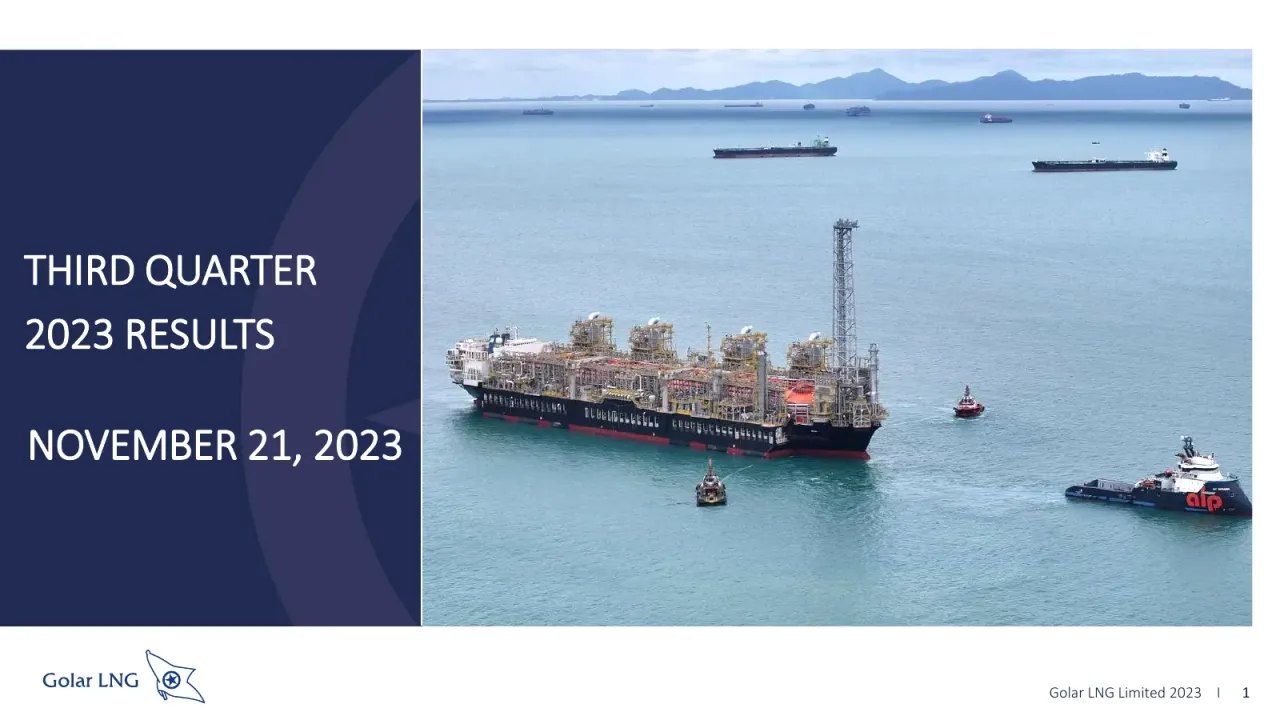
0:31 Thank you, operator, and good day to all of you. Welcome to Golar LNG's Q3 2023 earnings result presentation. My name is Karl Fredrik Staubo, CEO of Golar LNG, and I'm accompanied today by our CFO, Mr. Eduardo Maranhao, to present this quarter's results. Before we get into the presentation, please note the forward-looking statements on slide two. Turning to slide three and an overview of Golar today. We own and operate two FLNGs, the Hilly operating for Perenco in Cameroon and the Gimmi which delivered from Citrium Shipyard in Singapore now on Sunday and is currently sailing towards Mauritania, Senegal to start its 20-year contract for BP.
1:18 In Q1 next year, we expect to take delivery of the LNG carrier Fuji, which we acquired in May and intend to convert into a 3.5 MTPA Mark II FLNG vessel. We also own one LNG carrier, Arctic, which has just been through its five-year class. Arctic has a membrane storage system and is therefore not suitable for FLNG conversion, and we're therefore currently considering alternatives for the vessel, including chartering or sale. We remain committed to FLNG growth and have in addition to the Mark 1 FLNG design of Hilly and Gimmi spent considerable time and resources to develop two incremental designs.
2:05 Mark 2 with 3.5 million tons of annual liquefaction capacity and Mark 3 with 5 million tons of annual liquefaction capacity. We'll elaborate more on our growth ambitions later in the presentation. We also have two investments in Macau Energies, a land-based liquefaction company targeting monetization of flare gas and focused on operations in the Americas. And Avenir LNG, a small-scale LNG company owning five small-scale LNG carriers servicing local distribution trades. and the growing maritime LNG bunkering market, as well as an LNG terminal in Sardinia, Italy.
2:53 Turning to slide four, we're pleased to announce that GIMMI has completed its construction at Citrium Shipyard in Singapore and is currently on its way to the GTA field offshore Senegal and Mauritania. The construction of an FLNG is a major milestone for GOLAR. We have highlighted some key statistics to give some perspective on the scale of the conversion work now complete. During the conversion, we've added 44,000 tons of steel, equivalent to 3,650 double decker buses. The liquefaction topside requires 215 megawatts of power, equivalent to the output of 150 wind turbines, sufficient to power 80,000 homes.
3:41 We've added 1500 kilometers of cabling, which is almost eight times around Singapore where the vessel has been constructed. The conversion itself has taken 37 million man hours or 18,500 working years. Through adding sponsons, we've added the equivalent of 20 basketball courts of deck space to fit all the topside equipment needed to liquefy natural gas. This construction was undertaken in the midst of COVID, which caused significant challenges to the conversion project. However, we are now very pleased with the outcome of the vessel and look forward to get the vessel into operation for BP under a 20-year contract on the GTA field.
4:32 Turning to slide five and another milestone for the quarter. Hilly delivered its cargo number 100 on the 16th of October at the first FLNG in the world to meet this milestone. The unit continues to deliver and just offloaded its cargo 102 or more than 7 million tons since production started up in 2018. The stable operations of Hilly since startup as represented on the right hand side of the slide speaks to the testimony of the quality of design and operational performance of the GOLAR team and execution model. We're seeing increased interest for rechartering of HILI upon current contract expiry in July 26, including detailed commercial discussion for three different recontracting opportunities at higher capacity utilization compared to today's contract and with more compelling economics.
5:32 Turning to slide 6 with an overview of the global FLNG fleet. Golar owns the largest fleet of FLNGs in the world, measured by million tons of installed capacity, and at par with Petronas and ENI in terms of number of FLNGs. Golar pioneered the FLNG concept with the construction and delivery of Hilly, and have also demonstrated the lowest capex per ton of liquefaction capacity. We are today the only provider of FLNG as a service. All the other owners of FLNG tonnage utilize FLNG technology for owned or controlled gas reserves or to service their own portfolio of downstream demand for LNG.
6:20 Golar's position as the only service provider of maritime liquefaction enables us to offer a unique value proposition to owners of stranded and associated gas reserves. We offer gas monetization through a targeted, integrated approach, where Golar aligns its commercial model with the gas resource owner in a partnership. We ensure aligned economics through the commodity cycles and price volatility. It's worth to know the relative size of the companies controlling FLNG assets, for example by market cap. Golar market cap is around 2.3 billion, compared to NFE and Petronas of seven to eight billion, ENI of 55 billion, and Shell at $215 billion.
7:11 We're not suggesting that FLNG valuation alone justifies the value of these companies, but this gives insight into the relative scale of the players involved in maritime liquefaction. Turning to slide seven. and rationale for why we believe FLNG developments in Africa are attractively positioned for FLNG exports. Africa has 620 TCF of proven maritime gas reserves, the energy equivalent of 110 billion barrels of oil that today are either stranded, flared or re-injected. A significant portion of these reserves are best monetized through FLNG technology.
7:57 Golar's proven market leading capex per ton, compared to other liquefaction solutions, including shore-based developments, set for attractive cost of production. Africa's closer proximity to key LNG markets in Europe and Asia, compared to US export projects, reduce shipping costs. Hence, if you have a business with three cost drivers, then African FLNG projects are cheaper on all three inputs, We believe the ingredients for an attractive business model is present. Golar's position as the only proven service provider of LNG as a service is well positioned to take an active role in further expanding African gas exports. Turning now to slide 9 and a business update.
8:48 Hilly, as referred to, continued its market leading operational track record and have now delivered its cargo number 102. Gimmi sailed from Singapore on Sunday on our way to the GTA field for commencement of our 20-year contract. On business development, we continue to target an integrated model where we align FLNG Economics with the upstream partner to have shared exposure to LNG offtake prices. On Hilly, we continue to target commitment on rechartering of the vessel within 2024. Current discussions include detailed terms for three different redeployment opportunities.
9:34 On March 2, we continue to progress the sign long lead items and donor vessel delivery expected in Q124. The next step is to obtain commitment on commercialization projects before proceeding with the final investment decision. On corporate and other Adjusted EBITDA for the quarter came in at $75 million. Goal or cash position is about $840 million, and north of $920 million, including of the TTF swap receivable. We finalized the sale of the LNG carrier Gandria in the quarter for a net consideration of $15 million. We also continue our focus on shareholder returns.
10:21 and declared a dividend for the quarter of 25 cents and continued our buyback program, acquiring 0.2 million shares in the quarter, with total shares now outstanding at 105.9 million shares. Our fully-owned subsidiary, Macau Energies, acquired a majority stake in Logas, an established natural gas distribution company in Brazil. Macau remained on track to deliver its first Flair to LNG Pilot in the US within 2024. Turning to slide 10, with GIME delivery, we now expect a transition from capex to cash flow.
11:06 We look forward to get started on operations and to see GIME go from cash outflow through capex to cash inflow through earnings. As construction risk is now taken out of the project, we will focus on debt optimization for the unit. We will target an increase in facility size, a reduction in debt margin, an extended repayment profile, and duration compared to the current facility. We are in discussions with potential lenders and have received term sheets with improved terms for potential new vessel debt. We also see further earnings upside upon Healy re-contracting at limited incremental capex, extracting the full value of the installed liquefaction capacity in our portfolio.
12:02 Turning to slide 11 and elaborating on the next steps towards contract startup for GIMI. GIMI is now sailing under own propulsion assisted by OneTug. Two stopovers in Mauritius and Namibia is planned to undertake refueling and crew changes. The total voyage until we're on site is expected to take about 60 days, but can be shorter or longer subject to weather conditions. Once we reach site, we will notify BP that we're ready for mooring and physical connection of FLNG. We will then The project will start upstream commissioning and supply of gas to the FLNG.
12:52 Once first gas is introduced to the FLNG, we then target a commissioning period which originally is scheduled to take six months, but we're actively working with the GTA partners to make further efficiencies on the commissioning period. Once commissioning is complete, We will reach commercial operations date and the start of the 20-year contract at the GTA field. Turning to slide 12 and progress on our Mark 2 FLNG. Major long lead items have been ordered and are under construction. So you can see from the picture on the right hand side, several of the equipment is now taking shape.
13:42 This combined with more than 250,000 engineering hours to date allow for fast-track project execution, which will reduce execution risk and shorten construction time by about 12 months from when we take FID. We expect the Fuji LNG to be delivered to us in Q124. The vessel is intended as the donor vessel for the project. EPC contract negotiations and engineering have advanced significantly and Mark 2 is ready for execution as soon as we have commitment on commercialization of a unit. We continue to see increasing interest for Mark 2 and several work streams are ongoing for project specific applications.
14:36 Turning to slide 13 and Macao energies. As explained, the company is on track to have the first FLIR to LNG liquefaction pilot available in the US in Q1 of next year. We also recently teamed up with Pilot Gas to provide the first LNG to EV charging expected to take place in Q2. Operational startup of midstream commercialization platform in Brazil is expected to start up now in Q4. We're also actively looking at further expanding the asset portfolio of Macau, and this could include a potential separate listing of Macau energies into a standalone entity during 2024.
15:33 I'll now hand the call over to Eduardo to take us through group results. Good morning, everyone, and thank you, Karl.
15:41 I'm glad to share an overview of Goaler's financial performance during Q3. This quarter has been marked by significant milestones, including the delivery of Gimi and the continued operational excellence of Healy. Turning over to slide 15, I wanted to show some of the financial highlights of this quarter. Total operating revenues amounted to $67 million. with total FLNG tariffs reaching $95 million. FLNG tariff is a critical non-GAAP metric, which reflects a comprehensive approach to liquefaction revenues, including realized gains on oil and gas derivatives. Despite a marginal dip compared to Q2, this robust performance underscores the resilience of our commercial model. Adjusted EBITDA came in at $75 million, affected by lower realized contributions from commodity-linked fees.
16:33 However, we anticipate a positive reversal in Q4, driven by higher Brent and TTF prices. Important to note that these fees are calculated on a rolling average basis of the previous three months for Brent and one month ahead pricing for TTF. This quarter we had a net income of $114 million, a significant improvement compared to Q2. This figure includes a total of 39 million non-cash items, such as 34 million unrealized gains from oil and gas derivatives, and $5 million boost from unrealized gains in our interest rate swaps. Our liquidity position remains robust, standing at close to $1 billion when it includes cash on hand and other receivables from the unwinding of our TTF hedges earlier this year. With total contractual debt just under $1.2 billion, our net debt position was $251 million.
17:32 Now moving to slide 16, we can see how HILI's performance compared to previous quarters. When looking on a year-on-year basis, Healy generated $73 million in Q3, which is 14% greater than during the same quarter of last year. When we break down these numbers in comparison to Q2, we maintain consistency with a fixed tolling tariff of $32 million. Brent linked fees slightly decreased to 13 million from 15 last quarter, and TTF linked fees of $28 million were down from $30 million last quarter. As I explained on the previous slide, we see lots of tailwinds from these variable fees and expect a positive impact from higher oil and gas prices, driving increased tariffs for the rest of 2023.
18:20 Moving on to slide 17, We can see that we remain exposed to TTF prices for the remainder of 2023 and 2024, while at the same time we expect to benefit from lock-in gains from our previous swaps. The lock-in TTF gains resulting from the effective unwinding of our hedges will be allocated in addition to our fixed tolling fees and variable Brent and TTF revenues. So between now or between in the Q4 of 2023, We expect to recognize approximately $23 million in EBITDA from those locked-in gains. And for the full year of 2024, we expect approximately $49 million of EBITDA secured or approximately $12 million per quarter.
19:08 To illustrate how this can improve our earnings, For every dollar per million BTU change in TTF, we expect to make $3.2 million per year. So based on forward prices for next year, we should make around $39 million just from this. In addition to that, when it comes to Brent, the incremental contribution is $2.7 million for every dollar per barrel movement above $60. So when we look at forward 24 prices, the total contribution next year should be around $56 million. As previously announced in Q2, we managed to improve certain terms of the existing Healy financing, including lower margins and extended repayment profile. As a result of that, and based on current forward prices, Healy alone is expected to generate an impressive $650 million of free cash flow to equity between 2022 and 2024, as you can see on this slide.
20:04 Now moving to slide 18. Our balance sheet remains strong and we have a great level of flexibility to fund increased shareholder returns and at the same time back our growth ambitions. Current liquidity position, including cash receivables from TTF hedges, amounts to just under a billion dollars and fully supports the development and equity requirements for the construction of new LNG units, as described by Karl on the Mark 2 slide. We continue to explore alternatives that could further enhance liquidity in the near term, including the optimization and refinancing of Gimi, now that she's left the yard and construction is complete, potential asset sales, such as Arctic and Avenir, the spin-off of Macau, and further optimization and refinancing of Healy upon a new contract, among other initiatives.
20:54 This quarter we declared a dividend of 25 cents a share with a record date of December 1st and payment on or about December 11th. We have repurchased 0.2 million shares this quarter, leaving 105.9 million shares outstanding. Out of the $150 million approved share buyback program, 117 remains available for further repurchases, which will continue to be opportunistically pursued. Hilli's strong free cash flow generation will continue to provide the backbone and support of the current dividend and buyback program. On top of that, GIM is expected to start up next year. We'll pave the way for increasing shareholder returns. Now I'll hand over to Karl for some closing remarks.
21:39 Thanks, Eduardo. I'm turning to slide 20 for summary and next steps. Hilly has diversified revenues from its base Brent and TTF linked earnings, as just described by Eduardo. Secondly, with GIMI about to start up contract, we'll double the amount of FLNGs making cash flow. We see increased interest for rechartering of Hilly beyond July 26, and we're in detailed commercial discussion for three different opportunities with several other parties involved. are interested in the ship. Long lead items are well progressed for a Mark II FLNG. The yard contract, design, and engineering are ready, and our focus is now on the charter commitments.
22:30 We continue to target integrated projects with exposure to commodity prices. Potential startup of operations could be in 2027. As Eduardo explained, we have around $900 million in liquidity. With the delivery of GIMI, we now allow for debt optimization. There's further potential liquidity in potential asset sales of non-core assets. And we are targeting a spin-off of Macao Energies within 2024. There's upside to the dividend following the startup of FLNG Gimme Cashflow. There's potential further liquidity boost by debt refinancing and debt optimization.
23:23 And we also have continued capacity under the existing share buyback program to continue to return value to shareholders through share buybacks. That concludes the prepared remarks for the Q3 presentation. I'll thank you all for dialing in. I'll hand the call over to the operator for any questions. Thank you. To ask a question, you will need to press star 1 and 1 on your telephone and wait for your name to be announced. To withdraw your question, press star 1 and 1 again. To ensure everyone has the opportunity to ask a question today, questions are limited to two per person. Please stand by while we compile the Q&A queue.
24:13 Our first question comes from the line of Ben Nolan from Stifel. Please go ahead.
24:19 Great. Thank you. And Karl, Eduardo, first, congrats on getting the gimme out. I'm sure it is a welcome relief to see that leaving the yard. As it relates to the GIME, could you maybe just help me think through what the revenue and the cash flow looks like until the commissioning period? I know you get some payments, but maybe any color as to sort of what those should look like prior to commissioning.
24:55 Hi, Ben, and thanks for the question. The commissioning revenue only starts upon commissioning, at which point we make a fixed contribution per day plus a tolling fee for any LNG actually produced in the commissioning period. As alluded to, the commissioning period is targeted to take six months, but as also explained, we're targeting to reduce the commissioning period and working with the GTA partners to shorten that timeframe and get into COD earlier. As you correctly point out, there are also contract mechanisms that would provide GOLAR with further day rates in addition to commissioning revenue.
25:44 Those day rates are the contract mechanisms that we currently are in a discussion with BP on the relevance of. And given that we are in these discussions, we would disclose the details of those at a later point in time.
26:06 All right. Well, I guess I'll just wait for that. And then for my second question, I'm curious about the refinancing of the GIME. Is that something that you can do or anticipate being able to do prior to the final commissioning? And then you mentioned maybe using some of the proceeds. for capital return. Just curious, it would seem to me that buyback is overwhelmingly the easier option relative to a dividend, but maybe how you think about that?
26:42 So to answer the first part of the question, yes, we think refinancing is doable before commissioning is complete. As we have explained on several previous quarterly calls, We have looked at different alternatives for refinancing the vessel for some time, but it's been important to us to take the construction risk element out of the equation in seeking to get the best terms available. Now that the vessel has sailed, we are increasing focus on these refinancing alternatives, and as we have explained, we have already received term sheets, which we find attractive, for refinancing of the vessel. Our primary focus is to return operating cash flow to shareholders and use other liquidity for attractive growth, expanding our FLNG portfolio.
27:42 Okay, thinking between dividend versus buyback?
27:47 At the end of the day, that's a board decision, but we still have around $117 million worth of buyback program under the existing allowance. and we're currently paying out less than half of free cash flow to shareholders. So we think that there should be capacity to continue to do both and as long as the share is trading at the discount to where we think fair value of the company is, we think buybacks is a sensible way of continuing parts of shareholder returns.
28:19 All right. I appreciate it. Thank you, Karl.
28:22 Thank you, Ben. Thank you. We'll now move on to our next question. Our next question comes from the line of Greg Lewis from BTIG. Please go ahead.
28:41 Yeah, thank you and good afternoon and thanks for taking my questions. I guess maybe this is for Eduardo. As we think about the daily expense of the Jimmy, any kind of variance versus what it's costing to run the hilly? Is there contract language that differs much in terms of the operating cost side?
29:09 So, hi, Greg. So when we look at the forecasted operating expenses for GIME and as pretty much the same as we have in Healy, the bulk of the expenses are related to crew. According to our contract arrangements with BP, all of the operating expenses are basically passed through under the contract. So they should follow that arrangement once we start operations.
29:37 Okay, and is it, I guess it's, I mean, realizing the vessel is still sailing, I guess it's safe to assume during the commissioning process, at a minimum, we're going to be able to pass that through or we're going to realize a revenue number higher than that?
29:55 During the commissioning phase, that's correct. We will be able to pass through the operating expenses to our customers.
30:02 Okay, great. And then my other question is related to, you know, thank you for the detail on the, you know, the active discussions with the HILI potential rechartering. You know, I guess it's a two-part question. One is, as we think about these conversations, is there a potential for any of those conversations to spill over into the Mark II if the HILI gets contracted? and then really broadly speaking, just given the fact that the Jimmy is more of a tolling arrangement, is it safe to say going forward we're not interested in that type of work?
30:49 Hi Greg, this is Karl. To answer the first part of the question, for all of the commercial opportunities that we're in discussions with, there are spillovers between Hilly and Mark II. Some of them is better suited for one, some of them is better suited for the other, but many projects can do either. It's obviously different capex involved, different sizes involved, so for us it's really about gas flow and the size of the reserve and to some extent the level of pre-treatment before the gas enters the FLNG. because a Mark II would be built from, we have more space to deal with pre-treatment than what we would have on Hille.
31:41 Hence gas quality, gas flow and reserve size is basically what decides between the two. But yes, there are spillovers. If you think a little bit of the history of Golar, so Hille was ordered on spec and the Perenco contract was done even if the unit wasn't fully utilized to prove the concept. The GIME contract was entered into with BP. It's well known in the industry that after the Macondo incident, BP probably has the highest operational standards for maritime equipment globally. Hence, if our technology is sufficient to meet BP operating standards, is a significant proof of concept on using the same technology for basically any other potential FLNDG chartering prospect.
32:35 That's also why we accepted a tolling fee to BP.
32:41 And you're correctly pointing out that going forward, we would not be looking for tolling fees, but mainly more integrated solutions given the very attractive risk reward that we see for that type of contract structure and also because we are the only service provider of FLNG that can monetize these assets.
33:06 Super helpful, Karl. Thank you very much and talk to you soon.
33:10 Thanks, Rik. Thank you. We'll now move on to our next question. Our next question comes from the line of Chris Robertson from Deutsche Bank. Please go ahead.
33:26 Hey, good morning, good afternoon, Karl and Eduardo. Thanks for taking my questions. Guys, this question just relates to slide 10 on the adjusted EBITDA guidance looking at 2024. Just hoping you can provide clarification around kind of the delta between last quarter's update and this update. Is the difference in the 24 level related to timing around the GIMI startup, or what goes into that number that's changed since last time?
33:58 You want to have a go, Eduardo?
34:00 Yeah, sure. So I think the main difference when it comes to 2024 is we have updated those figures with the current forward curves for both Brent and TTF. So I think those will largely drive the variable fees on Healy. And that's where the bulk of the difference can be justified.
34:20 Okay, that's clear. Just looking at the HILI, when the current contract ends, what type of downtime and maybe range of CapEx requirements do you think would be required to prepare it for its next contract? I know there's questions around where it will go and the type of project, but are you thinking about maybe a range of CapEx required at this time?
34:47 Hi, Chris. The range is basically, well, it really depends on location and duration of the next contract. But assuming we go for a 10 to 20-year contract upon recontracting and a relocation to another geography than Cameroon, we would likely look at anywhere between six and 12 months downtime, which would include the transportation legs to the new site. and any potential vessel upgrades. And CapEx could be anywhere from, I guess, in the very low end, $50 to $200 million.
35:28 Okay, got it. That's clear. And then just following up on CapEx guidance here, can you remind us what's been invested to date on the long lead items on the Mark II project and kind of what the total projected CapEx remaining would be upon an FID decision?
35:44 Eduardo? Yeah, sure. So to date, we have committed around $300 million in LNG Lead items, out of which approximately 50% of that, or $155 million, has been spent to date. We have an agreed payment scheduled with all those respective suppliers, and that should basically be paid over the next quarters and going even further beyond the end of 2024. So we have an agreed price and the price follows an agreed schedule.
36:19 And then the incremental 100 million is basically related to the ship and engineering costs. That takes the full commitment or current commitment on Mark 2 to around 400 million. And then the incremental fixed upon FID would then be approximately 1.6 billion, bringing total capex to around 2 billion.
36:41 All right, that's clear. Thank you, guys. Thank you. We'll now move on to our next question. Our next question comes from the line of Christian Weberby from Citigroup. Please go ahead. Hey guys, this is Matt on for Chris. Thanks for taking my question. I wanted to follow up on some of the details on the GIMI timeline. And so it's currently in route to arrive at the GTA hub around that mid to late December timeline. That is still the expectation, correct? And then just to gain a little bit further clarity on when we could potentially see first gas begin flowing and ultimately realize that full permission rate. If I'm understanding everything correctly in the press release and the conversations today, That will take approximately six months right from when GIMI arrives on site at GPA, which would sort of put that in sort of mid-year next year when you would see that full realization. Just trying to gain some further clarity on that because I was under the impression that that could potentially occur towards the end of first quarter 24. So any details there would be great.
37:54 Thank you.
37:56 Hi, Matt. So The transit is expected to take around 60 days from today. So we're looking, call it late December, early Jan. There is possible to do it quicker. It's really subject to weather going around the Cape, which is the key sensitivity. But 60 days includes for weather window. then subject to the project being available to send us gas we would then hook up and start gas flowing into the FLNG as we are on site and we would then take up to six months for commissioning and as just explained in Greg's earlier question we would then make a Commissioning Fixed Day Rate, plus a tolling fee based on actual liquefaction concluded in the commissioning period.
38:52 And again, we're working with the GTA partners to shorten that timeframe. In the event that the project is not available to send us gas, there's another contract mechanism that then kicks in, which is effectively a standby day rate, but we are paid to be onsite. until the project is available to send us gas and commissioning starting up. The standby day rate is the staircase that starts off relatively low, covering OPEX and a little bit more, and then increasing as the potential time of being on standby day rate extends.
39:42 and the GTA partners clear ambition is to get gas flowing and get to commercial operations date as soon as possible. Great, really appreciate that detail. Yeah, that is very helpful. And then just as a follow-up, could you just touch a little bit more on sort of the further contracting or I should say re-contracting opportunities for Hilly? I know that I see a now 2024 potential commitment on the horizon. which appears to be a development since last quarter. Just any details there just to fully understand the situation and the likelihood of the commitment fully materializing?
40:25 There's always a trade-off between what we think industrially maximizes the return on the assets and what the financial markets want in terms of visibility. And we're trying to balance the two. But at the end of the day, this is the only FLNG available for gas monetization at the end of 26, early 27. And we think that the commercial value of that is very attractive. And that's further confirmed by the commercial discussions we're in. As we alluded to, we are in detailed commercial discussions with three opportunities, and there are several other gas resource owners doing technical work on the feasibility of FLNG monetization of their resources.
41:17 Once we reach commercial agreement, which frankly is not the most challenging part of an FLNG commercial transaction, We then need to get together with the upstream partner all of the regulatory approvals that's needed. Subject to geography, that is anything to do from PSE terms, fiscal regime, environmental sign-off, confirmation of mooring location, and these steps that's required for FID. So commercially, we think we will have line of sight significantly earlier than when we would formally have a firm commitment. So we are now actively working to finalize commercial terms.
42:09 and to develop a clear timeline together with the upstream partner and the local regulators on where the ship would work and for now we see the competitive tension on the interest on the vessel working in our favor and that's what we're trying to balance together with the financial market anxiety or sort of need or want to see clarity on recontracting. Very helpful. I really appreciate the detail. I'll turn it over on that. Thank you. Once again, to ask a question, you will need to press star 1 and 1 on your telephone and wait for your name to be announced.
42:55 To withdraw your question, press star 1 and 1 again. To ensure everyone has the opportunity to ask a question today, questions are limited to two per person. We'll now move on to our next question. Our next question comes from the line of Craig Shear from 2E Brothers. Please go ahead.
43:23 Good morning, New York time. So congratulations on all the progress. The clarification on the answer to Ben's question on the gimme refi, it sounded like your operating cash flow is intended for return of capital to shareholders, but One-time asset sales or cash outs like the GIMI or EFI are intended for future growth investment. So my question is, how much do you expect to be needed for a Mark III FID in terms of cash on hand? And if you have notably more liquidity after GIMI or EFI, would you see that merely helping bridge a HILI redeployment period or are you already eyeing something beyond the Fuji conversion?
44:20 Okay, so the way we see it is operating cash flow can be returned to shareholders through a combination of buybacks and dividends at the moment. We think the cash at hand can be used for HILI redeployment, FID of a Mark II and subject to the timing of which potentially further FLNGs beyond that. In terms of the money required for a mark two, we think that CapEx would be plus minus $2 billion. We think that debt available in the construction period should be anywhere between, call it plus minus one to 1.2. So we are estimated around 800. Given that we're currently Also retaining some of the operating cash flow, we think we have ample liquidity to deal with an FLNG FID, the redeployment of Hilly, and then some.
45:21 If and when we do asset disposals, it will be up to the board on how that capital is allocated, but mainly our thinking is operating cash flow should be a sustainable dividend, and then other cash should be used for attractive growth projects.
45:40 Gotcha. And once you recontract, you know, for redeployment of the hilly, I guess, you know, maybe maybe to start out at a new location, possibly the beginning of 27. Are you in a position that it's dramatically more attractive than, you know, some higher locked in cash flows with some upside kickers. Are you in a position to do a refi on that as well and cash out?
46:17 The short answer is yes. So today the unit is utilized around 1.4 to 1.44 million tons per annum versus installed capacity of 2.4. We would typically discount the committed volumes under a new contract to anywhere between 2 and 2.2 million tons, which would drive the majority of the earnings to increase versus the current contract. Just the fact that you increase capacity utilization. That combined with also targeting higher or more attractive economics in a new contract should boost earnings from HILI. So both capacity utilization and improved earnings.
47:02 And yes, that should trigger refinancing of HILI.
47:08 And is the thoughts about what to do with a HILI refi similar to what you've already shared on the GIMI? Or is that just extra gravy and maybe can go towards a return of capital?
47:24 Well, it should be, I guess that's up to that point in time if we then see the same attractiveness of FLNG growth projects. But the way we see the outlook right now, we would still deploy that for FLNG growth because we think the market opportunity is very significant and significantly more than one, two or even three units.
47:49 Thank you. Thank you. This concludes today's question and answer session, so I'll hand the call back to Karl Staubo for closing remarks.
48:03 Thank you all for dialing in. Q3 was a notable quarter in Golar's history, both with the operational milestone of the 100th cargo on Hilly, and importantly, the deliver of Gimmi. We look forward to the next steps and speak to you all in the next quarter. Thanks for dialing in, and bye-bye. This concludes today's conference call. Thank you for participating. You may now disconnect speakers. Please stand by.
Follow Golar LNG Limited into a list and get an email when it puts out news.
CEO of Golar LNG
CFO of Golar LNG
Analyst at BTIG
Analyst at 2E Brothers
Analyst at Deutsche Bank
Analyst at Stifel