Transcript
Automated transcript · Written by software from the replay's audio. It can mishear names and figures; the replay is the record.
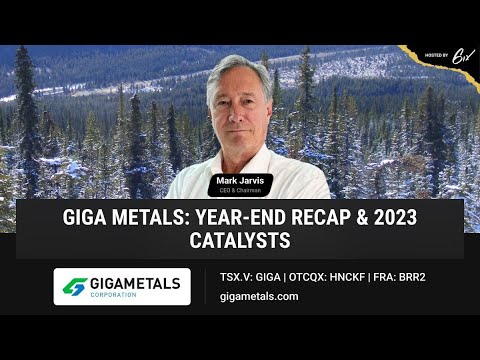
0:08 Hello everyone, welcome to Giga Metals live investment summit today, hosted by 6. Today I'm joined by CEO Mark Jarvis, who's going to be walking us through a brief end of year review. And after we're gonna go on to a live Q&A session. If you'd like to participate and ask questions, please do so in the Q&A chat found on the right hand side of your screen anytime today. And as always, this summit is being recorded and is gonna be available on demand in the coming days in six.com. But Mark, I wanna pass things over to you to get started.
0:34 Well, thanks very much, Cameron. And I just wanna thank everyone who's attending for your interest. So in this presentation, I'm assuming that you already know our story. So I'm not even gonna do a slide deck or anything like that. I'm just going to talk. If there's anybody that's absolutely new to our story, we've got a presentation on our website at www.gigametals.com, and you can review it there. So this was a very big year for us. We had been working for some time to try and attract a strategic partner and we met success. We got Mitsubishi Corp on board.
1:23 They love our project and they seemed to like our management team. So they wrote a good check and we're using that money to advance the project through a pre-feasibility. That was the highlight of the year. And it's also a platform. So, you know, they get involved in a good project, we think at a very good price for them, but we get an excellent partner, Mitsubishi Corp. Their model is to own a minority interest in large mines. And they don't want to operate.
2:11 They're very interested in the offtake. But the way our deal is structured, at this point they own 15% of the project and they've got 15% of the offtake, full stop. It's a very simple deal. But they're just excellent to work with, and we are working very closely with them. And in fact, we, the senior management, myself, Martin Vibra, and Lyle Tritton, who is
2:44 our in-house engineer, traveled to Tokyo to have a board meeting for Heart of Creek Nickel, which is a subsidiary corporation that we own jointly now with Mitsubishi. And they introduced us to other companies there that they think could be interested in becoming part of our joint venture team. So that's it. We also finished last summer all of the work we need to do at the site to get the data we needed to finish our pre-feasibility report. And so that work is now underway. We've got all the data we need and we expect to have that pre-feasibility report finished end of May, end of June, somewhere in there.
3:37 So with that, I think I'm just gonna open up to questions and we'll have an extended question period. No, fair enough, Mark. Appreciate the update. And yeah, just as a quick reminder to everyone in the audience, if you do want to ask questions, please do so in the Q&A chat on the right-hand side of your screen. Mark, first question, why didn't Mitsubishi choose your project? Well, That's a good question. Our understanding is that they reviewed 26 large greenfields nickel projects before settling on us. There's a number of factors. One is environmental, social, governance issues.
4:20 We will be at the very least a low carbon intensity mine. And we have a real possibility of being a carbon neutral mine or even better. That really appeals to them. They like Canada as a jurisdiction because Canada has a tough environmental assessment regime, but nonetheless you can get through it. If there are no showstoppers in your project, you can get your environmental assessment through and you can get permits to build a mine. And then of the Canadian projects, I think they liked ours because it is the simplest.
5:13 99% of our nickel and cobalt are contained in pentlandite. So it's just, you dig the rock up, you crush it, you grind it, you put it through froth flotation,
5:26 and you float out the pentlandite and try and suppress everything else. And so The ratios of concentration are amazing. This is also old tech. In fact, it's very similar to a copper porphyry mine. It's technology that's used worldwide. The reagents are different, but conceptually, our processing is very similar to a copper-4-free mine. We don't have any complications. Our recoveries for this type of deposit are very high, and we make a very nice clean concentrate. And the simplicity translates to low risk. If you're gonna spend a couple of billion dollars building a mine, you want to feel good about that you think is going to work. So we're not inventing anything new here. It's just all old tech.
6:25 And I think another thing that they've told us is that they like our management team, which I take that as a great compliment. And it's not so much about me, it's about Martin Vibra and Lyle Tritton, Greg Ross, Pauli Miller. We've got a whole team here. But I'll focus on Martin Vibra and Lyle Tritton. They both had careers, lengthy careers at Sherrod International. So that's a nickel and cobalt producing company. And then when they left Sherrod, they ended up here. And I can tell you, after their careers at Sherritt, they could have gone anywhere.
7:14 The fact that they chose us is, to me, a real compliment to the project.
7:19 But Martin is the guy who is leading the charge in terms of putting together a team of partners around this project. And I give him full credit for introducing us to Mitsubishi and guiding us through the process of getting Mitsubishi on board. Lyle Tritton is just an extremely credible and intelligent engineer. And I think whenever we get together with Mitsubishi, they're always peppering him with questions and he knows how to answer them. So I think that they're impressed by the technical quality of Lyle Tritton.
8:05 And Martin Bider, by the way, is no slouch technically himself, but he's spent a great deal of his career in marketing Nickelodeon Cobalt. So he understands the market very well. Anyways, that's another reason, we've got a small team, but it's a great team. That's awesome to hear. We have a couple questions about the pre-feasibility study that you guys are working on. So, you know, in summary, you know, do you have any updates for the team or the audience here?
8:31 You know, is it going to include the updated larger resource? And when you finish it, what's next? Okay, well, yes, it will include the resource, the updated resource. We now have, you know, on the order of 1.5 billion tons in measured plus indicated. And so you need measured plus indicated for a pre-feasibility and ultimately for a feasibility study you can't use inferred resources. And I don't know yet where that's going to end up in terms of mine life, but I would say somewhere between 30 and 40 years would be my guess of mine life. And then bear in mind that we think we've only drilled off 20 to 25% of what we think is highly prospective,
9:27 very similar type of lithology. So we will be using that. We have been doing a ton of metallurgy and we're working a lot on geometallurgy. So this is where, with a really large deposit, it's very gradational between lithologies and very gradational between grades and sulphur content and that sort of thing. Nonetheless, different parts of the deposit are different and they respond differently to the metallurgy. We need a deeper understanding of what our recoveries will be all through this deposit. But again, it's relatively simple. So we are doing that detailed work, the geometallurgy as we speak, and we'll be doing engineering work and so forth.
10:18 It's well underway. No, fair enough. That's great to hear. You went to Japan recently to meet with Mitsubishi and the question is, what was the purpose of that trip?
10:29 Well, we were having a board meeting for Heart Creek Nickel which is the joint venture company but also giving them a project update. Lyle was with us on how the pre-feasibility is going, and they had many, many questions. But also, they wanted to introduce us to some companies that they have working relationships with some other extremely large Japanese companies that they think would be good partners in this project. And so we had excellent meetings with them. Now I would just caution, that it's not time to get super excited about this. This is the beginning in each case of a process.
11:19 And what I've learned about Japanese companies through dealing with Mitsubishi is they are extremely thorough in their due diligence. And nothing happens quickly, but once you get on the radar, things do happen and things do progress. And I just think that being introduced to a company by Mitsubishi Corp is very, very helpful. And I just also have to say, if anybody out there ever gets a chance to be wined and dined in Tokyo by a major Japanese company, you should do it. My God, the food was incredible.
12:06 And also Tokyo in November, it's a beautiful month in Tokyo. It was really warm and sunny. We had a wonderful time. That sounds amazing. Good recommendation, certainly. Question from Cameron in the audience. Can you speak to conversations or agreements that you have with local First Nations? And are there any prospects of joint ventures there?
12:30 Well, I don't know about the prospects of joint ventures. We do have agreements with the Talltown in place, and we have more ad hoc arrangements with the Kaskadenna, although we are talking to them about formalizing an agreement. And Those are the 2 First Nations that assert traditional territories where our project is. Under Canadian law, if there is a traditional territory involved, you must consult and you must accommodate.
13:06 Now, that is the duty of the government, according to the Supreme Court of Canada, but in practical matters, it's up to the proponent of a project to make sure that all of that happens. And I would say that the First Nations that we're dealing with are in favor of economic development. And so it's all about, you know, how can we develop this project and benefit, you know, not only us, but also them. And also the province of British Columbia has to benefit as well, more broadly. Fair enough, absolutely. And that dovetails nicely into the next question. But do you think that the federal and provincial governments are doing enough to support projects like yours?
14:01 Well, of course, they could always do more. For example, the federal government has made a pot of capital available to build infrastructure in support of critical minerals projects such as ours. And, you know, we would love to see some of that money spent to extend the BC Hydro line up Highway 37 to Deas Lake. And so there are discussions underway involving that. You know, who knows how that all ends up, but to me, it seems like a natural, you know, way to spend that money. That would save us, if we could do that, that would save us about 150 million US from our capital costs, which would be, of course, significant.
14:55 So we'll see. I think I've heard that there's gonna be a significant announcement today by the federal government about critical mineral strategy. It'll be very interesting to see what they have to say. Apparently they're making an announcement in about 15 minutes, I understand.
15:15 That's good timing then, I guess. Can you provide any context on funding conversations? And is it necessary to wait for nickel prices to appreciate substantially? Oh, nickel prices, I checked this morning, we were at $13.75 a pound. No, nickel is trading in a price range where we have very robust economics. We ran our PEA at $7.50 a pound, so almost 0.5 where the current price is. Nickel has been trading steadily in a range between sort of $10.50 a pound and $14 a pound.
15:58 Now, I think that we're probably not gonna use even the current price in the pre-feasibility. The people that we're using to estimate long-term nickel prices are, I think, quite conservative. So I think that price will be below that, but it'll certainly be above the £750 that we use in the PEA. I don't think we're going back there. There's not enough nickel in the world to supply the battery business for the electric vehicle market. I just don't see that demand dissipating. You can have projects coming on stream, you can have very temporary surpluses, but I think long term, there's no doubt that we need all the nickel we can get.
16:51 But to answer the question, I mean, at 1375, if you run our PEA model, we've got a depreciated net present value at a discount rate of 8% of about $2 billion US.
17:10 So if you look at our market cap of $30 million Canadian dollars, All I'm saying is there is a significant amount of upside. ASH BENNINGTON. Fair enough. Absolutely. And this next question might deal with the same content, but it's a bit more general. And As the question reads, markets are terrible right now. How does that affect you? If there's any context you want to provide further, that'd be great. God, it is really a tough time to be a junior mining company right now in terms of market. But With us, we are very fortunate in that we are fully funded for at least another year. We don't have to worry about, oh my God, do we have to do a financing and dilute at these horribly low prices?
18:01 No. We're insulated from the bad market in that respect. I don't like seeing the stock trading where it's trading. It does not reflect in our view anything like a fair value for a company. I mean, if you look at the terms of our deal with Mitsubishi and how they valued our project, that would translate into a price of about 55 cents a share for our stock, and we're trading at about 30 cents a share. It's ridiculous.
18:39 And all I can say is the one thing I know about markets is whatever they're doing right now, they're gonna change. And so if markets are good, at some point, they'll turn bad. And if markets are bad, at some point, they'll turn good. And I think when markets change, we've got room to have a rather sharp repricing. Oh, fair enough. Kevin wants to know if there's any showstoppers with the tribal leaders or the community surrounding your land. Well, nobody surrounds our land. Our closest community is Dease Lake. And that's about 70 kilometers away
19:24 to the west. No, there's no showstoppers as far as we know, you know, to this point. There's no showstoppers environmentally as far as we know, but we still have a great deal of work to do. So there's certainly nothing obvious and and again in general, but First Nations that we're dealing with are quite business-friendly and quite business-like. You know generally good and quite businesslike, generally good, what I would call well-governed nations. So yeah, I don't see any showstoppers right now. No, fair enough, absolutely. This question, how often are you meeting with Mitsubishi and how is it to work with them? I know you've touched on this, but any further context, of course, would be great.
20:12 Well, we meet with them at least once a month and sometimes more, and there's lots of communication back and forth outside of that, but I'm talking about full meetings, Zoom type meetings such as this. And they've also got, I mean, they've got in-house engineers but they've also got external engineers that they've hired to help them evaluate, track the project,
20:40 understand what we're doing in terms of the PFS study, make suggestions for how it can be improved. I mean it's a very, very interactive and active partnership. They're not silent partners. And I just, I don't know if you've ever dealt with any Japanese companies, but I would have to say that they are a pleasure to deal with. Just the culture, I just love the culture. If you have been watching the World Cup, the Japanese team did A very well. They defeated, they've been knocked out now, but they defeated Germany and they defeated Spain. So they're kind of giant killers.
21:25 But the part that caught my attention was that after the match, the cameras would go to, you know, where the Japanese fans were sitting. When the match was over, they were pulling up these plastic bags and picking up garbage and tidying up their area. That's so Japanese. When you go to Tokyo, there's no litter anywhere. It's just a very, very civilized culture, in my mind. All right, fair enough. Does Mitsubishi want to work with any other big strategic investor?
22:01 Are they helping you with that process if it exists? And is there a consideration that you're going to wait for the PFS until seeking a next partner if that's the case?
22:10 Oh, we're not waiting for anything. And in fact, as I mentioned, Mitsubishi is being helpful in introducing us to potential partners that they would love to get involved. But that's not all we're doing. We are doing
22:30 outreach on our own. In fact, I had a meeting yesterday with a company that is getting into the battery business, it's thinking very long term, it's a very large company. It happened to be in Vancouver, so we had an initial meeting, which went extremely well. Again, big companies, you don't expect anything to happen overnight, but it's very helpful once again when I'm meeting with a very large company, they don't know who we are, but they know who Mitsubishi Corp is, and they understand that Mitsubishi is a seasoned and sophisticated investor in mining projects. So it is helpful that we have them as a partner.
23:17 Absolutely. Jasim in the audience wants to know if you're looking to process any of the ore on site or sell it directly to a smelter? Well our base model is that we are going to make concentrate and sell it to a smelter. And the reason we're doing that is that that's a market that exists right now. It's not a future market. And we know the terms, we know the smelter terms. And so you can, and again, we're planning to build this at 0.5 scale at first, we're going to stage development, and then run it for a few years, get the bugs out, but also do all sorts of pilot testing for all
23:59 sorts of different things during that period. And then double our production in year 5 or 6. We can get this up and running and start selling concentrate to a smelter on day 1. We've also talked in the past about modeling production of chemical forms of nickel, such as MHP. You could also make sulfate, you can make anything you want with a pressure oxidation circuit. You basically build a refinery on the back end of your mill. For now, we're not going to do that at the same time as we're doing the pre-feasibility study.
24:46 And the reason we're holding back on that for now is that when we were first looking at MHP, had payabilities in excess of 90% for both nickel and cobalt. Those payabilities have plummeted recently. And I think it's largely to do with the 0 COVID policy in China, frankly. But with payabilities below what we would get from a smelter, it makes no sense then to be looking at extra capex, extra opex, and so forth, if you're not gonna get paid extra money for the product that you're producing. So that plan, we are, We're not dropping that plan, we're just delaying it.
25:36 And we're going to get through the core study, the base case study first. Right. Adrian in the audience says this, The London Metal Exchange appears to no longer be fit for business subsequent to the cancellation of valid contracts earlier this year. Do you think that any other markets can be or will need to be developed? Boy, that's a good question. What's happened with the LME, frankly, since that short squeeze and since that short squeeze broke the market on the LME, is that volumes have dried up. It's become a very low volume market. A lot of people were pretty angry about, not, you know, I mean, circuit breakers, everybody can understand that.
26:30 But canceling contracts, that was a step too far in the minds of a lot of people. There's people that just won't trade on the LME anymore. Now, that said, I talked to Martin about this. Martin, I don't think there's very many people in the world that know more about the nickel market than Martin. He's going, yeah, but what else is there? The LME is still the reference market for the world, because there is nothing else. So it does matter. However, the lack of liquidity, the low volume, means that nickel prices are quite volatile. So They've been wandering around recently in anywhere between $11 and $14 a pound, which is quite a wide range.
27:23 It just goes back and forth and back and forth. However, it has been holding that range. It still matters because there is an alternative. I've heard rumors that the Chicago Mercantile Exchange is looking at developing a financial-based nickel contract. And we'll see what happens there. They certainly got the heft and capability of doing that. It would be a different type of market than the LME. The LME is a physical settlement market, whereas the Chicago market would be a financial market, much like the oil market, say. Absolutely. Michael in the audience wants to know who are the major owners?
28:12 Well, I'm the largest individual shareholder with about 5%. The rest of our management has stock. We've got amounts that are significant to them. And we don't have a lot of institutional participation. So our stock is quite widely held. But I would say out of, you know, there's another individual who I've known for a while who owns as much or almost as much as I do. He owns less than 5%, so he doesn't have to report. I'm not going to mention his name, but it's just an individual that's just been involved with this since about 2005.
29:00 So, very patient investor, I must say. All right, thank you for that. Adrian also has another question about if you could say anything about how the pricing is going to be structured for the Mitsubishi offtake. Well, Mitsubishi's offtake right now is basically their ownership. So they own 15% of the project. And as long as they keep up with this plan, that means they're responsible for 15% of the capital to build this mine. So they would then simply get, and then they would pay their operating costs. So their cost on that 15% will ultimately be the operating cost to produce the nickel and cobalt.
29:48 Full stop. We still have 85% of the offtake available. Mitsubishi may end up with some or all of that. Somebody else could end up, I mean, it's just wide open right now. But that offtake and the rights of that offtake are worth money. And so we're not giving that away to anybody. Absolutely. With the, Michael in the audience asks this question, he points out that the Canadian government might be fast tracking permits, according to Bloomberg at least. How does that play into when you could start production? Well, the permitting frankly will be the slowest part of the process. And how it works is once we're finished the PFS, we will then submit what's called a project description.
30:44 And that will formally kick off the environmental assessment process. Until we've done the PFS, you know, we don't have the confidence in our model to submit a project description. Once we've done that, we're going to be pretty darn confident in our model. And, you know, there is room to make minor alterations and so forth. But basically, we want to submit the model that ultimately will get built. And then that model describes here's the pit, here's where, you know, Here's the facilities for crushing the rock. Here's the conveyor belts. Here's the tailings. Here's all these pieces that could impact the environment. Here's the roads. And so, That process, we've been thinking internally that that could take as little as 2 years, but we've been thinking 3 years is realistic.
31:41 It also could take longer. We can do, if we have the cash, we could do the engineering much faster than that. We could take this to full feasibility in terms of engineering much quicker than that. So that is the bottleneck in terms of timing for this project is the environmental assessment process. And if the government wanted to fast track that, that doesn't mean you're gonna do any less of a thorough job but hopefully that means that the government has the capacity on their side to turn things around quicker. So that, I mean, it's an iterative process. You present information to them, they've got a certain amount of time to turn it around and get it back to you and say, yes, this looks good or no, here's some problems we have with it, can you address these issues?
32:34 And that sort of iterative process should go quicker, frankly, than it goes. And if they, if the federal government and the provincial government want to make the process faster, no less thorough, but it could certainly be faster, well, we would be delighted. Absolutely, I'm sure. Kevin in the audience has this question regarding the sustainability front. Are you putting out more requirements to heavy equipment manufacturers for the construction of non-diesel powered mining equipment? Well, I don't think we've got the market clout to require anything, but we do know that we've used a diesel mining fleet in our PEA and we will probably use a diesel mining fleet in our pre-feasibility study.
33:26 However, we do believe that the market is moving that way. We believe that large trucks and all the other equipment that you need in a mining fleet will be available as electric vehicles by the time that we get this mine built. And so, we will preferentially use large electric trucks for our mining fleet if they are available. And we see the market moving that way. It's not just little old us pushing that way, it's large mining companies are pushing that too. And basically, in a capitalist economy, if there is a demand, the makers of large vehicles will find a way to provide the supply.
34:18 Absolutely. Are you still considering producing MHP? Yeah, no, as we talked earlier, yes, we are. But we probably, but we're not fast tracking that. It was always going to be a separate bolt on study, and we were planning to do it originally at the same time, but that's when payabilities were above 90% for nickel and cobalt. Payabilities have dropped to below what a smelter would pay us. So it just makes no sense at this time. Now, I believe, we believe that ultimately the route to the cathode for our product will involve a refinery and not a smelter at the end of the day at some point.
35:07 But the smelter market exists right now. And so we could set this up, we could set this project up and, you know, sell concentrate to a smelter at any day. Whereas the refinery capacity is not there, and it doesn't make sense for us to build a refinery capacity unless The gains we would make in payabilities justify the expense and the extra operating costs. It's a whole interesting topic, and in fact, our in-house engineer, Lyle Tritton, is very involved and has done work for the government on this, the whole setting up of a supply chain to supply the battery business in North America, we need more refineries.
35:56 And I believe at some point, those refineries will get built, they may not get built by us, although they could get built by us. We would probably have to model building a refinery at site. But the likelihood is, is that the refinery wouldn't be at site, the refinery would be somewhere else. So we would be shipping our concentrate to wherever the refinery is, and that refinery would then pass along the chemical form, whatever that is, to the battery supply chain. I think that's where the market's heading, but it's not there yet. So we have to keep our modeling within the confines, we think, of what exists today.
36:42 So we are gonna take a look at the MHP option, but we're not gonna do it immediately. No, fair enough, absolutely. Jason wants to know if you anticipate the Inflation Reduction Act playing an interesting role in the project. Oh yes, absolutely Jason. You know, it's very, very helpful to us. And I mean, I think it adds win to the sales of what was already happening already. I mean, people are worried about their supply chains. If you're Ford or GM or Volkswagen or Mercedes or Toyota, you have to be concerned about your supply chains, You have to be concerned about your supply chains. You have to be concerned about the security of your supply chains.
37:36 And then this adds, the Inflation Reduction Act as a financial incentive to sourcing as much of the raw materials as possible from within countries that have a free trade agreement with the United States. But that's an added financial incentive in addition to the strategic consideration of, you know, how secure do I feel my supply chains are? Am I relying entirely on China? And then what happens if China invades Taiwan? What happens then to my supply chain? So, also with ESG considerations, there's a movement to have the supply of raw material closer to the factory. So there's less, less carbon burnt and in transporting your material to the factory.
38:31 No, absolutely. Jason also wants to know if you're seeing more car or battery manufacturers, for that matter, hiring mining engineers to help them assess projects like Turnagain. We have the first one. I talked to the 1st mining engineer at a car company a couple of months ago now. But I think that that is a movement. It's been a very gradual thought process by the car companies in my observation where a year and a half ago, there was absolutely no chance that anybody in the car business was gonna invest in a greenfields mining project. Now, they're looking to invest. And they're starting to sort through the projects, they're actively investigating projects. And how do you evaluate, how do you tell the difference between a good project and a bad project without a mining engineer?
39:25 So that said, it's not easy to hire mining engineers right now. I mean, the mining business is already at full employment and more than full employment. It's difficult to find good people. So it's going to be difficult for the car companies, now that they've decided to start hiring mining engineers to find them. But it is necessary. They have to tell the difference between good project and bad project. In fact, I know of projects that are not that swift that are being backed by large OEMs, and they will learn, There will be mistakes made. But again, our project is simple, it's reliable, The technology is easy, and we've been through an incredibly, exquisitely detailed due diligence by Mitsubishi Corp.
40:30 So We're at a good starting place for discussions with OEMs. All right. I mean, that sounds super interesting. Adrian wants to know if streaming or royalties are being considered as a way to raise funds. Not at this time. Fair enough. Jason has another follow-up question. Can you explain the significance of the PFS in terms of timeline? And also a more general follow-up to that, what impact do PFS studies have on junior mining projects? Well, In terms of timeline, again, we expect to have this finish no later than the end of June, possibly by the end of May. It is at that point that we will submit a project description to start the environmental assessment process.
41:21 So that's how it affects the timeline. And what was the second part of the question? Sorry. It was just a general question about how important PFSs are to junior mining projects. Well, they're quite important. I mean, especially a really, really large project like this, it is a ton of work because you've got to understand all the different parts of your deposit. And so that's a lot of sampling, that's a lot of drilling, that's a lot of testing, and it's a lot of detail. It's quite different than a PFS for say, a little high grade gold mine that's gonna last for 7 or 10 years. This is a huge project that's gonna last for 30 to 40 years initially, and then we believe as you keep drilling out from the core deposit, you're gonna find more. That's what we think.
42:22 And you know, but you have to drill it to prove it. So we haven't done that. We're just saying that we've got a lot of ground. You know, we've got drill holes 5 kilometers away from the deposit that look quite similar to what we've got in the deposit. So we've got a lot of room for growth. Anyways, it's significant work to get a PFS done for a project of this size. And then again, to get the full feasibility done is going to be the same model as the PFS, probably, but just in a lot more detail. Absolutely. Do you have any NDAs with respect to other potential offtake agreements? We've got NDAs with companies that may want to get involved at the offtake levels rather than the project level.
43:17 So yes, we do have Vendee's with companies that might be how they want to invest. And if it's the right deal, we'll consider it. All right, well, fair enough. Listen, Mark, that looks like all the questions you received for today at this point. So I wanna thank you and of course the audience for being so engaged in today's conversation. But I wanna pass things back to you for some closing remarks if you have any before we wrap up for the day. Well, I guess I just wanna say thank you. Thank you, Cameron, and thank you to the audience for attending. Merry Christmas. Have a great holiday. And hopefully, we see a spark in the market in the new year. Yeah, it's been a pretty slow market, as we all know, in the junior mining space, but that will change.
44:12 So good luck with your investing, and have a great new year. Thank you very much.