Transcript
Automated transcript · Written by software from the replay's audio. It can mishear names and figures; the replay is the record.
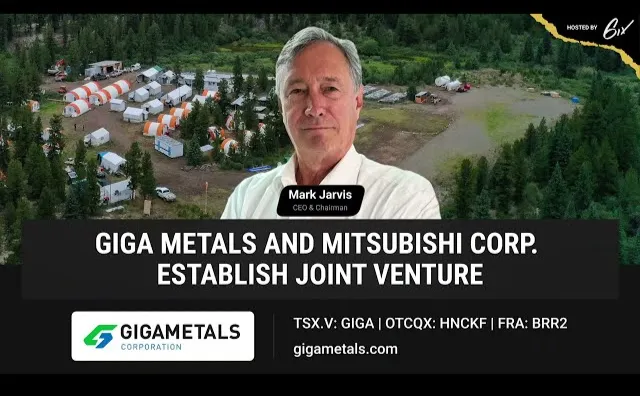
0:08 Well, hello everyone and welcome to GigaMetals Live Summit today hosted by 6. We're joined today by the company's CEO, Mark Jarvis. Mark is going to walk us through a live company update and after we'll move on to a Q&A session. So you can submit your questions at any time using the Q&A panel on the right hand side of the screen. We'll try to get to as many as possible. And as always, this is being recorded and available to watch afterwards on six.com. But without any further ado, I'll hand it over to you, Mark, to kick it off. Okay, well, thank you very much, Dasha. So as you know, I'm Mark Jarvis,
0:39 CEO and chair of Giga Metals. And we've got some pretty exciting news that came out yesterday. Now I'm going to assume that most of you are aren't familiar with the project. So, let's go. This is a transformative transaction. Mitsubishi, It's the culmination of more than 3 years. They are one of the largest companies in Japan, maybe the largest company in Japan. They're certainly the largest trading company in Japan, in terms of commodities trading.
1:35 And they are worldwide. They're very sophisticated about the mining business. And their typical pattern is they like to own a minority interest in an operating mine. They don't want to operate mines, but they do get involved and they finance their end of it. They help with financing. It's just They bring a whole lot of skill to the table and they're very good at marketing commodities.
2:09 When they own a minority interest in a project, they like to get as much of the offtake as they can get. So in our case, that's yet to be decided, but right now the deal is extremely simple. We've created a subsidiary called Hard Creek Nickel that we owned 100% of, and we put in all of the assets, you know, associated with the Turnagain project into that subsidiary. Mitsubishi is now buying 15% of that subsidiary for 8 million Canadian dollars. And then we will use that money to produce a pre-feasibility report. So Hard Creek Nickel will now be producing a pre-feasibility report.
3:01 We at Giga are the operators, but we're working closely with Mitsubishi and they bring a lot of value to the table, you know, in a technical sense as well. They've got a lot of depth, you know, in-house engineers and so forth. So, just what a pleasure, you know, I have to say what a pleasure it is dealing with them. Mitsubishi is a company, you know, everybody talks about, you know, ESG, blah, blah, blah, ESG. Mitsubishi takes it seriously. I can tell you that. They really want to be a force for good in the world and this may sound naive of me to say that but that is strongly the impression that I get in dealing with them.
3:48 So they just bring so much to the table. Also, they have, because they are so familiar with the mining business and they've got in-house expertise, they have the ability to sort of sort through the greenfields projects and decide which ones they wanna get involved with. And they've done that. Now, I don't know what other projects they've looked at They don't tell me I mean they are honorable and they would not ever breach, you know a confidentiality agreement but I've seen how thorough they are I've seen how thorough that you diligence process is and
4:39 I Have to believe that they're looking at every project on the planet. That's that's my assumption. And so the fact that they've decided on us first, they may decide, they may move on other projects later, I don't know. Or this may be it, I have no idea. But the fact that they've chosen us is a strong validation.
5:04 So and it gives us the money that we need to advance this project. So important. And again, one of the things I you know, they're they're targeting net 0 for their whole corporation by 2050. One of the things that attracted them to us is that we can sequester CO2 in our tailings. We will either be a very low carbon producer of nickel, if we can get this up and running, we might even be a 0 carbon producer of nickel. That work is ongoing to determine that. So here's who we are and here's what we're doing.
5:53 Now, again, just for those of you that aren't familiar with the company, it's a giant deposit, capable of producing 33,000 tons a year of nickel in concentrate over a 37 year mine life. That's according to our PEA.
6:15 That is a giant deposit. It's similar in size to the giant HPL deposits that you hear about. It's an attractive mining jurisdiction. And that's one of the things too, is this is a jurisdiction that is a safe jurisdiction. From the point of view of, you know, if you're a car company or a battery company, a Western car company, and you're concerned about 2 things, reliability of supply and the ethics of your supply. Canada really does tick those boxes. We are a rule of law country with high environmental standards. So we will be going through a rigorous environmental assessment.
7:05 We're quite confident about that. We understand our project very well. We don't see at this point any show stoppers environmentally, but it will be a rigorous process. And so if you can get through that process and get a mind built, the buyers of your products can be happy that they're buying something that's ethically sourced. And again, a simple flow sheet. This is one of the reasons, this flow sheet I have to say is one of the reasons that Mitsubishi chose us. Because it's so simple. You dig the rock up, crush it, you grind it, and you put it through froth flotation.
7:55 99% of our nickel and cobalt are located in 1 mineral, 1 sulfide mineral called pentlandite. So when you put it through froth flotation, you have to float pentlandite and suppress everything else. That's it. That simplicity
8:16 means that technically the risk is as low as it can possibly get. So if you're going to spend $2 billion to build a mine, you want to have some confidence that it's going to work. And in our case, it couldn't be simpler. And it produces a very good concentrate. And again, you know, if you look at the amount of nickel and cobalt that we've got, And this is as of the PEA, 5 billion pounds of nickel in the measured and indicated category. And then you can double that for the inferred category. It's a big project. And by the way, it's not completely drilled off. We've probably got 20 to 25 percent of the total prospective area of this ultraviolet-infrared intrusive drilled off.
9:14 And this is again some PEA summary stuff. I'm not going to linger on this. This is a comparison of Canadian projects. I'm not going to linger on this except to point out that we are the only one, the only one of scale in Canada that has modeled production of class 1 nickel. The other projects all model producing ferronickel and they model their assumptions about, in the marketing section, how much payability they'll get for their ferronickel. We don't do that. I think the other projects could produce nickel for the cathode supply chain and I suspect at the end of the day they will, But we haven't seen any engineering on that yet.
10:09 And so here's, here's our plans and catalysts. And all of this, of course, is dependent on getting money as we go. So right now we're funded to get our PFS delivered in the first half of 2023. We're frankly hoping to get it done by the end of the first quarter, but we'll see. There's a lot of moving parts with the PFS. And again, what we're going to add, and this is what Mitsubishi wants as well, we're going to do a separate PFS level study on adding a pressure oxidation circuit to the back end of our operation to take our concentrate and produce mixed hydroxide precipitates.
10:54 This is the form, this is the chemical form of nickel. It is the most in demand by the car companies and the battery companies right now. Pardon me.
11:08 But with the pressure oxidation circuit, there is a lot of flexibility. MHP is 1 product you can create, but you can also create all sorts of other products. So if the market shifts and who knows what's going to happen 5 years from now, we could modify the pressure oxidation circuit to produce basically anything. So, you know, we will have the flexibility to respond to the customer's needs for nickel and cobalt in the forms that they want at that time. This is something else that attracted Mitsubishi. We have an excellent location to have a tailings management facility and we have designed this, even though it's more expensive, in the safest way possible.
12:01 This is going to be an extremely secure facility because it's dam construction by the central line method, and I'm not going to get into all of the details about that.
12:13 But we're also going to have a large beach area. So it'll be a small pond. We've got excellent water balance in this project. And we're gonna have a lot of the tailings exposed to the atmosphere, where they can absorb CO2 and gradually turn from silicate minerals to carbonate minerals. So the CO2 gets absorbed, it's gone basically forever. But also as the sand absorbs the CO2, it goes through a cementation process. So again, rendering this a tailings management facility to be ultra secure. And I think, I'm just, I think I'm I'm just, I think I'm almost done with
13:13 the slide show. Okay, here's 1 that we should probably talk about a little bit is this inflation reduction act in the US Is extremely interesting and I think it's providing tailwinds to something that was already happening Again, if you're a car manufacturer or if you're a battery manufacturer in North America or Europe, the old supply chain model has fallen apart. Just-in-time supplies, getting your supplies, not owning your source of supply, getting your supplies from all over the world and shipped in just in time. That's fallen apart. The war in Europe has dealt a death blow to that model, but also current concerns about Chinese saber rattling around Taiwan.
14:04 You know, if you rely on China for your supply chain You must be worried sick. What happens if China actually invades Taiwan? What happens to your supply chain then? So there's a whole shift going on right now, and it's early, that people want their supply chains closer to home. People want their supply chains in jurisdictions that aren't going to go to war all of a sudden. They want, you know, reliable supply chains. And increasingly, they want ethical supply chains. They care about how the materials are sourced. So this is a movement that's already underway.
14:51 And I can tell you in talking to car companies and battery companies that they are becoming increasingly aware of the need to vertically integrate when it comes to critical materials. Without naming names, you know, For example, there's a car company that we were talking to a year ago, and they at the time had no mandate to be investing in critical materials projects. So nice to talk to you. We went our different ways. They called us back fairly recently. They now have a mandate to invest in critical materials projects.
15:39 So bit by bit, they're coming to the realization and they're also coming to the understanding of what it's going to take to secure those supply chains. Mines cost money to build, it takes money, and you're going to have to invest money to get the mines built and to own at least a piece of the mine. This Inflation Reduction Act is adding fuel to that particular fire because, you know, you can get rebates on your electric vehicles of up to $7,500, but 40% of your battery manufacturing has to be either in the USA or in countries that the USA has free trade agreements with. And those are the countries marked in green on this world map, and they include Canada.
16:35 40 percent of the raw materials in your batteries have to come from either the USA or a free trade partner. And that includes Canada as well. Now that percentage, 40% is gonna rise to 80% over time. So there's a big incentive for companies to source their materials from a free trade jurisdictions.
17:03 And this is all stuff we've gone through before. I don't even think we need to talk about HPEL anymore. I mean, some people are doubling down on HPEL. I mean, this Inflation Reduction Act is going to throw a kibosh into that, I think. But also, you know, getting nickel from Indonesia is environmentally problematic. Not all mines, but most of them that are extracting nickel, both nickel pig iron for the stainless business, but also chemical forms of nickel used by battery makers processed by high pressure, high temperature acid leach.
17:54 You know, they're strip mines, and they are mowing down tropical rainforests. That's what they're doing. And these are ecologically very diverse areas. These tropical rainforests on islands, 1 valley may have a whole ecosystem. The next valley over might have a completely different ecosystem with completely different species. And they're just mowing down it all. No one's keeping track of how many species are being destroyed by the mining in Indonesia. And then in most cases, not all cases, but most cases, They don't have proper tailings management facilities. They are dumping their tailings in the ocean. What's happening there out of sight out of mind So, you know, I think this inflation reduction act is going to help to to realize that if you're if you're trying to improve things if you're trying to save the planet by buying an electric vehicle you need to take a serious look at how those materials are being sourced and if you're destroying Unknown amounts of species by ripping down tropical rainforests to get your nickel for your nice clean vehicle You know, you need to take a look at that Anyways, and miss Abishi is taking a look at that. They they they really do take this ESG stuff very seriously.
19:22 They like our low carbon intensity. There we go. I haven't gone through the whole thing. I'll leave it on this slide because this is, for those of you interested in investing this is an important slide. So that's it. The other thing I want to talk about is that what comes next Because this is the beginning of a process. Closing this deal with Mitsubishi is the start. And what we hope to do is now bring in another minority partner who will buy into Hard Creek Nickel. We'll be looking for a higher project valuation for the next transaction than we got for this transaction.
20:08 Mitsubishi got, we think a great deal. But it was also a good, good, you know, good enough deal for us just on his commercial terms. But the other thing that we got is Mitsubishi for a partner, and that is an extremely valuable thing. They are a joy to work with, and they're respectful. They're good people. They want to do well, and they bring so much to the table. But also this is sending a signal out to the world that, you know, this project has been through an extremely detailed due diligence and, you know, both in-house at Mitsubishi, they also hired an outside engineering firm to help them.
21:03 I'm not gonna name names, but this is a firm that is extremely conservative. And at one point they remarked that the assumptions in our PEA were reasonable. And that's when I knew that we would probably get this deal. You know, you have reasonable assumptions. You don't get higher praise than that from a conservative engineering firm. And we were high-fiving when we heard that. So, you know, and this is an important point because Mitsubishi does have the capability of distinguishing between projects. The car companies and battery companies, and we've talked to a lot of them.
21:51 I have not once talked to a mining engineer. I have not once talked to a metallurgist. They do not at this point, as far as I know, have the in-house expertise to sort through the projects. And you really do need a mining engineer. You need someone with experience at different projects that knows what to look for. And so far, at least, none of the car companies and other battery companies have that kind of in-house expertise, none of them.
22:25 So, but the fact that Mitsubishi has stepped up the way they have, I think that sends a signal to the car companies and the battery companies that, okay, here's a project that can pass a due diligence by someone that knows what the heck they're looking at. Anyway, so
22:46 That's the presentation. I'm open for questions now. Great, thank you so much, Mark. There's lots of questions here. So let's get right into it. Carl's asking, are there any specific conditions that need to be met or questions that need to be answered in order for Mitsubishi to increase their stake in the project? Well, that's wide open and no, there's nothing specific. They're very interested in seeing the results of the pre-feasibility, of course, and they're paying up to see those results. But no, we haven't discussed anything specific. Yeah, I suspect they would like to end up, if this project is a go, they would like to end up with more than 15%, but that's all fluid at this point. Okay. Next question is, which factors will determine the project's valuation of Mitsubishi's future investments in the GV?
23:40 Have rough valuations at certain milestones already been specified, indicated, and if so, what are they? Or is it yet to be negotiated between the parties?
23:48 Yet to be negotiated. And I think it'll depend on what's happening at the time. I mean, it'll be very interesting to see what valuation we sell our next piece to. We're free to sell more, you know, another minority interest in this project. And we're free to create a kind of auction if we want to. So I think the market's going to determine the valuation. And the sense I get is that the market is coming to us. These people, Mitsubishi, the car companies, they are not looking at today's price of nickel. They're looking at securing a long-term strategic supply of something that they need.
24:37 And so, you know, the price goes up, the price goes down day by day. They don't care. That's not their focus. Thank you. Jim's asking, how did you first contact, get in contact with Mitsubishi? Well, I, full credit to Martin Vydra, our president. Martin is ex-Sheriff. He worked there for 30 years. He's an engineer Who spent a good part of his career there selling nickel and cobalt to various end users You know battery companies, but also dealing with the trading companies both the western and the asian trading companies and so You know, he had relationships developed. We also have one of our directors, Bob Morris, had a career at Vale, the big iron ore company, that is also a huge base metals company.
25:36 And he was responsible for marketing base metals for Valley worldwide. You know, depending on pricing, it would be 5 to 8 billion dollars a year that he was overseeing. Before he was in charge of worldwide sales for Vale, he was in charge of base metal sales to Asia and he lived in Japan. And in fact he's married to a Japanese woman and has half Japanese children. So, I mean, these 2 people know everybody and have done business with people for a long, long time and are known and trusted. In terms of running a process between Martin and Bob, there's no investment bank in the world that can compete with us in terms of running a process.
26:28 So that's why we're keeping it internal. Anyways, so the simple answer to the question is, yeah, Martin got us in there. Great, yeah, thank you. How much will a PFS cost? Well, we've got a budget of 8 billion, or we've got 8 billion in the treasury of Heart Creek Nickel. Or we will have when we close. I should emphasize this is going through normal closing procedures. This should be closed within a week. Once it closes, we will have the $8 million in. Currently, we are looking at about $6 million. Is what we have got budgeted from where we sit right now. Okay thank you.
27:13 Bruce is asking is the fatal flaw to your project still the whole road access to Highway 37? It's not a fatal flaw. It's a it's a solvable problem. I mean, yeah, no road, no mine, no tailings, no mine. I mean, you know, you have to have certain things. But that road, or that road, I should say, it's easy road building. I mean, it's undulating terrain. It's not steep. There's nothing particularly challenging in building a road there. It's just engineering and money. Great, thank you. Ben's wondering what kind of questions did Mitsubishi ask about ESG and have they put in place any requirements for you to use certain ESG reporting management frameworks?
28:07 Well, as I say, it is important to them. They were very interested in the low carbon aspect of it. They're very interested in the fact that because of the nature of these ultramafic rocks, that you're not going to get acid rock drainage, for example. So you're not going to have to do a bunch of environmental damage by building this mine they're also very interested in the fact that in British Columbia Were signatories to the UN, you know UNDRIP, you know regarding indigenous peoples They take that very seriously as well.
28:55 And that's a value that we share. In terms of reporting, there's no formal reporting thing set up. It's just we're going to be in constant communication. They want to know what's going on. And, you know, and that's no burden, believe me. It's always a pleasure communicating with these people. Great, yeah. Richard's wondering, he's asking, do our Giga shares include the new JB company, Hard Creek Nickel? Hard Creek Nickel is a subsidiary of Giga. So it's a wholly owned subsidiary, which will, when we close, become an 85% owned subsidiary. So, you know, and we control it. We, you know, board representation on Giga will be proportional.
29:49 And so, you know, it's a subsidiary that we will then own 85% of. That's the simple answer. Okay, thank you. Matthew says congrats on the deal. Will carbon sequestration and the MHP option be part of the PFS? Will we see the new results and how will this impact Giga News Flow over the next 12 months? Okay, there's a few questions there. So yes, a carbon sequestration as in the PEA, we plan to model the carbon sequestration in our PFS. The pressure oxidation circuit is a separate PFS.
30:39 We're going to model that separately but they will both be delivered. And the reason we're doing that is we will model putting a pressure oxidation circuit rate at turning but You know, I think one of the points of doing it separately is that it doesn't have to be at turning it you could You could have the pressure oxidation circuit, oh, say at Tidewater, at Stewart or Kitimat or, you know, or you could have it next to a gigafactory somewhere. I mean, it's, it's flexible, but we're going to model what we know we can do, which is we know we can build something at Turnagain and we know we can, you know, you know, one of the limitations on where our pressure oxidation circuit gets located is that part of what you're doing is you're rejecting the iron.
31:31 And so you have to have, you know, a place to dispose of that iron which we would have at Turnagain because at least at this point the iron is not in a form that would be marketable before you know so let me cut that question off. Now that could change. I don't know. I don't know. But but but at this point, the iron is a waste product and you have to deal with it. Okay, to be answer all those questions, how does impact a good news flow over the next 12 months? Oh, okay. Well I guess, you know, I mean it's going to be until we get the PEA out, it's going to be fairly quiet actually in terms of, you know, news.
32:18 Other than, you know, I guess the next big news event to watch for is if we get another partner involved. And who is that partner? What are the terms of the deal? Stay tuned for that. I mean, some of the people we're talking to will want to wait until they see a pre-feasibility before they make a move. Others might not feel the need to wait for that. So, you know, it's hard to call the timing. I'm not expecting anything to happen tomorrow, but I can report there's a lot of interest. And I think The fact that we are in partnership with Mitsubishi now will increase the interest not decrease it And it will give confidence To people that don't have the wherewithal to analyze mining plays that this is a good 1 Does the MC deal change the timeline when first concentrated nickel from Turnagain will start to flow to the market?
33:29 It helps to consolidate that timeline because that timeline is dependent on capital. And by the way, I should mention Mitsubishi also has a bank in-house and that bank loans money to mining projects to help get them built. I mean, my God, they, they're an awesome company. They, they, they, they, they really are. And Lionel's asking, what are your metal tenors new to your project? What are my... Metal tenors new to your project? I don't know what new to the project means, but the metal tenor is pentlandite. I mean, we've got pentlandite, and it's sort of an average Nickel tenor.
34:24 I forget the numbers. I think it averages 20% nickel in the Pentlandite, but I could be wrong on that. No, don't quote me on that actually. But basically that's it, Pentlandite. We're recovering Pentlandite, it's that simple. Sure. I was asking, why do you need another partner? Money. Fair enough. Harry is asking, Why did you have to set up a subcompany rather than having Sumo Tomo participating in Giga itself? Well, for one thing, it's Mitsubishi, not Sumo Tomo.
35:14 And, You know, we wanted financing at the project level. We didn't want equity financing because we felt our market cap didn't reflect our value. And The other possibility was that you could have done a simple joint venture, which is, you know, a fairly Canadian model. The reason we didn't do that is that Mitsubishi wanted to do it this way. And, you know, it's the golden rule. So We did it in a subsidiary because that is what Mitsubishi wanted. Great, thank you. Carrie is asking, is there a potential that government will participate or take over building the road? I hope so.
36:00 We will see. We are talking to the provincial government all the time. And there's been some good progress made on infrastructure challenges to this project. So one of the things is that when we did our last PEA, there was basically a hookup fee. If you wanted to hook up to the BC hydro grid, you had to pay, I think it was something on the order of 250 million dollars US to hook up and About 2 weeks after we came out with our PEA the British Columbia government did away with that So So there's there's about a 250 million dollar improvement from the PEA But we're also talking to them. I mean the federal government has created, you know an infrastructure fund to help provide infrastructure for critical minerals development and You know before all that money disappears into Ontario and Quebec, we're kind of urging the provincial government, maybe you could get some of that money and extend the BC Hydro line further up Highway 37, say to Dease Lake.
37:21 That would be very helpful to us. The road in, could the province build it and perhaps even build it as a toll road. You know, there's all sorts of possibilities. And I think the other, you know, it raises an interesting element. Mitsubishi's involvement is sending a signal to government that this is a project with a much higher likelihood of actually going forward than before we did the deal with Mitsubishi. So I think we'll get a more serious hearing from the various levels of government and where we're talking about how to how to help us get this thing done.
38:12 Yeah, amazing. Victor is asking how many partners will there be? Will there be more than 1 car or battery manufacturer? I doubt it. I think there's going to be one more partner, one more minority partner, and I'm hoping to get enough money in the door to take this to full feasibility and to take this right through the environmental assessment. So that's my goal. I want to get that kind of money in the door on the next transaction. And then we can just motor away to shovel ready. Frederico is wondering, he wants to know if the company plans to develop other projects in the future.
39:00 We are totally focused on Turnagain right now. Anything else at this point, we just don't have the bandwidth. That would be a distraction. Ben's asking, do you have any suggestions on how to speed up the process of providing finance to new mining projects in North America. Do government agencies need to play a bigger role in financing? Well, I think what they've done with the with The Inflation Reduction Act in the US is quite good because what they're doing, you know, I'm always nervous about governments getting involved and, you know, picking champions and, you know, and, you know, typically they'll pick the wrong champions. They'll pick somebody of theirs or whatever, and they'll throw away taxpayer money.
39:52 I'm fairly conservative about that. But what they've done with the Inflation Reduction Act is created incentives. So if your raw materials are coming from North America or from another free trade companies, anywhere in the world, Australia, for example, you can get incentives for your automobile. So this is incentivizing private industry to get these mines built. I think that's a clever, you know, much more clever approach. All right, well, that's all the questions we have so far. Thank you so much for Mark for taking us through the update and all these questions that were submitted. And of course thank you to everyone who joined in today and submitted all these great questions. If you do have any follow-up questions following the summit, feel free to reach out directly to the Giga Medals team. I believe their contact is right here on the slide. Of course, there's also more information on their website, gigamedals.com.
40:53 But again, this has been recorded and you can watch it on six.com following this event. But I'll pass it back to you if you have any closing remarks. Well, really, all I can say is stay tuned. This is this Mitsubishi transaction is going to accelerate the next steps for us, and we're going to be working very hard on the next steps. So.