Transcript
Automated transcript · Written by software from the replay's audio. It can mishear names and figures; the replay is the record.
0:08 Hello everyone and thank you for tuning in to today's event. Today we're joined by GFG Resources President and CEO Brian Skanderbeg and VP of Exploration Anders Carlsen. They'll be providing an in-depth discussion on the recent high-grade gold drill results from the Aljo Mine Target. It's actually their best intercept to date at this target. So following the presentation, we will be taking questions. Just please feel free to submit them anytime in the chat box in the bottom right corner of your screen. As a reminder, this event is being recorded and will be available for replay later today. But with housekeeping out of the way, I'll pass things over to Brian to kick things off.
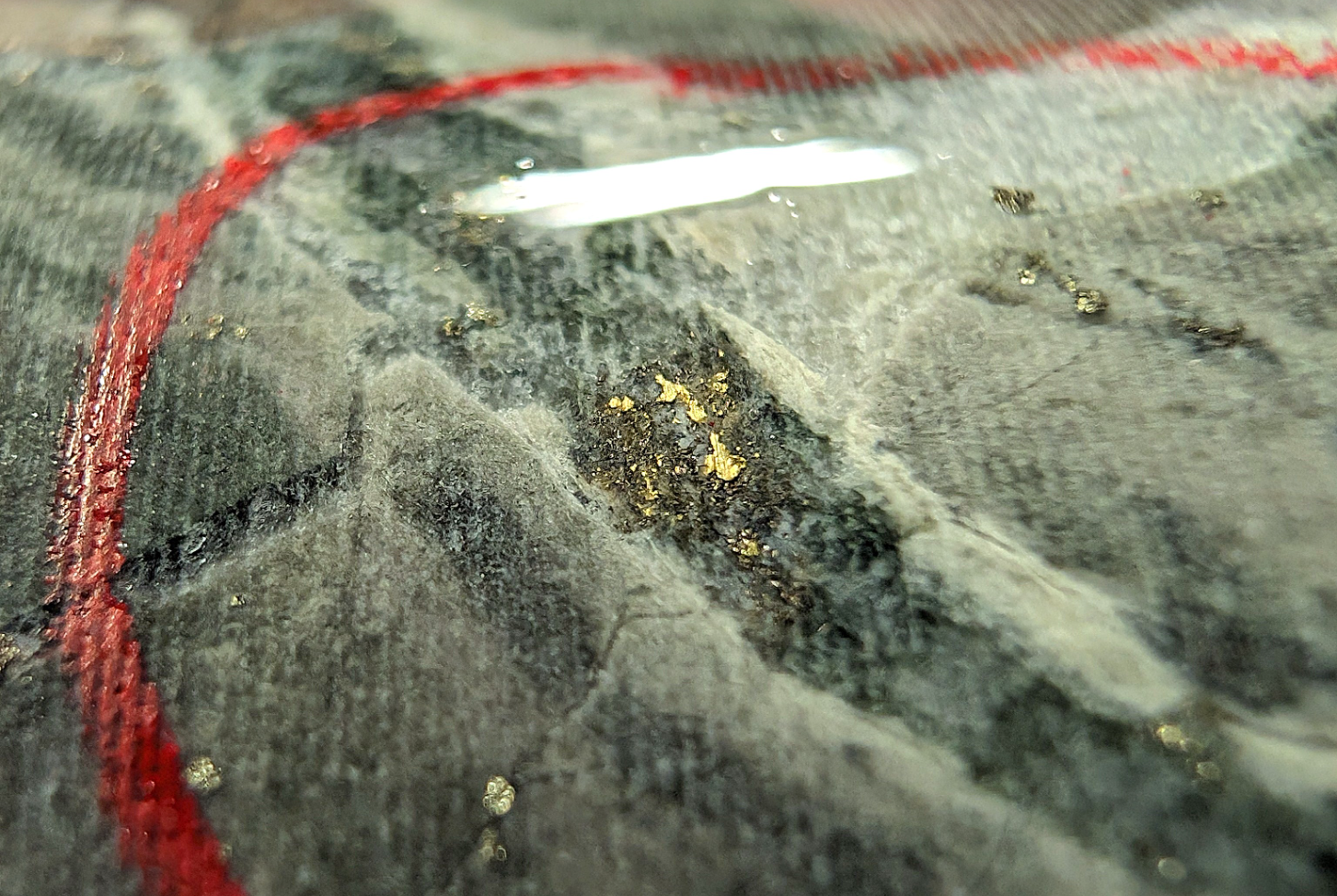
0:45 Thanks very much to 6 and thanks everybody for joining us today. I'm going to talk to you about our AlgaeO drill results and why we think it's quite exciting for us. This introductory slide shows you some of the visible Gold we've drilled in our last program. We're going to look at some details of these things, but as an exploration geologist, nothing excites me more than some core like this. This is really great looking mineralization and hopefully today I can give you some context and provide you some opportunity for discussion with management about what we think about this target. Just a cautionary statement, I'm an explorationist, an optimist, a geologist, I will make forward looking statements and I would refer the audience to our cautionary statement on the website or as presented here.
1:31 So before I get into the details, I want to talk a bit about TFG and make sure we have an introduction as to who we are and where we're going. We're a North American focused exploration vehicle. This is a company that's been around since 2016 and I think is a really unique opportunity in terms of the exploration space. We're a team that's done it before. For those of you that don't know, Mark or myself or Anders previously ran a company called Clode Resources and had some great success at discovery, bringing a new ore body to production and ultimately transacting to generate some good value for shareholders. When we put GFT together, we really wanted to focus on these district scale land plays and district scale is a bit colloquial, but when I think about it, it's like truly when you can take a belt and explore it at a truly regional scale.
2:20 And this is what we're trying to do in Timmins, generate new targets by looking at things on a truly regional scale. And this is what a district means. Timmins, we're gonna speak towards the details what Timmins is. This is truly a world-class belt and next to Newmont, TFG is the largest landholder in this district. And when I think about our exploration strategy, our company's been around for 6 or 7 years and we want to do things differently and I think successful exploration companies really need to do things differently, thinking about how we are being disruptive, how are we being aggressive in advancing our pipeline and this is really all what we think about as DFG mission, vision and goals and objectives here.
3:08 On the balance sheet side and share structure side, this is an overview of where we sit today. We've traded in a range of anywhere from $0.06 to $0.12 over the last kind of 12 to 18 months. Good volume tied to drill results as you would have seen it yesterday and again today. This company already has about 240 million shares outstanding. On the back of a financial raise we did in Q2, we have about 3 million cash in the bank, and we also have some payables coming to us as a result of the Rattlesnake sale transaction, which I'll touch base on later in the presentation. I think it's really key to find a company that is leveraged and aligned with shareholders and has really strong, sophisticated and credible shareholders and I think this company does. So you can look at our insider participation still around the 6% level. Alamos Gold being our largest shareholder at 9.9, you know, very seasoned mid-tier with a good track record, good institutional backers, and certainly a lot of high net worth individuals, Lundin families in Geneva, but also some very large US retail shareholders on that front.
4:15 Now, here we sit at gold, 3,300 Canadian, 3,400 Canadian, 2,500 US, and I wanna take a short opportunity to speak about why exploration. I think it's really important to think about how you find the right vehicles to invest in at this time of the cycle. And here I show you a 30 year trend of the exploration spend. Discoveries are really rare. And ultimately what we're finding is those discoveries are even more and more valuable as they're being made. Exploration dollars, which is the red line in this graph, has been pretty steady, driven by the cyclical trend of gold price and free cash flow of the sector. But you can see the discovery trend, which is how many ounces are found by year. This graph has been dated a few years ago, but it really hasn't changed that much.
5:06 It has declined. We are finding less Gold. I think what it means is truly relevant discoveries are even more valuable, particularly if they're in an area where you have an infrastructure-rich belt like Timmins. GFD, I think, has taken a strategy where we consolidate these really large land positions. I think you need to do that at the right time of the cycle as a junior explorer. So 6 years ago, we recognized the opportunity of an entry point into Timmins at a reasonable cost and we started consolidating our land position. I think it's really important to emphasize the cycle timing of entry point into these belts. And then we successfully layered in new and innovative exploration techniques. And I think GFG is really skilled at using these techniques to look undercover, look in belts at a regional scale and find new gold systems that can drive discovery.
5:56 So this is really what GFG is doing. I think the timing right now is really unique where you see a large gap between gold price and gold equities, gold producers and gold developers and gold explorers. And I would urge you to look at some of the presentations out there. The valuation gap is enormous and it's at an all-time high. So I think the exploration space is really prime for a move these days. When we think about what GFG has done over the last 24 months, here's a graph, share price graph reflecting performance. The red is all our press releases and I don't want to go through all these, but The point I want to make is you want to remain relevant in the exploration space. You need to stay in the news environment. You need to be there every 6, 8 weeks. So here we sit. We published a number of economic results at Aljo, at Montclair and Evo over at Penn over a 2 year time frame. These are great results. A number of these are economic hits and all in very shallow systems. So this company's remained very active and it has built news flow despite the difficult junior sector timing that we're in.
7:04 Now, when I think about Timmins on a macro scale, and people ask you, why did you go to Timmins? Why is this belt where you're choosing to allocate capital? I think it's one of the best places to make a big discovery. And this map outlines the land positions around Timmins. It's about 200km across this map and there's 150Moz there. So that's where we start as management. Gold endowment. There's lots of gold here. Second piece, what's left to be found? Lots of gold to be found in this belt. And you can look at the discovery of Cote, the discovery of Borden, the Pan American mine and mill. These were all discoveries from the last exploration cycle and I think
7:49 they lend itself to the next phase of discovery. So lots of gold here, lots of gold still to be found, lots of infrastructure. This is the other key piece. Who's going to buy a discovery here? You can look at the likes of Newmont, who's actually selling this camp but somebody's going to buy it, Pan American, McEwen, Alamos Gold obviously is a big player and even IM Gold, much bigger player too in likes of Cote. So you have a lot of infrastructure, you have a need for feed. This is why when you think about GFG controlling 800 square kilometers, it's really exciting the work we do. And I'm going to start by talking about Goldarm, but Towards the end of the deck, we're going to talk about Penn and Dore, the western end of here.
8:35 We've had those positions for quite some time, but we continue to advance the targets and one of the most exciting things in this company, in parallel with Eljo, is what we're seeing out on the west end of the Penn property, could truly be the next discovery in the making. So this is what we're doing in the land positions around Timmins here. It's a great place to make the next truly significant discovery. As we look at east of Timmins and the Gold Arm property, and here we show you a detailed blow-up map. It's quite a large land position. It's about 30 kilometers in strike length. The west end of it is Montclair, moving through Carr and the central portion and some other targets around car and out towards Aljo on the east end of it. So very large land position, quite strategically located. We would have Fen, Gibb and the Creasis mine east of us. So that would be near Fairgold and Onyx. Great peers doing good work regionally in this belt. South of us you have the McEwen Black Fox complex, you have Agnico Eagle with the Hislop and other infrastructure of the Agnico Eagles fault all the way further to the East. Going to the West of us, you're into the main camp of Newmont and Pan American.
9:52 So you've got the Porcupine Duster fault zone, the southerly at the 2 breaks, and you have the Pipestone break, the northerly at the 2 breaks here. So highly prospective area and a great place to make a good discovery here.
10:06 When we think about Alzo specifically, and I'm going to talk to you about the results here today, Alzo is an old historic mine from the 20s and 30s. And here we sit here on the northeast side of the land position. And this was mined about 15, 20g ton material, Not a large mine, but a very high-grade mine. This is what first attracted us to the area. It was the grade of these main systems, the historic production profile. We drilled it in 2023. You can see some good results here. 4g over 6m, 13g over 4m, and then some broader mineralization that's 1.5g to 2g over plus or minus 20m. This is an area and a system we quite like at Aljo and this is the second phase of drilling we've done. And I'm going to let Anders speak towards this slide, which is really where we get into the details of what we released yesterday morning and where we see this target going. So go ahead, Anders.
11:06 Thanks, Brian. Like Brian said, the release that we put out yesterday included this plan map here on the left side and the cross section on the right. We released the first 120 meters of the first hole of the drill program that we completed back in June. That's hole 12, so ALJ 2412.
11:28 You can see at the bottom of the drill hole there. And we saw a good result there of almost 14 grams over 7.1 meters. So that's using a 0.2 cutoff. If you use a 3 gram per ton cutoff, which is what we like about this hole, you still get 16 grams almost, excuse me, over 6 meters. And that's held up by assays of 4, 9, 6 and 77g per tonne. So, a really intriguing intercept. There have been a few historical holes that have tested that Aljo hanging wall zone previously. You can see them on the long section. The previous hole drilled by GFG would have been 3g per tonne over 12m, including 60g over about a metre. And so, a really intriguing target.
12:16 Last year, as Brian mentioned, we did test the main zone as well. And what we found when we pushed in that first hole, hole 4, that Brian's highlighted there, is that we not only saw mineralization within the hanging wall, but then we saw it within the main zone that's associated with those pink structures, those Feldspar porphyry dikes. And then we also saw a footwall zone that's highlighted with that leftmost porphyry dike looking 33g over 1.5m. And so, looking at those 3 intercepts, we knew right away that, okay, there's more to be tested here. It's a very interesting area. As Brian mentioned, the veins are very high-grade and there's generally 2 orientations of veining that we see. So if you look at the mine workings on the plan map on the left side, there's actually 1 dominant orientation of mine working and that's just about Northeast. So on like an 0.65
13:18 Azimuth trend. But what we see in the drilling is that not only do we see high-grade veins along that structure, so at a very good angle to the core axis, very high angle to the core axis. So you're seeing nearly true widths on those. You also see veins that you're drilling, you know, sub-parallel or at low angle to. And those are also hosting significant visible Gold and Telluride. So that was really exciting to see, you know, 2 vein sets at high angle to each other that may or may not have been really well understood by the miners back in the 20s and 30s. I'm sure they would have seen them underground, but from what we can tell, none of the surface or underground drilling historically, or even from the 80s and 90s, really ever tried to test those more North-South oriented vein systems.
14:10 So, we only have a first, a few holes into this area. It's the second program that we've drilled, But seeing the coarse visible Gold, which really differentiates itself from perhaps other targets along the pipestone that might have different sulphide mineralogy, this is coarse visible Gold. You can see it in the veins. You've got tellurides that are telling you that you've got a nice, you know, likely intrusive source. And then you see the porphyry dikes, you know, in direct contact with, you know, mineralization in most cases thus far. So, you know, really exciting and, you know, more results to show. You can see in hole 12 there, that blue line shows all the assays that are still pending. You know, some of the most significant goal that we'll look at in photos in the next slides are from that interval.
15:00 And so we're excited to see what those results have.
15:06 But we really need to look at it from a wide lens right now, because we're just starting to test these areas at wide spacing. And so there's lots to learn yet. Yeah, I would just add as well, other holes pending regionally, we did drill several holes stepping out to the west. You can see them on the plan map, the red colors, and several holes also to the east, stepping out further along the strike to the east. So these are 4 of the holes that are pending along the strike and obviously this dip hole, which is the deepest hole drilled to date. I would also flag that hole 12 was really interesting that it hit 4 or 5 nice looking vein systems. This is the hole we drilled last year, but when we drilled through the mine workings, we actually hit a void just as a relation to some of the historic records are incomplete, so they would have mined modestly deeper than maybe the records indicated.
16:00 So we actually didn't hit the main vein in last year's drilling. We hit the void, but in this year's drilling, we went deeper on dip side in terms of moving down dip. And you can see where we've hit nice visible Gold. Our interpretation would be that visible Gold relates to what was historically mined in this environment. So, overall, you see a really interesting looking system with good vein bidirectional orientation.
16:28 You see a well mineralized hanging wall system up near close to surface. And you also see a very under-explored footwall environment where you're still seeing these porphyry dikes, you're still seeing some diorites and some very reactive units, and you're still seeing this coarse VG telluride assemblage. So really exciting where you can drill underneath an old mine, see exactly what the old timers were working and see that this thing still remains very much wide open. So we would hope to be able to disclose and talk towards the remaining releases in the assays in the coming weeks. Anders, maybe you just want to speak towards this slide and what you think of some of these relationships and why they excite you. Yeah, for sure. So 3 of the photos would be from the Aljo hanging wall zone that we, a result of which we released yesterday.
17:16 And so those would be from 62m, 63m and 77m, all
17:22 very proximal to the Ultra-Mafic-Mafic contact that hosts that Aljo hanging wall zone. And then the fourth one that is at 2226m depth, That would be from the main algal zone that we have yet to release in this hole. And so you can see generally very nice coarse sulphide, telluride mineralization, what you would expect to see in a high-grade system within not only sheer hosted veins, but also later overprinting brittle veins. It's an interesting structure and system in the way that these Mafic volcanics, these basalt packages are highly altered. And so very similar to Moncler in some cases, you wouldn't even think that they're mafic volcanic. They're so altered.
18:10 But yeah, really nice visible Gold. So it tells you something about the character, the metallurgical character of the system, which is important for us. And yeah, I think just more visible Gold than we've probably seen at any other target, I think would be safe to say from GFG's perspective, going back 7 or 8 years.
18:36 So moving to from the Aljo target, 30 kilometers west to the Montclair target. So if you're familiar with GFG, you would have been following the Montclair story for the past 3 or so years. You know, bulk tonnage style deposit, near surface on the west side of the Gold Arm land package, just north of the Pipestone Fault system, north of the Timmins Camp. And so what we've been doing here, we did drill here in the first drill program when I came on in 2023.
19:09 So last fall, we intersected on the lower foot wall zone, approximately 4.8 grams over 12.9 meters. And that really for us, you know, was really important to try to show, yes, this system can be expanded. And so that intercept is right there that Brian's just outlining in the plan map. I believe there's a cross section here as well. And, you know, so Brian, if you just want to outline that one on the cross-section that has intercepted from last year, what that showed us is really that the system is changing, the geology is changing at depth. Yeah, thanks. There's a cross-section right there, the trace. And the system is open and we can go and test it. I think the lowest depth there, that intercepts at around 440 vertical metres. So you're not overly deep yet. There's room to expand this thing and you can step out laterally on the system and probably hit good grains at good grades at very minable widths from an underground environment. So you've got the bulk system near the top where you've got that main zone and upper footwall, and then you've got that deeper zone, the lower footwall that would be amenable to
20:24 underground mining. And this is something that we have generally continued to look at. Right now, we're going down the path of looking at the metallurgical character of the system and trying to understand that better. We've had some good work in the past done on that side and a lot of whole rock analysis. We really do have a very good understanding of the high Titanium and Iron character of these basalt packages. And that I think is something key that we need to understand more of if we're going to grow the system along striking at depth.
21:02 Thanks for that, Andrus. That's Gold Arm, east of Timmins and it's where we focused our drilling back in Q2 here in June. When you think big picture here, we also own 600 square kilometres west of Timmins in Panandore. And this is where GFT initially pivoted into Timmins. And these are pure greenfield plays. There's not really an advanced target moving to resource here, but we've continued to simmer these properties in the background and revisit the data. And what's came out is some really interesting work that Anders completed both at Penn and Dory is that there's really interesting targets here that are evolving and that could be the next relevant discovery here. So The Muskego Gold Target we mentioned in the last press release and the upper left map is, it looks small, but that's 60 kilometers across that belt. That is the Penn property.
21:55 The Porcupine-Dester fault zone would extend in entirety across that whole block. It's got a nice basin of porcupine sediments in gray, and the Muskego target sits indirectly in the Western end of this. And the main map you see here, shows some of the till samples, but it also shows the sonic tilling that was done back in 2020, 2021 and 2022. And there was some really interesting results that came out of that. So Anders, I'll leave it to you to speak towards this. Thanks, Brian. So like Brian said, we're looking at
22:30 where these blue squares are. Those are the sonic transects. So those blue squares were drilled, you know, vertical base of till holes that also sampled bedrock and they were done at a 250 meter wide spacing. So, you know, those blue squares across would be roughly a kilometer and a half, and that spans only about half of the width of the actual Muskego Swamp. So the Muskego Swamp would be roughly 3, 4, 5 kilometers wide at the widest by maybe 8 to 10 kilometers north to south. So 30 plus kilometer area
23:03 where you've got the Porcupine Dester Fault to the south with a Porcupine Dester, you know, fault splay, you know, bounding that kind of ultramafic volcanic package that's always been really interesting to us. And even in a previous, you know, you know, company, we tried to option this block, the western half of Penn in 2018 from GFG, because we really saw these structures as under explored, you know, beautiful, you know, ductile deformation, even the fabrics and the magnetic signature of these rocks, it really tells the story that this area has been very strongly deformed. And then you put it under a swamp where nobody's even been able to look at a rock or an outcrop in, you know, 150 years of exploration, you know, going back to the early days in Timmins. So, really interesting for us.
23:55 Great work by the previous team to flag this and go out and do these sonic holes across the Mexico swamp. And what we found when we compiled the data and had a second look was that there is a pretty good grade sample from bedrock that actually sampled glacial boulders and bedrock getting for a diluted grade of 2.25g over 1.5m. We pulled the rocks, we had all the data, there's lots of ICP data, there's Gold grain data for all of this stuff. We're still working to compile all of it, but really for us, you can see really nice sulphide in these bedrock samples associated with that grade, and we'll look at a little bit of that.
24:46 But I think really the scale of the target is what's really interesting when you look at the magnetic interpretation, which is, you know, what we're looking at underlying these green mafic volcanic panels, you know, you see this kind of, you know, 065 azimuth trend, this northeasterly trend that we believe, you know, these sheared sulfide, you know, laden mafic volcanic rocks are hosted within. And so looking at the area, And Brian's always been really, really big on the slate rock area and what that brings to the system as well. I think when you look at the whole area, you can't help but be excited about the size and scale of a very underexplored area with bedrock hosting gold.
25:35 I would probably just add a couple other things there, Anders, is that when we first did this survey, the structural model underneath here was built like 4 or 5 years ago, And now you've gone out and overlaying the sonic till data and lo and behold you have a really high grade, you know, anomalous bedrock sample plus anomalous gold in the till and these interesting pathfinders, whether it's tungsten, whether it's bismuth, whether you're seeing some molly association, seeing a really strong, interesting geology on the local scale. And as Anders pointed out, back to the Slate Rock area, it's a target that's just off the map to the northeast of us. And that was really large-scale alteration. So one of the things we look for in these systems is, hey, yes, you want gold, you want the right structural setting, but you really need to see large scale fluid flow.
26:26 And what we're seeing in the areas that are around some of these bounding structures is very significant regional scale alteration. So it just gives us more credence and really enthusiasm for something like Muskego. And so this is a target we're working up. But when I see grades in a structural setting like this at the termination of Greenstone belts under a swamp, this is exactly what GFG came out here to find, is things like Muskego. We're pretty enthusiastic about what we've seen in that profile and this target in general. Anders, I'll let you speak towards this. Sure. So these are just some hand samples from the bedrock at the base of that one sonic hole.
27:11 So these are hand samples that would have been part of the sample that graded 2.6g over the 1.5m. These ones are roughly the size of your fist and these are cut and polished pretty nice. You can see, I think we said 20%, there might actually be more than 20% Sulfide in these, dominantly Pyrrhotite, but you can also see Chalcopyrite, Pyrite, little bits of Sphalerite and maybe some Molybdenite in there. When we got these polished up and we looked with a hand lens, we were actually starting to see fine-grained, visible Gold. And so it explains that obviously the Gold that you're seeing in the system, we ran these through just the slabs through a photon assay lab in Timmins, and we got between 1 and 10 grams per ton. So, you know, golden in these samples. So that was, you know, just, you know, nice to actually see the grades come out
28:13 of an assay, you know, in additional to the original firehouse that would have been on the entire Sonic bedrock portion. But as you can see in the pictures, you've got really strong deformation. So obviously high strain zones, you've got really nice banding. You can see a lot of CS fabrics in this, which just means a lot of these kind of wispy, highly deformed areas that are going in and around
28:43 more competent parts of the rocks. So be it quartz veins that have been attenuated and booted and dismembered, things like that. Then you just see a lot of the classic features of a Gold-rich and sulfide-rich ductile system. It's really exciting for us to see something in the dataset that stood out. You go and look at the hand samples, you're like, okay, that's a lot of sulfide. You look at it a little bit closer, you're starting to see fine green visible Gold. And as Brian mentioned, you know, one of the things that we're trying to do now is just try to think bigger. I think if I could go back in my career, you know, to work, you know, that Brian and Mark and I have done in Saskatchewan, it would be well, when you know you're in an interesting area, If you try to think a little bit bigger at the forefront, it can save you time and energy and also dollars when you start planning your program. And so trying to understand the Muskego area just from the bedrock and till and ICP and alteration samples and data that we have is what we're trying to do. We're reprocessing geophysics and geochemical data that we have and just really trying to bring it all together because in the end, the targets that make it, in my experience at least, and I think Brian would agree, they have all of the right, you know, signatures, they have generally all of the right characters, even if it's 7 or 8 out of 10, most of the time, you know,
30:15 the right systems that go all the way through and become resources, they will have a lot of things in common. And so right now, what we're trying to just figure out is how many of these, you know, different characters and signatures and ingredients does Muskego have? And so far, we're pleased to see that it's got most of them. So we're excited. I would just reiterate, if you flip back and think about this slide. So we went out in this 4km wide swamp. We took a sample at the bottom of the swamp through a sonic hole. And what are the chances when we're actually trying to sample the till that we would actually hit Gold in the bedrock? Very, very low in terms of probability of actually hitting that with a sonic hole.
31:01 So the location,
31:04 The likelihood and probability of seeing actually golden bedrock in a till sample is very exceedingly low. When you pair that with the character of what we've seen in these rocks,
31:16 really enthusiastic about it. From a targeting point of view, Pyrrhotite is a conductor. It also has a weak magnetic signature. So these are things that you can use in targeting here. And we have EM, regional EM data across this entire area of the Muskego Swamp. We can look at the historic legacy airborne datasets that help us target in here. When Anders pulled together this mosaic of these till pieces, it's just really fascinating in terms of the local textures, presence of visible Gold and the character of the sulfides. Lots of really, really positive things about this rock. Go ahead, Anders, on Dory here. Okay, thanks, Brian. So we're pivoting now. We're still in the Western Abitibi, the Swayze, but now we've moved down to the South end of it. And so the Dore property sits generally kind of right between the Cote mine to the Southeast and the Borden mine to the West, each about 40km away. And this is an area that we flagged in 2023,
32:19 kind of just after I would have come on with GFG as an area that we needed to get some data out of. We needed to understand more about this property. And so we initiated a regional till survey in late 2023. We completed that just before Christmas last year, and now we've received all of the gold grain accounts from iOS for the bulk of the property. So the yellow triangles that you see on the map are areas where we took samples in 2023, the Eastern block, so an area that we really like to the Southeast, just off of the main part of the land package, We've infilled that now this summer as well. And it's an area for us that not a lot of data at Dory.
33:09 It historically doesn't have some of the classical things that you would wanna see in terms of Tamisca Ming or Porcumine style conglomerates. But having been out there for a couple of weeks this past summer, you know, all of those things, they really do sit on that, you know, ride out sheer zone just to the south of the property. And now, you know, having seen it in context, there's a lot more, I think, interest geologically that we've gained from working, field tripping with the OGS geologists and trying to understand really what the South Swayze is. So I would say definitely, you know, orogenic gold potential, not only within the main portions and mafic volcanic, you know, but also within the felsic volcanic pieces of the stratigraphy and in the East block where you've got a really interesting setting where you've got Deloro aged felsic volcanics, shown by the yellow rocks there, intruded by diorites and granitoids from the large bathlith that sits just kind of eastboard of the main camp. And so that setting is actually really similar to some of the magmatic and hydrothermal breaches that you've got within the older assemblage at Kote, but geologically, having those discussions with the OGS and trying to understand what are the similarities between host rock areas and overall prospectivity, we came back with the feeling that this
34:40 is an interesting area that has basically seen no work. There are some high-grade Gold and Copper showings on the property, and it's just something that we need to understand a lot more. On top of that, there is also VMS potential. So there is actually a 50m by 20m wide massive sulphide lens that basically straddles our property, kind of just right in the centre of the property, straddles the property boundary. And then you go to a lot of the showings in the central portion of the Dory property where you're seeing these yellow units, felsic volcanic rocks, rhyolites, and a lot of them have massive sulfide class within the different volcanic breccias and conglomerates. And so that leads you to think about, well, is there a buried VMS system here that we've never really identified?
35:33 So the more we learn about Dory, as with everything in life or geology, there's always there more to the story than you originally think. And part of what we're trying to do right now is just take a broad brush approach and try to understand Dore at a higher level year over year. When we think about the land position and the game plan for 2024 for GFG and Timmins, we go back and we think about this map, Penn, Goldarm, Dore, the budget this year is about $2.5M in the ground. And from a meterage perspective, that was about 6,000m. We've drilled 1,700m so far, so we have sort of 4,000 plus or minus metres yet to allocate here for the remainder of the year. We think of those from a prioritization point of view, Aljo definitely sits at the top of our list.
36:26 Understanding the remaining targets at Goldarm, which would be Carr and Montclair, continuing to advance, those also sits pretty high. But we're definitely not forgetting about Penn and Dory, where we've just showed you an emerging discovery potential target at Penn, where Muskego now sits at the top of our pipeline of things that are really exciting for GFG. And I'd love to see us get out there and continue to advance that target, whether it's through to drilling in Q4 or Q1, it's going to be one of those 2 and Dory as well. So that's the budget for this year and the game plan. We have pending assays from Eljo that will come to market over the next month, which are direct step outs and further downhole extensions from the zones we've already published. And we'll be back here drilling in Q3 as well.
37:18 So this company is going to remain very active for the remainder of 2024 and 2025. Now I want to provide a brief update on Rattlesnake. This is the US asset that we're in the process of selling. We put out a press release last Friday, which is monetizing this asset. We explored it for several years. It's a very interesting asset that has an abundance of historic drilling on it. I quite like this asset. I'm happy to find a good home for it in a group called Patriot Vault Gold and Axe Cap Ventures. We've signed an LOI and as of Friday, we signed a definitive agreement wherein they make the next stage of payment and advance towards closing, which will occur in here in Q3 or early Q4. Total value of this transaction is on the order of 3.2, 3.3 million dollars, with the vast majority of that being in cash. So this helps us shore up the balance sheet, maintains leverage to the asset via an equity position, or an underlying milestone payment should they be successful in outlining a large resource present on Rattlesnake.
38:23 This is good exposure from somebody else putting money in the ground at Rattlesnake and we will remain focused on Timmins and advancing what we have there. Overall, look, we've spent about 35 minutes today talking about GFG, Go For Gold, Get From God. I think we're a unique team that has a very large-scale, district-scale asset in Timmins. And what we've talked about today, which Aljo shows extremely high gradients, Montclair and Carr are interesting. Muskego and Dore are new targets which are emerging and could really drive the next phase of discovery. These are district scale assets in a very compelling belt, Timmins. What we try to achieve in these presentations and why Andrews and I and Mark would speak today is like this is a strong technical team. We've had a track record of finding ore bodies. We did it with Claude.
39:15 We found the largest Gold ore body in Saskatchewan and it really turned the company around and it was a real moneymaker. So this is a team that's had a successful track record of finding economic ore bodies. We've got good backers, the likes of both mid-tiers, large institutional holders, high network individuals and we thank you for your participation and your support in GFG. Really cognizant with trying to put the money in the ground. Our GNA is around a million dollars a year and everything else goes in the ground. I can certainly point you to our financials or to our website for some of those details. Most exciting, I think this is the opportunity to be involved in something that could be truly be the next relevant discovery in Timmins. So with that, we'll wrap up the presentation and leave it open for any questions. Perfect, thank you, Mark and Anders, great presentation.
40:04 For any individuals that did come in a little late, we are accepting questions, so please come in the chat. We have a few sent via email and a few in the chat. Mark, I do see you posed a question regarding Rattlesnake Hills prior to Brian touched on it. Please just raise your hand and we can cover everything you were looking for. I'll start with the email ones. Let's see here. So with multiple instances of visible gold logged below 120 metres at Aljo 2412 and pending assay results, How do you anticipate these deeper results might compare to those already reported? That's a good question. I mean, when we discuss this internally about whether we're going to show pictures of the core now, historically that's not our practice.
40:52 But we also have a mandate and an obligation to share any material news. So even looking at core like that, to me, is a material piece. If you have 1 or 2 grains of Gold, history tells me that's going to grade 1 to 10g. If you have 5 or 6 grains of Gold, you should be able to see a 10, 20 gram. When you're starting to seeing 20 or 30 or 40 grains of Gold, you're in the 1, 2,300 gram range. So it was important for us to show not only the results that we published at the upper portion of this hole, which was a great intercept, 13 grams over 7 meters. But also to show further down, look, we hit more visible gold-bearing vein systems, and here's what we've intercepted. So that's our full disclosure of, here's what we know now.
41:44 I'm extremely optimistic that the zones down at 220 and further down the hole will return very impressive intercepts. At this stage, all I can talk towards is, let the photos speak, anybody can look at those and say, that piece graded peak of 80g, it had 20g or 30g grains in them. The second zone had 30 or 40 grains. They're obviously much coarser. So we would hope to see a very impressive intercept. And I think the guidance that provided, which is just a general guidance on the number of Gold grains and related Gold should give the audience some flavor for what our expectations are. And when you release the remaining assays for that hole, are you planning on releasing algal holes 2 through 4, the step-out holes?
42:35 It will really depend on how the assays come back and you know if we have a remainder of this hole that comes back in the next short term and we complete our QAQC or any reruns that need to be done, we would publish that. The remaining holes, 4 holes, both throughout east and west, still pending assay. There's certainly some good visible looking intercepts in those as well. So we'll really just have to let the assay return date guide us on what the best disclosure path is here. Thank you. Now there were a couple of questions via email for the Moschego target, but you guys did spend quite a bit of time on it. I guess I could ask, when can investors expect to see the first drill results from Moschego?
43:25 It's a good question. Moschego sits out there and Anders and I will say it's out in a slump. It's not an easy logistical target. So the choice of Muskego is either we put a barge out there in the warm season, inclusive of Q3, Q4, and we use a helicopter access to drill off a barge. It's not open water, but it's a big enough swamp that you couldn't walk or rig out there. You can miss too long to corduroy it with other materials. So there's a path wherein you could see us drill it in Q4 via barge. There's an alternative path where we prep it as we would a typical ice program and drill it in Q1 of 2025. And then we would be packing down ice snow, potentially making some further ice by flooding it to give us the required depth to drill on that.
44:17 So at this stage, we haven't committed yet to whether it's a Q4 or Q1 program, it'll be one of those 2. But I do think that as we advance the target through the remainder of this year, we'll be able to publish some more technical details in the end. Our technical details that the market wants to see, no, they want to see us drill it. And trust me, management's excited to drill this target. We'll drill it as soon as we can as well. And looking at what is a cost effective way to do it. So what I don't wanna do is go and spend $1,000 a meter testing a target here and blowing a budget. So we're also cognizant to do things in the most efficient manner. So let us come back to you in each 2 about whether this is a Q4 or Q1 drawing program for Muskego.
45:05 Of course, that makes sense. An individual did email in wondering if you could explain why the warrants were repriced. It's a good question. You know, we've had some feedback on that, both positive and negative. As management, I'm always looking out for the best interest of shareholders. And trust me that we looked at this path and the decision to reprice this warrant, there was full knowledge that some shareholders would not like this. And there was full knowledge that other shareholders would be benefited by this. What I can say is that, you know, when you have large shareholders and amongst our share registry is, you know, if we took the top 10, there's some very large shareholders. And, you know, when you looked at our warrant base, there was a half warrant issued on each of the 2 previous financings.
45:52 Those were priced at $0.18. The last financing we did was a $0.13 financing, and we were requested by some large shareholders to align the price of the warrants, the old warrants with the new ones. Now, warrant resistance always plays a role in share price behavior. There was already going to be a price of 13 cents that would have acted as resistance for a share price. What I can say is that we definitely took to mind that those of our largest shareholders, this was certainly a request from their side and it made logical sense to align the pricing of all these warrants so that any warrant holder would have the same benefit to this one. In the end, we finance at 8 and a half cents. If down the line our share price moves above 13 cents and we have warrants exercised, we're exercising and bringing in financing at a dilution price that's far higher than $0.08. So I know there's 2 sides to this equation.
46:51 I think we made the best decision as management for all shareholders, and that's what I'm always trying to do. But I can understand certain shareholders will feel this is beneficial to others and not themselves. So That's a bit of context on the rationale for pre-pricing. We appreciate the transparency. I believe the press release said 4,000m for the next drill program, but I believe I saw 6,000m on the presentation. If you could just confirm the next drill program meterage, it's rather large compared to this last one, which was 1700, right? The 6,000 meters is the budget that we have for the year, 2.5 million. So the 6,000 meters is an annual budget, going 1,700 meters, which is what we've built before, leaves the remaining 4,000. That's the origin of the 2 numbers. Got you.
47:41 And can you touch on where that meterage would go then the next 4,000? Certainly as we went through the program, we talked about Aljo, we talked about a little more at Montclair, we talked about Carr, we didn't touch base on Carr in detail, it's a target on Gold Arm, and then thinking about Muskego and Doray. So that's the ranking of targets. There's one other target on pen called Chabot, which is also quite interesting. It's on the Eastern flank of the land position, which would be at a drill ready stage, never been drilled by TFT and has some really high grade results tied to it. So from a target perspective, we would expect the ranking and allocation of meters to reflect that ordering as I've talked about. Thank you, Brian. I see one more question in the chat and I think it's a good way to end this. So I'll leave this with your closing remarks here, but Mike is wondering, in your view, is a current market cap of about $15 million US dollars a fair valuation for GFG?
48:40 Yeah, no management is going to be happy with their share price. But, you know, look, there's lots of 5-10 million US companies. I don't think they have anything near what TFT has. Relevant discoveries when they're made and things that are going to translate to scale. Often you'll see a move up to the 50M to 80M mark. I think As we advance Aljo, as we show scale, as we look to advance Montclair, even as we test Muskego, I would lobby that we definitely warrant a higher share price valuation. For a team that's had good success with the backers we have, with the numbers we're putting out, I think this stock and this share price could easily be $50M plus, which would reflect something more at $0.25, $0.20, $0.25 a share.
49:30 So I think there's good upside. I do think as we continue to deliver drill results from Aljo and I'm optimistic that the next couple of releases will unlock the potential and show scale from Aljo that we would see a continued move in the share price as we publish more results that clarify the scale, scope and grade at Aljo. So I think we got a lot upside here from where we sat today. Gentlemen, thank you so much for your time. That's all the questions we have submitted. For individuals that did come in a little late, this is being recorded. So the YouTube video will be available within the next couple of hours. I'll leave it for any commentary for final remarks. Andrew, if you have anything, and then we can finish with Brian here.
50:17 Sure, I'd just reiterate that the Aljo target is something that we're testing today. We feel like we can grow it. The Goldarm property on the whole is really interesting and there's value to be extracted there. The Carporphyre target that we didn't mention much on contains high-grade Copper, high-grade visible Gold-bearing intercepts that haven't been tested in more than a first round of drilling in 20, 30, 40-years. To me, Aljo and Car Porphyry are both really interesting targets, but I go back to the conversations that I had with Brian a year and a half ago, and Mark and Rick coming on, is that, well, if we're going to do this together, you know, again, we're going to come in and we're going to look for the biggest targets we can possibly find. And we're going to go test the best ones and allocate money to the best targets. And I feel like with Muskego, you know, coming into itself and us maybe realizing what's actually there in terms of a district scale target in an under explored area.
51:26 That's really what we came to find. And so, we're gonna advance it. It's gonna go one of either 2 ways, but we're all optimistic and that's why we're here. And I would just point people also, any questions, Mark or myself or the office here, always happy to take inbound some shareholders. Our website's got a lot of good information on it. So please reach out to us at the office here or have a look at our website. We're also going to have some presents down in Beaver Creek in Colorado here in September, and we're really excited about getting the next batch of news out here before Beaver Creek. So I think with that, I'll leave it for today. Thank you very much to 6 and Kyle for this, this great webinar. Thank you, gentlemen. And thank you