Transcript
Automated transcript · Written by software from the replay's audio. It can mishear names and figures; the replay is the record.
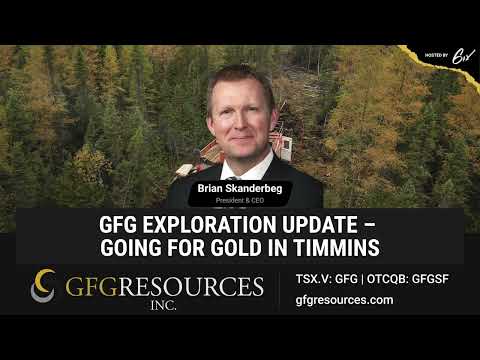
0:08 Hello, everyone. Welcome to GFG Resources Live Investment Summit today, hosted by 6. I'm joined today by Brian Skanderbeg, President, CEO, and Director of GFG Resources. He's going to be walking through a company presentation today and after we're going to be accepting questions live. Feel free to submit them in the Q&A panel found on the right hand side of your screen at any time. And as always, this summit is being recorded and is going to be available to watch afterwards on six.com in the coming days. So be sure to look out for that. Brian, without further ado, I wanna hand things over to you to get us started.
0:37 Thanks very much, Cam. And thanks everybody for joining us today. Today, I'm gonna talk about TFT resources and I'm gonna introduce our context for the assets in Timmins. A bit of background for myself, Brian Skenderbeg, I'm the founding CEO of the company and we've been public for about 6 years. Focus of today's presentation is really on the Montclair project, the results that we put out yesterday. Great results, I'm going to walk you through what they mean, where we think we can go with these things, and also both plans for 2023. When we think about GFG, it's a really interesting company. We set this up 6 years ago. I think we've got an exceptionally strong team and board of directors and a team that's been in the sector for, you know, literally decades and had a lot of success behind us. The thesis we set ourselves up to be is really driving discovery.
1:27 And when we think about this in our strategy, it was putting together district scale opportunities. Several of those are in Timmins. We've got some assets in the US and ultimately what we're trying to do is find world-class systems and tier 1 belts. And it's an easy thing to say and a difficult thing to do. What I'm gonna talk to you a bit about today is also our strategies. And ultimately those really drive where we're focused. When we think about our corporate snapshot and before I go into the technical details a bit on GFG as a whole, we trade on the TSX, we also trade on the OTC, Symbols GFG and GFG SF in the US. We're right around this sort of 20, 25 million market cap company. Looking back at Q4 last year, we had about 2, 2.5 million dollars in the bank. One of the things I'm quite proud of, it's exceptionally strong shareholder base.
2:16 Insiders have always participated and backed this company. Myself is certainly one of the larger shareholders. Alamos Gold, one of the most reputable mid-tiers out there, believes in this team and is a very strong and supportive shareholder. 1875 Lundin Family, other institutions, US Global, Delbruck, these are very strong and seasoned investors. Looking at the chart, I think if you're on this forum, you've probably been in the gold space a while, aware of how difficult it was moving through H2 last year and that slide in GFT stocks really did mimic the TSX Venture stage in many of the gold companies. What you're seeing in Q1 this year, very different. Price breaking out, Many of the equities moving up more strongly, good strong news flow, feels pretty good. So I think GFT today and yesterday has broken out where we are at the base and chart looks great.
3:11 Great people, as I said, involved. Patrick Downey, Brian Booth, Arnold Glasson and Lisa Riley are board of directors. These people are all extremely savvy and have been in this space for a long time. When we think about Gold, and before I go into exploration, it's why Gold, why now? I think 2023 is going to be a year where we do break all-time highs and continue to move through. Today we're approaching $2,600 Canadian. These are extremely strong metal prices. I think the sector has a lot of value to be unlocked. I'm really optimistic that we see a really strong market for the gold space this year. Inflationary times of conflict. Gold has broken through and ultimately even the central bank buying is an extremely strong sign.
3:58 And we've seen that for the last several years. That's the why gold thesis. I'm an explorationist. Why exploration? And I think about this in terms of why we set up GFG and where we're going with it. And the truth is, exploration has become more difficult with time. And as an investor, you have to find teams that have had success and are looking to do things differently. I think GFG is one of those teams. We put big blocks of ground together. We understand the history of exploration. We're applying new technologies. And ultimately, I think we're one of the teams that can make these relatively few discoveries that are being found these days. Up on the upper right of this table is the trends of exploration and you can see these declining exploration trends. And ultimately that just supports the thesis that metal prices have to be higher.
4:45 Reserves and resources aren't being replaced. Asset competition is very fierce. These are all driving the rationale to why to look at gold exploration and I really feel GFG's got a great team, a great track record and some very solid assets. When we think about our portfolio, TFT has focused on Timmins for the last 4 years. We've amassed an extremely strong and formidable land position. It's about 800 square kilometers. 3 main land positions, Penn and Dore, west of Timmins, and more recently Gold Arm, which is the focus of today's presentation out east of Timmins. But just to give you history of this belt, it's about 140Moz of Gold in this map. It's one of the most endowed pieces of crust on the earth. And ultimately, looking at that endowment is where we as explorationists decide and focus on where we want to go. So Timmins, high endowment, good history discovery. So when I look at the history here, There's lots of new deposits that have been found in this last cycle.
5:48 And it's been found because there's lots of till cover here. And I believe there's lots more to be found. The other thing we look strongly for is infrastructure. Natural acquirers. So this belt is extremely rich in infrastructure and I think there's going to be more and more infrastructure going to this belt. The likes of Cote, the likes of the Newmont infrastructure, Agnico's infrastructure, McEwen, Alamos, these are all mid-tiers which are leveraged and own infrastructure in this belt. So here we have an area which is A, high endowment, B, infrastructure rich, C, preserved endowment because of the extensive till cover. And these are the reasons why GFG is focused here.
6:34 There is a need for feed. We put it on the bottom of the slide. I think the majority of the mills in this camp have ability to either take on more feed or certainly displace marginal feed. And That's a great sign for discoveries. These are the reasons why GFG is focused on Timmins. When we look at a little more granularity going east of Timmins, this is a really fascinating belt. The Porcupine Duster going out east of the main Timmins camp, the Pipestone fault zone moving out east of Timmins as well. These both host major multi-million ounce systems and infrastructure along them. When we think of what GFG has amassed here over the last 12 to 14 months, it's about a 30km trend. We're in pink at the top of this map.
7:20 We extend across the entirety of the Pipestone Break for about 20 kilometers. We also have the North Pipestone Break abutting high gold on the east and moving over towards the owners of the Clavos mine to the west of us. Great land position along the Pipestone Belt. I'm gonna focus most of my talk on the Moore and Clare Gold System, and I'll come back and revisit where we are regionally. Significantly, infrastructure south of us. In Maine-Timmins Camp, you've got Pan American in Newmont, you've got Agnico and McEwen, and then going out to the east of us, Monetta and Fenn Gibb, these are assets that are flanking our land positions just off to the east. I really am convinced that you're gonna see major infrastructure and continued build of infrastructure within this map zone, servicing some very large deposits that will come to development.
8:14 GFT stepped into this land position with the acquisition of Montclair, and that was 14 months ago. We started with a 10-kilometer segment and we acquired this from a private company called IEP. It had about 120 holes in it. When I look at this map, it showed a good Gold system. It showed a system that was under-explored and it showed systems that we could grow. There were 120 holes here. Most of those were prior to 1965, pre-1943,101, really just focused on the shallow, higher-grade component of the system. But for us, it was like a great sign to say, there's a system there, it's under explored, it's a great place to start. So what I'm gonna walk you through is where we've taken this system since acquiring it. I'll focus most of my time on the Montclair, the MC Corridor, which is the northerly of these 2, and but I'll also touch base on the Canamax, which is the southerly of these 2.
9:12 This has been our journey over the last 14 months and it's been quite a ride as you can see in the share price graph. But one of the things I would try to bring home is that we've been very newsy. We've put more press releases out over the last 12 to 14 months than we have in at any point in our history. And we've been very reliably generating news with economic hits that I think will translate into resource. You can see the upward swing that was triggered yesterday with the press release and where we can go. I think you could easily see this stock moving back up into the ranges that are $0.20, $0.25. I'm optimistic we can keep the news flow going with very positive results. Now, when we think about Montclair, this is a map blowing up of what we started with in that first phase of drilling, taking us back about a year.
10:02 The grey holes are the historic holes. The black holes on this map were ones drilled by GFG in Q4 2021. This is really the first kick at it. We came out here, we drilled about 3200 metres and 14 holes. What we were able to do was quite astonishing. We hit the best hole ever drilled on this property on hole 5. It was 5 grams over 26 meters. Extremely strong and compelling mineralization at shallow depths, 100 meters depth. We built the solids. You can see on the right here, you see how we started to interpret these shallow north dipping vein systems and the arrays of continuity, building our understanding of the system, and then drilling a few holes deeper to say, what's it depth down below 200? What's it look like at 300?
10:50 And what we found was that economic intercepts from as shallow as 50 meters all the way down to kind of 250, 8 over 8, 5 over 25 these were all holes from our first program and were very compelling and interesting to us. When we think about the character of some of these systems, and the part that I like most about it is, this isn't an extremely high nugget system. And by that I mean we got grade reliability. It's a good thing for gold. So lots of sort of 5, 10, 15, 20 gram material, good continuous hits, stacked lenses, both bulk tonnage and high grade. So In this particular hole, you can see a high-grade interval that was 5g over 26m.
11:36 Further above that, structurally, you see some of the shallower Felsenkost mineralization that's in that 1g, 1.5g range. We were very compelled. This is things we drilled almost a year ago. We came out in 2022 and we were pretty excited because we just published some great drill results. We published a budget for 2022, which was in that $2.7M to $3M range. It was always designed to drill 8,000 to 10,000m through the year. What we were successful in doing was drilling 17 holes in the first phase of it. Not only did we step out and drill or continue to drill in the MC Central panel. These red highlights are all GFGs, but we also stepped out laterally, both to the east and west and down to the Canamax trend.
12:25 We saw mineralization in all of these target environments, generally only testing the system quite shallow, but we had lots of economic intercepts. If I talk to you a bit geologically about what we were successful in doing last year, you've got this 5 over 5, 5 over 8. These were all part of the 1.6 grams over 70m, good vane systems, good reliable grade, and These were published as part of the 2021-2022 Phase 1 program. What I'm most excited about today and what I want to focus on is what we published yesterday. Yesterday, we published the initial results from our Phase 2 2022 program. Just to revisit that, what we did last year was we started drilling in about October.
13:12 We drilled through to mid-December. That was a 17-hole, 3,500-metre program. It was really designed both to infill and grow the MC Central panel, take step-out holes, bold step-out holes along strike, and then start testing the region. We were very encouraged by what we saw in the drilling and what we saw was some very interesting assays come back in the initial holes of this program. What we published yesterday was the best intercept we've drilled on this property to date. And I say that from a gram meter product perspective. 10 grams over 16 meters is very compelling. It was a step out on the 5 grams or 26 meters down dip.
13:59 And what we saw here was a very good, reliable grade intercept. And by that, I mean, peak assay was in the sort of 30 grams, 35 gram range, 10 assays above 10 grams per ton. So it gives you really good reliability and it links directly to other high-grade intercepts that we had. I'd like to maybe draw a little bit of our interpretations here. When we think geologically, this footwall environment here, these are mafic volcanic rocks, high iron, high titanium basalts, really reactive rocks. They're a great host rock for Gold. We're seeing strong continuity in this football trend. We're seeing high grades. We're seeing a linking to the mineralization that also hosts the felsic volcanic material. What we see is these domains that are generally shallow are coming across the felsics, and we're seeing the blowouts and much thicker sections on these intersections.
14:57 So we've always felt there was this dual structural control in this setting. And I think the more we drill the more we understand it. What I'm very encouraged to see is that we're still at a very shallow depth. The hole we published yesterday, the best hole was literally 100 meters vertical and remains open at depth. It does directly show us continuity in a very interesting setting. I'll show you a few slides down here to show you what the mineralization looks like. This would be something that ran about 10 grams per ton. 10-15 percent sulfide, very intensely altered mafic volcanic rocks and good grade reliability. One of the things we're also keen on though is these deeper footwall systems.
15:43 I expect to see more of these with depth. And we have indications of those, and we have some holes that have come through that we're waiting to pend assays on this. So not only will we prove the strike continuity and of the upper foot wall zone, which is really in this environment, but we have a number of holes that have been completed testing the deeper environment and also testing the felsic main zone hanging wall style mineralization. Now that was within the MC central panel and I'm encouraged to say that we have a lot of assays pending in that area. I'll just circle some of the holes that we have pending back in this environment. These would be the deep MC Central. We have holes pending in this environment. There's 4 holes that are pending in that step out to the east, which were infilling drilling down to a 50-meter spacing. Visuals on both of those look very encouraging.
16:39 I'm optimistic we can continue to publish good results in the MC Central Panel. To me, as an explorationist, it's always fascinating to take big, bold step outs and say what's out there at the edge of our system? Where is the edge of our system? We drilled this hole last year and it looked interesting. We recognized that the mineralization was relatively narrow, but we did see the same hallmark system out there. Peak acid was about 5g. We always knew we were going to go back there given Porphyry's present, the right stratigraphy in terms of its chemistry and the characters. We drilled this hole out here back in Q4 of 2022 and we're still waiting on assays for this one. It was one of the ladder holes we drilled. I think we completed this thing on December 21st, much to the chagrin of the drillers.
17:30 In the press release we put out yesterday, we talked about visual encouragement, both within the MC Central panel, but also at depth. So I'm going to show you some slides today and some core photos. These are of the interval, the hole that is literally a kilometer to the east of us.
17:47 Very, very fascinating textures we're seeing. When I see things like this, I see a very altered post rock. This was a mafic volcanic rock. I see an intense sulfidation overprinting veins in a number of areas. This is all very encouraging. When I talk about mineralization, what we've seen in here is multiple zones that are 6 to 10 meters in width, strong sulfidation, good veining. It looks very similar to stuff we see in the MC Central panel. We're a kilometer out there and there is literally no drilling in the area we've been testing off on the Eastern extent. So extremely encouraging to see the signs of the system working so well as we step out a kilometer to the east. These assays, these holes are pending. I don't have assays on them, but what I can say is it shares a lot of similarities to what we see in the MC Central Panel. So as a reminder, we have 13 holes pending.
18:45 Many of those are within the central panel and host good mineralization. A number of those are step outs to the east and several of those are also out to Aljo. I'm going to migrate a bit on the property here. The upper right map shows all the way 30 kilometers to the east. The GFT controls the area in pink. The map in the central is really a compilation map of some of the historic holes. But what we see here is 1.5oz to 3oz material over 1, 2, 3, 4 meter widths. There's a historic mine here from the 30s. There's very good high-grade mineralization visible at surface and in trenches and in spoils. We have grab samples up to 300 grams here so we know there's good mineralization here.
19:35 These are generally northeast oriented vein systems that were mined at very shallow depths historically. We have 3 holes pending in here that were drilled in mid-December as well. Visuals on those look great. We've seen very encouraging Bain systems, very likely to be Telluride's base mineralization, but also significant mineralization through these holes. Assays pending on this as well. I think when you stand back and look at GFG, you see there should be good continuous news flow, strong results on the back of what we published yesterday. And we think about the big picture here for GFG. And I like to do a little arm waving at this stage to say, we put this whole land position together, it's 30 kilometers long strike.
20:22 We did that because we felt the regional prospectivity was very high, not just could we grow Montclair into something of critical mass, but I think there's more Montclair's out there across this land position and it is quite highly underexplored. So we received 5 drill permits in December of last year, covering Aljo, covering the Pipestone break in the direct extension to the east of the Pipestone. And we also had the direct strike extensions in Montclair. So we received 5 drill permits. We're actively building the programs for some of these. We've already executed an initial program at Aljo and we have pending results from it. So what you're going to see GFG do is to continue to build a pipeline of targets, continue to advance Montclair towards critical mass. And I think this land position is continually going to yield economic results in an area of high infrastructure.
21:21 Now, that's what we published yesterday and where we're going with the Gold Arm property, which is east of Timmins. And the big picture now you see where we're located, you know, literally 20 kilometers east of Timmins along the highway, flanking a number of mid-tiers with infrastructure.
21:37 I really still like what we have west of Timmins, the Penn and the Dory Gold project. These are assets that are earlier stage. There's nothing that I would say that's going to advance for resource yet there, but they truly are regional scale land positions, 60 kilometres long strike infrastructure running right across the property in terms of highways and electricity, railroad and very high endowment. We're flanked by Newmont, we're flanked by Newcrest and I am gold and Pan-American, so I'm really encouraged equally by what we have at Penn and we will find the right way to continue to advance Penn and Dory as well as take Gold arm forward. A couple slides here that show some of the drill results from Penn. Look we had some good high-grade hits, great scope to grow this yet, good geological and geochemical background in terms of the targeting layers that are there and lots of drill ready targets yet.
22:32 How do they compare to Moncler and Goldarm?
22:35 I like Moncler and Goldarm because we can drill readily drill and demonstrate continuity at a shallow level and see a quicker path to resource. So we're going to allocate the majority of our capital into Moncler and Goldarm versus Penn at present. This shows Dore, which is the southerly of these 2 land positions. And as I said, this flanks Newcrest. It abuts the IM Gold land position at Cote Lake. So this is a formidable land position, 200 plus square kilometers in an area of high endowment and prospectivity as well. Overall, when we think about the strategy for 2023, we really are going to focus on Montclair. We're extremely encouraged by what we've put out to date in terms of drill results and demonstrated continuity, high-grade hits.
23:20 When I think about the Timmins camp, these are amongst the best results that are putting out in the camp by anybody. These are economic grades, they're high grades at shallow depths and they're in a system that is underexplored that we think we can grow it. We think Montclair probably isn't the only system on this land position. Things like Algil look great. We've already drilled them. We don't have the assays on them yet. Other greenfield targets across the belt are equally as targeting, are equally as compelling. So we'll continue to build Montclair Gold Arm pipeline and we'll look for the right strategic paths for Penn and Doré and we have lots of interest in them. I like them, I think they're a critical part to us, there's great value to be unlocked within them and we'll continue to focus on Timmins as a whole.
24:06 So when you think about GFG, I've talked to you about some of the best assets, some of the best drill results in Timmins that come out in the recent times. I do think we're on to a very relevant discovery at Montclair and I think GFG has been correct in allocating its capital into a jurisdiction like Timmins. I think there's a lot more to be found here and we're a technical team that's found ore bodies before and we've got a track record of building good value for shareholders with good loyal shareholders that have supported us for the last 5 years and we expect them to continue to do that. If you think about teams and optimizing exploration, you have to put the money in the ground in the drill bit and this team does exactly that. I'm not going to spend as much time talking about the US side of things, but we also control the Rattlesnake Hills project in Wyoming. It's under option to Group 11 Technologies and they're advancing ISR technology into Gold and were leveraged through their success by ownership of both equity in them and the asset level.
25:08 Overall, you have GFG as a district-scale explorer. I've talked to you about a portion of our portfolio in Timmins. We're having great results and introduced what I think 2023 is going to look like a very busy drilling year. What we think the drill results are telling us about both the structure and opportunity that exists in Montclair. With that, I'll end my presentation and I'll turn it back over to Cam and I'm happy to take any questions that anybody may have. Thank you. Yeah, absolutely, Brian, thank you so much. And as a reminder to everyone in the audience, if you do have any questions, this is the time. Please submit them in the Q&A chat found on the right-hand side of your screen. To get started though, Brian, first question, how do you feel about the opportunity for the foot wall zone continuing at depth? When you think about controls of the foot wall zone, there's the upper foot wall zone which we've modeled.
25:59 And we already know there's lower foot wall zones And those are sitting sub-parallel to the upper footwall zone. They're established generally in the 200 to 300 meter vertical sort of search spaces I call it, so just depth.
26:16 So I think the likelihood is that you see repetitive footwall zones developed as that mafic volcanic unit goes to depth and we've already seen good signs of that. There exists at least one more signs of a second more which would mean 3 footwall zones and I think I'm really encouraged by that. To me, it's a combination of repetitive footwall zones going down that highly reactive mafic volcanic unit. Even when we've done the research 10km off to the east, 20km off to the east, what's really key for us is we're seeing that same chemistry of rock. That high iron, high titanium basalt, that's the reason the footwall zone is where it is. And it is continuous across large portions of our property going to the east. So depth extension is one thing to the footwall zone.
27:09 I'm very optimistic we will find other footwall zones in that same stratigraphy going to the east, like we've drilled on hole 44. Right. John wants to know if there's anything happening at Brattlesnake with Group 11 Technologies?
27:24 Yeah, Group 11, and I can revisit where they sit. Group 11 is a private company. They're focused on bringing the in-situ Uranium expertise and technology into the Gold space. They have Precoric proprietary leach technology, which uses a different ligand than cyanide, and hence they can use it in an in-situ setting. They've optioned the property. They're undergoing initial testing, which was testing historic ore. They designed a program, large diameter drilling, and that's really the next step. We're awaiting a proposal for 2023 for them from a budget perspective. I expect them to be drilling large diameter core this year and continue to move on that technology. Originally, we planned that for Q3 of 2022.
28:11 It didn't get executed. There were a few reasons from the permitting side that didn't move forward in terms of 2023 and those large diameter ones. But I do think those are hurdles that we'll get through. I'm optimistic they'll be drilling those large diameter holes and looking at the in-situ angle in 2023 with GFG. And really, we think about this as legs to the stool. Group 11 provides some good leverage and optionality for GFG shareholders.
28:39 I truly am committed to that technology. I think it can be successful. Penn and Dory and then Montclair, Those are the 3 value builds and pillars to the TFT story. Right. You used the term critical mass several times. Could you explain what you mean by that? When you think about an ore body and reaching an economic threshold, there are certain fixed costs that you need to achieve to make anything economic. And that's really contingent on whether you control the infrastructure or not. The mill. And when I think about critical mass, critical mass of an ore lands next to a mine within its infrastructure might be as small as 50,000, 75,000,100,000 ounces. It might reach critical mass for that lens.
29:29 As you start looking at differential mines, you're
29:31 never going to develop a little lens at 75,000 ounces, or very unlikely to, because it doesn't reach critical mass. It doesn't have enough mass to generate enough revenue and enough free cash flow to fund the infrastructure. Now, When I think about critical mass where we are, we're surrounded by mills that have opportunity and feed to feed into other mills. And I do think that that controls your critical mass calculation. What do I think makes critical mass for where we are in Timmins? I think if we're looking at a small pit, you might get something that's 1 million ounces and it still is valid and reasonable and economic to a party looking at it. If you're looking at an underground, you might be something as small as 500,000 ounces. Higher grade, higher margin, you can float a ramp into it in that way. So the minimum critical mass I think you see is going to be 3.5 million ounces to reach something that might start becoming interesting to a Pan-American or to a Mekuan or to a Ngniko or a Newmont, given their infrastructure is right there,
30:40 that decreases the critical mass required to make something economic. So that's how we think about the land position, why the infrastructure is so important for us. And if we can find something that's approaching 1 million ounces or 2 million ounces where we are, we think that starts getting interesting. Right. Richard has a question. It's a bit in depth. So it is, what cash resources does the company need to execute its plans over the next 12 and 24 months relative to the 2 million in cash you have right now or Xi has right now? Is there a need in the next 12 months to issue more equity to accomplish your plan? The short answer is yes. When you think about a balance sheet and where GFG sits, we have $2 million going into Q4. We did some drilling at that point.
31:32 Whether it's later into Q1 or early in the Q2, you're going to see GFT raise some money. We've typically raised on the order of $3M to $5M per year. I think that's probably a path that we would continue on. Now, When we think about our timing to do that, as I said, whether it's Q1 or Q2, it's going to be one of those windows. I think what we want to do is to be able to continue to aggressively explore in Timmins. We talked about a budget and it's not formalized yet, what I like to see us spend is $2.5M to $4M a year in the ground. What that does for us is allow us to continue to drill plus or minus 10,000m a year. Start advancing this thing to scale and critical mass.
32:19 Our G&A is about $1M a year in terms of hard dollars. So that combined gives you sort of that 3 to $5 million target for raising a year. And I do expect us to probably raise that magnitude through 2023 as well. So Just to give you some guidance on where the cash is, where the cash requirements are and what kind of budget we'd be looking at for this year. Great. Paul wants to know what your cash position is right now. And a subsequent follow-up that he has is, can you also speak about assay turnaround times? That would be about 1 million dollars right now. We can kick off drilling this year in Q1 of this year, which will start in mid-February. What we want to do is get these drill results out to market, which are pending on 13 holes. We'll get the rig turning and we'll find the right window in terms of capitalizing ourselves further.
33:11 Sorry, what was the second question, Cam? Sorry, I was muted there for a moment. Just about assay turnaround times, your expectations. You know, this is much improved. When I think back to 2022 at this time, we were seeing 789, 10 weeks in terms of turnaround time. Where we're seeing it right now is kind of the 4 to 5 week time frame. So assays that went into the lab before Christmas, you know, we anticipate that goes to come back here in January, early February. And that's really what we're seeing. So I would say much improved over where we were last year, whether it's COVID, whether it's industry, pace, personnel, not sure, but the proof is in the pudding. The labs have gotten a little bit quicker moving into 2023. And even we saw that late in 2022 as well.
34:02 Fair enough. Marius wants to know if you could walk us through a realistic share price predictions that you might have. You know, this is always a bit of speculation. I would go back to our chart and thinking about what the logical drivers are for a company like TFGs. So we did publish some very, very good drill results in Q1 of last year. We moved up to in the sort of the $0.20 to $0.25 range. April rolled around last year. The precious metal space rolled over quite hard and took us all the way back down to that 12 to 14 cent range, where we traded largely for most of last year. Bottom down around 10, Now we've jumped back up.
34:50 I'm optimistic that with continued positive drill results from Montclair, we should see that sort of 20 to 25% range. And what it does is you need to generate momentum. You need to do this over 2 or 3 press releases. What we put out today is the first one of several that are going to come out over the next few months. We also have a big marketing push doing both MIFF in Vancouver and into Toronto. We have presence at Roundup, presence at PDAC and a marketing push to really bring these news, these results to the market. So I'm optimistic that these results will gain traction. There's the factors that are outside of our control. The market fundamentals of the TSX and the gold space are components that are out of our control. But as I started this presentation with saying the fundamentals of gold price breaking out is a very positive sign. Everything in this space indicates that this rally may well have some legs to it.
35:48 So when you combine the external factors with what we think we can drive internally, I think you can see, can we transform GFT into something that should be reasonably more of 50 to an $80 million company, which I would benchmark and say is what the valuation of relevant discoveries start to become. And that's not publishing a resource. That's the market recognizing this team is on to something that I think is valid, reasonable continuity and reaches critical mass. And that's where I think you see GFC move to that sort of 50 to 80 million from where we are in the sort of 20 to 25. And then if you start proving economics and growing to a much larger critical mass, then you're in sort of that 1 to 150 mark where you're considered more a developer. So those would be the valuation benchmarks. We have 180 million shares out.
36:38 So optimistically, if we can transform Montclair or deposit into something that becomes a development stage asset, you should see this thing start trading in this sort of $150 million a share. That's a 10 bagger from where we were yesterday. So that's the type of value that can be unlocked if we continue to demonstrate to Montclair. Right. How much more drilling is needed at the Montclair to get it to a resource stage? I think we still probably have 12 to 18 months to really start to prove the continuity, to build the solid models and to get it to something that's critical mass. No company wants to publish a resource that's too small or doesn't meet market expectations from a size perspective.
37:25 Great Bear was the best example, never did need to publish it. All they needed to do was keep drilling and keep drilling step-outs and keep proving the system's going to grow. And ultimately, that's what you need to do if you're on to something that's relevant in size. So I have little doubt that Great Bear would have crunched lots of internal models and known exactly what they thought the resource was, as well as Trinidad would have done before they acquired it. So that's the time frame before I think we would get comfortable with characteristics and the spacing to drive an internal resource. Then it really becomes around scale of whether it's in your interest to publish that or whether it's your interest just to keep drilling big goals and growing the system. Fair enough. Are you aware of what and how the groups around the Penn and Dorr projects are doing?
38:16 Very aware. We keep close touch with our neighbors at Penn and Doray. So whether you're talking about Newmont going to the west of us at Borden, whether you're talking about groups that are immediately adjacent to us south of Penn, We have IM Gold as a new neighbor, very close with them. They actually have bought the Penn property. Newcrest abuts the Dore property. We're a very strong relationship with Newcrest and close contact with them in terms of the drill programs. IM Gold obviously publishes some guidance on Cote and where the progress is. When I think about the Swayze, which is the Greenstone belt that hosts these 2, it's an active area. It's host to a lot of mid-tiers and majors and we're very keenly aware and keep fully up to speed on what our neighbors are doing.
39:05 Right. Are Alamos personnel looking at your core? Alamos, great group to use. You know, Scott and Michelle and Dean, their technical group are very, very interested in the system we're working on, reviewing photos with us, reviewing our thoughts and models and understanding, you know, from their interest as a shareholder, what does it mean? And so we're more than happy and we fully keep Alamos up to speed in their technical group around what we think, what it looks like and where we think we can take it. And I know that yesterday's press release was of interest to them and little doubt that they'll spend significant time trying to understand what it means for us and what it may mean for them.
39:57 Great. Could you speak to what GFG's overall strategy is on advancing Montclair? Would you take it to production if you find enough ounces? It's always the path of value and time. And when we think about finding 1 million ounces at 6g, The value at lock for GFG shareholders at 1 million ounces, 6 grams isn't building a mill in Timmins. It's selling that for several hundred million dollars. And so it really depends on scale of the discovery and how far we take it and whether we're provided the time to achieve such. You know if you start we start showing this thing has scale potential and size given the amount of infrastructure around us I don't think we'll be building a mill and the likelihood is that it wouldn't be in our interest to build a mill. There's already 4 mills there so maybe it's simpler to buy a mill on the cheap and as opposed to build 1 if it's consistent with our flow sheet or with a flow sheet that might work on our ores.
41:06 So there's lots of strategic paths that may evolve. But what I can say is that the history in Timmins is that relevant discoveries get bought. Fair enough. Well, listen, Brian, I want to thank you for having such a great presentation and a good Q&A session. Of course, I also want to thank everyone who's joined us today, especially those who have asked questions. But that looks like it's it. So before we wrap up, I want to pass things over to you for some closing remarks. Awesome. Thank you very much, Kevin. And thank you very much, everybody, for listening and great questions. We're excited at DFT. Putting out results like this are really something that could drive this stock to new levels and translate DFT into a relevant discovery into Timmons. If anybody would like to spend some time, Mark, LaPage, myself are always available on phone.
41:51 We love talking to shareholders. The website's a great use of information. We also will have some presence at Mineral Investor Forum out there next weekend in Vancouver and also the Mineral Estimate Investor Forum in Toronto. Those are both great venues to get a chance to catch up with management and we will also have some presents around up. So if there's follow-up questions and interest, always reach out to tftresources.com, the website and our office here in Saskatoon, always available and happy to take any inbound questions. I think I'll leave it at that. Thank you very much, Cam.