Automated transcript · Written by software from the replay's audio. It can mishear names and figures; the replay is the record.
0:33 And as always, it's being recorded and will be available to watch afterwards on SIX.com. There's also a copy of this presentation available for download, so you can grab a copy of it under the handouts tab also on the right-hand side. But without further ado, I'll hand it over to Brian to kick things off. Thanks a lot, Dasha, and thanks to SIXX for hosting the seminar today and to everybody in the audience that's listening. So today I'm gonna talk to you about our acquisition. We announced this morning, GIT acquired a property east of Timmins called the Montclair property. And today I'm going to walk you through that story and rationale and a bit of our vision for where we see the project going. Just a bit of a cautionary statement, I am an explorationist, a geologist, and an optimist, and I will make forward-looking statements throughout the presentation.
1:23 So before I go into the details, I'd like to talk to you a bit about the company and platform as a whole. So we're a North American exploration vehicle. We're established and set up in Saskatoon, And our thesis when we established this vehicle was to be district scale explorers. And what you're gonna see is there's 3 legs to the stool now, there's the assets in Timmins, Montclair and our Panandori projects, and there's the assets in the US. We're a very strong technically driven team and we put these belts together off cycle, looking at the right opportunity to build these land positions. Working in jurisdictions, we feel that great potential to yield a tier 1 style system. And I think as much as anything it's about just being active and aggressive and being disruptive. And these are some of the themes that we've built GFG around is continually looking for ways to do things differently to unlock that new discovery.
2:17 So that's an overview of who we are at GFG and what we're about doing. On the share structure side, we trade in the TSX, put 132 million shares out, and we'd be right around a 20 million market cap today. There's good volume, you can see today, we've traded about a million shares up in Canada, also a good presence down in the US. We'd have about a million and a half in cash, so we're reasonably well financed going into this acquisition. And we have some great shareholders. I'll highlight Alamos as a 9.9% shareholder and a very strong backer of GFG, good, strong mid-tier that believes in the technical ability. And then the institutions, whether you're looking at Gold 2000 or US Global or Dell Brook, these are seasoned, highly technically driven, resource-based investors. One other point I'll bring out, insiders. Look, everybody wants to see insider ownership. So I am amongst the largest of the GFG shareholders and as a group, we're insiders hold 6% of the company. And if you're looking for a trading trends, I'll show you the chart on the top right. You certainly haven't missed the story. We've traded generally flat for about 15, around the 15 cent mark for the last 6 months. I think this is a very good catalyst to moving into Q4 and into Q1 of next year, I think to some good timing ahead for this stock.
3:28 As I mentioned, we're a technically driven team. This is the former management team of Code Resources. Our board of directors very seasoned, engaged in the sector. Patrick Downey is our chair, Brian Booth, Arnold Bass and Lisa are all engaged in this gold space and have functioned in it truly for decades. We're transactional oriented, we're technical, we're explorationist operators and developers. We cover all facets of the space within this group. So when we look about why we set up GFT, this slide really demonstrates our thesis. And it also demonstrates this thesis for why we look at things like Montclair and why we look at things down at the US and Panadore. Discoveries are rare, so that yellow bar is how many gold ounces are found per year, and it is declining.
4:14 Exploration spend is still remaining relatively robust through this market. And what that means is that per ounce discovery costs are increasing. We believe very strongly that relevant discoveries will be acquired these days, particularly if you're working in areas of infrastructure. So we've put these 2 belts together off cycle, Timmins, Pan and Dore, and now Montclair, where we have a large presence in Timmins, and the asset in the US. We look for ways to look differently at the same data. So whether we are under a cover in Japan and Dory, or whether we're re-looking at a system at Montclair, a gold system that's been discovered, but I think only poorly understood and not very well drill tested, we look at data differently. And we look for ways to do different things like ISR mining, in-situ mining with our partner G11 in the US. So in trying to find teams that will make the next discovery, these are some of the things I think GFG does well.
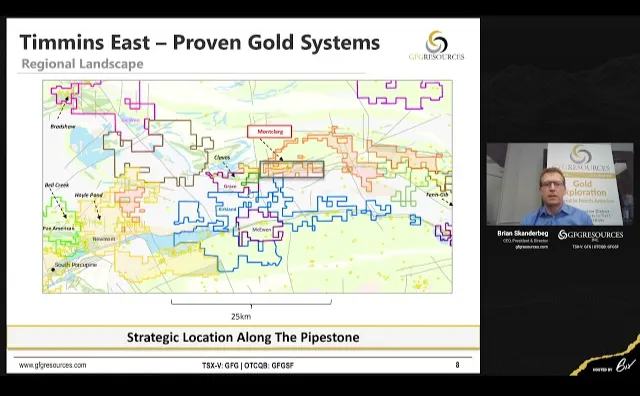
5:13 Now backing up a picture, a step, and looking at the landscape of Timmins. So we've been active in this jurisdiction for about 3 years, and we own one of the largest land positions in this belt, namely Panandore. We're announcing today the acquisition of Montclair Block. This is east of Timmins, about 40 kilometers, and the land position there is about 200 kilometers across. Huge endowment, big systems on every side of us, and work strategically located both along the Pipestone to the east of us with our Montclair acquisition, and to the west of Timmins with the Porcupine Duster going across our Penn Block. This is an area that is extremely well endowed in infrastructure, mines and mills on every side of us. It's not an exceptionally high-grade camp, and I think people have to remember that about Timmins is many of the mines are wondering working there to grab an apple, open pit, or 2 to 4 grams in an underground mine environment. That is the normal grade for this camp, but very, very large gold systems. And you can highlight things like Cautay and Bowerdin and Young Davidson, their mine in the Timmins Camp, and see these are 2, 5, 10 million ounce systems on every side of our properties.
6:25 Focusing on Montclair, you can see we're along the Pipestone break, which is immediately east of Timmins, and certainly very, very strong infrastructure there. So when you pair all these projects together, GFG is continuing to build a presence in Timmins and has now added a more advanced build project in the Timmins camp. Zooming in a little more at the land position, so this is a snapshot of where Montclair sits. The Pipestone Break is along the north of these 2 structures. You can see the main Timmins Camp in yellow, controlled by Newmont. Great to have a neighbor named Newmont. Kirkland Lake also abuts our land position with our recent acquisition here at Montclair. And then some of the smaller names, although they're not irrelevant deposits like Fenn, Gibb, and Mayfair is immediately off the map to the east.
7:15 And then Grace Gold and up into the Bradshaw system is to the immediately northwest of us. So we like this land position. We've always felt we wanted to make more advanced project acquisition in the Timmins Belt. And Montclair is our entry and the addition of a more advanced project east of it. Strategically located along this belt and I think there's very great potential to outline a continually grow the system that is Montclair. So let's zoom in a little more now and talk about what Montclair looks like in detail. So here's the land position we acquired. If you just put a ruler on that, it's about 10 kilometers along strike. And there's about 120 drill holes here historically. The main zones, we break them up into 2 corridors, the NC trend, Montclair, and the Canamax trend, the CX trend.
8:07 So these are the 2 corridors that have been historically tested and outlined with the vast majority of the drilling has been focused on these. One thing I do point out is that almost all the exploration that's been done here was done in the 70s or earlier. Models were different. Sampling was different. Our understanding was different of gold systems at that point. So the system was maybe drilled on broadly spaced centers, relatively shallow, but relatively poorly sampled. And you're going to see that as a theme as we go through this. About 23 holes along the CMX trend. The point is you can see the main deformation zone, the pipe stone break. You can see the stratigraphy north of it. You can see the stratigraphy south of it. And you can see the location of the historic drilling. This is a very fertile system. It's the first thing that attracted us to this area was looking at the core, understanding the system and saying, there's a big gold system of work here, and this is a relevant land position.
9:01 Zooming in a little more detail, and this shows you now a composite cross-section through the 2 main areas of historic work. On the right is the MC prospect. This is hosted in rhyolites and porphyries north of the Pipestone Break. And on the left of this figure is the Canamax prospect, the CX prospect, and this is sitting in a porphyry that's been in place right on the Pipestone Deformation Zone. So a few things to point out here. A, you've got a nice volcanic stratigraphy north, you've got an ultramafic package in the central part, and then you've got the break with 14-point sediments to the south here. There is a number of gold systems at work here. And as we look at this area and think about why we like it, I'll focus in on the MC prospect. This is the historic work done by IEP, which were the vendors of the property and several predecessor companies. Now I'll point out a couple of things.
9:57 Some of these holes are drilled vertically and they're actually sampled reasonably well and you can see some nice composites. 123 meters at 0.75 grams per ton. Nice intercept you can see down in here. And that was well sampled. Now if we go back another vintage of holes and look at these ones in here, these are predecessor holes and you can see they're relatively poorly sampled. We will go back, we will resample these, we see that as great opportunity. System as a whole, the MC prospect, very nicely well-defined in this environment. Down dip holes are poorly sampled and we'll be working to resample those. One of the things that attracted us very much was this footwall system. This is a recent discovery from the more recent phases of drilling in 2016.
10:47 Higher grade, hosted in a different geography, made for volcanic rocks, very much wide open. And we quite like these trends in the footwall environment. And then we have the setting over here at the CX prospect, which is Canamax. So this is a Clavo style setting in place right on the break. Only tested relatively shallow. If you look at the analogy to Clavos, Clavos really didn't become a mine or even a good gold system until 200,300,400 meters depth. So when you stand back and look at this, what I feel is that the systems are quite robust. There are a number of gold systems present and they remain open in a number of directions. So that's a good scale on a cross-sectional view through these ore bodies.
11:32 Zooming in a little more detail, what I'm gonna show you here now is some of the relevant textures and cores that got us excited in looking at this detailed map. So the cross-section on the left shows you the location, the porphyry's in the center of it. Lots of really nice veining. And this was very common theme as we looked at the due diligence here on the historic drilling was that, you know, the system is very well endowed in terms of intense veining. The host rock is extremely well altered, hosted in pyrite, minor amounts of arsenopyrite. And as you go through an individual drill hole, let's just take this vertical hill here, you go through 5 different zones going down a single hole. This is a reflection of what we think is the system. A very nice lower grade porphyry hosted system in the shallow environment. You can see lots of these grades are sort of 1 to 4 gram hosted in quartz-veined porphyry and rhyolites.
12:32 You can drill through that. You cross into the footwall stratigraphy, and you start moving into these mafic volcanic-coasted rocks. These are much higher grade. They are a subparallel system to it, and they are really only discovered late in the exploration history and remain very much wide open along the strike. Lots of 3, 6, 8, 10, 12, 15 gram per ton material in the number of holes down there, very intensely altered, shattered and brecciated host rocks, which is a number of mineralizing events superimposed on them. So we stand back and look at the big picture and say, look, there's a number of zones present here. They've been broadly tested. Some of the historic drilling hasn't been sampled properly, and many of them remain open along the strike.
13:20 As we look to move further to the east on the land position, so I showed you 1 section in the center of it, now I've stepped out about 250 meters away to the east, and this exemplifies What we saw in the opportunity of the system so on this particular section There's only one hole drilled it has good mineralization on it I list the grades on the right side of the map here and the other legacy hole was very much sampled only intermittently, probably drilled in the 40s. And obviously, they were looking at 5 plus gram material at that point as a cutoff, which is very different than where we are now. So this was a step out to the east, led our management to really think there's great potential moving to the east in the system along the MC trend, and it's one of the areas we quite like and will focus on as we advance this project.
14:11 And then let's step to the south. So we looked at the MC trend, now we're looking at the CX trend. This is the Canamax trend. You're on the main pipestone break here, porcupine sediments to the south of us and porphyry and the ultramafic coast rock. So when we look at the rocks here and the cross section that I show you, It's only been tested quite shallow, down to a couple hundred meters. But what attracted us to this setting was the right age of porphyry. This is a 2670, a young or late tectonic intrusive. Those are the ones that are really the source of the gold and most strongly tied to gold mineralization and timbits. And then we have the host rock sediments and we have a setting like Clavos. So Clavos sits about 5-8 kilometers to the west of us. It's an existing resource within grace. It's been a historic producer from St. Andrews.
15:05 Very robust system, extends down to a kilometer depth. I show you some of the cross sections on the bottom here about the setting of Clavos And we see the exact same setting at Canamax in terms of the age of the intrusives, the nature of the stratigraphy and the character of the structure. So we really like this CX trend as well. And we will be exploring this along with the MC trend. So I think when you stand back and look at that, these 2 corridors are saying there's a really relevant gold system at work here. It's been tested only relatively shallowly. We will test it along the strike, we will test it at depth, and we'll use our understanding that we apply to our systems in terms of exploration methodology, detailed structure, detailed magnetics, and in this case chemical stratigraphy is really, really key.
15:56 I'm not going to go into a bunch of details here, but suffice to say this footwall rock and this footwall zone that we see present in the setting in the footwall of the Montclair MC prospect is very much controlled by these iron-rich basalts. These are very reactive lithologies. There's a reason the structures are behaving well and there's a reason the grade is higher down there and it's because the chemistry of the stratigraphy is right. So I just point this out to say we have a good reactive chemical stratigraphy. The vendor of the property IEP, Lionel Bonhomme has done an excellent job of putting the thesis together around why this works to control golden neuronization. Tim Barrett, his consultant to a chemist was very keen on that. So we'll continue to work on building the stratigraphy and applying it to the exploration model.
16:48 So let's stand back now and think about where GFG is going to go with this project. We've introduced the concept of why we like it is, where we are, touch base on some of the historic drill intercepts and cross-section controls and mineralization. So here we show you back to the snapshot of the property again. It's about 10 kilometers along there. We show you the blown up zone, which is the vast majority of historic drilling, so a kilometer and a half of strike length of which the CX zone sits and MX MC zone sit in the middle of it. We see good potential to grow those so on the bottom map we show you some of the green targets and blue and red. These relate to extensions of known zones So the red is this foot wall zone, high grade MC trend, drilled with only 4 or 5 holes. They all hit the zone and it remains wide open along the strike at about 2 to 300 meters depth. Great looking target, immediately step up there and you can drill it. And then you have the direct distal extensions and the long strike extensions of that stratigraphy in blue. You can see them laterally.
17:53 Then you step up to the main MC corridor. We can see these green targets. Now recall the core of this might be drilled on 25 or 50 meter centers, but as you step out laterally, you can step out 100,200,300 meters, and there's only very widely spaced drilling that shows the system's still working quite well. So we will test those lateral extensions. And then we will shift down and look at this CX trend as well, which is along Canamax Porphyry, along the Pipestone Deformation Zone. So these are kind of what I view as the kind of brownfield opportunities, direct extensions and direct depth and strike extensions. Then there's the greenfield stuff. And this project's 10 kilometers. It's enough to have greenfield targets that have not seen any drilling. We like these conceptual targets. They're still early stage, but we will be stepping up to drill some of these as well. In terms of a work program in Catalyst, we're gonna step up here and get drilling very shortly in the next month or so.
18:48 We will drill about 3,000 meters this quarter. And the permitting and these patents are in place to really go and execute this. So we feel pretty strongly that these are compelling, drill-ready targets that we can step up and have good success at. We feel that the historic work needs to be redone and rebuilt and re-logged so we will go back to the old core and re-sample things that haven't been sampled right, do the right chemical analyses that we need to do, and we will apply this entire property with the detailed drilling bag. All this is really driving a further understanding of the system and guiding our drilling. So I think you see the point is that with this acquisition, GFG is able to add some very compelling drill-rated targets where there's a demonstrated robust gold system working already.
19:38 Let's just talk a bit about the deal. The deal is, I think, very logical for GFG. We've worked on this deal for about 6 months with Lionel and we put together I think is a very relevant and simplistic deal for GFG and it works for Lionel. It's a simple equity deal. We give him a million dollars in equity on closing. We have 2 subsequent payments of half a million dollars each on 12 and 24 months to be granted. So a 2 million dollar over 24 months in equity payment to IEP, which is a local, a Timmins based private company. Commitment to spend exploration of about a million dollars over 2 years. What I can tell you is we're probably gonna spend more than that, we're still working on the finalization budget for 2022, but we're gonna get out there and start this year. We have money in the bank to start drilling, and I feel very confident that we're gonna meet this exploration spend requirement.
20:31 We did transfer some exploration credits, so this is just another detail of the transaction where we transferred Lionel some credits and IEP to apply to some of their other properties. And there's a modest royalty granted back to some of the vending and underlying companies that ceded to IEP. So overall, the Moncler deal, we're giving up 5% of GFG's equity right now, and we'll give up another 5% in 12 to 24 months. So it's a simple deal. I think this is a great property to fold into our portfolio. What does it do for us? And why would we do it? It fits our strategy. This team has found gold in these camps before, and our core competencies are working on assets exactly like this.
21:17 It is a strategic land position along a very productive and well-known break, the Pipe Spun Deformation Zone. We pair this with our Pan-Indore properties out west and we will explore these all together. And together we take our team, we expand it modestly, and we continue to push on all these fronts. I like the fact that this system offers scale. It is a demonstrated robust gold system working over a large volume of rock. And it is host to numerous drill targets. When you think bigger picture, this reduces our exploration risk. We've gone from a greenfield explorer with the Panandore blocks, and we've added in something that is a much more advanced project. You have a higher probability of success, and you will, I think, mitigate some of the inherent high risk that comes with pure green field exploration, and you're balancing this with a little more brown field exploration methodology.
22:13 We have the ability to step out there and do this immediately, And it's because it's patented ground, the deal is simplest and we can get out there and already be exploring and drilling this year. So we have a good opportunity to move the project towards a resource in the near term. We've got a lot of work to do on the historic drilling, some modeling and resampling on our side, but there's a good robust gold system working there. And I think it has a significant potential to re-rate this company and add to the catalyst that we already have, which if you're a follower of GFG, you know we executed the deal with G11. You know we've got a great land position west of Timmins that's going to generate catalysts and now you put Montclair into it where you have a much more higher level of confidence in outlining and growing this gold system. So overall, why would you invest in GFG? Look, you invest for people first and foremost.
23:04 But with this team, you get district scale assets. There's now 3 land positions we control in Timmins, Penn Block, the Dory Block, and now Montclair Gold. And you get the G11 exposure, which our partners are trying to bring in-situ mining to gold in the US and in Wyoming. This is a team that has found mines before. We have a very strong ability to finance and we put our money into the ground. And What do we mean by that? Our DNA is about a million dollars here. Everything else goes in with ground. So I think when you look at GFG, you have the opportunity to be part of the next discovery in Timmins and to really be part of bringing in-situ mining to gold. This is a fully funded exploration vehicle that has a lot of catalysts to look forward to in the last quarter of this year and into 2022.
23:54 So with that, I will end the presentation and open up to any questions that you may have. Great. Thanks so much, Brian. So now we're gonna jump right into the live Q&A. So if you do have a question, feel free to submit them now. But to kick things off, Brian, what attracted you to this project? Yeah, when we look at that, Dasha, I mean, we've looked at this project for about 6 months. We've looked for a more advanced project. So our filter is really saying what's the character of system we like, are the rocks right, and do we see great potential to grow it. So I like the fact that you can drill a really thick mineralized package of rocks, you can drill 2 or 3 different zones that have demonstrated scale, but yet I don't think they've been well understood historically. Further to that there's another system in the football and another system further south. So it's the character and scope of the system that attracted us, so it starts with endowment and potential, and then it has to be executable. So getting a deal done these days isn't easy, but if you can find a partner, and a willing partner that wants to do a deal like IEP, they believe in us, they actually approached us with this property and we came to a good agreement. So it starts with the real nuts and bolts of believing in the character of the system.
25:07 Right, absolutely. And then why did you decide to add another project?