Replay available
General Insurance Corporation of India (NSE:GICRE) Q1 2027 Earnings Call
General Insurance Corporation of India (NSE:GICRE) Q1 2027 earnings call, held 2026-08-17. Watch the replay and read the transcript on 6ix.
- Company
- General Insurance Corporation of India (NSE:GICRE)
- Period
- Q1 2027 earnings call
- Date
- Mon, Aug 17, 2026, 8:47 AM ET
- Replay
- Watch the replay on this page · 50 min
On 6ix: 6ix.com/event/general-insurance-corporation-of-india-gicre-q1-2027-earnings-call
Replay
Transcript
Automated transcript · Written by software from the replay's audio. It can mishear names and figures; the replay is the record.
0:00 Ladies and gentlemen, good day, and welcome to General Insurance Corporation of India Q1 FY 'twenty seven Earnings Conference Call. As a reminder, all participant lines will be in a listen only mode, and there will be an opportunity for you to ask questions after the presentation concludes. Please note that this conference is being recorded. I now hand the conference over to miss Nikita Atri from Thank you. And over to you, miss Alfred. Thank you, Ranju. Good morning to all the participants on the call, and thank you for joining Q1 FY 'twenty seven earnings call for General Insurance Corporation of India. Please note that we have mailed out the press release and presentation to everyone, and now you can see the results on our website, and it has been uploaded on the stock exchange as well. In case you've not received the same, you can write to us, and we'll be happy to send it over to you. Before we proceed with the call, let me remind you that the discussion may contain forward looking statements that may involve known or unknown risks, uncertainties and other factors.
1:09 It must be viewed in conjunction with our businesses that could cause future results, performances or achievements to differ significantly from what is expressed or implied by such forward looking statements. To take us through the results for the quarter and answer your questions, we have with us Mr. Itesh Joshi, Chairman and Managing Director and other top members of the management at GIC. We will be starting the call with a brief overview of the quarter gone by, which will then be followed by the Q and A session. With that said, I'll now hand over the call to Mr. Joshi. Over to you, sir. Good morning, ladies and gentlemen, and thank you for joining us for GICRE's earnings call covering the first quarter FY twenty twenty seven. As we begin FY twenty twenty seven, the global reinsurance industry continues to demonstrate resilience supported by strong capitalization and sustained demand for risk transfer solutions.
2:02 While abundant market capacity has resulted in increased competition across certain segments, particularly within Property Catastrophe Reinsurance segment, underlying industry fundamentals remain supportive and continue to provide opportunities for profitable growth. In this environment, portfolio quality and prudent risk have allocation remained key determinants of performance. Reinsurance continue to focus on maintaining risk adjusted returns through selective underwriting and active portfolio management, while investment income remains a meaningful contributor to overall profitability. Against this backdrop, GICRE remains well positioned to navigate evolving market conditions, supported by its diversified business profile and strong financial foundation. We continue to focus on delivering profitable growth, while creating long term value for our stakeholders.
2:52 We now look at some of the key highlights of our financial performance. Gross premium income for Q1 FY twenty twenty seven stood at INR13475.36 crore compared to INR12388.01 crore in the corresponding period of the previous year. Investment income for the quarter stood at INR3265.51 crore vis a vis INR31313.74 crore in the corresponding period last year. Income claim ratio for the quarter was 85.04 as against 90.42 in the corresponding quarter of the previous year. Combined ratio for the quarter stood at 104.88 compared to 106.94% in the corresponding period last year.
3:45 Profit before tax stood at INR2490.25 crore for quarter one FY twenty twenty seven. Profit after tax was INR1922.04 crore for the quarter. Solvency ratio improved to 4.32 as on 06/30/2026 as compared to 3.85 as on 06/30/2025. The quarter delivered a marked improvement across key underwriting metrics, lower claims experience and an improved combined ratio contributed to a meaningful reduction in underwriting losses. The improvement in operating performance reflects the continued benefits of portfolio actions undertaken over recent years and demonstrates the resilience of our business across market cycles.
4:34 As we progress through FY 2027, our priorities remain centered on maintaining portfolio quality, prudent deployment of capital and disciplined risk selection. While competitive intensity has increased across certain markets, we remain focused on opportunities that meet our return expectations and support sustainable value creation over the long term. With a healthy solvency position, diversified portfolio and strong financial foundation, we believe GICRE is well positioned to deliver consistent performance while continuing to support the risk protection requirements of clients across domestic and international markets. Thank you. With that, we now open the floor for questions and answers. Thank you.
5:20 We will now begin the question and answer session. Participants are requested to use handsets while asking a question. The first question comes from the line of Avina Chai with MK Global. Please go ahead. Hi. Good morning, sir. Thanks for the opportunity. One question on domestic Indian market. So what we have seen, I mean, on the fires or other world commercial side, there have been a in the primary market, there have been a steep price decline.
6:15 The cause of this, of course, is the resource support capacity and the kind of a pricing level are far, far lower. Now can you comment on the prevailing market condition if we were to segregate the reinsurance players, say, like GICRE and then you have many of the foreign global insurance branches and third will be offshore and the new shops in New York City. So which of these players have been very, very aggressive that has led to this situation? And secondly, on that, if the experience in terms of the natural or manmade catastrophe continues to be benign that has been at least the last one, two years that has led to this pricing. Do you expect this pricing condition to further deteriorate?
7:10 And second, if you can provide some updates, I mean, rough assessment kind of are the losses from the recent flooding activity, particularly in the state like Gujarat and all, that is going to be material to cause kind of losses to some of the reinsurers or so what will be your assessment of this recent flood related losses in some of that case? Thank you. So starting with your market segmentation in terms of say Indian reinsurers, the foreign reinsurer branches, maybe the GICRECity players and the cross border reinsurers. Given that the global capacity is ample and fairly surplus, the aggressive stance of the reinsurer is all around.
8:00 There may be some nuance to a particular reinsurer's approach, but overall, almost all players have displayed competitive behavior. So that is the first question you put. Second question is that what we expect in terms of the price deterioration or competitiveness. We believe that to the extent the players in the GICRE city will try to scale up their operations, their competitive behavior may continue. But as you also pointed out that there are flood losses, we have to see how soon the figures come in, how the claims develop and what will be the experience of the players all around and whether they react to the claims experience, whether the claims quantum is enough to influence their behavior, I think these are the levers which we need to watch before we conclude anything.
8:59 To the third point regarding the quantum of flood losses, as we usually tell you that it takes a bit of a time before the figures travel to us. In terms of our experience, it has been our stance that whatever might be the market losses, our losses from CAT events tend to be around 30% to 40%. So if there is any estimate available with anyone for any flood event, we could be having participation of 30% to 40%. Avinash, does it help? Yes. Yes, yes. One follow-up, if I may. Now if I see in this quarter, you have kind of grown and retained life insurance piece meaningfully.
9:49 Now historically, I mean, you have been typically more of a general insurance side or insured than life. But last five, six years, you have been growing in life as well. But overall experience on the life side, including that unfortunate COVID year, COVID delta, the life side, you have not been kind of making much kind of a profit. Now in this backdrop, what has led to this kind of growing so much in life? Has the pricing environment been supportive? Or has is it that, okay, in order to gain market share, you have gone a bit aggressive here. So if you can help us understand your strategy around life? I agree with you that we for us, life is a focus area, and we'll continue to grow.
10:42 Coming to the performance and results, I think it is probably too short a period to judge on this portfolio. We have during various earnings call and also other interactions have indicated the reasons, particularly the, say, result strengthening carried out. So I would suggest that the Life portfolio needs to be watched over a period of couple of years because ultimately, it remains it continues to remain competitive and one has to watch a particular segment over a cycle rather than a couple of years. Sir. Thank you. Thank you. Next question comes from the line of Sanket Koda with M and Despac. Sir, my first question is on overseas combined issues.
11:47 Probably from I seen for many years, for the first time, probably you reported a underwriting profit with 95% combined. And I see bulk of the improvement happened in higher segment, which is a dominant piece in your ROCE business. So just wanted to understand what materially changed in overseas business, which led to this improvement in the O2 segment, whether this is structural transient. And given given you are alluded to the concept pricing competition or the market is still soft and the international markets will be improved as well. So just wanted to understand color here. Hello?
12:36 Yes. Hello. This is Sanjay Mukashi, Chief Underwriting Officer. Yes, Yes. On foreign portfolio, our focus has been specific more because it has not produced desired results in the past. So we are looking at our portfolio class by class. We are also looking at our underwriting guidelines, our underwriting approach, if anything needs to be changed in terms of our past experience. But having said that, I would add that Walter result cannot be an indication of the entire efforts that we are putting in improvement of the portfolio. Let us wait yes, sorry for that interruption.
13:34 And I'm not sure where we lost the line. But just to recap quickly, as I mentioned that our focus has been on foreign portfolio, which has not performed to our expectation and we are looking at every portfolio carefully and taking necessary action. Having said that, I would suggest that a one quarter result may not give an entire picture of what has changed in the portfolio. There is some amount of seasonality in foreign portfolio. And I would suggest that let us wait for further quarters to develop to look at exactly how the portfolio is developing in terms of our expectation.
14:27 Understood, sir. Yes, But just a follow-up, given we were at 120 in last year foreign portfolio and given we started at minus 95%, is it fair to say that there could be at least 10%, 15% improvement in the combined ratio even first quarter is not yet to represent you compared to what we experienced last year? Although we have taken measures on both property and motor, which are our significant portfolios, even aviation, although it is not a significant portion of our foreign portfolio, we are looking at it very closely and taking necessary action in terms of how we can improve the quality of the portfolio.
15:17 I would still say that the first quarter may also involve some accounting entries as well that may not be exactly resulting in the outcome that we expect. We expect the foreign portfolio to increase significantly. At this stage, we would refrain from putting a number to it. Although over three to five years, we have set goals for ourselves. Understood, sir. Sir, but given the prudence, is there largely the reason why overseas business did not grow in the current year because there was an expectation that this recent upgrade, probably your foreign business will do well in the current year.
16:04 But in the quarter, we have declined by 6%. Anything to read there? Yes, it is a reflection of how we are looking at our portfolio. I had mentioned this in the previous quarter results also that particularly in Motor, we have taken corrective measures in the respect of contracts, which were not developing in the desired way. We have taken some hard decision in motor. We are also streamlining our aviation portfolio. We are having a closer look at our overseas cargo portfolio. Having said that, property being the maximum having the maximum share in the portfolio, that is also a focus area.
16:53 So yes, we improve our portfolio, but I would suggest that we wait for further quarters. Understood, sir. And sir, I just want to understand that your domestic, I mean, clearly, there is softness in the fire market. I'm hoping I'm assuming that it would have declined for us to in domestic business. But we still reported 12.3% growth for the quarter, and it seems to be driven by largely health. When I see the combined ratio also, to some extent, it seems to have deteriorated either because of motor or health in the domestic piece. So just wanted to understand where your strategy, whether health, what exactly businesses you're writing, whether you think profitability will be there in this line of business? And consequently, if you can even give me a color, what kind of combined would be there in the aggressive business from a full year perspective, given it has deteriorated in quarter on sequential year on year basis, sorry?
18:03 Yes, you have rightly observed that health we have grown in other than property segment, property being the way on the direct side, there is heavy competition in property segment. In other segment too, there is there are competitive pressure, but our focus has been in growing other than property segment in this particular year. And as far as health is concerned, our focus is more on the retail health segment rather than the corporate or group health segment, where we believe the profitability lies. The nature of health portfolio is such that there is a significant portion of obligatory there.
18:53 So obligatory portion will reflect the market growth and the nonobligatory portion is gets influenced by certain major contracts. If we win those contracts, you will see spike in our health portfolio. And if we don't win that contract, you might see a dip in that particular portfolio. So health, we have been able to write certain contracts, which the targeted contracts, show the growth segment. And as I mentioned that we have been focusing on the retail health care. In motor, yes, there has been deterioration in domestic motor court.
19:39 It is largely from the treaties that we have written in the past. There are competitive pressures on the motor segment, but it is developing to the extent to our expectations. Understood, sir. And just last two points. One, given today morning, IR did give an advisory to the merchants market that you can't give such huge discounts like 99% to the benchmark rate. Given there is an advisory from regulator in the morning in their website, is it fair to say that some people discipline probably in Indian domestic fire market or property market can come back a bit?
20:33 Yes, IRDA has issued a directive on July 22 as well in property segment where they have flagged the rates being quoted on the direct side. We are in touch with insurance market with the insurers, and we are having conversation with them as to what measures they are taking in response to IRDA directive. It is only a guidance. So let us see how the impact will be over next two to three quarters. Understood, sir. And lastly, you just did not answer this question. On domestic, we reported in the quarter 107.5 combined. How do you see full year to play out? It will be better than the last year?
21:21 Or do you think it could be similar given you have cat events and also motor is going be deteriorating for the industry and then you have a pressure in finance entity? The major renewals in the domestic segment are on April 1. And we have used whatever handles reinsurance tools we have, whereby we support the domestic insurers as well as we protect the interest of all our stakeholders. So yes, on one hand, there are competitive pressures in the market. On the other hand, we have taken certain measures on the reinsurance side and let us see how the results pan out. Understood, sir. That's it from my side. Thank you very much for the answer.
22:15 You. Next question comes from the line of Kartik Yanki, an individual investor. Please go ahead. Thank you for the opportunity. Good morning. I have a couple of questions related to growth. I mean, what's the growth that you're expecting for the domestic and international now considering the fact, I mean, a lot of portfolio pruning and all that you're doing. And next question is like, see, we are continuously seeing losses in life. I mean, when are we going to see a turnaround in that portfolio? In terms of yes, Kartik and Sanjay Mukashi here, Chief Underwriting Officer.
23:08 In terms of growth, we have set a target of, say roughly about 10%. It varies for domestic and foreign. In foreign, we would expect a more pronounced growth than the domestic market. That is about growth, but we will also be managing the cycle. There are soft cycle and taking a review mid year this year as to what should be our whether growth target needs to be relooked, needs to be revised based on our experience midyear. In terms of losses in Life, as our CMD sir in his opening remark mentioned or in one of the answers to one of the questions he mentioned that LIFREE results need to be seen over a cycle rather than for a short period of time.
24:11 Our strength remains what we have earlier advised that in domestic market, despite the competitive pressure, our goal will be to maintain our market share. And on foreign side, to the extent we have got our rating back and we are in touch with all the cedents and markets where we lost our business, which we had prior to rating downgrade. So we'll be trying to inch up on all those aspects. At the same time, the pruning will continue and our guidance on overall underwriting performance improvement remains. I completely understand on the foreign part. At one point of time, we had almost INR 18,000 crores of premium coming from foreign portfolio. So that I mean, is it possible to reach that maybe in a couple of years?
24:58 Maybe in next Maybe few not in a couple of years because of the significant softening trends, the same exposure is coming at a lesser premium. But maybe not in two years, maybe three or four years. But then while we have the broader targets and goals and direction, we are not really keen on pursuing those targets at the cost of overall risk return optimization. We are very much focused on return on equity and shareholder value creation. All these targets will be directional, but not driving our decision making. Got it. And sir, the credit rating upgrade to any time lines you have in mind?
25:48 That is difficult to say because there are very, very many factors in terms of the business model, the global softening trends and where we end up in terms of the our financial and business competitive position. Also, there are two major developments which are in the offering, the IFRS and RBC. So it is not really possible to give any time line. But if things go all right, probably one can expect in a period of, say, something like four to five years. Okay. And you had mentioned in some interviews, like, say, you're focusing on the company has to focus on specialty insurance, I mean, rather than going for, say, property in the international market.
26:37 So how big is an opportunity on the specialty part? And and can you elaborate on that part? See, as a global reinsurer, I think the entire global markets are available. It is basically approaching those markets and picking and choosing one's risk selection, one's path in building the risk portfolio, which is so very material. Because if you look at, say, GICRES market, sir, globally, it will be fairly small because this market is essentially dominated by, say, Europe and The U. S. So given the market share that GIC has on the international book, the scope is tremendous.
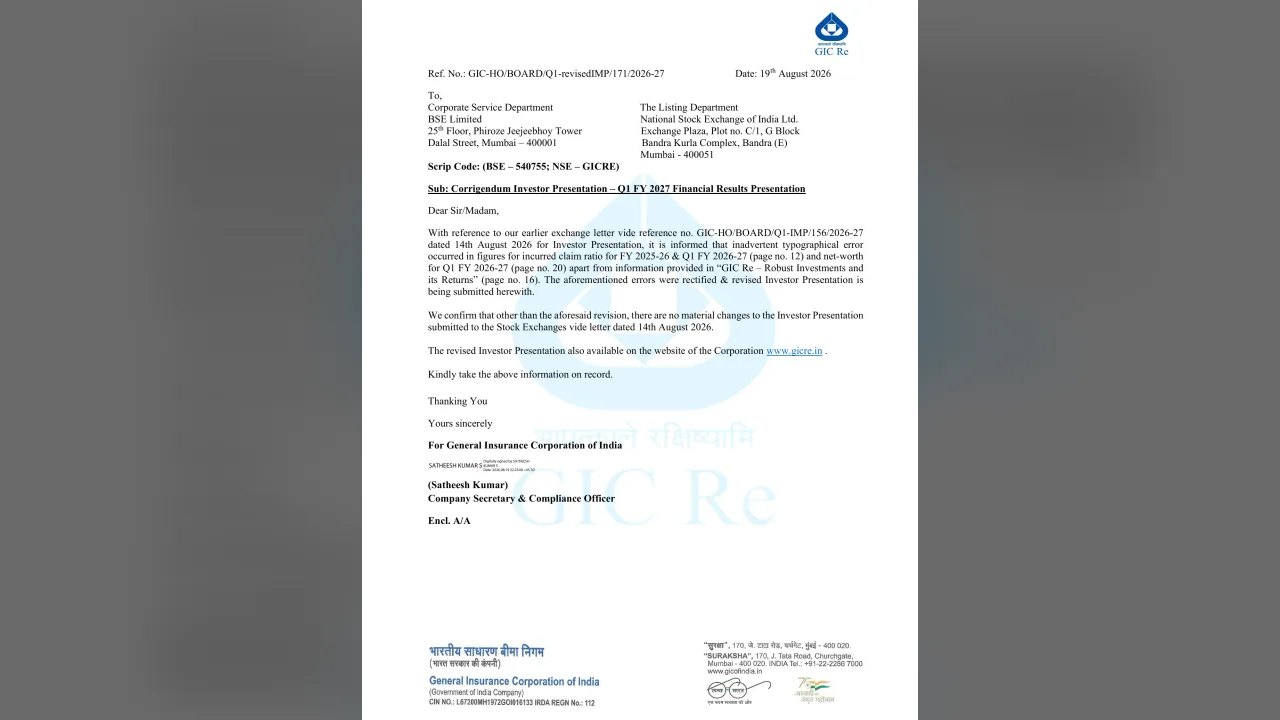
27:25 All the classes, specialty classes, casualty, but it also requires a different level of skill set. So we have to have a calibrated approach and that is what we are planning to pursue. Okay. So one final question. The presentation, whatever is put in the website. Right? The investment slide is is showing the March data rather than the June in data. I mean... We'll correct it if there is a mistake. We'll take a look at it. I mean, that's fine, but I just want to know what's the current investment book like, I mean, from debt equity and money market and all the other part, what...
28:13 What's the current size of the book by end of June? Yeah. Yeah. I'm able to hear you. 73.4% is in the fixed income securities, sir. Okay. Around 17% in equity and around 8.67 or something in money market instruments. So what's the quantum of the book? I mean, it it was like 1 lakh 17,000 crore in the in the March. 1 lakh 20,000 and odd crores on book value basis. Market value is INR 1 lakh 52,000 INR 57,000 So essentially, the share of debt in our book on book value basis doesn't fluctuate much because it is a fairly stable book.
29:09 And we are not planning to reduce our equity share in a very major way, which continues to be around 17%. Got it. Thank you and that's all I have. All the rest. Thank you, sir. Thank you. Next question comes from the line of Janesh Shah, an individual investor. Please go ahead. Yes, sir. Thank you very much for the opportunity. I have two questions. One, first, is with regard to the Gujarat flood, basically, you mentioned that there could be the numbers are still coming. Is there anything we can provide it right now in the numbers in the Q1 results? That is first question.
30:01 Second is, is it a bit on the growth and the profitability you're trying to balance both of it. But it seems like, I mean, a couple of years, for the last couple of years, you've been setting the target, especially on the... How the business mix looks like in terms of an international, you aspire to be fifty fifty. But it looks like we are still on the downhill part of at least on the international side, and there are headwinds to go up in that number. Profitability, obviously, I mean, it's been the job has been much better than expected, and I congratulate on that. But looking at this current environment, your aspiration to reduce that combined ratio by one percentage point every year, how feasible that looks like in this year and the next year for the profitability to perform in the in the business?
31:08 And the third is on the obligatory part. I've seen this quarter the obligatory portion has been around 33% of the domestic book. Is it the new norm that we are looking at that the obligatory side of the book is going to see a lower contribution? Although I've also observed that that has come with a little bit of a higher combined ratio on the domestic side. Usually, you have been around 102,103. This time, it's 107. So if you can give a little understanding about these three aspects, how are these going to shape up in this year and maybe next couple of years for you in this asset?
31:56 Thank you, sir. So to start with Gujarat flood, our provisioning is INR 400 crore plus. INR $4.40 crore. INR $4.40 crore. INR $4.40 crore. That is the provision we have made in the Q1. Thank you for recognizing that there are better profitability trends than your expectation. Fifty-fifty that we talk about domestic versus international is fairly a long term goal. Given that the domestic market continues to be the growth driver globally in comparison to the other global markets. So as you rightly recognized and we agree fully that it is an appeal task. So fifty-fifty is absolutely long term goal. What we are presently targeting with a medium term in view is sixty-forty.
32:44 But again, I mean, our goal will be sixty-forty, but as I said that domestic market outgrows the global market, so it will be a tough job. So we continue to try to optimize the risk return balance, and that is where our entire energy is devoted. As I said that these targets are just targets, they can't drive the decision making beyond the point. Now coming to the 1% improvement, we have further drilled down, and we are now differentiating between domestic book and foreign book. And we would like to have, say, combined ratio target for domestic book at something like 103 and the foreign book at 95 in line with the global markets.
33:37 So that is where the that is what we should be targeting. That is the global trend in terms of the mutual Is there any timeline to it? Timeline, I think we are fairly close to INR103 crores. INR95 crores, again, we feel that probably in a span of two to three years. Okay. Yes. Coming to the third question that we I think you are right that it is our effort to grow our non obligatory book. And I think that is partly getting obvious from the figures. Yeah. But is it is it going to come at the cost of the profitability?
34:26 I think that we have seen, I mean, other other speakers also mentioned that life insurance is a new area, and that's where the losses are still coming in. And if your your experience is very new to it, is that an experiment which we are we are doing to mitigate that mitigate the effect of the non obligatory sorry, obligatory side of the business. Will be mindful of the profitability and I would not at all agree that we are experimenting. Our book in life has been fairly stable at around 20% market share. Now that we are going to focus, it will grow. But it is certainly not an experiment. It is backed by actual analysis and all the analysis that is usually available to our insurer.
35:15 Okay. And lastly, I think, I mean, in spite of all the I mean, that observation, I mean, following this company for last three years and have seen consistent improvement in the performance the company, although the growth rates have been a little bit slower than what I've expected. But in terms of the shareholder returns, it's nowhere near the expectations. You've also been recently, the government has reduced its stake. But it looks like the market is not recognizing the kind of performance which you have, which you've been delivering.
36:02 Is there any thoughts around and of course, the one part which I want to also mention about is the capital. I think the capital is far more... I mean, the the solvency ratio which you're calling is far more higher. And with the kind of performance that you have, it will keep ballooning. Your return on equity is absolutely online. But I'm saying what is lacking here is a growth. I think the profitability is already you've achieved, but the growth is still lacking. And that's one reason why probably it looks like to me that the market is not recognizing. So maybe on two part, one, on your call on the market, is there anything with the management is mindful about having when the the the kind of valuation is being trading in the market? And the second is about the capital.
36:55 What's your plan on capital because it keeps increasing very fast in the absence of growth? So our writing solvency at 4.3 has to be seen in the context of the improving performance. The conservative approach that we have followed because we have come out of a rating downgrade and we are aspiring for now the next level, which is A from A-. At the same time, we also have to keep in mind that we are in the phase of implementation of IFRS and RBC. So and any growth globally in terms of reclaiming our business that we had as A- reinsurer, getting that business back takes time and that is why this entire focus on rebalancing the catastrophe expenses on property side as well as growth in casualty on the international side.
37:49 So we are very much mindful, but I think we will have to be a little patient and our focus will continue to be on more on profitability versus growth on the specialty and global book. So maybe solvency will come down gradually. We don't want to grow at the cost of profitability. Okay. And any thoughts on the shareholder value creation, sir? Thank you. I think we'll continue to be focused on our return on equity and you can expect some improvement. I think when we are talking about 1% overall improvement in combined ratio or say domestic getting targeted at 103 combined ratio and four ninety five over a period of say something like next two to three years, that should give you some idea as to what will be the improvement in return on equity.
38:45 Okay. Thank you, sir. Thank you. Thank you. Next question comes from the line of Saima Ali with JPMorgan. Please go ahead. Thank you for the opportunity. I had two data keeping questions. First was, what is the split of your investment book by market value in terms of equity and debt? And also, second question was if your investment book on the market value basis incorporates your markup for NSE, like your share of investment in NSE? Thank you. Yes, this is Rajika Ravishekar again, the CIO.
39:32 Market value as told is INR 1 lakh 57,800 crores. So that includes only equity, which is around 58,000 crores, but the debt is kept at cost only in hours as it is held to maturity. Okay. Thank you. Yeah. I'll And my second... Yeah. Question regarding NSE. It includes NSE also. Okay. Hello? Thank you, ma'am. Yes. Thank you, ma'am. The next question comes from the line of Shivam Kotari, an Indojil. Sir, please go ahead.
40:30 Thank you for the opportunity. I had a few questions. The first one, was in the investor presentation, and And in that, the slide which explains the net worth excluding fair value change. In Q1, it has fallen from 51,000 to INR 45,000 crores despite us reporting a profit. Can you please explain why has this fallen to network? I think our net sales has only increased. We'll recheck the figures because excluding the network, there is no reason for the excluding fair value, there is no reason for the networks to drop. Exactly, yes, because there is a significant drop of almost INR 6,000 crores from March to June. So I was not sure why it's dropping. We will check and we can come back. If you can share your contact details or maybe contact us.
41:24 Yes, sure. So that's the first question. Second one, I'm seeing the network, including fair value change from FY 'twenty four to FY 'twenty six, and there's largely being flat income from INR 81,000 to INR 84,000 crores. That's been the range, whereas our profits have been almost INR 7,000 to INR 8,000 crores on a yearly basis. So can you help me understand why the network, including fair value chain has been flat despite profits? And if this is the IFRS linked network, then does that mean our ROE at the IFRS level would be like probably zero to 2% range? We are yet to get into IFRS regime for the corporation. And whatever is the change in fair value is only entirely because of the... Fair value changes in quarter to quarter. It is entirely because of the reduction in fair value.
42:15 Which is fine. So I understand it it could be because of your equity market value changes, the investments we should do. But then why is the network, you know, being flat between that 80 to 84,000 level for the last three years despite good profitability. Is it is it good to under... Assume that the profits which we have reported has been offset by, let's say, reduction in the fair market value of the equity investment? That the only is to answer. There is a small reduction. Yes, I agree. What you say is that? That's a significant number that what is flat for the last three years. So Mr. Shiva, are you there? Yes.
43:07 So what do you say is correct? I think almost entire change on the network, including fair value is on account of essentially market value changes. And you are right in including the profit or whatever is financial performance, changing the network. So the only variable which is moving this is market value, fair value. Okay. Which also largely be from equity because the other fixed income instruments would not really have a falling value? We only mark to market and consider fair value for equity, not for debt. So the entire explanation has to come from fair value. Okay. But it's quite a significant number. So it would be good to understand maybe next time the details around that why as the cycle review.
43:55 Sure. And last, our Q1 performance in terms of consolidated profitability that came lower than the stand alone profit. I really missed the first part of the transcript call. So can you explain which subsidiary is causing the loss and what was the loss reason? It was loss per se. This is Rajiv's slide, CFO. There is no loss per se, but the profit has decreased basically. For AIPL, this has decreased by almost 5060% decreases there in their profit for this quarter.
44:40 So this is very first quarter, so it's not the real indicator for the full year. And other associate companies, we have seen some losses also. And for similarly, for other subsidiary companies, there are some changes actually is happening in the very first quarter. That's why this figure is a little lower. Okay. So for the guidance for the entire year at a consolidated level, would still be growth in terms of profitability? I want to know subsidiary company wise. North Africa, we have shown INR $2.87 crore loss during this quarter.
45:30 And MOSCO, some INR 29 crore loss from the subsidiary. That has resulted into the lower figure compared to last year in consolidated operating profit. Okay? Thank you. Next question comes from the line of Anushree, an individual investor. So my question is just a very plain one on the business. So as we could see from the financials and annual reports that the company has been growing share in its health insurance business.
46:23 So as we speak very macroeconomically, obviously, the medical costs here in India are rising, and that is one reason I mean, the predominant reason why we see the health insurance sector that to be like riding a lot of premiums. And yes, so my question is, so an increased business in health insurance can bring a lot of reinsurance business for the company. But doesn't it mean also a lot of clients could be settled, a lot of clients can actually come in and why we are the focus is on improving the underwriting I mean the combined ratio. Doesn't the growing business in health insurance means a lot of claims could come in and then that could affect the profitability?
47:14 Anushree, this is Sanjay Mukashi, Chief Underwriting Officer. Your observations are right that health insurance is growing due because of medical costs, but health insurance is also growing because lot many new buyers are buying health insurance. With regard to your specific question, whether the portfolio growth can bring more losses, the answer is on reinsurance side, we are focusing more on the retail segment rather than the corporate or group health segment. And our observation, our analysis shows us that it is this segment which is more loss prone and retail a better performing segment. With this measured and calibrated approach, we hope that the whatever happens on the direct side, we get protected on the reinsurance side. Hope that answers.
48:21 Yes, guys. Thank you. Ladies and gentlemen, as there are no further questions, we have reached the end of question and answer session. I now hand the conference over to the management for closing comments. Thank you all for joining in. And as we have explained and we have elaborated on our philosophy towards the business, that profitability will be the driving factor as compared to the growth. And we have now further subdivided our targets for domestic underwriting combined ratio and foreign combined ratio.
49:09 So we hope to do a much better job going forward in line with what we have been doing. Thank you for engaging. Have a good day. Thank you. On behalf of General Insurance Corporation of India, that concludes this conference. Thank you for joining us. You may now disconnect your lines.
Follow General Insurance Corporation of India into a list and get an email when it puts out news.
Latest news releases
- NSE:GICRE — General Insurance Corporation of India has informed the Exchange regarding a press release dated October 30, 2026, titled "GIC Re announces Financial Performance for the period ended 30.09.2026". · Fri, Oct 30, 2026
- NSE:GICRE — General Insurance Corporation Of India Press Release Aug 13 2026 · Thu, Aug 13, 2026
Companies on this call
Speakers
Itesh Joshi
Chairman and Managing Director at GIC
Avina Chai
at MK Global
Sanket Koda
at M and Despac
Kartik Yanki
individual investor
Janesh Shah
individual investor
Saima Ali
at JPMorgan
Shivam Kotari
at Indojil