Ashmi Shah
at AdFactors IR
Replay available
Gandhar Oil Refinery (India) (NSE:GANDHAR) Q2 2026 earnings call, held 2026-10-28. Watch the replay and read the transcript on 6ix.
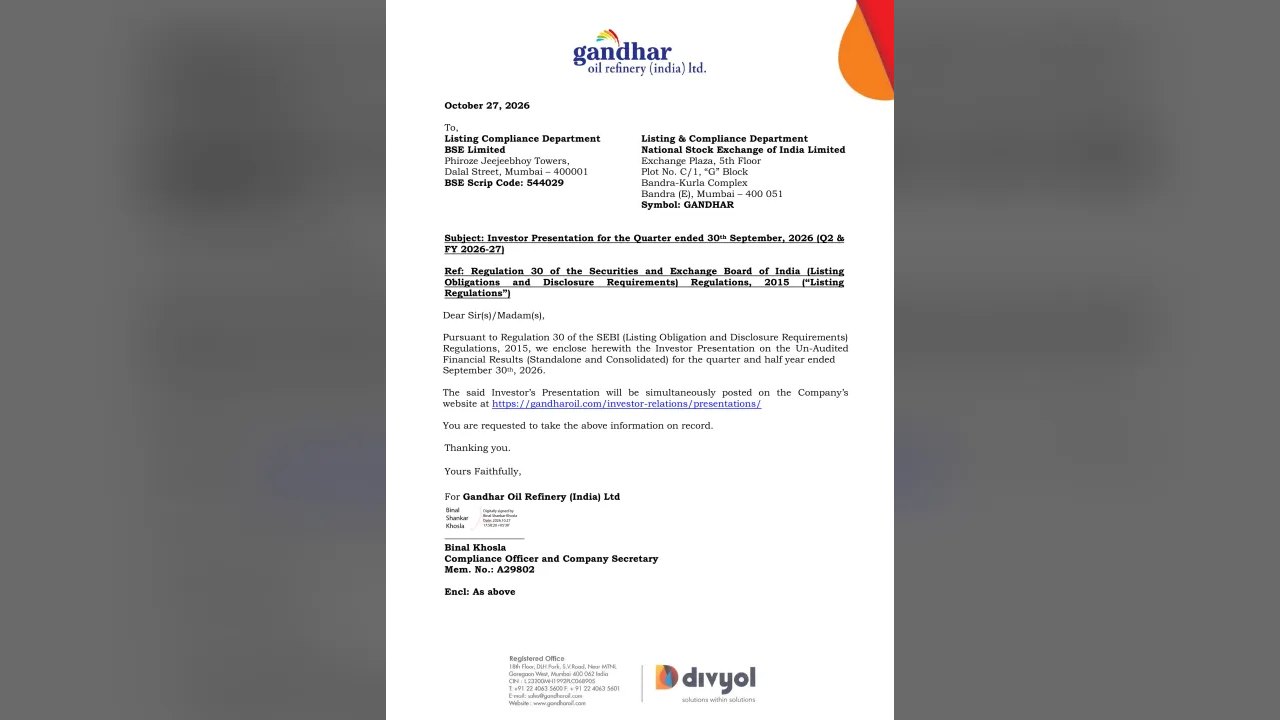
On 6ix: 6ix.com/event/gandhar-oil-refinery-india-limited-gandhar-q2-2026-earnings-call
Automated transcript · Written by software from the replay's audio. It can mishear names and figures; the replay is the record.
0:01 Ladies and gentlemen, good day, and welcome to Q2 and H1 FY 'twenty seven Earnings Conference Call hosted by Gandhar Oil Refinery (India) Limited. As a reminder, all participant lines will be in the listen only mode, and there will be an opportunity for you to ask questions after the presentation concludes. Please note this conference is being recorded. I now hand the conference over to Ms. Ashmi Shah from AdFactors IR. Thank you, and over to you, ma'am. Thank you. Good morning, everyone. On behalf of the company, I welcome you all to the earnings conference call for q two and h one FY twenty seven.
0:46 Today on this call, we have with us from the management, mister Ashish Parekh, joint managing director, mister, chief financial officer. We will begin the call with opening remarks from the management followed by a q and a session. Please note that certain statements made during this call may be forward looking in nature. Such forward looking statements are subject to certain risks and uncertainties that could cause actual results or projections to differ materially from those statements. Gandhar Oil will not be in any way responsible for any actions taken based on such statements and undertakes no obligation to publicly update these forward looking statements. I would now like to hand over the call to Mr. Ashish Parekh for his opening remarks. Thank you, and over to you, sir. Thank you.
1:33 Good morning, everyone, and thank you all for joining us on this call. We have successfully sustained the strong performance momentum of Q1 FY 'twenty seven into the quarter two, delivering yet another exceptional quarter for Gandhar. During this quarter, we achieved our highest ever quarterly revenue and for the second consecutive quarter, maintaining our gross margin spreads at elevated levels, demonstrating the strength and resilience of our business performance. What makes this performance particularly noteworthy is that our profit for the first half of 'twenty seven is already near 3x the profit we reported in the entire FY 'twenty six. This performance reflects the strength of our diversified businesses and our continued focus on value added products. The operating environment during this quarter continues to remain challenging with ongoing tensions in the West Asia and disruptions to the global shipping routes.
2:22 Our key raw material base oil availability and prices remain uncertain and freight and insurance costs continue to affect supply chain planning. In this environment, our long standing supplier relationship and multiple sourcing options proved to be an important strength. We continued with the sourcing strategy that served us well in Q1, buying from a long term international supplier as well as domestic base oil producers. This ensured uninterrupted supply to our customers. Moving to our strength wise segment wise performance, let me take you through the key developments across our businesses. Starting with our PHQ, which is the Personal Care Healthcare Performance Oil segment. The volumes of the first half remained broadly in line with the previous year, although we saw a slight decline in the second quarter compared with the same period last year. This was primarily due to the slower uptake from certain key personal care customers who are facing increased competition from the newer and smaller brands.
3:16 However, demand from the health care and pharmaceutical sectors remain steady. The PFO continues to be our largest and the most important product category, and we remain focused on strengthening our customer relationships and addressing evolving market dynamics. Moving to our PIO segment, the process and the insulating oil segment. This business continued to deliver a very strong performance, with H1 volume growing 23% year on year. The growth was driven by healthy demand from the transformer, power and the rubber industry with increasing electricity demand and continued investment in the power infrastructure in India and globally, we see encouraging long term growth opportunities for this segment. In our lubricant business, volume remained broadly stable year on year, while improving by approximately 9% sequentially compared with our previous quarter. We view this sequential improvement positively and will continue to focus on expanding our customer base, strengthening existing relationships and improving our product mix to support our future growth.
4:12 Turning to our geographical performance. Domestic volumes continued to register healthy Q on Q growth despite price increases. However, export volume had moderated during this quarter, primarily due to the geopolitical developments in West Asia and the impact on the shipping and logistics. The total overseas revenue, including Taxol, stood at INR $17.21 crores, contributing to 48% of the consolidated revenue. While the near term commission remains challenging, exports continue to be an important part of the business, and we remain focused on serving our international customers and capturing long term growth opportunities. Finally, at Exol, our subsidiary in UAE, export volumes were lower during this quarter amid the geopolitical situation in the region and its instability. However, revenue from the unit increased during the quarter. Our focus remains on ensuring operational efficiency, maintaining reliable customer service and managing and minimizing the impact of external disruption.
5:08 We are closely monitoring the development in West Asia, particularly their applications for raw material availability, shipping and logistics. Our installed capacity on a consolidated basis now stands at 838,637 kiloliters. As shared earlier, our Silvasa Unit two was affected by a heavy rainfall and a flood like situation in July this year. Our priority was to carry out required cleaning, inspection and repair work and restart operations safely. Thanks to the efforts of our team, operations resumed in early August. The facility is insured and we have launched our game with the insurance and Mr. Will take you through the financial impact of this specific event. During this quarter, Crystal reaffirmed our long term rating at A plus stable and our short term rating at A1.
5:54 At the same time, our rated bank facilities were announced to INR $11.14 crores. This reflects the confidence of our lending partners and give us headroom to support the larger scale of our procurement and businesses. Looking ahead, our priorities remain clear, deepen our presence across segments, expand into new geographies, move into higher value chain and expand capacity, while we remain mindful of global macroeconomic and geopolitical developments, the underlying demand environment remains encouraging. With a strong balance sheet, robust internal approval and a disciplined approach to capital allocation, we are very well positioned to capitalize on emerging opportunities and create long term value for all our stakeholders. With that, I will now hand over this call to Mr. Indrajit Patacharya, who will take you through the financial performance in a greater detail. Thank you. Over to you, Mr. Gandhar Oil Thank you, Ashish, and good morning, everyone. I will now take you through the financial performance for Q2 and H1 FY 'twenty seven.
6:53 On a consolidated basis, revenue for the quarter stood at INR $18.47 crores compared with INR $10.68 crores in Q2 FY 'twenty six, a growth of about INR 73% and INR $17.32 crores in Q1 FY 'twenty seven. This is the highest quarterly revenue in the company's history. The gross profit stood at INR $3.88 crores compared with INR 130 crores in Q2 FY 'twenty six with a gross margin of 21%. The gross margin spread was approximately INR 29,128 per kl compared with 9,000 per kl in Q2 FY 'twenty six and 28,000 per kl in Q1 FY 'twenty seven. The spread this quarter reflect current market price market pricing supported by disciplined sourcing and our index linked pricing model.
7:49 EBITDA for the quarter stood at INR $2.88 crores compared with INR 66 crores in Q2 FY 'twenty six, a growth of approximately 337% year on year. EBITDA was 15.6% compared with 6.2% in Q2 FY 'twenty six. Profit after tax stood at INR 186 crores compared with INR 40 crores in Q2 FY 'twenty six, a growth of approximately 368% year on year. EPS for the quarter was INR 17.9. For the first half of FY 'twenty seven, revenue stood at 3,579 crores, up 82% on year on year 82% year on year. EBITDA stood at INR $5.69 crores compared with INR 112 crores in H1 FY 'twenty six and PAT stood at INR $3.92 crores compared with INR 66 crores, which is about a 2.9x the PAT for the entire FY 'twenty six.
8:47 The flooding at Silvasa resulted in an inventory loss of approximately INR 21 crores. As this is a onetime event, we have presented it as an exceptional item. So gross profit and EBITDA reflect the performance of the underlying business. We have launched our claim with the insurers and the insurance proceeds will be recognized once they are received. Our financial position strengthened further during the half year. The stand alone company remains debt free as of date. Consolidated borrowings, which relate mainly to trade finance and borrowings at our overseas level reduced to about INR 85 crores as on thirtieth December 'twenty six from INR 168 crores in March 'twenty six.
9:33 With cash and bank balances of about INR 135 crores, we are net cash positive at the consolidated level. Total equity increased to INR $17.71 crores from INR 1,400 crores in March 'twenty six. As Ashwin mentioned, Kisil has reaffirmed the credit rating at credit Kisil has rated at A plus stable and A1. These facilities are predominantly nonfund based and support our raw material procurement requirements. Our strong earnings performance in H1 provides us with significant flexibility in capital allocation. Our priorities remain focused on funding growth, funding growth CapEx largely through internal approvals, maintaining a prudent balance sheet and creating sustainable long term value for our shareholders. We will continue to emphasize disciplined working capital management, operational efficiency and prudent capital allocation while ensuring that our financial strength supports the company's long term growth of objectives.
10:30 With that, I conclude my remarks, and we will now be pleased to take your questions. Thank you. Thank you very much. We will now begin the question and answer session. Participants are requested to use handsets while asking a question. Ladies and gentlemen, we will wait for a moment while the question queue assembles. First question is from the line of Vineet Thakur from PLUS91.
11:15 Please go ahead. Hi, sir. Thank you for the appall... Congratulation in the results. Sir, I noted that we have increased the capacity from five ninety seven to eight lakh something in our PPT. Could you throw throw some color on that? So see, we've been capitalizing our CWIP over the last one point five to two years, which has been enhancing capacity at both the Indian plants. Having enumerated the same, our installed capacity for the Indian plant now stood at INR 602,713. At the installed capacity unchanged of Teksol of INR 235,924, the total installed capacity now stands at INR $8.38 crores, which is the enhancement of INR 240 crores over the existing capacity of INR 598 crores. It's basically on account of the capitalization over the last few quarters of the capital WIP.
12:16 Okay, sir. So then what are you originally aiming this year then? Sorry, couldn't hear So what is the utilization that we are aiming for this year? And what are the utilization this Q2 with the new capacity? I can tell you currently currently, the utilization on stand alone levels is 80%, 82% to be precise. Okay. Consol level is on 61%. Okay. But we can run around 130% as three shifts. So we are operating at three shifts or we are operating at two shifts now? Two shifts. Two shifts. Two shifts. Okay. And sir, what is throw some color on the now the incremental sales volume going forward will give up expansion.
13:10 Your voice is slightly covered. Can you... I couldn't hear the question properly. No, sir. I'm asking. So could you provide color with the sales volume going forward with the West Asia crisis? Are we seeing some decline in sales volume going forward? No, are we going to no. So I'm actually here. I've heard your question. Now see, if you look at the sales volume, we have grown at a volume of around 16% on a stand alone basis year on year, H1 last year and H1 current year. But obviously, since the Dubai plant, the Dexter plant is in UAE, which is basically practically between the state of almost. So which is the capacity, the sales have been affected, which is why you see an overall decline if you consolidate the balance sheet. But yes, I mean, the volumes are going up with the once the situation eases in Dubai as well, we are very optimistic that the lost volumes, the lost businesses will be coming back once the state is opened. But having said that, yes, our domestic our sales from a stand alone basis have increased by around 15% year on year.
14:22 And we confident of taking this forward. Okay. And just to confirm, again, the eight thirty eight is just debottlenecking, there is no new capacity addition? No, no. So apart from debottlenecking, there were investments which was which were done while from the IPO process and also support from some internal approvals, which for which which is just informed, which has a transfer from CWIP to the fixed asset. So that's a combination of debottlenecking and you get new capacity. This is mostly capacity enhancement, Puneet. Okay, sir. Got it. And so just last one question. What would be our guidance for margins this year now?
15:18 Yes, please go ahead. No, sir. Just I'm asking, are you going to sustain these margins for the next few quarters? See, as we discussed, the situation remains what it was when the war had been disrupted in the March in March this year. So when about that, the availability of raw material is still a challenge. We remain optimistic in ensuring the margins that we are currently getting, the gross margin that we are currently earning to be protected in the quarters to come. And so there is three jump in our employee expense also from a usual run rate. There is there there is a 15 crore... 16 crore, which is being paid across the board to everybody.
16:18 Next question is from the line of Pawel from Choice International Limited. Yes. Thank you for the opportunity and congratulations on a good set of numbers. I just wanted to understand that is it possible for you to bring the part of inventory gain that may have come in over the past six months in your business? And if possible, some provide some color on the screen? So we if you see our inventory, we don't have much of inventory, sir. Any inventory gain or loss is insignificant in this entire listing. There is no inventory gain practically. We have been maintaining very low levels of inventory. Okay. And as far as the revenue growth has grown by about double digits, how much of what would be on the back of? Okay. No, that's pretty much here.
17:12 Thank you. Thank you. That all answers my question. Thank you. You. Next question is from the line of Mohammed Farukumar from Pearl Capital. Good morning. Can you hear me? Yes. Hello? Yes, yes. Good morning. Please go ahead. Thank you. Thank you for the opportunity and congratulations. Your revenues and profits have grown like five, five, four, so while your volume growth is in single digit. Could the management quantify how much revenue and profit growth came from higher selling realization, volume growth and better procurement and cost savings?
18:02 The average realization currently is 135,000 per kale, which has grown from close to INR 80,000 per kale at the end of the last year. So there has been an increase. Plus in addition to this, there has been a 16% increase in volume terms from H1 to H1. So it's a mix of both. Perfect, sir. So is the rate currently in October, is this same in 136,000 level or it has dropped or increased? No, no, it is currently in the same region. Around INR 136,000 or anything, no change? The current selling price is around the same INR 135,000 a case.
18:48 Okay, perfect. Second question is, the trade receivable has increased from INR 700,000 to almost doubled. Does the management expect this receivable to decline in the next quarter? Sir, the trade receivable has increased, but the sale has also doubled practically. So what has happened is the trade receivables today is only around seventy days of sales, which was sixty seven days earlier. So it is in of terms of days, it has not increased substantially at all. Correct, correct. Yes. I agree. My average debtor days is seventy, seventy five days. Okay. Yes. Fine, fine. So that will be in the same range in the future also for may come down, yes?
19:36 So the employee expense you mentioned before, that's onetime, yes, that increase or it's going to continue? It's onetime. It's onetime. Perfect. Thank you. And I really appreciate your performance for this quarter. Thank you. Thank you. Thank you. Next question is from the line of Aditya from Genuity. Please go ahead. Hello? Hello? Hi, sir. Good morning, sir. So I have one question. Sir, your spreads in q two were approximately 1,000,000 per kilo liter.
20:21 Sir What? In the month of October, where are they right now? Because the base supply from Gulf is the base supply from the base oil supply from The Gulf is coming back? Yes. Okay. Okay. Yes, sir, please. So what was your question on the spreads? Yes, yes, yes. Spreads in the base oil supply from nickel. Is the around base oil supply? What base oil, see, majority of our supply comes from the from South Korea. That remains uninterrupted. The Gulf suppliers have begun again supplying back to us in smaller quantities.
21:10 So yes, the margins also protected. Okay. Okay. Okay. Okay. And sir, in July, you guided for eight to 11% volume growth for FY 'twenty seven. And in first half, the growth is approximately 1%. So where are we on that particular guidance range? See, as informed in the earlier question, if you look on a stand alone basis, the volume growth has been registered is more than 15%, approximately around 15 odd percent. But because of the Dubai problem, because of the Gulf oil crisis and because of The Middle East and the state of hormones problem, we are not able to get enough raw materials in our UAE facility. So we are trying to mitigate this problem by buying domestically and buying through by using surface transport.
22:02 But having said that, we are trying our level best to ensure the volumes that we had indicated would be we are trying our level best to achieve that volume growth. But obviously, with geopolitical situation, which is absolutely out of our control, we are trying to just mitigate the risk and ensure there is a stability in performance and overall profitability. Okay, okay. So correct me if I'm wrong. So you are trying to say the... In the stand alone business, the volume growth is fine. In the subsidiary, which is the... Which is our current subsidiary, there the volume have been bit lumpy. Right? Yes. Yes. Okay. Okay, sir. And the cash flow conversion in the first half, we generated profits of INR $3.41 crores and the cash from operation is INR 284 crores. Can you throw some light on that particular point?
22:59 It's INR 183 crores, right, the cash flow from operations on a consolidated basis? Yes. So that is exactly it. The cash flow is INR 183 crores. Positive. INR 179 crores, INR 174 crores. Yes, it is. The profit is on the consolidated profit is INR 92 crores and the positive cash flow is approximately INR 179 crores. Remaining cash flow, when can we expect it to convert into with remaining profit, when can we expect it to convert into profit cash? As we go ahead, operating cash flows will also increase.
23:46 Okay. Okay. Okay. Thanks a lot. Thank you. Next question is from the line of Dinesh from KMD Capital. Please go ahead. Hello, Am I audible? Yes, yes. Yes. So there's a slight dip in the margin. Is it because of our overseas subsidiary? Because last quarter, was around 17%, now it is less than 15%? You talk about that? No, margins, net margins, operating margins. EBITDA? No, overall margins are dropping quarter on quarter.
24:32 There is a slight dip. This quarter, we've taken a hit of about INR 21 crores on account of flooding at our Silvasa plant. Has been the only reason why we have taken a bit of where the margins have reduced. Okay. That INR 21 crores in inventory? No. It's not only inventory, INR 21 crores represents if you see the thing, it's shown as an exceptional items after the PVD. That represents loss of stock, contamination of stock and expenses incurred to get the factory up and running again. Okay. Okay. Okay. So that's onetime, right? It's a onetime. Yes. Very much all. We don't expect that every time.
25:30 Next question is from the line of Svesha Jain from ANS Capital. Hi, sir. Thanks for giving me this opportunity. Sir, I have a couple of questions. So the first question is regarding the gross margin spread. So how do you see this, you know, going forward? Like, do you see these high gross margins for next couple of quarters? A, is that? Second, you know, related to this is, like, when do you see this, like, normalizing back to, you know, 8,000, 9,000 levels, like, you know, earlier our gross margin spread were always in that range. You know? So how do you... Like, when do you anticipate margin spread being at these elevated levels?
26:19 So coming back to your first question in terms of the gross margins. As you said, the current gross margins are in the level of INR 29,000 per KL. Obviously, we are quite optimistic. We will continue we are quite optimistic and quite positive in achieving this run rate even for the quarters to come. Q3 and Q4, are quite optimistic. Coming and going back to your second question about normalizing it to INR 8,000, INR 9,000 crores, I think it's your guess is same as our guess. I mean, we never know when the war will be stopped and when the hormones will be open, right? So it's absolutely we are very unclear about it, about when as to when it will happen and how it will happen.
27:06 So obviously, our focus continues to remain on servicing our customers and focusing on our value added products. Understood. Sir, would you be able to give me the volume for H1 FY 'twenty six segment wise? Because I think in one of the slides, you've given the volume segment wise for this year, for FY twenty seven. Yeah. We can we can give it. We'll share it with you. Email. Just send... Just reach out to our investor team, and, you know, they will be able to, you know, help you with the... With your queries. And fair enough, sir. And sir, is it possible for you to share with us the segment wise EBITDA margins that we make, like in PSPO, PIO and Rubrican? No, ma'am. Ma'am, that is slightly difficult because we segment wise, we have it only for gross margin level.
27:58 After that, because of the commonality of the expenses, it becomes difficult splitting them into the various segments of ours. And just a last question. So how about the freight rates now? Have they moved on a higher price compared to last quarter? Or are they on the same range? I mean, how do you see the freight rates now? I mean, so quarter on quarter, if you ask me, I mean, the freight rates have been more or less at the same end, maybe it's a slight increase, but there's not been a substantial movement in terms of rate compared to previous quarter. So we have not seen so many, but only the warrants premium has been added from especially the vessels coming out of the hormones.
28:50 Insurance rates have gone up, ma'am. Insurance has gone up, is it? Yes. Yes. Yes. So these these are passed on, right, to our customers? Yes. Okay. And so base oil shortage is still the same or there is more shortage in the base oil? How do you see that? Probably, there is a supply gap because of refinery closures because of vessel disruptions. So there continues to be a gap between the demand and the supply. So how are we managing? I know you mentioned in your commentary... Yes. Obviously, with our yes, so with our optimal sourcing strategy, we are able to mitigate the risk and deliver the volume and value to our customers.
29:41 But has it worsened the base oil shortage for the across Yes. So I informed you earlier, there has been the shortage ongoing because of the disruption. So the situation still remains precarious, and we're trying our best to mitigate the risk by diversifying our sourcing partners and efficiently focusing on our value buy, even from our domestic suppliers. Thank you, sir. That really helps. Thanks. Appreciate it. Thank you. Thank you. May press star and one on their touch tone telephone. Next question is from the line of from Omni Management LLP. Please go ahead.
30:35 Good morning, sir. Congratulations for a good set of. Sir, firstly, on the increased capacity, the... We have increased capacity in India through debottlenecking and some capacity addition from the IPO proceeds. Right? So by itself, what do you think will be sustainable quarterly or annual run rate for these volumes given the current capacity? This is the first question. Okay. You want to like us to answer that? Yes, yes. So the capacity, like I mentioned, is currently around 82% utilization capacity utilization on an annualized basis. This is from Indian capacity? I'm talking Indian, Indian stand alone Indian plants.
31:23 Okay. Sharjah is impacted. So we expect the capacity utilization to go slightly better in Q3 and Q4 also. But it will leave me enough scope for further additions to my capacity utilization in the next year also. Okay, sir. Secondly, sir, on your gross margins, once the work pulls off, you said you were not going to see margins around INR $89,000 crores, and it will stay elevated. So what is your take on it right now? And do you think that you can sustain margins of, like, $1,415,000 even after the war ends? Currently currently currently, my gross margin is at 29,000 rupees per Okay?
32:13 At the earliest before the war, was about INR 8,009 thousand a kale. Yes, with the if and when the war does settle off, there will be a reduction, but we don't know as to what level it will reduce. By gross margin, I don't think we'll go back to those days where it be INR 8,009 thousand. It might not be 29,000, settle somewhere in between. Sir. Okay. And sir, the last question, is this increase in gross margin is due to which segment? Like is it our PSPO, PIU, which segment is contributing most to this elevated margins? Yes, it's mostly across the board, all our products. Okay. Okay, Thank you, sir. Thank you so much. Welcome.
33:01 Thank you. Next question is from the line of Anirudh Sharma from Aecant Investments. Please go ahead. Hi, sir. Good morning. Am I audible? Yes. Yes. Yes. Hi. Congratulations on the numbers, sir. So I just had a few questions. So firstly, sir, how are you positioning your products against domestic and international competitors, particularly when customers are becoming more sensitive to pricing? How are we positioning? That was your question, right? Yes, sir. Okay. So we the main increase, the fact that my gross margin has increased to INR 29,000 a KL has been because we have been able to pass on the increase and the additional margin to my customers. So the pass on effect has very much worked in our case.
33:56 And the demand for this product is such that in spite of the prices being increased, there has been no reduction in demand. So yes, we've been able to pass it on, we've not seen any reduction in volumes on account of the price increase. Okay. So sir, have you seen any changes in the customer preference? As in do they tend to go towards low cost alternatives? Or... And has this affected the company's ability to maintain its product mix? I don't think... You know, I mean, there is no such low cost substitute as we speak, you know, is available for this specific product. I mean, there are these are all application oriented products that have been manufactured and supplied to our various multinational and domestic end users.
34:43 So there is no such cheap substitute, which is available in the market. And these products are culminated at the high end of research and R and D approvals from necessary customers. So there is no such substitute. Okay. Okay. Understood. One last question from my side. So to what extent can stronger customer relationships and product approvals can help you protect its market share against new entrants? See, obviously, this is more of an oligopolistic market because I mean, because of the sourcing strategies, because of the base oil demand supply, obviously, the availability of raw material becomes a key challenge. And with the new entrant, it becomes all the more difficult because there is no established network in terms of suppliers, in terms of customers. So it is more of an oligopolistic market, as I informed you. So we don't we are open to competition, whatever I mean in the market.
35:43 Okay, sir. Understood. Understood. So, yes, that's it from my side, sir. Thank you for the opportunity. Thank you. Next question is from the line of Prisha Shah from Shah Family Office. Please go ahead. Hello. Good afternoon, sir. Sir, I have couple of questions. Firstly, considering your volume declines of PHPO. So I just wanted to understand, is this because of the weaker demand from the existing personal care customers, or it is because of the increased competition, or possibly because of the change in the customer sourcing pattern? If you could help me with this.
36:33 So, ma'am, PHPO is and still remains our forte, and the drop and the decline in the volumes of PHP was not so significant that will alarm us. Second is that, see, we don't see any huge competition coming into this business because these marquee names like Unilever, Procter and Gamble, others, they kind of are very finicky about the sourcing, their sourcing and their suppliers. So yes, no, it is not something which is alarming and it is not something on which we are losing sleep. And just to clarify, the stand alone volumes in PSO the stand alone balance sheet, there has been a good improvement from 45% to around 50%, 51% in the domestic in the stand alone business.
37:30 Because of the Texsol because of the geopolitical situation and the state of 1,000,000 UAE, there has been a significant drop in the volumes catered from the taxol plant to the PHP of the customers. Okay. Understood. Sir, so that was about the PHP. I also would like to understand more about the PIO volumes, which have grown significantly. So the gains which are coming from Mhmm. And now what is it? Yeah. Yeah. Please worry. What is your question? Yeah. My question was regarding the increase, the strong growth we are observing in the PIO. So I just wanted to understand that these gains are coming from the new customer addition, or it could be because of the deep penetration of existing accounts, or there is a shift towards the higher value application.
38:28 So just wanted to understand the growth in the volumes. See, there has been a robust increase in the demand from the power sector contributed by addition of data centers, increment of the power requirement across the country. So the PIO I mean, in the PIO, we have the Transform Oil, which is primarily used in the Transform Manufacturing businesses, wherein we have registered a growth not only in terms of existing customers, but also new customers. We anticipate this growth to continue with the increased power requirement and substantial reliance on power by the country. So we are quite optimistic and quite hopeful this increment in terms of the volumes from the PIO will continue in the quarters to come.
39:17 Okay. Understood. There were about these were my questions. Thank you so much, sir, for addressing them. Next question is from the line of Ishika from BJX Investment. Miss, you're not audible. Hello? Hello? Yes. You are Go ahead. So, sir, my question is regarding our gross.
40:05 So I just can't understand that we are able to source the oil at higher prices and then pass on it to customer. So why is there so much change in price from 8,000 kl to 29,000 kl? What's your question, ma'am? Hello? What's your question? So why there is so much change in gross margin that is we are earning per kl, like we are sourcing oil at higher prices and then passing it on to customer. So where is this spread coming from? Ma'am, okay. Shash, the spread is basically coming because of our optimum sourcing strategy. So obviously, these are there has been still an increase in the gross margin as we see while focusing on our value added customers and efficient sourcing strategy.
40:53 Okay, sir. Thank you. Next question is from the line of TD from 11H Advisors. Hi. Good morning, and thank you for giving the opportunity to ask. Congratulations to the management for a fantastic result. Sir, I just had a couple of questions. If I have to model the sustainable EBITDA margin for the next, say, two years, what would that be broadly? Number one. Number two, I think our interest cost this year was about INR 14 crores in FY 'twenty six. Depreciation was around INR 30 crores. What do I model that for the next two years given our expansion in all the various segments?
41:47 And what do you see as a resolution for the current ongoing conflict in terms of crude prices? How does that impact the fresh sourcing of inventory on a spread basis? If you can guide for the next maybe two, three odd quarters, if not longer. Those would be the broad two, three questions. If I can come to your interest cost is expected to come down in the future because the SOFR rates have softened. Most of our interest cost is not on account of CC or packing credit. Most of our interest cost is in account of SBLC and the supply spread. So far has softened, although the spreads have gone up, but we expect interest cost to improve slightly in the next two quarters.
42:37 On the depreciation, currently on a console level, we are on INR 9 crores, INR 9.5 crores per quarter. We expect that to be around INR $10.10.5 crores, not much beyond that. What was your third question? Sir, third question was the resolution of the current war situation and sourcing of inventory for the next two, three quarters. At what rate will be sourced compared to the previous two, three quarters? And as a result of that, where do head land towards the middle or end of FY 'twenty eight? If some kind of guidance can be developed on that. Currently, it's difficult to give you like a one year guidance, but obviously, quarter three and quarter four are at least quarter three is a near term guidance for them. We are able to give you. I mean, obviously, we remain quite optimistic in sustaining the margins that we have given across the past 0.5.
43:29 With the elevated pricing of crude, we anticipate the basal hedging also will be on the higher side. And we are quite often saying ensuring that our existing suppliers will be in position to deliver the raw materials that we require for servicing our customers. Understood, sir. And the last question would be if we have any plans to increase the contribution of higher value added products over the next two years, particularly, let's say, things like Transformer Oil, where do you see the management taking the share of those products in the next two years in percentage terms? Yes, yes. The company obviously trying its best to increase the value added products apart from transformer and other oil. So there are new products which are under formulation under R and D. Obviously, we will obviously, but since we are under R and D stage, it will be difficult for me to divulge on more details about the products.
44:28 But obviously, the company is endeavoring to add new products to its portfolio. All right. Thank you. Thank you so much for answering the questions. That's all from my side. All the best for Q3. Thank you. That was the last question for today. I now hand the conference over to Mr. Ashish Parekh for closing comments. Thank you once again for participating in this conference. And at the outset, we'll wish all our investors a very happy Diwali and a prosperous New Year. Thank you. Thank you. On behalf of Gandhar Oil Refinery (India) Limited, that concludes this conference. Thank you for joining us, and you may now disconnect your lines.
Follow Gandhar Oil Refinery (India) Limited into a list and get an email when it puts out news.
at AdFactors IR
joint managing director
at PLUS91
at Pearl Capital
at ANS Capital
at Aecant Investments
at Shah Family Office