Transcript
Automated transcript · Written by software from the replay's audio. It can mishear names and figures; the replay is the record.
0:04 Hello everyone and thank you for joining us today. We're excited to have David Russell, President and CEO of Gallium Gold joining us for this live event. Now I have a few questions prepared to lay the foundation for our discussion, but feel free to ask your own in the chat as we go. Also, if you prefer one-on-one conversations with management, there is a request meeting button at the bottom of your screen if you hover over it. Feel free to request a meeting at any time. Happy to connect you with the galleon management team. But hopefully we can address all your questions today. So for anyone just coming into the West Cache story, David, give us the lay of the land. You're 13 kilometers west of Timmins on the Dust River Porcupine, 100% owned with a resource already on the books. How do you frame what Galleon is and where it sits in its lifecycle right now?
0:55 Okay, that's after being going through this actually in Canada on the Black Fox Project, life cycles are fairly long. Number 1 is we are along the desert porcupine, we're 13 kilometers southwest of town. And they call it the Golden Highway and our project, I compare it with the dome complex, the MacIntyre, Hollinger, Pamar mines. Anyway, those are the big, big mines that had 15, 20 million, 30 million ounces of gold in production. We're very similar, but we're in the early stages of that. And when we look at framing a life cycle, what I think of is many things, usually about 6 different things. The first one is you start with owning the property and exploration.
1:40 And you go from there, which we have roughly about 555 core holes today within at about 360,000 meters. Then you go into the second part of the cycle, which is resource calculation, modeling, and that sort of thing, which we did do. And we modeled out at about 2 million ounces. Then we did a PEA study that qualified roughly 1.56 million ounces, turned that out in 2022, had a great NPV of 387 million at $1,700 goal. Well, today it's well over $2 billion in value. It's just, you know, the luxury of having an increased price. Obviously inflation with that, but that to be taken into account in the next studies. Then you go into the permitting and some of the first stages of feasibility.
2:26 That's really where we are right now. We're fully permitted on our project to take water, discharge water, excavate, go underground. We can do everything with the permit we had. And we started that permitting about 3 years ago, 3 and a half years ago and got it done. I wouldn't say quickly, but within the timeframe that was reasonable with the ministry and they worked with us very well. Now, where do you go from there? Well, the next life cycle is really how many ounces of gold you have, where are you going with your ounces of gold in your next studies? And the next study is really your feasibility level work. That could be more drilling from the surface, which we are doing right now, and we've had some
3:06 great success so far drilling. And you take a project underground. So we've done all the surface work, got ready to take it underground. And that's where we sit today. In the next 2 weeks, you will hear about the ramp system being started and taking underground. That all feeds into a feasibility study. Could be feasibility or bankable feasibility. We'll make that determination as time goes on. But 2026-27
3:30 is heavy on the bankable feasibility or feasibility side. Like I said, we've got the permits to do everything we're gonna do. We will have to go to final permits. And that includes a few things, so getting the final permits, bonding, and that sort of thing, and working with our neighbors, the First Nations, which we have a great rapport with them right now. And then you go into what I call the final phase, phase 6 I call it, and that's building the full mine out. Now we're doing a lot of pieces of that right now with the underground ramp, the surface work, so there'll be a whole lot less work in the final mine construction, which should be about 2028-2029 for us. So that hopefully that answers the question on the cycle of mining here. Yeah, no, you laid a great foundation. You did mention that you've had some great success with the drilling.
4:18 I know there's results in May that confirm great continuity down dip of the planned bulk sample stopes with holes WC26-235 hidden over 5g per tonne across nearly 10m. What did those holes tell you about how far the mineralization extends below what you've already modeled? Well what it told me right away is we had the structural hit. Now whether you're in the rake or the dip or the centroid or out on the edge you're not quite sure till you get it drilled off And that'll come with a lot of underground work and drilling. But what it told me is the systems there, it's got good widths, it's got over 5 grams, depending on how you want to look at it, you could, you know, narrow it down to 4 or 5 meters, and you got about 8.8 grams. And that says the system below or our stope level again, the stope levels are the 150 meter level, the 180 and the 210.
5:09 That's what we'd be developing. These holes went down below that and it was great success and yep, it's there where you are within it. We didn't know and that was May 21 press release. Now, what you may have seen is May 27, press release. And what we did is we use that data and we went further down dip, what 275 meters below the 210 meter level and said, okay, if it's there, I call them the go bigger go home holes. You know, if the structure is not there, it'll destroy what you you theorize, or it'll validate it. Well, we validate it in hole 26237. We have 12.69 grams over 12.35 meters, which included about 16.07 grams, a half an ounce over 9.25 meters. That said, voila, we hit it. We hit the Holy Grail. We've got the continuity And by continuity, what it tells me is, we've got the top of the number 9, and then down, we're going to develop stopes, we had the blank area, then we had what was called West deep, the theory had been that we were connecting
6:17 eventually the number 9 with the West deep, we had no holes for 500 meters in between. So we just stepped out, dropped it way down below and said, Okay, drill it. And we hit it. So we've now hit it in several holes. And you're going to see press releases come out over the next so many weeks that define, you know, what further success if we have. But when you have, you know, a system, we'll call it in this one, we hit 40 meters or 41 meters wide of 4.07, then you edit it down where the hanging wall side is the higher grade. That's where the 12.69
6:53 grams or you want to define it down to 16 grams, your high grade and what that tells me is on the strike of this, we're right on our levels, the 150,180,210, to set up blast-hole open stopes.
7:07 And the reason I say that is you do them in panels. They're roughly 10 meters from hanging wall out that you'll take. You'll do them 30 meters in length on strike, even though the strike may be 270 or 300 meters, you're only going to, you know, step out, let's say 30 meters, and then you go 30 meters in depth on the stokes. But having a width that is so wide, you divide them into panels. So you call it blast open stoping, but it's almost like taking panels across a very wide zone. Never in my career have I worked with direct real veins. Now you can have porphyry
7:40 systems that are very wide, half a mile by quarter of a mile. These are veins. These are veins that run from anywhere from, we'll say, 20 meters to 40 meters wide. That's almost unheard of. The Timmins Camp does have these though, and that's the good news is I think, you know, our comparison to the Hollinger dome complexes, McIntyre, Pamor mines is very valid because we're in the same system, we're in that not far away, And we're getting these big, big vein structures with high grade zones within. So anyway, stay tuned, I guess, for more of those same type of intercepts as we go. So we brought ourselves down now again, 275 meters below the 210 meter level. So you know, we're pushing forward to 5500 meters in depth, meeting up down below with the 800 to 1000 meters in the West Deep that have great intercepts. There are 10-12 meters there too, 9, 10, 12, 15 gram rock down there. So what we can say now is we're pretty sure it's going to tie up. If not, we have an echelon vein system that will flush out as time goes on as we get underground.
8:50 But anyway, it's all good news on the drilling and Leah Page is our VP of Exploration. I can't say enough about her. She hits every target. It is just amazing, you know. She worries and worries and worries that she's drilling the hole, and then pontificates and then sends me pictures of the core and go, well Dave, we hit it. So I just say congratulations,
9:11 you know, she's batting 1000 so far in all our holes. That's awesome. Now besides depth, you also mentioned some step outs. And one thing that jumped out was the mid-south zone running more than 100 meters east of the diabase unit you previously read as the eastern margin. How does that change your picture of the south zone side?
9:31 What it is, is diabase, I'll just explain real quick. The main system is quartz-feldspar porphyry. We have 8 shears within that. And within those shears, you're going to get diabase rocks, and they run more south to north. They may have been fault structures at one time that got rehealed, but they usually wiped out, you know, gold if there was in gold, but use them as markers between either rock units and whatnot. When we're 100 meters away, and you're not seeing any dye base, we do the wave, we don't have any any structures coming through like dye base dykes, wiping the number 9 or the 1011 12, whatever you want to call the south zone. So dye-based is important to measure off of, is what it is, to say, OK, we're 100 meters away, and we haven't seen any dye-based rocks.
10:18 So to a geologist, that means quite a bit. It's all good news for more gold mineralization. Now, you've talked about the footwall and hanging wall consistently given you broad 1-3 grams per tonne envelopes around a higher grade core. At today's gold price, how does that lower grade halo factor into the way you think about the deposit? It's tremendous. You know, what happens is when you model lower grade, it's going to lower your overall grade. And what you do within your modeling and specific mine planning is you go into your highest grade areas. Let's say for mining and panels in the first 10 meters wide on the blast open stopes, 8, 10, 12 meter or grams across 10 meters, we're going to take that first.
11:06 Then as you grade out into the footwall side, you go for the next panel or the third panel, the say from the 10 to the 20 meter from the 20 to 30 meter level, or zone, you'll have lower grade in Halo. That adds to the ounces to your portfolio is what it does. And it's a tremendous addition. Just an example of 1 gram, in our cutoff grades that we used within the PEA study we did was 1.6 grams. Well, now you could probably use 1 gram, mainly because of the gold price. For an example, 1 gram, if your ounces per ton is 0.03 ounces per ton, multiply that by 4,500 US dollars is about $135.
11:49 You multiply or change that Canadian dollars, it's 188 per 1 gram, the cost of mining milling processing should be right around 100 to $120. So profitability on 1 gram is you're pushing probably 60, 70 dollars on that per ounce of gold.
12:09 So that alone says you're going to have a lot of ounces. Like I said in the overall picture, somebody says, oh gee whiz, I have 5 million ounces, but you look and say, what do they really have for the higher grade? You'll have to separate that out and say, well, we got 8 grams for the first million and a half ounces, next million and a half, or maybe 3 grams. Well, it all adds into the economics and when you structure the mining schedule. So if you go into a mine, my theory is number 1, you go after the highest grade ores first. So let's say after the first 5, 8, 10 years, you've been mining the 8, 10, 12 gram rock and you're just making cash like crazy, then later on you're gonna mine the lower grade rocks. Well, the good part, you've paid for your operation, you've paid for everything on that property.
12:55 So then it becomes economic to put that lower grade in there. The other one is on lower grades, we have to watch is how close to the surface are you? Well, we didn't model originally in our PEA an open pit. Could we have an open pit? Right now everything's in crown pillars and says you can't recover it, so we don't count those ounces. We should have probably in that, we'll say the lower grade category, the 1 gram, 2 gram, 3 gram near surface, that will be an open pit someday. So once you finish mining the underground within a certain reach, let's say 50 to 100 meters of the surface probably would be left for the open pit. So that adds major economics. Obviously, it's much cheaper mining in an open pit than there will be in underground. So again, you know, the cutoff
13:43 at 1 gram even is still very economic today, where yesterday, let's say back in 2021-22 when we did our PEA, we used 1.6 cut. That's where the economics cut off then because of the price of gold at 1,700. No, it wasn't bad news. It's still a great project. Well, now it's it's even better. So hopefully that answers the question on, you know, what helps us within grades and cutoffs and things like that. No, no, that's great. Now, there's also the 86,500
14:17 tonne bulk sample, which is nothing to scoff at, is central to the de-risk and plan. Walk us through what that program is actually meant to prove out and why a bulk sample rather than just more infill drilling. You know, there's different thoughts or theories on how you develop war bodies and when you do feasibility work. And, you know, the way I look at it is if you have a deeper seated system, it's very difficult to drill it to a point where you've gone from the inferred category to indicated. That's very important because you may have to be on you know 10, 12, 15 meter centers where now you're really on 25 meter centers. That gets you in the inferred category. So what it says to me is that from the surface you're gonna spend a ton of money, you're only maybe 50 million, 75 million or something to turn it into a PE or from a PEA study into a feasibility or bankable feasibility study. So I opted to do a say, okay, my past history says, if you go underground, you get alongside these or systems, like we're going to do on the 150,180,210, we're going to set larger platforms.
15:26 And we're going to drill on very close space centers. So instead of drilling 500,400,500 meter holes at an angles coming across the ore to turn it into reserve, we're going to drill 50, 80,100 meter holes from underground, and probably do it on 7, 10, 12 meter centers and get it all drilled off. And you'll have a very good understanding
15:45 when you move up in categories with that. So like I said, it's not wrong to say that you're going to drill from the surface. Or if you're going to go underground, it's just what do you prefer and what is going to be the cheaper and the quicker way to do it. And we found that probably in this case, from our experience of the Black Fox project and on the east side of Timmins is go underground, do some underground mining. What that does is to de-risk things and it tells everybody yes the metallurgy worked. There's a lot of mines unless you've done a tremendous amount of metallurgical work, there's always a risk factor. Somebody says,
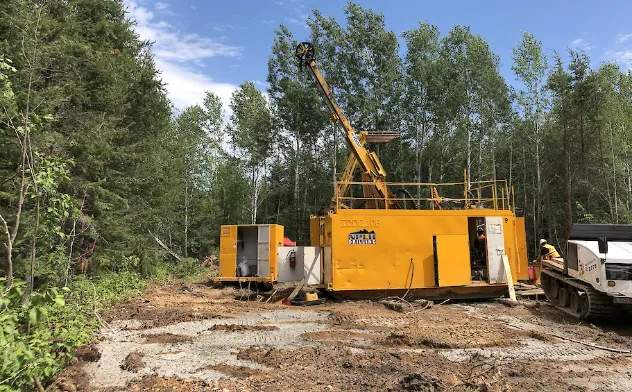
16:20 well, have you milled this ore? Well, we're going to have milled it in the Bell Creek Mill. The Pan American Group, who's our partners, are going to allow us to mill our ore in there. But the underground end of it is very important because on these different levels we will drill off on closed space centers and we'll get a better understanding of what spacing you really need to get it into the right categories for what's called reserves. So to have true reserves again it can't be an inferred, it has to be indicated or better categories. And that's where we're going to go with this project. So stepping through the bulk sample, what we've got to do is we've got the, we'll say the surface, Karon, the actual surface contractor, He's done with the major parts of the surface. He's still got to put our water decamp ponds in. He'll be doing that over the next 3, 4 months. In the meantime, we're using a modified system for decanting water before we discharge it to the Matogome River. But they will actually color the first part of the box cut and they actually started yesterday.
17:22 And that'll be about a 20-day process to go through this. And then by then the contractor, now we've accepted all the bids, We've evaluated, we do have a contractor, we'll release that information to the market in the next 2 weeks, so watch for that. The contractor, I'll just tell you right now, they're local. They're a group that is well-versed in underground mining and shaft sinking and that sort of thing. I think it'd be great for the Timmons camp. And they'll be advancing the 1,250 meter hardcore part of the ramp that probably will say 5, 6, 7 meters depending on what they're doing as time goes on per day. And let's say within about 6, 7 months, we should have that ramp turning toward an area where we can put a diamond drill station in. The ore will be hit probably within the first 9 months on the 150 meter level.
18:14 And we'll do the top cuts on that, deliver the ore to the Bell Creek, they'll stockpile that, and it'll probably be the 12-month mark that will actually start the first stopes or try to drop the first stopes. But it's really about an 18-month project from start to finish on this to get the 1250 meters of ramp, but then you have internal 1250 meters for electrical substations, diamond drill stations, muck bays, different things that you need underground. So roughly about 2500 meters total of work for the contractor on this job. Now, once we get to the point where we're going to build a full mine, tremendous more amount of development, we're talking
18:53 over time, 100,000 meters of underground development to get to all the ore points and be delivering from all the main structures of the big shear structures. So right now we're concentrating on 1 specific area and that's number 9. And that's important because we have a very good understanding. We put extra holes down there to get up to the 8 gram gold grade that we get delivering. So watch for that over the next, we'll say 9 to 12 months, where we encounter the ore, we've done a lot of the work, we've done the drilling underground. So we'll have a much better idea and totally, We'll just say not totally de-risk, but we've de-risked a lot of the plan for the investor, where if you're just drilling from the surface, you don't have real life ramps, development, know what the cost is, what the time frame to mine is, that sort of thing.
19:47 It always will be a question in investors mind. I've been in other projects. Yep, they've got the question. They go, how can you assure me? Well, I'm going to not assure on everything, but I will have a lot of the answers for everybody when I finish this part of the project. That's great. Very thorough response. Thank you for that. I'm going to see if I can extract a couple more nuggets from you just because Bill Gallinger from the chat asked a question and this is an interactive event, so I do encourage other people to ask questions if they have any. Okay. And like I said you you addressed this very thoroughly but maybe I could extract something else. Bill is asking what are the biggest risks you're trying to de-risk through the bulk sample program and where do you see external support adding the most value?
20:35 You know, the most risks right now on the contractor, once he's on site, meeting the goals and objectives. That means 6 meters a day, 7 meters, so you stay on schedule. And that has to do with capital cost structure of the project itself. That's one of the risks. And I manage that, you know, through my team. And you know, they get paid a little extra, if they they meet the goals or exceed the goals, if they don't, then we nick them a little bit. But what I like to do is stay on schedule. So the schedule is very, very important on this one. The other risks that you always take on in ramping or underground development is unknowns. You have a fault structure that comes across the ramp system as we go down or in the drifts, that will be an issue. We don't see that we did a lot of geotechnical drilling.
21:27 And we did RQDs on all the rock and it looks like no structures that we can see in front of us, but you never can believe there may not be 1.
21:36 Mother Nature puts structures in faults wherever it pleases. So as they encounter, we'll have to deal with that. Then as you get into the ore zone, I have to stop just before it. I talked about the zone possibly being anywhere from 10 meters to 40 meters in width. And the interesting part is, you know, the first 10, 12 meters are very high grade from hanging wall site is cut like a knife. I need to get the drill holes through to say, what am I going to encounter as I bring the top cuts of the drifts
22:07 into the ore zone area there. That's a risk, but that's more of a managed geotechnical risk as I set these stopes up. And what we've set up again is roughly we drive across the top cut, but then we only develop down on 10 meters wide by 30 meters. And then we drill down dip to drop the blast open stopes. That's a risk. Did we pick the right configuration for these stokes? That's a very integral part of doing your feasibility work. So if I hadn't done this, and I only drew from the surface, there always be a question of RQD on the rock on the development rock or the RQD on the actual ore itself. On will it hold up? You don't want to get too wide before you backfill stokes next to it and that sort of thing.
22:56 So those are some of the risks that I look at. And then you have a final risk is when you bring the ore out, you go through a crushing and sampling, and then you send it, let's say, to the Bell Creek mill, and they're going to mill it. Is the grade that you modeled from all your sampling from the drilling, blast hole drilling, sampling on the surface, you crush it down to 5H material, sample it very well, go off to SGS labs, and then it goes to the mill. Do those results match what you encounter?
23:27 That's going to be a critical one there. So is that a risk factor? Yes. Is it higher grade, is it lower grade, or is it the grade you project? That was a great question. Yeah, and a great response. Thank you for the transparency. Sticking with Bell Creek, Pan American just announced their 146 million Timmins Camp expansion, and one of the headlines points, one of the headline points rather, is that the Bell Creek mill runs around 4,400 tonnes a day against a 5,600 tonne design capacity. You said you're roughly 7 kilometres from the Timmins West Mine. When you see a major neighbor openly looking to fill spare milling capacity in the camp, how does that shape the way you think about Westcastle?
24:12 Westcastle's path to production? You know, I was doing the wave when I knew they were going to put 146 million into the camp over the next so many years. And that includes drilling development, I think, and shaft sinking. So that's that's a template that says we're in the camp, we're staying in the camp. So the longevity is there. What I was looking for is how many years can I expect to ship ore of mine into their mill before I need to go to some other milling operation or build my own mill? Now if we build our own mill, you're talking another 150 or 200 million capital. I'd rather divert that as long as possible, 3 years, 5 years, 7 years, and use somebody else's mill. Obviously, they're going to charge me a premium to mill my ores. But what the numbers tell me is they're short, roughly about 1200 tons today in their mill.
25:05 And, you know, maybe that's getting worse or better. I don't know. But just in general, they've expressed interest in us by putting money into us. They loaned us 46 million in a line of credit, which we only used 11 million to buy a royalty from Newmont. It was on the property that we have. We have 0 royalties on it. But with that, they've also stepped out, done an $8 million convertible. They also put in 11 and a quarter million on the last equity issue. That is a real, you know, stamp that says we're going to be in the camp. And I was always wondering, you know, what can tell me they are staying in the camp, you're going to stay in business and not shut their operation down where I don't have a mill. Well, them telling the whole world market, they're going to put 146 million in, that's a good postage stamp that said we're in business for the long term. So that really sent a message to us at Gallium Gold that we're going to have a partner with a mill to continue operations for probably many years to come. And I noticed that they were talking about the 46 million being spent between now and say 2029 and 2030, but their operation should stay running till 2040.
26:16 That's a lot of years that they may need our ore in that mill. Yeah, their intentions are pretty clear. On the execution side, you've got the water permit in hand, the box cut started and surface development underway. What are the next physical milestones investors should be watching for as you move from drilling into that bulk sample work? Well, obviously, we're having great success on surface drilling. We'll keep doing that. We have a first 18,000 meter program to finish that should be done probably by October timeframe. Then we'll decide on what's next for us. And that's fully funded. Also, the finalization of the box cut is well underway. Now the surface contractor had to do all the surface work and get everything done before we could actually start the box cut, which started yesterday on the drilling and blasting part of it, they should watch for what point in time does the actual underground contractor take over. I'm just gonna give you a figure of 15 to 20 days, you should hear that we're starting the actual underground ramp. And by the box cut, you've actually got all the surface works done, all the riprap, you got everything done, and you're at the hard rock phase. Now keep in mind the glacial fill was anywhere from 6 to 12 meters over the top of us, that's sand gravel rock that's been taken off, and we hit the final bedrock down below the tree line.
27:36 So if you go on our website, you'll actually see those pictures. And you should watch us when we transition. Then every couple weeks, we'll put a release out that said the contractor got x meters, He's ahead of schedule, behind schedule, even with schedule, that sort of thing. And while we're doing quite a bit of the work in the underground, the Caron group, they're the surface contractors, will be developing our water management plan, which is huge decant ponds. Those decant ponds will take about 4 or 5 months to build, probably a cost of about 15, 16 million. We did project that, that's within the budget. And the interesting part is we're building that for the full mine complex. We're not just building it for this ramp system. So we're thinking way ahead. We brought in power lines.
28:21 We brought in the 17.6 line into the site for full open pit, for full underground, for a mill facility if we need it. So we have the power on site to do that, because we could and we did do that. Now, so a lot of information will come out and for that, but you'll get bi-weekly updates you should be looking for. And then as we get closer to the ore, we'll tell you, hey, we're only 300 meters from the ore, then we'll say we're 200 meters, get ready to hit the ore, that sort of thing and drill it. But should be a lot of data between that the surface drilling, then the underground drilling, that actually is sequenced down in the market. So the next 9 to 12 months are very important for an investor to pay attention to how we progress. Now you mentioned the 18,000 meter drill program.
29:11 A lot of the results still pending on a number of polls. When do you expect this campaign to feed into an updated resource and how should people think about the timeline? Well, you know, I was gonna tell everybody that probably a good September, October, when you're done with the program would be good. I didn't expect to have 100% hits on everything. So now we're gonna have to probably bring in consulting geology people that actually do modeling and have them start looking at the model itself and say, okay, where do we need extra holes? What do we need to do? And get ready for that model. So over the next, we'll say 6 to 12 months, we're going to be, you know, light years ahead of where we are right now with modeling and specific model will be from where we are in the number 9 orbit all the way down a kilometer deep, you know, 1000 meters deep of where the source system are ours. If you project, I'm just projecting out loud here, the strike, let's say you've got 250 or 270 meters of strike, it's 10-12 meters wide, and you project 1000 meter, you can fit 1000001 half to 2 million ounces very easily in 1 horseshoe.
30:20 And when we did the PEA, we have 1.56 million ounces in it. That included 1 through 8 shares, the top of number 9, and then a little bit on the south zone. But we have tremendous potential now to, you know, move the ounce count light years ahead. And again, then we've got to decide is how do we get it to that next step, get it to the from the inferred to the indicated categories. So we're gonna have to do a lot of work. So the 18,000 meters is probably good between September, October. And then after that, we're going to have to have a new plan that we bring to the market and say, OK, globally, we've got X ounces of gold. This is what we need to do to advance this project. And again, it's a mirror image of a lot of the mines that, you know, in yesteryear that operated in the Timmins camp that are still, you know, in operation, the Dome Complex, McIntyre, all of these mines, Tony McCooch at Discovery Silver, he's reactivating everything.
31:17 But he's from Timmins and he knows the camp very well and my hats off to him, he's done really well. But I've got a brand new one. I've got a Greenfields new project for 6 kilometers by roughly 2 kilometers, have never been mined with open pit underground, even though our next door neighbors are 4 kilometers away. That's the West mine been in production over 20 some years. We've got an area nobody's ever mined. And then keep in mind the sand and gravels were over the top of the ore system. The old timers had nothing to bang their rock pick on and say, hey, Eureka, there's gold here. So they bypassed that one. So it was our benefit to look at it and say, hey, is there something here? And there sure is. Exciting stuff, dude. Thank you for taking the time out of your day.
32:05 Let's just do a little closing remarks. That is a nice way to wrap it up. But I know you'll be at the Canadian Mining Expo in Timmins this month. A lot of investors will be going in there weighing their options. For an investor weighing galleon against the rest of the junior space right now What's the one thing about West cash you want you most want them to walk away understanding? What I'd like them to understand is First of all, we're only 13 kilometers from Horton's coffee shop So if you want to pay us a visit, grab a coffee, and 10, 15 minutes later, you're at our site. We're right there. We're on the main trend. We're on the Golden Highway. We have the main structures. You've got to have these main structures there if you want to have the bigger ounces, let's call it. You know, by bigger ounces, I mean the 3 to 5 to, you know, 7, maybe 10 million ounce deposits. Obviously, it takes years to develop those.
32:53 But I'd like everyone to go away with the understanding. We didn't fast track this. We did our homework ahead of time. We put a lot of the permitting in front of everything. We did a lot of the original drilling, the PEA studies. And we ended up with a 1.56 million ounce ore body to start with, with permits in hand. A lot of companies wait and wait and drilling, and they move up to 2 million, 3 million and then they go, oh, now we've got 3 or 4 years of permitting. Well, we learned from history that if you do it with the right structure, the right sequence, you can actually step through the process very well. You're not going to cut any corners. And you also do your homework with the First Nations. We've done all our homework with the people in town, the contractors, the First Nations, and we've done everything right. And we're on the cusp of building the next mine in the Timmins Camp.
33:44 Great. David, thank you so much. For anyone that came in a little late, just a reminder, the replay will be available shortly. And if you do want to still ask any more questions with David or the team, there's a request meeting button when we sign off here. But thank you everyone for joining. Thank you, David, for taking the time out of your day. We look forward to the next update. Thank you, Kyle. And thanks to your team at 6. Appreciate it. Have a good one.