Transcript
Automated transcript · Written by software from the replay's audio. It can mishear names and figures; the replay is the record.
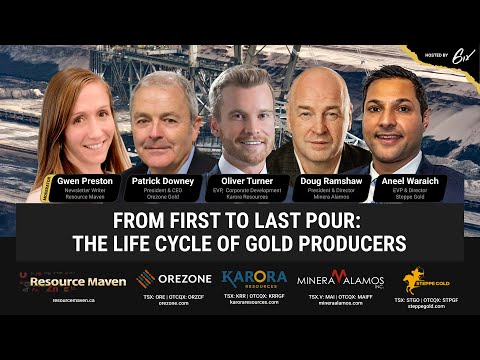
0:08 Good morning or afternoon, depending where you are. Good evening. Thank you so much for joining us. I'm Gwen Preston of Resource Maven, and I'm very happy to be here today Hosting this panel from first to last pour the life cycle of gold producers Certainly, we'll be focusing a bit more on the on the first half of that sort of getting assets from oh We have a deposit through to how do we actually build this thing and then all of the pitfalls that belie such challenges along the way and there are a lot and we've actually had some Unfortunate examples in the market in the last little while of some of those pitfalls So I'm very excited to have this group of gentlemen here with me who have a lot of experience building mines, are in the process of building mines, and or commissioning mines, or have newly operating mines. So lots of experience around this right at hand.
1:01 So without further ado, I'm going to introduce each gentleman on the panel just by name and title and let them take you through what their asset is, what stage they're at, just a few minutes, no slides or anything, but just a few minutes introduction to each asset so we can set the stage of it here. I'm just going in the order of the faces that I see them on the camera. So Doug Ramshaw, who is with the president of Monero Alamos, would you like to kick it off? Sure, absolutely. Like everyone here, We're a gold producer. We specialize in low capex builds.
1:35 Right now, seemingly very smart in the inflationary environment. We're just completing the pre-commercial ramp up of our first mine that's built for 10 million bucks. And the strategy is to build a number of these sequentially. We have PAs out on our next 2 projects, hopefully bringing on the second mine early 2024 and the 3rd mine probably 2026 to build a growth profile
2:01 of 150,000 ounces plus, but not putting all our eggs in 1 basket, that often with scale means the scale of your capex overruns and cost inflation can be directly proportional to that size of project. So happy to be here today Gwen. Fantastic.
2:21 Next in my list of names here is Patrick Downey who is in a similar stage in terms of operational readiness with Orzom. Pat do you want to give us a rundown on what you're up to? Yes, thanks, Gwen. Yes, we're just finished building the mine. It's in West Africa, Bikini Faso. We built it under budget on time, which was a fantastic achievement in the current environment. And hopefully we'll be talking about some of those issues as we go forward. We will be producing Gold next year, commercial production, at this quarter, full production next year, probably around 130,000oz to 150,000oz from the oxides. And then like Doug, we've got a staged approach to our development. We have our underlying sulphides, which we're drilling right now, sort of unusual to be drilling exploration holes during a construction period, but we were able to do that. So we're planning our next expansion right underneath our current development.
3:19 It'll be a brownfield, so again, it'll be less capex per produced ounce. So quite exciting times for us. You know, obviously, it's difficult to do this in these days, and we talk about some of those issues. And again, there's risks involved. We're in West Africa, we're in Burkina Faso, so you've got to overcome all of those things while you do this. So that's sort of where we're at.
3:40 Fantastic. Oh look, coffee's being delivered to me, how lovely. Next up is Oliver Turner with Karora Resources. Could you give us a little view into what you guys are up to? Yeah, absolutely. And wonderful to join everyone here. So at Karora,
3:56 we're actually a little bit further down the curve, but sort of a multi-mind story here. We restarted a past producing operation called Beta Hunt several years back and it really turned that asset around and producing about 120,000oz to 135,000oz. This year we are also working on an expansion of that asset, bringing it up to probably about 160,000oz to 170,000oz as part of the overall plan of growing to 200,000oz. And we've certainly been navigating some tough capital environments in Western Australia with respect to the impact on supply chains and COVID. So we're happy to talk about that and how we've navigated through that. Happy to say it's on track and under budget, which also feels weird in the current environment, but is wonderful to say. And then we're kind of building a new mine within a mine. So we've actually got a nickel operation, very, very high margin nickel operation that we're actually building inside of Beta Hunt as well, which will help to drive down some of our all-in sustaining costs. So several projects on the go, expansionary and restart, but it's been an interesting period to do it in. Absolutely.
4:58 We certainly have good, a wide jurisdictional representation here, So I think it will be really interesting to discuss that in a bunch of the questions that we're gonna come up against here. So that'll add to the conversation, which is great. And last but certainly not least from Stepgold when we'll move over to
5:14 Mongolia. Anil Varich, could you give us a little insight into STEP?
5:19 Absolutely, and thanks everyone for joining the panel and of course for the audience as well. STEP Gold is a fairly new gold producer. We're in our phase 1 operation today, commercial production in July, 2020. So in a very tough environment, April, 2020, we started production for the first time ever. And we produced for about 1.5 in that time until now. Obviously, supply chain issues have hit us and COVID has also hit us. During that time, while producing, we've actually managed to, as well as explore our Sulphide. So similar to Patrick, we have a larger, much larger deposit underneath. It's about 2.5Moz on a resource, 1.6Moz on reserves. And we're actually already starting construction on that expansion, which is phase 2. So while producing from phase 1, over the next 2 years, we'll construct our phase 2 and that'll take us to over 100,000oz at random. Currently about a 10.5-year mine life for that phase 2.
6:13 We'll continue to grow. So we're using that cash flow to expand alongside debt into our phase 2 operation And then we'll continue to explore the country where we have another large exploration license So quite exciting to be in Mongolia during this time Fantastic now even in just those interactions There's so many things I could ask about. But let's open up the discussion with sort of like the biggest question of all, which is sort of what task or item, what thing do each of you see as the most critical, the most important
6:45 in terms of meeting the promise, which is the capital cost and the schedule. Those are the promises that you give investors, right? When you're either building a mine, expanding a mine, transforming a mine, whatever it is, mostly building a mine. What do you think that for single asset operators, what is that thing? What is the standout thing? Maybe it's the thing that keeps you up at night. And we'll go on reverse here. What stands out for you? So for us, luckily, we're very local team. So we have all our staff in country. So we actually managed to operate during COVID when you couldn't get in the country. So the people, manpower, not an issue. Mining, crushing, stacking, building up inventory or process, not an issue. Actually, we have 18 months of ore ahead of us to process. It will last for the next 18 months. So all that's good. Again, it matches supply chain issues. So the reagents that are required to process this oxide ore, that's the issue. That's what keeps us
7:42 awake at night, because without that, you can't produce or generate cash. It's as simple as that. It creates an overhang in your stock. People assume that you have to raise money if you're not in production, like we were for probably about 9 months last year. We avoided that. But that's certainly still a very real issue that is out of our control. That's an interesting, yeah, that's a very specific answer and I think obviously pertinent to the times I was going to get into some of those COVID impacts and whatnot. I know they've been very significant in lots of jurisdictions and perhaps particularly in Mongolia. So that's a little segue into that. We'll get into that in a moment. By the way, audience, please,
8:20 if you have questions to ask this group of, this base of knowledge that we have represented here, please submit them. I will certainly, I'm starting with a few that I have prepared, and then I will absolutely jump into those from the audience. Oliver, what do you say is the critical path item when you're building a mine? Yeah, so absolutely. So for us, again, a bit of a different scenario. We have the Beta Hunt operation, which we've been expanding underground. We're very comfortable with it, with the mining operation and adding a second decline there. You sort of had 2 years of success in ramping up and turning around that asset. So the critical path for our growth plan was
8:54 the expansion of our Higginsville mill. So what we were going to do is take that mill from the 1.6 to 2.5 million tonnes per annum. Now, certainly no stranger to anybody on this call, late last year that expansion had 2 things happening to it. Number 1, capital costs were going up and then number 2, there was schedule risk. We all know about the tight labour markets globally. Well, Western Australia, which is essentially sealed off from the rest of Australia for 627 days, in fact, you saw massive issues with talented laborers, a very, very tight labor market. There's nobody coming in from abroad. So we saw schedule risk there as well. So what we ended up doing was we actually turned around and acquired a second mill. So that extra million tons per annum of capacity we needed, we went out and acquired that earlier this year in April and actually jumped about a year and a half ahead in terms of our milling plan.
9:45 So our priorities are now refocused
9:48 on that underground expansion and trying to accelerate that as much as we can, which we've been able to do. But the rate limiting step in Western Australia still remains that talented labour. It's a hotly contested market for talented labour across gold-based metals, of course, the you know, the iron ore industry and certainly the booming lithium industry in Western Australia. So securing that talented labor for an expanded operation is something that we're very focused on. Yeah, interesting. Okay,
10:17 Pat, yeah a little bit of a different situation from the previous or from Oliver's answer there. Obviously you've just finished building a mine of scale. So what was the critical path item there? Can you limit it to just 1? Yeah, I mean, from me, you know, making sure that you can get things done is about your team. The people that you have around you, how you empower them, that they have the experience in the area, they know how to make decisions. So when things happen, they're ready for it. They actually make those decisions. They help you make those decisions and they get on with it. Things happen in mining. They are always going to happen in mining. And if you don't have the right people who understand what to do, don't panic. Don't make rash decisions. Make proper, well thought out decisions and are empowered to do it. That's what really, in my experience, not just in this mine build, I've built quite a few mines in various parts of the world, including Argentina, Papua New Guinea, Canada.
11:11 And it's always about having that group of people around you who know what to do, have been there before, understand the conditions, understand the logistics, etc. Understand the labour issues and help you make decisions to get the thing done right.
11:25 And don't point the finger at them. You're in there in the room together, you know, when you make the decision, you've made it, get on with it. Gotcha. Yes. I was going to talk a little bit more about people in a bit too. I don't know if it's as tight a labour market across mining as Oliver has been facing, particularly in West Australia, but it is a tight labour market. So I think we'll have a little bit of a conversation about people as well. Doug, what's the critical path for you? Or how it has been? Yeah, I couldn't, I mean, you're gonna talk more labor later. So, but I couldn't agree more with Patty. I always say that the best asset Monero has is our team.
12:03 And that certainly allowed us, because they're Mexican nationals, and even our CEO spent most of the pandemic in Mexico, we didn't have issues with getting people in there. They understand the country. That's the first thing. If you're going into a jurisdiction, you've got to understand it. And there's no better thing than having the people there. But, you know, COVID certainly pushed our timelines. You know, our business model focuses on very low-cap ex-projects. So ultimately, we didn't come in under budget and we didn't come in ahead of schedule because of Covid. But we pre 2020 we were going to build a 10 million Canadian mine. It came in at 10 million US. So given that we built that in the middle of a pandemic, I'd say that's as close to on budget as you could probably have given the circumstances changed so dramatically.
12:55 To Anil's point about reagents, it's kind of interesting because I think A lot of the challenges one had and has to be aware of moving forward are the supply chain issues.
13:09 The Lord Almighty did not give us much water this last year. That was our biggest reagent issue. And yet we still managed to get through that. There's been a huge drought in northern Mexico and Southern California. And so we think about Lyme and cyanide and stuff, but you can build a heap leach nice and cheaply but without water availability. It doesn't matter
13:30 And yet despite only 2 millimeters of rain falling in the first 5 months of the year We still managed to have month on, you know quarter on quarter growth in our gold production So it can't get any worse next year. I guess it can get 2 millimeters worth That was actually the biggest challenge and and it in terms of supply chain it was interesting because We thought there was a lot of news about a big, it was either in Poland or the Czech Republic, a big cyanide producer shutting down
14:01 earlier this year because of energy costs and the like. And I know that a lot of the cyanide costs coming into North America were impacted and there was a heightened cost for cyanide. In Mexico, it's actually all produced domestically. So fortunately in that regard, we didn't see a supply chain issue. We did see a certain amount of price gouging because they can look at the North American market and go, well, you're going to have to pay X amount more up there. So, but I mean, you know, it wasn't material. But I think on a go forward basis, it's very much incumbent on a company to ensure that whilst operations can be going great, You can have a situation where a pump fails. We had this at one point. We were able to track down our contractor needed a pump. The only pump we were able to find out there, please don't ask me what type of pump it was. I just heard the story that we were short a pump.
15:01 We had to go caterpillar in Germany had 1 pump available. We air freighted it over. It's now a point where you know our business model is turning our cash flow into exploring and adding ounces to hopefully add further production. But I think the early cash flow should absolutely be to increase the inventory of all manner of spare parts because that's far more critical missing something which can actually grind operations to a halt than worrying about expiration potential which is always gonna be in the ground. And if it takes 3 or 4 months longer, you know, to actually get round to doing that drilling, that's actually, you know, time well spent in ensuring you've got proper inventories
15:44 to every conceivable thing that might actually be critical to the operation running. I've certainly had that conversation before with the more experienced operators with whom I have chatted. I started that question by asking what lessons you've learned from the experience that you've just had at your own assets. Now I want you to point fingers a little more. If we look outwardly at some of the mismanaged capital builds that have happened in the industry of late, We don't need to talk about them by name, we can if we want, but there have been some very significant cost blowouts, some during construction, some even before construction began with costs ramping up dramatically. As builders, I'm sure you've watched them to some extent, do you think that there is a lesson particular to today that runs through those examples, or do you think that they're all individual things that happened?
16:40 I just, I think it's worth touching base on some of these other events that have taken place. Doug? I mean,
16:51 I think part of the problem, I mean, there are good examples, and I don't think, you know, this is casting stones. You can look at a project like Kote Lake, the Iron Golder building. And this isn't point fingers at them, because they could say the same thing for a number of these big projects, which you're making a determination to start investing in them, because they take years to build, years to raise that money, years to execute on the build. And everything can go right. And then you can enter an economic environment like we are in now with cost blowouts. Now, some of them can be technical issues that weren't addressed early on, But some certainly can be a combination of inflationary pressures now hitting.
17:38 And you know I don't know if it's entirely fair to to look and go well you should have anticipated a pandemic followed by Ukraine, followed by you know black swan after black swan. It was, But unfortunately, what happens is those companies,
17:58 I've said it before in interviews, like poker parlance, are pop committed. You can't just stop. So you've got to look at your asset base and go, OK, there's some tired assets to monetize to help bridge that funding gap. Ultimately, what we've seen with a few of them, which I think is unfortunate for our sector and our investors as a whole as those loyal and patient shareholders that have stuck with company, ultimately it's that last money that comes in, you know, that steals a lot of the value there and it's unfortunate but I don't know, in a lot of cases it has nothing to do with necessary mismanagement.
18:36 Sometimes projects are just built at the wrong time. And certainly I think that's been the case for a couple of them. Pat, what do you have to say about some of these stories of late? Yeah, well, I'm not going to get into specifics but you know the way I approach things and the way I've always seen successful approaches to things and the way I've seen failures is right at the get-go. You know I look at when I'm looking at something I look at, you know, who did the feasibility study? And I look at ratios of things such as EPCM or what's called engineering procurement construction management against total capital cost against installed equipment cost of various ratios that I use and I If they don't fall within that ratio, I'm going, something's wrong here. A lot of it is people not having walked the ground. I mean, really not knowing what they're building. I mean, you know what the subsoil is like. I mean, geotechnical for me is huge. I mean, I'd rather spend an extra $10,000 drilling 2 extra geotech holes than
19:35 say, oh, it's OK, it's good. And particularly the Canadian Shield, you just don't know. It can be right there today and 30 meters below you tomorrow or inside 10 meters, in fact. And I've seen it. When you look up North, it's people like, have they done permafrost design? Do they know all about that? How do they put it in, you know, logistics? I know when we approached Bombori, we looked at all of the quantities, such as concrete, steel, and whatever, and went out and looked at that. We talked to people who had built mines there recently, people like Endeavor who were very open with us and very helpful. What should we be looking for here guys? Is there anything we should be aware of? Is there something we should be, you know, and we got a lot of input into that and about the type of contractors to avoid, the type of contractors to use. You might be a bit more expensive, but it's gonna get the job done. You're gonna sleep at night.
20:30 And, you know, so for us, if you haven't done that type of work, if you haven't got a team, there's no point in having someone who's a fantastic construction manager or project manager who's built refineries in Saudi Arabia for billions of dollars coming to build something in northern Canada that's never seen the sort of weather and the sort of issues and the sort of things that you're just not aware of and the sequence that you have to put things together in.
21:00 So in West Africa it's totally different than Canada because I call it 360 construction. We don't have to put roofs on buildings. We don't have to do. So we hired a contractor who had a big 330 ton crawler crane who could set it in 1 spot and just drop things in. We could, so we paid more for that crane, but we saved on schedule, we saved on installation costs, you know, on all that sort of thing. So get the fundamentals right. Don't kid yourself about things. If there's something, if you're looking at a concrete and it says, oh, it's 4000 meters cubed And you go, well, you know, I was looking at this one on a 43101 and they had like, you know, 9,000m3 and we've got 5. How come we've only got 5 and they've got 9?
21:46 Ask those questions. How come we think we can build it in 14 months when it took somebody 26 months just 3 years ago?
21:54 So, people kid themselves about that and say, no, we're going to do it. And they haven't done the risk analysis. They haven't looked at all the fundamentals. And I can tell you, I worked for 2 great companies in my day that built projects and built them well. One was Anglo-American in the day, and the other one was Placer Dome. And they knew how to build mines, and they had a great team, and they didn't cut corners, and they made decisions, and they made them right, and they didn't overspend, and they built some great mines, which are still world-class mines. And they had a team of people and they knew what they were doing. Right.
22:28 Oliver I think there's probably part of this conversation is a bit of a is the constant balance between wanting to deliver what shareholders and investors want to hear, right? Lower costs, short timelines, and then what the reality is. And I mean, that that's always that sort of inherent in this question, isn't it? Yeah, no, absolutely. And making sure that you're setting realistic expectations that obviously satisfy the market, but most importantly, are based off of sound engineering. So 2 things that Patrick mentioned sort of stick out to me there.
23:03 Before you even put your first shovel in the ground is the level of requisite study. So we've seen several swings at the sort of construction off of a PEA or construction off of a pseudo PFS attempted in this sector over the last 10 years. And there's been a couple of stumbles that have hurt everybody, right? So not trying to skip that necessary engineering and design step, maybe because there's a market window right now to finance your project. I think we've learned time and time again, that at the best of times, this is an extremely tough exercise to build new operations and there's always new challenges that we encounter. So getting the right amount of work done by the right people over the right timeframe before you even begin to finance a project, I think is critical. Some groups have had benefits of having lots of recent data.
23:51 For example, with our Nickel operation at Beta Hind, we're actively mining right there. We have costs from yesterday. So we know exactly what kind of costs we can make into that study. So using that is important. And then the second thing, again, sort of piggybacking off of what Patrick mentioned here is communication. And if that's communication with people in the region that have recently constructed something, or even if it's a communication on your construction site,
24:15 well aware of some operations where let's say individual EPCM or construction groups aren't communicating with each other and maybe have too many of them on site. So do you have a single leadership on site that's managing these groups or is it sort of construction by committee that ends up being a big challenge for a lot of companies. So checking those things off, doing it the right way and look where we're all pressured by investors. We need their funds and their support, but just set realistic time frames, realistic expectations and then if you beat it, it's a win for everyone. Give yourself a chance to be on track. Fair enough. And Neil, lots of answers already. Do you have anything to add about these recent stories and whether there's
24:55 a lesson of late? Yeah, I mean, I'm a technical, so I won't go into any technical issues that some of these startups or build outs have had, but I do feel that some of them have been forced to build, whether it's investor pressure or to keep a role or some roles within an organization. And that's an issue, I think. I think, you know, if you're if you're being forced to build something that you don't want to or aren't ready for, I think that's an issue. And I have a feeling without money, any, you know, some of the the the build outs anywhere in the world that you can point a finger at. There's some of those that were kind of forced, were forced to. And then you saw like you saw last money come in, the investors who've been supporting all the way through.
25:43 There is some cases where actually most of the last capital came in, it came from all the investors. So it's almost like a rights offering. So you're getting the people to double down for the last money in before you open it up. And I've been made aware of some of those from some of the bank relationships I have. So that's not the worst thing. It looks bad on paper when you look at
26:00 it. It looks like, oh, wow, I can't believe this happened. There's overruns and they just diluted all the shareholders. But if it's all the same or majority of the same shareholders coming in, then they're doubling down on their own on their own bet. And there's no issues. But I guess those are my comments. OK. OK, let's bring it back to to our own operations. Our as though I build mines. Anyways, to your own operations
26:25 and talk a bit about the topic du jour, which is of course inflation. And I wanted to ask whether labour cost or overall inflation, how you think those are impacting your operations? I mean, whether it's whether you're in the build or whether this is a go forward type, like an ongoing question, and whether there's any particular ideas that you're contemplating to manage that additional pressure. So what hedging or various different contract opportunities with providers on your site or financing that you wouldn't have expected to do but maybe now are facing because of inflationary pressures. Let's talk about this topic. Anil, what do you have to say about inflation?
27:13 Yeah, so obviously in our phase 1, it was built between 2018
27:18 and it was commissioned mid-2019 in the summer before COVID started, wet water commission. So the costs were kept relatively low. Again, a local environment. Mongolia is a cheap place to do business. We still paying a well above average rates in terms of employment salaries there for the country, so that's good for retention. We're next to China, so we have a logistical and cost advantage versus a lot of places in the world. So we're able to keep costs low and build our first heap leach operation for 25 million US in about 14 months. And so, you know, it all worked out for us in that phase 1 operation. I think phase 2, yep, you're seeing 1 is, yep, certainly inflation exists. It's going to. And the way we can minimize some of those things are, you know, for example, not using diesel for phase 2, but connecting to the grid. And we've already seen that offsets
28:10 the increased usage and costs there, because diesel costs have increased significantly, not just globally, but in our region, given the, you know, we're dealing with, we're dealing a lot closer to the war than anyone else, given we're sandwiched between Russia and China. So, you know, some of those things we've made adjustments on, which we're planning to anyways. So that's that kind of offsets where we see the most. Labor still very solid. These are jobs that are needed. You know, we're a meaningful impact to the community, so they're willing to work with us to have those long-term employment opportunities. So I think, you know, we're managing the best we can, but we are expecting that some things you can't control. You just can't control transportation costs to bring in equipment.
28:55 Equipment, for the most part, has been locked in. You know, while we're doing our feasibility study, we're doing, We're negotiating with our vendors, our equipment providers, for phase 2 over the next 12 months as we're constructing. We locked in prices last year. Stuff like steelworks were priced at the highest price and they've come down. We have some offset I think just naturally going to happen, but there's some things we just won't be able to control. And that's it's really time now, right? If it takes longer to get something on site, I mean, it's going to cost more. And you're going to see that creep up. But there are some modifications we can do to offset it, such as the power upgrade as 1 solution already.
29:35 Fair enough. Oliver, what about inflation in West Australia? Anything particular there that cropped up?
29:42 Yeah, yeah, absolutely. So as I outlined earlier, late last year, we're kind of staring down the barrel of a very significant capital cost increase for planned Higginsville Mill expansion. And then even more concerningly was the schedule risk that we were experiencing. We were told by the EPCM group that we had planned on using that, you know, simply put, they didn't think they could get personnel there on site to start on time. They're working on 2 other projects that were overrunning as well. So, you know, we had to get creative. We've always monitored other assets in the region, you know, from a corporate interest standpoint. We went out, we evaluated 3 mills in the region and our creative solution was simply inflation of our capital expansion have reached a point that it was actually cheaper to go and buy a ready built mill, which was a wonderful solution. And we were able to finance that during the rate window earlier this year.
30:35 So that was a great strategy for us. Some of the other things that we're looking at moving forward, and Neil mentioned it with their project as well, I mean, A lot of Western Australia is that it's great connected, is connected to quite a dirty grid. The Western Australian government's actually pushing a mandate for a very large switch to renewables, but a lot of the mines as well are remote enough that they're not connected to the grid. So our Higginsville asset is entirely diesel gen set power. So we've been very exposed to diesel price increases over the course of the last year. So we've heavily evaluated hybrid and renewable power solutions. And there's all sorts of wonderful creative financing opportunities you can do for renewable and green power solutions from third parties that will construct and pay back through a rate. So we're evaluating all of those right now for the Higginsville solution and then looking at new grid tie-ins on a cleaner grid solution for Beta Hunt. So reducing your exposure to and reliance on diesel, always having that as a backup is something that we're very focused on.
31:39 With respect to reagents, we are in a very large
31:43 Gold mining camp. The Kalgoorlie region really is sort of the nexus of Gold mining, certainly in Western Australia. So we benefit from very large suppliers there. We haven't seen as much squeeze on the region side, but our procurement team is pretty creative when it comes to picking low moments there to grab supplies. So a bunch of different solutions ongoing. The biggest one going forward is that renewable power also has the added benefit of course of reducing our carbon emissions, which is something we're very focused on. So a bunch of moving targets. But the last creative one was acquiring versus building, which was quite creative for us. Pat, what do you think about inflation? Have you had to be creative? Have you had to change plans? How'd that work for you? Well, we haven't had to change plans, but look, you know, we're all going to face it. I mean, you know, as the previous 2 guys, Oliver and Aneel rightly pointed out, fuel is fuel is fuel and you're paying
32:42 the world price for that. So the way I look at it is always looking at what we call our KPIs and key performance indices and what's driving each area and what can we do about it to reduce that cost. I built a mine in Sweden once and one of the things I loved about it was they always looked at how many people handled that piece of rock before it became an ounce of Gold, and how could we cut down on that to make sure that that was much more beneficial to the cost per ounce. We've done small little things actually in that regard, which followed a Swedish example, is just the truck dump. You know, what you generally do is you have to come up, you spot, you reverse, you come in, you come out, you have to go down the same ramp, you come up a ramp at 10% because it's the shortest ramp and it's less capital. We've put in what we call a race course or a race track, so it's quite a shallow ramp and it just goes right round. You see, you come in, you dump and you drive out. So you've cut your cycle time down by about 90 seconds. That's huge in terms of cost, not just time of equipment and it's less trucks, but it's less fuel burn.
33:48 So we brought that into it. And it's a very, very simple solution. Power for us is, you know, we've got a contract for LNG but we are looking forward here and as Oliver rightly said, renewables are, you know, like solar power for particularly West Africa is a huge benefit for us. And so we are looking at with our neighbors, in fact, of how do we put in a solar plant that can serve both. We're not putting in 2 solar plants and that attracts finance. That attracts a company who will put that in for you. So, oh my, I've got a big solar plant and I've got 2 mines to run it off and I've got longer term, you know, this is great for me. So they will look to put that in. Labour for us has not been a huge issue. We don't have a lot of expats but Burkina has a lot of highly trained you know we're the 16th mine to start up there so you've got a lot of highly qualified local people and we've made a huge effort to train our local communities on things. So we don't have to bus them in and out. They're right there for us.
34:51 That type of thing. Inflation in Burkina is different. Like African countries is different. It's a lot of food stuff. It's what you put on the table. They're not going out and buying something in Walmart. It's really about seeds and fertilizers. So we help them with that and try and keep that it's not a pressure on them. And that has really worked for us as well. So that we haven't seen, but it's out there. I mean, you know, so we look at every, right now we're looking at as we ramp up this plant is, you know, how do we reduce the cyanide consumption per ounce of Gold? And we are doing that already. So it's really fine tuning and having people there who've done it who know just, okay, well, this feasibility said 0.2kgs per tonne. Well, that doesn't matter anything.
35:42 Can we do it better? We've changed the charge in the ball mill, but it's actually reduced our cost per ounce produced downstream in terms of power and given us better recovery. So we balance that off. You're always looking at angles. We don't dictate the price of gold unless we've hedged it, and I don't hedge. But what we can do is look at every input cost and where it's at and how do we look at it to make ourselves more efficient. Yeah absolutely, I think we're going to get right back to that with the next question which will be about people who are the ones who can make the things that you just suggested possible. But Doug, I'll give you a chance to talk about inflation and your experience with it, whether it's impacting your plans going forward. I mean, you're building 1 mine and looking to build 2 more. So you're kind of in the middle of it all.
36:29 Yeah, I mean, we're fortunate in, I mean, to everyone's point here about energy cost, we're fortunate in Mexico that how they approach energy is with a rolling kind of three-year average on price setting. And so, sure, over the next few years, energy prices are higher, that rolling average is going to increase. But we didn't get the benefits when prices collapsed not that long ago, but we've been very much insulated from this rise. And so
37:03 I got a slightly different take on this because it's not been all unicorns and rainbows, but operationally our costs have been actually very nice in control. We saw maybe a $16 difference between Q1 and Q2 this year. And that was at a time where I know, I mean, outside of people asking me for the weather report, that seemed to be the most invoked question I get from investors. The other one was, you know, what about your costs? And so we've been very insulated in that regard. And where I think, and we can kind of look at the Santana build, I mentioned it was 6 months, 6, 7 months behind and it did come in slightly over cost by 1 million bucks.
37:50 But that was a kind of a direct result of delays at the bureaucratic level. And time is money. And so you can see inflationary pressures potentially hitting Mexican operations like ours, not so much from the local costs and you know over two thirds of our costs are in pesos, but more if you're going to have delays on getting some of the secondary permits. After you can start building, there are still secondary permits before you can start mining. So 1 needs to be aware of that. We've certainly experienced that to some extent, although all the permits that we have right now have come from the current government. But there were a lot of people that were let go in key departments like Sermanat in Mexico.
38:41 And a lot of unskilled people being brought into roles there that haven't really overseen the process of permitting of mines. And so we can give our best estimates as to and plan for them for how long permitting should be in Mexico, which is a pretty rapid permitting country. But there's always that concern about that time and costs associated with delays. The nice thing about the PEA we just put out, it's funny, I can think back 3 years ago. I tell people we're gonna build a mine for 10 million bucks I think I told you when we're gonna build a mine for 10 million bucks And I'm not sure if you're one of the people that gave me very quick quizzical looks You know raised eyebrows and and the like but we we actually went ahead and did that. And in many ways, our first mine, I think it's fascinating that all the companies here have this staged approach, whether it's multi-asset or just a different expansion phase of their projects, which I think is a very smart way about building growth within a single asset or multi-asset producer.
39:51 The really nice thing about the Santana build is when we came out with our PEA a couple of weeks ago saying we're going to build something for the 30 million bucks, It's a 60,000 ounce a year producer. I didn't have a single person questioning those CapEx numbers. I did have a whole bunch of engineering firms check my LinkedIn posts. They were the top reviewers of it because I'm sure they were looking going how do you build this thing for so cheaply? But all those costs were very much informed by something we've just done. You know, to Patti's point earlier about getting quotes from people who've done the stuff in the region and understand the real value as opposed to kind of a database of numbers that an engineering firm will kick out, is really important. So I'm very happy from a planning perspective, outside of, there's always permitting issues which are outside of your control. From a cost perspective, we've just built something which is where is very much informing our costs moving forward. And and despite that we still added 30% contingency to our capex numbers because I think it's just it's just prudent to do so Just like we ran the MPV and our press release at 10% discount rate Even though the standard for gold companies is 5% I think it's important to show that You know, let's face it. No one's actually giving you money at 5% now nowadays, so you know, they'll give you 5% to take your money off you and your savings accounts, but they're not giving you your project finance
41:22 at 5%. So let's get realistic here. Let's take that into a question about money. Obviously, you guys, well, Doug's going to have to go out and raise $30 million to build this mine, the next mine, sometime in the next, in the future here. Obviously, interest rates are going up, so debt is becoming more expensive. At this moment, equity interest in the markets is very low. It's across broad markets. It's like everybody else is joining the mining party. In this context, as money is getting more expensive, how do you see that impacting how single asset developers or newer developers could or should proceed with the cost side of building mines? Like accessing capital?
42:16 What advice as someone who's been there, what might you do given the current capital environment for trying to build mines? Let's keep our, we're running out of time and I have so many more questions. Doug. Yeah, we're raised, but we'll take debt on to build our second project. You know, we're debt-free right now and the whole point was you get the first one up and running it, it's producing cash flow, it's effectively the equity component to a debt package you put in place for the second one. And I've had this conversation, you know, and well before we received permits, I'll address that in the market by making sure that I have a funding package out there in place, you know, that sees us likely take debt on upon receipt of those permits to build, to remove that concern in the marketplace that would otherwise be there. And the interesting thing when you can build with low capex, you know, with a project at $1,600 gold that has 11 month payback, is I'm more than happy to actually take slightly higher cost money if it ensures they have less covenants attached to it and less hooks into us as a company.
43:25 Because in reality, if it's 20, say it's $20 million in debt that you take on and you're paying 15% instead of 10, it's paid back in a year. The actual dollar difference in interest on that is worth actually maybe paying a little bit more just to have less hooks in you. So you can just be free to do what you do, which is build and not worry so much about the the lender here. And so yeah, I think that's the beauty of whether it's a phased expansion where you can fund out a cash flow for that or you've just got your first mine up and running, and it's producing enough cash that, you know, whilst it can't completely fund the next project, you're more than happy to serve as taking on some very short term debt. I mean, really, for our projects, they're bridging loans rather than what I call like classic debt. So you know I always thought it was a smart business model but I think in light of the current environment it's it seems that much more smart now.
44:32 Pat now that you've just gone through the process, what advice might you give to someone who's looking to finance a mind build? Or to fund? Right, yeah, yeah. Look, it's very difficult. It's a very difficult decision for a junior company because you're sitting there, let's just think about it, you're sitting there, you've got your stock at a certain price, you've got a feasibility study out, you're trying to raise capital and the debt market just isn't there for the type of debt that you want and the equity market isn't there, but you've got to do something, otherwise you're withering the vine or M&A comes along. So it is a very difficult decision to do. We were lucky. I'm just going to tell you, I'd love to put it down to brilliance, but it wasn't. It was luck. And we got a local bank and it's completely covenant light.
45:19 The beauty of it was, we borrowed approximately $100 million at the time, and now we owe under 88 and it's getting less. We haven't paid a penny back yet because it was in local currency. And with a US dollar rate, we're selling our gold in US dollars as far as I know it's actually come down so because it's set in the local currency so we actually are one of the single asset junior companies that's got a negative interest rate in US dollar terms. And that's just luck. It just, you know, you know, just happened to be and it's great for us. But more to the point, we've formed a great relationship with this bank. I mean, they took a chance on us. I mean, they're a local bank and that was a lot of money for them. And, you know, they were the senior lender and, you know, for us to perform and build it and build it on time and under budget and for them to be able to go out every month or whatever they wanted to do because it's only an hour's drive to the site.
46:16 They got great faith in us and now really, really like what we're doing in the team and how we're building things. So for us, the expansion will be done through them. And because we owe less money than we borrowed in US dollar terms, we're able to pay off our debt fairly quickly and for our expansion it will be a combination of debt and cash flow from the from the current asset. But for junior companies I'm telling you, I mean, you know the shareholders can say what they want in a lot of ways but where are you? I mean if you're not building it, you know, people lose interest in you and go to the next story and if you're building it, are you borrowing money at such a cost that it's truly difficult to repay and you look at the cost of the actual debt, some cases it's probably 20%. It depends on all the hooks and things that are in that debt and are you truly able to get out of it. But I think for us as well, and I'm sure for other guys here, it's it's given us M&A opportunity. We're through that hurdle now. Now we really have to look at, you know, what, you know, what's growth? Is growth organic? Or are there other opportunities where we look at other juniors out there and going you know what we should be talking to these guys because they're they're not going to be able to raise the debt or if they do it's going to be horrendously horrible debt and because as you say Gwen the the debt and equity markets aren't there right now for juniors and they've either got to hunker down and live or they've got to do something and hopefully it's not planned yet.
47:42 Yeah, we'll talk to him about M&A and where what the path forward might be in this context for each of you as the next question for sure. Oliver, what would you say about do you have advice for those who need to spend money on building mines or raise money to build mines? Yeah, it's a bit of a catch 22, right? In some circumstances, you're certainly damned if you don't, but you're damned if you do. So I'd layer on 1 other thing to hopefully not do, and that's don't suffocate the economics of your asset with a stream. Often we see that as a sort of a bridge to get through to the next phase. But in the end, it ends up crushing your equity because you're not sharing in a reasonable amount of the economics of your asset. I mean, Again, to steal a phrase, we were quite fortunate in our timing too when it came with when we acquired, originally acquired the Higginsville asset, we used a new lender in the space that never had invested in the mining space. It was 10% paper to acquire the Higginsville Mill, but it was completely covenant light and they're fantastic partners.
48:50 After they did our piece of paper, they figured this mining gig was pretty easy. So, but anyway, we ended up refinancing that with a larger facility right at the beginning of this year. Most of the work was done late last year. And we've always been, we always have the phrase, you know, money is cheapest when you don't need it. So what we figured is, well, we didn't, we didn't need to expand our debt facility. We could refinance it. We were a much bigger company. We're producing serious cashflow right now. We're well covered for our growth plan, but we refinanced that with Macquarie at about half the interest rate we had previously. And then we threw on a revolving credit facility, standby facility, which we have no intention on drawing down, but we knew, you know, if there ever was a stormy day that came forward, we would have that locked in at a much lower rate. Now again, timing was fortuitous. Certainly, you know, 2, 3 months later, you know, the Fed started raising rates and we all know where that's gone.
49:40 So it was good to put that in place. So maybe some advice would be, you know, it doesn't look like there's any sunshine on the horizon right now, but if a window does arrive, you do have to move quickly when those windows are there for sure, and definitely capitalize on those when they present themselves. But it's a tricky situation. We're looking at several assets ourselves. We always are as part of our mandate. You know, where they don't have the balance sheet to move their projects forward, you know, it doesn't make sense to leverage ours. First and foremost, we got to make sure we can execute our own plan and not get too aggressive here. But certainly some interesting opportunities out there as well. Oh, man, there's been so much. There's so many teases here on growth plans. I want to get back to it. But Anil, I haven't given you a chance to talk about lessons learned, advice on capital.
50:27 Yeah, absolutely. So we avoided debt for phase 1 in a very tough environment. We raised equity, the only IPO in 2018 for Mongolia, which is still I would say misunderstood then and still a little bit now even in terms of perception of risk. And we've shown that there wasn't really a risk. We've built a mine with the government support. We did utilize a stream that didn't encumber the upside for our investors because the upside is really on the face too. The small oxide mine only runs for at that time 3, 4 years. Now it's probably going to be 4 or 5 years, but it still generates cash flow net of the stream. But more importantly, we brought a solid partner through Triple Flag. This is a very strong technical operational outfit that supported us from the outset in 2017, buying the asset, diligently building it with us, helping us along the way, and then still being our partner. So they're a very strong partner that we couldn't pay for it, to be honest. So it worked out for us and that's how we funded. And it doesn't encumber the upside of our much larger phase 2 expansion. And in phase 2, we announced the feasibility study late last year, while not in production, production deferral, so the market didn't recognize that. But we added a lot of value and 2 weeks later the the government of Mongolia Sponsored so local again. Just like like Patrick mentioned we were able to receive 60 million us of You know, no bells and whistles cap debt for three-year term 9% interest rate No prepayment penalties That allowed us to move phase 2 forward while not in production. And we did.
51:53 We procured a crusher, we built it. It's actually fully completed in about a week or 2 now for phase 2. It's almost like an $8 million installation and acquisition of new equipment. So we have a very supportive government utilizing local capital. And what we're going to do is refinance and expand that over the next couple of quarters. But we have cash flow and we'll continue to generate cash flow, build up a balance sheet, use that to keep pushing operating cash flow plus some debt to push phase 2 forward. And if the capital is there, which we think it will be in that region, then we'll have a debt package and maybe some prepayment and offtake to fund the phase 2 alongside, just like Doug mentioned, the equity contribution from our cash flow from phase 1. That's our goal. We managed to avoid raising any equity in the last 2.5 years. We own 20% of the company. All of our sophisticated investors have come in at double our current share price.
52:42 So we're highly aligned with them and we're supportive of them. So We're trying to avoid equity dilution at all costs if possible. But everyone will understand if it's the last piece that's required by lenders, we'll see. But that's our plan for phase 2. Okay, this is the last question. I mean, we could continue this conversation for another hour, but as you guys have all made clear, it turns out you have a lot of balls to juggle as leaders of these companies. So we can let you get back to that after you answer one more question, which is what we were just referencing there, which is sort of what's next. And I know you've each talked about what's next for the assets that you own and that you're building and advancing. And those those plans are clear, clearly laid out. But what about the M&A side of things? I mean, often in conversations like this, when I ask juniors about the M&A, the assumption is that we're talking about larger companies being interested in buying you guys, but from what you have all just referenced in the answer to the last question, there is just as much interest from within each of your operations to potentially go out and grow yourselves by buying things. So let's just talk a little bit about that, maybe particular to your jurisdiction and how majors are or aren't interested or who else is operating there. Let's talk a little bit about growth plans from the M&A side of things. Anil, we'll just, we'll reverse one more time. Yeah, no problem. So yeah, so we really are focused in and on Mongolia. That's where
54:12 we think we have a first mover advantage. Our team's worked there since 2009, successfully built and sold a company for 500 million cash back in 2011. Now we built an operating mine, expanding, created jobs, and using that cash flow to continue to grow. It's a country that's relatively underexplored. It's resource-rich, home to world-class assets, discoveries, and mines with Oetogoe. And we want to be the guys focusing on precious metals in country. We believe, you know, there's tens of mines to be built in the precious metal side. We want to be the consolidator, the multi-asset, multi-mine company focused, you know, in Mongolia. We're a local company. Our CEO is Mongolian, half our board are Mongolian, all our employees. So we can continue to grow that and create more jobs, contribute. The government wants to clearly grow gold production from primary sources and we feel That's our role to play here. We have a lot of room to grow. We want to build a mid-tier precious metals company with a resource profile that could be the 5 to 10 million ounces and a production profile that can grow to 300 to 500,000 ounces over time. And using that cash flow from phase 1, 2, and hopefully a phase 3, We do have a large exploration license that we own today that's sandwiched between another company called Ardine. They have almost a couple million ounces and we're smack in the middle.
55:24 That could be our next production center in a few years. So there's, without buying anything, we think we can probably get to a phase 3 in the next 3 to 5 years. Gotcha. All right. Jurisdictional focus. Okay. Oliver, what about, I mean, you guys certainly have several projects on the go already, but if I were to ask you if there were more things that you wanted to take on, or if you sense that there's interest from larger's in you, what would you say? Yeah, so in terms of our own backyard, we're obviously surrounded by sort of the titans of the Australian gold production environment. Goldfields is right around our property. In fact, we're on a sublease on one of their properties as well. So we have been opportunistically active over the last several years. I mentioned the mill previously, but also we acquired the Spargos Gold mine from another company right during the pandemic actually for about $4.5M.
56:14 And that thing is cash flowing very nicely for us right now. So, you know, when valuations move and as particularly relative valuations move in a direction, what you want to make sure is that you've already got your technical work done. So what we do throughout the cycle is assets that we think are high quality with the group that we like, we're always doing work on them, making sure that we're up to speed on what they're doing. And then if market conditions move in the right direction, we'll reevaluate those looks. Ultimately, it's capital deployment. Where's a dollar best spent? Can you get $3 out of your own assets or is there somewhere else where you want to spend your money? We've talked about this Nickel operation, which is wildly exciting. You can achieve $150 an ounce off of our AISC, which means a lot for us. And Doug, I'm not trying to steal any thunder here, but it is a mine within a mine.
57:02 But we're building it for $7M. But that's you know we're kind of cheating because we've got all the infrastructure in place. So but anyway so there's there's great ROIs on projects such as that. We're always looking at what's in the region. And when valuations move in the right direction, you know, we can be more aggressive, but we're on the path of becoming 200,000 ounces a year plus ultimately this sector plays in 2 ways. One is margin, the second is scale. You can get both of those, you can become a seriously meaningful player in larger indices and things like that. So we look at everything. Gotcha. Okay, Pat, I know you have an answer. Yeah, I think it's A lot of great points there. I would say first, there's 3 key things.
57:48 You talk about location, location, location. For me, in M&A, it's discipline, discipline, discipline. You really have to not get caught up on somebody else's asset, etc. Secondly, I think it's important that you really measure it against where you could spend your own dollar in your own backyard and with your own project. So every dollar counts here, so you really have to figure that out. It's all nice and handy saying we've got another asset, we've done another deal and it's a big splashy thing, but really have you looked at it from the point of view of if we bought this and issued equity or whatever, would we get a better bang for our buck doing it internally? But The other key thing is opportunity. I've been involved in a lot of M&A and they've generally been very successful.
58:37 It's looking at something that maybe you see something that they didn't see. I think that I'll give an example. I was on the board of told me that there was a broken down story we turned it around we were doing quite well actually you know it but but we were single asset company in it couple things occurred that you know you don't have to tell the market but tells you boy if this did really happen we'd be in trouble here. And then along came people knocking on the door and we decided to have a look at it and one of them was Silver Standard SSR and I said, why do you want to look at Claude? And he said, well, I want to grow and I got a fish in a pond that I think I'm going to catch a fish in. And there's no point in me fishing in a pond with other guys with motor boats and nets and whatever. I'm never going to get that fish.
59:31 So I have to start somewhere and I have to maybe start here and I think there's opportunity here. And I said, you know, where do you see the opportunity at Clode? They said, well, I think that the mill can perform better. I said, yeah, I think you're right. And then we've got the capital to do it and, you know, and whatever. And we did a deal that was great for everybody, and that's great M&A. I think that it's not just doing it at parity, it's also looking at the other company and going, what are they gonna bring to the table here that's actually going to really grow this company. If I'm putting stock in and I'm a big shareholder, what am I gonna get out of this? And we got 33% of SSR, people forgot that. Claude got 33% of SSR and it grew into a great company and it was a great foundational piece for them.
1:00:18 And I think that's important. Why are you doing it? And if I'm going to sit down with someone, I want to know, am I possibly going to do an M&A? Am I wasting my time? And if I'm not wasting my time, is it going to be good for everybody here? And do I see opportunity to use my dollar to put more value to their dollar? Yeah, cool. I like that story for sure. Doug, what do you have to add to this conversation? Yeah, I mean, it kind of dovetails on from what Patty was saying in terms of thinking about why you're doing something and what the alternatives are. You know, you hear all the time, oh, the market rewards scale. And I think unfortunately there's been pushes for scale at times with M&A where the deals weren't necessarily the right ones, but people get caught up in, well, the market's gonna reward you for scale.
1:01:12 Sometimes it's better to be smaller and nimbler and do things your way than marching to the beat of someone else's drum who Has the attention span of a mat and will be moving on to the next deal that they're trying to do anyway And it's like then you're left with inheriting a push that honestly, I think sometimes apologize to any bankers on the phone call, but I've said to bankers on Bay Street that Bay Street's enabled a lot of corporate malpractice. Because there's this push for, oh, scale up, we'll get you all this cash and everything else. And I think sometimes companies then try to do too much too quickly. And that's that's often, you know, a great failing and emanates like what what is the rush? And I understand, you know, we have investors. It's like, what have you done for me lately?
1:02:01 When you're building and developing these minds, they're not necessarily as exciting stories. But I tell you, they're the ones that have staying power if they're built the right way. So everything that all these companies doing right now is absolutely spot on, which is focusing on the foundation, and making sure that you've got a solid foundation where you can start entertaining M&A. For us, we could sit back and not do anything much because we've got multi-assets. And we could just, And I think one of our biggest things when we're constantly reviewing opportunities, like Oliver and I'm sure like all of us, is you look at those opportunities and then you look at your own portfolio of assets. And it's like, isn't it? Is that money better spent internally? So we're constantly reviewing that and judging opportunities up against those dollars going into our projects.
1:02:54 But we're Mexican focused. We're always looking stuff in Mexico. But rather like you want to be a multi-asset company, it de-risks you. I think also you want to be a multi-jurisdiction company at some point. So we've got a very solid base in Northern Mexico. We've started at least looking at stuff elsewhere in North America, Because we've got through the worst part of the Lassonde curve. I always joke that that orphan period between the exploration discovery peak and you've gone into production peak, is a God-forsaken time and it can last anything from a year to 3 or 4 years. So you're better off actually at least building your first mine in a jurisdiction where you can build rapidly.
1:03:39 I believe all of us did. Because you can actually take on a project now that might take 2 or 3 years to actually go through that period, but it doesn't matter because you've got through it first and on that accelerated profile on your first mind. So we're looking beyond Mexico now, but there's something to be said about the the cost structure in Mexico, our teams there, again, you know, recognizing the key attributes of the company and not trying to do anything too quickly. All the great gold producers nowadays, they have storied histories like Newmont that go back 100 years. You know, they've had 20 or 30 year histories. We think of them now, you know, we look at Kenross now, but mid 90s, it was producing 50,000 ounces.
1:04:30 You know, Now it's 2 million, but it took 20 plus years to get there. The Alamos Golds of the world started out as a 30,000 ounce a year producer. In the case of all those companies that are around today, they ensured themselves of a solid foundation for growth and recognize it takes time to get from point A to point B. In a sector where everything seems to be in an almighty rush, the worst thing you can do is start marching to the beat of someone else's drum, because only you know what your team is capable of, how you can grow that team. As you can completely upset the parity and group dynamic with trying to grow quickly when your key asset is a team, you know, ensure that, you know, everything is done in growth in such a way as to not spoil the very foundation you put in place. So, yeah, you know, we have a luxury, We're looking at opportunities, but we're also weighing those up against internal investment into our existing opportunities.
1:05:39 Can I just say something going quickly? I mean, if we look at history, look at this as an investor in mining business, Look at where the really, really good companies came from and how they built it. I mean, if you look at Rangold, you know, did he discover all those assets? No, he did not. He bought them off BHP when BHP did not want to be in the gold sector. I'd spent a lot of money exploring for gold and sold them for a song at the time. And so you look at, and I've seen so much of that. I mean, those are where the opportunities come where somebody has mismanaged an asset or doesn't look at an asset right, or doesn't want it anymore because, but they've spent a lot of money on it and there's a lot of data and you can look at it. It doesn't always mean it's going to be right. I look back in my history like Guacamayo which was an asset that nobody loved but we put a met it in an ore pass and built it into a mine, a very successful one.
1:06:31 But I look at those companies that built off of somebody else's mistakes or somebody else's unloved assets because they're not focused on them. And I think Oliver U. O'Croar has done something like that. You've just taken something that somebody had overlooked and built it into a great company. So it's not just that the bankers, because I mean, somebody made a phrase about investment bankers once to me was, you can take an investment banker to water, unfortunately, you can't drown him. You know, so. So they pitch you ideas. If you haven't thought about those ideas yourself and having them in looking at them in your own, you're not doing your own job anyway. These guys pitch you something you already know. They just want a fee.
1:07:17 Sorry to say that guys, but that's sort of what it is. And you should be in your own group and your own team and you should know about these things and looking for these opportunities and looking for these assets. And I also think going forward, some of the things that now Barrick was around, look at where he's reduced costs with his neighbours, the sharing infrastructure and things like that. These are things we should be looking at because inflation infrastructure is very, very important to us as growing companies. How do we manage that and make things better for all of us, for all of our shareholders and attract more capital into our market because we're not being stupid about capital. You know, I mean I could go on and on and I won't. I've loved this M&A discussion because it's very different from a lot of M&A discussions that like I say are focused on like the big majors and what they want and what they want these days remains these massive tier 1 operations or build opportunities that are very capital intensive and have huge scale.
1:08:20 And what your 4 companies are doing is very different. And I think that that, and Patrick's point about finding opportunity that's been overlooked. Well, I think that this focus on only tier 1 assets and having very efficient, therefore that being a way of having an efficient large mining company is leaving a lot of things to the side that don't deserve to sit on the side. So I love this conversation and that you, that companies of your scale and outlook are pursuing those. So yeah, super interesting conversation. We could keep talking about everything. I mean, we didn't really get into people and how short we are on them and all kinds of things, but we have been at this for an hour. We've answered a bunch of the questions that have come in. If I didn't get to your question, I'm sorry. I was trying to keep focused sort of on the topics at hand and there were a few other questions out there that I therefore couldn't get to, so I apologize. But thank you so much to the audience for tuning in. This was a great conversation and the fact that you are interested in listening makes it possible. And of course thank you to Doug and Patrick and Oliver and Anil for participating and sharing your insights on the lifecycle of gold producers.
1:09:30 And hopefully we can all chat again soon, maybe in better markets. That's a topic that we didn't get to. So, ideas for now? Let's check back in. All right, everyone. Thanks very much for your time and attention. Take care and we'll see you again soon. Thank you, Glenn. Thank you, everyone.