Automated transcript · Written by software from the replay's audio. It can mishear names and figures; the replay is the record.
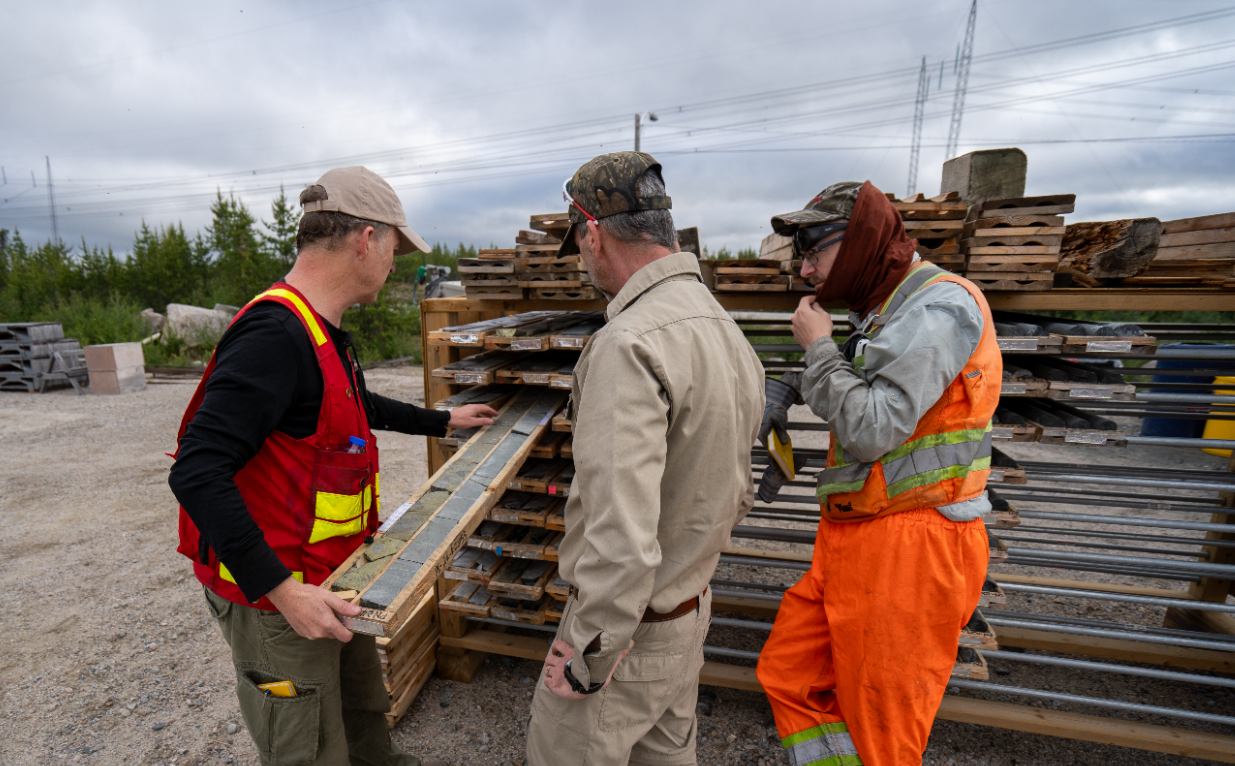
6:30 7.2 as I recall, and we're probably, you know, north of 8 now, 8 and a half, something in that range, and growing. It was, the resource was basically on a ultramafic rock. And so we were obviously, you know, that's where the mineralized zones were hosted. And in looking for more of this, really, we stepped out on our, about 5 and a half kilometers to the Northeast to what was at that time called the Wildcat Zone, and subsequently now the Lime Zone. And we drilled it there. And again, looking for the nickel sulfides, and you know, but the God said something more in mind. He gave us this tremendous polymetallic discovery. The first hole was a corker, almost 8 meters of 1 ounce PGMs and 1 and a half percent copper.
7:15 So exciting enough, but we followed up with something even more profound. Next slide. So in January of this year, we reeled off 16 holes, 15 of the 16 hit in the newly named line zone. And over half of those were massive hits of, some of them, an excessive 20% copper equivalent, but several of 10 meters of 10% copper equivalent, like really honestly unheard of type numbers. So that was fantastic. And obviously we were super stoked and that obviously led to the investment. Next slide. And then we stepped forward this summer and obviously this is what we're talking about today is sort of the summer program and the results we've gotten from that. So we've expanded the zone by 50% and just as usual when we you know have good drill cores we feel honor bound to sort of publish them to our shareholders and let them know that we think we've got some more good news coming. And I think we've got 7 cores there and we've released 4 of those 7 cores and I think Those 4 core releases have been great. So one of us could assume that the next ones will be equally great.
8:36 And it's probably at this stage, I'm gonna turn it over to Ken for a little bit. And Ken's gonna just walk us through our thought pattern, how we sort of see the line zone playing out, what we're doing to sort of move us forward and maybe give us a bit more background context into the actual exploration results. So Ken, passing the baton over to you. All right. I'm not mute, am I? Nope. All right. So thanks, Terry. So to follow up on the beginning of your speech there, I'll start my own part here with the very last long view that we've published that shows all of the holes for which we have received results for.
9:31 So I'm not going to go in lots of detail about the grade and things. People probably have read the press release, but what I'd like to do here is to complement a little bit with the knowledge that we've gathered more in terms of geology and what's coming next for us. So on that long view, what we can see is that we've tackled 2 areas of the Lion Zone. The first discovery footprint was highlighted in green here, that dashed line, so covering a fair volume, but we decided to follow geology indications, I guess, and presuming at that time that the plunge of the ore, sorry, I should not say ore, the plunge of that mineralization was interpreted to be very steep going east at first.
10:34 And that would explain those blocks of holes, 6 holes that we've drilled on 2 distinct sections here to test for continuity of the zone at depth. The results we obtain in terms of grade are very, very good except for hole 65, which didn't reported nothing of significance there, except in terms of structural geology that O65 is showing lots of faulting and very intense deformation where the zone should be. So it kind of confirmed a few of the hypotheses that we had. Hypotheses that were saying the zone is there but the zone is highly deformed so we're pretending or presuming at one point that the zone is going to get probably attenuated but inside a shear zone and likely to be cut off at one point and offsetted somewhere else. So we believe right now that that fence of holes, the couple of fences of holes that we have here demonstrate or highly strongly suggests that we are entering actually that stream corridor that we were predicting before.
12:00 The change here is the rake of that deformation corridor on the long view. Initially it was very following the edge of the eastern boundary of the zone. That's how we thought the structures were cutting the zone. But with the new holes, what we now know and what we now understand better is that those faults, those shears likely will intercept the mineralized plain, but with an intersection lineation that is much shallower and to the west. So that's a drastic change but it does make lots of sense just because the the 3d modeling we've done and the interpretation we've done at the Lion Zone is much more elaborated than it was a few months ago.
13:00 Now we've understood a little bit better, I guess, the geometrical relationship between those faults and the mineralized zone. And it happens to be a very, very similar geometry, what we see at Lyon, to what we had seen and interpreted at NISQ Main now. So in terms of geometry and chute of the mineralization, it makes total sense to revert back to the NISQ main interpretation and then chasing the zone in a much shallower direction towards the west this time, towards NISQ essentially.
13:46 So the hypothesis was on the table as well. We didn't know when we prepared those drill holes. And once we had covered the bottom of the zone, or the deeper part, we decided to move up and to the west that time and then started to drill that new sequence of holes here, 69, 70, 71, etc. 71, 2, 3, 4 are going to be released momentarily once we receive the the results from the lab and 75 was currently drilling when we stopped for the the moose break So as soon as we get back there, we'll be able to complete that hole and then be able to present another group of 5 holes that this time should be directly in the shoot of the mineralization itself.
14:48 What did we learn from those Western holes? Well, that the thickness is there, still there, or even increasing. As you can see on yesterday's press release with all 70, 32 meters of that grade. I'm not gonna list it all up, but it's quite impressive and if you pay attention to the table you'll notice that there are 2 zones in there, tens of meters wide, plus gives us like a spectacular grade in there. So I invite you to have a look at the table. It's very, very impressing.
15:35 So we do anticipate from the visual that we have, lots of semi-massive sulfide were seen, I guess in those holes. We're yet to see the results from there, but if we do a comparison with all of the other holes that we had, the visual is almost a one-on-one in terms of will it kick good or not. So the more sulfides we have the better the grade is it seems. Well, kind of. Why am I saying kind of? The more sulfides we have that the grade is going to be better, yes, in the core of the zone, but that doesn't mean that when the zone is thinning down, like at depth here, we still are preserving those grades.
16:31 So that could be, to me, an indication suggesting that the mineralization got developed maybe in a synchronous way of deformation at the same time but later on deformation kept going and highly deformed those pods or what is left as pods right now. So, the size of them pods needs to be better defined, as we can see the first one we've discovered is wide open at depth on the east
17:10 and the the West sorry and the eastern part here is where we believe the offset equivalent of the lion's zone number 1 would be. So if we can lock on to another pod in this area, that will give us indication on what is the motion vector along those faults and where could potentially be those offsets that we are looking for. Now from the discovery day to now we've made significant progresses in terms of expanding the volume of that zone.
17:57 And just for sake of curiosity here, That's the historical sequence of where we're at. So we started off with 3 pierce points that gave us a first volume and every time we've drilled, we've expanded, expanded, expanded. So at the end of the summer, we were covering that blue box and as of now, we've drilled below that box and we're attacking the western side right now. So how does it look? I've prepared a series of sections that will go from west to east. So the first section will show this fence of holes here, which aren't drilled yet, and then progressively we'll reach the core of the zone supported by pictures and stuff like that. So if we go through this Relatively quick the first section we have is to the west so section 300 showing the top the target zone Shit sorry I forgot to change slide on the right screen.
19:20 I was wondering. Man, okay, rookie mistake. What I just explained with the first volumes, that's that slide. I'm not going to repeat. And here goes the sections. So sorry about the little glitch there. So, section 300 to the west shows the target zone being underneath literally O30, which was a miss back then. But we're not discouraged by that at all. If we follow that westerly plunging thing that we've discovered with Ole 31A, then we fall exactly in this area here underneath that hole. So we'll be testing that.
20:07 That's a very high priority for us. And then we've drilled that 74 hole which is the last one we've drilled completely. We're doing 75 now. And as you can see, I lighted with the red brackets, we still see lots of sulfides in there. So if we move 150 meters eastward, we'll see the location of all 69 and 70, as well as 72, 71, etc., and lots of room at depth here or below on that section to expand still the zone.
20:55 As you can see I was referring to all 70 earlier 30 32 meters of very spectacular stuff, that's an including interval here, which has almost 11.5 meters all in all, at almost 12% Copper equivalent. Mind you, that Copper equivalent is calculated the best we can. So take it with a little grain of salt, but it gives a really good ballpark range of what to expect there. So 32 meters including 12, almost 12 meters of 12% copper, that to me is just spectacular.
21:43 And that's the follow-up I guess of what we had previously with good reported holes in the past few months with 48, 57 and with all results to come 72, 73, we can see lots of Sulphide seen and still wide open at that. So, keep... Here's the, the core, I guess, of the zone and that's where it starts to pinch out a little bit at depth. So, grade remains but thickness decreases quite significantly down to a meter, couple of meters as compared to the 12 meters we had just above, that's 50 meters above, the grade though remains almost the same but the zone gets squeezed and that's why I'm really really thinking that a fault has offset the thing and transposed the zone inside the shear zone after, not as if the zone is pinching out or dying out, you know, with losing grade and losing thickness, not what we do observe here.
23:07 And then I think I have maybe another one of them sections showing the the first hole of the summer 63, 4 and 5, that shows again the same kind of thing, grade remains but thickness progressively decreases up to where we hit that fault zone, literally in hole 65, with no significant values. You can see that picture here. The tunnel light up there is very badly deformed. So losing the zone there. But the zone to be picked up again on the other side of that fault is the expectation.
23:53 So how would that work? Here's a... I've resurrected, I guess, old plan views that show the geometry that we anticipate happening here. So on each side of the zone, say for instance on the eastern side here, what we believe is happening is that portion here gets sheared out and attenuated into a shear that is slightly oblique to the ultramafic contact. So it creates some sorts of lozangical shapes where the north side and the south side is anticipated to get transposed into fault zones.
24:45 I believe that what we see at depth with O65 is one of them faults here that completely attenuates and transpose the zone in that location, but at depth. So that illustration here is good to show the concept that we're working with now. And I'm heavily working in 3D every day to try to unravel the geometry of the dykes that we see in the logging. Why? Because those dykes, I believe, will be reused or could be reused by faults after or could get injected in pre-existing faults, whichever way, but dikes and faults to me are very, very intimately tied together.
25:44 So I'm hoping that with a very robust DIKES model, we'll be able to unravel what's the real structural story that we are looking at here. Can I keep going? Yes, absolutely. All right. So what will we do to out-drill those targets in a better way? We have a tremendous budget this year, but that doesn't mean it's like an open-ended well. So we got to spend that money really well. And we've got a fortunate few months back to hook up with Steve Beresford, who's a Semite, I guess, in polymetallic discoveries and deposits and things like that.
26:41 So he came up with lots of good ideas about how should we be tackling polymetallics deposits. So out of those ideas, I'm gonna bring up 3 on the table here that are happening in parallel as we speak. Well, we're in the moose break now, but let's pretend it's all happening now. So the first thing we initiated was a ground-based EM survey in and around the Lion's Own area that will we believe be a really neat complement to any EM maps that we had, airborne stuff and things like that. The ground-based will provide us with a lot, lot more resolution and will become a really good complement to the geophysic data that we already have.
27:40 Another tool that we're doing right now is a ground-based gravity survey as well. That is to complement the ANT survey that we had flown, or not flown at all, with the probes and stuff. As a reminder, the ANT survey gives us a velocity model which can then be tied to density of the rocks and density of the rocks we use that to discriminate between tonalite and ultramafic or very large contrast in density we can see from that tool. And with the ground gravity survey complementing this, we believe that we'll get much more out of both data sets by combining all of this together.
28:36 And finally what we're also doing is what we call platform holes, which are holes designed to literally miss the zone by purpose and remaining in the footwall of it at a certain distance such that we can sink down after a down-oleum survey. So here's a representation on how that works.
33:53 Add on that Gold and Silver, we're definitely here at Lion. And at NISQ, it's not purely nickel. We had a little bit of PGEs kicking in once in a while. So we'd be falling here in that kind of transition zone between real polymetallics and pure nickel with a nickel system with credit metals, that would be NISQ-Made, and the ozone would be more in the polymetallics. So, in Between the 2 lenses that we've discovered, there is kilometers worth of playground to explore.
34:40 So it would be probably not a good idea to poke holes just for the sake of poking holes and praying that we'll get lucky. Luck won't be part of, well, will be part of the story, but we'll try to mitigate luck as much as possible here. So that's why Terry did a really good job convincing Steve or Dr. Beresford to join us up and collaborate with us. So the team right now with the GeoVector guys that are really, really knowledgeable about the field, the outcrops, where they are, the geology, mineralogy, they're on top of their game. Dr. Beresford, definitely on top of many games in terms of how to explore for those systems and things.
35:35 And me with all modesty, I think I'm good enough to handle the 3D aspect of this and the structural geology. So all together, we definitely are covering all of the scientific aspects of the work we're doing. So for Dr Beresford, maybe it's more on the scientific side. For GeoVector, it's more on let's make it happen in the field. And for me, it's let's grow resource. So we're covering all the spectrum here of what we got to do. Science, good fieldwork, and expanding the mineralization.
36:21 So that being said, I'll just conclude here with a geology map of the area Just to show where the property is, where Lion Zone is versus NISQ Main, and as, and seeing here in really faint pink color here, it's an ultramafic that stretches, we believe, all the way up to Nisk, Maine and there's a good chance that other pods, maybe of different compositions, in the polymetallic realm are yet to be discovered within that 5 and a half kilometer stretch. And we're not talking about the 3 kilometers remaining to the west of NISQ Main as well.
37:14 Now on that picture we can see some of the faults that were interpreted at NISQ Main, and that's what I was referring to earlier, taking that interpretation, slapping it over lion zone, then all of a sudden everything makes sense with the transposition of the zone inside shears, a little bit as what we had seen on the eastern part of NISQ Main anyways. You guys maybe remember ANT2 target derived from the ANT survey. The ANT2 was interpreted to be the offset equivalent of NISQ main along those shears.
38:00 Well, what we're thinking here is Lyon zone is there, attenuated by a similar oriented shear on this side, on the north part, which is cutting the zone at depth, still being wide open to the west, a little bit as what we had seen at NISQ Main. And finally, if we zoom right back out in the area, and I'm covering stuff that is not part of our property, but just to back up a little bit the geology story and the interpretation that we have. Geologists in the audience, you guys know that what's happening at small scale should be repeating itself at much larger scale and vis and versa.
38:53 So when we look at the tectonic scale here, what we had interpreted those small shears that are almost east-west on that map, we can recognize major breaks, I guess, in that map that share the same exact same orientation as what we see offsetting the mineralized lands. So there's a lot to learn in terms of the history, the geological history of the area and why actually there is a copper rich and PGR rich mineralization in this area, which was quite frankly not that much expected.
39:43 So it's a nice surprise for us And usually when you find something where you're not expecting it to be, that to me has always been a good sign at discovering something new that we didn't know was there. So in that perspective, my own take on this and I'm glad that there was a disclaimer page at the beginning of the presentation there, not going to tell you lies but this is my own opinion here. I believe sincerely that NISQ main and lion zones are just 2 little tips of a big, big iceberg that is hidden underneath us.
40:35 So remember NISQ, Maine and Lyon are near surface targets or pods. It's almost outcropping. It's really rare, unless we're an hundred year ago, it's really rare to find a major deposit close to surface in the Abitibi with the amount of exploration that there's been done over here. So now to have discovered that near surface and thinking that stuff is usually happening at that, well, the story is just beginning here, I'm thinking. So let's find something that is the size of LionZone plus NISQ main all together at depth and then joining the 3 pods together we become a major world-class system here in really quickly.
41:36 So let's drill this but let's drill this in a very well-educated way. So that's what we're doing thanks to Terry for the nice budget that allows us to do that because it's not cheap. Okay, Ken, thanks so much for that update. If you could just pop us back to the my deck. Yeah, and go to the next slide. Hey, I've done well. Yeah, you've done fantastic. That was a smooth transition. No, I mean switching the bar points. Yeah, and a great job, you know, helping us all understand the expiration story here. And I guess the takeaway I get, and I've listened to it a lot, of course, but every time I listen to it, I get goosebumps, is, you know, I mean, that's why I say to people, you know, people say, well, you know, have we missed it? You know, like the stock's gone from 20 cents to 80 cents. And they're like, oh, you know, it's gone up 4 times, we've missed it.
42:35 And my story is that you missed a 60 cent move, you haven't missed a $6 move, or possibly, who knows, maybe a $60 move. This thing is crazy, asymmetrically posed. I'm not guaranteeing anything, because I can't, nobody can. Mother Earth's a crafty rascal. But I mean, I'm always looking and all of our investors I think are looking for an asymmetric risk opportunity. So there's obviously risk in mining, so there is risk, but you want a lot of upside. And I think that's why we were able to get Robert Freeland in, Rob McEwen, all these smart mining funds, because they saw that asymmetric upside, and we're seeing now the results of it coming back with the assays where we're delivering the goods. And as Ken said, I mean, this is just like near surface stuff that scratched the very essence of the potential of this thing and getting guys like Dr. Beresford on side and GeoVector and Ken to, these are really rock all stars to work with to be able to pull the science together is super exciting.
43:39 We're pretty motivated to keep it going here at NISK and we'll see what the next coming months have for us. Luckily, we're just about to start a 30,000m drill program. We've just secured a third rig, just found out yesterday on that, so that'll be great. We'll have a second rig going up Lion starting October 15th and you know, we'll get at this in an earnest way. So we're the team's getting together this weekend up in Ottawa for a three-day sort of session on the strategy on the you know, you know, reviewing all the data we've got, what we got coming in and, you know, targeting the drills to get after this. So it's exciting times for sure.
44:28 Next slide, Ken. So we've obviously talked about this. So I won't go into that. Obviously we're super proud to have this group leading our exploration effort. I think they've done a whale of a job. You know, the Canon and GeoVector obviously got us here with the discoveries that we've had to date. And obviously did a whale of a job to do that. And bringing in Steve, gives us that polymetallic expertise that we didn't have on the team because it's, polymetallics are different beasts and we need tricks of the trade on how to explore them properly. Next slide. And I think Steve's given us that, you know, cause he's, you know, with his history as a former chief geo at first Quantum and then MMG and then IGO as the chief scientific officer. He's had like several hundred million dollars worth of spending experience on the exploration side. So he's got this just deep years of experience of what tactics work, under what conditions, and that's stuff that you just, the only way you basically make mistakes in mining and you learn from them, but mistakes in mining are basically misses and they're expensive.
45:47 So if you can make less mistakes, you can just really leverage your exploration budget and that's why it was so key to get a guy like Steve to come in and join us. And of course, we did not know him from Adam. Luckily, we reached out. My son had seen a great video of his and we followed up with him. And he talks about hunting for the next giant polymetallic. And We basically reached out and we started to send him the data and he came across and went up to the site and he fell in love with it and thought, wow, this could be the next big thing. And we found some commodiite boulders, which is something I didn't know much about, but it's often associated with massive nickel sulfide projects.
46:38 And Ken's philosophy, or Steve's philosophy, is that there's this orthomagmatic deposit, which is, you know, he's got a triangle there of nickel, copper and PGEs, which are really noble metals. So it's like PGEs plus gold, silver, and somehow your polymetallic, you know, fits somewhere in that triangle. And Oktoberrisky is basically Norelsk. So that's, Norelsk is literally the world's greatest mine in the history of the world. It's the only mine with almost, I guess, over a trillion dollars worth of either produced or in-situ value material. So these are monsters that have tremendous value for us and great ambitions to what possibly we could grow up to be. Next slide, please.
47:27 The cool thing about the polymetallics is that they generally have tremendous cost benefits. You're lifting costs on a nickel is sort of $253. So it really doesn't matter. People get all heffed up about, oh, Indonesia nickel and what's that mean? And it really is not gonna impact us that much. It doesn't, certainly wouldn't stop us from producing very profitable nickel because our lifting costs, we think when we get there, will be very, very small because we got a polymetallic deposit. And so that's certainly a significant point. Next slide, please. So Ken sort of touched what we've gone over and we'll go back over that, but we're pulling all this together. Next slide.
48:14 And the whole ambition is in the program is sort of to sort of pull, you know, sort of see just how big this can be and and then, you know, what does that mean for us on the value proposition. So next slide. So this is a, you know, little matrix that we developed internally just to vision what that could mean. And I think the world still hasn't figured out that power nickel isn't just nickel. It's really polymetallic. And when you get into the polymetallic realm, the valuations can go up very rapidly and should for what we've discovered, I believe. And you can see, you know, I mean, the Bravo Mining is a good example of another polymetallic that's done well in the market. And I think if you looked at the deposits of Bravo and Power Nickel, I think many people would choose our deposit, not throwing rocks at Bravo. It's just that each has their own merits.
49:13 But certainly, we're a third of their price or something. I don't believe they're, I believe they're fairly valued and maybe undervalued. Shows you in my mind, where we're at. I think we believe we're a ridiculous deal right now. So, and we're going to sharply move up that ladder. Next slide, please. So it all gets back to, you know, this curve is really sort of, you know, where do you see us at? You know, for us, we see us very much at the front edge of this expiration curve. So, you know, when investing in money, that's where you want to be. So, next slide. A little update on the CVMR. So the feasibility studies have been coming along. We'd hoped to have it out.
49:59 By now, there's just been more work needed for some of the new moves we're trying to do. So we're gonna get it out, but it's probably gonna be towards the end of October. So that'll be exciting news. And we'll talk a lot more about that. I mean, generally speaking, we're pursuing an ability to build a nickel refinery in conjunction with CVMR probably as early as 2027, not at NISC, but in Amarillo, Texas, where CVMR has another facility they're building and the permits to build the refineries that could supply North American nickel powder to the automotive sector, the defense sector, and the 3D printing sector, and could be a lucrative business opportunity for us. So we'll have more detail on that in the coming month.
50:52 Next slide. We'll just wrap this up because this gets into a bit of the pitch, which is We'll just conclude it just in case there's some new folks on. But generally, I would say if people are on the call, they're probably aware that commodities are probably gonna be the spot to be. Tech is pretty toppy. I mean, there'll always be room for tech investment, but commodities will have their day at some point. The spread between equity valuations and commodity valuations has never been bigger. So it's likely over the next cycle that commodities will outperform and you'll want to be into some good mining stocks for that to happen. Next slide.
51:39 This is just another, you know, this is the famous mining clock and they're talking about mergers. There's another one announced today. Silvercrest got acquired today. You can see this thing is starting to pick up speed. So I've told people they need to be in. I would be having my mining allocation doubled and pushed into the table. And if you can't stomach buying individual stocks, then buy some good mining funds. There's a number of them out there. Several are invested in Power Nickel, you know, BT Global, Palace Capital, Bank of Nova Scotia. These are all really great, solid mining funds that deserve your investment and do a good job of managing your money. Next slide, please. We're still maintaining our theme of being carbon neutral. So obviously this will be now polymetallic versus just Nickel. Again, just the proximity to Hydro-Quebec, being across the street, the clean green energy there, the natural ability for our ultramagic rocks to sequester CO2, And on the carbon footprint side of things for the nickel business, with the nickel sulfide with CVMR, it's the lowest CO2 footprint out there. So all these things could enable us to ultimately get to a carbon neutral nickel mine. And it may lead to higher prices, but for sure it's gonna lead to better offtake partners in our choice of them. So that's been what we've been experiencing right now. Next slide.
53:11 We talked, Ken touched about this, some of the ambient noise, you know, which has led us into being able to better understand our deposits quicker. Next slide. And generally it enables us to measure the speed of the rock. So we know in our nickel sulfide area that if it's 36 to 3750 meters a second, That's where our mineralized areas are. So if geology comes back with 20 locations and we know that 12 of them are 5,000 metres a second, but have fit all the other parameters, we wouldn't drill them because we know that that's not gonna work out. So that's been a nice new technique for us to accelerate, you know, our exploration program. Next slide, please. We're spinning out our, with I think that mailing should be going up next week and we'll be having this meeting in November and the spin-out will take place in in late November early early December and generally speaking for every 20 shares of Power Nickel you'll get 1 share of the new co. You'll own 50% of the company, our shareholders, Power Nickel retained 50% and we'll go forward with that as a separate entity. And that should be a very interesting business opportunity for us as well. And a nice kicker since you're getting no value for that at the moment. Next slide, please.
54:38 The team has always been pretty lean. We've added Steve, of course. And We're continuing to maintain our lean focus to continue to put the money in the ground, but we've got it, by working with GeoVector, gives us a lot of extra breath, in terms of the exploration side. So we're lean, but we're well staffed. Next slide, please. Just wrapping it up. So this is effectively the share structure. Maybe there's been some warrants exercised and stuff, so it's maybe closer to 190 million out. But the one big difference here is that our top 6 or 7 shareholders own more than 50% and they've been the largest investors in these rounds. So the Lynch family has probably been the lead investor in the last 2 and a half years. You know, but obviously getting guys like Rob McEwen and Robert Friedland and Sivya Marr in has certainly been helpful, but all the big shareholders, the Stern family, the critical elements all have participated in the growth of the company, and we certainly wouldn't be here without those guys. Next slide, please.
55:43 So that pretty much wraps up the conversation for today. We think it's a tremendous time to look at Power Nickel. A lot more catalysts to come. We think we've just scratched the surface on our project. We've demonstrated again and again with the drill bit, which you can't fool, that this thing has really got legs. And it's just, I think as Ken said, the tip of the iceberg, I think I agree with him, that that's coming along. We've also got some other interesting business development opportunities in the Nickel powder business with CVMR that is something that's grown out of our discovery process that's got tremendous leverage potential for us. And we'll speak more about that in the future. But it's a great time to be looking at power nickels. So happy to answer any questions in the audience.
56:33 If there's some out there at the moment. Perfect, yeah, thanks a lot for taking us through that. First, it's more of a personal question for Ken, is how are your ribs? The ribs are okay. No more step buttons for you, Ken. No, no, I've been careful lately. Thanks for asking. And then another question here for you, Ken. On the gravity survey map, could you please provide an idea of the direction of the structure of the lion's own? So northwest, southeast, north, south, something like that. I don't know if you could pull that up. Let me see if I can back. And they're also saying that they missed the beginning of Voices Bay and they're glad to be in Power Nickel at the beginning.
57:26 Yeah, yeah. Okay, I need to switch. Hold on. This and was about gravity? Yeah, so gravity survey map provide an idea of the direction of the structure of the Lansum. Okay, well, as NISQ main, it's following the Ultramafics in one-on-one relationships. So at NISQ main, the Ultramafic here is, let's call it East-Northeast trending. And in here, the Ultramafic is more in a North-East trend, and it follows literally, we're quite lucky, but kind of follows literally the boundary with Agro-Québec land to the south of us.
58:21 And the dip is towards the northwest. So the zone would outcrop, say, on the north-south of the boundary all along the stretch and it's dipping towards our ground such that the gravity survey that we're doing here is covering from surface down to maximum depth that the survey can reach, which I'm not sure what it is. Perfect. And additional follow-up question here. So are you looking to acquire additional properties to support the potential mineralization outside the current one? I'd love so. I think we already are in discussion with some groups.
59:11 So I'll let Terry probably get back to that. Yeah, I mean, generally speaking, the ground here is all owned by other people. So, you know, we've, you know, got obviously had great relationships and continue to do with critical elements. So you know working with them on on on things and Yeah, we're generally in conversation I think that the good news is, as Ken mentioned, that the meat of this thing is definitely on ours already. And we've got like maybe 8 kilometers potentially of this. So, you know, that's we got a we got a lot to chew on right now. And we're busy digesting that. And we'll see just how far it goes. But Generally speaking, that's what we're doing on that side of things.
1:00:03 Perfect. And how does the 24070 hole conform or descent from your sigmoidal view of the deposit previously? Would it be possible to see this explained using your 3D leapfrog model? I'm not ready to display that in 3D yet, unfortunately. How does the hole fit in this story? I'll just go back to this view here. Alright, so I understand it's a long view so it's going to be maybe a bit difficult to visualize but I'll do my best to explain. So What we believe is the sigmoidal shape is created by transposing the zone on each side, but each side as we can see the the rake is about 45 degrees just to make it simple.
1:01:03 So a cut in plan view or a cut in section would give you essentially the same geometry. So what we had seen in plan view earlier with that sigmoidal shape we believe is happening in a section view as well. But everything is kind of oblique in that longitudinal view looking north. So the core of the Zulu, which is that wider central sigmoid part would be located here with 70, 55, 48, all of those very spectacular holes that we had reported. We believe now that the, because if there is a sigmoid, I guess the 2 shears on each side will define an intersection lineation with the mineralized lands and the 2 shears.
1:02:02 That intersection lineation is now interpreted to follow that deformation corridor that we see on screen. Now the sigmoid will then be plunging sub-parallel, we believe, to that deformation corridor. So the preserved core would then have, I don't know, 250 meters width across the zone and it's kind of plunging in an open way without as of yet disappearing in that direction. The sigmoid attenuation is clearly seen in all views but in here for instance where you take thicknesses that are over 10 meters down to the 5-ish meters down to the 2-ish meters and then to 0-ish meters.
1:03:07 Now that being said, perpendicular to that thing, or that intersection liation, we are anticipating another, I agree, shoot that would be plunging essentially subparallel to it again and we need to lock on that and when we do then all of a sudden there's a wavelength thing that will come into play in the sense that as it is to me very purely structurally controlled, then repetition of the same phenomenon is more than plausible in such a system. And I have seen with experience, once you lock on to a couple of those chutes, you measure the distance across and you kind of repeat this with your drilling and most of the time you're lucky.
1:04:05 The one good example I have on that is the O'Brien mine from Radisson Mining. They had 1 high-grade chute initially. We've discovered a second one and based on the spacing between the 2, I wasn't there anymore, but they've discovered 2 more. So they ended up with 4 of those shoots based on the first one. So I'm trying to re-rinse and repeat that same thing here using the same technique and approach. I don't know if it answers the question. No, that was great. I mean, that's about as clear as we can get at this point. So I think that's pretty much the core of the questions and we sort of had budgeted like an hour of time or so.
1:04:56 And I think that Max will probably look to wrap it up and again, wish you best of luck in your new career. Thank you. We'll miss you. Come back and visit us as a shareholder now that you're... Sounds good. All right. Thanks, everyone. So thanks, everyone, for taking us through these updates in the Q&A session. Also, thank you everyone who submitted questions. The recording will be available to watch on demand in the coming day or so, so look out for that. And before we wrap up, just passing things back over to you guys, Just for any closing remarks and maybe some upcoming catalysts. Duncan, we haven't heard from you, so why don't you sort of close it off here, why don't you sort of wrap it, wrap us up? Well, you know what, there's going to be so much coming down the pipes, it's exciting.
1:05:44 We've got a whole bunch more assays to come out. We'll probably see a bunch of research reports updating investors with what the analysts think. We'll have some analysts up to the site later on in the month. We've got the CVMR feasibility study coming that's going to be a item of major importance and Ken's gonna drill drill drill gonna be fun so we've got our AGM at the 30th of the month coming up. That's also going to be significant with the stock spin out. And we'll see what the markets do with that. It should be a lot of fun.
1:06:32 So don't be afraid to go buy some paper here. I think you'll have fun. We're cheap. Maybe I'll plug in 1 last question here for you guys just to finish it up here that came in. How many holes are still pending from the summer program? So we got 4 more holes. Yeah. And then the fifth one was was in process. So basically 5, I guess. Yeah. Awesome. Okay. Thanks a lot, Terry. Any closing remarks from you? No, I think that Duncan did a good job wrapping it up. I'll do one. Drill, baby, drill. Thanks again, everyone, for participating. And I hope you