Tim Warlow
Co-founder and CEO of Fevertree
Replay available
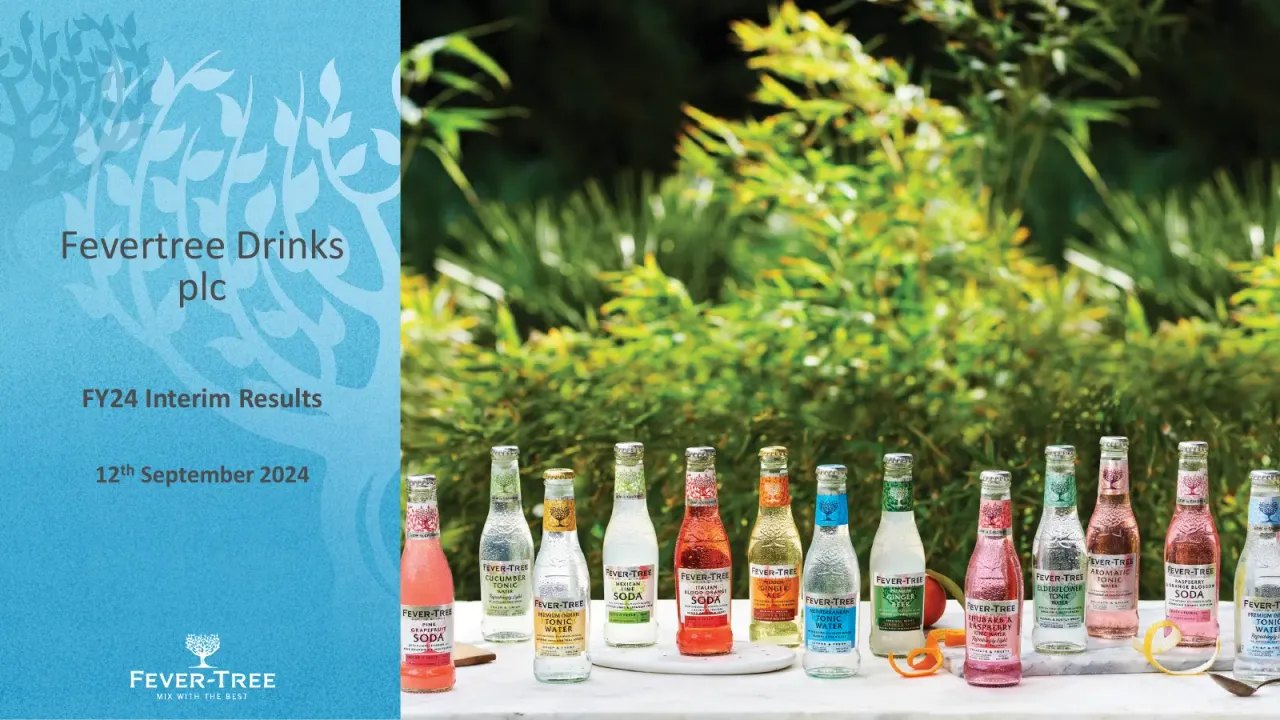
Fevertree Drinks (LSE:FEVR) Q2 2024 earnings call, held 2024-09-11. Watch the replay and read the transcript on 6ix.
On 6ix: 6ix.com/event/fevertree-drinks-plc-fevr-q2-2024-earnings-call
Automated transcript · Written by software from the replay's audio. It can mishear names and figures; the replay is the record.
0:00 Good morning, everyone, and thank you for joining us to hear about Fevertree's performance in the first half of 2024. My name is Tim Warlow, co-founder and CEO of Fevertree, and I'm joined on the call by Andy Broch, our CFO, and Charles Gibb, who has very notably got up very early in the morning, our North American CEO. So this morning, we will talk about Fevertree's robust performance despite the tough macro environment how we've delivered almost 80% EBITDA growth as we begin to drive strong margin recovery, and as well as demonstrating how we continue to position the business for long-term success. Fevertree continues to gain share across our key markets as the brand grows in strength around the world. The focus of this slide and the following slide is to show how we're controlling the controllables. despite the well-publicized headwinds that are impacting the drinks industry around the world.
1:03 In the US, our largest revenue-generating region, the brand delivered double-digit growth at constant currency despite the subdued spirit backdrop. Future is also outpacing the total mixer category by about 10% as we continue to drive distribution gains and maintain our superior sales velocity on the shelf. In the UK, Fevertree remains the number one brand by value by a significant margin. The on-trade channel remains challenging, which was compounded by poor weather in June, but we performed well in the off-trade and are delivering good growth from our non-tonic products, which are catering to the greater variety of drinks being chosen by consumers.
1:46 Europe had a tough first half of the year with unfavorable weather during the period.
1:50 However, we remain the largest premium mixer brand across Europe. extending our value share as we grow ahead of the competition. In addition, our depletions, which represents our sell-out to the market, were significantly ahead of our reported sales, which reflects our shipments to distributors due to the phasing orders between June and July. Finally, in the rest of the world region, we delivered very positive year-on-year growth as we lacked the transition to our subsidiary setup in Australia. supported by continued share gains in our two largest markets in the region of Australia and Canada. Another way in which we're controlling the controllables is through our margin improvements. As you all know, the group has experienced significant macro cost headwinds over the last few years, resulting in gross margin pressure on the business.
2:41 However, we have turned an important corner. improving our gross margin by 520 basis points year on year during H1. This is primarily being delivered through better glass pricing and transatlantic freight costs, as well as continue to take consistent price increases to offset underlying inflationary cost pressures. And we're confident of continuing this improvement to deliver 600 basis points of gross margin improvement across the full year. In addition, we've been focused on driving improvements for the long term, including the optimization of our global footprint alongside driving operational efficiencies across our end-to-end systems from forecasting to procurement and inventory management, which will drive improvements in the years to come.
3:30 Despite the headwinds we've experienced, we've not compromised investment in the brand, unlike many of our competitors. We continue to increase our marketing spend across multiple regions, as well as extending the brand through innovation, which I'll come on to talk about a bit later. And the reason we've not compromised on our investment is due to the clear opportunity that lies ahead for the group. As you can see from the left hand side of the slide, spirits are forecast to continue to grow by around two to three, 2.3% every year until 2028. and this will be led by the premium end of the market as consumers care more and more about quality. We're also seeing a number of important trends develop from a desire for longer, lighter drinks that can be enjoyed throughout the day to interest in a broader set of spirits and serves as well as more mindful drinking where consumers want to socialize with lower or non-alcoholic drinks but crucially expect them to be the same quality and sophistication as their alcoholic beverages.
4:33 And we believe that when it comes to every one of the evolving consumer trends outlined, we are best placed to satisfy these new and evolving expectations. For example, not only do we have the broadest distribution of any premium mixer brand globally, but our range of mixes is unmatched. And we have recently developed products of an extension to our mixer range, creating new flavors and formats perfect for that of soft drinks. Innovation will continue to be at the heart of the Fevertree proposition as we broaden the brand into more premium drinking occasions. We've built on our strong tonic range and mixing reputation to great ranges of gingers and flavoured sodas, which all contribute meaningfully to our growth and give us the ability to flex our portfolio to cater to differences in consumption habits by market.
5:22 In addition, we've started to expand our total opportunity beyond our core mixers into both cocktail mixers and adult soft drinks. which attract younger consumers and broaden our reach to any adult socializing occasion. Consequently, we now have a much more balanced global sales mix. Our non-ponic products have grown by 24% caca over the last six years and now make up 40% of our sales, up from just over 20 in 2018. We expect the portfolio to continue to diversify as we grow across different markets and enter significant new categories. which gives us confidence about driving growth long into the future. Before I hand over to Andy for the financial review, I'd like to update you on our progress as part of our ESG agenda.
6:14 As you can see from the slide, we're driving action across the ESG spectrum, but I'd like to point out three areas of focus from the first half of the year, climate, communities and colleagues. Firstly, under our climate branch, we started to develop our first net zero roadmap, which builds on the work we've done to map out our carbon footprint, both at a corporate and product level. Secondly, under the communities branch, as well as continuing with our important support of malaria no more, we've updated our human rights charter, engaging directly with our ingredient supply chain partners on human rights and responsible sourcing practices. And finally, under our colleagues branch, We've advanced the DEI agenda significantly, rolling out new events, training and employee resource groups to better support our fantastic team.
7:06 I will now hand over to Andy to take you through the financial review.
7:11 Thank you, Tim, and good morning, everyone. This summary slide sets out the key financial metrics for the first half. I'll talk to the detail this morning, including particular focus on the platform we're building to deliver margin recovery in 2024 and strong, profitable growth going forward. So turning page, Tim and Charles will talk to our revenue growth by region. The Fevertree brand revenue increased by 2% on a constant currency basis in the first half. and we've made a strong start to H2 and expect to deliver an acceleration in growth as we proceed through the year. In March, I spoke of our confidence in driving gross margin improvement in 2024 and we're on track to deliver this with a 520 basis point gross margin improvement in the first half, which has helped to deliver a 79% uplift in EBITDA to 18.2 million.
8:06 We delivered strong operating cash flow conversion of 140%, reflecting both an improving EBITDA margin and working capital profile since year-end. Whilst working capital is higher than it was at H1 2023, it has improved notably since the year-end, as the elevated receivables held at that point have been collected, whilst we're working hard to optimise our inventory levels, leveraging our new ways of working and technology platforms. Looking forward to the second half, we expect revenue growth combined with further margin recovery and working capital improvements to drive continued strong cash generation. As such, whilst our capital allocation framework remains unchanged and we will always prioritise opportunities to accelerate growth, we anticipate being in a position to return surplus cash to shareholders in 2025 and we will announce details of this at the full year results.
9:03 Now turning to look at our gross margin progression. As we outlined this time last year, following the headwinds faced over recent years, we're confident that we've turned the corner and are in a position to deliver margin recovery over the medium term. In the first half, we saw the continuation of a consistent gross margin improvement since the inflection point we reached in H1 2023, and we remain confident of delivering circa 600 basis points of improvement in gross margin over the full year. The key drivers of H1 gross margin improvement are as we set out. As expected, improved glass pricing following the UK and European glass tender performed last year is delivering margin improvement. Whilst we've laid in hedges with our primary glass supplier, which gives us confidence of delivering further improvement in 2025, our US production and logistics is driving margin recovery as we increasingly benefit from lower transatlantic freight rates on product delivered from the UK to the US.
10:03 with an operational shift back towards our efficient UK production base to capitalise on this. And finally, net price across regions, including the benefits of the new Australian route to market, has driven further margin improvement as expected. The H1 gross margin also includes the headwind as we released our opening inventory, which was held at last year's elevated costs to the P&L. As such, in the second half, we'll see the full benefit of our improved 2024 cost base in this bridge and this is why we expect the gross margin to continue to tick up as we progress through H2 and we remain on track to deliver circa 600 basis points of improvement over the full year. We continue to remain positive about the medium-term margin recovery opportunity ahead.
10:48 The normalisation of inflationary pressures, particularly compared to the more extreme headwinds faced on glass and transatlantic freight over recent years, should continue to provide a tailwind into 2025 and we remain committed to building out our production footprints. New UK canning capacity is now online with production scaling over H2 this year, and we'll be commissioning a local production line in Australia in Q1 2025. Whilst we've delivered a good recovery in the local US gross margin this year as we benefit from recalibrating transatlantic freight rates, we remain focused on building and scaling a local production network in the US at the right pace, with the right partners, and at the right pricing, with a current focus on onshoring local can productions.
11:33 Over time, the ability to produce locally at scale in the US will offset the incremental freight costs of shipping product from the UK, which will improve US local margins and with it the overall group margin. And lastly, we continue to work on pricing and a wide range of operational efficiency initiatives as we leverage the investment and improvements we've made over the past few years in our operations team, our ways of working and our technology platform. Finally, turning to Outlook. We've seen an improved sales performance since period end, particularly in the UK and Europe. And as a result, year-to-date sales growth at the end of August for the Fevertree brand was plus 4%, a significant improvement on the half-year position.
12:19 As we look ahead to the remainder of the year, the market backdrop remains challenging across regions. And on top of this, we're experiencing continued FX headwinds. However, we've got strong plans in place and that's such we're confident of delivering an acceleration in growth with H2 reported growth for the Fevertree brand in a range of circa 7% to 10%, which means we expect full year reported growth for the Fevertree brand in a range of plus 4% to plus 5%, which on a constant currency basis is growth of plus 6% to plus 7%. As I've already discussed this morning, we are on track to deliver 600 basis points of improvement in gross margin over the full year, As we look forward to next year, whilst there remains the risk of macroeconomic volatility, we are confident that we have sufficient mitigations, opportunities and initiatives to deliver against the consensus expectation of a further 200 basis points of gross margin improvement in 2025. We will continue to invest in opportunities to drive growth in the remainder of this year and are comfortable with consensus overhead spend of circa 90 million.
13:27 whilst we also reflect here some minor changes to other key metrics. With that, I'll pass back to Tim.
13:34 Thanks, Andy. So, despite more positive trading post-period end, of course it's disappointing for us to be trimming our full-year outlook. However, as the next few slides will demonstrate, there is no doubt that the brand is gaining in strength and our long-term strategy is not only working but opening up even more opportunities for future growth. The success the brand is achieving is due to our unrelenting investment behind the brand, when many of our competitors have been disinvesting. Over recent years, we have faced significant margin pressures on which that understandably has been real focus, and encouragingly, we're starting to turn the corner on those pressures now. Throughout that period, rather than take short-term decisions on pricing or on cost-cutting, we remain focused on making the right decisions for the long-term health of this business and brand, We continue to invest, we continue to innovate, and we continue to capitalize on our first move advantage across the world.
14:36 Our long-term approach to both portfolio expansion and geographic expansion has meant that we have an unrivaled presence across the world. In every one of our key regions, we're gaining share and driving category growth with more consumers finding, enjoying, and becoming loyal to the brand each year. And vitally, as I said earlier, we are right at the cutting edge of the fast-evolving consumer drinking trends that will drive growth across drinks categories over the next decade and beyond, with a unique position across alcoholic and non-alcoholic occasions. And that is the lens through which we're making decisions to run this business to ensure we are best placed to capture the opportunity ahead. And the opportunity ahead is no more evident in the US So I will hand over to Charles to talk you through our progress during the first half of the year.
15:30 Charles.
15:33 Good morning, everybody. Fevertree delivered £60.3 million worth of revenue in the first half of the year, which represents double-digit growth on a constant currency basis. This despite a weaker consumer backdrop as we continue to gain market share and popularity amongst US consumers. The brand is performing incredibly well against the competition, gaining three percentage points of share in tonic water and six percentage points of share in the ginger beer category, which means that we now hold a 27% and 30% value share respectively in these two important categories, extending our leading position in both.
16:20 Our team are doing a fantastic job across both the on and off trade channels, as we continue to expand our distribution, both in terms of number of accounts, as well as our presence within each account. In the off-trade, we've strengthened our position as the category leader and the largest retailers across the country. The strong presence in national grocery has enabled us to introduce new flavors and formats, such as our 150ml cans, which have grown quickly since launch and now make up a significant contribution to our total off-trade sales. In the entree, we still have a huge opportunity to go after, despite more than doubling the number of accounts we are present in since 2009. The team have done particularly well to get large national chains such as Marriott Hotel, Landry Restaurant to embrace the brand alongside the increasing number of products each account stocks, including on menus and incorporating within their cocktails.
17:19 We've increased our number of distribution points by over 50% in the entree in the first half of the year. as well as featuring the brand as part of various activations, experiential initiatives, and pop-up bars, including our takeover at the Parkway Hotel in New York to create a Fevertree Spritz app that you can see on the right-hand side of this slide. Moving on, the cocktail mixer category represents a significant opportunity for the brand, both in terms of scale as well as the ability to attract new consumers into the brand. Our cocktail mixers have gained good annual distribution and popularity with consumers, especially in Hogwarts, where Fevertree is already the top-selling Margarita and Bloody Mary brand, less than a year after its first listing.
18:07 And in Q4 this year, we're very excited to be extending further and introducing our Espresso Martini Mixer, just in time for the peak holiday trading period. We've already received fantastic uptake from many accounts ahead of the launch, as well as attracting interest from both vodka and tequila brands, and look forward to updating you on the launch and initial performance during the course of the next year. Overall, as the last few slides have demonstrated, Fivertree is outperforming in the US market, driven by our unmatched understanding of US thinking habits, our relentless pursuit of innovation, all supported by our strong distribution network and Spirit Brand Partnerships. We still have a long runway ahead and I look forward to delivering further growth in this substantial market.
18:54 I'll now hand back to Tim to take you through the UK, Europe and the rest of the world.
19:02 Thank you, Charles. So the UK, we've delivered £50.9 million of revenue, which is a 6% decline year on year. But this is primarily due to the challenging entree backdrop, as well as continued weakness of the gin category, both of which were compounded by poor weather in June. And while this is a disappointing result, July and August sales have been much more positive, resulting in high single-digit growth across these two months. This means that our year-to-date sales are closer to minus two year-on-year. Importantly, despite the tough macro, futures outperforming the mixer category. The brand continues to be the mixer of choice in the UK, with a higher value share than any other brand by a significant margin, as well as being purchased by more households.
19:53 Our premium price point, along with our popularity, ensures that we deliver approximately seven times more revenue per store each week to UK retailers than any other premium mixers, all of which puts us in a strong position as the macro environment improves. Futree has built an unrivalled portfolio to cater to a broad range of mixing occasions across a growing number of spirit caskets. At the end of the first half of the year, our non-tonic products grew by 10% and accounted for almost 30% of our portfolio. And when we break down our value share growth by sub-cascade, Futree has gained over 3% share of all non-tonic mixes over the last year. driven by our versatile soda range, with consumers drinking a greater variety of drinks than ever before, both at home and in the on-trade.
20:43 We're also seeing good growth from our ginger ale, which is gaining particularly good traction in the off-trade, as well as our newer cocktail mixer and adult soft drink ranges, which have already gained over 8,000 and 9,000 distribution points at UK retail, respectively. So as I mentioned at the start of the presentation, the group has continued to invest behind the brand. And I want to use the last slide to give you an insight into a few of our initiatives during the first half of the year. Firstly, we continue to remind consumers of our strong Tonic credentials through marketing campaigns, as well as new product development. This summer, we introduced our latest limited edition Summer Garden Tonic, which has served to excite the category and open up new distribution and partnership opportunities.
21:29 We've also focused our above-the-line marketing efforts on our cocktail mixes to increase awareness of the new range and highlight their simplicity, using a radio and poster campaign to show consumers how to create a variety of exciting cocktails in just three simple steps. Finally, we launched a completely new style of product, a rosé spritz, in collaboration with Mirabeau, an award-winning founder-led rosé brand. The two businesses have worked together to create a beautiful product by combining Mirabeau's rosé wine with Fevertree's raspberry and orange blossom soda, which has attracted a lot of PR interest and traction with our customers. So as you can see, despite the headwinds the UK market is facing, there's a lot to be optimistic about, and the brand remains as strong as ever, making as well-placed a return to growth as consumer sentiment improves.
22:19 So turning to Europe. The feed-through brand delivered £44.5 million worth of revenue, a decline of 10% in constant currency. Our reported sales were impacted by subdued consumer confidence and poor weather across the region, alongside the phasing of distributor orders. The underlying brand revenue increased by 1% year-on-year, with positive depletions growth in Southern Europe offset by Central and Northern Europe. However, we had a good July and August, helped by the phasing of orders as expected, with 22% growth year on year across these two months. Fruitree continues to grow its value share, the total mixed category across Europe, especially in the Nordics and Southern European markets.
23:04 The brand is seeing a greater outperformance when compared to other brands, as we continue to gain distribution and invest behind marketing and innovation. where many other smaller brands have been forced to cut back on investments as a result of tougher macro backdrop. This place is featuring an even stronger position as consumer confidence returns. The right-hand side of the slide highlights some of the new products we've launched by market, including our new cocktail mixes in North and Central Europe and our pink grapefruit across multiple markets. One of the strengths of the fruit tree brand is being able to drive growth by using our broad portfolio to increase our applicability to specific drinking trends by market. We've done this to great effect over the last year, growing the contribution of non-tonic products from 24% of sales in H1 23 to 28% in H1 this year. Our ginger beer growth has been very strong as we start to create a significant category within Europe, growing our sales by 19% over the last year.
24:02 outperforming the total category by 14% and extending our lead as the largest ginger beer brand in Europe with just over 37% value share. This year, we've launched two of our most popular versatile products, ginger beer and pink grapefruit, in 250 more cans as an on-the-go adult soft drink option for consumers. We supported this launch with Fevertree branded fridges at a number of locations such as petrol stations and convenience stores to enhance the brand visibility and extend its occasionality. So overall, while the first half of the year in Europe presented a challenging backdrop, we look forward to the second half of the year with more optimism as the brand remains strong. In addition, the investments we've been making behind the brand set the business up for continued success, especially as consumer confidence improves.
24:55 Our final region is the rest of the world, where Fevertree delivered 14.9 million revenue, a 56% increase year on year, and 57% constant currency. This strong growth is due to a combination of strong underlying performance of the brand, as well as lapping of a prior year inventory buyback as we transition the Australian market to a new subsidiary setup. Our two largest revenue generating markets within the rest of the world region are Canada and Australia. both of which delivered good brand growth and grew share in the first half of the year. In Canada, the brand is gaining traction in the market and growing ahead of the category, increasing our market share by 2% and our household penetration by 30%. In Australia, we spent the last year building our new team's capabilities with a focus on marketing, sales, and distribution, as well as strengthening our customer relationships and resetting our activation plans to accelerate our growth in the market.
25:52 Foodtree continues to grow ahead of the competition, now has 17% value share of the total market, with a lot more opportunity to grow, especially through portfolio extensions. The brand continues to make good progress in a number of other markets within the rest of the world, particularly in Japan through our distribution partnership with Masahi Breweries, as well as through our work with high-end on-trade and spirit partners across Asia more broadly. So I'd like to finish by summarizing the key messages I want you to take away today. Firstly, as I said at the outset, we are controlling the controllables despite the tough macro backdrop. Our sales growth of 13% across July and August has been encouraging.
26:40 And importantly, Fevertree continues to outperform the category and gain share across our key markets as the brand grows in strength around the world. This is particularly true in the US, our largest region, where we continue to grow strongly and well ahead of the competition. Secondly, the business remains focused on margin improvement. We delivered strong margin recovery in the first half of the year and are confident delivering 600 basis points of gross margin improvement across the full year, as well as further margin improvement in the medium term. And thirdly, our strategic pillars remain firmly on track, namely The brand is in robust health, growing in popularity, distribution, and gaining share. We're successfully diversifying the range to catch a far broader long-term opportunity, and we continue to grow and diversify our geographic footprint.
27:37 So overall, the brand remains uniquely positioned to make the most of the growing opportunity that lies ahead, and the balance sheet remains healthy, allowing us to invest the growth and return cash to shareholders So thank you for listening this morning. Andy and I, along with Charles in the US, are now happy to answer your questions. Thank you. If you would like to ask a question, please press star followed by one on your telephone keypad. If you would like to remove your question, please press star followed by two. When preparing to ask your question, please ensure your phone is unmuted locally. And the first question goes to Edward Mundy of Jefferies. Edward, please go ahead.
28:22 Morning guys. So three questions, please. They're all slightly more longer term, I think. So on Europe, I appreciate there's a bit of phasing given weather and shipment phasing, but it's probably not lost any that brewers are becoming more interested in soft drinks as a slightly faster growth category. How do you think about the trade-off between your existing distribution model in Europe versus perhaps going with a larger pair to get more scale? And as part of that same question, any learnings from Japan with your tie-up with Asahi from a distribution standpoint? The first question on Europe. The second one's on Australia, where the ready-to-drink market's on fire, which really points to an appetite for low ABV mixed drinks. Could you talk about the interplay between ready-to-drinks and then the premium Long Drinks Occasion. Do you think it helps to recruit into spirits and longer term makes consumers more likely to drink spirits with premium mixes?
29:15 That's in Australia. And then the third one is for the US for Charles. Clearly RTDs are flying within the US and the big spirits companies are missing out on this wave given the new to world brands are really driving a lot of the growth. As the RTD cycle rolls over, how do you think about the opportunity for premium spirits plus premium mixes to fill in that vacuum as a successor to RTDs over the medium term.
29:41 Thanks, Ed. I'm furiously scribbling down your questions, so I hope I remember them correctly. But let me tackle the first. Look, yeah, you mentioned Asahi. You're right. They came to us because their strategy was to broaden beyond beer. And they also saw this growing opportunity with adult sauce. And, you know, we were the first people they called as a result. And as I've just reported, we're growing well with them. And our joint ambition is growing in that market. So, you know, that's been a very positive move for us. And of course, as you infer, that's not lost on other distributors.
30:32 And as I've always said, that, you know, we spend a lot of time looking at and making sure we've got the right distributors for the right market at the right time. and with the Fevertree brand growing the way it is and broadening our range, clearly with everyone increasingly looking at total beverage opportunities, we sit right at the heart of that opportunity and so ever more interesting for bigger players. And so these are things that we will certainly consider going forward. With regards to the RTD category being on fire in Australia, yes, we're watching that same trend.
31:23 And I suppose the long and short of it, as we've always said, is that we've always believed RTDs are an interesting opportunity for us, but we want to do it at the right time and we want to do it in the right way. But it's something that is clearly of growing interest. as the category grows. And you won't be surprised to hear that we've had, you know, a growing amount of people approaching us to work with us collaboratively on this. So, you know, what I would say is that, you know, that's something that we are looking hard at, but nothing to announce yet. And then I think the third one was over to Charles in the U.S.,
32:08 Yeah, which I think is pretty much, I mean, very similar answer to the one that Tim just gave regarding Australia. I think the interesting thing here is that we're seeing the major successes in RTD in the US have all been new to world or new to market brands, much, much more so than branded RTD collaborations, where you take a spirit and a name to Drinks PLC Drinks PLC Drinks PLC and the Sicilian lemonade, which is great with bourbon or with vodka.
33:03 And so I think it gives us the opportunity to leverage off the back of that as consumers are looking for these longer, simple mixed drinks and for us to be able to present those in bars accordingly.
33:17 Thank you.
33:18 Thanks, Ed. I hope that answers the question. Thank you. The next question goes to Rashad Kawan of Morgan Stanley. Rashad, please go ahead.
33:31 Hey, good morning. Thanks for taking my questions, guys. Just a couple on go-forward expectations from here. I know you touched on it in your opening remarks, but can you get into a bit more detail around expectations for next year? I think consensus is expecting about 8% growth, 200 bits of margin expansion. It would be great to get your thoughts on, you know, top line across key markets first, whether you're seeing any fundamental change in the longer term TAM opportunity, and second, on expected margin evolution into next year. And on that, you mentioned hedging on energy and glass costs for 2025. What level of prices do you expect that to come in at compared to this year's prices, please? Thank you.
34:13 Yeah. Sure, I'll take that in the first instance. In terms of guidance for next year, we're clearly not giving formal guidance at this point. I think, as I said, from a margin perspective, we see enough opportunities, efficiency initiatives, tailwinds effectively taking us into next year that we're very confident of delivering against the 200 basis points of gross margin improvement that we have. That consensus has, and I suppose coming on to your hedging point there, part of that relates to, for instance, the level we're hedged on gas for next year, which at this point is circa 70%, and it will increase as we progress through the year.
34:58 But that kind of hedge price is an improvement on the hedged level of energy, is an improvement on the average hedge that we've had going into this year's glass pricing in 2024. So that will naturally provide a tailwind into next year. I think in terms of top line guidance, yeah, you referred to that consensus is plus 8%. We're not going to get into the specifics region by region of how we see that building. But look, if you look at where this year's growth is on the constant currency basis of circa 6% to 7%, and given the uncertainty around the, you know, the tough trading backdrop that we've talked to this morning, then that's probably a reasonable place in the short term for revenue to be. But that doesn't necessarily reflect our thoughts on the long-term total addressable market.
35:51 And I think, you know, Tim... Yeah, just to pick up on that, as I hope came through from the presentation, that, you know, what is so exciting for us is the size of the opportunity that lies ahead. is that now we are spreading our wings you know we started life very focused on the world of tonic we moved into a broader range of mixes and now as we've been very very purposely doing over the last five years investing in this broader category of adult soft drinks, cocktail mixes and indeed non-tonic mixes so with that our addressable market has certainly grown and we just touched on with Ed's question about the world of RTDs and that clearly is something that is also in our consideration going forward so there's no question that the future total addressable market is much more significant than we first set out but we want to go about it in the right measured way because there is a speed to this growth and a speed to the way you need to develop these things but the way these are growing for us as I mentioned about our CAGR of our non-tonic products growing at 24% over the last five years is very encouraging and we're very confident in being able to grasp this bigger opportunity into the future
37:22 Thank you very much. Thank you. The next question goes to Anubhav Mahultra of Panmer Librem. Anubhav, please go ahead.
37:33 Hi, team. A couple of questions from me, please. Just wanted you to elaborate a bit on your non-tonic categories in the UK. You mentioned they grew 10%, maybe a bit more clarity on whether it was more driven by off-trade versus on-trade, and particularly for the uh... new categories you have the cocktail mixers and little soft drinks to see off-trade that's a bigger opportunity there versus on-trade and uh... on the same if you could put in context the eight thousand and nine thousand distribution points that you mentioned how would they be in context to how many distribution points you have for your tonics portfolio uh... and lastly on the gin category itself that's obviously the key part of your UK sales uh... what's your view on where that category in general is going the gin spirits category and how do you see that involving and any scope for improvement there?
38:23 Thank you.
38:28 So I'm just furiously scribbling there your questions, but let me take the first. You're talking about the UK, and as you rightly say, we saw 10% growth with our non-tonic products, and these include our gingers, our sodas, And within that, you know, our newly launched pink grapefruit, but also our growing adult soft drink format and flavors and indeed our cocktail mixes. So it covers quite a plethora. And the off trade has been the sort of primary driver of that growth.
39:13 over the last year, but we are very encouragingly seeing the on-trade starting to adopt our adult sauce and cocktail mixes. But, you know, we've got a long way to go. You know, we're in about 2,000 accounts now with our sauce and cocktails. And when you think that with our tonic, to answer your question, we're over 50,000 accounts. You know, there's an enormous amount of headroom there, but it's positive the way that's developing. and then with regards to the 8,000 and 9,000 that we've got for adult sauce and cocktail mixes that accounts for about I'd say about a third of the kind of tonic distribution points that we're in at retail but you've got to remember that within those distribution points at retail with our tonic we've got a good amount of shelf space so actually it's a lot more in terms of tonic in terms of our actual SKUs in the off trade so again we've got a lot of headroom to go there but the great thing about it is these categories are developing The cocktail mix category is very much in its infancy, but the retailers are increasingly interested in this opportunity. So we're starting to have discussions about more shelf space. And that is absolutely the case with adult softs, because this is still pretty early on in this journey. And the retailers themselves are starting to look at
40:47 giving a lot more shelf space to these adult drinking occasions. And so as you can imagine, being the leader that we are in this adult positioning, we're having those conversations. So there's a lot of headroom ahead, but as I said earlier, these take time, but the way they're performing is very encouraging.
41:14 And just last one on the gin category and your views on that.
41:18 Okay.
41:19 Yeah.
41:20 Yeah, sorry, could you repeat the question, the final question?
41:23 Sorry. Yeah, the question was on the UK gin sales. The tonic sales basically are 70% of your UK sales still. So your views on the gin category, which has been declined for a while now, on if you see any scope for improvement there and what the spirits brand themselves are doing, is there more engagement with the consumer there in the gin category?
41:44 Yeah, look, You're right. Gin has been coming off from its 2018 high. But don't forget, it's still a very significant, very substantial category, enormous amount bigger than it was 10 or so years ago. And we are anticipating that that you know decline will start to stabilize that's certainly what IWSR are anticipating the fact that this stabilization will start to occur over the next couple of years but you know it's very hard to predict precisely you know the speed but there's no question on mind that we believe that that will start to stabilize Thank you Thank you. And the final question goes to Matthew Ford of BNP Paribas Exane.
42:42 Matthew, please go ahead.
42:45 Thank you. Morning, Tim, Andy, and Charles. Just two questions from me. The first one's just on kind of the midterm growth outlook, both in the U.K. and in the U.S. I suppose, firstly, on the U.K., you know, it looks like in 24, probably not going to see growth, top-line growth there. you know for the market but I was just interested to see you know what are your expectations kind of over the mid term for the UK business now obviously as it starts to pivot away from core tonics you know when would you expect that business to kind of return to growth on a more consistent basis and then in the US you know 10% growth in H1 clearly quite a lot of things going into that in consensus you know mid term expectations are for around kind of mid teens growth in that market is that kind of the level you're thinking about in the US based on the opportunities you see it or do you think perhaps that's a bit too much from this level and then the second one or just a small one was just on the EBITDA guidance for the year obviously you kind of pulled the 15% margin target, you've given the moving parts around gross margin and the like, but any thoughts on your decision to pull that entirely rather than lowering that guidance from here?
44:11 Thank you. Let me just take the first one on the UK. Look, I mean, we are predicting, projecting that H2 will return to growth in the UK, albeit just plus one but we anticipate being able to take that into next year so we are anticipating growth back in the market for next year but albeit that would be low single digits but we are still optimistic that we can drive that to a higher level going forward for all the reasons that I outlined earlier about the rest of the range growing positively and opportunity opening up to that and we believe that that will help drive the UK again, particularly when tonic, as we were just referring to, starts to stabilize alongside gin. So there's no question in our mind that we are confident that we can drive the UK back to good growth going forward.
45:15 Yeah, I mean, from a consensus perspective, I think we're comfortable with where US consensus revenue sits. Obviously, The pace of growth isn't linear, but certainly that kind of CAGR going forward reflects where we are relative to what remains a very significant opportunity. I think from an EBITDA guidance perspective, what's driven the margin dilution of this business over the last three or four years has been the impact to gross margin. And what we were very focused on is driving recovery and gross margin and we talked this time last year about our confidence in being able to turn the corner in gross margin recovery and delivering 600 basis points in 2024, which is what we're on track to do.
46:04 From an EBITDA margin perspective, we could deliver 600 basis points of EBITDA margin improvement as well, but that would require us to pull back on our overhead spending Q4 in line with the revised revenue outlook and what that means in real terms is pulling back on marketing spend planned marketing activities and just in line with everything we've said this morning and how we view the opportunity and the importance of continuing to invest in brand and the benefit we're seeing from that and the extent to which that's setting us up for the future that's not something we're planning to do and hence therefore you're going to see a little bit of operational kind of deleverage if you like in the final Great, thank you.
47:19 thank you that's all the questions that we have time for today this now concludes today's call thank you all for joining you may now disconnect your lines thank you
Follow Fevertree Drinks PLC into a list and get an email when it puts out news.
Co-founder and CEO of Fevertree
CFO of Fevertree
North American CEO of Fevertree
Analyst, Jefferies
Analyst, Morgan Stanley
Analyst, Panmer Librem
Analyst, BNP Paribas Exane