Rafael Padilla
CEO
Replay available
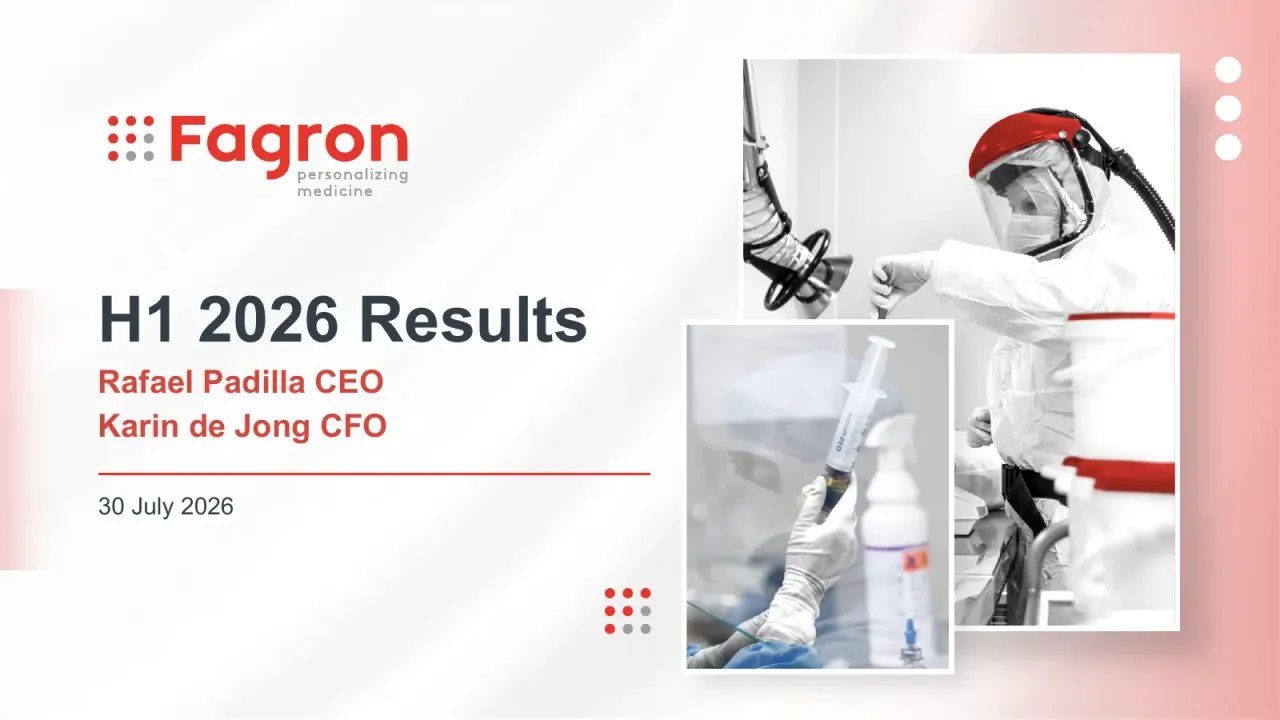
Fagron (Euronext:FAGR) Q2 2026 earnings call, held 2026-07-30. Watch the replay and read the transcript on 6ix.
On 6ix: 6ix.com/event/fagron-sa-ord-arsuf-q2-2026-earnings-call
Automated transcript · Written by software from the replay's audio. It can mishear names and figures; the replay is the record.
0:00 Hello, and good morning, everyone. Welcome to Fagron's h one twenty twenty six results webcast. I'm joined today by our CEO, Rafael Padilla, and our CFO, Karin Dejo. Rafael will start by discussing the company's performance and a closer look at regional developments. Kenneth will then walk you through the financial results. We will open the floor for questions at the end of the session.
0:26 With that, I will hand over to Rafael. Thanks, Ignacio, and good morning all. We're pleased to report a strong performance with revenues reaching €552,000,000 This reflects 3.1% organic growth at CR, 7% when normalizing the GLP-one effect. Growth was driven by brands, Latin America, B and E North America and EMEA. Profitability grew by 12.7% to €107,000,000. The margin of 19.4% reflects an improvement in both EMEA and Latin America and temporary effects in North America Pacific Compounding Services. On M and A, we closed the acquisition of Amber in Singapore and Malaysia, completing five acquisitions across all regions in 2026.
1:18 We also entered into a collaboration agreement with NutraConect in Asia, which will complement our nutraceutical platform. Integration of earlier announced acquisition remains on track. We have also appointed Amy Jones to lead the North American Pacific region. Finally, we're also reiterating our full year guidance of mid to high single digit growth at CER and an adjusted EBITDA margin of around 20%. Moving on to the regions. In EMEA, performance was led by brands on the back of continuous strategic focus, while essentials remained balanced. We saw, again, strength in compounding services through high demand for key therapies and our focus on operational excellence translated into better availability and procurement savings, supporting both top line and margin expansion.
2:19 During the period, we completed the positions of Pharmavit, Machlab, and Amber and are working on integrating them into the group. Pharmavit and Machlab will strengthen our European platform and enhance our market positioning, while Amber will help us further expand our footprint in Asia. Finally, we continue making progress in our capacity expansion project in The Netherlands. In Latin America, strong organic performance was led by the successful execution of our commercial strategy. In brands, our global R and D center in Brazil continues to be the engine of our global innovation. During the period, we completed the position of Puripharma and Vipakum.
3:06 Like in EMEA, synergies and efficiencies during the integration process supported the region's profitability. In North America Pacific, performance was led by Brands and Essentials, together with contributions from CurveFirst and UCP. Revenue growth in B and E was driven by new customer wins, improved product availability, strong essential sales and continued operational improvements. Compounding services was affected by the normalization of GLP-one related revenues and an industry wide IB back record. Handheld wellness continued to deliver solid growth driven by high demand for personalized therapies and new product launches. On m and a, over the last eighteen months, we have done 17 deals across all regions.
3:56 So far, all previously announced acquisitions have been completed except for Ingeplast. During the first half of this year, we have focused our effort on integrating this successfully. Our teams have achieved significant synergies during the integration process, as shown in EMEA's and Latin America's margin performance. We will continue to benefit from further synergies during the integration process, which usually last eighteen to twenty four months. In H1 twenty twenty six, M and A contributed around €69,000,000 to the overall group revenues, with all acquisitions performing as expected or better. And as Karin will comment, our balance sheet continues strong, and we remain open to exploring more opportunities across our regions and categories, while maintaining a disciplined approach.
4:50 On our expansion projects, as announced during our CMD in April last year, we plan to add 500,000,000 extra capacity by 2028. In The Netherlands, the sterile facility with a €15,000,000 CapEx investment has a revenue potential of €15,000,000. In North America Pacific, our new 5038 Tampa facility is already online with extra revenue potential
5:17 of $100,000,000, while Wichita and Las Vegas, both 503Bs, are ongoing with a combined CapEx of around $16,000,000 and revenue potential of $315,000,000 All expansion projects are currently progressing as planned. The additional capacity positions us to successfully capture future growth opportunities. Moving on to the health and wellness activities, we have received a lot of questions regarding peptides, especially after the hearing that took place last week where the PCAC recommended the FDA six peptides for inclusion in the five zero three b five zero three a books list.
6:04 Given our existing infrastructure and our proven track record, inclusion in the five zero three a books list will be an overall tailwind. The time to market is variable and can range from six to eighteen months post inclusion depending on various factors such as qualifying the right API suppliers and performing validations. And finally, on our North America Pacific leadership team, Amy Jones has been appointed area leader after being instrumental in transforming our b and e business. She brings fifteen years experience in pharmaceutical compounding and will help scale the region to the next phase of growth. Additionally, building on our existing quality infrastructure, we're happy to announce the appointment of Kenneth Bonnell as the global head of quality.
6:56 Ken brings over thirty years of experience working in the industry across quality systems, quality assurance, regulation, and compliance. With this, we hand over to Karen. Yes. Thank you, Rafa. Good morning, everyone. Thank you for joining this call, and let me walk you through the first half of the 2026 financial results and provide more color for the full year 2026. In H1 twenty twenty six, revenues increased by 16% on a reported basis to €552,500,000 driven by acquisitions and organic growth in the regions. Gross margin decreased by two eighteen basis points year on year, driven by acquisitions and change in North America Pacific product mix.
7:44 Our operating expenses increased by 10% year on year, owing to our recent acquisitions, though as a percentage of revenue, they decreased by two thirty basis points. At a group level, our profitability margin decreased by 60 basis points year on year to 19.4%, mainly due to lower production volumes in Compounding Services in North America Pacific. We maintained our strong cash generating capabilities as operating cash flow improved by 10.8% year on year to EUR 58,100,000 for the first half of the year. And lastly, our net debt to EBITDA ratio increased to 2.1 times, largely because of payments for acquisitions. However, it remains below our internal threshold of 2.8 times.
8:31 Moving on to the next slide. The bridge illustrates our revenue development for the first half of twenty twenty six. EMEA reported a solid 4.1 organic growth at constant exchange rates, while LATAM America posted an 8% organic revenue growth at CER, supported by strong performance of brands in Brazil. North America Pacific revenue was largely flat, growing at 0.2% organic at CER, where a strong performance in the Brands and Essentials was offset by soft compounding services. Our recent acquisitions contributed EUR 68,700,000 to the revenue. And FX during the period was a headwind mainly in The U. S. Due to the weakening of the U. S. Dollar. On the right side, our P and L shows a 16% revenue increase, together with our adjusted EBITDA growing 12.7%.
9:23 Depreciation and amortization increased by 27.6% year on year due to the recognition of
9:28 acquired intangible assets on a larger asset base, reflecting both the acquisitions and continued investments in capacity and R and D. Our financial costs increased versus last year, driven by increased debt because of funding of the acquisitions and higher interest rates on our debt. As a result, earnings per share grew by 1.6% to €0.63 for the first half of the year. Turning to the next slide, EMEA. Revenue growth reflected solid organic demand across all categories and countries, alongside the contribution from acquisition. Geographical diversification, along with a mix of price and volume increase, drove organic revenue growth. And looking at the region's profitability, adjusted EBITDA margin expanded by 30 basis points versus H1 twenty twenty five, supported by operational excellence initiatives, sales mix and integration benefits.
10:23 And as Rafa mentioned earlier, we closed the acquisitions of Pharmafit, Magilop and Amber during H1 twenty twenty six. Moving on to Latin America. Sales increased by 38.7 to 120.5 reflecting strong organic growth in brands and contributions from recently acquired companies, aided by a strengthening of the Brazilian real. Organic growth at CER was 8%, and it was largely led by a strong volume growth and recent product launches in brands in Brazil.
10:55 We achieved a 120 basis points adjusted EBITDA margin expansion to 18.6%, supported by operational improvement and strong performance of the acquisitions, especially for Baku. Moving on to the next slide. Revenues in North America Pacific grew by 0.4% to EUR 213,200,000 as strong traction in Brands and Essentials was offset with short term headwinds in Compounding Services. Reported growth were also affected by currency movements. B and E continues to grow at a fast pace, mainly supported by operational improvements in product availability, leading to volume growth.
11:36 Compounding Services performance was impacted by the reduction of GLP-one production at our 503B facility and limited availability of the IV bags. Adjusting for the GLP-one impacts, the organic growth for the region will be around 10%. Our operating costs in the region increased slightly year on year due to acquisitions and ongoing investments. Overall, this resulted in an adjusted EBITDA margin of 17% in H1 twenty twenty six.
12:04 Turning now to our cash flow. Our business model has several strengths and one of them being the strong cash conversion. Our operating working capital increased by three ten basis points to 16.9% due to the recent acquisitions and higher inventories to support product availabilities in Brands and Essentials. Operating cash flow increased by 10.8% to 58,100,000 and maintenance CapEx ended at 2.6% of revenue when excluding the one off projects. Our free cash flow conversion was 40.9%
12:37 when adjusting for one off CapEx, slightly below our guidance, however, as we've seen during full year 2025, we expect it to correct towards the end of the year as working capital normalizes. Moving to our net debt evolution. The bridge shows an increase of €222,100,000 in our net debt, growing from 283,300,000 at the end of full year 2025 to 505,400,000 as of H1 twenty twenty six.
13:08 The increase is mainly related to acquisition and working capital movements. As a result, our net debt to EBITDA increased to 2.1x, however, still below our internal threshold of 2.8x, giving us ample room to pursue opportunities. So before I hand it back to Rafa, let me go through our full year 2020 outlook. For the group, we are expecting revenues to be in the mid- to high single digit organic growth at CER with different dynamics depending on the region and a profitability margin of circa 20%.
13:40 We expect maintenance CapEx to be at 3.5% of revenues for 2026, excluding the already announced one off projects and investments. I would now like to hand it back to Rafa for his closing remarks. Thanks, Karin. To conclude, Fagron is a unique, global, vertically integrated company operating in the fast growing, highly fragmented market of pharmaceutical compounding with a defensive business model, predictable revenues, and strong cash conversion.
14:11 We have highlighted over the years the resilience of our business model and how it is reinforced by our diverse global footprint. This was clearly visible in H1 twenty twenty six when excellent growth in EMEA and Latin America more than offset the challenges in North America Pacific. These factors, coupled with demographic trends and our emphasis on personalization, are the basis of our success.
14:37 Our quality focus, together with our ongoing operational excellence initiatives, will optimize our business through global synergies. While a disciplined m and a strategy remains a key part of our growth, sustainability is a paramount priority and a strategic cornerstone for us as together, we create the future of personalizing medicine. Let's open the floor for questions. Thank you. Ladies and gentlemen, we're now ready to take your questions.
15:10 The first question comes from Frank Glasser from ROTH Capital. Please go ahead. Yes. Good morning, all. I've got two questions. First of all, on the issue with the IV bag, the supplier. Could you elaborate how much did that impact your Q2 or first half results? And when do you expect it to be solved? So that's the first question.
15:36 And then secondly, on the situation in The Middle East, the turmoil, could you elaborate how is that impacting your business model?
15:46 Do you already see inflation on raw materials, APIs or logistical costs? Could you elaborate on that situation? Thank you. Good morning, Frank. Yes, so starting with your first question on the
16:03 issue with the IV bag. So if we look at North America compounding services for the first six months, we see minus 8%. If we take the GLP one impact out of that, which as you all know normalized, will be around 4% roughly. So this is below the guidance of high single digit, low double digit before any capacity expansion for that segment. So this gap was driven by the availability of the IV bags at our compounding services facility.
16:35 And so that gap really is driven by, on the one side, the missed sales, you see that's impacting q one and q two, but also a CARPA that was initiated by the supplier and triggering a revalidation of us. So we expect to be back in the course of q three with the IV bags. Yes. And good morning, Frank, on the Middle East one. So far, we have not seen any disruption in supply. So we have as we have discussed before, and you always ask the, the operational question. So thanks for that. Our profitability is, is high. It's good. What we have seen on the raw materials, they're rebating from, from oil, an increase there, which, of course, we we have the ability as we also saw with COVID and and the previous years that we have the ability to pass the price increase through.
17:25 It's also true that the beginning of the year, we
17:28 we took an strategic move, and we also discussed this during q one to increase our inventories for key items, mainly for the eight items also, again, coming from this oil source. Okay. That's helpful. Thank you. Thanks, Frank. Thanks, Frank. The following question comes from Stang Demaser from ING. Please go ahead.
17:59 Yes. Good morning. Thanks for taking my question. I have a couple. Maybe first on peptides. The PCAC hearing showed that support for these, peptides is not unanimous, given these drugs often lack some medical evidence and burden to self medication. Nevertheless, the drive from the industry to to grow this segment seems very strong. Can you address any concerns that there won't be unfavorable evolutions down the line such as adverse results from using these drugs? That's the first question. And secondly, on the profitability outlook of circa 20%, can you decompose that a bit for the different regions? And then lastly, on
18:41 the 503A to B developments, to what extent are you currently benefiting from this regulatory change that was implemented a while ago? Could you maybe give some
18:53 examples on where this is boosting your business? Thanks. Yes. Thanks a lot, for the questions, Stein, and good morning. On the peptides, you have said it, really well. So there are six peptides that were voted for inclusion in the five zero three eight books list. What's currently happening now is the is a grave market, an important market from Asia of Finnish, of Finnish goods, and people are self medicating. So with this initiative, of course, if the FDA if the FDA votes for because the last word is, on the FDA, then with this market will be regulated, will be produced, compounded infantry facilities across the country and on adverse effects. Of course, we we cannot comment on these ones as we are not technically technically capable to do that.
19:44 We believe that we are well positioned to capture this growth opportunity as we have a nice network of five three eights. We have one in Tampa, as we said previously today, with the capacity of $100,000,000. We have Kerfurst in the Northeast part of the country,
20:02 and, of course, UCP, our last acquisition in The US in the West Coast in San Diego, so we are well prepared to capture this growth. And, of course, we have a good track record on that.
20:15 Yes. Good morning, Stijn. And on your question on guidance for profitability. So the first half of the year profitability was supported by strong performance in EMEA and LATAM, driven by solid underlying business momentum and also the positive contribution from recent acquisitions and early realization of integration synergies. So for H2, EMEA is expected to maintain its strong performance with further integration benefits still to be captured. It is important to note that while a portion of the readily achievable synergies already been realized, Our integration program typically delivered a majority of benefits over an eighteen to twenty four month period, providing continued, albeit a more gradual potential for margin improvement.
21:03 For LATAM, we expect you to deliver further margin expansion in H2, supported by favorable seasonal trends, as we always see, and the additional synergy realization of the acquisitions, mainly Beauty Pharma. And now moving to North America. The profitability was temporarily impacted by product availability constraints within Compounding Services. And as we said, we expect a gradual improvement during the second half as the production capacity is restored again and we recover our volumes. So we expect a step up also in North America. So overall, we reiterate our guidance of circa 20% adjusted EBITDA margin for the full year. And on the last question, Stan, on the b two a developments, next to the fact that the underlying market is is increasing rapidly driven by telehealth, there are two drivers, two positive tailwinds. One is outsourcing that we always command, and the other one is the b two a phenomenon.
22:06 And this can increase substantially our revenues in The US in the upcoming years. Therefore, we took the strategic decision of investing in new capacity. We have explained that on the five zero three b side of the business, we're bringing 350,000,000 extra capacity in 2028 in both Wichita and Las Vegas. We have identified already 20 items that we want to produce. Of course, we need to go through all the validation step that you are very much aware of. And at this moment in time, we have already one item being sold, and we have five more in the pipeline ready to, be launched during the second semester. So, of course, when we get those 20 items that we expect to get during next year with extra capacity, this will be a nice tailwind for us.
23:03 Thank you. I'll put myself back in the queue because I have some more questions. Thanks, Thanks, Stein. Thank you, Stein. The following question comes from Usama Tariq from ABN AMRO, ODDO VHF. Please go ahead. Hi. Good morning, team. Thank you for the opportunity. I just have two general questions. Number one, with respect to, for instance, yesterday's press release by Medius, they, they are expecting some trouble with regards to their pricing and margins, especially in the medical cannabis market. I just wanted to indicate I just wanted to ask, is is is is there a trend that you are seeing in EMEA, or is it something that is only related to the peer? And my second question would be with regards to the to the peptide market. I mean, I apologize for my ignorance, but if something really concludes for Fagron, if it's an opportunity going forward, when would be the earliest that you see some of it flowing into your sales? Would it be more like a 2027 opportunity or 2028?
24:18 Some clarity there would be would be really great. Thank you. Yes. Thanks a lot, Usama. On your first one on cannabis, as you know, we for the last twenty plus years, we worked together with BMC. That's part of the Dutch Ministry of Health distributing, you know, European scale cannabis. We also repacked that one in one of our facilities in The Netherlands. And so far, we have not we have not seen any price erosion from that part of the business. And then on your second question on the peptides, after inclusion, that time between now and inclusion, there's uncertainty as we were discussing with Stan. It's an FDA call, of course. So after inclusion, it will take for us a period between six and eighteen months and depends on two things.
25:09 First is the the sourcing of a API supplier of a peptide supplier, of course, FDA registered. And the second one, it's all the validation process that we always go through in our compounding facilities. Thank you. Thank you. Thank you, Usama. The following question comes from Michael Heider from Berenberg. Please go ahead. Hi, good morning from my side. Thanks for taking my questions. Most of them have been answered, but maybe you can shed a little bit more light on the margin in LATAM. I was positive surprised, to be honest, to see the progress already in the first half.
25:58 You already explained that you had early synergies, but maybe you can, yes, give a little bit more detail here. How much of the synergies are already have already been seen in the first half? How much more do you expect to come? And how did you manage to realize them so quickly? Thank you, Michael. Yes. So indeed, what we see in Lotham, but we saw a similar pattern in EMEA, that when we exclude the contribution from acquisitions is that the underlying business is performing very strong. So the profitability compared to last year for both regions improved despite the dilutive impact of the acquisition. So you see that mainly for Lotham, our strategy on increasing and accelerating our brand strategy, but also operational excellence initiatives that we have taken in that region regarding, for instance, product availability, strengthen our position in that market. And you see that in the underlying performance of that region. And historically, we guided that it would go towards 19% to 20%, and we're well on track of that. If we then look at the two acquisitions specifically for the Lotham region, we have Puripharma, which is dilutive, as you know.
27:21 We according to our M and A playbook, we've lined out the synergy benefits over a period of time, in this case, eighteen months. And of course, on the back of that playbook, we have some early wins on Ord procurements and some cost savings. That's what you see translated. And second, Fagron performed very nicely in their running business. So overall, positive for the region. And as said, we expect a continuation of that in H 2 on the back of seasonality that we have in that region, but also a further improvement of the performance, specifically for Beauty Pharma. Okay. So Beauty Pharma by itself would still be dilutive, of course, but you're still working on that, right?
28:09 Yes, yes, yes, of course. So we have usually for all acquisitions, an eighteen to twenty four month period where we work on our initiatives for synergies, and so we expect a continuation. So it's not at the level yet. Yes. Many thanks. Great. Thanks. Thank you, Mikael. The next question comes from Matthijs Gjerdstanao from KBCS. Please go ahead. Hi. Yes, congrats on the results. First of all, I had a small question on North American performance because, yeah, the organic growth was down compared to last year. And I was wondering about what you see in in the underlying demand for for, yeah, compounding services there. Thanks.
29:04 Yeah. Thanks a lot, Matthijs. And, as we were discussing before, the underlying demand is, remains strong. We see, clear tailwinds. Telehealth is one of the of one of the tailwind. This is also related to the prevention of lifestyle market. It's clear that not only The US, also in the rest of of the of the regions, countries, we see that people want to live longer and better, and that's what the provincial lifestyle is about. And personalization plays an important role there. And outsourcing is also a clear tailwind. You see regulation, quality requirements increasing. And, of course, as you know, really well, Matthijs, one of our strategic enablers is quality focus. We want to outperform the market from a quality perspective, and therefore, you see us well positioned to capture this this market growth.
29:57 Okay, Top. Thanks. And you still see the the capacity to, yeah, to to fill all of the capacity capacity that you are building now Because, yeah, that's quite a lot. So a lot of growth will be needed to fill that. Yes. That's correct. That's a very good question, Matthijs. So next to our current capacity, so what we're explaining, 503 A, we have three sites. Tampa, brand new, 100,000,000 revenue. CURFERS Northeast was in a position. Also new, Sunny and the rest of the team, they built up a nice facility where around 40% there. And then UCP as well, We see a nice facility in the in the West Coast in California, so we have capacity on our 53 A facilities.
30:42 And then when you go to the B's, we have integrated, them as we're discussing many quarters ago. And you have Las Vegas, which is at 85, 90% capacity, the current Wichita one. As we said during this year, we would reach at 90% capacity, and that's when we start filling the factory. And then we, of course, we need to wait for a new capacity. And then, of course, we have those two facilities that we're discussing before, the new one in Las Vegas and the new one in Wichita, 350,000,000 extra capacity that will be online during 2028. And the growth that will come next year will be coming from our Boston facility, which is at around 40% now. So we have a lot of room for growth there. It's a new facility coming from Fresenius Kabi, so we are well placed to capture this growth. And we have good visibility on the market, on how the market is developing.
31:37 So we are quite confident that we will fill this capacity in the upcoming years. Okay. Sounds good. Thanks. Thanks, Matthijs. Thanks, Matthijs. The following question comes from Erik Wilmer from Kemper. Please go ahead. Good morning, Rafa and Karen. I also had a question on your EMEA profitability, which I believe came in ahead of expectations. Perhaps this margin was helped a bit by m and a, particularly the margin profiles. Some of your more recent deals may have fueled it. But, yes, I would expect this the I would expect the usual time it takes to pass in to pass on inflationary costs to more than outweigh this, especially given from where you source the majority of your APIs and also basically from the lessons we've learned, I would say, past COVID.
32:37 And I I guess a lot comes down to operational savings from potentially previous deals. So I'm just very keen to understand where specifically you managed to further optimize your operational footprint and and squeeze out these the sequential improvement for EMEA. Thank you. Yes. Good morning, Eric. If we look at the EMEA region, they had a strong improvement in profitability if we take out the acquisitions. And if we take out the biggest one that we announced, PharmaFit, it has a dilutive impact on the overall margin of EMEA. We see that if we exclude that, that EMEA had strong performance, and it was driven by a couple of elements. First, we have operational excellence initiatives, which are paying off, and that's what you see in product availability increase, having a direct impact on top line.
33:30 We see procurement savings having an impact on margins, and then we have solid pricing power of our strong position that we currently have in certain markets. So the combination of that, we see translated into our EBITDA improvement of the underlying business. On top of that, we indeed have some early synergy benefits from the acquisitions. And as I earlier mentioned, we expect a continuation of that, maybe a bit more gradual over the period, but we do expect to see improvement. As said, of course, we are well positioned when we have price increases on our raw materials to pass them through to our customers. There can be a lagging impact there in the sense that can take a bit more time, but in general, we have the experience that we are able to do that. So from on the back of that, we believe that there's still upside potential for the EMEA margins to increase.
34:29 We'll, of course, be at the lower part than, for instance, North America. That's helpful. Thank you. Thank you, Eric. Thank you, Eric. The next question comes from Stein Demaiser from ING. Please go ahead. Yes. Thank you. Two additional ones from my end. First one, Fagron, this has been a somewhat larger acquisition at a below group margin in a relatively new product category, which may also be a bit more competitive product category. Can you comment on the integration of this acquisition, where you are in terms of margin and also uptake of these nutraceuticals with clients?
35:16 Second question is on the guidance. Maybe the share price reaction is today driven a bit by the fact that you need some growth acceleration in the second half, whereby the IV best issue, yes, expected to persist in q three. So what gives you the confidence in this growth acceleration and and and what phasing do you expect over q three and q four in terms of, organic growth? Thanks. Yes. Thanks thanks a lot, Stan. And, the pharma question, which we like a lot because, we believe that, the nutraceutical products that, pharma carries have a, what we believe we we are certain that, it has a a huge match with our portfolio across the globe, especially in Latin. When you look at compounding in Latin America, in Brazil, there is a lot of compounding in the in the pharmaceutical segment. So when you make a think up analysis with the Pharmalyx portfolio, you see an overlap of more than 85, mainly the same manufacturers' specifications.
36:18 So the first part of our m and a playbook that we explain in each one of our integrations is let's first integrate the operations. That's mainly the procurement and the manufacturing being, of course, the quality control labs and the repackaging. So this is now ongoing. It's it's going above expectations. The collaboration with the Pharmavic team is, is great. Entrepreneurial family family state, really easy to, to work, to collaborate. We execute fast, good decision making, and this is very important in this first operational part of the m and a integration playbook as we're capturing there the synergies. So we announced when we acquired Pharmavead that the EBITDA margin was around 14%.
37:10 And as Karin was explaining the previous question, we have seen an an early improvement there, so that's a positive. Second part of the integration, well, of of course, there is always a a a an integration phase zero, which is finance, IT, all the admin part, which, of course, we we integrate rapidly. Then you go into the second part of the integration, our integration playbook, which is the commercial part. We already started with that. So we are introducing our branded items into the Pharmavit platform. And this will bring, for sure, nice revenues and margin developments because the conversations with the customers will be not only on the essentials and the raw materials, which, of course, there's a quality part involved.
37:56 And as you said before, there's the competitive price involvement. We will also have a more scientifical discussion with them, and this is a copy paste of the Brazilian model, which we have seen giving excellent results. So then we add the brands on top. And then third part of our integration playbook, which is the regional expansion, We have or as we speak, we are planning now a plan together with Amy and Jerome, who's a pharma business leader, previous owner, and Ronald and Kim, of course. We are now developing a plan to enter The US market, which is the the biggest one by far in the nutraceutical segment. And this complements our component offering, which, again, there is an overlap of 85%. So thanks a lot for your very nice question, Stein.
38:43 Yeah. And then on the second question, Stein, on the sales guidance, If we look at the different regions, we expect EMEA to maintain its strong momentum, delivering mid single digit percentage of growth for the full year. LATAM is on track for high single digit growth with potential upside driven by the continued strong execution. And then North America, as you know, was impacted in the first half by discontinuation of the GLP-one production and the limited IV bag availability. Comparison will become more favorable, of course, in the second half as the impact from GLP-one lapses. We expect compounding surface activity to recover gradually with a more meaningful acceleration towards the fourth quarter. As Serapha mentioned, underlying demand remains healthy, and our other businesses are performing very nicely, supporting a stronger second half outlook for North America.
39:39 So overall, we reiterate our guidance for the full year revenue growth in the mid- to high single digit range, albeit towards the lower end of that range. Maybe also good to add, our inorganic contribution for the full year is expected to be around mid teens, with 14.4% reported in the first half of the year. Thanks. If I can squeeze in one more. I saw some approvals for GLP one in Brazil, including from Sandoz. Is that a threat to your weight loss category in that in that region? Yeah. That's a really, really good one. We have continuous conversations with the teams. So what we're doing now and if you go to Instagram, you can follow us in the channel GLP one support, and, it's more generic account.
40:30 So we are offering to our prescribers, a combination of, of adjacent products or formulas, compounded formulas personalized on muscle recovery. So we launched a nice brand that's strong two years ago, which works perfectly to regain regain muscle mass. And, of course, other nutritional branded items that we have in our portfolio supporting the GLP one, GLP two, and G receptors and acceptance of these new concepts that we have launched to support these therapies as you have just already, asked, Stein, is quite positive, and we see it back translated in our, in our results.
41:16 That's good to hear. Thank you very much. Yeah. Thanks a lot for the question. Thank you, Stein. You, Svein. Well, thank you very much for your participation today. I will remain at your disposal should you have further questions. We wish you all a great summer. Thank you, and goodbye. Thank you. Thank you. Bye. Bye bye.
Follow Fagron SA into a list and get an email when it puts out news.
CEO
CFO
at ROTH Capital
at ING
at ABN AMRO, ODDO VHF
at Berenberg
at KBCS
at Kemper
at ING