Replay available
Eve Holding (NYSE:EVEX) Q3 2026 Earnings Call
Eve Holding (NYSE:EVEX) reported Q3 2026 results on this call. Replay available.
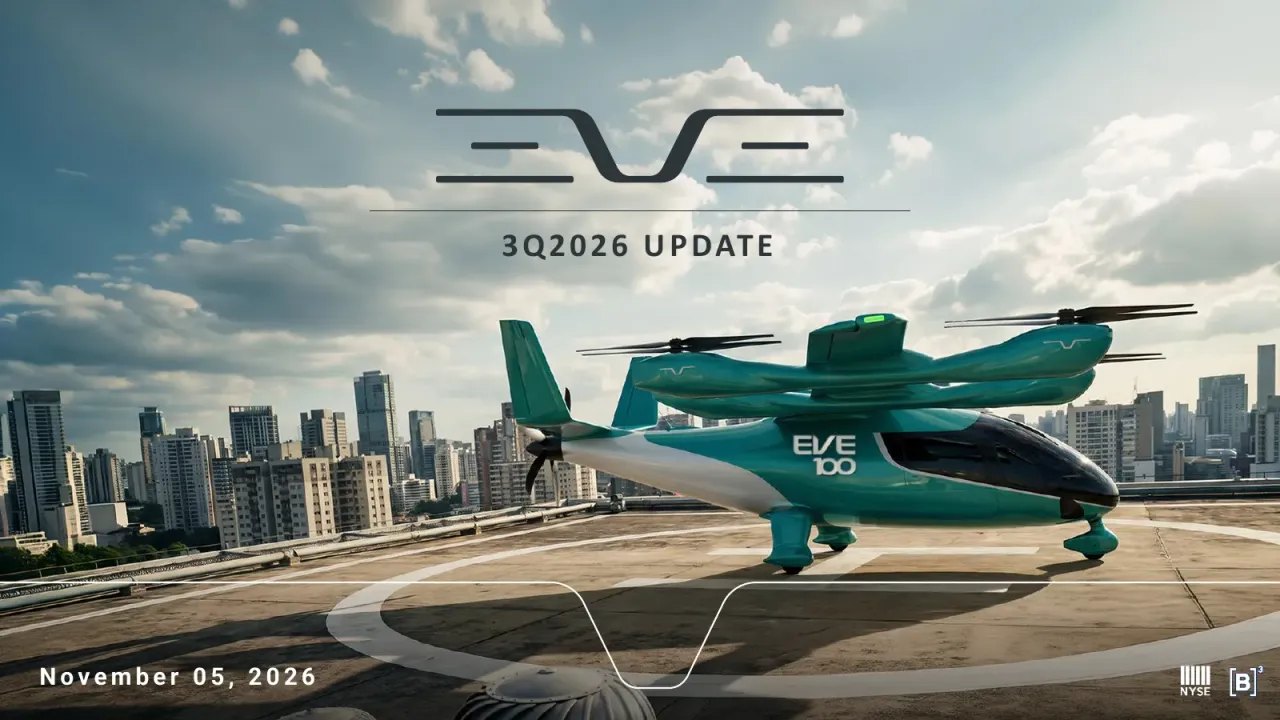
- Company
- Eve Holding, Inc. (NYSE:EVEX)
- Period
- Q3 2026 earnings call
- Date
- Thu, Nov 5, 2026, 8:00 AM ET
- Replay
- Watch the replay on this page · 46 min
- Results news release
- Eve Holding, Inc. Reports Third Quarter 2026 Results · Thu, Nov 5, 2026
On 6ix: 6ix.com/event/eve-holding-inc-evex-q3-2026-earnings-call
Replay
Transcript
Automated transcript · Written by software from the replay's audio. It can mishear names and figures; the replay is the record.
0:00 Good morning and welcome to the Eve Holding, Inc. Third Quarter 2026 Earnings Conference Call. All participants will be in listen-only mode. Should you need assistance, please signal a conference specialist by pressing the star key followed by zero. After today's presentation, there will be an opportunity to ask questions. To ask a question, you may press star then one on a touch-tone phone. To withdraw your question, please press star then two. Please note, this event is being recorded. I would now like to turn the call over to Lucio Aldworth, head of IR. Please go ahead. Welcome to EVE's third quarter 2026 earnings conference call. Earlier today, we released our financial results for the quarter, which are available on our investor relations website. Joining me on today's call are Johann Bordais, chief executive officer, and Eduardo Couto, chief financial officer.
0:57 During the call, Johann will provide an overview of our quarterly performance, strategic initiatives, and progress in our development process. Edu will then review our financial results in greater detail and discuss our outlook. Following prepared remarks, we will open the call for questions, at which point Marcelo Basili, our chief flight prototype engineer, will join us to address more technical questions. Before we begin, Please note that today's discussion may include forward-looking statements regarding future events, operating performance, and financial results. These statements are based on current expectations and assumptions and are subject to risks and uncertainties that could cause actual results to differ materially.
1:46 Additional information regarding these risks can be found in today's earnings release and our filings with the SEC. We will also discuss certain non-GAAP Thank you, Lucio. Good morning, everyone, and welcome to our third quarter 2026 conference call. We had a good quarter with several milestones that clearly demonstrate consistent progress in the development of our eVTOL and the surrounding ecosystem. After the inaugural flight of our engineering prototype last December, we went through a series of hover flights. After we concluded a planned ground test period with software updates, we resumed our flight campaign with partial transition flight, where we started to engage the pusher with the lifter still powered on.
2:50 and we gradually faster speed. That phase is now complete and we plan on performing our first full transition flight by powering the lifter down before the end of the year. In parallel, we continue to test individual components in dedicated rigs as part of our building block approach. This multi-phase testing approach validates not only our design philosophy by extensively testing every part individually, but also the integration of critical systems such as fly-by-wire and fixed-pitch lifter rotors. We have also started to receive the first parts and components of the first of six prototypes we will assemble for our certification campaign.
3:37 We have some additional pictures further in the presentation. Lastly, we signed a new binding agreement with Brazilian operator Flybeast, who will serve the southern part of Brazil with our aircraft. Flight 3 and 4 show the progress of our flight campaign. With successful completion of our ground test, we cleared the prototype to get back in the air and started transition flights back in July. The prototype flew 73 times and logged a total of 3 hours and 6 minutes of air time. The pusher was engaged at first with low RPMs and then powered up to around 1200 RPMs, allowing the aircraft to fly forward at 45 knots, The next phase involves accelerating further towards the transition speed of around 100 knots.
4:28 This is the speed at which air flowing through the wings is enough to provide it with the necessary lift and maintain airborne, with the lifter's motors off. We are now 8 to 10 flights away from the full transition phase. Flight 4 shows the progress we have made in the last few months in terms of speed and, perhaps more importantly, the engineering test points we have validated so far. Our aircraft never flies for the sake of flying. Our engineering team diligently plans the individual points that need to be successfully validated for the aircraft to move to the next phase. These points may involve aircraft performance metrics, such as the aerodynamic drags, or the loads or the performance of individual components such as the rotor vibration, battery temperature, motor RPMs versus thrust, etc.
5:22 It is precisely these validations that allow us to move ahead with confidence. As of today, we have successfully validated 170 of 185 planned test points for the engineering prototype flight test campaign, achieving a 91% completion. On slide 5, we wanted to show you some additional details of our rigs we have put in place to test individual components separately. We can see here the one of the lifter motors running the last set of tests before shipping, and all lifters are on track for delivery and assembly of our certification prototypes. These tests confirm that each motor produced the necessary thrust for takeoff and landing procedures for the flight schedule. The rigs are used to corroborate the energy requirement and expected drain on the entire system and that the inverter also successfully managed the flow of energy during the peak demand and the takeoff and landing phases of the flight.
6:26 On top of that, we run successful containment of thermal runaway event on the battery pack. There are multiple ways to prevent thermal events via cell isolation, Control of charging discharging on a cell by cell basis, all of which are part of our aircraft design, but it must also be able to successfully contain a thermal event to assure the flight safety. On slide six and seven, we show some of the additional components and parts that have already been produced for our first conforming prototype. As you can see here, large fuselage sections, as well as tooling for wings and pylon structure are ready. We will start receiving these and other parts in the next few months to start the assembly of our first prototype early next year.
7:16 The assembly of the subsequent five other prototypes will start right after delivering each of them 30 days after another to the Gavião Peixoto test facility. The next piloted prototype flight will take place by the second half of next year. Now, moving to slide 8 and 9. As mentioned before, we just signed a new firm agreement with operator Flybeast for a total of 12 aircraft. Two firm orders and an option for additional 10 for a potential contract size of $60 million. Flybeast is a regional operator in the south of Brazil with routes in region with a high touristic demand. Brazil represents the premier market for urban air mobility.
8:01 Driven by government and certification authority support, a rapidly maturing ecosystem, and strong passenger demand in cities where infrastructure has not kept the pace of growth. This makes Brazil one of the most important markets and positioned it as among the first scale commercially following the certification, with two operators already committed and several more showing strong interest. This is a good entry point into the next slide, which shows our total pre-order backlog of approximately 2,500 aircraft valued at about $12.6 billion at least price. Additionally, approximately 1,100 of those aircraft have a service contract attached to them, bringing a total potential tech care revenues to about half a billion dollars in the first year of operations.
8:56 The next slide shows some of the SunTracks Ecosystem Summit in Florida, gathering 150 representatives of all of our future UAM operations stakeholders. The event, in partnership with the Florida Department of Transportation, provided insight into the infrastructure, operational procedures, and airspace navigation procedures needed to enable the safe and efficient integration of UAM into Florida's transportation network. Some TRACS advanced air mobility facilities include an aerial test track, vertiports, hangars, and charging infrastructure for simulated EV tolls, takeoff, and landing, plus the low-altitude corridor for drones, air taxis, and autonomous logistic tests in a controlled, regulated environment.
9:41 And now, I hand it over to our CFO, Edu, for the third quarter of 2026 financial review. Thanks, Johann. On slide 11, EVEN ended the third quarter of 2026 with $356 million in cash and total liquidity of $471 million, which includes $114 million in undrawn standby credit loans. We believe the current level of liquidity is enough to support operations through 2028 without new funding. One important highlight during the quarter is that EV has already started to show Synergies and cost avoidance gains that were identified in the first half of this year.
10:27 We have been working extensively with Embraer to find ways to reduce our cash burn until certification. We've identified savings of 100 to 150 million. Only in 2026, we already captured approximately 50 million of those savings, despite higher development activities and stronger engineering engagement. Eaves SG&A is going down year over year and our total cash burn in the first nine months of 2026 was 174 million. With that, Eaves total cash consumption is now pointing towards the low end of our guidance of 225 to 275 million in 2026, which is a reduction versus our initial forecast.
11:19 The capture synergies are reducing our cash burn and extending EVE's cash runway without any impact in our vehicle development and certification timeline. Now moving to slide 12 with a summary of our financial results. EVE invested $48 million in R&D during the third quarter of 2026, mainly for the eVTOL development. Meanwhile, SG&A totaled $6 million for the quarter and many more. and 174 million in the first nine months of 2026.
12:23 With that, we conclude our remarks and I would like to open the call for questions. Operator, please proceed. Thank you. We will now begin the question and answer session. To ask a question, you may press star then 1 on your telephone keypad. If you're using a speakerphone, please pick up your handset before pressing the keys. If at any time your question has been addressed and you would like to withdraw your question, please press star then 2. At this time, we will pause momentarily to assemble our roster. The first question comes from Andres Shepard with Cancer Fitzgerald. Please go ahead. This meeting is being recorded.
13:09 This meeting is being transcribed. Hey, everyone. Good morning. Congratulations on the quarter and all the great progress, and thanks for taking our question. Johann, I wanted to maybe start with the quality of the flight campaign. You know, I think very exciting to see the progress here, 91 of the planned progress for the year already complete. So I guess maybe just help us understand, you know, what is left to get to that first transition flight by year end, what gives you confidence in getting there, and then what comes after that. Thank you. Oh, great. Thank you, Andres, for the question. I will start and then Marcelo can complete also here with us. This is, you know, the company has been going very well. It's based in three phases. The first one that we did when we had the first flight.
13:57 In the 19th of December last year, hover phase, what we called, and then we flew. And hover phase doesn't mean that you don't make some movements, but it means that you don't have the pusher on. And then we did, so we completed this by April this year. Then we stopped the aircraft to do some upgrades and software upgrades, some reinforcement, as I mentioned before, just for the next phase, which is the transition, where you have the loads, right, on the aircraft. and that's something that we wanted to make sure it matches our engineering model. So this is what we've done and right before the Fumble Rotor show, we actually announced the resuming of the flight and then this time with the pusher on. And it's not really so much about the number of flights, it's the quality of flight and exactly what the engineering wants to test.
14:47 That's what we call the engineering test. And the 91% is exactly what we wanted to do by the end of this year. We're 8 to 10 flight away from the full transition because then once you have the full transition, you have a typical full flight of what we're going to be operating for the E-100. So together with the prototype flying to the full transition, along with all the CDR that we have, we're doing with our suppliers and finalizing the configuration of the aircraft, then we can move on and start producing the conforming prototype. Marcelo, do you want to add anything on the test? So we're in the very end of the flight campaign, our uncrewed prototype, and that you provided the final definitions for our conformed prototype that we start building the next year.
15:45 So, perfect, Johann, your speech was great. Thank you. Well, thank you both. Very helpful. I appreciate all that color. And maybe just a quick follow-up. I was wondering if you could maybe – I know you mentioned it a little bit on the call, but maybe can we get an update on the six ANEC-conforming prototypes that you're planning to build? I think you briefly mentioned where the second one stands. Just how should we think about these? What's the timeline for these being built and then ultimately used for test flights? Thank you. Yeah, great question. Well, Basil, you go ahead. Okay, so those six prototypes were mentioned to allow us to reach the final of 2008 with the EV100 certified. So we start with the first prototype.
16:42 It'll be responsible for opening the envelope. Opening the envelope means we're progressing both in speed and Altitude, we know their craft, you provide the pilot feelings, and you finish after four to five months the definition of the systems under the integration of the airplane. After that, we have the airplane tube flying at least one month after the prototype one, which is responsible for part of handling quality and performance flights. followed by the third prototype which is responsible for the systems some of the systems of their plane the fourth prototype with mainly propulsion test and other systems the fifth prototype with interior testing and some remaining electrical system testing and the integration of HEERF and the final prototype is the sixth one so that will be designed for Operational flight, we call function and reliability flight.
17:50 So that's our plan for 2008, starting from the end of 2007. Excellent. Very helpful. And congrats again on all the great progress. Very exciting. We'll pass it on. Thank you. Thank you, Andre. Thank you. The next question comes from Savi Saif with Raymond James. Please go ahead. Hey, good morning. Just on the annex certification, can you discuss, you know, how that's progressing and then just kind of the discussions around the means of compliance and associated test plans? Are there any kind of regulatory requirements or, you know, physical testing that you still need to kind of scope out? Or are you still on target to maybe finalize that before year end?
18:45 Yeah. Okay, so in this year we are closing all our certification plans. Our detailed design standards is 99% closed, which is a demand from both ANAC and SAA, and our certification plans are defined. We just defined also our noise certification base this year, which was accepted by INAC and just finished the public consultation with success. For the next year, we're writing this specific test proposal, grant and test proposal for flying, which will ensure our readiness for the beginning of 2008 and the end of 2027. So we're in the Thank you. And if I might just, you know, congrats on moving forward in getting some of these orders firmed. I was curious if you could remind me again, is that, does that, The PDPs, do they come closer to certification or will you see anything in
20:21 2027? Yeah, I can start with the PDPs and Johann can talk about the orders. Yes, those firm orders are an important goal for us because we are converting the letters of intention into firm orders and with that we start to receive the down payments. We have some aircraft that we're going to receive almost 40% of the value of the aircraft before the delivery and then we receive the balance at delivery. So, yes, this is very important. We are progressing with good customers in very good use cases, especially in Brazil.
21:10 But in terms of cash, we're going to start to see more and more PDPs flowing through our cash balance. Yeah, remembering that we have the bigger pre-order book backlog with 2,500 customers Aircraft. I've been saying, you know, since the beginning that I joined the company that more than a number is really the leap of faith that, you know, customers are seeing in the solution that we are providing. If, and that's always what they can tell us, you know, we want to go for the UAM solution. We want to go with EVE because EVE is not only the vehicle, but it's a whole solution. It's all about customer support. It's all about creating the ecosystem. And now we're seeing this happening.
21:55 It started with REVO. and 25. Now we you know we had the early this year another customer with AirX in Japan and then this is the natural third one quite natural as we're moving forward and showing steady progress on the program development so customers were eager to also get the slots right of the first production line and and this is what's happening with like this right this side the LOI in 2022 they We've been discussing with them. We've been showing the progress as of the other customers, and they're very eager to develop the UAM in southern Brazil. Highly touristical. I don't know if you had a chance to go there, but it's a beautiful area where the growing city with many cities, Rio Grande do Sul, Balneário Camboriú. It's a bit hard to say, but it's a beautiful place, by the way. A lot of tourism growing exponentially.
22:49 So it fits perfectly, you know, the EVE solution and what they need for the urban air mobility and be the first one in the world, right, in that region. Yeah, that's great to see that progress. So just to clarify, do you have to start flying the force certification before you start getting some of those funds or could you get it sooner? We get sooner. We get the signature. We have no payment. Then we have 18 months, 12, and six months prior to deliver. We receive additional payments and the balance at delivery. Got it. Perfect. All right. Thank you so much. Thanks, Abby. Thank you. The next question comes from Adam Samuelson with Jefferies.
23:36 Please go ahead. Yes, thank you. Good morning, everyone. I guess for me just maybe on on just on expenses and cash and cash uses the R&D kind of analyzed up around 48 or so million after kind of being low in the second quarter. Should we look at that 50 million or so quarterly run rate as kind of the new peak intensity or is there going to be a step up at some point in 27 with six conforming aircraft kind of entering kind of production? No, I think the level should stay around this 50 million level that you mentioned, R&D, per quarter, right? Around 200 million per year.
24:24 Of course, next year we're going to assemble the six prototypes, as Basil mentioned. But we have been able to get synergies, additional synergies with Embraer. We're also controlling non-R&D related expenses, SG&A expenses. So we have been doing a lot of cost savings and synergies with Embraer. that allows us for next year to have the six prototypes being assembled and keep cash burn and total expenses kind of the same level of this year, which is a big win and a big achievement for us. So we're excited because we're going to be showing much more next year and moving towards certification in 28, at the same time keeping our cash burn around current levels.
25:18 Okay, that's very helpful. And again, just as you move past 27 and through into the certification program and then to production, can you just update us on how you're thinking about the modular kind of manufacturing ramp and how that can scale as you get 28, 29 and beyond? Yeah, we have a modular facility, right? We can produce up to 500 eVTOLs per year. Thank you for joining us. As we have additional demand, right? So initially we're starting with this 120.
26:13 It's an investment that we already have a law and right of facility to pay for this investment committed. This is part of our standby facility that we already have. So it doesn't bring an additional cash burn for us. So we're going to start to invest on that. Prototypes are still assembling at the Embraer facility. So the vehicles being delivered, we're going to produce in another facility. We're going to have more investments on that towards the end of next year in early 2028. Okay. That's very helpful. I'll pass it on. Thank you. Thank you. The next question comes from Amit Dayal with HC Wainwright.
26:59 Please go ahead. Thank you. Good morning, everyone. Just one question for me, guys. Just any clarity on what Embraer is helping you guys with today and what kind of assistance and support you might get from them, you know, down the line. Thank you, Amit, for the question. Every day they're helping us. Absolutely. It's the way that we're, you know, e-voice created and spin-off. I mean, we're a separate company, but obviously we do have an MSA with Embraer for the obvious reasons. The program right now is the program development. So it's more than 1,000, it's around 1,000 engineers dedicated to the EVE program. So the Embraer engineers focused on EVE, but it's a program development. So you have to also talk about the, and prepare the industrialization, which is exactly what Edu just talked about.
27:51 And then we're taking the best of what Embraer does today based on lean philosophy. and then obviously putting in the factory that we'll have that will trigger at the right time right it's a brownfield it's another advantage that we have being a part of Amber Air Group and also the quality system we're talking about the customer support and services where we've been working together to prepare the aftermarket and how we're going to be supporting the customers it's what we call you know the make or buy whether it's going to be Thank you. The next question comes from Andre Madrid with U.S. Bancorp BTIG. Please go ahead. Good morning. Thank you for taking my question.
28:56 I wanted to dive into the backlog real quick in the order book. It looks like maybe a bit of a sequential decline. I know this has happened before, but I was hoping you can maybe elaborate on what might have been the driving causes. Sorry, Andre. Of what? Did it happen before? Sorry, come again. A sequential decline in the order book and backlog. Oh. Well, it's natural, right? Like I say, you know, we've been for the last six years since we created EVE, we've been designing the solution for the customer and with the customers.
29:41 So ever since we had the first design, but also talking about the customer support and how we're going to be developing the ecosystem, it's done with the customers. And They're early adopters, they're pioneers, they're visionary. And then we have really the profile of our customers. It's from helicopter operators, it's from airlines, it's from also the leading company with different missions. So it's a touristical ecotourism, as we mentioned, but it's the primary business that we're going for. And what the customer want is the urban air mobility. It's really under 150 kilometers. They want to have a solution that is fully electrical, one pilot, four packs, and it goes to a 30 to 40 typical route, which is what we call the shuttle route, downtown of the city to the international airport and back and forth, but it could be any point of the city.
30:35 And that's exactly the market that we're aiming for. And the customers, when they decide it, it's from the world. It's 29 customers from nine different countries. and wherever there's a strong support and ecosystem readiness, which comes from authorities, the local government, also the different partners like infrastructure, the power company. We've been leading those discussions and then customers see that, okay, the E100 plus the ecosystem readiness and the customer support they placed those LOI and that's what we got to the 2600 as you mentioned a decline it's natural I mean it's early you know there's a lot of you know those companies that can be just going bankrupt or they changed their strategy on a game but also bringing new customers and new lead right and that's you know like Flight B Airwrecks that we you know we recently signed and I think you know as we progress in the very quickly now in 27 and 28 They will be able to see the actual aircraft, especially in Brazil.
31:43 Geva Peixoto will have the first prototype. And I can tell you there is no better catalyzer than having a full prototype ready to be certified in the next, you know, 60 months or 24 months. Right. So, you know, in 2028. So it will happen. It's natural what's happening right now. And we're thrilled about it. Right. It's now it's about not additional LOI. It's about The quality LOI, if we go for it, for new market, for new customers, and also the conversion rates, right? And that's what we're doing right now. Yeah, if I may add, Johann, it's exactly, you know, the focus now, guys, is to firm the orders, right? We have this very big backlog, 2600, 2700, doesn't really matter if it's 26 or 27. What matters is our ability to to move those LOIs into firm orders, firm contracts, start to receive the payments, start to plan the entry into service and the use cases.
32:41 That's what matters. So what analysts should be looking is really this firm order backlog needs to keep growing, growing so that we have the initial use cases, the launch markets, and the initial delivers. So that should be the focus. Got it. That's helpful color. And then maybe, Edu, one for you. You know, I know you talked a lot about the synergies with Embraer, but I'm also looking and it seems like on a CapEx level, you guys are running pretty light for the year and it requires significant step in the fourth quarter to hit what you guys have outlined. I mean, could you maybe just put Thank you so much for joining us. No, the majority of the cash burn goes on the development, right?
33:37 We have around 800 engineers at Embraer today working on the development of our eVTOL. On top of that, we have production guys that are going to be starting to assemble the final prototypes. So that's the bulk of our cash burn and our spending. Anything outside that is not a priority and we're trying to bring synergies with Embraer and reduce as much as possible. In terms of CAPEX, all these, you know, the expenses of the engineers, all the expenses on the prototypes, it all goes through these payments we do to Embraer, so it doesn't show in the CAPEX line. CAPEX line only shows some toolings and some machines that we're starting to buy.
34:25 As the prototypes are assembled inside the Embraer facility, I believe we're going to see more CAPEX probably towards the end of next year when we start to prepare our final facility, which will be used for the initial delivers in late 2028. So, you know, probably throughout next year, we're still going to see light CAPEX investment, but that doesn't mean that we're not You know, buying parts, assemblies and prototypes, it just means that all of that goes as operating cash flow on those payments we do to Embraer. I don't know if it's clear. Yeah, that's perfect. Thank you so much.
35:10 Thank you. The next question comes from Austin Moeller with Canaccord. Please go ahead. Hi, good morning. Just to walk through the timeline here on development, if we get the full transition by end of year, does that set you up for closing out critical design review in early 2027? And then when should we be thinking about ANAC or other FAA officials stepping into the final prototype to do their own tests? Yeah, that is correct, yeah. Yeah, it's really, you know, the final transition. Also, you know, in parallel with the CDR, by the end of this year, right, we're down to, yeah, probably 10 to 11, you know, CDR that we need to close yet.
35:57 And we're on track. And then we'll be able to start the assembly, all the parts that we showed you and all the other parts that we showed you in this presentation also are at the suppliers that they're starting to send to us. And then we can start the production of the first prototype. and that's when you know then the authorities which they have been engaged by the way right they all been engaged even in the engineering prototype we have ANAC representative and you know following the development and all the flight campaign but go ahead Marcelo on the ANAC. Yes I was about to say that they are already engaged both ANAC, SA and EASA with our program but to be more directed to your question they'll be getting into their plane After the half of the next year, after opening the envelope, and locally in the beginning with some system certification.
36:48 Because we are already designing and getting ready for the test campaign to be a certification campaign. So, since the beginning, we will have the INAC representatives going to Gavião Peixoto, witnessing the tests, and by the half of the 2008, with the final envelope opening, we closed the final aircraft systems and the aerodynamic integration, we expected to receive our TIA, right? And we have ANAC on board. By the end of the year, 2028, we have The FAA getting there for the validation of the certification.
37:41 Okay, and can you talk about what countries or municipalities might be launching the Vector air traffic management system first? Would this be in some of the launch cities where you'll have aircraft with customers like Sao Paulo? Oh yeah, definitely. The launch of Vector, it's happening. It already happened last year as a matter of fact at the Brazil and Grand Prix, Revo, our launch customer for the eVTOL. They didn't want to wait for the eVTOL, but already want to use it because it's the first modular vector of the UATM, right? The traffic management also does the ground, and that's the first module, the ground management of the helipad. and they're doing it again this weekend as we speak so they're using the Vector first module then it will go you know they will be using the fleet module and then it will go up to eventually with the UATM air traffic management module so it's three phases which will be developed along for the next five years right Vector it's also part of the solution that we're offering to our customers part of the tech care solution right the customer support services It's the aircraft customer support services and the ATM ecosystem readiness.
38:54 And basically all the customers will be operating eVTOL will be very interested to get also the vector. They showed interest, they are part of the LOI that we signed with them. Just to highlight, Johann, as you said, right this weekend, guys, there is the Formula One race in São Paulo, right, where we will be operating A lot of flights. Now we're talking about 300 flights during the weekend. And they're going to be using the Vector solution this weekend in the São Paulo F1 race. And thanks to Vector, they'll have the very efficient landing and taking off of the activities of helicopters. So turnaround time, the most efficient one. There's a lot of people you want to get in and out of the Grand Prix of Brazil.
39:45 Very exciting. Congrats on the operational progress. Thank you. Thank you. The next question comes from Pat McCann with the Boral Capital. Please go ahead. Hey, good morning. Thanks for taking my questions and thanks for the thoughtful answers to all the questions already. I'll just add one more. I believe you mentioned in your prepared remarks a little bit about the opportunity in Brazil being a favorable one. I was wondering if you could talk a little bit more about that, if you give any more details as to kind of what makes that a strong opportunity for building additional customers in the pipeline. And maybe on top of that, if you could speak a little bit about if you kind of broadly look globally where you think your strongest opportunities are as you move towards commercialization.
40:45 Very nice, Pat. Thank you for this important question. Absolutely. In the remarks, we did mention that Brazil is and will be the leader of the UAM. And that's a good reason for this because it takes different aspects. The first one, it needs to have a wish from the government. It's a new segment we're talking about. So it's not a A regular aircraft that you'll put in service, right? Of course, at the beginning, we'll be using everything that it is existing, whether it's in the air, whether it's in infrastructure, using the helipad, remembering that Sao Paulo has the biggest fleet in the world of helicopter. It's got the biggest number of helipad. It's more than 2,000 in and out of helicopter taking off and landing in Sao Paulo. The city has been growing.
41:32 We've done and we came up with the market outlook in 2025 last year. And we did mention that the planet Earth will have 2 billion more people in the next 20 years, right? And 70% of those 10 billion people will be living in cities. So if you think that spending 200 hours in traffic, whether it's in Sao Paulo or any other big cities in the world, it's bad. I mean, it's going to get worse. And I think it's just Brazil is the perfect ecosystem, the perfect market to make it happen. We have the history and the DNA of aerospace development, right? We do have Embraer. Now with the eVTOLs, we do make a vehicle that would be very safe, you know, at the highest level to be operating. We do have a big city.
42:21 People ask me, like, what about, you know, urban air mobility? When is it going to start? It already started. And Revo is the proof of it. Revo didn't want to wait for the eVTOL. They wanted to go and really start because they see the market. They see the need of having an urban air mobility alternative in the big city. And that's what they started. They started with a dual-turbine, dual-pilot helicopter. It's not the most efficient in terms of operating costs, but that's what it takes to get the customers and grow their market base. And that's what they've been doing. They started in Sao Paulo, but now they're also going to other cities. And and this is exactly what urban and mobility is about. And you can see with FlyBase, it's happening in the south of Brazil. I can tell you there's other operators that are talking to us now to also cover other regions. And I know that you're probably thinking about, oh, what about Rio?
43:10 Absolutely, Rio is another place that with the UAM and eVTOL will be perfect for the environment and for that type of business. So Brazil, I can tell you, will be, thanks to Eve, thanks to the aeronautical DNA that Brazil has, all the The big, you know, governmental wish and incentive that, you know, they were pushing for this, the vision of the future for the Brazilian cities and the Brazilian. Yeah, Brazilian will be one of the first ones in the world to be flying on the eVTOLs. And of course, the market is the big one also for us is the U.S., right? Very well prepared, great infrastructure, a lot of initiative also from the government. We've been in talks with many states. One of the latest one, and you saw it in the presentation with SunTracks in Florida, They've been supportive of what it's going to be for the next few years, the urban air mobility, and we're part of it.
44:03 But not only, we've applied for Yaja. Marcelo mentioned it early this year. It's also another important market. We believe that it may come a little bit later. But another one, very important for us, which represents almost 20% of what we see as a growth for all the eVTOL, is Asia-Pacific. And this is not... Not by chance that you know we announced this new customer, AirX in Japan, having the same business model that Revo is having, or Flybase, or even Australia. We were the only one having such a big base of LOI also in Australia for ecotourism and also shuttle operation. Excellent. Really appreciate the commentary and congrats again on the continued development.
44:52 Thank you, Pat. Thank you. Again, if you have a question, please press star then 1. This concludes our question and answer session. I would like to turn the conference back over to Lucio Aldworth for any closing remarks. Thank you, Drew, and thank you everyone who joined the call today. This was an important quarter for EVE. It was marked by significant milestones and continued progress across This meeting is no longer being transcribed. This meeting is no longer being recorded. Thank you for your continued support and engagement, and we look forward to seeing you in the many of the upcoming conferences and investor events we're going to be attending.
45:55 Have a great day, everyone. Take care. Thank you. The conference has now concluded. Thank you for attending today's presentation. You may now disconnect. Let's go to the other links, guys. Yeah.
Follow Eve Holding, Inc. into a list and get an email when it puts out news.
Latest news releases
- NYSE:EVEX — Eve Holding, Inc. Reports Third Quarter 2026 Results · Thu, Nov 5, 2026
- NYSE:EVEX — Eve Air Mobility and RV Connex Sign MOU to Advance Urban Air Mobility Regulatory Framework in Thailand · Mon, Aug 17, 2026
Companies on this call
More from Eve Holding, Inc.
- Nov 05, 2026 Eve Holding (NYSE:EVEX) Q3 2026 Earnings Call
- Aug 04, 2026 Eve Holding (NYSE:EVEX) Q2 2026 Earnings Call
- May 05, 2026 Eve Holding (NYSE:EVEX) Q1 2026 Earnings Call
- Mar 17, 2026 Eve Holding (NYSE:EVEX) Q4 2025 Earnings Call
- Nov 04, 2025 Eve Holding (NYSE:EVEX) Q3 2025 Earnings Call
- Aug 06, 2025 Eve Holding (NYSE:EVEX) Q2 2025 Earnings Call