Claudio Descalzi
Chief Executive Officer
Replay available
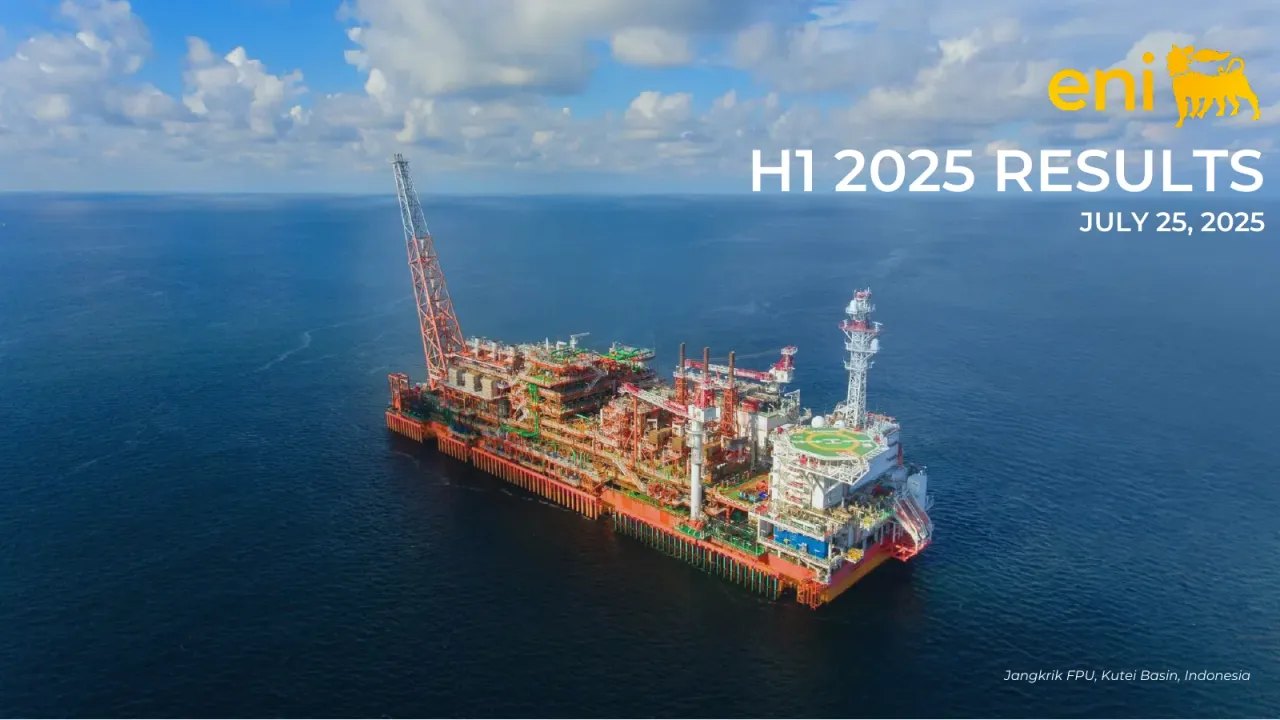
ENI (Milan:ENI) Q2 2025 earnings call, held 2025-07-25. Watch the replay and read the transcript on 6ix.
Automated transcript · Written by software from the replay's audio. It can mishear names and figures; the replay is the record.
0:00 Good afternoon, ladies and gentlemen, and welcome to ENIS 2025 First Half Results Conference Call, hosted by Mr. Claudio Descalzi, Chief Executive Officer. For the duration of the call, you will be in listen-only mode. However, at the end of the call, you will have the opportunity to ask questions by pressing star and 1 on your telephone keypad. I am now handing you over to your host, to begin today's conference. Thank you.
0:33 Thank you. Good afternoon and welcome to our Q2 2025 result presentation. I'm pleased to say that the strong and consistent pace of strategic progress we have set in transforming Haney has continued through the first half of 2025. Our speed of action is enabled by the clarity of our strategic intent. that can be summarized as, in upstream, delivering efficient competitive growth and improving the return of our portfolio, most notably through exploration success, active portfolio management, and organic production startups and ramp-ups.
1:19 Integrating our equity gas production into LNG chain to maximize value, In particular, ENI is the leader in floating LNG, which provides an opportunity to unlock large amounts of resources in associated gas or from deep water, far from shore discoveries. In parallel, building new complementary and competitively advantaged energy business related to end-product decarbonization, such as ENI-LIVE, plenitude and CCS, transforming the downstream and chemicals, converting these businesses to new growth opportunities, such as our plan for Versailles, enhancing profitability and margin capture in areas such as trading to take benefit of more complex energy markets, and anticipating new trends, such as data center and nuclear fusion.
2:28 Critically, our business initiatives are supported and improved by unique and innovative financial strategies that disclose its value, support investment growth, and contribute to our enhanced balance sheet strength with leverage at historic lows. Executing this strategy, we expect to grow CFFO by around a total of 40% by 2030 and materially improve return on capital employed. This, in turn, drives shareholders' returns, which are our first commitment.
3:13 combining a competitive Euro-denominated dividend that has been growing at over 5% per year and is our top priority with our share-by-back program. If we now take a look at the important developments of the year to date and their context, we continue to grow and enhance our upstream. The key engine of our organic growth remains our industry-leading exploration. In the first half, we discovered around 600 million barrels of oil equivalent of new resources, including from Namibia, Ivory Coast and Norway.
3:59 And in the second half, we have significant further activity, including followed railing in Namibia, Angola, and material prospect offshore Indonesia. Our Norwegian satellite bar started up two major projects, Johan Casberg in March, and Mulder X in June, which will contribute towards driving bar production to more than 400,000 barrels per day in Q4 this year. These are the first two of five major projects in the ENI portfolio due for the first production in 2025, with Agogo and NGC in Angola and second floating LNG in Congo to come on stream in the second half.
4:53 We are now advancing our fourth and largest upstream satellite focused on Asian LNG in combination with Petronas in Indonesia and Malaysia. I will come back to this in a moment. In June, we also opened a new equity gas to LNG opportunity by signing an agreement with YPF for the Argentina LNG project. combining significant resources in the Vaca Muerta and 12 million tonnes per year floating export facility. Alongside our existing development portfolio focused on time to market and our continuing exploration success, we are forming compelling visibility over the profile of our long-term upstream activities.
5:47 Alongside growing upstream, our strategy in building transition businesses, supported by aligned fresh investment, is unique and delivering material value while strengthening and diversifying any overall returns. With the conversion of San Azzaro into a biorefinery, we have now four additional biorefinery projects in pipeline, of which two are located in the Asian market. Plenitude's binding offer to Acea Energy, made in June, grows the customer base by more than 10%, parallel to the expansion of renewable capacity.
6:36 That capacity growth will also be marked in 2025, growing by over 30% year-on-year to over 5.5 GW net to plenitude, or more than 7 GW in gross terms. The growth outlook for Enilive and Plenitude, with EBITDA close to tripling between 2024 and 2030, is being recognized by important investors. In addition to the top up by EIP taking their stake to 10%, we announced the 2 billion investment by Ares for a 20% stake valuing Plenitude at around 12 billion euro in enterprise value. This transaction is expected to close around the end of the year.
7:33 In April, KKR top up its stake to 30% in any life by investing €601 million following the €2.96 billion we collected in March. Our satellite model is also adaptable to supporting a more nascent business. In May we agreed an exclusivity agreement with the GIP related to the sale of a 49.99% stake in our CCUS activities, providing aligned capital ahead of the build-out of a wider platform of CCUS projects, and is expected to close in the second half of 2025.
8:23 The agreement followed the financial close reached in April with the UK government on our Liverpool Bay project. Finally, our goal of improving financial performance and profitability is also focused on corporate cost efficiency. But in this respect, our transformation plan for Versailles is a critical lever. In this, we are accelerating our actions. In March, we closed the Brindisi steam cracker and we closed Priolo in July, well ahead of our original plan. These closures will allow us to address a significant portion of the losses through the remainder of 2025 and 2026.
9:14 Together with the investment into a new platform, they will contribute to delivering a turnaround in EBIT of almost 1 billion euros, bringing Versalis back to free cash flow breakeven at the end of our four-year plan. Q2 results broadly reflect any sensitivity to the scenario. We are delivering in line with our guidance. In the upstream, production was 1.67 million bar per day in line with our guided range. EBIT for the quarter was around 1.7 billion euro and performer EBIT of 2.4 billion euro was both consistent with the prevailing scenario.
10:07 GGP results benefit from the positive effect of a contract renegotiation and full-year performance EBIT is now expected to be around 1 billion, capturing the original guidance upside. Analyze zone improvement in EBITDA versus Q1, almost unchanged year-over-year. This positive momentum should be supported by typically stronger marketing contribution in Q3 and the recovery in bio-spread that we already saw toward the end of Q2. Plenitude was supported by retail business and continued progress in renewable productions.
10:56 Both transition businesses remain on track to meet their full-year guided results. Versailles' results show an improvement quarter on quarter, but remain significantly loss-making. Ahead of the expected positive impact of the transformation plan now underway, the first effect of which should be observed in the second half. Our refining operations improved on Q1 on a better margin, but were impacted by downtime at key assets. Cash flows before working capital in the quarter were 2.8 billion euro or 6.2 billion euro for the half year, maintaining our efficient conversion of earnings into cash. Gross capex year-to-date stands at 3.9 billion euro and we are on track to deliver the lowered guidance of under 8.5 billion euro for the full year, while the net capex is expected below 6 billion euro, thanks mainly to the IRS investment into plenitude and upstream valorizations.
12:24 On the cash initiatives of €2 billion announced with our Q1 result, €1 billion has been delivered. Moreover, we have identified a further €1 billion to be captured by the end of the year, raising the total benefit to €3 billion. In the first half of the year, we repurchased €0.66 billion, of which €0.3 billion related to our 2025 programme that we confirmed to complete in Q1 2026. Net debt fell again quarter on quarter to €10.2 billion, €2 billion lower than year-end 2024.
13:17 and leverage stood at 19% despite the impact from forex on equity balances. With outstanding valorization received, pro-forma leverage was 10% equivalent to 9% net debt to capital, the lowest level in our history. Before moving to Q&I, I want to update on an important achievement in this quarter, our upstream combination with Petronas in Indonesia and Malaysia. Since announcing the MOU in February, significant work has continued, culminating in the framework agreement signed in June, setting out key principles, including the asset level valuation of the respective contribution yield, a 50-50 split. Work is continuing on completing financial due diligence in defining the business plan and in receiving the relevant approvals I had of the completion targeted around the end of 2025.
14:29 Our upstream satellite model is proving to be a powerful means of creating critical mass and new strategic options and generating material additional cash flow. VAR, Azur, Itaca clearly demonstrate this. Our combination with Petronas replicate the model and will be our largest to date, creating a leading regional player. with an exceptional growth outlook in a highly dynamic area of the world where gas demand is forecast to increase substantially and with significant capacity to independently fund its investment program.
15:17 Together with Petronas asset, the combination will combine 19 blocks and across Indonesia and Malaysia, spanning production, development, and exploration activities. Five FIDs are targeted for 2026 and four more in the following years. And we expect gross production of over 300,000 barrels per day at closing, with the prospect of over 500,000 barrels per day in four or five years. Additional exploration success offers the prospect of even higher production levels, extending well into the 2030s, as emphasized by the over 10 billion barrels of estimated and risked resources in place.
16:11 Indeed, at least 10 highly probability of success high impact wells are planned to be drilled over the next three years, aiming to prove up this material upside. We have also agreed a mechanism for the AJV to compensate the legacy acreage owner for new discoveries made, representing a further source of cash upside. In addition, we continue to expect to valorize a retained minority equity stake in cutane blocks in a separate portfolio operation, likely in 2026. The patronage combination is a compelling example of how Eni uses its distinctive features, exploration skills and technologies, valuable relationship, dual exploration and satellite model to deliver portfolio high grading, growth, cash and ultimately value in a way I would say is unique in the industry and is highly material to Eni.
17:23 Looking ahead, the second half of the year will build on our strategic execution, speeding up growth and value delivering in 2026. Production will benefit from the startups and ramp-ups to each around 1.7 million bar per day full-year guidance. The third quarter will reflect this impellent growth, but also the usual seasonal maintenance activity with the production seen at between 1.7 and 1.72 million bar per day. New renewable power generation capacity will come on stream to reach the target of over 5.5 gigawatts by the end of the year.
18:12 We now expect CFA4 in 2025 to be €11.5 billion, €0.5 billion higher than our Q1 outlook and €0.5 billion higher on an underlying basis than our original guidance. In addition, we realize the remaining $2 billion of the overall $3 billion of cash initiatives highlighted earlier. Distribution will continue, as promised, with a steady pace of buyback to recognize to our investors an attractive and resilient return in a volatile market.
18:57 we will continue to keep the company's performance leverage between 15% and 20% in 2025 within the planned range. On the basis of these results, our operational momentum, and with the closing of the current live deals, we can expect a positive second half of the year and even more promising 2026 that will build on a larger, diversified and more valuable set of assets. And now with the team, we are ready to answer your questions. Thank you. Okay, thank you, Claudio. We're going to move to questions.
19:52 Good afternoon, everybody, I should say. And the first question is from Josh Stone at UBS. So, Josh, if you'd like to ask your questions, and if I can, again, ask if you can keep it to two questions just so that everybody can participate. Thank you, Josh.
20:08 Thanks. Good afternoon, John. Good afternoon, everyone. First question I'll ask is on GGP. You signed... a fairly large contract with Venture Global this quarter, starting 2030. It's significant. It's the first U.S. LNG contract you've signed. I'm sure it won't have passed you by. There's an arbitration ongoing with some of your competitors and peers. So I was curious as to if you could elaborate on the terms of that contract and what gives you the confidence that these volumes will appear as promised when the project starts up. And then second question, actually a bit more of a modeling question around the satellites. your stake in any live has now gone to 70% and Plenitude will go to the same level at the end of the year.
20:53 It's quite intuitive to model the minority interest. But in terms of the minority dividends, are you able to give any guidance there? I presume your private equity backers want to get paid at some point. And is there any dividend policy within these? And how should we account for that in our cash flow balances would be helpful. Thanks. Okay.
21:13 Thank you for the question. The first question is for Guido, for GDP, and the second Francesco is going to answer. Well, of course, we cannot comment on the third-party contract and proceedings. We know that there is an arbitration ongoing. We know which provision has been posted by Venture Global. And of course, but of course, we rely very much on their project ability to deliver modular plant as they did already in the past. As far as concern the contract in itself, we've actively scouted the market and we found this project very competitive.
22:07 We found it very much in line with our need to complement our portfolio of contracted volumes. As you know, we have a target to hit 20 million tons per annum, and also to cover geographically the whole globe. And this contract is very complementary to our current portfolio, which covers East and West Africa, Middle East, and Far East. Yes, about the distribution policy that are related to any live-end planning, we do not disclose this value that are related to clearly reference to net results on a proportion of that. And I think we can provide the further details in the future, but for the time being, we are not disclosing that volume that are not particularly material in this phase.
23:04 Okay, understood. Thanks. Thanks, Josh. We're going now to Biraj at RBC. Biraj. Hi there. Thanks for taking my questions. The first one is just on the asset sale to VTOL. There's roughly a two-year gap between the effective date and the expected close, based on what you said, and the headline price. It's a project where you're obviously spending quite a lot of development capex. I was just wondering... if the adjustment would be in ENI's favor, i.e. the cash received would be higher than the headline value, or it would be lower, just any kind of sense of the magnitude of that adjustment there.
23:50 And then as we have you on the call, Claudio wants to ask about succession planning. You've been CEO for over a decade now. The strategy and the business has changed quite a bit over that time. Just wondering if you could give any comments around whether you're looking to be present within E&I from 2026, either as exec chairman or as another term CEO. Thank you. Yes, it is right. You are correct in describing the deal, the consideration, the effective date of the deal, and clearly the closing will take into account the amount that is cashed in terms of production, because both assets are producing assets, and clearly in terms of investment because as you are correct in saying there is a an unpopular investment for reaching the plateau of the different phases clearly it is still an uncertain amount because will be determined at the time of closing but the the consideration have to be adjusted for that amount so uh for the succession plan what i can say that you know the strength of any
25:09 It's not the CEO alone. It's not the CEO. It's the team. We have a very competent, strong team. That is the strength. We built together this, I can say, fantastic strategy, very resilient, that has been able to navigate this very agitated sea. We are clearly inside of a section plan. But, you know, any people, our people, our management, has a very strong sense of belonging, competencies, and know the company and know the strategy. So I just can say that there is no worry. I think A&E is strong because it's A&E, because we have a culture, because we have a strong management.
26:02 Okay, understood. Thank you. Thanks, Biraj. So we'll move now to Peter Lowe at Rothschild. Peter, if you're there, if you can ask your questions.
26:16 Yeah, hi, thank you. Yeah, the first was just on the tax rate. It's come in a bit lower than kind of your previous guidance for a couple of courses now. Can you perhaps just elaborate on what's driving that and kind of where we should expect it to be going forward? And then the second was on the refining market. We've seen a step up in margins in the third quarter. There seems to be mixed views out there as to whether it's transitory or maybe a bit more structural. I'd be interested in your perspective on what's driving that and then whether there's any reason you won't fully capture the improvement in 3Q. Thanks.
26:52 So Francesco is going to answer for the two questions. See, about the... The tax rate, you know that we drive a tax rate in the year between 50% to 55% related to clearly an assumption on scenario, performance of the different business, and the different ways of return and results related to the business are impacting the tax rate. Another element that is more important that is becoming relevant is the conversion rate. of loss-making business make Italian assets profitable and not instead, they say, a factor waiting negatively on the tax rate. And another factor, this will allow also to restate certain tax credits that were considered not recoverable assuming a long-term loss-making activity.
27:48 So the conversion of biorefineries, the conversion of crackers to new opportunities as the battery storage will help also to reduce the tax rate. So we can now provide a lower expectation for the tax rate, closer to the 50%, so the lower boundaries or lower range of the original assumption. I leave them to Pino for the question about the margins. No, about our vision on the refining margin, what we are seeing is a sudden increase in the margin starting from the end of June, early in July, and what we expect is that for some months this situation could remain because The storage of products is very low. The crack spread of gas oil is very, very high because of the stress in the ban of Russian crude, Russian gas oil. This is very positive, at least for all the driving season.
28:59 Thank you. Thanks, Peter. We're going to move now to... Irene Himona at Bernstein. Irene.
29:10 Thank you. Good afternoon. My first question on plenitude, as you clearly are moving towards the 28 capacity target of 10 giga and then 15 by 2030, can you provide a timeline for that satellite turning cash flow neutral? So will it be by 2030 or later? And then my second question on this very material new upstream satellite in Indonesia. To better appreciate the materiality near term, can you perhaps give us a sense of the uplift to your 2026 production, CFFO, et cetera? Thank you.
30:00 Yeah, good afternoon, and thank you for the question, Irene. This is Stefano Goberti. For Planetoo, Planetoo is a growth company today. We, of course, we will reach our 10 gigawatts. Financing that growth by 60%, 70% from cash from operation generated by the company, the remaining through debt. We want to maintain a very strong financial statement, balance sheet, and so the net debt to... to EBITDA ratio will be below 3 in our statutory numbers and the growth will continue up to when our retail domestic client will be served with our production from the renewable plants and we expect this to happen between 35 and 40 so before that date also the cash flow will turn to positive.
30:47 For Indonesia it's clearly a a big project, a transformational project for us, not just for where it is, but also for the dimension and the potential that can express. We cannot disclose, for sure we'll be positive and grieving an upside in 2026. We cannot disclose exactly figures in terms of returns, financial returns or growth. dividend or production. It's something that we're going to clarify in February when we will present the four-year plan. But clearly it's one of the best deals we have done in the last period and will be very creative for any overall.
31:43 Thank you. Thanks, Irene. We are going to move to Henry Tarr at Berenberg. Henry?
31:57 Hi, and thanks for taking my questions. The first one is just on the YPF Argentina project. Could you give more color just around what might need to happen for it to reach FID? And are you happy to sort of push ahead with potentially large-scale LNG projects currently, just given the sort of large ramp-up of capacity that we're seeing in LNG towards the end of the decade? And then the second question is just on the buyback. Clearly, the balance sheet continues to be in good shape. You have had strong divestment proceeds coming in. What could cause you to reassess the buyback as you look towards the rest of the year? Thank you.
32:48 Okay, Guido's answer on the YPF and then I take care about the buyback. Yeah, of course, quite a number of steps needs to be made and fine-tuned with YPF, which includes the final project configuration and the final field development plans, commercial agreements, and then off-take agreements and the project financing. So this would require sometime. Our expectation is to finalize all of this by the very end of the year or beginning of next year.
33:30 Good. For the buyback, we said that we presented during the RQ1 the buyback as a floor. Clearly, the The trend is very positive. So we are improving. The execution of the strategy, I think, is really very positive. The leverage, all the KPIs are good. So we're going to see... In the next month, if we are able to continue, I'm convinced that we can continue this trend. So we can consider, considering our balance sheet and all what I said, we can consider it to improve our buyback. We will be clear in the next month. But there is this possibility.
34:28 Thanks, Henry. I would just actually just to compliment one thing that Stefano said earlier on is we do disclose the net debt position of Plenitude. So you can see the capacity that the company has just to add to Stefano's comments. We're going to move now to Lydia Rainforth at Barclays. Lydia? Thanks, John. And good afternoon, everyone. Two questions, if I could. First, just come back to the 3 billion cash management, obviously, that's quite a long way from where we were at 1Q. Can you just talk through that a little bit more? And have you been surprised at how easy it's been to actually kind of to manage that cash and to get to get those savings?
35:16 And does it make you think about the rest of the business where else you can make savings? And then secondly, I just want to touch on the pockets of financing that you're tapping. When I take a step back and look at the transactions that you've done, it's a combination of national companies, it's trading companies, it's private equity. What advantages over traditional forces of financing and partners do you think that gives you, both short-term and long-term? Thank you.
35:47 So, I mean, before... Before asking Francesco to talk about the 3 billion, first of all, it was not an easy exercise. It's not easy. It's not something that we start one week ago. It's something that we work and all the strategy is working. It's clearly part of the efficiency that we are finding also with the new model. With the business combination, the satellites, we are trying to... delete all the overcost or additional overlap we have in the structure. So as I said before during the presentation in February, this model is not just to give us dividend or the capacity to invest or to give value, but it's also a complete new organization charter for the company. And clearly, step by step, you can improve. So we need it. We didn't need for today to express an additional 1 billion, but after the work, we got this 1 billion more. It was work.
37:13 Not easy, because it's organizational work. Then we can be more flexible on our stocks with the new organization. and the other financial move that Francesco made. So that is the main reason. So we are not defending ourselves because we need more cash. We are adapting our organization to the new models. Francesco, you want to say something more? Yes, what is clear is possible in all organizations to think and work differently than in the past. There are a lot of tools, financial tools, or capability to redesign what was a typical cycle, for example, for payment, a typical cycle for storage, etc., that could be shortened and improved in terms of financial needs. So it's a sort of just-in-time logic that you had, for example, in the automotive industry 20 years ago.
38:21 And this gives you a lot of more. availability and the inefficiency in term of use of cash because at the end of the day the cash for an oil and gas company is expensive and outside of this company there are other suppliers of capital and cash that are much more they say cheaper and therefore optimizing the overall cost so the second question about new partners uh is through we open up to new partners uh
38:50 so traders or national oil, energy company, funds. I think that also that is linked to the new organization that we are expressing with the model, with the satellite model, because we give more opportunities. Clearly, these partners are very good partners, especially when we work in a local situation like in Indonesia and Malaysia with the state company, we go faster. They know the asset, they know the country. They are in the need to give priority to their own production, to their own project. So the same need we have.
39:42 They don't have any other priority than give value to their own resources. Then we have the fund. The fund clearly has been very key. And so these private partners in developing our transition satellite, that is good because they do diligence, they go deep, they dive deep inside your model, they challenge you, and is not typically the role of another oil and gas company because they put money we run we run the show we are in charge we are operator and we define a different so it's a different different logic so once again once again uh The model that we started three years ago that now is going very well and is giving a very strength to our, not just balance sheet, but to our organization.
40:46 open up new possibility, more focused, more faster, and that for us is essential. We need to go fast. We don't want to lose money and time, and when there is resources, we try to find the partner, the right partner that is focused to deliver as soon as possible return on that resources. And that are the right partners. Thanks, Lydia. We're going to move to Spain now. Alejandro Vigil at Santander. Alex, are you there?
41:26 Yes, thank you for taking my questions. The first question is about if you can share with us the opportunity of ASEA Energia. You can discuss this potential investment. And the second is hearing all these comments about satellites Just a question about if Namibia could be another potential satellite configuring the process that is now currently trying to execute there. Thank you.
41:59 Thank you, Alejandro. A chair, please. Yeah, about the chair, not Namibia.
42:05 Namibia, no. At the moment, don't try to... To do something that is not in your own competence.
42:10 No, no, no. Acea transaction. We submitted a binding offer and the board of directors of Acea upset the binding offer. You know that we offer a value for the company, an enterprise value of €460 million plus a potential another €100 million to be verified in terms of KPI and target KPI on the quality of the customer base. in June 2027, plus the cash position normalised for another €130 million. The operation for us is pretty in line in our strategy because we will acquire, counting the customer base at the end of 2024, 1.4 million clients, 70% of which are power clients, so perfectly in line with our strategy to increase the the power client customer base. So I would say a very good operation, and we hope to complete it as soon as possible. The process is taking the necessary authority, authorization, mainly from antitrust, so we envisage by the first half of 2026 to close the operation.
43:25 Well, Namibia is a clear example of how effective our operations is our business model with the satellite. So when we created the satellite of Azul, the objective was, of course, to develop the resources in the country, but of course also to expand regionally. And Namibia is a clear example of that strategy materializing into an execution.
43:54 No interest in the GALP process. No, we are not interested. We have found our resources. We have a new exploration well coming. So we are focused on our block and our resources at the moment. Excellent. Thank you. Okay. So we're going to move. Thank you, Alejandro. We're going to move from Alejandro to Alessandro, a media banker. Alessandro Pozzi, are you there?
44:26 Yep. Thanks, John. So I have two questions. The first one is going back to your opening remarks around Versalis. You talked about the acceleration in the restructuring plan. Can you maybe talk about what will be the next milestones in the second half into next year for the restructuring of Versalis and how do you expect chemicals margins to evolve And the second question always on the outlook, but this time on biofuels. One of your competitors reported really good results the other day. Maybe you can talk about the dynamics in biofuel markets as we go into second half and 2026 again. Thank you.
45:16 Okay. Thank you for the question, Adriano, and then Stefano for biofuel. Sure.
45:21 Thanks, Alessandro, for the question. So as you might have seen from the public announcement, we decided to speed up a little bit The action plan that we announced about the closing of the cracker in Brindisi and the closing of the cracker in Priolo. You know, when you close big machine, the positive impact start to materialize after 12 months. But that said, in the second half of 2020, 2025, we are going to see some positive effect. in the range of 9.0, almost 100 million. And this is coming from more or less 60, 65 million from the shutdown of the two big machines, another 20, 25 million from the development of the new platforms.
46:09 Clearly, when I say that you start to see the big effect by the second half of 2026, so the effect of this efficiency and this shutdown will be in the range of 250 million on a yearly basis. So you start to see from the second half of 2026. And, of course, you start to see more in 2026 coming from the development of the new platform plus a more efficiency plan. Going to your question about how we see the scenario, honestly, we see lack of meaningful economic recovery in the chemical sector in Europe. So we see some slight improvement in the scenario, but as I said, a very slight improvement. So all this number that we provide to you are based on a pretty much flight scenario.
47:00 Yeah, Alessandro, thank you for the question. Definitely market dynamics are improving significantly. And the reason we can simplify are twofold. From one side, we are seeing additional demand. This is in line with our expectation. We said demand would have come, for example, from Germany or from South close to the second half of the year. And this is what's going on. Second, there are a set of very good news, both in EU and in US, about future demand target. An example, Germany published a proposal on the Renewable Energy Directive 3 deployment, and this proposal is moving the 14% of GHG reduction to 25% at 2030, and they're even setting a target for 2040.
47:53 Very relevant one. And second, they are proposing to get rid of the double counting feedstock. This means a significant increase of demand, even that every HVO will count for one and not for two. In US, we have a similar situation. We have a proposal from the EPA for the new renewable volume obligation for 2026. And it's a big step up in terms of demand, above 50%. And on top, actually, we got eventually approved the new LCFS target in California from 13% GIG to 22% starting 1st of July. This has been delayed compared to initial assumption, but now it's there. So it's going to start to make the difference. And finally, it's not a detail, we got clarification about the new clean fuel production credit, the so-called 45Z, that was fully of uncertainty until a few weeks ago, and clarification creates value.
48:52 So these are pretty much the main reasons, structural reasons underlying the market upside and improvement you are seeing right now.
49:02 What could be the demand uplift from the new proposals in Germany, especially the double counting, the removals? On Germany, you mean the expectation is to have an uplift around 1.5 million tons. That's a rough number, but it's a very significant one. But we're considering that actually we are already seeing an increase of around half a million this year in Germany and that we are coming from previous year of pretty much no demand. So this is all on top of all the other major trajectory.
49:36 okay thanks thanks alessandro we're going to move to uh martin rats at morgan stanley martin yeah hi hello um i wanted to follow up briefly on the comments uh that there is at least depending on i would imagine the macro and other things but that there is the potential for the buyback to um to go up um if i'm not mistaken on page three of the statements there is guidance um that uh the pro forma leverage ratio will go up back into the 15% to 20% range by the end of the decade from the 0.1% level now. So it does suggest quite a bit of an increase in gearing in the second half of the year, which in and of itself does not point in the direction of a lot of room for the buyback to go higher.
50:21 So I was wondering how these two things relate to each other. And perhaps as part of that question, maybe you can... Give us a little bit of a refresher on the timing of the various disposal proceeds that are coming in in the next couple of quarters. Maybe there's more that sort of falls over the second half of this year. Is there sort of a timing impact there that leads you to suggest that the buyback might go up, even though the gearing in the second half itself might still trend higher? Thank you, Martin. First of all, you have to consider that a range of 15% to 20% is a wide range, and it was what we presented at the beginning of the year.
51:08 And this 20% or 15%, 20% means that potentially you could go, you see, towards the lower bar of this range. Secondly, there is in the scenario an assumption that certain businesses will be less generative, clearly because we are assuming eventually in terms of price of oil 68, consequently to the average for the full year, or certain returns that are lower. For example, we are assuming a quite conservative view on... On downstream margin, we are now probably also taking into account some upside that are emerging in biofuel. And you have also to consider that in the pro forma logic, the disposal plan has already happened in terms of event. But this doesn't mean that it's ended because we have a negotiation and opportunity that could emerge that are not included within the proposal. the evaluation of the rain. So it's a view, it's a conservative approach to take into account of risk and disposals, and also a certain scenario, conservative and prudent scenario. So the two sentences about potential buyback uplift and the 15-20% are fully compatible one with the other.
52:30 Okay, thank you. Thank you, Martin. We are now going to move to Bertrand Rodi at Kepler. Bertrand?
52:42 Yes. Hello. I have two small questions. The first one is a clarification on the Argentina LNG. Do you intend to take an FID early 2026 or it was just the the closing of the, I would say, agreement with YPF. And then the second question is also related to LNG, but to Mozambique. E&I and partners have awarded partial awards to contractors.
53:27 What we frame E&I at this stage to take a full final investment decision And what will be the stake of ENI after everything is being closed on Coral Norte? Thank you. So on Argentina, yes, the plan is to have an FID by the Q1 of 2026, while the agreement with YPF on how to progress the project will be reached before that, of course. On Mozambique, we have, as you may have noticed, we've got the government approval, full approval, and we are now in the process to progress and finalize the JVFID. However, we have already secure the long lead items. We have already secured the yards and all the critical elements to secure the schedule of the project.
54:36 And your final state? Sorry, say it again.
54:41 Because on Coral South, your participating interest was, if I remember well, 25%. And on Coral Norte, We have 50% because we have an agreement with one of the other partners to swap interest between the onshore and offshore project. And so we have taken a higher stake in the offshore. Okay. Okay. Got it. Thanks, Bertrand. We're going to move to Matt Lofting at J.P. Morgan next. So, Matt, if you're there.
55:24 Thanks all for the presentation. Congratulations on the strong strategic execution through the first half of the year. I think it's been very impressive and important to acknowledge. Two questions. First, the production ramp up. The guidance implies a strong ramp second half of the year versus first half. If you could just remind us of the, let's say, the key milestones over the next two, three months to de-risk their full year target and perhaps where any risks could sit as well. And then secondly, the cash efficiency or cash initiatives that you highlighted in the press release this morning increasing from 2 to 3 billion. It struck me that 3 billion is quite a significant proportion of CFFO and FCF on an underlying basis. So I wondered if you could just expand there on the main initiatives and how perhaps underlying versus transitory some of them may be.
56:18 Thank you. On production ramp-up, as you know, this was a very key year for the organic growth. We had five major projects coming, two in Norway, two in Angola, and one in Italy. And basically three of them have been delivered. The last two are John Kasberg and Bolderix in Italy. In Norway, John Kasberg already reached his plateau production, while Balder is in its ramp-up phase, which will be completed by the end of the year. We have a project in Angola coming very soon. It's an FPSO of 170 units.
57:10 thousand barrels per per day as a as overall capacity we have also another project coming towards the end of the year the ngc it's a gas project to feed the angola lng plant and then we have the second floating lng on on congo coming by the end of the year so Of course, the whole production profile was backloaded, so we will have a pretty strong exit rate, which will set ourselves for a great 2026 also. About the cash initiative, clearly these are mainly related to working capital management, some cost efficiency, so nothing to do with the cash flow from operation or marginal impact in the cash flow from operation.
58:06 Everything else is related to other lines of the cash. Thank you. Thanks, Matt. We're now going to move to Massimo Buonasoli at Equitar. Massimo?
58:23 Good afternoon and thank you. I have just one question left on Libya. If you can provide an update on the status of your Libya gas projects, specifically the structures A and E, and what is the expected timing of first gas, please? On Libya, actually, we have more than one project ongoing. We have three projects, one which is monetization of some gas in one of our Mediterranean platforms, which will come on stream by the Q3 of next year. Then we have a compression project to expand the plateau of one of our offshore platforms, which is forthcoming by the end of the year.
59:25 It would help to maintain the plateau. And we have the A&E structure where we are executing the main contract and the first production is expected by the end of 2027, the first production.
59:45 Thank you. Good. Thanks, Massimo. Into the final stretch, we have Paul Redman at BNP Paribas. Paul, are you there?
59:55 Yes. Thank you very much for allowing me to ask some questions. I've got two relatively brief ones, I think. The first one's just on the CFO guidance upgrade. If I run the sensitivities and have a little bit more on for GDP uplifts, I'm just trying to work out why the increase in CFFO from last quarter, i.e. the guidance for the year, is not as much as the sensitivities would suggest. And secondly, when we talk about these working capital initiatives for 2025, do you know what class these as one offs? They can't be replicated in 2026. Is that how I should think about it? Thank you. Yes, about the cash flow from operation increase, this is related to the fact that substantially you have to take into account that the scenario is not just Brent and FX.
1:00:47 So scenario is biofuel, is power, is margin, is chemical, is a lot of stuff. And therefore, these are clearly not completely reflected in the benchmark you provide in the simple calculation of three metrics. So there is an uplift on the scenario, on valuation in performance versus the scenario, and this is what is happening. Take into account of all the variable and not just the three that you are referring to. About the cash initiative, you have to consider cash initiative are an improvement in the way you manage your cycle of payment. And therefore, the time you apply this on the first element or the first step is a step up. And then you continue to roll over this initiative in all the remaining year, the following year.
1:01:35 So this is a way to change the way you manage your cycle of payment and your cycle of storage. Thanks, Paul. And finally, and thanks for your patience, we're going to move to Matt Smith at Bank of America for the final question. Matt, if you're still there.
1:01:57 Hi there. Thanks, John. Thanks, everyone. Just one left from me, which I don't think we've covered, coming on to GDP gas trade in another strong quarter. Once again, for you and I, just it's been an interesting quarter for trading performance across the space, at some point into good results, some less good and unusually talking about too much volatility. for the traders in some sense. So I just wanted to pick up, obviously, how you saw the opportunities in the quarter clearly played out quite well, but how you see the rest of the year in the current conditions, how conducive is it for that business to keep outperforming, please? Thank you. Well, thanks for the question. In terms of performance, this quarter has been marked by two elements. One is the one-off settlement that we discussed before.
1:02:45 And the second one also was the fact that the volatility, as you said, has been somehow less than first quarter 2025, but still in a good shape, especially, I would say, on the LNG global scenario because of the volatility between JKM and TTF and oil. So that allowed us to take advantage of few arbitrage opportunities globally and set up that result for this quarter. Okay. Thank you, Matt. Thank you, Christian. That wraps us up. for the second quarter call thank you to everybody for attending any follow-ups then myself and the team are available for your your questions and if we don't speak have a great summer and we'll see you again in the autumn goodbye
Follow ENI S.p.A. into a list and get an email when it puts out news.
Chief Executive Officer
Analyst, UBS
Analyst, Rothschild
Analyst, Bernstein
CEO, Plenitude
Analyst, Berenberg
Analyst, Santander
Analyst, Mediobanca
CEO, Versalis
Analyst, Morgan Stanley
Analyst, Kepler
Analyst, J.P. Morgan
Analyst, Equita
Analyst, BNP Paribas
Analyst, Bank of America