Transcript
Automated transcript · Written by software from the replay's audio. It can mishear names and figures; the replay is the record.
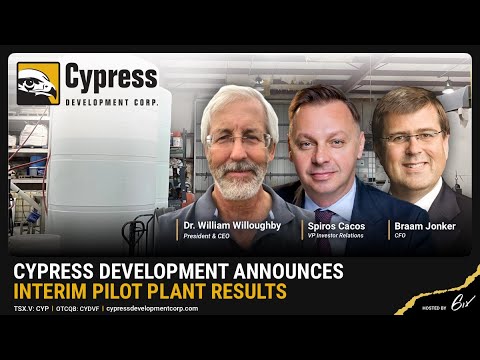
0:08 Well, hello everyone and welcome to Cypress Development's live summit today hosted by 6. I'm very pleased to introduce Dr. Bill Willoughby, President and Chief Executive Officer. Joining us soon will be Bram Yonker, Chief Financial Officer, and we have Spiros Kakos, Vice President, Investor Relations on the line. Dr. Bill's gonna walk us through a company presentation after we will be accepting questions live. So as a reminder, you can submit your questions at any time throughout the presentation on the Q&A panel on the right-hand side of the screen, and we'll get to them
0:39 after the presentation. And as always, the summit is recorded and will be available to watch afterwards on fix6.com. So without any further ado, I'm going to hand it over to you, Bill. Great. Thank you, Dasha. Pleasure to speak with everyone today and talk about Cypress and our company. And we have a news release that went out this morning about results from our pilot plant program in Amargosa Valley. That will be open for discussion and questions at the end of our brief talk. We'll run through a brief talk of the project itself, just if anyone's new to it, can get a background on where we are and what we're trying to achieve. And then we'll go into the details on the pilot plant and our program. So this is a view in the opening slide of our project site. It's in Nevada.
1:28 We're halfway between Las Vegas and Reno in Clayton Valley. We're standing on our clay deposit. Cypress's project is about extracting lithium from a clay. We have an extensive clay deposit under our feet in this slide. We're looking across where we plan to construct our full metallurgical facility for the actual operation. You can see that the vegetation here is fairly sparse. It just has a thin gravel overburden. It's a really good place for a project site. If we were to go over the top of this ridge, we'd come into Clayton Valley proper. That's the site of Alvin Marl's Silver Peak lithium brine operation.
2:11 Some cautionary statements. So for some compelling reasons why Cypress is strategically well positioned at this point in time. Like many clay deposits in Nevada, we have a large lithium resource in clay or clay stone. It's a multi-million ton LCE, lithium carbonate equivalent, and resources and reserves. But to convert those resources into reserves, you need some technology to do that. You need a process. And at Cypress, we've developed what we think is a very unique and sustaining process in that we're using a chloralcaline leach first to extract the lithium from the clay and then secondly we have a proprietary direct lithium extraction DLE process as we call it, which is we purchased from a company Chemionix in Ontario.
3:02 It's called LionX, it's a process based on ion exchange And that's our means of extracting the lithium from solution once it's extracted out of the clay, and then being able to separate it from the unwanted elements, such as magnesium, calcium, potassium. We also have the facilities to do our project in that we have a large metallurgical pilot plant facility now in Amargosa Valley that's dedicated to our project. We also have a sample preparation facility over by Tonopah Airport, which we're using for sample prep, storage, and administration. And finally, water is critical in Nevada. Can't do a project without it. Last year, we were able to secure our water rights sufficient enough now for our project to go ahead at full scale.
3:50 And Brom has joined us, our CFO. I see. Good morning, Brom. And Brom has just joined us.
3:58 Okay. Talk Briefly about some objectives for the year and things that we've already accomplished. In January and February, we completed a bought deal financing that is a Booker Onford terms financing in which we brought another $18 million into Cypress's treasury. We already at the end of last year had 23 million in the treasury, so that makes us very well financed and positioned for the work ahead of us. We expanded our lease on our pilot plant facility in Amargosa Valley. We now are leasing all of the 12,000 square foot building on an 8 acre site. We completed continuous 24 hour a day tests. And those are the basis of the results that we will talk about today. Those have been very positive and will now feed into a feasibility study. Contracted wood engineers, large engineering group to head the feasibility study.
4:52 And they'll also be helping us out now with the environmental side of things.
4:56 And we're also doing a bulk sample, get a larger sample to keep the pilot plant running throughout the year, continue not only feeding data for the feasibility study, but also looking at ways to optimize and improve upon our process. That's something that's a unique feature of our facility in that we're able to shape our program around our own desires. That's a very positive thing for the company. And finally, we're working on our water right permit to relocate our point of diversion and doing the hydrology to best utilize our permit and providing water supply to the project itself. Spiros, you can say some words about our share price and structure and where we're at.
5:45 Thanks, Bill. Yeah, shares, everybody can see. This is using the share structure from February. We'll update it next month and actually probably by tomorrow. So we got 143.2 million shares issued outstanding roughly 170 fully diluted market caps just around 200 over 230 million right now. Cash position which is what everybody's interested in. We had reported roughly 23 million dollars in Q3 and brought in as everybody knows from the bot deal that bill was just talking about $18.1 million. So total roughly around $40 million in our treasury. We'll have the, I guess the updated numbers when Brom finishes publishing the Q4, the numbers which should probably be out sometime in April or the middle of April.
6:36 On this slide, you can see, you know, we've all the stock prices taking a hit in the new year. A lot of it had to do with beginning was with, you know, interest rates coming up. Job numbers in the US were really bad. Then, of course, we were all everybody's been affected with the war in Ukraine, excluding the oil and gold companies. But we seem to be slowly but surely bouncing back. One thing I do want to point out here is that the company did get picked up by Alliance Global Partners, who initiated coverage earlier in the month of March. So if anybody wants to copy that report, just feel free to contact Alliance Global Partners, and Jake will be able to kind of get that for you.
7:20 Continue on our board of directors led by Cassandra Joseph, who's our chair, Brian Bisher, Ken Owen, myself, Don Myers, James Pettit, very strong board and experienced. And our management, our management team is all experienced in Nevada, both with operations and development. Myself, Bram Juncker, who's joined us again. Daniel Kolmbach, Adam Knight, and Spiros. We have all worked on Nevada projects. I'll just say a few things about lithium being a critical mineral, critical element. It's essential for the EV, electric vehicle market. Growth there is very strong.
8:05 All forecasts point to a sustained future for lithium as a commodity, and it's recognized by the U.S. As a vital element, both in the current administration and the last administration. We have had talks with the Department of Energy. There are loan programs out there. To take advantage of those, we need our feasibility study in hand. We're working hard towards getting that this year.
8:32 On this table, we have a list of Nevada clay stone projects. If you were to add all of the lithium in the ground in those clay stone projects, you get a resource that is third in the world behind Bolivia and Argentina in terms of lithium. But the issue here is being able to convert that lithium over into a reserve. To do that, you need a process. We are 1 of 3 companies that have achieved the pilot plant stage. The other 2 being Ioneer, which is west of us, about 40 miles in Fish Lake Valley, and Lithium Americas with their Thiocarpast project up on the Oregon-Nevada border. Again, we border Albemarle-Silver Peak brine operation just to our west, and Slumber J is also active with a planned pilot plant program for the valley.
9:21 Our project 6500 acres, we're in Clayton Valley right next to Albemarle's. In that slide on the right, you can see the evaporation brine pools of Albemarle's operation. We're about 3 hours from Tesla's Gigawatt factory in Sparks, Nevada. And our pilot plant is located about 100 miles to our southeast. We chose that site because it was an existing metallurgical facility. We'll take a look at that next slide. We do have a 3% underlying royalty to our property, which can be bought down for $2 million. That's a fairly reasonable rate. We also have a 1 square mile geothermal lease at the head of Paymaster Canyon. That's about 3, 4 miles to our northeast. That could come in play as we look for renewable power sources for our project.
10:11 This is a view of our pilot plant. The 12,000 square foot building is on the right. It's on an acre site. Pardon me. Go back 1. It was permitted. We had to do a minor modification of the permit to be able to use our reagents. But that worked very well. It was an existing facility, former gold refinery. We were able to pick up operators and staff. It all worked very well last year. We were able to do this well under budget. It's been a great asset to the company. What you see on the slide on the left are the process water tanks on the right. In the center there's a leach air tank, which is a green insulated tank.
10:56 And from the left, there's several thickeners. We'll talk about those as we go through the process itself. And in the bottom left-hand corner is our INX process for ion exchange. We have a large amount of resources on our property. This is from our prefeasibility study, which was amended last year. 1.3 billion tons of clay material, grating 900 parts per million lithium. We only need, however, a small portion of that, 200 million tons, to formulate a long, significant mine life. This was 213 million tons at 1,100 parts per million selected out of that resource. It's shallow. We'll look at the configuration of the pit in a moment.
11:45 But we only needed a small portion of that to run a mine producing about 25 to 30,000 tons a year of LCE, lithium carbonate equivalent product, and that was at a rate of 15,000 tons per day and 5.5 million tons a year.
12:03 Quickly, some deposit features that make us able to look at attractive economics at relatively low lithium grades. The fact that deposit is outcropping and surface has a thin gravel overburden to it, lends itself to a low strip ratio, and importantly, the grades both vertically and laterally within the clays units are very continuous, so we're able to project those grades along distance, much like you might in a phosphate or a coal deposit that has great lateral continuity to it. The deposit itself is also soft, which means we'll not need to do drilling or blasting. We can produce the material with an excavator and a conveyor belt, transporting that material to the mill. And also importantly, it's leachable clay, meaning we can leach it with an acid. We initially started with sulfuric acid and then shifted over to hydrochloric acid last year. That proved out very well. We'll talk about some of the features of that in a moment.
13:03 And importantly, low carbonate content in that clay equates to low acid consumption, relatively low. So those are all important features for working into the operating cost of the project. These are results from our prefeasibility study last year. I don't want to highlight too much on this slide. We could point to the fact that lithium prices now are way, way up, approaching 10 times this $9,500 price that we used in the pre-feasibility a year ago. The one number I do want to point to on this slide is this well, I'll point to the production rate, too. We're still targeting this 25 to 30,000 ton a year rate for our production rate.
13:51 But also we're right in this ballpark of 83% net lithium recovery. That's after extraction and recovery through the processing. Our configuration for the mine itself will remain mostly the same as what we had in PFS. I will shut off my camera then. Let's do that. OK, hopefully this is better. Can you hear me?
14:21 Yes. Yeah, we can hear you. Yeah. Thanks. All right. So the general arrangement will remain about the same. We will look to relocate our tailings facility somewhat, free up some material on the southwest end of the pit. We have our wood tailings team coming to site in the next week. We have picked up 160 acre parcel on the northeast end of this from a company in Ertopia that allows us to extend this pit further to the northeast. The pit itself will run about 2.5 miles long by 0.5 mile wide and it's relatively shallow which lends itself well to conveyer haulage using all electric means of extraction and transportation.
15:10 Brief comment on our processing. For PFS we focused on sulfuric acid leaching. With that you need a sulfuric acid plant which has an acid burner to it. So you're dependent upon sulfur being trucked to site to feed your acid plant. We lose the benefit of having a cogeneration power plant when we move away from that source. But we also pick up some features which make the whole process potentially more sustainable. And it's sustainable in the fact that we can use a sodium chloride brine, which is abundant in our water system around Clayton Valley. We can use that sodium chloride brine in a chloroalkali plant, apply an electric current to it, hopefully through renewable power source, say solar or geothermal.
15:59 And we're able to break that brine apart into hydrochloric acid, our leaching reagent, and sodium hydroxide, our neutralizing reagent at the same time. We regenerate all of those. All of those are generated on site, so we don't have to bring in any leaching reagent or neutralizing agent for the process to work. And we're able to then look at alternate means of lithium extraction, in our case, direct lithium extraction, using our LionX process of ion exchange. We found that both in bench scale and now in the pilot plant, we are able to do easier washing and filtration of our tailings. That's very important in materials handling and the overall simplicity of the project. And also we were able to achieve higher slurry densities, being able to use less water, make up water, which is critical given that we're in a location where water is a premium and we want to conserve water as much as possible.
17:00 Now we'll get into the meat of our PR and our process itself. This is a layout of our pilot plant, relatively simple. You can think of the top half of this slide as being solids and liquids, a slurry. And then as you move into the bottom row of boxes, we're dealing entirely with a liquid, trying to separate the impurities and produce a lithium concentrate. So our sample feed comes in, gets run through a leach tank, has a relatively short retention time, 2 to 4 hours. We leach that at an elevated temperature and low pH, adding hydrochloric acid to that leach tank. We then move that into a thickener that has a short retention time and that moves into a bank of other thickeners where we do a countercurrent washing of the tail using recycled water from the process.
17:54 We've replaced our belt filter with a plate and frame filter. That's working better in terms of the moisture content of our final tailings. We are then taking our pregnant leach solution, after a couple steps we run it through a primary and secondary purity removal, adding sodium hydroxide to drop out all the unwanted elements, primarily aluminum and iron, also magnesium. And then we move that solution into our LION-X area, where we do our ion exchange steps and we produce a lithium concentrate solution. We also reject the unwanted elements back to a tertiary step. We drop those out with an addition of sodium hydroxide and then recycle that solution around in the process.
18:41 We've had a number of objectives going through the year. We wanted to optimize our lithium extraction overall. That's including both the extraction of the lithium from the clay and the recovery of lithium from that solution as it moves through the LION-X process. We wanted to produce a tailing, which had a low moisture content. We've successfully done that. Our solution steps in adding sodium hydroxide to neutralize and buffer the solution, drop out unwanted elements are working well. In fact, we're trying some modifications right at this moment to simplify that process. In terms of line X efficiency, we'll get to the results in the next slide, that's worked exceptionally well.
19:27 We have not made a lithium hydroxide product. To do that, we need to evaporate our solution down and get it up to a very high grade and then ship that solution off site. We had NORAM engineering in Vancouver lined up to do that step in converting by electrolysis the concentrated high-grade lithium solution into a lithium hydroxide crystal product. That has not yet happened. That was due to a failure of an evaporator step in our processing. We're working still on that step, but all indications are that it will work well. And then finally we just have to check the quality of our solution to make sure it works well with the chloralkali plant. That's basically just cleaning our solution up so it has high salt content and low impurities.
20:16 So on to our results. We have been able to, that last step, we haven't achieved the high-grade concentrate, but we have made a solution grade in 2700 parts per million lithium. Insignificant impurities, meaning the magnesium, iron, and other elements are absent. And What we need to do from that point is concentrate that another Anywhere from 10 to 20 fold getting that number up around 30 to 50 thousand parts per million lithium and at that point we'll be able to ship that off site and produce lithium products. Our overall extraction coming out of the leach tanks have been exceptionally good. We're averaging between 83 and 85%.
21:02 And the tailings have been easy to handle. We're easily below 40% on the moisture content coming off of the tailings press. Our lithium extractions from ion exchange and the separations of unwanted elements, unwanted canines from the lithium have been very good, exceeding 98%. So we're getting very good performance there. The sodium-potassium removal has been above 80% as well. Those are important. And those are hitting our targets. And finally, we're continuing on our work with the evaporation process. And we're working to make that all happen on site under the same roof. We have shipped some material off to a Vancouver lab, which is working on the evaporation stage independently.
21:54 And the indications there are also very positive. On the right, you see on the slide, you see a solution which is coming off of the PIR SIR area, and that is the feed going into our ion exchange. So you can see it's a very clear solution. All the iron and magnesium have dropped out of that solution just by our initial chemical treatment step.
22:21 Couple views of the pilot plant. Those are our sample bags. We feed 0.75 to a ton of material per day through the pilot. On the left is another view of the pilot plant. The left-hand side of that is where we have a feeder into an intruder box, which feeds our green jacket to the leach tank. And then our bank of 4 thickeners are in the foreground. That's a vacuum belt filter, which we have now replaced with a plate and frame filter. It's made the whole plant a lot quieter and easier to operate. We do have an on-site assay lab. We collect 11 samples every 6 hours while we're operating continuously. Those are analyzed both on site and by an external lab, ALS in Vancouver.
23:09 We're just still getting the last of all those assays in hand. We've been compiling them. And some of those results are reflected in the results we announced today. On the left-hand slide you can see our thickeners. On the right is our PIR, SIR area. So a few points on ESG values with our chloroalkaline process and DLE. We've worked to develop a process which is self-sustaining. We don't need to bring sulfur to site. We don't need to have a cogeneration power plant. We can operate just with a renewable power source that should lend itself to a project which has good ESG values and low carbon
24:00 footprint to it. Summary, the company is in a great position financially and in terms of our project. We do have our pilot plant running, continuing work. That results we've announced today and going forward into our feasibility study, we'll drive the project to the next level. Permitting looks favorable. We're working hard on that.
24:27 Use load and catalysts upcoming. We are still running our extraction tests. We've just completed another seven-day continuous run. Our pilot plant is producing a high-grade, a intermediate-grade concentrate. That's got to be upgraded through evaporation. We may contract that off-site, some of that work, but we're working to build an evaporator on site that will be up to the task. And finally, our feasibility study is underway and our wind engineering has their environmental and infrastructure people on it as well. Okay. We can open this up to questions now. Great. Yeah.
25:14 Yeah. Thanks, Bill. That was great. Yeah, I've got a question here. Jake is asking, any color on the timeline for the remainder of the test work? Can you just walk us through the next steps before achieving the production of a final battery grade end product
25:34 sometime in the second half of 2022? Yes. Well, let's start with the last part of that question. To get to a battery grade product, we definitely need to take that intermediate stage solution, which we have. We now have about 1000 gallons of it, I think, on site. That needs to be evaporated down and produce enough solution that we can take it to a pilot facility in Vancouver and run it through electrolysis to make lithium hydroxide. So that we expect will happen in the next quarter. And that will get us to a lithium product. There is also the option that we have of producing lithium carbonate instead of lithium hydroxide, we will likely examine that option as well.
26:22 So 2 steps right there in terms of getting the battery grade. First step ahead of us is just doing that final concentration, getting the numbers up to 30,000 to 50,000 parts per million up from our 2,700 that we have on site. The indications, however, and the fact that we have low impurities, and we also have done some tests with preliminary in upgrading that solution through evaporation. We know from that that the solution does look very favorable for making a final product, whether it's going to be carbonate or hydroxide.
26:58 We're confident that If we need to do another ion exchange step to clean that solution up, we can. Or if not, we can just go straight to making a product. So now to the, what was the first part of that question? Oh yeah, the first part was any color in the timeline for the remainder of the test work? Can you just go on? Right. Sure. So the test work, definitely all the assay base that we've developed and the test work, the flow rates, the mass balance, All that information that we've collected so far is relevant and will feed immediately into the feasibility study. Our process team has already met and laid out what requirements they need to start the work.
27:46 I think we'll soon be into doing some scoping on the equipment selection. And that engineering process is already starting. The remainder of this year, we'll definitely be looking to test another material. That's what the purpose of our bulk sample is to get a bit deeper into the deposit. And we will be doing a number of sonic test holes that will also be checked in the lab. We don't expect anything different in the way of performance in terms of asset consumption recoveries. But we do want to confirm that. So those are on the list to do things. And we're also looking at ways to modify the process as we go through and make it better. We've already looked at the PIR SIR area, found a way that we might integrate that into the Thickner banks and have been testing that in the last month. So the whole purpose for us in having that facility available to us is not only just to feed data to the pilot plant and pilot plant information into the feasibility study, but also to continue that into an R&D effort to improve on our process and then if we have to, we can expand the plant and make it more of a demonstration sort of facility.
29:07 Great. Thanks Bill. Maybe, maybe he can get, maybe you should go back on camera too. I'm getting a lot of people saying Bill's disappeared. So that works. Okay. I'll stay off camera for now. Now, Mark from noble finance, has a question here. Would you please discuss the advantages and disadvantages of using a chloride-based versus a sulfide-based leaching process and durability of test work and results to date regardless of which process is employed?
30:08 Well we were seeing similar results in terms of lithium extraction using sulfuric acid and hydrochloric acid. Our extractions were in that 80 to 90% range. We did have a different suite of impurities. We tended to get more magnesium in the solution using sulfuric acid and more calcium definitely when we used hydrochloric acid. Overall, the advantage for us is that we don't have to truck sulfur to site, and we're not dependent upon sulfur. A disadvantage out of that is you lose your cogeneration power ability, since a sulfuric acid plant, by virtue of burning sulfur, has that heat source which is able to generate electricity. We instead would have to look at a power source, but under the current environment where we have inflation taking hold and we know Definitely the price of sulfur has gone up several times since we did our PFS last year. We're not dependent upon that as our supply.
31:06 So on the power side, we do need a lot of power to run this process. But we're in one of the best places in North America for solar power and geothermal. So it's quite likely we can find a renewable power source that will run the process. We don't think the cost structure is similar in terms of operating. If we go back to the PFS, when we did our scoping study to look at hydrochloric acid, operating costs came out about a tradeoff. But for us, the big thing for us with our clay is the materials handling side of it. We're usually get much better separation solids from liquids. That whole step is easier. We had a complicated approach to that in our PFS using elaborate filtration.
31:53 This has been greatly simplified. We can just use conventional thickeners for that with a flocculant addition. We're selective in which flocculant we use. But the materials handling side of it is easier. And finally that water balance really comes into line for us. We're able to produce a tailings material which is easily under 40% moisture content. And that means we can dry stack it. It's a lot easier to handle for us and we use less processed water in the whole operation. All right. Thank you. A really popular question we have here is, are we battery grade quality yet? Yeah. That's a common question. And No, we're not there yet. We've made a very pure intermediate solution in bulk.
32:43 From that, we will concentrate that solution up, make a higher grade solution, and then we will make the battery grade material. And until we get to that point, what does battery grade mean? Battery grade is what a particular manufacturer of batteries needs. We know generally what those impurities are that we don't want to have in our final product. And it looks from all indications. Everybody's looked at the intermediate solution. We've done tests making a final solution. We haven't had enough solution to produce a battery grade material in any significant amount yet. But indications are we'll get there. So we're confident in that step.
33:29 Thank you. Adrian's asking, what do these preliminary test results mean with regards to being able to produce battery grade lithium carbonate and hydroxide? Less so on what they mean relative to the end product. We're confident in where the end product is going to wind up. But importantly, they confirm our basic understanding of the deposit that we have a process here that works. We have the information now to feed into a feasibility study. So in all, if you look at the big picture, we've done a big step now in confirming our data and assumptions to get to this point. So from here, we have the information, we can do a design for an actual full metallurgical facility.
34:18 The process is working. It all will come down to now, what are the costs? What are the costs of that power to generate the hydrochloric acid? What are the actual capex and opex costs of the whole operation? And all of these so far are supporting our concepts from the prefeasibility study and additional work that we did in thinking through our process for the chloralkaline and DLE work. Great. Thank you. Mark is asking if you could please elaborate on processing steps conducted offsite at NORAM to take the concentrated lithium solution to produce lithium hydroxide and when will you take on producing lithium hydroxide? Well offsite steps so far have just been the quality of our solution, looking at the impurities and then doing an evaporation trial and then looking at the impurities at that step.
35:13 NORAM Engineering has a lot of experience in doing the final step in electrolysis. They have their own process, and we're also looking at others that will be able to take that final step in running it through an electrolytic cell and then converting that lithium chloride solution to a lithium hydroxide and then precipitating it. So we haven't really seen the bench scale work yet to know that we're going to produce that product, But the indications just in the quality of the solution are that we will. Okay. Thank you. A lot of people are asking if you can give specifics on the water rights challenge. Not at this time.
35:59 We should be sending news out shortly on that. Okay. Thank you. William is asking, are the SA lab results being shared with NDA and other potential offtake clients slash battery producers? I cannot comment on who are sharing those under confidentiality agreements. And at this point, we're still compiling the data. Okay, thank you. I have a question here. How does the intermediate solution differ from to the high-grade concentrated lithium solution that will be produced on site during Q2? There is less water and less salt in the high-grade solution since we've evaporated down and crystallized out the sodium chloride.
36:51 Okay. So. Also, I had a question about, just a clarification, he's asking, can Bill explain the sentence a bit in detail? Sodium and potassium removal in the lithium recovery area is 80% less than 0.5% lithium entrainment. All right. I think that's our metallurgist speak for being able to reject the sodium and potassium at a desirable level and not see much of the lithium go out with that recycled water. We also make a third filter cake out of the TIR step, and there's some entrainment of lithium in that, and that's minimal as well.
37:40 Okay. Thank you. Wes's question is, with the dynamic increase in the price of lithium over the last year, up to 10 times. At what price do you foresee for the upcoming feasibility study? This number, he says this number is of course crucial to optimize any IRR that banks will be looking at closely. Well, yeah, first for that, we need a long-term price since we've got a long-term project. So we can't go from what this year's price is and last year's price. We have to look long-term and where the growth rate is going to occur in Lithium supply and demand. We will have already subscribed to benchmark minerals as a source. We'll look for other sources.
38:27 And at the time we finally get down to the economics of the feasibility study, we'll be looking hard at that price. Okay. Alessandro has a question about the cost and CapEx. Given the strong, general strong increase, Sorry, the question just disappeared. 1 2nd. Given the general strong increase in cost of materials and energy, do you expect a steep increase in capex needed for the plant and in the operation operating costs? Where do you see the highest risk on the cost side in terms of overall value on the project? Well the key part of this process, and it has the analogy going back to sulfuric acid, is the acid plant.
39:18 That's probably 2 or 0.333 of the total capex will be in the acid plant. So we look first at that and what that number is going to look like. Chlorophyll implants are very common in the world. We know the size of it already that we need to support our production. That number we should be getting to fairly quickly and seeing how does that stack up in the current market, current inflation environment. Obviously, we've got steel components that have to be specialized steel. We have a large amount of tankage and pumps. Definitely electrical supply is based on copper. In Nevada, the labor costs are up, so there is an inflation component we're going to have to take into account on it.
40:07 We will try to work on the project and the scale of it to be an appropriate size and not blow out the capex. Obviously, we're in an environment right now where capex capital expenditures can increase dramatically. So we're very conscious of that and gonna pay close attention to it. Okay, thank you. Taylor's asking if you can explain the need for evaporation. Isn't the point of DLE to not need evaporation? We're talking now about mechanical evaporation rather than big solar ponds, having a lot of pondage out there. So yeah, you do have to eliminate the water and you do that with a mechanical evaporator. We elevate the temperature on that and likely do it under a vacuum so the temperatures are lower.
40:58 But that water is then recycled back to the process because you capture the steam. It's not the same as a lithium brine where you put that 200,300 ppm brine out into a evaporation pond and let it set for 2 years. So the whole one of the functions of DLE is to conserve water and then be able to recycle it. Thank you. Ethan's asking, could you provide some insight on the recent property acquisition and its significance to the future of the project? Well that's the Enertopia 160 acre parcel, which is at the northeast end of our pit design. The significance of that is that we know from their drilling that it's similar grade.
41:47 There's 1 or 2 nice intercepts in there, a couple of drill holes on it. It allows us to extend our pit to the northeast. That's important. And as we go into the feasibility study we'll be looking to see if we can optimize our production schedule by putting more higher grade material earlier in our online life. And finally, with a longer pit, we're able to make it shallower, And shallow production is a much better opportunity for us than going deeper. The deeper you go, the more difficult the extraction becomes. So we're first able to extend the pit length. We're able to shallow it out. And then we have the potential to optimize our production schedule.
42:34 And we have taken a preliminary look at what those numbers look like, and it made sense for us to do that acquisition. All right. Adrian's wondering if cyber development is waiting on anything from NORAM. NORAM engineering, I suppose. Not at this time. At this time, the evaporation step is all on us. Okay. The follow-up question was, What is the expected timeline for NOREM to produce lithium hydroxide samples for potential clients to evaluate? Once they have the material in hand, our solutions, it should be about a one-month process. Okay. Thank you. William is asking, has there been any update on the appeal of the water rights extension to demonstrate beneficial from the other junior exploration company with the state engineer?
43:27 That was the same question as before and I'm not gonna comment on that today, but I'll say that there's news worth coming. Great. Thank you. Austin's asking why Okay, that's not 1 2nd. Okay. So Wes is asking He says, great pilot plans results, Bill. When do you expect the feasibility to be completed? Our timeline that we have worked out with our consultants has it being completed by year end. So a lot of that's dependent on how quickly we can assimilate the results out of the pilot plant, what additional steps are needed, and getting everybody on board with the studies that are required.
44:17 So target is the end of the year. Great. Thank you. A lot of these questions are similar, so I'm just making sure that we've covered everything. Spiros, feel free to jump in if you think there's something I've missed. Great. I'm just worried that my internet's choppy, I guess. Here's 1. Bill, can you, this is from Chris, can you comment on potential for inflationary cost pressures on OPEX and CapEx? Well, I thought I had just done that, but yeah, we're definitely in the environment where labor costs are up, copper prices are up. We need that copper for wire, steel prices are up. So we can expect that construction is going to cost us more, operating will cost us more.
45:03 I feel really good that we're in, looked at the core output approach in that we're not dependent on sulfur as a supply source. We can look to just power costs. And power costs have not increased that much yet. And if they do, we have the opportunity here to look at a renewable source of our own and being able to generate our own power for the project. Great. Here's 1 from Corey. I'm going to answer this so you can help explain because a lot of people might have are thinking about this Could the 2700 parts per million solution be evaporated by conventional conventional means? IE evaporation pods if we had more land Well, you could but it takes time. You know where we're at in Nevada. We evaporate somewhere around 80 inches a year. Precipitation is only around 7 inches, so you've got a huge amount of evaporation that goes on. But then we would just be into a time frame where we are waiting for that evaporation to occur and move it from pond to pond.
46:10 Mechanical evaporators are not all that unusual or expensive. They're not that expensive to operate. So the evaporation side can be done best in a plant setting. Plus, we get that recycled water back from it. Okay. Thanks, Bill. Another one here from Mark. How difficult would it be to move from 2,700 parts per million lithium to 30,000 to 50,000 parts per million lithium? Is it more of a function of the evaporation process or the feedstock? It's entirely just evaporation at this point. We've done about all we can to get that grade up and then the next step is just to run it through a mechanical evaporator.
47:02 So, I mean this is not on there, but I'll throw this at you because I get this question a lot. Scaling up. How do you feel about scaling the project up? If you look at the pilot plant right now and imagine it as a larger scale production facility, I think there's no issues in that we've got something that's entirely doable. You're not going to scale up this from 1 ton a day to 15,000 tons a day. You'll break the plant up into several trains. So you might have 4 trains of leach circuit plus thickeners. Maybe you have 1 large thickener train at the end. But your scale factors are at a point where everything is reasonable, considering the technology we have. It's all conventional steps.
47:54 The communication, breaking the clay apart, that's a standard step. Just run that through in a tritter and add the water to it. The leaching is very standard. All sorts of tank leaching, agitated tank leaching, occur in the world. You can see that step very easily. And the Thickner Bank, that's all reasonable. The chemical treatment area, if we're doing that separately, that is all was done. Every conversion patent for lithium does that. And the ion exchange area, that's all quantifiable. So I feel very good that we've got a scalable process right now. Perfect. Thanks, Bill. Here's 1. Will the holdup with NORAM converting the evaporated material to end product delay the feasibility study?
48:43 No, I don't think so at all. I think the bulk of the work that we're doing is in the leaching and lithium extraction area. We know what evaporation step is going to look like. And the tail end of that is just what we have the option on making it a carbonate or hydroxide. It's evaluating which one we want to go to. Great. Thanks, Bill. I'm trying to get through, trying to answer every question that's out here. Here's 1 from Daniel. It says, is technical process of extraction in any way unique for Cyprus versus competitors? No, we're absolutely unique. We're unique in the fact that we're using a proprietary process on our ion exchange. We're unique in that we're using a chloralkaline process for leaching.
49:32 And that's entirely from the fact that we're in a chloride basin and have that water resource available to us, that salt source. So we're definitely in a position that would be hard to replicate somewhere else. Great, thanks. Here's 1, Dr. Bill, now that the internal process are configured and working as expected, can you elaborate on the extraction of various REEs? What types, quantity, and how are these REEs will add value in addition to the lithium extraction moving forward? Thanks and kudos to you and the team. Your hard work and dedication is much appreciated.
50:18 Yeah, I'll just end that thought by saying thanks to the whole Cypress team. All our people have done great in bringing the project to this point, both the management and the board, all very dedicated to bringing the best value to our shareholders. So, back to the rare earth question. That was something we saw early with the pilot plant that it was something we were going to have to research and it was going to take time to do it. It would likely involve either doing some separation out of the PLS as it comes off the leach tank, or after we neutralize that PLS and drop out a filter cake, which we were doing through the 7 day trial.
51:06 And that was precipitating, actually it was most of the 14 day trial as well, were precipitating a red filter cake coming off the PIR SIR. We would have to look back on that filter cake now, do more assay work and determine if we can re-leach that filter cake to get the rare earths out of it. That's likely where the rare earths are being deposited along with the iron and magnesium. So more work to be done. Right now our focus is definitely on the lithium side. Produce lithium first, maybe some other salts, potassium sulfate, I mean potassium carbonate, potassium chloride might be products. Okay. I got time maybe for 3 more questions here.
51:54 We had a lot. Is scale-up, sorry this keeps moving, is scale-up then effectively only limited by physical building size and water availability? Going beyond the 15,000 tons a day, I assume he means? Yeah, well, water availability is first. Can only expand the project to the limits of what our water right has at this point. There's some potential for looking at other ways to obtain additional water that we have in mind. But for our first basis for the feasibility study. We're working with our water right for that. But yes, it's what else, what are your other critical elements?
52:41 And one major 1 for us now is power supply. Do we need 100 megawatts for the project? And if so, where do we get that? And can we get then 200 megawatts? We can build it as big as we want, assuming we have the power and water to do it. Okay. Here's 1. Has any work been, kind of related to this, has any work been done to evaluate the potential power generation from the geothermal lease? Not yet. Maybe you can talk a little bit about what the geothermal lease is. We have a lot of geothermal work in place. Yeah, well, we have a 1 square mile geothermal lease that's just north of the project. That became available in our lease auction, and we picked it up 2 years ago.
53:31 But I know that several geothermal companies are active in the area. There is geothermal potential right in the basin. So something that we are going to evaluate. Woods infrastructure team is going to take a look at that and also solar as a potential source for us. Okay, I'm going to have, I think I've got time for one last question here because we're running out of time and then I'll let you conclude any comments in the end. This one from Ethan, do you foresee the project becoming a joint venture or is Cypress prepared to go to production alone? We get a lot of this, I mean I get this a lot from people, Do you want to go to production?
54:17 How timeline for that too would be good. Might as well throw that in there as well. And maybe talk a little bit about the permitting and the steps required. Or do you just, you know, JV versus selling the company? What do you want to do? Well, we'll wind up on that last part as a summation of this talk. For the timeline, we're probably a year out from getting the feasibility study done and doing the financing work that we need to move ahead. Maybe longer on the financing side of that. Permitting could start as soon as we have a plan of operations in hand, which I'm hoping we can do that this summer. That starts the clock on an environmental impact statement. You can just round that off to about 2 years.
55:04 A process puts us somewhere into 2024 on a timeline. And then constructing the project after that. So figure year after year after that puts you in 2025, 2026 area. I like 2025. Yeah, we all do. So, it's better. It depends on how much support we get out of our federal government as we move ahead. This is a U.S. Project. We're very U.S. Focused in terms of producing a domestic source of lithium. So then we'll wrap up with the last question. What do we want to do as far as a joint venture or selling the company or X, do it ourselves, get a loan? We're going to do the best thing we can do for our shareholders.
55:51 That's the first and foremost thought. I have a personal lean towards doing it myself, going to production. If there's a good JV partner that might be next door to us that wants to join us, I welcome that discussion and moving ahead with that. But we're absolutely going to do the best thing for our shareholders as we go forward. And the team is all focused on that. That's great, Bill. Great, thank you so much. Right, appreciate everyone's time and thank you for listening to us today. Yeah, thanks everybody. And Bram, thanks. I know he had some technical difficulties and had to hop off, but I know his heart was there, he was dedicated to this.