Replay available
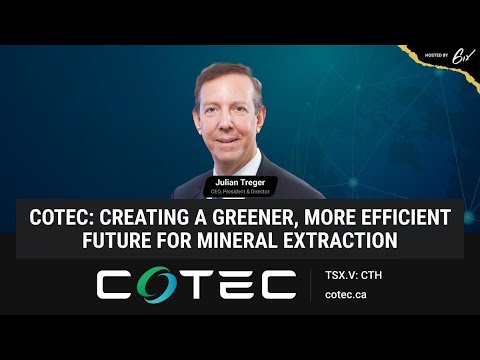
CoTec: Creating a Greener, More Efficient Future for Mineral Extraction
Join us for a great event!
- Company
- Cotec Holdings Corp (TSXV:CTH)
- Date
- Wed, Jun 29, 2022, 11:00 AM ET
- Replay
- Watch the replay on this page · 46 min
- Results news release
- CoTec Holdings Corp. Appoints PI Financial as Market Maker · Mon, Jun 27, 2022
On 6ix: 6ix.com/event/cotec-creating-a-greener-more-efficient-future-for-mineral-extraction
Replay
Transcript
Automated transcript · Written by software from the replay's audio. It can mishear names and figures; the replay is the record.
0:08 Hello everyone and welcome to Kotech Holdings live investment summit today hosted by 6. I'm pleased to introduce the president, CEO and director of Kotech, Julian Traeger. Julian is gonna walk us through a company presentation and after we'll be taking questions live. Remember that you can submit your questions using the Q&A panel found on the right hand side of your screen at any point during today's presentation. And as always, this event is being recorded. It'll be available to watch on six.com in the coming days. Without further ado, Julian, I'd like to hand things over to you and get us started. Great. Thank you very much, Cam. And thank you all who are attending for your time and interest in Kotech. We're super excited about this business, which is effectively a new concept for commodity extraction as you'll see during the course of the presentation. Initially I thought I would introduce myself and a bit talk a bit about my track record Then we can talk about the concept behind Kotech and then we'll canter through the presentation and as Cam said, we'll end with a Q&A session. So why don't we start with a bit about my background and why Kotech and why now? My background is really as a change agent in the natural resources sector.
1:20 I'm not an engineer, but I'm an investor. And I've been investing in this space successfully since 2005. Initially, I invested actually in the coking coal sector. I was involved with Brahm in rescuing a company called Western Coal, which was in financial difficulties and then using the track record and experience that I had as a activist investor in the UK, which is my origins, we got involved in refinancing the business, changing its strategy, streamlining it and expanding the operations. And we were fortunate to sell it for over 3 billion dollars at the top of the market. It was a company called Western Coal. A number of investors in Canada should know it with a warm feeling.
2:19 Thereafter, I got involved with a streaming and royalty business called Anglo Pacific, which also had a coal asset. When I joined Anglo Pacific 8 years ago, it had 1 asset, which was a coking coal royalty in Australia and income of around $5 million in the first year. I subsequently raised over $500 million for the business and completely changed its focus so that by the time I departed early this year, it has around 70% of its assets in battery-facing minerals. And the income this year could be, you know, well over $150 million, even perhaps $200 million. So an enormous change for that company. Along the way, I was also involved in liberating and turning around some copper assets, which we bought from Anglo American to mines in Chile.
3:17 We purchased for around $300 million, $220 million of that in cash, $80 million in a royalty, and we raised 1 billion dollars to expand that business. And we were fortunate to merge it earlier this year with Capstone and it's now named Capstone Copper. We achieved a multiple of several times of our investment and on the back of that sort of realization event I was thinking about how to continue to make money out of investing in the natural resources and commodity space. As you can see over the last couple of weeks commodity prices have gone up and they could come down and so buying mainstream assets Is quite a risky business and there is- a lot of potential downside.
4:11 I and as you well know I'm sure the best way of making money in the space is to. Invest cheaply at the bottom of the market. So I was thinking what assets are there. That are still cheap and the answer which ties very well into- the arguments now for a circular economy. Are marginal assets, which aren't that profitable even at current commodity prices, waste assets, which are often seen as liabilities and problems, and recycling opportunities where assets are already effectively available but they have to be reprocessed. Those categories seem still to be quite interesting in terms of the cost of their entry points And that is one of the focuses of Kotech, as you will see.
5:05 The other interesting observation I had is that our sector is one of the only not to have been completely disrupted by technological innovation. I mean, we obviously know about Tesla, eBay, Amazon, FinTech companies, most sectors have really been completely changed. The majors in our sector continue to dominate the space as they have for the last couple of decades. Therefore, it strikes me that there's an opportunity for a commodity, for a technology focused commodity extraction business to emerge as a disruptor for the sector. And in fact, there are lots of super interesting technologies which have been developed in the various universities and research institutes around the world, but they haven't been adopted by the sector yet, which has been very slow to embrace change.
6:05 And so the other part or pillar of Kotech is that we are a very technology friendly company. In fact we are starting with technology and then we are going to move to applying those technologies to assets, the sorts of assets I talked about previously, marginal assets, waste, to develop a significant operating business. And so when we look at what Kotech is today, we're still a very small TSX-V listed company, but we have significant ambitions to scale a company which could in due course become a mid-tier disruptor and challenger to the status quo within the mining sector.
6:54 Not so much focusing on mining, which has obviously been the tradition in commodity extraction. Our focus will be a lot more on the circular economy, on recycling and reprocessing, but we do end up intending to have a number of significant assets around the world in safe jurisdictions, which we will operate using the technologies which we have invested and have the rights to. So we're a pretty small company still with significant ambitions. And as you'll see later, we have a very strong board of very experienced people who will assist us in executing on that path.
7:40 Also for a company which is pretty new and we only really moved to the TSX-V a couple of years, months ago, we already have 2 very interesting investments, which I'll talk about later, where there's a real uplift on our investment cost, and we have 2 very interesting other investments in the pipeline, which I'll talk about as well, as well as a fascinating funnel of things which we are looking at. All of these technologies are technologies which we believe can change the world. They're not incremental, they're disruptive, and they have to be scalable and have high margins and most importantly have asset applicability because ultimately we want to use those technologies to build an asset-rich commodity extraction business, but at a low entry point.
8:36 The business at the moment is around 60% still owned by the directors and the management team, but we have big ambitions and we expect to scale the business rapidly over the coming months. So if we then turn to the next slide, we are thinking about the challenges which are facing the globe and how a new look commodity extraction business can address those. So there are obviously significant issues around global warming, around doing things more efficiently, around using less water, around waste. And the idea behind COTECH is to provide an answer to all of these challenges using technologies. And the technologies that we've been involved with, as you'll see, have a commonality in that they use less water, less heat, they're much more nimble and modular than historic mining or commodity extraction processes.
9:50 In a way, I think the day when you had to have scale to have economies is changing to the day when you can have technology to have economies. And that's certainly the strategy which we are adopting. And also these new technologies allow you to process commodities at a much, much cheaper price and that commonality I think underlies a lot of the things that we've done. So our strategy is to acquire stakes in these disruptive technologies that are innovative, you know, have low carbon footprints, disruptive and scalable, as I've said, and then get rights from those technologies to apply them to various commodity assets.
10:42 And we'll talk about later how we've already got a number of these rights and we are starting to develop assets which use these technologies, all of which will have valuation increases for Kotec which are way in excess of our current market cap. We continue to focus very much on safe regions, so there's no reason to go to extreme parts of the world to do these things. There's in fact more waste in a lot of the developed economies and recycling opportunities than emerging opportunities. And as you'll see when we find these opportunities we propose to joint venture with the owners of these assets in exchange for a share of the profits using the technology as well, which will also have some right to the profits on a royalty basis. And in the end, as I said before, we want to build a super innovative scalable business, also a business with a different culture. So the idea behind Kotech is not to be like a traditional command and control zero-sum mining company. It is to be diverse in terms of gender and race, to be much more open, more collaborative.
12:13 Our philosophy is we're all facing significant challenges as a planet and we need to work together to solve those and together we will be much stronger. So we have a really interesting pipeline of things. When we look at them, we say to 1 another, you know, is this really going to change the world or is it something that's somewhat marginal? So you know, electrifying a truck is being done. We don't see that we can really add value there. And also where there are many, many competing technologies, we generally don't go there because it's very difficult to tell which ones are going to prevail. And we also generally don't go into very early stage technologies, which are very much in the laboratory. There needs to have already been some real world applicability, because otherwise it can take a very long time to get income from these technologies.
13:22 And one of the interesting things about our way of building businesses is that we will get to P&L and income much more quickly than traditional mining development businesses. So with that, perhaps I could talk a little bit about the team. You've heard more than enough about me already. As I mentioned, Bram Jonkers on the line as well. We've worked together for a very long time since Western Coal. He's also been involved in the mining space in Canada for decades. He's also involved with Nevada Copper and involved with Cypress resources as well. Then we have Tom Albanese as a non-exec director. Tom, as you may or may not know, used to be the CEO of Rio Tinto.
14:15 He's extremely experienced in many aspects of mining. And obviously Rio had a venture arm. So when we need to check certain technologies on a sense basis, He really knows a lot instinctively about whether something's really going to be making a difference and viable or not. We also are very pleased to have Sharon Fay join us recently as a non-executive director. Sharon was extremely senior at Alliance Bernstein in charge of equities, but also in charge of their sort of green efforts.
15:03 And so she's really a great asset to us because as you appreciate from what I've been saying already, Kotex sits at the conjunction of commodity extraction, green, ESG, investing and technology, which is a really interesting place to be. And the longer we are working at this, the more exciting we are about the potential of the business. We also have Lucho Genovese, who's the non-executive chairman, a partner of mine for many years. Initially, he ran the copper business of Glencore. He's now chairman of Forexpo, a large iron ore producer out of Ukraine.
15:52 But through his Glencore network, has great input as well to opportunities for us. John Conlon is also super experienced, has been on the board for a long time, and knows a lot about mining, and knows a lot of people investing in the space, So he can help us particularly on that side. And then finally, we have Margot Nordy as a non-executive director who also in Toronto is well known in the natural resources space. And amongst other things, used to run the natural resources investments for CPP. So it's a very high powered board, which I think signifies the level of our ambition and the way in which we really want to build something significant.
16:46 And in the couple of months that we've been going we've really done a lot. We've raised 6 million dollars. We've changed the business. We invested in our first investment binding solutions which we'll talk about which has already doubled in value. And we have opportunities to invest again at a low price there. We've invested in a application potentially of binding solutions at a valuation. And the valuation in the short period of time has already more than doubled according to a recent investment by one of the world's leading trading houses and we can talk later about how both of these investments have still enormous potential And then we have a heads of agreement with a public company in the UK, which uniquely recycles magnets to extract the rare earths from them. And we have the opportunity to bring that to the US which we are super excited about and we're starting to explore how to engage with the US government to do that. This technology has already been endorsed in the UK by the UK government and also in Europe by the German government, both of whom are building plants.
18:04 And we can talk about some of the other opportunities in the pipeline which we've developed. So, I think in a short period of time, we've done quite a lot. And We intend to continue to grow at this space. We're looking at application opportunities on the asset side for the technologies we've acquired. The Mekango transaction will be completed. And we're starting, as I said, to talk about how to roll that out in the US. And you know we will continue to make new investments which we're pretty excited about as we as we talk later. Before going into the technologies just a bit about the market cap. Honestly, the stock, the market cap is $15 million on a fully diluted basis, $23 million.
18:58 We can talk about why we think that's significantly undervalued even today. One of the assets which I think is very important to us which we inherited was $90 million of accumulative tax losses which on a sort of 20% basis adds up to already $18 million so almost the current, more than the current market cap. And then, as I said, these 2 investments we've made already have gone up quite a lot. So we're pretty happy with the track record we are developing and we expect the share price to go up further. We have some existing commitments, but they can be funded over a long period of time. But, you know, we do need to grow quite fast to get to the scale which we think is an opportunity for us.
19:56 And so we're considering around $35 million of potential investments at the moment. So, conscious of time, why don't I talk about what's in the portfolio and our existing commitment. Binding Solutions, which was our first investment, is we believe the world's leading technology for pelletizing and agglomerating iron and iron ore related products like vanadium and titanium. We invested at a valuation of $70 million, $2 million. A big Japanese trading house recently invested at a valuation of 130 million dollars. But very excitingly we think that the technology can produce a high quality electric arc furnace steel which would be a game-changer globally particularly for automotive manufacturing and if that's true the business should be shortly valued at over $200 million, which would be 3 times our investment in a matter of months. We also have the right, as you'll see at the top of the page here to invest another $2 million, which we can do at a discount. And so if the valuation does get to around $200 million, our
21:26 investment should be worth around $10 million US, which together with the tax losses and the NPV of that already is more than the current market cap of the business. And what's very interesting about binding solutions, and you'll see here is that 95% less energy usage, 98% lower carbon dioxide emissions, but also the technology can be used on waste. And Kotech has acquired the right to apply that technology in 4 jurisdictions, which includes Canada. Each one of these waste opportunities is effectively like a small mine and we're already in discussions with a number of steel and iron ore producers and would be producers in Canada, in the Labrador Trough and elsewhere to work with them on their waste.
22:24 The NPV of any one of these projects would be a multiple of the current COTECH market cap. And so we are hopeful that within the next 0.5 we'll be able to announce one of these and on this page you can see how this makes a difference to the owners of the waste, reducing the carbon footprint, reducing their liability exposure, et cetera. So it had a lot of interest from people with waste, which we could help reprocess. If I move on to Magine, that is a business in Minnesota.
23:17 It's a series of iron ore deposits, iron ore processing businesses to increase the grade, to create lumps, and to create pellets. In total, these several plants have had almost 1 billion dollars spent on them, but they went into receivership because they were over leveraged. And we have already invested and bought around a 15% stake in the business for around $2 million. As I mentioned, one of the world's leading trading houses has just invested at a $30 million pre-money valuation, so that's roughly a doubling of our investment. But we think that the next round should be, you know, 60 to 100 million dollars, and our stake there also would be then worth, you know, 10 to 15 million Canadian dollars, which would be another place where there's a lot of value. And ultimately we need to raise 80 million dollars to get the thing going.
24:31 But we think that with this investment, we'll be able to get close to justifying the original capex of the whole complex. And strategically, it's super important because these will be green inputs into steel manufacturing in North America, which will help with US self-sufficiency. The other interesting thing about Mag-Iron is we have been testing the mag-iron material on the binding solutions technology and the initial results are very positive. And so we may be able to increase the production of pellets in Minnesota which have a super green low carbon footprint as well. So that's pretty exciting.
25:24 And the restart of production is expected 24 months after refurbishment. So this is something which can come into production quite quickly and generate- income- before us- we are. Yeah marking another 5 to 10 million dollars for the support of the fundraising as the business gets up and running, and also to ensure that we don't get unduly diluted. But as I said, I think the next round of funding should be valuing at between $60 and $100 million, and we'll work that out in the coming months. The plant has a 14-year life of mine at this stage, and so it will have considerable value.
26:16 The next investment we have made or committed to is the rare earth magnet recycling technology, which we believe is world changing. Again, we've invested and committed sort of 5 to 6 million dollars to this business, but we have the right to bring it exclusively to North America. They have a patented process to recycle these rare earths that cannot be recycled by other available technologies and it's pretty green.
27:02 It is focusing on an area which is obviously of great concern to the US, both magnets and rare earths, but there's a lot of magnets already used in North America. And so this would be a way to, again, increase self-sufficiency of the North American area from Chinese dominance of magnet and rare earth production. And as I mentioned, both the UK and German governments are building plants using this technology. We think there'll be enormous traction to do so in North America and we think it will be a very profitable exercise.
27:53 Next we have on our second commitment we've committed to a fund which is using the technologies and has a link to the CSIRO, which is the research institute in Australia, use their technology to monetize it. We don't expect a large amount of money to be put into this, but what's interesting again is that we have the right to use the technology and co-invest with the technology in asset applications and We are looking at one of these technologies, which is called Nextdoor, which can sort ore in a superior way using magnetic resonance, sort of MRI technology, and can tell the exact grade of any piece of all super quickly and this is a way in which some minds which haven't been able to be successful because they have very variable grades and they can't control that. We can improve the grades, we can lessen the variability of the grades and make them economic and successful.
29:16 And so that is the way in which we plan to apply these technologies and we're pretty excited about the asset application of the technologies from this fund. We also will be, as I mentioned, and we are engaging with a number of Canadian iron and steel companies and also companies in North America about recycling their waste and cleaning up their waste on a joint venture basis. And we are planning to rapidly, hopefully within the next couple of quarters, secure one of these and we will need some capital to build the plant. But as I mentioned, the CAPEX associated with these plants is a fraction of the traditional methodology and these are going to be much, much greener.
30:12 So that is one of the other things that we're interested in. And then if we go to the next slide, there are a couple of other super exciting investment thematics we're exploring. Technologies for green iron ore dust or fines for 3D printing. The whole 3D printing world is moving very fast. Cars are being 3D printed, rockets are being 3D printed, airplanes are being 3D printed, and there's going to be an enormous demand for the powder which is necessary to do this. And we are looking at green ways to produce this in some volume. We're also looking at applications associated with graphite and graphene, in particular new ways of fusing graphene with traditional materials to create new alloys, which have interesting features.
31:20 And so that's really an exciting area. And then also, there are a number of ways to produce concrete without heat, which we would like to explore bringing to North America. So, you know, these are big issues, but we are pretty excited that we can identify and invest in the technologies which are solving these and then apply them to assets, whether, you know, it's building a new recycling plant or recycling an existing waste dump, or getting hold of a previously uneconomic mine or copper mine, and with these technologies, unlocking the economic value of the inherent Mineralogy in a super green way. And so and so it's a pretty exciting story and technology you'll see on the next page the way in which you know we look at these technologies whether they're innovative whether they're scalable whether there's applicability and of course we are like anywhere else we invest in technologies which we think are cheap. And so far within our short life, we've doubled and tripled the value of the investments we've made.
32:44 So, so Kotech is an unusual beast. It starts to some degree with stakes in technologies but morphs into an operating business using those technologies in the same way that other disruptive challenges to the incumbents in auto manufacturing or FinTech, start with the technology and then develop a significant asset basis. So in conclusion, we think this is a very exciting story. We've put our money where our mouth is. Not many people know about us yet. We're super small, but it's an opportunity to enter at the ground level. We think that the share price significantly undervalues the existing portfolio and gives absolutely no value for the potential to apply the technologies to assets in the waste area, which, as I said, we're exploring, or to build new plants using the technologies to do recycling, which I think there's a big market for.
33:55 And, you know, we're very excited we're on this journey, which can both improve the world. So, you know, all the things we do make a difference in terms of carbon footprint as I said use of heat use of water but also make considerable money and profits for the for the businesses The technologies themselves, each of them are potential IPO opportunities. Some of them need to mature, but to the extent there are IPOs and SPACs happening in 12, 18 months' time, I think binding solutions could be one of the first to go public.
34:45 And that's another potential source of value to our shareholders. We would distribute those in specie. Ultimately, what we'd like to do is monetize the technologies, but maintain the rights to use them on assets as we scale our asset business. And as I said, by comparison to many other natural resource plays, we think we'll be able to get into revenue production and profitability within 2, 3 years, which is pretty quick compared to traditional mines, which can take up to 20 years to get licensed and into production.
35:31 So we're pretty excited. We are moving fast and we'd love to have your support and involvement. And with that, I thank you for your time and I'll hand back to Cam to monitor the Q&A session. Thanks Cam. Thanks so much, Julian, for the great presentation. I'd like to remind everyone in the audience that you can access the Q&A tab and ask your questions. Found on the right hand side of your screen, it's beside the general public chat. But Julian, We've already had a couple of questions come in, so we're gonna launch right into it. Brittany wants to know, is it your view that a car or a battery company eventually buys these technologies to save money on their supply chain? It is perfectly possible. I mean, we are starting to talk to Japanese steel companies and car companies about the BSL technology.
36:28 The higher quality of steel will mean that they'll be able to use the output for making green cars. So I think that is certainly an area of potential down the line. Wonderful. She actually also has a follow-up question, but do you have a published rubric for how you evaluate technologies to get involved in? Well, as I said, they need to, I mean we did publish something here and that they need to be scalable they need to be asset applications they need to be high margin they need to be somewhat unique they need to be disruptive not incremental you know they need to solve a major problem and they need to be somewhat unique and not at a very, very early stage. So, we don't generally want to waste time in laboratories.
37:30 We want to worry about them and helping them scale and monetize and finance, which is our area of expertise. And they have to have great management and they have to be cheap. So all of those things. But maybe we should put that on our website as a criteria. Awesome. Great, thank you. But another question coming in from John. Which of your initial investments are you most excited about? Well, I mean, we are excited. We're excited about all of them. I mean, we don't make an investment unless, as I said, we see the scalability there at different stages.
38:18 There are things in the pipeline which are super exciting as well. You know, we generally don't look for situations which are too niche because we really need to scale a reasonable business, but something like Binding Solutions, I mean there's a competitor to Binding Solutions called Jetty Resources, it's currently raising money at 2 billion dollars, you know, and we have invested in Binding Solutions at 70 million dollars. There, you know, as I said, the Magine complex hopefully will be worth hundreds of millions of dollars. And we have at the moment 15 percent of that. So you know we haven't done a lot. We've done a lot in a short time, but we're very careful because roughly 60% of the business is owned by the board, we're investing our own money.
39:11 So we don't look for things which can be, you know, a double or a triple. I mean, we are looking for 5, 10x investments and all of those have the potential for delivering that. Absolutely. John, as a follow up question, how soon can you expect or how soon can people be expecting for you to begin generating cash flow from your portfolio? But as I said, I mean, there are 2 different types of cash flow that we can expect. One would be monetizing technologies, and that should start to happen in 18 months time. But I think in terms of, you know, turning around poorly performing marginal operating businesses or investing in recycling plants or reprocessing opportunities, It's really, you know, 24 to 30 months out.
40:06 But that's much quicker than a traditional mining company would be able to generate cash flow. Okay, great. Thank you. Where do you see the big gains in valuation coming from? Is it holding these investments or supplying these technologies to assets. Ultimately it's applying the technologies to assets- I mean that's definitely- where we can really grow a huge business- But that requires capital and we don't have much capital yet. So we will need to raise the capital to do that. But even the technologies themselves you know I'm encouraging them to take more principal risk because just licensing doesn't really capture the enormous value which we think is there for disruptive technology which can really liberate a lot of value from assets which aren't considered to be of great worth.
41:03 So the asset side is absolutely where we aim to go. But we need to enter the asset side through the technology. Which is why we're starting in this way. Right for sure. Are you planning to make larger investments versus the- the toll hold investments that you've done so far. Absolutely I mean ultimately we need to become an operating business we need to have- control or you know joint control- of the assets we are investing in. So that will be the next stage. I think realistically, that's probably something to start doing next year. I think we want to make a couple more technology investments this year and continue to follow the stakes we've already acquired.
41:49 But we don't want to be a holding company of venture capital stakes in technologies or minority stakes in operating businesses. That will lead to a discount. Ultimately, we need to move to being the operator. And we have a great track record as operators in unlocking value and turning around businesses. And so that's our core competency as well. Is it likely that companies will require these technologies in a down market to help cut costs? Absolutely, I mean these technologies are much cheaper That's one of the commonalities. They obviously also have a much lower carbon footprint. So as a carbon tax comes in, that's another way in which they can help companies reduce their costs.
42:45 And in this period of higher inflation, higher cost inflation, potential pressure on demand, I think the impetus to use technology to protect your business is going to increase, if anything. It's not a time to be complacent. So we think this will be a very fertile market for our technologies and already you know Binding solutions is engaged with every leading company in the world who are interested in exploring how they can produce green pellets. So so it's not theoretical it's practical that we see the way in which this demand is growing.
43:30 Right. Do you see yourself as more of a tech company or more of a resource company? Well, we see ourselves as a resource company using technology. You know, Kotech, which is our name, is about taking technologies and using them for commodities. But the commodity piece in co-tech comes first. The co is in front, it's not tech-o. So technology is our way to unlock value for commodity extraction in a new way for the 21st century. But the tech piece is our means to the end. It's not the end in itself. Right. Thank you Julian.
44:16 That looks like all the questions that we received so far for today, so I want to thank you for not only taking us through your presentation today, but also launching through a great Q&A session. I want to also thank of course everyone who has submitted questions, and if you didn't find a chance to ask a question or if you think of one later, you can find today's presentation in the handouts tab on the right-hand side of your screen, which includes contact information that you can reach out directly to the team at Kotek Holdings with. You can also, of course, find more information on Kotek's website, kotek.ca. But Julian, I'd like to hand things over to you for some final words before we wrap up. Well, thank you, Cam. Listen, again, just thank you for your time. I hope during this 45 minutes you've got a sense of our ambition, of how excited we are about what we're doing. This business which combines commodity extraction, technology and green impact ESG investing, I think is a really interesting meeting point.
45:13 And, you know, we've done a lot, we have a great team and, you know, watch this space because we have super large ambitions and the track record should give you confidence that we plan to execute on that. So thank you. If you have any other questions, please reach out to us. We are always keen to engage. Thanks again.
Follow Cotec Holdings Corp into a list and get an email when it puts out news.
Latest news releases
- TSXV:CTH — CoTec Holdings Corp. Comments on Share Trading · Fri, Oct 30, 2026
- TSXV:CTH — CoTec Holdings Corp. Notes HyProMag USA Pre-Feasibility Study Outlining Future Expansion Options to Quadruple Planned U.S. Rare Earth Magnet Capacity, Indicating an Incremental Post-Tax NPV… · Tue, Oct 27, 2026
Companies on this call
More from Cotec Holdings Corp
- Jul 31, 2025 Critical Minerals in America
- Jul 30, 2025 Cotec Provides Investor Update
- Apr 24, 2025 CoTec Provides Market Update
- Mar 17, 2025 Strategic Investments: Navigating North American Resource Development
- Mar 14, 2025 CoTec Provides A Live Investor Update
- Feb 07, 2025 The Ground Floor Advantage: Emerging Tech in Resource Innovation