Transcript
Automated transcript · Written by software from the replay's audio. It can mishear names and figures; the replay is the record.
0:11 Hi, everybody. Thank you for joining Contango Ores Live Investment Summit today hosted by Sixx, developing Alaska's Nix gold mine in partnership with Kinross and a Tetlin, Alaska native tribe. I'm pleased to introduce President and CEO Rick Van Nieuwenhuizen today. Rick is going to walk you through the company presentation. And after that, as always, we will be taking questions. As a reminder, please submit your questions using the Q&A tab on the right hand side of your screen at any point during the presentation.
0:41 Now, without further ado, I'm going to hand it over to Rick to kick things off. Well, thank you, Jane, And thanks for joining us in this virtual world. I'm looking forward to presenting contango. It's not a well known story. So hope you'll. We'll find it interesting. Of course, be making forward looking statements. And I draw your attention to our cautionary language around resources and the all-important non-gap measures. So just high level, our project is located in Southeastern Alaska, near the Canadian border right along the Alaska highway. It's called the Peak Gold Deposit. We've outlined a 1.3 million ounce measured and indicated resource there.
1:29 Lots of exploration upside. What's is key here is the grade, 4 grams per ton, Very high grade for an open pit gold mine. We are working on private land owned by the. Tattlin Alaska Native tribe and they have 675 acres of fee simple land. That resulted from their aboriginal rights and title settlement of the Alaska
1:59 Native Claims Act. Back in the early 19 seventies. Most importantly, we formed recently formed in the end of September, a business partnership with Ken Ross, where they were by they purchased. 70% interest in the project. And allow allowing us to fast track this project to development. As you all know, Kinross owns and operates the Fort Knox mine in outside of Fairbanks here where I'm located. And it's been operating for 25 years, so. The plan is to mine the ore at peak gold and transport it by highway trucks up to the Fort Knox mill and process it there. This lowers our capital, lowers our permitting risk and lowers overall construction risk for the project. So let me walk you through what some more details of plan and our exploration upside as well.
2:55 It's a pretty fascinating story. Here's a shot that just shows the overview of the peak gold deposits. There's 2 deposits, the main deposit and then the North Peak deposit. As I mentioned, we formed a 70-30 joint venture with Kinross. This came about as a result of a three-way negotiation between our former joint venture partner Royal Gold, who had earned a 40% interest, but had decided they really wanted to just go back to being a royalty company. And So when I joined the company here in the beginning of the year was really to kind of get the project off of high center because basically nothing had happened in a couple of years after Royal Gold had earned its interest. So long story short, Recognizing that Kinross had a big mill and an underutilized mill at Fort Knox, we put this three-way business arrangement together, whereby Kinross purchased a 70% interest. They bought 40% from Royal Gold and 30% from us, ending up in the 70% position. They are the manager and operator.
4:10 And they paid about $100 million, a little shy of $100 million for that purchase. So it's not an earn-in deal. They've put real money on the table to earn their 70% interest or to acquire their 70% interest. Our plan, as I said, is to mine here and to truck the ore up to the Fort Knox mill. We have, outlined and I should say Ken Ross really has outlined, this plan and the cost to do this at a scoping level of about $110 million of capital to accomplish this. Again, we're not building a mill, we're not building a tailings facility, so that greatly reduces our capital. I would estimate that it would probably cost $400 million to build a mill and a tailings facility here if you were going to develop it on your own. So we're saving a tremendous amount of capital by utilizing that mill and tailings facility.
5:03 Kinross is estimating our all-in sustaining costs to produce gold at $750 per gold equivalent ounce. And this is in terms of recovered metals, it's gold and silver. So the plan would be to complete a feasibility study in 2021. We're actually meeting later today to approve an $18 million budget to accomplish that, get the permits ready, be permitting in 2022, and then construction in 23 with production in 2024. That obviously is a fast track to production, but again, we're not trying to permit a mill and a tailings facility, so I do think it is a realistic timeframe. Lots of exploration upside, I'll touch on that in some of the subsequent slides.
5:51 We have close to 850,000 acres in the heart of the Tentina Gold Belt. So I think lots and lots of exploration to talk About in the future. This is a win win deal. It's obviously a win for Ken Ross. It puts additional high grade 6 grand material through their mill. And I think if you go to Ken Ross is corporate slide deck, you'll see that there are a number of slides. As it pertains to Fort Knox and the importance of adding the peak gold resource to their mine plan. It basically almost doubles their production. Certainly doubles their production out of the mill. So a very significant improvement to one of their star assets, The Fort Knox operation.
6:37 Obviously a win for the Tetland tribe. They'll receive a royalty jobs and training. We've had a good working relationship with. With the tribe for over 10 years and certainly plan to continue that policy in the future. Obviously a win for our shareholders as well because again we get to see the benefits of production by utilizing the Fort Knox Mill and Tailings Facility.
7:07 Just a quick introduction to the company. This was originally an oil and gas company. And When they figured out quickly that there wasn't any oil and gas in these high-grade metamorphic rocks around the Tetland lease, they switched gears and hired a good friend of mine, Kurt Freeman, to see if they had any mineral potential here. Kurt and his team at Avalon quickly discovered what became the Peak Gold Deposit. Short history here, then brought in Royal Gold in 2014. Royal Gold spent about $35 million earning their 40% interest, And then as I said, decided they really wanted to get back to being a royalty company. And so we subsequently put this three-way deal together with Ken Ross.
7:58 I joined the company in January of this year, basically to put this effectively to put this deal together. My background, I've got a lot of history here in Alaska. I grew up here. I started NovaGold 25 years ago. Now it's a $4 billion company. Started Trilogy probably 10 years ago now. It's over $300 million market cap. Sandfire and Olexco are also companies that I started. We like real projects. We like building real wells for shareholders. And I think we've got a great opportunity here with Contango to do much the same thing. Well structured company, we only have 5.9 million shares outstanding, 6 million fully diluted, no warrants, no debt.
8:46 We've got, as of last quarter, we had $35 million. I think we're probably down to a little over 30 right now. We're obviously spending money on exploration, continuing to advance the project. We've got a $3.6 million program ongoing right now, which will wrap up hopefully just before Christmas. Our shareholder base, about 40% institutional. Some of that, all sort of resource-focused funds, a little over 20% held by management and directors. So a strong ownership by management and directors and very much aligned with shareholders. And then the 37% retail is, it's not widely distributed retail. I'd say it's mostly high net worth individuals.
9:34 So one of the things we're working on is to improve our liquidity. We're currently traded over the counter OTC QB, and we're applying for an uplisting to the New York Stock Exchange, American Exchange, first quarter of next year. Excuse me.
9:57 So if we look at our production profile, and I'll caution and say, this is a projection. It's basically a five-year mine plan with a ramp up in year 1 of 3 full years of production and then ramp down with the current reserves that are that are outlined as reserves.
10:20 Kinross has guided that our all-in sustaining costs are gonna be about $750 per gold equivalent ounce. Again, the gold equivalency here is just gold and silver. There's a little bit of copper associated with the ore, but Fort Knox doesn't recover copper so that won't be an added metal benefit. We look at it on a cash flow basis. You can see the total production and our share of production in the gold bars subsets. Because we've got so few shares out, I like to use the $1,750 long-term gold price just to look at the cash flows. It's a reasonable long-term gold price in today's world, And it makes for very simple math. 750 all in sustaining costs 17 to 1750 gold price, thousand dollar margin, 6 million shares outstanding. Again, you can do this math in your head and you're Averaging over $10 per share in pre-cash flow.
11:21 Pretty amazing statistics. And knowing that we don't have to do additional financing to achieve this objective is very, very key for shareholders to understand. We have $30 million in the bank. We can get all the way to a production decision through permitting for our share of capital in a neighborhood of $10 to $15 million. And we can put a debt financing piece for the last 20, our share again, 20, $25 million to get all the way across the production hurdle. So very, very reachable with the shares that we have outstanding and no real need to do an equity financing at this point. We look at it on a net asset basis looking at a 5% discount and a range of gold values here you can see again that $1,750 makes for a nice even $35 share price.
12:17 Obviously these are projections and we'll be updating this with feasibility level work as a result of our program in 2021. That is the objective to spend the $18 million to get a feasibility study out the door. The joint venture covers, it's a 70-30 again with Ken Ross as the operator. Royal Gold will retain a royalty. The Tetland Tribe retains a royalty. The joint venture applies to all of the Tetland lease, which is roughly 675,000 acres and a small portion of our state mining claims, around 13,000 acres, immediately adjacent to some known mineralization in the northern part of the lease. The rest of the state mining claims outlined in this hot pink color here are 100% owned by Contango with no relationship to Kinross, no clawbacks or anything like that for Kinross. These are just flat out 100% owned by Contango. And I'll speak to the exploration upside on that in a little bit here.
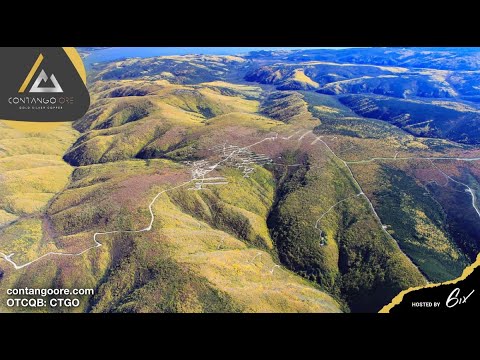
13:25 So what makes this project unique in Alaska terms is it's right next to the road. I've certainly worked on my share of projects that weren't next to roads. Donlon needs a 300 mile pipeline and the Amber Project needed a 200 mile road, which we got done, but it took a long time to do that. We're right here, The peak deposits off in the hills behind the bushes there, maybe 15 miles off the road. The Alaska highway is paved. We're looking here southeast towards the Yukon border. If I turn around, I'd be looking up towards Fairbanks. Paved highway, 250 miles. The Fort Knox mill is located just outside of Fairbanks. So an easy truck haul up the highway to the Fort Knox mill.
14:16 The Fort Knox mill, it's a big mill. I think it's a 50,000 ton a day mill. They're averaging in the neighborhood of about 10 million tons of low grade, about 0.6 sort of grades through the Fort Knox mill. We'll be adding roughly a little over 1 million tons of ore a year, but at 6 grams per ton. So that's why they're basically doubling the amount of gold coming out of the Fort Knox mill by adding the peak gold ore. And the way the Fort Knox mill is set up is there's a big gyratory crusher that feeds into a large sag mill shown here. And then on either side of the sag mill, there's a ball mill. You see one of them here in the picture. So there's 2 ball mills in this. They only use one for the 10 million tons.
15:03 So our ore is going to go in the other ball mill and then be blended for the CIL circuit and then the tailings put into the tailings facility. Again, these have been operating for 25 years. Fort Knox knows its mill very well. You don't have the typical construction and ramp-up issues that you would have at your typical mill. What we have to do to accommodate the peat gold ore here is have a stockpile, a conveyor feed, a weightometer to track the ore, and the rest goes through the plant as it has done for the last 25 years.
15:41 The resource base that this is on, this whole plant is based around, is shown here. 9.2 million tonnes of just over 4g. You can see the measured grade is a little over 6 grams. We'll execute a program in 2021 to basically upgrade the indicated resource to measured so that we can come up with a detailed month to month, 0.25 to 0.25 mine plan. So tons and grade fed to the mill along with metallurgical characteristics so that all that planning can be done to accommodate the addition of the peat gold ores to the Fort Knox mill.
16:25 From an execution standpoint, relatively easy. I like this cross section because it shows a detailed block model on the 2 deposits. You're looking north here, so on the southwest side is the main deposit, and then the north peak deposit on the other side. Main deposit dips to back towards the northeast, so it was properly drilled with angle holes off to the west. The north peak deposit dips off to the west with angle holes off to the east. That meant that the middle wasn't really drilled. And that was something we had a long, quite a bit of discussion on earlier this year with the Royal Gold guys and identified, did some structural work, brought Chris Brown in and did a bunch of good structural work, identified a number of targets here between the 2 deposits dipping towards each other that so far has not been drilled. So we certainly see a lot of exploration upside right in and around the pit here.
17:31 And then of course, if we want to look a little broader. You can see the perspective picture here again, main peak and North peak, and a whole series of known occurrences that are drill ready targets. This image I think shows it really well. You can see outlined in black the North Peak and Main Peak deposits. They're pretty small footprints. I mean, the total tonnage here is 9 million tonnes. It's mostly a lot of massive sulphide ore, so it's a dense rock, so it doesn't take up a lot of room. And you can see that the golden soil anomalies continue on strike for 3 or 4 kilometres along strike up to the northwest. There's been some drilling, but not enough to sort of condemn the whole area. So there's a lot more exploration drilling that can be done along those trends, but also along the discovery trend to the South here.
18:25 And then the North saddle area still has some good exploration upside as well. So lots of things to look at and explore for additional reserves. I can say that if you look at our model, every year of additional reserves, we would add about $6 to our share price. So we'll certainly be focused on that. When you look at the area that has had the most intense expiration on the whole Tetland lease, it's been focused in this circle area, this up to the north area there, north part of the Tetlin lease. Some work done on the rest of it, but not a lot, certainly not a lot of drilling on the rest of the 675,000 acres. So again, a lot of exploration upside here. And then I'll speak also briefly about our exploration prospects on our 100% owned lands at Hona, Eagle and ZZZ here in just a second.
19:28 Here's the ZZZ project located to the northeast of the Peak Gold Deposit. It's right next to the Alaska Highway as well, actually kind of at the junction between the Taylor Highway and the Alaska Highway. It's a porphyry copper gold target, classic signature with gold copper and soils on the surface, mag low, resistivity high. And then an IP survey was completed that identified 2 nice targets here that are basically all drill ready. We drilled some holes off to on the periphery of the deposit or in the periphery of the anomaly and got some interesting copper and gold numbers, not ore grades, but getting there.
20:14 We were not able to drill this area because we're waiting for a land transfer between the federal and state government. And we were hoping that that'll get done early next year so we can drill this target next summer. So excellent target, all drill ready. Good work done on that to identify drill ready targets. Similarly at Hona, we've identified with Surface Geochemistry and MAG VTEM survey, 3 nice bullseye anomalies, porphyry-intrusive hosted Gold deposits. Those are all drill ready. We'll plan to do more work there next year as well. My particular favourite is the eagle area, eagle and dome, where we've only done very early stage stream sediment and pan concentrate sampling, but over a very, very substantial area. And you can see the tall, hot pink colors here, the hotter the color, the higher the Golden Stream and Pan Concentrate sample. You can see the size of this anomaly here, very, very significant size.
21:22 And I draw your attention to the same, you know, the inset map here, where here's the Eagle anomaly. Well, there was the Peak anomaly, And we know we found there at least 1 million ounces and growing. I'm very, very excited to get on the ground, get boots on the ground here. And we've not spent any time there. In the last 10 years, there's probably only been a few days of work done in that whole area there, besides the original stream sediment sampling. So very excited to get out there this summer. Meanwhile we will assist our partner Kinross and staying focused on accomplishing the main objective which is to get into production as quickly as possible. As I mentioned, we have an $18 million program plan for next year. We'll approve that later on this afternoon with our first joint venture meeting.
22:12 That program will upgrade indicated resources to measure and then outline a detailed mine plan related to and complete a feasibility study. So, and then get the project ready for permitting. Again We're not permitting a mill. We're not permitting a tailings facility, so relatively simple. Construction on site is planned for 2023. Again we're not really constructing a lot of things. We are upgrading the road, the existing road that connects the project to the Alaska Highway. That's in a neighborhood of 15 kilometer road. We're building a truck shop. We're moving some echo trailers in for admin. We're bringing in a mobile crusher and housing them in a temporary building. So it's all relatively simple construction plan and relatively simple overall execution plan. So production plan for 2024, again, our share of production 65,000 ounces of gold at an all in sustaining cost of $750 per ounce. Again, all that's going to be updated with the feasibility study.
23:25 And we've got 850,000 acres of mostly private land and state land, actually all private land and state land, in the heart of the Tentina Gold Belt, certainly one of the more prospective and highly explored belts in the world today. A lot of money being spent in this belt, both across the border in the Yukon and several mines being developed in rocks that are hosted by the same rocks that we're dealing with. So again, we think we're in a very prospective part of the world. So we'll look forward to updating you on our exploration activities over the course of the year here. I think from an investor standpoint, we tick all the boxes. We've got a high quality deposit that's well drilled.
24:12 We've got a great operator in Kinross. They've been operating with an excellent track record in Alaska for 25 years. We've been working very closely with the Tetlin tribe. They'll receive very tangible benefits in terms of a worthy payments, jobs, and training. And we have 850,000 acres of real estate. In a very productive geologic belt of the world, so, I will end the presentation there and be happy to take questions. First question is, what is the total number of shares outstanding in the company? It's issued is 5.9 million and then there are 100,000 options.
24:59 So the total with including the options is 6 million, no warrants and no debt. So That was the first question. Although the company is listed OTCQB, the OTC states you have no market maker. Why is that? Not DTC eligible. How are investors supposed to buy? Well, that's a very good question. That's why we're addressing right now. We want to step up to the American Stock Exchange. That's the main objective. We meet all the criteria. So that is something that I think you can look for. It is a tough stock to buy, we realize that, and we're working on making it a more liquid stock. The main objective this year was to get this deal done with Kinross.
25:57 I'm now turning my attention to improving liquidity and 1, getting the story out, and 2, getting ourselves on a more higher profile exchange. But thanks for the question. Is Kinross ready and open to expand its operations globally? Not really sure how to answer that question. I don't work for Kinross, so it's probably a better question to direct to Ken Ross. But what I can say is that. In terms of our project, gold. This, if you go to the Ken Ross corporate deck, there are a number of several slides on the Fort Knox operation, and, they specifically talk about their importance of.
26:44 Adding people
26:48 to, to the Fort Knox production profile. As I said earlier, it really doubles the side of the size of the. The middle production from Fort Knox. So very, very significant. Next question is what will it take to list on the New York exchange and the timeline. We basically do meet all the criteria with the exception of the liquidity. So that is something, as I said, we're working on and with the, get to work with a market maker. And we're looking to do that in the first quarter of 2021, 1st quarter next year. No warrants, no debt, impressive. How are we able to accomplish this? Yeah, what's really unique is our share structure. Again, we were spun out of an oil and gas company. We've only done a couple of, you know, what I would call friends and family kind of financings.
27:38 We've been fortunate that we have, most of our friends and family were wealthy oil related friends and family. They're less wealthy today probably than they were back when they did the financing for the company. But the most recent money that came in the last quarter was a result of selling our 30% interest to Kinross. That brought in about $32 million. So that's why we're in such good financial shape. But it is a sound structure and a sound level of financing to accomplish what we need to accomplish to get ourselves into production. So I think we're in really good shape.
28:23 Next question is our continue our can Kinross and contango involved in production of other men, my minerals other than gold and silver? Short answer, no, we will only produce gold and silver out of this peak gold project. Obviously there's lots and lots of exploration potential. Copper gold porphyries are known in the region. So that's not to say that we wouldn't take a look at mining copper, adding copper to the profile if that made sense down the road. But I do point out that the Fort Knox mill is only set up to recover gold and silver. So Again, that's what we're focused on right now. Next question, can a Joe Biden administration cause issues for exploring state mining claims? Short answer there is no.
29:12 And I also point out that we're working on private land. Peak Gold is located on private land owned by the Tetlin tribe. So, who knows what's going to happen with the President-elect Biden makes changes to EPA and the Department of Interior that only affects. Federal lands. In terms of permitting you still need permits from the Corps of Engineers. That would be the main permitting the federal main federal permitting agency that we would need a permit from but again, the mine is located on top of a hill. We're not in the wetlands we're only developing a mine the road, the upgrades to the road, and in the lower part lower elevations of the road there will be impacts to wetlands and that is something that will have to be permitted.
30:09 But again, we're upgrading a road, so we're making improvements. We can probably improve drainage, Put in culverts that allow more free passage of water. So I think I think regardless of who's in the White House. I think we can accomplish these things. This is a small high quality gold deposit.
30:41 It's not a a big low-grade deposit. We've got very well-demonstrated economics. We have a known producing partner in Kinross that's been operating very well, with a very good track record in Alaska. So I think, again, I think the level of risk, you know, permitting is always a risk, no question about that. But I think we're at the lower end. You have a scale of 1 to 10, I think we're down in the 1 to 3 sort of range, not up at the high end of the scale. Next question, Kinross Gold's mill does not come freely. What will KGC charge to the joint venture to mill the ore? Great question. We have a tolling arrangement and the we here is the joint venture. So you have to keep in mind that Kinross owns 70% of the joint venture and so we're, you know, they're kind of doing business with themselves.
31:31 So I'd say they're cutting themselves a pretty good deal. Which means they're cutting us a pretty good deal. We don't have final numbers because that they'll be based on the feasibility. Study but we certainly know. In in ranges. What the Fort Knox mill costs to operate on as is that it averages around 10 million tons. So that's kind of our. Our guidance. And I think. It's a big mill, so it's a lot cheaper to run a big mill on a per ton basis than it would be if we built our own mill. If we built our own mill at 3,500 tons a day, we'd probably be $25, probably $25 a ton operating costs. I think we'll be under 20 including the toll with this. But that's all guidance and I'd say wait for the feasibility study to get more firm numbers.
32:35 Next question. I'm gonna take a glass of water. Next question, what would be the percentage if any of the current and 2021 budgets will be used to add to the resource at peak versus the feasibility site? It's a good question. In rough numbers, it'll be about 20%. So we have an $18 million budget and we're looking at probably spending 2 to $3 million, so maybe 15% on exploration. And included in that is what we call condemnation drilling. Condemnation drilling is great because it's a drilling budget that engineers put together to make sure that you're not putting your waste dumps on ore. And so it's a great budget for exploration geologists to use to go find more ore.
33:26 We've certainly done that many, many times. So we'll, like I said, it's roughly 15%. And I think we'll be, the exploration dollars we spent, I expect it to be right in and around the known deposit. I don't think we're going to go rush off and drill things that are, you know, 10 kilometers away. Next question from Mike Kneheiser, please comment on permitting under a new administration. I think we touched on that a little bit. I really don't see. That this will be a controversial project again. We're on private lands. Tetlin Tribe is very, very, very strongly supportive. The road improvements that will be subject to the 404 permit will improve access to their village.
34:15 Right now, the road floods in the springtime when we have the snow melt, and it floods in the wintertime when the when the water glaciates and covers the road with ice and makes it impossible, So we'll be able to fix all that by making the upgrades to the road So I again, I and I think that's the only that's the only federal permit we need And again building a mill Not building a mill not building a permitting or permitting a tailings facility great fairly simplifies things Next questions or if it's already covered, but how does the processing agreement with Kinross work with just Miller by the ore? Yeah, so I think we went over that.
35:00 It's a standard tolling arrangement. And again, they're kind of tolling themselves in the sense that Kinross Corporate owns 70% of this deposit. Our deal is with Kinross, it's not with Fort Knox. I think that's an important distinction. So effectively Fort Knox is a contractor, a tolling contractor to the joint venture. How likely is the resource in the JV to be increased and expand over line life? Well, I've been a successful exploration geologist my whole career and I don't plan to stop now. And as we pointed out in the slides earlier, I think there's a tremendous amount of exploration upside right along the known trends at peak and along the northwest trends of peak and north peak.
35:51 I think the discovery zone is under drill. I think there's more exploration upside there. I mean, it's called the discovery zone because that's where the first samples were taken that had good Gold values in them at surface. They drilled there, they found some interesting results, but not as high grade as when they went over to the main peak, which they actually found kind of by accident because they were drilling, putting a road in to get to another target. And it passed over, you know, Gossiness boulders, they sampled them, they were very obviously mineralized. So there's a lot of exploration upside here. I just, You can see the strength of the Geochem anomalies. And of course, that's on the joint venture land. As I mentioned, ZZZ is a Gold Porphyry target already to drill. We just need to wait for the land transfer to take place between the federal government and the state government. We expect that to happen early next year.
36:51 And like I said, I'm really excited about the Eagle Prospect, just an amazingly strong set of stream sediment and pan concentrate samples along about 7 or 8 kilometers of streams draining the very southern portion of the Alaska range there. Those are mountains. That's not hilly country like around Tetland Hills. These are straight up mountains, so we'll be able to do some prospecting in the hills and there's a lot of outcrop up there and subcrops. So there's something up there, we'll find it pretty quickly. Next question, for the 65,000 ounces per year Tribunal profile. How many tons per day? Does that represent?
37:39 That's about 3500 tons a day. In terms of the mill throughput. Mining inside and then the mill throughput at Fort Knox. And then how significant trucking effort, truck capacity, et cetera, will this be through Fairbanks? Is there any special municipal permits which will be required? And I'll say on trucking, we're, again, Ken Ross is the manager here and is handling all of the community relations issues, permitting issues related to this. I'll hear more about that this afternoon and what the plans are, but from a commercial standpoint, it's a state Alaska highway. If you talk to DOT, they will tell you there's plenty of capacity on the road to handle the trucks, but we'll, I'd say, wait for the feasibility study that will outline all of this in great detail.
38:32 I'd rather not give guidance now, in terms of number of trucks and trucks per hour, or whatever it is, let's wait for the feasibility study. I think that's the most prudent thing to do here. Any concerns given the permitting at Pebble? Short answer is no. Pebble is its own little universe. It's been controversial for a long time and no doubt will remain controversial. We're working on private land. The Tetlin tribe strongly supports the project. We're a tiny high grade mine compared to a big low grade mine. No similarities. We don't impact any salmon streams.
39:19 And we're, you know, we're, we're off the radar screen for, terms of controversial products, projects. Mike, asking lots of questions here. Mike, does the Olin sustaining Cost of 750 include costs related to the total charges and the royalties? Yes Short answer is yes. Again but they'll be upgraded updated story with the feasibility study, so. And all you know, like most feasibility studies, there's some gains and some pluses and some feasibility studies so. And all you know, like most feasibility studies. There's some gains and some pluses and some minuses. 11 thing that what we've seen the last year here. Since that 7 50 price was estimated is the fuel price has gone down almost a buck. And obviously, with a big part of our costs related to trucking, when the fuel price is 260 a gallon versus 360 a gallon, that makes a big difference in the cost to truck the ore.
40:15 So That'll be a gain. Undoubtedly, there'll be some things that'll cost a bit more than what we're envisioned in Ken Ross's initial evaluation. So like you say, it'll do the typical feasibility, some pluses and some minuses. But I'd say wait for the feasibility study guidance in towards the end of the year, towards the end of next year, sorry, after we complete our $18 million program. Timing for completing the feasibility study and critical path items. Yeah, so just to go over that, we'll approve a budget later today of $18 million that essentially will be directed at spending about $6 million to convert indicated resources to measured. With that, we can come up with a good month to month and 0.25 to 0.25 mine plan, how many tons at what grade and what metallurgical characteristics delivered to the Fort Knox mill. And with the feasibility study plan for the end of the last quarter of 2021 during the next year, 2021 program will also be obviously getting the project. You know, permits, permit applications ready and, that kind of is done in tandem with the with the feasibility study. And that is the last question. I think I have. Let me see if
41:47 a few more don't come in. Yeah, so I think those are all the questions from our live audience here today. First of all, thank you very much, Rick, for taking us through the presentation and for answering all of our questions in such detail. Everyone, if you didn't get a chance to get a question answered because you just thought of it now or if you want any additional information, please stick around after the webinar. We do have a short survey where you can leave your details and then the Contango ORE team can follow up with you directly. You can also find more information on their website at www.contangoore.com. Now, Rick, I'll pass it back to you for the final word.
42:33 Sure, thanks very much. I see Mike Neihiser, he's always full of questions. He's got a question here regarding Dome and Eagle and road access. Yeah, they're just off the highway too, right? Just opposite the village of Tantacross, which is right on the Alaska Highway. I'd say you're within 10, 15 miles of the highway. Now, that area, the area between Dome and Eagle is steep country, so it's high mountains, but you can build roads. Roads into it to access it. And so again, not very, not very far off the. Very far off the highway. Another question. What provides power to Fort Knox Mill? They're on the grid.
43:23 So plenty of power in in the grid. Fort Knox is the largest user of power in the Fairbanks area. The grid goes all the way and includes coal power generation here in Fairbanks, but also down in Healy, hydropower, wind power. It's a pretty well integrated grid, So plenty of power. And on site, we're again, without a mill and tailings facility, you don't have a lot of power requirements. You know, you will have gen sets on site to keep everything warm basically and keep the lights on, but, very, very small scale. Power another questions come in from Justin Tolman.
44:12 Given, Ken Ross is operating in the joint venture and leading execution that will G&A cost be over the next few years and what do you expect any other significant expenses? Yeah, so good question on our overall budget. So our share of the $18 million 2021 budget that will approve later today is $5.4 million. Guidance wise, I'd say we'd be spending another 5 to $6 million next year on our share of the Peak Gold Joint Venture. So you add those numbers up, let's shoot to the high side. Let's say that's $12 million. And we've got $30, $32 million in the bank. So that would bring us down to $20 million in the bank.
44:59 We'll spend, besides that, we'll spend $5, $6 million running the company and doing, you know, 3 to $4 million of our own exploration on projects like Triple Z and Eagle and what have you. So That we, obviously we're in control of that budget. That sort of would bring us down to that in 2 years when we're ready, assuming we execute our plan, we're ready to go to production, we'd need to probably raise about $20 million of debt, 10, 20 to $25 million of debt. And obviously when you're generating the kind of cash flows that this thing does, I don't think we'll have any problem raising that level of debt for the project at that time.
45:51 And I thank you for those questions and please, I'll direct you to our website, but I'll also give you a heads up that we're in the process of updating it. It's, I'll totally admit it's a very out of date website as it currently sits. It's got a lot of information on it, but it's just a bit clunky. Hopefully in 2 weeks, we've got that upgraded to a nice modern website with all the bells and whistles that you can read on your iPhone or your tablet. But do also, if you have questions, you can go to info at contangoor.com. Those will end up in my inbox and I'll get back to you. And otherwise I will wish you a good rest of the day and happy holidays and stay safe. Thanks very much.
46:44 All right, everyone, Until next time, bye now.