Transcript
Automated transcript · Written by software from the replay's audio. It can mishear names and figures; the replay is the record.
0:08 Hello everyone, welcome to Contango OARS live investment summit today hosted by 6. I'm pleased to introduce their president and CEO, Rick Van Noonhuisie. He's going to be reviewing some of the latest news and updates that Contango has, and after we're gonna be accepting questions live. So as a reminder, if you do have any questions, please feel free to submit them in the Q&A chat on the right hand side of your screen at any time today. And as always, this summit is being recorded, So you'll be able to check this out in the coming days on six.com if you want to refresh. Without further ado, Rick, I want to pass things over to you so that we can get started. Cam, thanks a lot. And thanks, everybody, for
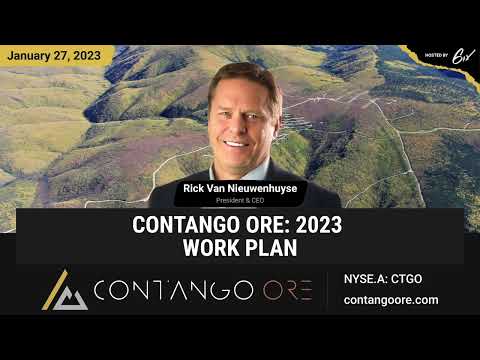
0:39 joining us this morning. Pleasure to speak to you over the internet. 2022 is a pretty busy year, and 2023 will probably be a little bit more busy. Certainly, we're seeing some good activity in the Gold market. Nice move in the Gold market since sort of mid-November. I think our timing is really good. So I'll just, there's 1 slide here I'll just keep referring to, and I'll just kind of walk through our plans to continue to advance our project to production at Moncho. I'll talk a bit about Lucky Shot as well. As I said, 2022 is a busy year. We got started construction on the project, at least the construction of the road and construction of the camp. The Camp now is completely finished. I was up there last week. It looks great.
1:37 If you recall, the camp was an old abandoned hotel in Toke, not too far from the project. And we've refurbished that and turned it into a 200-person camp. And so it's a pretty nice camp as well. Excellent place for our workforce at Muncho to live while they're working at camp on a rotational basis. The other big accomplishment that got underway this year was the road access. Of course, we've had road access to the project for quite a few years, but it was a drill road access. This photo here shows the road that goes up to the 2 deposits that you can see in the middle ground there with all the drill roads, the main deposit a little bit in the background and then the north deposit in more of the foreground.
2:29 That road pretty much goes right up the ridge and it's a good drill access road but it's too steep for the highway trucks to maneuver so one of the things that we're doing I started last year and will continue to do this year is just level that road out to about a 6% grade so that the highway trucks can come up right off effectively to the edge of the pit there and load the highway run-of-mine ore into the highway trucks with a loader and then they can easily make the journey down the hill to the main highway, the Alaska Highway, and then of course truck the run-up mine ore up to the Fort Knox Mill and drop it at a stockpile area there before it gets put into the mill. So that work, the original plan in 2022 was to work on the road until November and then shut down over the winter, but they found that they're actually making really good progress on the road through the winter months and winter starts in September in Alaska.
3:30 And so they just were continuing to build the road all winter. I was up there last week and they're making good progress. They're about a little over half completed with the road. It's this is a sort of a typical mine access road for the larger trucks. And I think the schedule right now has them completing the road in the May time frame, all the way up to the lay down area. And At that point, the 2 deposit areas will be connected to the highway with a good access road. We're continuing to advance on the permitting. The last permit we need, Well, you've never really done permitting, but I mean, the last major permit we need is called the Mine Operating Permit.
4:21 It's a permit that's issued by the state of Alaska, overseen by a number of the departments in the state that will allow us then to mine, put the lay down areas in, put all the stormwater drainage areas, temporary water storage ponds, temporary ore storage lay down areas, and peg, potential oxygen or any waste rock storage areas. It's a complete plan, it's a cradle to grave kind of a plan. It's are you going to operate during construction, during operations, and during closure. That's being completed now. It's been submitted and we've got comments back.
5:07 It will go out for public comment. We're planning to have that in place by April, which will allow us to start what we call mine operations at the Manchurian site itself. I always remind people that one of the biggest challenges in mining is typically water and managing water, making sure you're keeping the water clean, but if you're going to discharge water, it has to be clean. So the fact that our project is right up on top of the hill means you have sort of a minimal amount of water, not in the middle of a river valley or below a water table, You're right up on top of the hill. So our water management is on a relative scale pretty modest.
5:55 But nonetheless, that's part of the whole operating plan and the Kenderos folks have done a good job of putting a good plan to the state and we'll expect to have that permit in April and then start the mine site works at that time.
6:14 We'll have a mine contractor, I think that'll be announced in the next few weeks. And they'll get started in that once the permit's issued, getting site prepared, and then start, then you're actually starting mining. You're pre-stripping, you're start to stockpile your ore, you start to stockpile your waste, sort of 2 different kinds of waste. Your non-acid generating waste and then your potentially acid generating waste that goes into a temporary storage facility that'll be backfilled into the pit at the end of the mine life. All that's part of that plan. By the summer, there'll be mining and starting to develop a stockpile. By the fourth quarter, we should start to look at transporting.
7:02 The plan is to be in operations and production in 2024. I think if all goes well, it might be in the first half of 2024. If there's some delays, it might be in the second half. Kinross' guidance to the public or to the shareholders and to the public is operations production by the second half of 2024. So right now, I think we're slightly ahead of schedule, we're on budget. So I think all those are, that's all good news. And particularly when you consider we still have a pretty significant inflationary pressures across the country. But I think Ken Ross has developed a good plan and a good work team.
7:47 And they're, as I said, they're, I think, slightly ahead of schedule and on budget. So good news there. What we're working on specifically is financing. Obviously we're spending money and it goes quick. So we are arranging the debt facility to be used to pay for the balance of the costs. And I was up there last week with this group and got a couple more groups coming up this week and the following week. So I think on a relative basis, this is a fairly simple project to debt finance. You know, the mill and tailings facility is built of course at Fort Knox. It's been operating a long time. Fort Knox has demonstrated themselves to be really good operators at Fort Knox.
8:43 And so this you know on a relative basis I think this is a very financeable project. Our objective is to raise between $50 and $60 million in debt and hopefully get that done by the end of the quarter, get that lined up. That will assure our place in getting our 30% of this project into production and starting to cash flow in 2024. So kind of a big milestone a year this year to accomplish all that. And I have to really give a lot of kudos and shout out to Ken Ross and their team. They've done a great, great job. They've been very good and supportive of our efforts to finance the project with debt. And Obviously, the bankers have lots of questions and I think Kinross has been a great partner in answering those questions and addressing the concerns that the bankers have.
9:44 It was joked that bankers have about 10,000 questions that they wanna ask you about your project. So we're working our way through that and we'll look forward to sort of a milestone, many milestone updates as we go along here. I think the mine operating permits is a big one because once that's issued, then we start mining. And the contractors will be in place. And the Oro Hall contract's in place. That's a company, a local Alaskan company that's been in business for 35 years, Black Gold Transport, or Black Gold Express. They've been in the transportation business hauling lots of equipment and supplies up to the North Slope. So they're well-versed in trucking.
10:37 So yeah, I think that's our plans for Mon Chaux. On the Lucky Shot project we're starting to assay is asking you know we've drilled 29 holes on the project in 2022. We got a good amount of underground development work in, a drift in the footwall, completed a couple of fan drilling in the drift. So these are, you know, sort of fan drill sites where you're drilling, you know, sort of on 15, 20 meter centers. You know, in-field, detailed drilling of the vein to really understand the grade distribution. Assays have been slow but we're starting to catch up now and I think in the next few weeks we'll have most of the assays back, or hopefully all QA-QC'd, and be able to report on that, as well as use all that information, along with the geologic logging and mapping that we've done underground to put together a resource model, our initial resource model, by the end of Q1.
11:40 So hopefully by the end of March we've put out sort of a maiden resource based on that drawing. As I said we drilled 29 holes. All holes hit the Lucky Shot vein structure and we'll let the put the assay results out so people can see, get an idea of what we've been hitting. It'll be a spread of results. The whole vein is not going to run 20-30 grams, but our vision and what we've seen is based on historic mining of this vein structure is that there are chutes or chutes that are, you know, where the grade of 10, 20, 30 grams per ton is focused on. Usually these are structural corridors within the whole overall vein structure. So That's certainly what we expect to see, and we'll start to put the resource model together.
12:37 We did shut down this winter at Lucky Shot. We were thinking about maybe operating all year round, but we decided we weren't quite ready. I'm glad we made that decision because southwest Alaska, the Anchorage area has gotten just an inordinate amount of snow this year, about twice as much as we had last year. We had a fair bit of snow last year. I'm glad we made that decision and we'll probably get started back up underground and underground development and drilling probably in June of this year or so. I think I'll wrap it up there and see if there are questions. Cam, I'll turn it back to you. Absolutely. Thanks, Rick. As a note to everyone in the audience, if you do have questions now that we've entered the Q&A period, please submit them in the Q&A chat on the right-hand side of your screen. First question from Ron, though, are there any potential permitting roadblocks for Mancho or is it a clear path from here?
13:34 You're always permitting a mine that never stops. The next major permit, as I mentioned, is the mine operating enclosure plan. Again, we permit a mine in Alaska, you permit how you're going to construct and operate your project during construction, during a mining operation, and then all the way through closure. That's a permit that's coordinated by the Department of Natural Resources in Alaska. There's other agencies that weigh in on various parts of that permit. And, you know, We typically don't have big issues with state permits. I mean, they can take time and there's things to address.
14:23 But again, this is a relatively simple project because we don't have a tailings facility or not building a big mill, a big power plant. There'll be a very modest power plant here basically to keep the lights on and keep people warm, but it's you know when you're not operating a mill you don't and you just don't need a big power plant. And as I said we're on top of the hill so there's sort of minimal stormwater drainage type structures to put in. It's pretty typical of any construction site. You're required to put in storm water drainage and collect the water, let it settle out. If there is any water that needs to be cleaned up, there'll be an RO plant to do that. I don't know that they'll ever necessarily get used, but sort of a backup system if you start to see any potential metals leaching into the water. Again, very minimal water here, just basically because you're on top of the hill, so you don't have to move a lot of water around.
15:28 So yeah, we don't really expect any large issues with that permit, but any and all, Kinross has been in business for over 25 years in Alaska, so they know what's required. They know how to plan for, you know, they know what the regulators are expecting. So I think we're in pretty good shape. Obviously it just takes time and the guidance is that we expect to have that permit in place by April. So we can start mining and site constructions in May. And I think that'll be good timing from a seasonal standpoint. Typically the snow's clear by May, June, so we'll be in good shape. All right. I want to know when you expect to have the economics pulled together on the Lucky Shot project. For instance, the scoping study, pre-feasibility, feasibility, that can be released to investors, of course, subject to any successful resource support, or report rather. Yeah, obviously, I think we're, frankly, a couple of years away from that.
16:33 We plan to have a maiden resource out here in March. I think another year of drilling from underground, we can probably start to think about putting a mine plan together. So I'd say, you know, within 2 years, we should probably have, you know, an economic case to sort of put forward to our shareholders, investors. All right. Kyle also wants to know if you're planning on hedging some of your gold production at today's gold prices. And if so, when would you expect to put these hedges in and approximately how many ounces would you plan to hedge? Yeah, great question. And that's a big discussion with the different banking groups that we've been talking to about the, for the debt financing.
17:23 The banks are gonna make a hedge, there's no question about that. They wanna minimize their risk and exposure. So I haven't looked at it today or something, but the forward curve changes every day. But if we put the debt in place by the end of the quarter, say, they'll hedge that gold, it'll probably be in the neighborhood of 20 to 30% of the gold that we're gonna produce on a quarterly basis until the loans paid off. Obviously, I think in the name, if you hedged today, you'd be hedging gold at sort of $2,050, something in that neighborhood. And I haven't looked at the gold price today, so hopefully we didn't tank, but, you know, say call it $2,000, and that's certainly a lot higher than what's been used in the feasibility study, which is, we've done scenarios at 1,500 and 1,700.
18:17 So yeah, you'll hedge, I think it's gonna be in the neighborhood of 20 to 30% and for the duration of the loan itself. Okay, Roger wants to know, you recently issued a few shares below market price and why that was? Well, as I said, we were spending money out constructing the project and we have quarterly cash calls and so we've got to meet those. So We went to our shareholders, existing shareholders and a few other folks and just did a quick financing to sort of top up the treasury so that we can continue to support the construction efforts. As I mentioned, the original plan was not to construct the road through the winter, but when they found that they're making good progress and ahead of schedule, they wanted to keep ahead of schedule. So we kept spending dollars through the winter. So, you know, raise a bit of money until we can get that debt facility put in place. And once that's in place, that gets us all the way through the end game and gives us a good amount of working capital to continue to be in the game.
19:30 With the plan to have batch processing, so we'll form a stockpile at site, we'll transport it up to the Fairbanks, Fort Knox mill area. There'll be a stockpile area there. Now on a quarterly basis, we'll batch process the ore. And that will require a pretty good amount of working capital. So if you're sort of adding up numbers and wondering why we're raising that amount of debt, it's because we will need a significant amount of working capital since we're batch processing on a quarterly basis. And you're going to get paid sort of in chunky amounts once 0.25, but you've got to pay your bills every month leading up to that. So, yeah, that's the basic explanation. All right. Fair enough.
20:16 Kyle's also wondering, what's the updated timeline for the release of the Manshaw Feasibility Study or Contango Oars portion? Yes, so one of the things that we have been working with Kinross on is on the trucking contract. So Kinross has decided to purchase the trucks themselves and then lease them to the joint venture, the Mansure or the Peak Gold joint venture. And so that's resulting in less capital that for our 30% of the joint venture that we had to put up, but we'll pay more in all in terms of our costs and our soar all in sustaining costs will be higher. So If you recall the feasibility numbers that Kinross put out, they had an all-in sustaining cost of $900.
21:08 This was last July of 2022 in Kinross' Q2 reporting. We gave guidance that we said it was going to be higher. We don't exactly know the number, but we're thinking it's going to be in the $1,100 range. Once the contract is finalized, called the lease arrangement between Kinross and the joint venture, then we can fix our all-in sustaining costs. That's the only missing number right now. I think that's going to be done in the next month or so. We'll be able to wrap all those numbers up and then issue our own SK 1300 technical report for the feasibility study. Okay, great. Mark's wondering if you're gonna be funding your 30% of Manchow via classic equity debt, or do you have something slightly more exotic planned?
21:59 No, I think it's gonna be pretty plain vanilla bank financing. They're gonna, as we talked about, they're gonna want us to hedge 20, 30% of the gold to be able to make sure we can cover that. So at that point, the only risk is that, for some reason you don't get the mine in production. So that's why they're covered. So yeah, I don't think there's gonna be anything exotic here. Don't like royalties and streams. There's a significant royalty on the project already with the Tetlin tribe, which is, you know, they're going to make a good royalty on the project. And of course, Royal Gold has royalty as well. That was part of our overall restructuring of the company, bringing Kinross in on a 70% basis and having Royal Gold revert to just a royalty interest.
22:52 Speaking of that, Wolfgang is just wondering if you could go into a bit more depth explaining the partnership in detail. Once in production, for instance, Are you getting a monthly paycheck from Kinross? Yeah, so these are the devils in the details here. So the way the joint venture is set up, the joint venture produces the gold. The members actually purchase the gold from the joint venture, Peak Gold Joint Venture, and then sell their gold onto the market. Practical sense, the way that it works is, you send your gold to the refinery, your dore to the refinery, and then the refinery writes Peak Gold a check, and then the members then technically purchase the gold from the joint venture company and then sell their gold on the market. We'll work through an agent to sort of manage all that. It's kind of sort of operating in the background, if you will, but ownership wise, we own 30% of the gold.
23:56 We're free to do with that what we want. If we want to hedge it, we can hedge it. If we want to sell it into the spot market, we can do that. Obviously, we'll hire some experts who understand that business well and hopefully do well at being a producer. All right, sounds good. Ellis is also wondering if there is enough capacity at the Kinross mill to use the ore trucking model for the Lucky Shot mine. There's plenty of capacity at the Fort Knox mill. It's a 40,000 ton a day mill. Just to be clear, we've had no discussions with Ken Ross on that, on any kind of a plan like that. We think it's certainly something to take a look at, but, you know, as I said, we're a couple of years out from sort of formally putting an economic mind plan model around that.
24:46 It's an exploration project. We think it's a good exploration project. It's certainly easy to work now, especially now that we have all the underground access in place. But as I mentioned earlier, we'll have a resource out, We'll start doing infill drilling and seeing if we can identify where these higher grade ore chutes are. We're kind of looking at something between 10 and 20 grams per ton that we think is realistic.
25:12 So then it's going to be how many tons of that can you put together? What's it cost to mine? Is it worth building your own mill and permitting your own tailings facility?
25:25 Or do you go have a good conversation with our partner at Kindros and say it might be easier to put rocks in the box and transport them up to the Fort Knox Mill just like we're doing with Munshow. So we do have one other advantage on the Lucky Shot side that we don't have at Munshow and that is that there's rail between Anchorage and Fairbanks. It's about 20 miles from the Lucky Shot site, so we could literally transport it down to the rail and transport it up that way. Again, no specific plans. It'll definitely be something we look at since we're already partnered with Ken Ross. It seems to sort of inherently make sense. Lucky Shots are really simple ore, I mean it's quartz and gold, there's very little sulfide, so it certainly would sort of fit the type of ore that would be easily be able to be processed at Fort Knox. And you know, we're not sort of shooting in the dark here. Ken Ross has rebranded its Fort Knox operation as Ken Ross Alaska. And they've certainly said, you know, hey, we've got a big mill. We've got, you know, have a lot of infrastructure here.
26:32 Let's all take advantage of it. So, we've heard that message and we're kind of exploring accordingly. All right, that's where all of our projects are on the road. And I think the other thing that goes along with that, you don't have to find a 5 million or 10 million ounce gold deposit to think about building your own mill. If you got all that there, just look at it a little differently. Say, how do I mine efficiently and transport it efficiently? And the advantage there is it doesn't, you don't have to permit a tailings facility. Maybe you save yourself 5 years of heartache. Oh, fair enough. Question about any exploration occurring last year at the Man Show.
27:17 What plans do you have for future exploration? We certainly have a modest exploration program every year, since with Ken Ross' involvement as a joint venture and manager. We had a $3M program last year. I'd say it was 0.5 split dollar-wise between drilling, particularly right in and around the deposit. We refer to that area as the Chief Danny area. Drilling along Strike, essentially, there were a number of areas that we spent a little bit of exploration work, but that's certainly the sort of low-hanging fruit, if you will. So I'd say half the budget was spent drilling on strike and intersected some interesting things. At the time we had our last joint venture meeting in early December, but we did not have asset results.
28:10 We'll have a joint venture meeting here in the middle of February, and We'll expect to see what the results were of that. The other thing that was done is, and you can kind of see in the background there, there's a lot of territory on the Tetland lease. The Tetland lease is the size of the state of Rhode island. So it's 685,000 acres. Then there's some state lands that are also part of the joint venture. So we did a lot of reconnaissance work, stream sediment sampling, some soils, some bridges and spur type sampling, finding outcrop. And you can see from the photo here that there's not a lot of outcrop in this country. It's typical interior Yukon tanner on terrain rocks. They're all schists.
28:56 They tend to not outcrop well and they kind of got to get down in the creeks and the gullies to find rock and debris. But they found some pretty interesting anomalous areas. And when we get the report with the next joint venture meeting, I'll include some of that in our corporate deck so we can talk a bit about some of the things that we're finding there. But there's definitely several other areas that are sort of hot spots from a geochemical standpoint that look a lot like what we've discovered at Manchot. I'm very confident we're going to find some interesting things here. And again, I just point out that it's private land. We have a mining lease with the Tetlin tribe. They've been very supportive of the project. I mean, they literally want this mine operating yesterday.
29:47 So I think there'll be a lot of good exploration work to do here. All right. I was wondering if you could provide your own sort of internal elevator pitch on how investors make money over the next number of years from today's share price. A good question. And basically it's, I view this as about cashflow. So when most junior companies have to go to the market as we've been going, and you go to your friends and family first, and then you reach out and develop a story. In today's gold price, we should be generating somewhere in the neighborhood of 30, $40 million of free cashflow. It's obviously with the higher gold price and inflation will play a role here, but we should be doing really well in terms of cash flow. And then, so then it's what do you do with that cash flow? Well, we've been good explorers.
30:39 We've had a good track record of success, certainly in Alaska and elsewhere. So it's, what do you do with that cash flow? How do you add value for shareholders? We've been very prudent about issuing shares. We have fewer shares than most shell companies. Certainly, you know, your typical Canadian junior shell company's got 30, 40 million shares outstanding before they have a project of merit. We've got 7.2 million shares outstanding. So we've been very prudent with issuing shares. We'll continue that discipline and think about, and I'm a significant shareholder. I own 7% of the company and I wasn't gifted that. I didn't get penny stock. I put my own money into this because I believe in what we're doing here, and I think this is a fantastic opportunity for shareholders to continue to see an appreciation of the share value because of the success of getting this project into production quickly, relatively quickly.
31:41 And I see great exploration potential, both here at Rancho and obviously we think the same of Lucky Shot. As I mentioned, we've been involved in some big projects like Donlon. We discovered Donlon 25 years ago and unfortunately it's still not in production because it's such a big project. It's complicated and it requires a huge amount of capital. So we've kind of shifted our, I've shifted my focus to 1, looking at things that are near the existing road infrastructure. And then 2, that maybe I don't need to find that 50 million ounce gold deposit again. Maybe we just go for 500,000 ounces and get that into production quickly. Right. Speaking of lucky shot, another question just about if you have any exploration results from there and if you can just elaborate on your continued exploration plans.
32:31 Yeah, so as I mentioned, we're getting, it took a long time to get the drill results this year and the labs are incredibly slow. I'm sure any exploration geologist you talk to will have the same complaint. And I honestly don't know that it's gonna get any better in 2023. I just don't see it. But anyway, so we're gonna have to get used to this slow, painful release of results. And we made a decision. We didn't want to release sort of, you know, this one drill result and then wait 2 weeks and have another drill result. So we're just going to release all the results when we get them at the end probably hopefully by the end of February. I think in the next 2 3 weeks we should have them all. And then you know more more importantly really is okay what does this all mean and that that's the resource model.
33:21 You know we're gonna there's the vein We hit the vein in every hole we drill. So we drill 29 holes, hit the vein in every hole. We know it's not going to run everywhere the same. There's going to be 1 2 gram intersections and then there's going to be 10 and 20 30 gram intersection. So that's typically how these mesothermal veins are. They don't run everywhere. There is a vein everywhere. They roll. There's cross structures and that's where you got to find the ore chutes. That's what they did, you know, that's what the old timers did. They handcuffed a lot of this ore, so they said, oh that's good ore, that goes over in this bin. And the other stuff, well it's maybe coarse, but doesn't have a lot of gold in it. So we'll backfill that stuff. And it would go underground. That's exactly what you see.
34:10 All right. Well, Rick, I want to thank you, as well as everyone in the audience for that matter. We've had a lot of questions in today's Q&A, but that looks like that's it for now. So I want to, as I just have, thank you again, but I'll pass things over to you for some closing remarks, if you have any before we close out for the day. Yeah. Thanks, Kevin. I just appreciate everybody joining us. Good questions. Keep going, you'll keep up to keep on our website. We'll keep that updated and we'll look forward to sort of regular updates now. And it's exciting when you're actually you go out the site and you see, you know, trucks and bulldozers and building a road. And it'll be exciting to get the operating permits so we can start mining and stockpiling. When we start seeing those trucks transporting the ore up to Fort Knox, there'll be great anticipation about seeing the Gold, the Dore poured out the other side. And I'm gonna look forward to holding that first bar of gold.
35:05 Hopefully maybe sometime next year here.