Todd Beiger
Vice President and Head of Investor Relations
Replay available
Coca-Cola (NYSE:KO) Q2 2026 earnings call, held 2026-07-28. Watch the replay and read the transcript on 6ix.
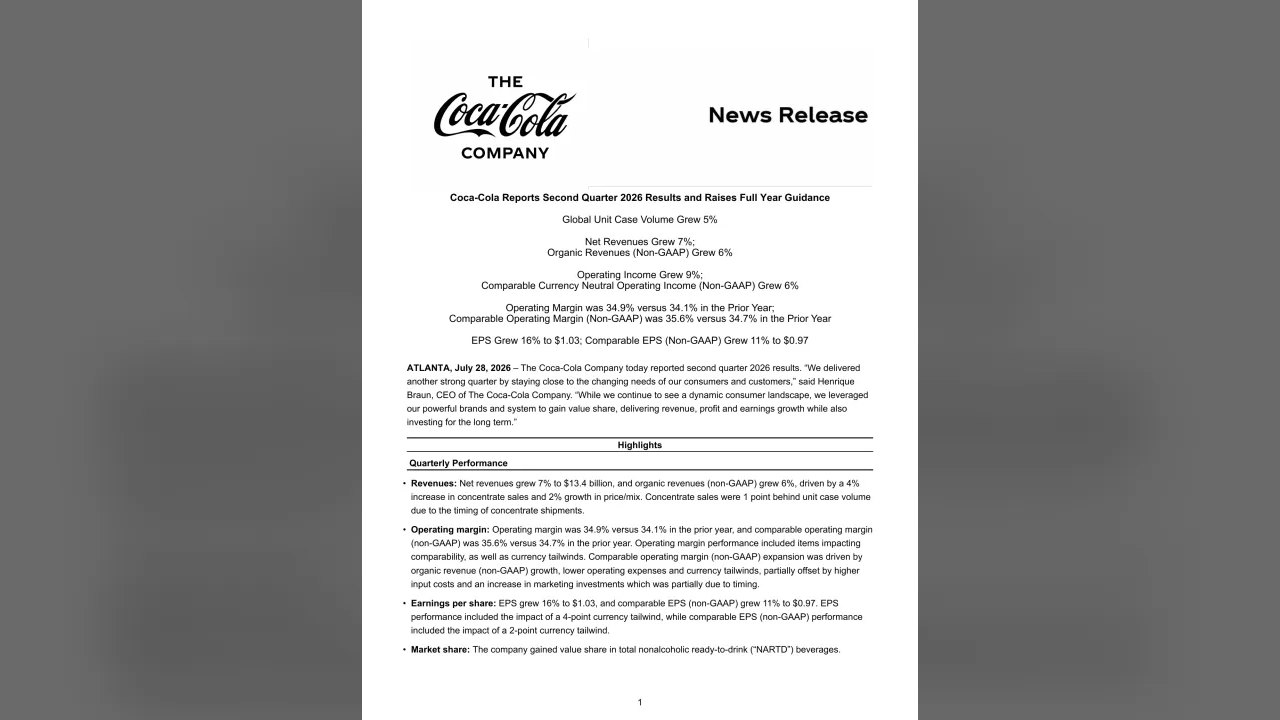
On 6ix: 6ix.com/event/coca-cola-company-the-ko-q2-2026-earnings-call
Automated transcript · Written by software from the replay's audio. It can mishear names and figures; the replay is the record.
0:01 At this time, I'd like to welcome everyone to the Coca-Cola Company's second 0.25 2026 earnings results conference call. Today's call is being recorded. If you have any objections, please disconnect at this time. All participants will be on listen-only mode until the formal question and answer portion of the call. I would like to remind everyone that the purpose of this conference is to talk with investors and therefore questions from the media will not be addressed. Media participants should contact Coca-Cola's Media Relations Department if they have any questions. I would now like to introduce Todd Beiger, Vice President and Head of Investor Relations. Mr. Beiger, you may now begin.
0:40 Good morning, and thank you for joining us. I'm here with Henrique Braun, our Chief executive officer, and John Murphy, our president and chief financial officer. We've posted schedules under financial information in the investor section of our company website. These reconcile certain non-GAAP financial measures that may be referred to this morning to results as reported under generally accepted accounting principles. You can also find schedules in the same section of our website that provide an analysis for our gross and operating margins. This call may contain forward-looking statements, including statements concerning long-term earnings objectives, which should be considered in conjunction with cautionary statements contained in our earnings release and the company's periodic SEC reports.
1:23 Following the prepared remarks, we will take your questions. Please zoom yourself to 1 question. Reenter the queue to ask follow-ups. Now, I'll turn the call over to Henrique. Thanks Todd and good morning everyone. We've had a strong first half of the year. Our results reinforce our 3 beliefs. We operate in a great industry, our beverages are well loved by consumers, and the strength of our system is unmatched. With the commitment and dedication of our Coca-Cola system partners around the world, I'm confident we are well positioned to deliver on our RAISE 2026 guidance. This morning I'll touch on our business performance and share our perspective on the global operating environment.
2:12 Then I'll discuss how we are executing against our 3 priorities to enhance our staying power and extend our strengths. John will end by discussing our financial results and provide further commentary on the outlook for the rest of the year. We delivered a strong quarter with broad-based momentum across our business. We grew volume 5% aided by cycling an easier prior year comparison, and we grew organic revenue at the high end of a long-term growth algorithm. Looking at the two-year average, we grew volume 2%, reflective of a more balanced contribution to the top-line growth.
2:59 This led to organic revenue growth at the high end of our long-term algorithm. We also expanded margins while continue to invest in our business, delivered double-digit earnings growth, and gained value share. Our results demonstrate key advantages. Number 1, the strength of our total beverage portfolio. Number 2, the power of our global yet local system. And 3, our ability to quickly adapt to changing consumer needs. Across much of the world, we see an uneven consumer environment. The economy is strong in many places, yet many consumers face inflationary pressures, geopolitical uncertainty, and economic challenges.
3:51 They are evaluating how they shop, what they value, and what they want to put in their basket. In markets like the U.S. And Europe, the consumer backdrop is stable in aggregate, but many remain under pressure. In China, sentiment remains cautious and spending continues to be selected. Across Latin America, the consumer sentiment is mixed, with improvements in Brazil and Central America, while consumers in other key markets remain under pressure. Across our more than 200 countries and territories, our mission is simple, ensuring our brands are valued, relevant, and worth choosing. To get us there, we are staying close to the consumer, adapting quickly, and doing a little bit better every day to earn every transaction.
4:45 In the second quarter, our FIFA World Cup integrated marketing campaign and the world-class activation brought consumers closer to the action, showed the power of our system at scale, and drove momentum across our business. In North America, while we benefited from cycling an easier prior year comparison, we delivered strong performance. We gained both value and volume share and grew revenue and profit for the quarter. Our dual approach with FIFA World Cup and America 250 gave us a unique platform to be part of a once in a lifetime celebrations in locally relevant ways across the country.
5:30 Harnessing our total beverage portfolio, we grew volume 3% by leveraging our growth flywheel. We had strong volume growth for many brands, including Trademark Coca-Cola, Fairlife, Powerade, Fresca, Gold Peak, Smart Water, and Simpli. During the quarter, newly relaunched Mr. Pibb grew volume more than 20%, demonstrating how we are using insights to innovate and stay relevant across need states and drink occasions. In Latin America, we gained both value and volume share, realized balanced top line growth and grew profit. We continue to navigate a difficult environment in Mexico, but we see improving conditions in Brazil.
6:21 Our system is taking targeted actions to strengthen the business and build momentum to capture growth opportunities. In EMEA, we gained value and volume share and grew unit case volume in each of the operating units. While we grew revenue, profit declined due to the phasing of investment. In Europe, favorable weather supported volume performance in many markets, while growth broadened across the region. In the region, the Middle East, geopolitical conflicts continue to disrupt the region. We are combining the power of our global scale with the flexibility to adapt to local needs. This led to value share gain and strong volume growth for trademark Coca-Cola, Fuse-T, and Sprite for the quarter.
7:15 In Africa, our system is highlighting localness and sharpening our revenue growth management capabilities to drive sustainable long-term growth. Lastly, in Asia Pacific, we grew volume across all operating units and nearly all beverage categories. Comparable operating income declined during the quarter primarily due to our focus on expanding our consumer base in all socioeconomic segments. While we are encouraged by the progress we've made, we recognize this is a journey. We are investing to bring more consumers into the franchise and build our business for the long term. For example, in China, we are using the strength of our total beverage portfolio.
8:03 And in India, we are taking our proven revenue growth management capabilities to meet consumer needs. Overall, growth was broad based across channels and consumption occasions, reflecting our ability to meet consumers with the right offerings at the right moment. To sum up our global view, we remain focused on our all weather strategy, building balanced quality top line growth while being locally agile and executing at pace in this dynamic economic environment. Earlier this year, I laid out our 3 priorities to deliver on our next chapter of growth. Becoming even more consumer-centric, remaining constructively discontented, and placing digital at the core of every connection.
8:57 First, on becoming more consumer-centric, The 2026 FIFA World Cup is a great example of how we are leveraging the 4 I's, insights, innovation, intimacy, and integration to build capability for the long term. We entered the tournament with a stronger foundation and greater system alignment, allowing us to bring the activation to life with more speed, precision, and scale. We started with deep insights, understanding fans, occasions, and how consumers want to engage throughout the tournament. We used innovation with connected packaging to make our brands more interactive. Through our long standing partnership with Panini, we distributed more than 1 billion players stickers across more than 40 markets, driving digital participation and engagement.
9:53 We've applied intimacy by tailoring activations to local consumers, market by market, team by team. We translated the tournament's momentum into powerful consumer experiences, placing Coca-Cola and Powerade at the heart of national pride and fan celebrations. We've brought it all together to integrate the execution across our system in over 180 markets in more than 20 million retail outlets. This execution delivered commercial impact, driving average incidents of over 80% at venues across 16 host cities, which is a record for us for a FIFA World Cup.
10:40 Throughout the tournament, we've collected more than 25 million first party data points and generated more than 9 billion views through digital and social media activations. These insights give us a stronger foundation to better understand consumers, tailor our decisions and improve how we show up in the marketplace. Activating around the FIFA World Cup contributed to trademark Coca-Cola volume growth of 5% for the quarter. It's the strongest volume growth in 17 years, excluding COVID recovery. Powerade also grew volume 8% globally during the quarter. Moving to remaining constructively discontented.
11:27 We are focused on driving more for more markets and more for more brands. This quarter's results show that we are making our brands more relevant to more consumers and making our $32 billion brands work harder for us.
11:43 For example, evening occasions remain a meaningful untapped opportunity. By redesigning Coca-Cola 0 0, we are better positioning the brand for this moment. Following strong initial success in Europe, we continue expanding the product to more markets globally. Combined with disciplined revenue growth management, strong execution, and world-class bottling partners, we are strengthening our ability to deliver more growth from our markets. As We continue to think about preparing the organization for the next chapter. We are putting great leaders in place, sharpening accountability, inspiring a culture of doing a little bit better every day. Finally, we are focused on elevating the role of digital across everything we do.
12:35 We are amplifying the things that we already do well with more agility and more scale. By focusing our resources on a selective set of consumer, customer and enterprise priorities, we can strengthen our competitive advantages and create more value across the system. In summary, I'm encouraged by the energy and ambition across Coca-Cola system. We are learning faster, acting with greater speed, and uncovering new opportunities to create value. Our priorities are helping us to create a stronger system today while building the foundation for our next chapter. With that, I'll turn the call over to John. Thank you, Enrique, and good morning, everyone.
13:21 Our second 0.25 and 1st half results demonstrate the strength and consistency of our business model. Given the uneven external environment, we continue to use the many levers available to us to drive long-term growth. For the quarter, organic revenue grew 6% and unit case volume grew 5%. The quarter benefited from several factors, including favorable weather in certain markets, strong global activation around the FIFA World Cup and cycling an easier prior year comparison. As Henrique mentioned on a two-year basis volume growth is 2% which is consistent with recent trends. Concentrate sales were 1 point behind unit case sales due to the timing of concentrate shipments.
14:12 Price mix grew 2%. This was driven by 3 points of pricing actions, partially offset by a point of unfavorable mix, primarily driven by investment timing, notably in Asia Pacific. Comparable gross margin increased approximately 120 basis points and comparable operating margin increased approximately 90 basis points. Both were driven by underlying expansion and currency tailwinds. Importantly, we expanded margins while continuing to invest behind our brand and executing revenue growth management strategies that provide consumers with the right package, brand and price point for their occasion. Putting it all together, second quarter comparable earnings per share of 97 cents increased 11%, which included a two-point benefit from currency tailwinds.
15:08 Free cash flow was approximately $6.9 billion, an increase versus the prior year. Our balance sheet remains strong with our net debt leverage of 1.4 times EBITDA, which is below our target range of 2 to 2.5 times. Given the momentum of our business and the strength of our balance sheet, we have increased flexibility and optionality to continue to both reinvest in our business and return capital to share owners. With respect to our ongoing dispute with the US Internal Revenue Service, we recently presented oral arguments before the 11th Circuit Court of Appeals. We appreciate the opportunity to present our position and now await the Court's decision.
15:55 Ultimately, our stance is unchanged. We will continue to vigorously defend our overall position and remain confident in our chances of prevailing on appeal. Let me now provide a brief update on Fairlife. The majority of production operations have resumed at our 4 facilities in the U.S. And retail availability has been largely unimpacted.
16:18 There was no impact to our second quarter results, nor do we anticipate any material impact to our results in the second half. As previously discussed, we anticipate our Webster facility to continue ramping up capacity through the remainder of the year. I want to recognize our Fairlife and Coca-Cola teams for their swift action and dedication. Now let me turn to guidance. While the external environment remains uncertain, our strong first half performance and business flexibility give us confidence in our updated outlook for the year.
16:55 Based on our year-to-date results and expectations for the balance of the year, including 6 fewer days in the fourth quarter, we expect to deliver at the high end of our prior revenue guidance with organic revenue growth of approximately 5%. We now expect comparable currency neutral earnings per share growth, excluding acquisitions and divestitures of 7 to 8%. We continue to monitor commodity volatility, but based on what we know today we continue to believe the overall impact of our cost baskets to be manageable. Divestitures are now expected to be a 2 to 3% headwind to comparable net revenues and an approximate 1% headwind to comparable earnings per share.
17:41 This assumes the pending sale of Coca-Cola Beverage Africa closes towards the end of the third quarter or during the fourth quarter subject to regulatory approvals. Based on current rates and our hedge positions, we now expect an approximate 1 point currency tailwind to comparable net revenues and continue to expect an approximate 3 point currency tailwind to comparable earnings per share for the full year 2026.
18:07 Our underlying effective tax rate for 2026 is still expected to be 19.9%. All in, we now expect comparable earnings per share growth of 9 to 10% versus $3 in 2025.
18:23 There are some considerations to keep in mind for the remainder of the year. We expect concentrate shipments to lag unit case volume by a point during the third quarter and now expect concentrate shipments to slightly trail unit case volume for the full year. We expect fourth quarter growth and operating margin to benefit from the refranchising of CCBA. Finally, as a reminder, due to a calendar shift, the fourth quarter will have 6 fewer days compared to the fourth quarter of 2025. To summarize, we are pleased with our strong first half performance. Our results demonstrate the effectiveness of our strategy and the advantages of our global system. We are focusing on staying close to our consumers and customers to create durable top-line growth and long-term value.
19:13 As a result, we remain confident in our ability to deliver our updated 2026 guidance and our longer-term financial objectives. With that, operator, we are ready to take questions. Thank you. Ladies and gentlemen, to ask a question, you'll need to press star 1 on your telephone. To withdraw your question, press star 1 again. In the interest of time, we ask that you please limit yourself to 1 question. If you have any additional questions, you may rejoin the queue.
19:42 Our first question comes from Lauren Lieberman from Barclays. Please go ahead. Your line is open. Great. Thanks so much. Good morning. Just, you know, after such a strong quarter and, you know, as you pointed out, it's, you know, the easiest comparison you have of the year. So I was just thinking as you look forward into the second half, how you're weighing the consumer environment globally into that outlook,
20:09 pockets of strength, pockets of weakness, and just curious to hear a little bit more on that consumer environment thought into the second half. Thanks. Okay. Lauren, great talking to you. Look, first of all, I think you saw on the numbers that we're delivering what we guided in the beginning of the year and having not only a great first half, a great quarter, but more importantly, how we got to the numbers and with the dynamic scenario that we have on a consumer basis, we delivered getting more formal markets, getting more from more brands and more categories. And we did that by getting closer to the consumer, right? Being really consumer-centric in a world that we're seeing, you know, a very uneven dynamic scenario these days.
21:04 The pressure actually on income, socioeconomic level, low income levels continues to be there across the globe. And we played our RGM toolkits to the fullest during this first half, and it's going to continue to be like that on the second half, addressing not only affordability, but pre-immunization in a way that we can continue to follow the consumer and to be closer to them. So we see the momentum that we built on those capabilities and the business moving into the second quarter. What changes is that on the second quarter, we're cycling a higher comp and 6 last days but
21:51 the momentum continues to be there and we're very happy to see the growth across every operating unit and pretty much about every category showing up during this first half of the year.
22:10 Our next question comes from Dara Mousonian from Morgan Stanley. Please go ahead, your line is open. Hi, I was just hoping to get an update on Fairlife. Short term it sounded like the existing productions returning to normal. You mentioned the incremental capacity at Webster. Can you just confirm is everything on track in terms of that incremental Webster capacity ramp up or has that been disrupted at all I know it's coming online but more the timing of it and then B if you can just discuss what the incremental capacity at Fair Life will enable you to do both from a retail availability standpoint are you looking at greater channel penetration, moving into new areas, is it more about availability within existing retailers?
23:00 And also just from a brand standpoint, are you looking at more flavors, packaging options, etc. What does it allow you to do from a brand standpoint? Thanks. Thanks, Zara. Look, let me start by with the results of the first quarter of our life that have been great. We grew 18%
23:22 and that was also something that we're planning in the beginning of the year with the ramp up of the Webster plant So the demand continues to be pretty strong and we were on par with what we had said as well that would be a year with increasing availability and continue to be strong moving forward. Related to the incidents, the business is back and running pretty much across
23:55 every line and plants that we have, and we did not have any impact on the supply on the consumer service during that period. So we continue to see our plan in line for the rest of the year and as we said as well the priority right now it's continue to have the main SKUs, the main offerings on shelf, right? Because the demand is still there. And the innovation will come as we have even more flexibility down the line. So that's the latest. We continue to be very excited with the brand. And as John said on the remarks in the beginning, we're also very pleased with the way our team and the ecosystem around it address the incidents in a very diligent way.
24:49 Our next question comes from Steve Powers from Deutsche Bank. Please go ahead, your line is open. Great, and good morning, everybody. Thank you. Enrique, I wanted to focus on Asia Pacific and India, if I could. You generated significant volume there as you expanded the consumer base, focused on affordability, revenue growth management, as you discussed. But at the same time, there was a bit more investment in price mix than we had expected to generate that volume, and you cited some value share losses in India. So if we step back, could you provide maybe a bit more context
25:21 on your approach to positioning for long-term growth in that region, where you stand today and what we should expect going forward as we monitor ongoing progress? Thank you. Sure, Steve. Look, it is also very consistent with our strategy. The region,
25:40 it's a long-term opportunity and continues to be very attractive to us. And we continue to build this for the future. Remember that we said in the past as well that this would be, you know, place that we're gonna continue to invest to have the curve, bringing more consumers to the base in the right way, dialing up our revenue growth management capabilities. And it's a place that we're seeing not only opportunities on the affordability part, where we are investing ahead of the curve, but also on the premiumization side as well. We do on in this specifically, 7 out of the top 10 brands today and building the equity of those brands is our primary goal.
26:33 And it's important that we continue to be focusing on where to build those capabilities to actually capture even more growth into the future. So that's the reason of that investment and behind it. But if I step back and talk about the PMO in the region, I want to unpack that and tell you exactly what it's composed of, the 9 points. 3 variables there. One was investment timing, a third of it. Another third was the affordability initiatives that are important for us to bring the
27:13 consumers to the base in the right way, as I was mentioning, investing on cold drink equipment and the right capabilities to execute these and gain more consumer engagement across that segment. And the other third, it's just the geo mix. Because when you have India and China outgrowing, for instance, other developed markets like Australia and Japan and Korea,
27:41 then you have that geomix impact in there. And we had a great volume growth not only in India but in China as well. Important to say as well that you need to step back and look at the overall global consolidation of the numbers. We said this would be a year that we would have a balanced growth on volume and price mix coming more in tandem. And that's exactly what we're seeing, right? And we should see that not only what we saw in the first half, but also in the second half of the year. And we think that APAC allows us to go and continue to build that region for the future with a right capabilities and the foundations that down the road we're going to be able to also capitalize like we did in markets that are a little bit more developed like in Latin America these days, okay?
28:49 Our next question comes from Chris Carey from Wells Fargo Securities. Please go ahead, your line is open. Hi, good morning, everybody. John, can you just refresh our expectations on potential implications of the tax case. Clearly, the Coca-Cola company sees itself
29:13 in a good position to make an argument for a favorable outcome. If that were not to happen, can you just give us a sense of the potential implications? And secondly, given that we seem to be getting closer to a potential resolution? Do you have any sense of timeline within a range of when we could expect the decision to then finally maybe just a refresh on how you would be thinking about capital allocation should you have a positive outcome. I know that's the topic we've covered, but given we seem to be getting a bit closer, I think it's important. Thank you.
30:00 Thanks, Chris. Maybe just a refresh for those listening on where we are with the tax case. We had oral arguments at the end of June and the timing of a decision from the appellate court is unknown at this stage. We have talked in the past about that being 6 to 12 months out and that's about the best I can offer at the moment. Not a whole lot more to add to what our current views are beyond what we argued. We continue to have confidence that we will ultimately prevail.
30:44 And then on best case, worst case outcomes, best case scenario is we win the case and we will have recourse to what we've already deposited with the IRS. The worst case is
31:06 we detail that in our financial disclosures. So at the moment, we've passed through a considerable milestone in June. We we await to see what happens and and and clear will provide more more context on that when when it arises. Chris, but thus far we're we're happy with where we are and look forward to the next milestone.
31:37 Our next question comes from Filippo Falorni from Citi. Please go ahead, your line is open. Hi, good morning everyone. Enrique, you talked about the FIFA World Cup being a very successful activation campaign, obviously big events, and you talked about being a contributor to the strong growth for Coca-Cola and Powerade. Can you help us understand how much uplift you saw from the event, and should we think that continued into Q3, given the gains, including the final, were in July?
32:15 Just any sense there? And then bigger picture or longer term, you talked about collecting a lot of first party data. Can you help us understand how that can help you for future marketing campaign to be as successful for other potential events in the future? Thank you. Sure, Filippo. Look, we
32:37 look at the FIFA World Cup execution this year as a clear representation of one of the principles that I have been saying that we are dining up on this next chapter of growth, which is it's really about being closer to the consumer under the 4 I's, which is getting the right insights, generating innovation that's linked to that, the intimacy market by market and the integrated plan that can dial up any of our activities and campaigns or events like the World Cup. And we leveraged this time to do a execution that was global at the scale,
33:26 you know, at the global level, but also generated, you know, market intimacy, different ways of connecting with consumers in the different markets in a way that was very unique. So the impact of that coming together brought us an opportunity to get, for instance, innovation that was scaled across the world with Panini, generating 1 billion stickers that was given away with consumers on our packages all over the world. That is a very unique and innovative way to engage with consumers in different markets. We also collected to your point, the first party data, 25 million new accretive first party data points that will help us to take the learnings from 1 campaign to the next.
34:25 And we bring those consumers experiences, you know, to new campaigns like Coke and Meals or Powerade Moments as well moving ahead in the second half of the year and that is something that we are going after Right being closer to the consumers engaging with them during the venue, but also taking that into new moments, you know, moving forward. When you talk about the overall result, it definitely helped us,
35:00 but it helped because we were ready for it. The system really showed up with the execution during the venues. If you had an opportunity to go like I did in many of these venues, we felt really good about the presence in there. We actually had the highest incidence of beverages in a World Cup ever. We got around 80%, which represents roughly close to 1 drink per attendee at the venues. And we also had a lot of work done during the anticipation for that event, as I was mentioning, with different packaging sizes and formats. So it's difficult to quantify what is the actual impact overall, but the most important thing is how we engage with the consumers and we can bring them along to other campaigns moving forward.
35:57 Our next question comes from Rob Ottenstein from Evercore Partners. Please go ahead, your line is open. Great, Thank you very much. I was wondering if you could give us any kind of insights into the Marriott contract, which you won after 34 years. Maybe what, you know, you, what made this win possible in your view? My understanding is that the coordination with Monster was perhaps the first time you guys have worked together, maybe elaborate a little bit on that, the timing of the transition, and to what extent it may help your volume. Thank you very much.
36:46 Yeah, thank you, Robert. Look, we're very happy to have, you know, Merrick back. As I said in one of the interactions before, I think in the past we lost that right to be with them for not being consumer and customer centric and we earn it back because we are consumer and customer centric like never before and We cheer a new partner as much as we also cheer the current ones that have been with us all these years. And it's great to actually have an accreted partner that wasn't there with us and we believe that our team really showed that the ability to work together with them and bring everything that we're doing all over the world through the powerful brands that we have, the value that we create with our customers today in a very unique way per customer.
37:53 And one thing that we're getting a lot better lately, it's exactly about bringing the complexity of being a global enterprise with more precision and more personalization with our customers and our consumers daily. And that's why we believe that with them and with the other customers, we are gonna continue to amplify that opportunity. And we want to continue to extend these, particularly by customer on what are the best experiences that our brands together with their brands can generate the right experiences and opportunities to engage with their guests moving forward. So that's the overall plan. To your point about bringing Monster and others along, we always go and work with our customers in a way that we want to have our entire portfolio with them. We want it all.
39:00 And that's always how we approach it. And sometimes it takes time to get to the overall portfolio. Others, there'll be different parts of the system or the country being a global business that you're gonna have to try and learn from. But here, what we did was being part of our overall portfolio and our partners on energy. It was something that was extended also as a full opportunity for us to work together with them. So, very excited with that, but more excited about what I said, that we see the system, the bottlers in us, very well focused on being consumer and customer-centric like never before.
39:51 Our next question comes from Peter Galbo from Bank of America. Please go ahead, your line is open. Hey, good morning guys. Thanks for taking the question. John, I wanted to pivot the conversation actually to the operating margin performance. Not only in the quarter, I think it may have been a record not only for 2Q, but maybe all time for Coke. So, certainly impressive. But just, you're going to get some structural benefit as CCBA kind of moves out, but how do you think about just the opportunity to continue to push the underlying kind of operating margins going forward? Again, you've established, I think, a pattern here of consistently putting up, you know, better margin numbers every quarter. So just how should we think about that, not only for the back half, but maybe over the next 12 to 18 months from here? Thanks very much.
40:44 Yeah, thanks for the question. It's a topic, you know, we've discussed in a number of previous calls. Big area focus. It's implicit in the long-term algorithm. We believe, and we've demonstrated I think in the last few years, that we have the levers to continue to expand the implied margin in the algorithm. In recent years, we've had a couple of primary drivers in our favor and some that have been headwinds. The structural changes In our overall model becoming more asset life as you know been a been one of the primary drivers and then both the quality I would argue the quality of our top line.
41:43 The resilience and adaptability of our supply chain and our ongoing willingness to invest ahead of the curve make a potent combination to be in a position to have confidence in the underlying margin agenda. And that's something that we are focused on. We will continue to be so in the second half of the year and for a long time to come. We've had a headwind as you know on the foreign exchange front for a number of years. And thankfully, this year it has been it has turned into a tailwind. So we have a little bit of a benefit in that in the 0.25 year to date and for the full year.
42:31 But for the you know, for the the the the quarter ahead, I think the primary area to judge us on is our ability to continue to drive a quality top line, and from there then to manage our both our cost base and our investment base to sustain that over time. And when that happens, the implied margin in our algorithm will come to fruition. Our next question comes from Peter Grom from UBS. Please go ahead. Your line is open. Great. Thank you. Good morning, everyone. So I was just hoping to get some perspective on the U.S. North America had another quarter of really strong organic sales growth. And obviously a lot of volatility in the quarter itself.
43:23 And you mentioned the consumer is broadly stable, but could you provide more detail on just what you're seeing from a consumer and channel perspective? Did you see any notable shifts in behavior as you progressed through the quarter itself? And maybe more importantly, how do you see that evolving from here? Thanks. Sure, Peter. Look, What we have been seeing is that the consumer continues to participate pretty well on our industry and the growth represents that, so we were able to capture that. It's important also to remember that we're cycling an EASER comp from last year. So I think on the run rate, you know, for North America, we're very pleased that actually how we got to these results, which is really growing pretty much every category in here, but it's also important to remember the cycling from last year. On the consumer front, what we're saying is while they remain participating on the industry, the lower income continues to be pressured And we've seen that it's really about value, not only pricing.
44:39 And I think one of the great things that we did in North America here to connect with the consumer was to make sure that our brands were valued, relevant, and at the end of the day, worth choosing by them in the different channels. And we made it easier for the consumer to actually go there and get that worth choosing happening because we either had around brands that were doing well, different packaging formats that allowed them to have entry prices at the right level. So a great example of that is you got mini cans on motorpacks in the retail stores that are more positioned to convenience and to premium.
45:30 And then when you go into, that's on the retail, and then when you go into the convenience store, you have the mini cans sold as a single at the lowest entry price. So That allows you to play the RGM capabilities really well. Another great activity that we have done during the quarter was to bring innovation to life as part of the overall connectivity with consumers. Mr. Peeb, as you saw, grew 20%. And it's another example of us bringing the 4 I's to life. There was a clear insight that brought the innovation of that brand to come back with a proposition that would have a higher caffeine content and then a more bold cherry flavor.
46:29 And with that, we're able to get these results that are really encouraging for us. Another interesting one is that the exportation of ideas and innovations from the U.S. To the world, which is a sprite in tea that was an innovation that helped us also to get momentum on the Sprite, and now it's exported to Asia. So in a nutshell, we believe that the consumers continue to participate. It's about value, not only pricing. And the way we're positioning our brands and engagement with the consumer here in North America, we believe that we're gonna continue to have the right momentum moving forward into the second half as well.
47:19 Our next question comes from Andrea Teixeira from JP Morgan. Please go ahead, your line is open. Thank you, good morning. I was hoping if you can talk about the momentum for the quarter as you exit. And also thinking, I understand it's hard to quantify the FIFA effect, but I understand that a lot of the consumption occasions, and you mentioned, Henrique, the 80% was a record on the venues that people would drink. But not only that, as you do the viewing parties and what happens with consumption away from home, vis-a-vis at home, and how we should be thinking as we progress the second half, if there is any dislocation we should be aware of in terms of mix or how we should think about worldwide as consumers also have to go through a higher oil price and at the pump. Thank you.
48:19 OK. And I could talk into. On the volume growth itself right on the quarter. You know, first of all, we were very pleased to see that it's, you know, one of the strongest ones in the last few years. And that gives us the confidence that everything that we said in the beginning of the year, that this would be a year that would be more balanced on volume and price mix, it's actually happening in the right way. The other point connected to what you're saying on how the consumers are reacting, you know, all over the world these days on not only perception and also disposable income for the industry.
49:11 We are showing up in the right way, giving them the options on affordability and premiumization. And that was translated as well in the first half. And we believe that we're gonna continue to have that being addressed in the second half. It's also important to always remember that while we have this strong volume, the run rate for the last 2 years is 2%, which if you go back to 2017 up to here, it's more or less in line with where we were. But most important thing is that we're getting more for more markets and more for more categories and then the degrees of freedom to get to that algorithm are amplified.
49:56 And that was something that deliberately we wanted to have in there. The World Cup, It's 1 factor into that. But it's not the sole impact of everything that you know is describing as the most important. You know underlying capabilities that drove these performances, so it really focused on durable and balanced top line growth, and that's our focus. Our next question comes from Kamil Gajarwala from Jefferies. Please go ahead, your line is open. Hey everybody, good morning. I wanna follow up, Henrique, on what you just mentioned, looking at a decade of revenue growth. And I think you said the degree of contributors to hitting that algorithm give us a lot more freedom or something sort of along those lines.
50:53 Given what we've observed, not just this quarter, but it's sort of building over the last couple of quarters and in terms of the evolution of the portfolio, whether it's getting rid of zombies or whether it's the contribution from some new things and the core, is it fair to say you should be towards the high end of that on at a base level, as opposed to sort of looking at the same range of what the last decade has been about. So, Camil, just trying to see if I got the last part of the question right to say about delivering, if it's more about the high end, you know, okay, got it.
51:40 Look, what we're seeing and I was mentioning is The fact that we're getting the results with more, from more markets and more for more categories, it allows us to have a better degrees of freedom. That's how I used and pause for my engineering background here. But that allows us to have better control of how we deliver that durable long-term algorithm. And that's exactly what we're going after, right? To the point that we make it about the volume, it you shouldn't look at 0.25 only. It's always better to step out and to look at the whole year And we said that this would be a year that if we did everything right, we would see volume and price mix more intended. And that's exactly what we're seeing. So on the first half, because of the extra 6 days, And we have some of the events like the World Cup, the weather that also helped us. And we captured that because we were ready for it, you know, made that first half a building, a momentum that we're gonna transfer into the second half with the learnings to
53:10 continue to take advantage of our campaigns and our plans for the second half, but it's 0.5 that has 6 less days as we plan. So, all aligned with what we said at the beginning of the year, excited with the volume growth, but there is way better opportunities to continue to get more from more markets and more from more brands moving forward. Let me just let me just add 1 one additional piece. Just keep in mind the long-term algorithm is a long-term algorithm. And it's rooted in, first of all, what the industry typically grows by.
53:55 And if you go back 30 years, there's been a handful of anomalous years, but it typically is in the 3 to 4 range. And that's one key consideration to think about longer term. And then the second one is, as we have worked hard over many, many years now, is to continue to build a differential set of capabilities to win more than our fair share of that growth. And so that lands you in a range which is what our long-term algo says, 4 to 6%. And the ambition clearly is to be at the higher end of that on a sustained basis. Our last question today will come from Bonnie Herzog from Goldman Sachs. Please go ahead, your line is open.
54:48 All right, Thank you. Good morning, everyone. I just had a quick question on your updated guidance, which does now imply more bottom line leverage for the year. So you may be just hoping to understand the drivers of this and should we assume less spending in the second half versus the first half? And then, you know, if you could just touch on your strategy around advertising spend and how that may be evolving, given the strength you're seeing in your business and certainly the changes we're seeing with the consumer. Thank you. Thanks, Bonnie. On the last piece, there's no significant change in strategy with regard to investing to support our brand portfolio and to stay close to the consumer.
55:34 As we've seen many times, what happens during 0.25 is not necessarily reflective of the investments that take place in a quarter, But over the long haul, we're committed to continuing to invest ahead of the curve. That may mean 0.25 to 0.25 higher levels than gross margin. Sometimes it'll be lower levels, number 1. Number 2, 1 of the areas that we are very focused on is the quality of the investments and leveraging an increasing set of new capabilities supported by AI and digital to be able to do so. So I think rather than just focus on the quantity of investment, we're very keen for that to deliver a higher return through better quality allocation across the marketing mix.
56:41 With regard to guidance for the rest of the year, we have this year, we have some benefits on below the line, which we're reflecting in that guidance. And we look forward to delivering that in the second half. Ladies and gentlemen, this concludes our question and answer session. I would now like to turn the call back over to Henrique Braun for any closing remarks. To close us out, we are really encouraged by our business results and are really confident that we have many levers to deliver on our objectives in 2026 and over the long term. Our performance is driven by our team across the Coca-Cola system who continue to demonstrate hard work and commitment every day. I want to thank you for your interest, for your investment in our company, and for joining us this morning. Thank you.
57:43 Ladies and gentlemen, this concludes today's conference call. Thank you for participating. You may now disconnect.
Follow Coca-Cola Company into a list and get an email when it puts out news.
Vice President and Head of Investor Relations
Chief Executive Officer
President and Chief Financial Officer
Analyst, Morgan Stanley
Analyst, Deutsche Bank
Analyst, Wells Fargo Securities
Analyst, Citi
Analyst, Evercore Partners
Analyst, Bank of America
Analyst, UBS
Analyst, JP Morgan
Analyst, Jefferies
Analyst, Goldman Sachs