Replay available
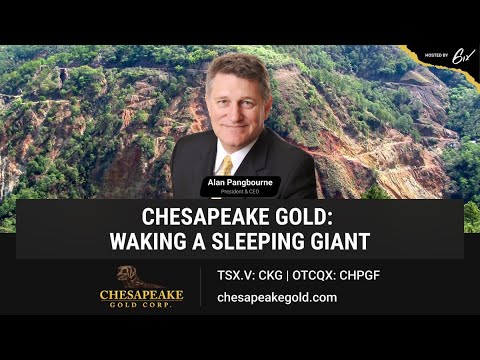
Chesapeake Gold: Waking a Sleeping Giant
Join us for a great event!
- Company
- Chesapeake Gold Corp. (TSXV:CKG)
- Date
- Wed, Dec 14, 2022, 11:00 AM ET
- Replay
- Watch the replay on this page · 37 min
On 6ix: 6ix.com/event/chesapeake-gold-waking-a-sleeping-giant
Replay
Transcript
Automated transcript · Written by software from the replay's audio. It can mishear names and figures; the replay is the record.
0:08 Hello everyone and welcome to Chesapeake Gold's live summit today. I'm pleased to introduce their president and CEO, Alan Pangborn. Alan's going to be walking us through a company presentation and after we're going to be entering into a Q&A session. As a reminder to everyone in the audience, if you have any questions for Alan, please feel free to submit them in the Q&A chat on the right-hand side of your screen at any time during today's summit. As always, this event is being recorded, so it'll be available on six.com in the coming days. So look out for that. Without further ado, Alan, I wanna hand things off to you so that you can get started. Thanks Cam. And good morning or good afternoon, everybody. My name's Alan Pangborn, I'm CEO of Chesapeake Gold and have been so since almost 2 years now. I'm a metallurgist by profession and today I'll be walking through our corporate presentation and as Cam said at the end, this will take me about 20, 25 minutes, and then we'll have time for questions and answers.
1:07 To start off, please note, I will be making forward-looking statements, and these 2 slides carry the usual disclaimers related to those issues. To start off, I think firstly, I'd like to remind people that this is not the project you may or may not have heard of before, which was a large open pit mine, low grade, all the Clay project. When we joined the company, we came with a technology that we believe will change the industry. And specifically in the case of Chesapeake, will allow us to take advantage of what is a massive resource, but treat it in a different way with a smaller starter project that is financeable, deliverable, and then expandable by Chesapeake Gold without necessarily bringing in a larger partner to fund the project.
2:04 And so this slide just compares the previous 2016 Pre-Feasibility Study that was issued back in 2016 to what the PEA showed that we put out in August last year. So moving forward, just to give you some idea, the Matatus project is one of the largest undeveloped gold silver deposits, certainly in the Americas, if not in the world, is over 1 billion tons of resource that contains over 20 million ounces of gold and 550 million ounces of silver. That's about 28 million ounces of gold silver equivalent. Initially for our project, we're targeting the higher grade massive intrusive for the heat bleach.
2:54 And that there's about 166 million tonnes of 0.76 grams per tonne gold and 15 to 16 grams a tonne silver, which is about a 1 gram equivalent, which if it was all oxide, it would have already been mined and processed. With the technology, we know we have a much lower capital and processing costs with the heap leach, which gives us a much better project as far as return on capital. So, what have we done over the last 18 months? So initially, one of the first things we did was drill 5 holes into the main intrusive core to get material for metallurgical test work. That material was then shipped up to Vancouver and testing has been ongoing since.
3:41 However, one of the interesting things was those first 5 holes showed about an 18% improvement in grade, which surprises and it's a nice surprise to have. We got some additional funds approved by the Board and we drilled another 18 holes and we expect to put out an updated resource before PDAC next year. Those additional 18 holes also showed an improvement in grade. So we're expecting to see some improvement to the resource grades, particularly in the intrusive area once we finish the work and understanding why it's coming back at higher grade. Additionally, we also put on a 1 column with some material, intrusive material that was available from previous test work.
4:32 And this slide shows the column from when we put it on in the 18th of May. As you can see, it's quite a gray color when it started. And over the next 3 to 6 months, you can see how it changed color from gray to brown. That brown is an indication of iron oxides being formed and the sulfides oxidizing. So that's obviously very encouraging. And in August this year, we released the metallurgical test work results that go with that to support what we refer to now as our proof of concept, that that whole concept of being able to oxidise sulphides in a heat bleach environment and then recover gold and silver currently looks like it's working as expected.
5:21 So moving on to the results, as you can see in these 2 graphs, we oxidised that first column for 128 days and we got about 30% sulphur oxidation. Once we'd oxidised it, we then put it into another column and we leached it for gold and silver using cyanide. So a conventional, what would be an oxide heat bleach. And with that, we recovered 60% of the gold and over 50% of the silver. That's not quite what we were targeting in the PEA of 70 to 75, but we're getting close and we're now working on phase 2 of the metallurgical test work, which is which parameters will change what to allow us to get up to that 70 to 75% recovery.
6:11 And that work is ongoing at the moment. So why will this work? Basically we are copying a process that has been used in the copper industry for over 30 years. And step by step, this slide shows a comparison between what they currently do in the copper industry and what we plan to do in the gold industry. The difference, the only difference is the chemistry. So the copper industry runs an acidic system. They crush it to half an inch, they mix it in an ablomerating drum with their sulfuric acid and any other reagents. They put it on a single lift on off pad that eliminates solution mixing and crossover issues and you can stop the process when you want to. Forced air injection underneath to maintain oxygen levels, because obviously if you want to oxidize sulfides, you need oxygen.
7:11 And in the copper process, we achieve 80% oxidation and 80% recovery of the chalcocite and cobalite and the pyrite oxidizers as well. As you can see on the right hand side, we're doing exactly the same thing in the gold process. The difference is that we're doing it in an alkali environment. So the PEA, we put out the PEA in August last year, based on some assumptions around what the recoveries would get to, which was the 70 to 75% value I talked about. The estimated capital is $360 million instead of 3.5 billion, which was the previous POX project.
7:58 Head grades are very similar to what I mentioned earlier. As I said, we assumed a 70 to 75% recovery for gold and silver. That gave us a 31-year mine life solely on the intrusive ore body. So there's still all the rest of the material that we can expand and treat at a later date. Based on that, we had a production of 112,000 ounces a year of gold and 2.5 million ounces a year of silver. Or if you like to look at it as gold, silver, gold equivalents, it's almost 150,000 ounces a year for the first 15 years of operations, with cash costs of $680 an ounce and all in sustaining costs just under $750 an ounce.
8:46 The economics on that gave us an NPV of 1.4 billion Canadian with a 35% rate of return and a payback in 2.5 years. So I think that's a sufficiently attractive project to justify continuing with the concept, continuing with the test work and continuing with the development of the project along this sulphide oxidation process. In addition to that, it comes with some very interesting and favourable environmental impacts. If you compare it to the pressure oxidation process, and the graphs below came from Barrett Gold's sustainability report, you can clearly see that It uses significantly less water, significantly less power and there's no tailings dam.
9:37 Those 3 are really important when you're talking to the local communities, especially water and tailings dam. Given the number of tailings dam failures recently, obviously nobody wants to live near a tailings dam. And anything that uses less water is obviously more welcome, given that water is one of the biggest issues that's discussed with the local communities, particularly when they're agricultural communities, because their concern is availability of water and then also potential contamination. So using less water and less power is favourable, Both from a cost point of view, but also a community and environmental point of view. And last couple of slides.
10:25 This is the typical, we're cheap. As you can see, this is based on ounces per common share compared to a lot of our competitors, significantly more ounces per share if you buy a share of Chesapeake Gold. And if you look at it on a dollar per ounce basis, As a base case, ounces in the ground, if that's the type of investment you're looking for with leverage to the gold price, we're probably one of the cheapest around, the largest leverage to gold price. So in summary, we are one of the largest undeveloped Gold deposits in the world. 20 million ounces of Gold, 560 million ounces of Silver.
11:12 The drilling has confirmed that there is actually a high-grade core and we'll get the results to that upgrade on the resource before PDAC next year. The technology allows us to lower the capital costs significantly, reduce the environmental footprint and produce a greener version of gold from refractory ore bodies. Additional to that, this technology, once it's proven, will change the way we look at the gold industry and refractory ore bodies. It did in the copper industry. I saw one of the very early ones back in 1990 in Chile. I actually built one of the largest ones that was ever built in, also in Chile in 2004.
12:02 That was the Spence project. Today, the copper industry produces around 4 million tons of copper a year using the same sulfide oxidation process in a heap leach. So We're extremely confident that we can get this to work effectively in the gold industry as well, because we're both oxidizing pyrite. 1 because it happens to come along in our process, because we want to oxidize the pyrite to get the gold and silver. The PEA demonstrated a financeable, deliverable, and then expandable project. Phase 1 is a robust project to continue development. We don't need to bring a partner in to help us. We believe that we'll be able to fund that.
12:48 We're in a decent jurisdiction in Durango. I've recently had meetings with the local AHIDO to start talking about exploitation agreements, which is a precursor for the environmental impact statement. And I met the recently elected provincial government who will be the ones that we will talk to as we move through the environmental approval process. Currently we've got just under $30 million in the Treasury. To give you an idea, we had $35 million at the beginning of January 2021. So over what is now 21 months, we've spent $5.5 million.
13:34 So very low burn rate. As far as shareholders go, Eric Sprott is a significant shareholder with over 13% of the company. Sutton Valley has about 11. I own about 7.5 million shares, which is about 11 as well. And we traded a significant discount. So that's really the presentation. I got through that way faster than normal, but happy to take any questions that people would like to ask. Absolutely, Alan, and thank you for the great presentation. And we already have a bunch of questions in the Q&A chat, but just as a reminder to everyone in the audience that didn't hear it the first time, if you'd like to ask a question, please do so in the Q&A chat from the right hand side of your screen as opposed to the public chat.
14:25 First question, I won't identify who's asking the questions because some people don't want to be identified. But the first question is how confident are you to hit the 70 to 75% recovery? As I think I mentioned, we got to 60 and 50, which is a significant improvement over the non-oxidised material that only gives us about 30 and 15. So we're a lot closer at 60 and 50. We've got columns running at the moment. We're doing smaller crush. We're doing different air and reagent strengths and air rates to the oxidation. We monitor the oxygen levels.
15:11 If I go back to this slide, As you can see, that oxidation line is still straight. We haven't seen any of them curve over yet, which is typically what would happen. So we're relatively confident that we will be able to get to 70 to 75% gold silver recovery if we can get that oxidation a little bit higher. And so that's what we're working on at the moment. So I hope that answers the question. Next question, What are the next developments for Chesapeake in the next 12 months to support what is now a 20-year low in the share price? Really the 2 key things coming up in the next 12 months, The first one will be the upgraded resource statement, which we expect to get out by February.
16:12 That will incorporate all of the 23 additional drill holes that we did, particularly into the intrusive. So obviously, we are hoping to see an increase in that grade of that material, which is where they start. And that will obviously flow through into a PEA or PFS when we get to that stage. We're currently doing a lot of the work prior to a PFS that you need to do. So we've restarted all of the environmental monitoring. So we've got continuous data, updated all of the topo over a wider area so as we can sort out where the access road is going to come from. We're talking to the power suppliers to ensure we understand where the power will come from.
17:01 Water is another one. We need to do all of that before we put a environmental impact statement in, because as I know from previous experience in Mexico, if you don't have a clear exploitation agreement, you don't have water and power sorted out, you won't even get past first base with your environmental impact statement. So that work's going on in the background. And then finally, the results to the next phase of test work that's currently running we should have out before the end of the year. Again, typically I like to get those out before Beaver Creek which is September, just because it's a great forum to be able to talk to investors directly one-on-one and walk them through where we're at.
17:53 What's preventing increase and stock price and interest so far? That is a great question. If anybody can tell me the answer to that one, I will certainly listen. You know, we've recently started with 6. They have had some great references from other people I know in the industry. We're getting out there and pounding the pavement to meet with more investors. I think part of the issue is it's wait and see, will the technology work? I would suggest that our base case or our downside case is it's still an amazing investment if you believe the gold price is going to move up, which it has been doing.
18:48 So it's really getting the story out there and people understanding that the new technology completely changes the economics of this project. And as I mentioned before, 90% less capital, 90% less water, 90% less power and no tailings dam is a dramatic change. Next question, will Chesapeake still planning to build the de-sal plant? If so, how can we leave it up? No, the de-sal plant goes. That was in the previous project. There won't be a second site down the bottom. Everything is all at site.
19:36 So the mine, the heat bleach, the waste dumps, power will be brought to site. Water will come from a stream nearby. We've already checked there is water available in that catchment, so we can get some water rights and move them up the catchment. So the previous project had a, I don't know how many megawatt power station, that's gone. De-sal plant, that's gone. Tailings dams, obviously gone. Pipeline all the way down to Sinaloa is gone. Starting smaller obviously has an impact on all the capital costs. So there are lots of things that have changed from the previous project that impact the economics, the ability to permit it, as I've mentioned before.
20:36 Why has this recovery approach not been used in the gold and the single fur industry before? How can I say this without being rude? Unfortunately, the mining industry does not exist as a mining industry where we all know what everybody else is doing in other areas of the same industry. And what I mean by that is the copper industry started oxidizing sulfides in a heat bleach environment 30 years ago, and they're even doing it in Arizona, yet for some reason the Nevadans can't seem to cross the border and go and see what they're doing. There are lots of other examples like that. The nickel industry has just started heat bleaching oxides, yet gold and copper and uranium have been heat bleaching oxides for decades and decades.
21:36 So it's partly it's that the industry is very conservative, takes a long time for people to get to a point where they try something. Usually necessity is the reason they go there. And so it's really that. So the physics of how to do it is identical to the copper industry. The chemistry of alkali oxidation of pyrite, you can find literature that is at least 15, 20 years old. It's just nobody seems to have taken that leap of faith and put 1 plus 1 and tried to do this.
22:24 So I'll see if I hope that answers that one. What would the silver extraction percentage in order to get a go on the project? So the PEA targets 70 to 75. The silver economic benefit is about a third of the revenue. So, if the increase in gold went up by 0.1 grams per ton, yeah, which is a 10%, 15% increase, That more than outweighs the silver. From a metal production point of view, it's a silver mine more than a gold mine, because 2 and 1 500,000 ounces of silver and 100 and whatever it was, 100 and 1,200,115,000 ounces of gold.
23:21 As you can see from those ratios, it's 95% silver and 5% gold. From a value point of view, it's closer to 70-30. If the silver recovery stayed at 50 instead of 70, it's not that bigger impact on the economics. In some ways, if I get the grade to go up and the recoveries only stay at the proof of concept column, you get about the same economics as the PDA shows. So that's still a go up. Yeah, I think a 35% project for $400 million is a great project. So, yeah.
24:15 So next one. Sorry, I just lost my spot. It seems the new oxidation process is not yet accepted or believed by the market. Yes, I don't disagree with that statement. I think it's get out there, keep pushing it and see where we can get to with the market. I think as we produce more results, get the next round of results out, get the increasing grade out and just keep sitting down with investors and explaining why this will work. You can Google most of what we're doing. You can certainly Google what the copper industry does and how they've advanced over the last 30 plus years.
25:09 It's we just need to do the work. If successful, how do you see the growth and potential for Chesapeake over the next 5 to 10 years? I like this guy. So the whole concept with Oldley Gold that merged with Chesapeake was to get a project that was preferably listed and then use that as the vehicle to prove up the technology. And then there'll be a point in time where management understands this way better than what is in the public domain, because there's obviously a lag between what we know now and what's necessarily out in the public domain.
26:05 And there are multiple other projects around that have a similar issue. Most of them are smaller. I mean, Matatus is just huge. But you can sit there and see a M&A track and or a licensing, sub-license, royalty stream where Have we got a solution for you to solve your refractory gold sulfide problem? And either, as I mentioned, license technology down to them and help them technically, or even sit there and look at doing a M&A transaction where we bring those additional projects maybe in other jurisdictions into the Chesapeake portfolio and grow the company to have multiple projects.
27:01 Having lived through the development of SSR and being a single mine producer and moving to a 3 mines in 3 different jurisdictions, I can tell you, boring is good. 3 different jurisdictions is good. 3 different operations is good. It's a lot easier to ensure that you meet guidance both from costs and production because you can balance out the pluses and minuses across the sites. It's certainly somewhere I would rather be than a single mine producer. So that's where we would go going forward. 5 to 10 years from now, I expect us to be a multi-mine producer, quite simply, using this technology.
27:53 Next question, is Biomajor still potentially likely? You never know who's looking for you. Right, you never know who's looking at you until they show up. Again, if I look back at my previous experience when I was with Guyana Goldfields, we didn't know that there would be 4 bidders. We didn't know that we would get into a bidding war. This technology, Again, as we get further and further closer to proving it up, the majors have to be interested.
28:40 They just have to be, because they are sitting on some massive resources, some of which are currently waste dumps, that this could apply to. So never say never, but at the moment, don't know. The flip side to that is when management and 2 major shareholders control 40%, we can control the process. So the one thing I'm sure is they're not going to get as cheap if they do try. So, let's see what happens. Who knows? If technology works, other companies will use it, will this decrease the attractiveness of Chesapeake?
29:39 It's protected by patents or patent pending at the moment, but there is patent protection As we develop more and more around it, we'll add to those patents. And so people can try, but it is patent protected. The majors won't try and go around you. Some of the smaller guys may try and copy it. The thing about technology and patents, patents tell you what the operating window is, sort of. They don't tell you what doesn't work or what some of the tricks are to make it work. And that isn't public, that's IP and go your heart out. I'm at least 2 to 5 years in front of anybody else.
30:32 So I don't think it reduces our attractiveness. And we've got a massive deposit. When does development project? The timeline to production, which I think is what you're asking. The next step is continue with the test work support for most of 2023. Assuming that's positive, that would then give me the information to be able to do a PFS late 23, 24. The PFS will give me the support for the environmental impact statement.
31:25 That in conjunction with the things I mentioned earlier will get us into the permitting process. You tell me how long that takes. It's supposed to take about a year. Whilst we're in the permitting process, we'll be doing additional test work and produce a PFS in late 2024, 2025. That's what we would use for financing. So 2026 would be built. 2025, 2026 would be built. Next question, what value do you place on potential for zinc production? Currently 0. The zinc doesn't show up in solution, that we do know.
32:16 So if it is oxidizing, it's in there as a solid. The only way you can get a oxidized zinc solid out is to go acidic. You don't want to do that because it creates other problems for gold and silver. So currently there is no related zinc production, unfortunately. Next question, if the heap leach works as a pioneer in the golds area, will Chesapeake obtain royalty for outcome? I think I've answered that one. That's certainly 1 route that we can go down, is to sub-license it to others, yeah, or acquire other deposits.
33:09 Next question, Alan, great progress in your estimation. By what time you will be overwhelmingly confident your heat bleach oxidation methodology will work for the project. Hopefully by the end of this next round of test work, once I understand which levers do what, So how much does the rate change by crushing finer? How much does the rate change by increasing or decreasing pH? It's a little perverse with what we're doing at the moment because I know what doesn't work sooner than I know what works. And to give you an idea what I mean by that, again, if you look at this slide that's up on the oxidation slide, now let's see if I can remember how to draw.
34:03 If I have a line that starts coming like that, that's obviously not what I want. And I can stop probably somewhere after 40 or 60 days, there's no point keeping running it. If I start getting a line that's going this way, I need to let it keep going to determine whether it does that or whether it keeps going like that. I hope that makes sense to people because I need to get it to go up here before I start the cyanide oxidation because what I'm looking for is to increase that, up that way. The more I can oxidize it in a shorter period of time, the more chance that all of these curves, even though they curve over like they do there, They'll do the same thing, but up here.
35:05 Okay? So that's what we're looking for. Yeah? So I hope that answers the questions, and I believe Cam, tell me if this is correct or not, but that's the end of the questions that I've got that I can see. Wonderful, awesome. Well, Alan, I wanna thank you, and I wanna of course thank everyone in the audience for joining us today and asking these great questions. It was a great Q&A. Thanks for filling in through those technical difficulties there. Alan, you did an amazing job as moderator. Don't know why I'm here. But with that, everyone, I just wanna pass things back to you, Alan, before we wrap up for any closing remarks, and then we will be closing out. Okay, well, firstly, thank you everybody for coming online today. I agree with Cam, it's great to see some interesting questions.
35:57 You know I'm looking forward to getting that resource update out and then also some more metallurgical test work results. If any of you want any more information, drop me an email, drop an email into ir, I think it's ir at chesapeake.com. Have a look on the website, there is a larger presentation, This 1 was shortened up because I was told I had 20 minutes. And so, you know, there is a larger presentation on the website. Some of you, I do know, I recognize some of the names. All that happy to have a chat with you anytime you like. And for those of you who are currently shareholders, thank you very much. And I hope you continue to hold.
36:45 Those of you that want to become shareholders, love to see you on the share register. So with that, thank you everybody. And don't forget, 90% less capital, 90% less power, 90% less water, no tailings dam. This is disruptive to the industry. Thank you, everyone. Well, thank you, Alan, so much. And thank you, everyone, for joining us today. I hope you all have a good day. Cheers.
Follow Chesapeake Gold Corp. into a list and get an email when it puts out news.
Latest news releases
- TSXV:CKG — Chesapeake Mobilizes a Drill Program at Lucy · Mon, Nov 2, 2026
- TSXV:CKG — Chesapeake Announces Proprietary Heap Oxidation Technology Updates · Tue, Sep 22, 2026
Companies on this call
More from Chesapeake Gold Corp.
- Oct 01, 2026 Chesapeake Announces Proprietary Heap Oxidation Technology Updates
- Jul 31, 2026 Silver's Next Chapter: Scarcity Meets a Shifting Market
- Apr 16, 2026 Beneath the Surface: The People of Chesapeake Gold
- Oct 21, 2025 Chesapeake Gold Update Call
- May 28, 2025 Introducing Justin Black, Chief Metallurgical Officer
- Feb 19, 2025 Exploring Mexico: From Discovery to Development