Replay available
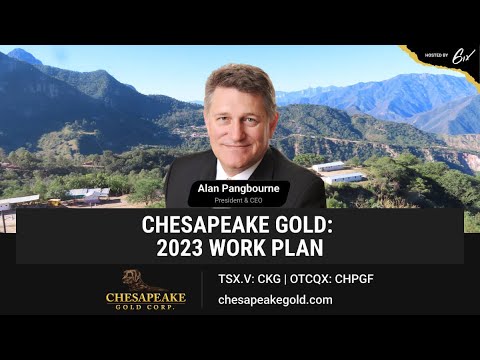
Chesapeake Gold: 2023 Work Plan
Join us for a great event!
- Company
- Chesapeake Gold Corp. (TSXV:CKG)
- Date
- Wed, Feb 8, 2023, 12:00 PM ET
- Replay
- Watch the replay on this page · 37 min
Replay
Transcript
Automated transcript · Written by software from the replay's audio. It can mishear names and figures; the replay is the record.
0:08 Hello everyone, welcome to Chesapeake Gold's live summit today. I'm pleased to introduce their president and CEO, Alan Pangborn. He's going to be taking us through his company's upcoming work plan for 2023 and after we're going to be accepting questions live. So feel free to submit them in the Q&A chat on the right hand side of your screen at any time in that chat box. And as always the summit is being recorded. It's going to be available on six.com to watch in the coming days So look out for that. Without further ado, Alan, I want to pass things over to you so that you can get started. Good morning. Good morning, everybody. Thanks, Cameron. So yeah, today, the idea is just to run through what the work plan is for 2023. I know some of the investors are quite interested in understanding what's in front of us for this year and obviously what catalysts come along with that. So moving right into it, there's really 4 things I want to touch on this today.
1:00 The obvious one is, as anybody who's been following us will have seen, MET test work. That is the primary focus going forward for 2023. As everybody knows, we put out our proof of concepts column back in 2012, in about August or September. We're now looking at ways to accelerate the oxidation process. So, we're happy that we could share that with you in August. It shows that our concept works. It's now, can we get the recovery from 60 to 70, the oxidation from 30 to 35 or 40, be able to get those higher recoveries. And so we're looking at things like the effect of size, the 2 different reagent schemes we're using, strengths and irrigation rates, air additions, those sorts of things.
1:55 That work has already started. We've already got a bunch of columns running at various sizes. We've also looked at a HPGR, high pressure grinding rolls crushing system. That sample has been crushed and is being loaded into the columns. At the same time, myself, Art Ibrado and others that are working on this, including some people we're working at at one of the local universities, are going through the previous results to try and understand exactly what is doing what and what we can glean from that so we can identify the things that work better, the things that work slower, and therefore get a more accelerated oxidation rate. So that's the first one, met test work. And that work is going to take the majority of the year.
2:45 At the same time, as some of you would have seen, November last year, we had our first meeting with the president and secretary of the Ajido, the community that is, who owns the surface rights to the mine, to where the mine is in Mexico. So the plan during the year is to have multiple meetings with them, build that relationship. South America is very relationship focused and it takes time to build trust with the community and explain what we're trying to do and how we're going to do it. To assist with that, we've actually commissioned a 3D model where you can actually see in 3D, on a table, with all the community, what it looks like now, what it will look like at year 5, year 15, and at 31 years, which is the current PEA plan, with the heap leaches, the waste dumps, the pit and everything like that, so people can understand potential impacts on the villages around it, the river, everything and what it will look like at the end. So, that's being built at the moment.
3:56 We'll take that down to Mexico and actually probably leave it with the local community so anybody can see what we're up to. So that's the next one. Probably the most important thing besides the test work that will come out very soon, and we're almost done. I know everybody's waiting for it. We have put the additional drilling results through. We've gone back and reviewed all of the previous data. We actually went back and did a bunch of check assays as well. And we're getting ready to put out the new resource statement, which I've previously said, and we're still sticking to that, and we will hit it. We will get that out before PDAC. In fact, we're aiming to get it out. We got an invite to the BMO conference.
4:45 So if anybody's going to be at the BMO conference or PDAC, please reach out, more than happy to catch up with you. But we will be putting that new resource statement out before the BMO conference, so as I can talk at it in a more open fashion with all of the investors and anybody that's down at that conference. And we'll obviously update our presentation and everything and that will go up on the website. Additionally, little bits and pieces we're doing in the background. And this is all focused on having all of the information ready to be able to produce a PFS. The earliest the PFS will be at the end of this year because I need all of the pieces, not just 1 or 2.
5:30 The most important one is the test work. But the other things that we're working on, just to give you an idea, power supply in the PEA, we assumed we were going to connect into a power supply near another mine. After a couple of site visits, there's actually a power line that comes right up to the little village nearby. We've now got all of the information relating to that power line, and it appears that we'll be able to just upgrade the power line rather than having to build a complete new one. And that also means that the right of way is already in place. So, that makes the permitting a lot easier. Because you're not permitting a new access way, you're just adding to something existing.
6:17 We're also working on understanding and sorting out water. And obviously a new road in, well, not a new road, upgrading a road into site. And all of that work needs to be done before you go to the engineering company and start a formal PFS study, because they need that information to incorporate it. So, those really are the work plan for next year. Obviously, we'll continue our marketing efforts. Last year we were able to go to the Beaver Creek Conference. We got invited to the Scotia Conference in November. We also attended the CannaCorp Conference in May in Palm Springs. As I mentioned, this year we've been invited to the BMO conference and we expect to go to the others as well this year.
7:10 Then we're also working with the SICs this year and so far they've been doing a great job for us, pushing us to get more information out to the investors. And so that in a nutshell is our work plan, Met test work, community relations, new resource, and then miscellaneous information that will support a BFS towards the end of 2023. And with that, Cam, I can't see you anymore, but I assume you're there and happy to go to questions and see if I can answer them. We'll see if you can. Appreciate it, Alan. Great overview. And yeah, just as a reminder to the audience members, I already see we're having a bunch of questions being submitted. But if you'd like to get in on this and pick Alan's brain, please submit your questions in the Q&A chat on the right-hand side of your screen.
8:01 To start, Alan, Jacques is wondering what the likelihood is that you're going to get into production, and if you have a timeline for that. Timelines are complicated, and for a couple of reasons. One is financing. Second one is simply permits. So we intend to get in production. We've deliberately sized the project so that we believe, as in the PEA, that we've got a financeable, deliverable, executable, and then expandable project for Matatus. Obviously, there's a series of steps you go through. We put out a PEA. The next step is the PFS. The PFS core becomes the basis for your environmental impact application.
8:53 So your EIA or MIA it is in Mexico. We've already started or restarted all the environmental monitoring so that we're getting that data again to support that next step. So assuming we get to a PFS towards the end of 23, early 24, somewhere around there, That takes you about 6 months to do the PFS. You then produce your environmental impact statement. You've got all the data and everything. That's why I'm so focused on collecting all the pieces this year to put the jigsaw together in 2024. Once you've done that, you're in the environmental permitting process. You're in the lap of the government.
9:41 We are building a relationship with the local government. I met with them last November. The current government in Durango is the government that will still be there when we go through the permitting process. So we'll be dealing with the same people, which is great. But how long that takes is difficult to predict. But once we get close to getting to the end of that, then we start looking for financing, feasibility study, and then construction. So you're probably 3 years at the earliest from construction, actually building it. No, Fair enough, Alan. Looking to see if you could review sort of the process and the status for that matter of proving your technology, you know, from experimental work, you know, and beyond.
10:30 But there's also a question if you're working with similar tech that Buffington tried at Highcroft. Yeah, so I know Randy Buffington very well. Randy's actually on the board. I've seen what Highcroft was doing. It's similar, but it's different. I guess conceptually it's similar. Practically there's a bunch of things that are different. If it's possible I might actually pull up a slide and share that with everybody. I don't know how I do that. You should be able to see an image that says start sharing screen.
11:16 Okay. Let me just open the file I want to open. This is in our current presentation. It was the deck I used for the Scotia presentation in November. But I think to try and address it's easier just to pull up 1 slide as it loads itself up. That one there. That one there. Go away. Share screen. That one. Okay, you should be able to see, there we go. Okay, so, the technology is based on what we do in the copper industry and I worked with that technology 15 years ago. Now built one of the largest heat bleachers that oxidizes sulfides in the copper industry.
12:17 It's been done in Chile and Peru for over 30 years. If you look down that list, we're crushing to half an inch. Why? Because we know it works in the copper system. So we're using the same size. We are testing crushing a little bit slower, and that's part of the work this year. A bit smaller, sorry. Ensuring that we've got a good mixing, agglomerating drum to make sure we mix the reagents properly. An on-off pad, single lift, with air injection underneath. That is critical. If you don't do that, you won't oxidize the sulfides. They need oxygen to oxidize. And it doesn't matter whether it's pyrite, chalcocite, covalite, or any other sulfides.
13:04 When you do all of that, in the copper system, we oxidize chalcocite, covalite, and pyrite, and they get up to 80% recovery on 80% oxidation. And there's a reason it's linear. It's because chemically, the copper is locked to the sulfur. So you have to break that bond. If you look at what we're planning to do in our project, it's exactly the same as what they did in the copper business. All we're changing is the chemistry around the alkali system instead of an acidic system. Physically, I know this works. We've done it in the lab. We've done it up to 60,000 tons a day onto a leach pad in South America.
13:51 And we ain't the only ones. So I sort of know what didn't happen at Highcroft. As I said, I have visited it. They were not using an agglomerating drum, they were not using a single lift pad, they didn't have forced air. So I think if you don't do those 3, how can you expect to do the last one, which is oxidised pyrite? The other thing that we're doing in our process is we're ensuring that we keep all solutions separate. You do a common concept in chemical engineering is 1 step, 1 process, 1 tank. And then the next step, the next process, different tank or different containment vessel solution containment.
14:42 And it's to keep your chemical reactions separate. The chemistry to leach the gold is different to the chemistry to oxidize the sulfides, even though they're in the same alkali environment. So that's why we believe we can get it to work. It's similar but different. We've incorporated everything we know that we needed to do in the copper industry based on that 30 years experience to ensure we can get it right. We have the proofs of concept column out that got me the 60% recovery. So we know it's working. That's an improvement of 100% over the base recoveries. Yeah. So hopefully that addresses your concern.
15:28 Fair enough. I'm gonna take your slide down there, Alan. But Ron's wondering why is the old ore tube oxidized better now? Why did the old tube oxidize better than the new ones? That is a great question. If I knew the answer, I would tell you. Part of what we're doing is we're going through all of the data on that first proof of concept column to understand why the velocity. And it's a kinetic issue. It's not it doesn't work. Every column we have run, every column we have run, except the 2 zeros where we only ran lime and cyanide, every column we have run, even if it's only for 60 days, has oxidized.
16:23 It's not that they haven't oxidized. Everyone has changed color. Everyone has gone brown. Everyone has produced sulfate. It's the speed at which it produces it. Okay, so the initial column was faster than the newer columns. That's why we're doing what we're doing now to try and work out why, what was the difference. There's 3 of us, 4 of us, 3 or 4 of us combing through the data trying to work out what was different between that column and the next 6, 3, 16 I think it was, 12 or 16 columns. We've got a few indications, we've got a few ideas, we may know what it was.
17:11 The new columns as we're putting them on, some of those things that were different, We're going back to why that one oxidized faster. But as I said, all of the columns that we tried to oxidize, oxidized, and sulfate came out at the bottom. We're going back and looking at individual size fractions So minus 0.5 mil 0.5 mil to 1 mil 1 mil 5 mil 5 mil 2 to 10 and plus 10 mil to see fraction by fraction. Is there a differential rate by fraction? All of those sorts of things to try and work out exactly, and sorry if I start getting too technical, but exactly what happened where, what went where, so that we understand the difference between those 2.
18:02 Right. No, fair enough. Absolutely. Brittany is wondering, talking about the next 9 to 12 months, what's the current thesis for investors looking for a return? So you've got the so base case, it's a massive resource with a lot of ounces in the ground, and it will respond to the metal price change. That's what several of our current investors are looking for and have been. Many of them, I can see some of the names I recognize them those that said hi on the chat They they they came in originally for that it is a massive resource Yeah, 20 million ounces of gold 500 million ounces of silver it's one of the biggest in the world that hasn't been developed. So you've got talk to the metal price.
18:52 And if you look at where we're trading, we're trading about $4 an ounce. Your upside is the resource update when that comes out. We know the drilling that we did on the 23 holes showed an additional was it 18, 19, 20 percent somewhere around there. I can't tell you yet. We will see what the impact of that is going through the resource model, and we will come out with a new resource statement around that. We know now, at least in the lab, and I sort of saw one of the questions flip past, we got to 60% gold. I need 10% more to get to what the PEA says.
19:37 So you can look at it another way you can look at it if people want to. Assume I get half of the increase in the grade, right? So I got 18 or 19%. So I get 9 or 10% increase in the intrusive grade I'm feeding the plant. I got 60% goal recovery instead of 70. 1 multiplied by 1.1, multiplied by 0.9, you end up in the same place. So it reinforces the economics that were in that PEA. If I then can get why it's slower, can I get the oxidation rate back to where that first column was and let it run out to the 180 days, because it only ran 128 or 9 or something?
20:30 You'll get to your 40% oxidation and you'll get your 70% recovery. Once you've got that, you've got what the PEA says. So it's all reinforcement to the PEA to move to a PFS. No, fair enough, absolutely. Okay. You know, And just speaking of that, I just want to make sure that everything gets covered. But Ron is also just wondering, what's the likelihood of a resource update this quarter? As I said earlier, BMO is in 3 weeks time. Yeah. Fair enough. I hope that answers your question, Ron. So David is wondering what the cash value of the company is per share, and what are the ounces in the ground being valued now?
21:17 So I think I sort of touched on that. The ounces in the ground on the entire resource is valued at the moment about 4 bucks an ounce. The cash position in the company at the end of the year was just shy of $30 million, I think. I'm not sure when we put the last number out. The last number that went out was just shy of $30 million. Yeah? No, we haven't done the end of year yet, So it would be the end of Q3. And next obvious question is, well, how much do you burn per year? If we've got just shy of $30,000, when we took over in the beginning of 2021, we had $35 million in the bank, just shy of $30 at the 0.75 mark in 2022, 5, 6 million tops a year. Not planning to do any more drilling next year, or this year, sorry. I didn't mention drilling on the work plan because there isn't any.
22:26 The other thing that there's a little bit of money in the budget for is we do have some regional projects and I think I mentioned this before at different times, we are making sure we understand what we've got before we either drop them or sell them or whatever. I don't want to give away something that is potentially interesting. So there's a little bit of money to do some work on those. Absolutely. And you know, I mean, Alan, you were in a panel yesterday also on six.com. So, you know, for everyone in the audience, if you if you want to check that out, it should be coming online today. But it was dealing with the topic of innovation in the extraction industry. And even before we went live, you and I were talking about some high impact, low effort, things that you look at and you see as being very helpful that sometimes people miss.
23:17 I was just wondering if you wanted to elaborate on that, maybe make comments about yesterday's discussion, anything that you thought was worth sharing potentially. Yeah, I think yesterday's discussion was great, and I'm glad I was involved in it. The industry has a perception that it's very conservative and slow to adopt technologies. Having worked in some large mining companies and even some mid-tier companies, I'm not sure that that's necessarily a fair statement. Part of the reason technology takes time to penetrate the industry is risk.
24:04 And if you're building billion-dollar projects, do you want to risk it on 1 technology that then doesn't work at full scale? And that's part of the reason why we're looking at a smaller starter project that is financeable, deliverable, and then expandable later by us, rather than having to sell out somebody else to be able to build a $3.5 billion, $4 billion waterclay plant. But some of the technologies are quite simple if you can get them installed. Things like that everybody takes for granted, being able to pick up your phone and check your share price. There's some sites, including Metatis, you can't do that.
24:50 There is no wifi. There is no phone signal. So, you know, just bringing in some of those simple technologies, the backbone of fiber optic. I mean, Cameron, I think you're alluding to, I'm sitting in South America today. I've got a 1 gig up and download fiber less than a meter away from my computer and I'm less than 20 meters away from the main cable that runs through the town I'm in. You can't even get that connection in Canada. So there's a lot of different technologies that come through. And I tend to keep an eye on all of them, or a lot of them. The whole heat bleaching thing, the copper industry went through this. How can I do it cheaper, less energy input? And that's the one thing I haven't mentioned, But I know some of the shareholders are very aware of this. This process uses 90% less power, 90% less water, and there's no tailings down.
25:57 I'd love to be able to get a meeting with Blackwater's ESG fund and say, boy, guys, we can produce the same product as Barrett with this project without using an autoclave, 90% less power, 90% less water, And no tailings dam. I'm not going to end up on the front of the Globe and Mail or the New York Times because my tailings dam just went to the Atlantic Ocean. Right? ED HARRISON Ideally not. ADAM POSEN As somebody else did. ED HARRISON Well, that's fair enough. We have a question from Thomas. He's just talking about a premium at $17, the historical price, he says. And today's price is vastly different.
26:43 What would be your idea of sales price based on current resources? If I understand what price would I sell the company? As much as possible. You know, I mean, Chesapeake at one stage had a quite a high valuation. It was driven by probably 2 things. One was the majors were buying large, low-grade ounces in the ground to be able to develop and replace their insatiable appetite for mining them out. And it may be coming back, Because if you look at what's just happened in the last 2 days, if you want to go that recent, you know, Newmont just took out Newcrest.
27:41 That doesn't bring any new production online. All it does is it consolidates it into one company that now is going to chew through their reserves at 8 million dollars an ounce a Year, sorry 8 million ounces a year. They got to replace it somehow You know and a large resource like this Particularly if the the metal prices keep going up and you we've all got our various theories on why the metal price, and particularly gold, will go up, the big project becomes economic. And a company like Newcrest or Newmont or Barrick or Agnico Eagle, or even a few of the mid tier ones who've got all the clave experience Could build that We can't Right, right. I cannot raise 4 billion dollars.
28:38 Can I build a 4 billion dollar project? Of course I can Yeah, I built 1 billion dollar project in sunny South America 15 years ago The problems getting the money Yeah, That is a big ask for a small company. And if we did that, the current shareholders will get diluted significantly. So we can't build that project. Can somebody come and buy us and build it? Of course they can. Will I talk to them? Of course I will. No, fair enough. I have to, if I don't, they'll put it in the press and then I'll have to. That's what happened with Newcrest. Right. That was leaked in Australia on Saturday or Sunday night. Okay then, yeah.
29:25 No, absolutely. John's in the audience and he's just wondering what sort of capex would be needed to run thousands of tons of ore through a complex oxidation process. You know, if it can be found to work, what does that process look like? You know, and he says, is that giant test tubes? But yeah, any of your thoughts on that? Can you give me my screen back? You should be able to, yes. You can just hit this stop sharing or you can switch your tab back over to this. Okay, let me do that. Sorry, just let me scroll through. Right, What does it look like? So if this process, not if, when I finish showing that this process works, what it looks like, I'll go through the flow sheet. Conventional crushing plant.
30:15 So whatever tonnage you want to put through, we designed at 15,000 tons a day, but it really doesn't change a lot. So standard primary crusher, in our case, a jaw crusher, secondary tertiary crushing to take it down to half an inch. If you go finer than that, there's potentially 0.25 stage of crushing, or what they call a HPGR, same end result. Next step, mix it properly with the reagents you want in the pile so as you can oxidise it. Convey it onto a pad. These pads, the pad for our plant is a kilometre long and half a kilometre wide, I think. And that's enough for 180 days of water to sit on that pad, have the solution irrigate through it. So dripping, same as irrigation drippers on your farm or your garden, that solution drips through, comes out the bottom, goes back to the top, goes round and round and round. In this particular case, you have air tubes and blowers underneath so that you force air through it. So as there's oxygen, it oxidizes, it changes color.
31:30 Once it's done the oxidation stage, you pick that up with a bucket wheel excavator or trucks and loaders, put it on the permanent pad. From there on, Everything else in there is a standard gold, silver oxide giblage. There are thousands of them around the world. If you want to have a look at what it looks like, that's the oxidation pad there. So that's what they call on-off. So we load it from one end to the other. Once that material at this end has been there for 180 days, you dig that material off, make a gap, and then you start loading the next slot behind it. And so it's a continuous, but not continuous process.
32:19 Yeah. Absolutely. And actually, just Alan, while you have this up, there was another question I was going to get to, but it was, maybe you can point this out for Jacques. And he was just wondering explicitly, is the processing mill downhill from the open pit? Yes. Yes. So everything is in 1 valley. This is all 1 valley. And part of it, when we were laying this out, we considered closure. And the reason we did that was because we cut off any discharge right at the neck of this valley before it goes into that creek. So we can control the discharge. And that's for closure and during operations. But basically, this pad is the permanent heap leach pad where all the gold and silver is recovered from.
33:08 This is the oxidation pad. So only temporarily stays there for 180 days. Then it gets moved and put onto this pad. And then these are waste dumps and sedimentary resource that will be processed at a later date, potentially. That's the final open pit. This is non-acid generating waste. That is potentially acid generating waste. Crushing plant, primary crusher, auxiliary buildings and stuff. So that's the rough layout of this particular project. That flow sheet is almost identical to the copper flow sheet. OK.
33:54 No, that's great. David's wondering, do you think the stock price can move above and beyond the gold price for company-specific factors once the PFS is released? Or do you think that they need to wait longer for the feasibility study? I think both act as catalysts. I think the resource statement potentially works as a catalyst, assuming that we get a grade uplift, because the grade uplift helps the economics from the PEA. As we get the Met test results, that will help. It's all going to take time to build confidence in the technology. Look, I'll be frank. There will be people, even when we start up, that say it will never work.
34:43 Yeah? I built a novel project in Peru that had firsts in a couple of things that I know people looked at it to buy it and they walked away and said it will never work. I hate to tell you, not only did it work, it produced what it was supposed to do at the cost it was supposed to do and ran the entire mine life. So, yeah. Okay, got more simple than that. Christian's just wondering if the company is sold, is the patented technology going to be sold along with it? It's in a subsidiary of Chesapeake. So if Chesapeake goes, unless they don't want it, and they want to give it back to me, right?
35:30 Yeah, it would go with the company. All right, fair enough. Well, listen, Alan, that was a great Q&A session, certainly. And thank you for taking us through the work plan for 2023. That's all we have currently. So I want to pass things over to you for any closing remarks you might have before we wrap up for the day. Look, if you want more information, check out the website. We trade on the TSX as CKG. We trade on the OTC as CHPGF. I'll be at BMO. I'll be at PDAC. Contact me through, I think it's ir at ChesapeakeGold.com if you want to get a hold of me to have a chat or have a meeting, more than happy to. Some of the people on the list know me well enough, they'll just send me an email and say, can we chat?
36:20 Open to talk to anybody who would like more information. All right, and look forward to the resource update, which will be out by the time I go to BMO on the 20 whatever it is of February, towards the end of February.
Follow Chesapeake Gold Corp. into a list and get an email when it puts out news.
Latest news releases
- TSXV:CKG — Chesapeake Mobilizes a Drill Program at Lucy · Mon, Nov 2, 2026
- TSXV:CKG — Chesapeake Announces Proprietary Heap Oxidation Technology Updates · Tue, Sep 22, 2026
Companies on this call
More from Chesapeake Gold Corp.
- Oct 01, 2026 Chesapeake Announces Proprietary Heap Oxidation Technology Updates
- Jul 31, 2026 Silver's Next Chapter: Scarcity Meets a Shifting Market
- Apr 16, 2026 Beneath the Surface: The People of Chesapeake Gold
- Oct 21, 2025 Chesapeake Gold Update Call
- May 28, 2025 Introducing Justin Black, Chief Metallurgical Officer
- Feb 19, 2025 Exploring Mexico: From Discovery to Development