Replay available
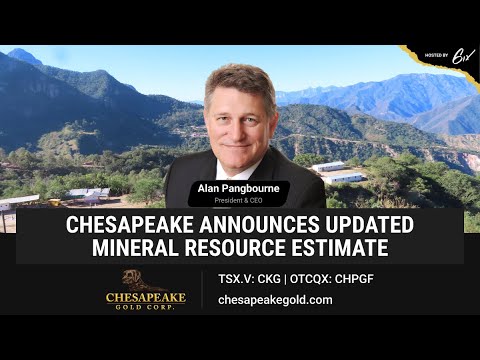
Chesapeake Announces Updated Mineral Resource Estimate
Join us for a great event!
- Company
- Chesapeake Gold Corp. (TSXV:CKG)
- Date
- Wed, Mar 1, 2023, 1:00 PM ET
- Replay
- Watch the replay on this page · 29 min
On 6ix: 6ix.com/event/chesapeake-announces-updated-mineral-resource-estimate
Replay
Transcript
Automated transcript · Written by software from the replay's audio. It can mishear names and figures; the replay is the record.
0:08 Hello everyone and welcome to Chesapeake Gold's live summit today. I'm pleased to introduce their president and CEO, Alan Pangborn. Alan's going to be taking us through a little brief talk just over going over some of the most recent news and as a reminder because we are going to be entering into a Q&A session after this you can submit your questions in the Q&A chat on the right hand side of your screen at any time during today's presentation so please do so. As always this summit is being recorded is going to be available on six.com to watch afterwards. We're gonna be also providing you a chance to submit a survey. So please check out for that and provide any feedback that you might have. But without further ado, I'd like to pass things over to Alan to kick things off. Thanks, Cam. Good afternoon, everybody. I'm here today, as you can see, in a hotel. I'm actually down in Miami at the BMO conference.
0:56 So today, I really wanted to talk to you about the most recent press release we put out, which was the update to the resource that I've been talking about for quite a while. It's really the culmination of the work that we started when we first took over. And if you will remember, we drilled 5 holes and they showed about an 18 to 20% increase in grade over what the block model said, particularly in the intrusive and intrusive pressure area. And as you know, the next thing we did was we went and drilled another 18. So the first 5 was a nice surprise, great, upside, upside's always good. The second 18 gave me the same sort of results, but it actually opened a bit of a can of worms because now you've got 23 holes that show that there seems to be a difference between what the block model was suggesting and what the drilling was suggesting.
1:50 With that, and that's what's taken so much time, we had to sit down and literally comb through all of the old data, all of the old block model, and we've actually rebuilt the entire block model. I worked with Carl Edmonds, who was our chief geologist when I was at SSR, and I trust him. He was right when we bought Marigold. He was right when we bought CB. He was right when we bought Chinchillas in Argentina. So he's had a track record, at least working with me, where what he said should be changed and what is right, he's been proven to be right. So I've got a lot of confidence in the guy. And we also work with a guy called Mark Jutras, who's a geostatician that used to work for Placidome. So they went through everything. And so what did we change? So there's a few things that were in the news release that we changed.
2:40 The first one was we put a 0.2 gram per ton shell. Now that caused some of the tonnage to go down, but it was really because it was less than 0.2 grams per tonne, and it shouldn't have been in the resource anyway, because there is no way we're going to get down to below 0.2 when your cutoff is at 0.26 grams a tonne. So we put that on and that stops the model predicting things outside of that grade range and holds that inside. The second thing we did, we went through and reviewed how much leakage is occurring between the intrusive and the intrusive breccia and the sedimentary package. And there's a way you can do some statistical analysis to know how far beyond that boundary you should or should not predict potential crossover of grades. So we installed that as well.
3:37 And then finally, the third thing we did, because there was some issues, we went back through every year's batch of drilling, looked at them all. And if you've read the PFS, sorry, the PEA in detail, you'll have noticed that there was a factor on some of the drilling from the 1990s. We looked at that as well, and we identified where the problem was, and we fixed that. So when you put all that together, what it resulted in, in the part that we're actually interested in, which is the intrusive and intrusive breccia, the gold grade went up by 16%. That's important because it effectively means that every ton of ore in that area is got more gold in it, therefore it's worth more, and therefore it goes to the bottom line for the economics for the project. So it assists that project.
4:35 So that's the new block model. That's the block model that will go forward and we will use in the PFS when we get there. So that's really the new news. The only other thing is I'm sitting down and BMO conference. So Cam with that I know it was very short but I'd really like to move over to Q&A. No absolutely, Short and sweet is the name of the game. So just as a quick reminder to everyone in the audience at this point, there is a Q&A chat found on the right hand side of your screen. If you want to ask a question, please submit it in that chat and we'll get to it as we can. But Alan, just to begin with, first question, does the increase in grade make a significance, a great significance rather, in the project?
5:22 It does. As I said, when you increase the grade by 16%, that's 16% on 1 gram a ton equivalent, it effectively adds 16% to your revenue, because it's all proportional. So it just goes straight to the bottom line. And then over the 30 odd year mine life, that's 16% more revenue. So it improves the economics of the project. And that's why it's so great to be able to get that much. I actually didn't expect to get that much of an uplift. I was expecting it to be, I think I'd mentioned before 9 or 10%, but with 16%, which is what we've got, that brings the model much closer to the drilling results we were seeing, which makes it a much better resource estimate, we believe.
6:12 All right, absolutely. We have a question coming in from Pirate. It's a very long one, so I'm going to try and get to the core of it as well as I can. He's just highlighting that on our previous investor presentation, there was a resource size that seems to have gone down. He's just looking to ask and see if there's any context for why this part of the resource is not in the mine plan and why it wouldn't be a part of the 43-101. He's mainly interested in the stock for the huge silver deposit, and he's just looking for some clarity. So he's right. The overall total resource of, I think, like you said, it's 500 and something million ounces of silver and 20 million ounces of gold has gone down overall.
7:02 There's been some reclassification too. Some's come out of measured into indicated, indicated into inferred. But as I was saying, the previous model didn't have a constraining shell at a certain grade. And the problem is when you get down to below 0.2, it might be there as ounces, but 0.1, 0.15, certainly in today's world, is not economic, and it never will be. Now, if you believe the gold price is going to 2345, even $10,000 an ounce in silver correspondingly, could it come back? Of course it could come back.
7:50 But if you think about the size of the resource and where we're starting, we're starting with that high grade core, and it's now higher grade. So the economics for the project that we're gonna start with will be better. Those low-grade materials, they don't get lost. They're stockpiled. If you look at the drawings, we've got a massive stockpile of material that comes out with what we're mining for the intrusive. So it doesn't disappear and if 0.1 or 0.15 or sub 0.2 becomes economic, it hasn't gone anywhere. As long as we're careful when we mine it and don't put it in the waste dump that's got 0, it's there. It's just not the way we've reconstructed the resource.
8:40 The definition of resource is potentially economic. At the gold prices and silver prices we use for the resource, it is not potentially economic. That's why it changed. And it's all the very, very low grade. And if you want to see the difference, Pirate, I know you know me and we've talked before. Have a look at the small amount of intrusive and what the grade of it was and have a look at the intrusive now and you'll see how, sorry, the inferred now and you'll see how the grades changed. What went out was very, very low grade material. No fair enough and folks, I'm just gonna go a little bit out of order here just because as a follow up question for you Alan, just to stay on topic, but why not leave the low grade ounces in the 43-101?
9:37 Because as I just said, they don't fall within that potentially economic classification that the BCSC insists that we use. Okay, fair enough. And I feel like that answers you to the couple other questions you're following up with. Just let me know in the chat, if you have anything else you'd like to elaborate on with this topic, but otherwise, Alan, we do have a number of questions about the BMO conference. You know, I believe you're going to be going there. And you know, Alan and Mark are wondering, how is it going? How does the BMO conference work? What's Chesapeake doing there? And has there been an expression of interest in your company? So I'm actually at the BMO conference. I came here on Saturday night and it runs Sunday, Monday, Tuesday, Wednesday. I've got one more meeting left after this. I've had over 26 meetings over the last 3 days.
10:37 With a mixture of people, I've met with my other 2 major shareholders. So Eric Sprott's family office and with Peter Palmetto and Sun Valley. So that's the 3 top shareholders, if you count myself. Randy Rifle's the fourth one and I talk to him regularly. So it was good to catch up with those other 2 shareholders. Met a different bunch of investors, some personal investors, some retail, some funds and institutional type investors. It's just a forum that BMO manages and multiple banks do these types of conferences. You may remember we went to Canaccord's conference last year in May.
11:25 We went to Scotia's conference in November. The BMO conference is the biggest, best well attended. Everybody from BHP, Rio, down all through base metals, gold, lithium, nickel, you name it. South 32 was here. A whole bunch of people that I know in the industry that I've known for years were here. And so it was a mixture of investors, financiers, talking about potentially how would I fund it and what part of the capital structure or capital raising they would play in. So, and understanding what their expectations will be when I start looking for finance.
12:14 Meetings with PE companies, royalty companies, other corporates, that we might be interested in them or they might be interested in us, and I really can't say anything else but that. So great mix, And as I said, over 26 meetings over the last 3 days. And next I go home and get some warm clothes and head over to Toronto for PDAC. Sounds like you're definitely busy enough, Alan. Don't necessarily envy you on that. But Rick Darrow is wondering, with a 16% increase in grade, do you anticipate that there are going to be any independent investment reports to upgrade their stance on the company? Because they're independent, I don't really know.
13:03 It's the same with whether one of the banks or others will initiate coverage with that as well. There's no, I usually know literally just before they put it out because they'll usually share it with you before they make it public to make sure they haven't made a fundamental error in it because they don't want to look like idiots. But otherwise, I don't know. I don't have any control over what they say either. ASH BENNINGTON I mean, fair enough. Arun has some general questions, just genuine questions about 43-101 regulations. He's just wondering if, so everything in the 43-101 needs to be economic, and why not include the uneconomic ounces in a 43-101 under a different section, as he suggests, like reserves?
14:01 Because you can't. The BCSC does review 43-101s occasionally, and if you get on the wrong side of them, they will put a default something or other on you, which means you can't do a capital raise, you can't go and put out a prospectus, and you can't do a bunch of other things until you clear it up, and they can force you to put out another 43-101 that is compliant. And you'll have noticed that we had to amend our 43-101 in December. We put the new one up, I think it was November, December. Now it's because the BCSC reviewed the previous one and said, you can't use the word or, O-R-E, because to be or, it has to be reserves, and to be reserves, it has to be proven to be equity.
15:02 From all the conference presentations, what's the mood about gold and silver price this year and for that matter, what the next few years? In general, people seem to be expecting the gold price to move up. There was a bit of, not doom and gloom, disappointment with the most recent move where it dropped back below 1900, but it seems to have recovered in the last couple of days. None of the gold guys were despondent. The copper guys and the lithium guys are ecstatic. No, in general, the mood was good. People seemed to still be able to raise money. Some people I know are really close to raising some more money for their project and they said they were almost closed now and they were oversubscribed.
15:54 So I think there's interest in the sector. Yeah, absolutely. Kenneth wants to know, could you provide details on current matrix from column testing and is there any evidence of preg robbing in Breccia? No. I'm sorry, don't just say no, no to which piece. There's no evidence of preg robbing in Breccia or intrusives at all. The other part of the question was matrix or something? Yeah, just if you could provide any details on current matrix from 4 column testing. So CrushItFiner is 1 that I've got running. HPGR Crushed is another one.
16:41 Alternative reagent schemes I've got 3, 1 primary 1 and 2 sub ones running. Temperature, I've got 1 running. Reagent strength and pH in 2 different alkalized systems I've got running. What else? Every one of those I run intrusive and intrusive breccia separately, just in case there is some difference in response, as suggested by the question whether it's preg robbing or something else. I've got about 24 or 28 columns running at the moment.
17:30 We actually, the lab had to expand their space so they could fit us all in. So yeah, that's about what we've got running at the moment. OK, great. Alan wants to know if you could just explain the drop in stock price from the past year? I don't know. I mean, with all the gold stocks, all the gold juniors have suffered. We seem to have a floor under us now at about $2, and that seems to have held. I mean, it did go down to $1.97 yesterday, but then this morning it was up to $2.10 or $2.12 or something. But Again, not on a lot of volume.
18:19 Some have been a lot worse than us, some not as bad, but overall, the junior gold space has seen quite a drop over the last year or so, and many, many of them are off way more than we are. Okay, fair enough. Alan is wondering, and we also have another question that deals with this, but Alan's wondering, what's next for Chesapeake in 2023? And the other question just sort of details, what are the next steps for you right now? And third, why should a speculator consider your company at this point in time? Okay, so let's leave that last one, remind me that one. So let's sort out 2023. So we've now got a new block model.
19:05 That's one key piece of information I need for the PFS. Everything in 2023 is focused on getting everything ready to be able to produce that PFS. So, new block model. When I get closer to the time and I know I've got other stuff lined up, I'll redo the mine plan. That'll be the second thing that goes into the new PFS. The metallurgical test work is key, extremely key. Other things we're doing at the same time, and I think I've mentioned this before, we've restarted the environmental monitoring. We've got a year under our belt. By the end of the year, we'll have 2. That's the sort of minimum you usually need for an environmental permit. We'll keep running it going forward so that we'll get 345, so on.
19:54 But that will be enough to be able to do with the PFS our permit application from an environmental point of view. We've now got all the information we need about the power line that comes near to site and the right of way. The right of way is the important piece for us. If the power line's too small, you replace it. But if you don't have the right of way, that's another permission permitting type issue. There is a full right of way, all the way back to the main sub. So that shouldn't be a problem going forward. And we've got all the information about how wide it is, where it goes, what the power line is, what conductors are, all of that information. We're working on getting a expanded water route.
20:45 We've got a small water right at the moment, but obviously for the full project you need a big one. We're working on the application to get a larger allocation of water within that water right. We're doing that rather than a new one because an expansion is usually easier than getting a new one. The other thing we've got to get, and it's not so much for the PFS but it's for what comes after it with the EEIA application or the MEA, whichever 1 you want to use, it's all the same thing, it's environmental permitting, is we have to get an exploitation agreement with the local community. And I've talked about this before. We had a great meeting in November with them. We've had further conversations by email and by phone with them and they've started thinking about well what about this and what about that which is good because it means they're thinking about it yeah and we're building a 3D model, plastic model that you've got add in and take out pieces so as we can explain to them in something that's visual, that's easy to understand rather than the plan. And we'll take that down in April, May and meet with the AHITO again and go through everything with them. So that's the other one.
22:03 And the reason for that is you get all the pieces for the pre-feasibility study. Once I've got the pre-feasibility study, I use that as the base of my permit application. But there's 2 things you have to have in your permit application or it'll come back in 5 days. You've got to have an exploitation agreement. You've got to have water rights. If you don't have clear access to the land, you don't have clear access to water, they will deem your application to be incomplete, go back and do it again or get those things and come back. So we're working on all of that during 2023 to get that to be able to do the PFS and the environmental application.
22:51 So that's what 2023 looks like. All right, awesome. Thanks for the update. What was the other bit? Exactly. As you asked me to remind you, the other question that was tacked on there was just why should a speculator consider your company at this point in time? Multiple reasons, I think. And we had a couple of really good investor meetings with investors that used to be holders in Chesapeake. And as they left the room, said they were going to come back, which would be great. So why? So 1, your base case, If like pirate, you're investing because of the ounces in the ground, that's, from my point of view, that's your downside. That's what underpins the share price.
23:43 And as gold price goes up, would move it up as well. So if you're a gold bull or a silver bull, we are still one of the top 10 undeveloped gold and silver mines in the world. Massive resource, 19 million ounces of gold, 480 million ounces of silver. We're one of the largest. On top of that, we've now got a way, we believe, to unlock value and move into production. Even if it's only phase 1 at 150,000 ounces a year, that's not a small mine when it comes to gold and silver. All of the mines we were running in SSR were 100,000 plus.
24:33 I joined the Oceana board, most of their mines are 100,000 plus. So it's a decent sized mine. On top of that, Once we've shown the technology works on 1, or when I'm convinced that the technology works well enough, we can start acquiring other projects that have a similar problem to Chesapeake's Matatus project and add them to the portfolio. Why would I want to do that? A couple of simple reasons. 1, a one-line mining company is tough. It really is. There's no portfolio effect. There's no smoothing effect. Every time there's a problem, you press release it. Every time things go well, you press release it, it's a nightmare for volatility.
25:23 And secondly, once the technologies are at the stage that we understand exactly how it all works, we can identify opportunities that from our point of view with our technology are mispriced. So we can buy, as any ounce investor knows, cheap ounces, because they're not currently economic. But with our technology, they would potentially become economic. So that's why a speculative investor should look at this. All right, fair enough. Kenneth points out that you mentioned roll crushing. Would that be as you go on or off of the oxidation pad and have you considered doing both? It would be, all the crushing would be done before it goes onto the oxidation pad.
26:11 The difference between conventional crushers, cone crushers and a Rolls crusher is the Rolls crushers tend to make a lot of micro fractures into the rocks and so they increase the permeability. By increasing the permeability it allows the solution in the air to get in, to get at those sulfides so as they'll oxidize faster. And it's a very different size distribution. So it's been used successfully elsewhere. They're using it in the copper industry in front of ball mills. They've been using it in the diamond industry for decades and decades. I commissioned 1 back in the, I'm showing how old I am now, in the late 80s in Australia in a diamond mine.
27:01 Amazing piece of gear. They're using them down at Rochester now in Nevada with Cord Lane. They're using them, Freeport's using them. Oh, the cement industry's been using them forever as well. So it's not new technology, but it is something that's slowly been penetrating into base metals and now gold. And it gives a better distribution. All right. Thanks for that. I know you touched on, you spoke about the PFS, but there was just a follow up question about when people can expect it. 2024, hopefully early 2024, but 2024. All right, wonderful. Well listen, Alan, that looks like all the questions we've received for today.
27:49 So I want to thank you. And of course, I also want to thank everyone in the audience for joining us and leading such a great Q&A session. But before I wrap up, I want to pass things back to you, Alan, for any closing remarks you might have. Not really. I mean, look, some of you I know and you're supportive of us and I really appreciate that and thank you for your support and thank you for being shareholders. It was great to be here at BMO. It's the first time Chesapeake has ever been invited to BMO. So that really says something about how at least the analysts and the bankers are starting to look at us. And if anybody's at PDAC and they want to catch up, I think most of you know how to find me. Just drop a note either on IR at ChesapeakeGold.com and I'll see that or if you've got my personal email or my company email, drop me an email. More than happy to chat.
28:45 You
Follow Chesapeake Gold Corp. into a list and get an email when it puts out news.
Latest news releases
- TSXV:CKG — Chesapeake Mobilizes a Drill Program at Lucy · Mon, Nov 2, 2026
- TSXV:CKG — Chesapeake Announces Proprietary Heap Oxidation Technology Updates · Tue, Sep 22, 2026
Companies on this call
More from Chesapeake Gold Corp.
- Oct 01, 2026 Chesapeake Announces Proprietary Heap Oxidation Technology Updates
- Jul 31, 2026 Silver's Next Chapter: Scarcity Meets a Shifting Market
- Apr 16, 2026 Beneath the Surface: The People of Chesapeake Gold
- Oct 21, 2025 Chesapeake Gold Update Call
- May 28, 2025 Introducing Justin Black, Chief Metallurgical Officer
- Feb 19, 2025 Exploring Mexico: From Discovery to Development