Tal Payne
CFO and COO
Replay available
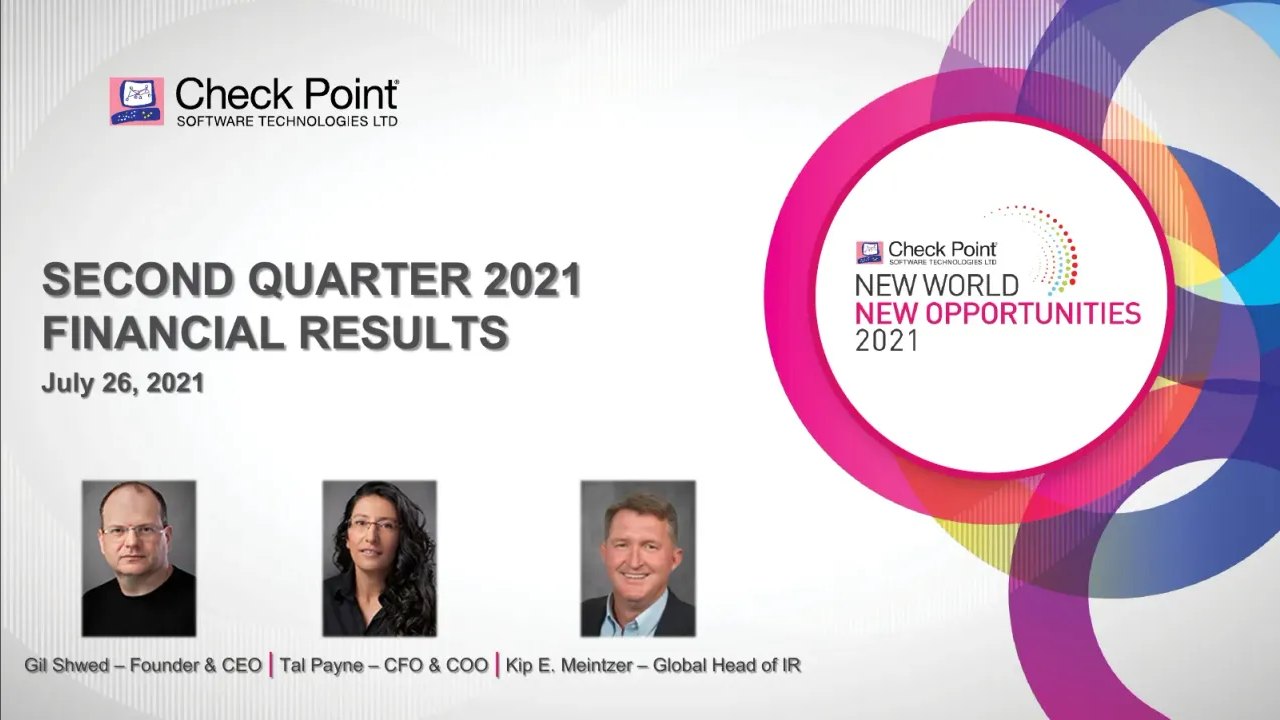
Check Point Software Technologies (NASDAQ:CHKP) Q2 2021 earnings call, held 2021-07-26. Watch the replay and read the transcript on 6ix.
On 6ix: 6ix.com/event/check-point-software-technologies-ltd-chkp-q2-2021-earnings-call
Automated transcript · Written by software from the replay's audio. It can mishear names and figures; the replay is the record.
0:00 You have joined the meeting as an attendee and will be muted throughout the meeting. For Check Point Software, I'd like to welcome everyone to our second quarter 2021 financial results video conference. At this time, all participants in our listen-only mode during the formal presentation, which will be followed by a question and answer session. Joining me remotely today on the call are Gil Shwed, founder and CEO, along with our CFO and COO, Cal Payne. As a reminder, the video conference is live on our website and recorded for replay. To access the live conference and replay information, please visit the company's website at Checkpoint.com. For your convenience, the replay will be available on our website.
0:47 If you'd like to reach out to us after the call, Please contact Investor Relations by email at kip.checkpoint.com. Before we begin with management's presentation, I'd like to highlight the following. During the course of this presentation, Check Point's representatives may make certain forward-looking statements. These forward-looking statements within the meaning of Section 27A of the Securities and Exchange Act of 1933 and Section 21E of the Securities and Exchange Act of 1934 include, but are not limited to, statements related to checkpoints, expectations regarding business, financial performance, and customers, the introduction of new products, programs, and success of those products and programs, the environment for security threats and trends in the market, our strategy focus areas and demand for our solutions, the impact of COVID-19 on our business, including on our product development, sales, and marketing efforts, and our financial condition and results of operations.
1:46 The impact of COVID-19 on our customers, suppliers, business partners, and the macroeconomic environment as a whole, and our business and financial outlook, including our guidance for Q3 2021. Because these statements pertain to future events that are subject to risk and uncertainty, actual results could differ materially from CheckPoint's current expectations and beliefs. Factors that could cause or contribute to such differences are contained in CheckPoint's earnings release issued on July 26, which is available on our website, and other factors and risks, including those discussed in Check Point's latest annual report on Form 20F, which is on file with the SEC. Check Point assumes no obligation to update information concerning its expectations or beliefs, except as were required by law.
2:35 In our press release, which has been posted on our website, we present GAAP and non-GAAP results, along with a reconciliation of such results. as well as the reasons for our presentation of non-GAAP information. Now it's my pleasure, I'd like to turn the call over to Tal Payne for a review of our financial results.
2:53 Thank you, Kip. Good morning and good afternoon to everyone joining us on the call today. I'm pleased to begin the review of the second quarter. Revenues for the quarter increased by 4% to $526 million, and $4 million involves the midpoint of our guidance. Our non-GAAP EPS increased by 2% to $1.61 per share, surpassing the top end of the guidance. Before I proceed further into the numbers, let me remind you that our GAAP financial results include top risk compensation charges, the multiplication of acquired intangible assets and acquisition-related expenses, as well as the related tax effects. Keep in mind that as applicable, non-GAAP information is presented excluding these items. Now let's take a look at the highlights of the quarter. Revenues for the quarter reached $526 million with 6% growth in product and security subscription revenues.
3:45 Our subscription revenues continue to drive the growth with a strong 12% increase year-over-year, reaching $184 million. During the quarter, both CloudGuard and Harmony revenues continued to show great results with high double-digit growth. Also, Infinity Build gathers momentum as customers move to more holistic solutions with subscription-based pricing. We have double-digit unit growth in appliance sales, mainly in the lower-end appliances and the maestro orchestrator that enables the scalable solutions. At the same time, we continue to see the shift from product to the subscription revenues as larger portions of deals are allocated to subscriptions, both in appliance deals and Infinity deals.
4:36 The Fed revenues as of June 30, 2021 reached $1,472,000,000, a growth of $134,000,000, or 10% growth over June 30, 2020, calculated billing of 9%, quite strong. Revenue distribution by geography for the quarter was as follows. 44% of revenues came from America, 44% of revenues the same, came from Europe, Middle East, and Africa region. And the remaining 12% came from Asia Pacific. So you can notice the strong strength in EMEA this quarter. And Gil will allude to that. Our non-GAAP operating margin was healthy at 49%.
5:22 Year over year, we had the headwind from the weakening of the dollar, as we discussed, against different currencies around the world. The effect year-over-year was around $9 million, as planned in our budgeting and guidance. Our margin is higher than planned, as we are still ramping up on the recruiting effort. Travel costs, while increasing, are still not back to normal. Our financial income for the quarter was $10 million, reflecting the reduction in the portfolio yield. As the portfolio is rotating and new investments are are in slightly lower or significantly lower interest rates, around 0.4 versus 2.5 before. Financial income will continue to reduce by $1 to $1.5 million a quarter, as we indicated before.
6:11 Effective non-GAAP tax rates for this quarter was around 19%. While tax rates remain unchanged, our provisions are linked to the index in different countries. Since the beginning of the year, we saw an increase in index in different countries mainly in Israel but also in the US, which led to slightly higher tax expenses. We expect similar tax rates next quarter. Gap net income for the quarter was $186 million or $1.38 per diluted share. Non-gap net income was $217 million or $1.61 per diluted share, an increase of 2% year-over-year and above the top of our range. Cash balances. As of June 30, it was $4 billion. Our operating cash flow continues to be very strong and increased by 4% to $264 million. Strength came mainly from our healthy collection from customers with BSO of 61 days.
7:14 During the quarter, we continued our buyback program and purchased 2.7 million shares for $325 million at an average price of $118. So that sums it up for me. And now I'll turn the call to Gil for his presentation.
7:37 Hi, everyone. Very happy to see you on our earning call. Actually, we're celebrating today. I think it's our 101 earning call, 25 years as a public company. We went in Q2 of 1996 was our first quarter as a public company. So I'm very pleased to see you. I'll go quickly. I'll try to go through this presentation. I'll skip the first few slides that you saw, the forward-looking statements, but I'll speak about the business highlights. This quarter, I choose to focus on case studies that will demonstrate our three pillars of security. So before I jump into that, a quick introduction. You've seen the data, you've seen the numbers, the increase in revenues, the full data again, so I won't stop on that. But let's go to state of the business.
8:30 First, I think we've completed a pretty good, actually a very good first half, especially in Europe and Asia. If you remember, a couple of years ago, we put some new leadership in Asia. Two quarters ago, we have a new leader for Europe, and I must say that two quarters in, We had excellent second quarter in Europe, very good first half, nice momentum, new customers on all the pillars. So I'm very, very pleased to see that in Europe and I'm very pleased to see the first half in Asia that continues with a positive trend, even with the few challenges that were being in Asia due to the corona in the second quarter, especially in India. By the way, I hope that in the US when we have now a new leader that was in the quarter for like five or six weeks during the quarter, I hope that within a few quarters we'll be able to see similar trends in the Americas as well.
9:27 In terms of technologies and products, the CloudGuard and Harmony product line doubled in the past two years, twice since 2019, and now accounts for 20% of our subscription revenues, almost doubling the amount that they were before. So this is again pretty good, the same strategic trends that we're speaking about with the Infinity architecture. And last but not least is our Infinity program. The Infinity program includes customers that are what I would call strategic customers. Customers that we commit to for a multi-year, they commit to us for a multi-year. Usually, most of the time, they buy multiple pillars of our technology, not just one set of technologies. And this business tripled in revenues and also in deals that we win that we'll show in the future since second quarter of last year. So which is a very, very good trend.
10:23 So let me speak a little bit about our architecture and what does it mean. So the Infinity architecture includes three pillars, the quantum that's the network security family, the harmony that's our latest family, securing users, securing access, very relevant now as we are a corona and post-corona timeframe and the remote work is becoming more prevalent in our world, and last but not least is the CloudGuard family. I believe it's the most comprehensive cloud suite in our industry. All of that is based on a unified threat intelligence, real-time threat cloud, unified management, and many, many, many other tools that can control the security across all the vectors of attack. My belief is this is a unique architecture that no one else in our industry has.
11:13 and this is I think a very important bet for the future, the consolidation, the simplification and providing companies with the real ability to block threats and the prevention-first architecture to block threats on every aspect. As I mentioned, what I chose this time is to give a few customer case studies, all deals that we won in the second quarter. Some of them are very large, not necessarily the largest deals that we want in the quarter, but each one or each case study of the customer will demonstrate the use of our technology in the different pillars, Quantum CloudGuard Harmony and the overall Infinity architecture. So let me jump right in and start with the Infinity architecture.
12:01 So the deal that I want to share with you here, it's a quite interesting deal, it's a A Fortune 500 financial institution that went through a merger recently. And following the merger, they decided to revisit their security architecture. They had multiple vendors. They were, like many others, shifting workloads to the cloud and decided to purchase Check Point Infinity. Consolidate the portfolio around our network and cloud offerings. replacing several other vendors that we had there before. Namely, you can see here Cisco FireEye and Trend Micro. And the overall is an eight-digit deal for multiple years. Again, strategizing and picking the Infinity architecture as the core of their architecture. So this is a nice first example of a relatively large deal that we had this quarter.
12:57 Let's shift gears into Harmony. I mentioned Harmony is our newest family to secure users and access. And here the deal we picked is actually also a very interesting one. It's around Harmony Mobile. Harmony Mobile is the software that runs on our mobile phones. A very underserved segment of the security industry. in the security landscape. And my belief, by the way, we started investing in mobile security many years ago. This is in many cases the weakest link in all of our security posture. All of us carry these phones. They see everything we see. They know everything we know. They are connected to our personal life, but they are equally connected to our business life, both to the networks and just by seeing everything we see. and yet less than 3% of enterprises do something about mobile security.
13:56 In this example, we're talking about a Fortune 500 food and beverage company in North America. They are one of those that do see mobile security as an important element. I think, by the way, one of the reasons is that their workforce also works in delivery, they're really mobile people. And they decided to change their mobile security. Mobile Devices for Employees. And each customer we asked, why did you choose Checkpoint? So first, they wanted the complete protection for their mobile workforce. In their checks and in their arguments, they thought that we have a superior threat prevention. And even more important, they found that the way we block malicious application and also address Network traffic. So if you click on the wrong link, if you go to a phishing site, we will know how to block that. They found that technology also superior.
14:55 In this account, we replaced Symantec that had a similar solution to mobile security. So this is a good example of, I think, Harmony Mobile, a very important yet still very small part of our portfolio. Shifting gears to quantum, and quantum is a very important part of our portfolio, the biggest part of our portfolio. In quantum, we picked here two examples. And of course, this is out of thousands of customers that purchased quantum during the quarter. But let's look at these two. First one is an energy company, actually mainly in energy delivery, pipelines and stuff like that.
15:40 They decided to consolidate security in three main sites, 36 remote sites, and they put the full checkpoint solution, hundreds of, I think it's close to hundreds of devices of the checkpoint quantum family. And again, we ask them the question, why checkpoint? So first and foremost, it's something we're very proud of for many, many years, is our superior management, the security management architecture. and their experience with a single console. Second was the highest malware catch rate based on their tests, based on what they saw. But the first one is also very interesting and you see the slide that impacted them. It's not just the slide, it's everything behind them. They felt the checkpoint is the vendor with the safest solution.
16:27 And what you see here is the number of security or code issues that every vendor reported. You can see that we reported about 16 issues like that. Compared to over 200 and almost 300 with two of our competitors here. But even more important shows, so they felt that our code is more stable, more mature, much safer, and the product is much more secure, is how we, us, the vendors in the security industry treat our code security. So in the Check Point case, the average number of days to fix a security issue was six days. Quite fast. In our competitor cases, you can see four, five months to fix a security issue. I don't know how can you be a security vendor if it takes you almost six months to fix a security issue in your own code.
17:21 But that's what the data says. This is, by the way, based on the reports of the vendors themselves. So, I mean, this is our own reports when what's called the CV is found, how many days later the vendor fixes it. This impacted this customer decision to purchase Check Point and we're very proud of that. We replaced Palo Alto Network and they standardized on Check Point for their network security. This is a good example. And let's shift to the second one. Here we're talking about the European government agency, a government office in one of the big European countries. Like everybody else, their experience is higher and higher workloads. It's more people access government services, government information over the internet.
18:06 And they're looking to protect their data centers, their public services, now and into the future. They chose the Quantum Maestro. Quantum Maestro, to remind all of us, is one of our biggest differentiators. It's the solution that allows the customer to build, basically, A very scalable, agile, flexible solution simply by adding up can be from a single digit number of gateways to dozens of gateways and get basically almost unlimited scalability in the solution and yet on the same time get redundancy reliability because each one of these solutions is part of the cluster that backs up each other.
18:54 So, and by the way, we've seen many, many examples. That's why we picked this example. Maestro is becoming a real game changer for our customers that are looking for reliability, scalability, performance, and so on. So, they scaled up. They can scale up now their security on demand. They can find a flexible solution for their fast-changing environment. And...
19:26 Did all of you lose Gil for a sec? Yeah, okay. Let's see if we get him back here. The problems with modern day technology. Let's see if he comes back here.
19:55 Yeah, he's probably dropped in order to connect again.
19:56 Apologize, guys. There was some issue here, and I'm trying to resume the presentation. I don't know until what place did you hear me. It was the energy company deal.
20:31 Okay, so I was... So probably the next one right after the energy company would be where you'd want to start.
20:38 Yeah. Now let's see how quickly can I shift slides here. Great. So I was speaking about this customer. Here I was speaking about Maestro, just to... I don't know if you heard it or not, I was speaking about Maestro. Maestro is our scalable solution. It became a real game changer in the last year, year and a half in our solution. Basically, Maestro allows the customer to get a cloud-like environment in terms of scalability, redundancy, reliability for their data centers simply by stacking up many solutions and get one very high performance network security solution with high level of redundancy.
21:23 So in this case, we're talking about a government agency in one of the largest European countries that needed to protect their public services. And like everybody else, they see more services provided through the internet in the last year and a half. And they're looking for a solution that will not just meet the current requirement, but will be a future proof. And QuantumAestro was the winner here. The reason they quoted is the ability to scale up our security environment on demand The flexibility of that solution in the fast-changing environment. And also very important is the EAL4 Plus certification. That's one of the highest certification a product in our industry can get. Not many vendors have that certification. So they liked all this factor and replaced Cisco with our solution. This is a brand new customer to Check Point, seven-digit deal.
22:15 So this is a very, very nice win with our European team. And actually, by the way, completes like a winning streak. and the same region that every quarter now we win a similar deal like that, major customer, new customer with a large deal. So this is something we're very proud of. Last, let's move to CloudGuard. I think we all know the importance of the cloud these days, the ability of companies to move workload to the cloud, to support private cloud, public cloud and CloudGuard I think provides the most comprehensive solution For cloud customers, I think we have here two examples that demonstrate different aspects of our solutions in the cloud.
23:01 First one is a technology company, a North American technology company. Like many others, they acquired several cloud startups and they realized that now they need to get more visibility, more control into their multi-cloud environment. different companies, different cloud providers, and so on. And they purchased CloudGuard Posture Management and Threat Intelligence to get that on this entire cloud. The reason they quoted is the best visibility across the multiple cloud environment and the superior flexibility or the ability to do automation scripting. Whenever a new asset is added to the cloud, it automatically joins the control panel Whenever automatic actions are needed to be taken, our scripting ability allows them to do it automatically.
23:56 And again, seven-digit deal, new customer to us, a new customer to the cloud, and competitive win over Palo Alto Network. So this is a good example in the heart of Silicon Valley. And switching to the last example, which is a very large, many years checkpoint customer on the network side. It's a Fortune 500 media company. And what they had here is a complicated project. On one hand, they had a new data center, a new private cloud or physical data center. And on the other hand, they are moving more and more applications to the public cloud and they needed to connect the private cloud and the public cloud.
24:42 And what they purchased here is both CloudGuard and the Quantum Aestron connected together. and the reason they quoted for choosing Check Point was first unmatched scalability with Maestro, which I think is great and we talked about it earlier. They increased efficiency with the unified management and this sounds simple because I spoke about our management but here it's another angle of that. We're the only vendor that have the same architecture, the same management for both the private cloud and the public cloud solution. It's the same architecture. The same solution that can secure the data on both ends and that can connect the data from the data center to the public cloud. So that was a very important factor for them, the ability to control it from within the same panel.
25:32 And last and not least, and I'm saying it here because they conducted very sophisticated tests, real-life testing of us versus several other vendors. and Check Point got the best results on the security side, on the performance side and you see we won here over Palo Alto Networks and Cisco. So I mean we're very proud of this seven digit deal that expands our footprint in this large media company. So I think overall I gave you some color about why the Check Point pillars win and I think you can see some of these reasons. And by the way, this sounds like our marketing material, but this is echoing what customers are saying, guys. They like us first and foremost for the real-time prevention.
26:17 By the way, this is a result not just of these few cases, but of many, many other cases that we collect and interview. We ask customers, why did you choose us? And these are the reasons. First, our prevention-first architecture, the real-time prevention. Sounds trivial, but it's not. Most of our competitors rely on on detection and remediation, which lets the attacks in. Not very good. They liked our security management, something that I think we're winning for for 27 years now. And they liked the complete solution, the infinity. And you saw here many, many examples that were part were the infinity solution and part were multiple solutions from our Three pillars that start to show the consolidation and the importance of that consolidation in the marketplace.
27:14 So all together, we really get that. We think that we can prevent the next cyber pandemic. We can really protect against the Gen 5 attacks that are now becoming the new norm for Internet and cyber attacks. So this is this part about the customer. One slide maybe about what we are seeing in the overall marketplace with our research organization. For those of you who follow, and I recommend that you can follow our Checkpoint Research CPR blog, you'll see dozens of different researchers, dozens of different vulnerabilities that we found, but here I'm not going to go through them because that may deserve a full presentation of its own, just some of the trends we are seeing at a high level. So we've seen 93% increase in Gen 5 attacks, namely here, the example here is ransomware attacks.
28:10 Over 1,200 organizations impacted by ransomware weekly based on our sensors. This is a 93% increase from June 2020. So this is huge and you can see that in the graph. The leading regions with the largest increases are in Latin America and Europe. But for those of you in North America, after seeing the colonial pipeline and so on, I think you can definitely see that this is not just an issue of someplace else. This is an issue that attacks our critical infrastructure everywhere. And these attacks, if you remember, we coined the term Gen 5 two or three years ago, attacks that are multi-vector, attacks that use zero-day multi-vector means that they may start from one place, go elsewhere. Thank you very much.
29:24 even though it was zero day attacks, even though many of these attacks weren't known before. So we are very proud of what we delivered to our customers over many years and especially in the last couple of years with the Infinity architecture. So this is just what we should expect. To summarize and to leave some time for your question, we had a strong Q2 Financial results, both in terms of meeting our projections and so on, but also in more and more internal metrics that we've seen internally, especially in Europe and Asia. The Infinity Architecture both as a solution in selling to strategic customers, but also in the different pillars that we sell that are part of the overall architecture are gaining momentum with double digit growth in CloudGarden Harmony and triple digit growth for the Infinity deals.
30:18 So overall, I think that we have good progress. There's plenty we still need to do. There's plenty we need to ramp up. and get to where we need to get. But I think we are fulfilling on the strategy of providing the industry most secure, most comprehensive architecture. So let's kind of summarize my presentation. And actually, before I open it to your question, one more thing, projections for the third quarter. So here are our projections. Revenues are expected to be between $515 to $540 million. You know my regular caveat. Projecting the future is always very challenging. Definitely these days that the world is turning upside down quite quickly and there's a high level of uncertainty. There's many reasons that can cause our results to be better or worse than our projection.
31:11 Still, the range here in revenues is 515 to 540 and the range All right, guys. Please. Keep it to one question at a time. And our first up is going to be Jonathan Ho from William Blair.
31:56 And following him will be Rob Owens from Piper Sandler.
32:02 Hi, good morning. Congratulations on the 25th anniversary for the company. I just wanted to maybe get started with a little bit more color in terms of your recent sales leadership changes and new channel incentives. And maybe, you know, could you help us understand, you know, sort of what's making the most difference in terms of driving either improved productivity or channel engagement? Thank you.
32:28 So I think first, in terms of changes, in Asia, we have new leadership for quite a few years, so I don't know if it's new anymore. In Europe, we've got in Torsten, who's the new leader for Europe during Q4, so it's now with the We're very pleased with the results so far. A good momentum in the US. We've got a new leader, Jeff. Jeff joined us halfway through the quarter. So I think during second quarter he's only been with us like for six weeks. So I think still needs to deliver the first quarter of leading the field. And I think I hope that within a few quarters we'll be able to see the changes being implemented, the new hires that he brings.
33:15 A new spirit that it brings to America. On top of that, I think that we have a large sales force that is doing a lot of different things. In the last few months, we've spent a lot of energy trying to accommodate more the channel, support the channel, even though I must say that I think most of our work is our... I mean, I'm not putting the responsibility on the channel or an incentive program. I think it's our people that should work with the channel people. At the end, that's what would lead the charge moving forward. We've done it better in some areas. We can do better in other areas. And I think overall, as I mentioned, we had...
34:00 Pretty good, very good first half in Europe and Asia, stable first half in the Americas, and I hope that the Americas will follow the suit with Europe in the next few quarters.
34:14 Jonathan, maybe I would just add that some we can talk about and some we can't, but we did quite a lot of changes in the partner program. the MDF which was introduced as a pilot last year and increased in the amount this year. So it's a lot of dollars have been poured into the working together and marketing efforts with the partners. We have different rebate programs in different areas. So we did quite a lot of changes in the marketing efforts with the partners and the direct marketing as well. All right, next up is Rob Owen followed by Shauli Al.
34:49 Great, good morning. Thanks for taking my question. Tal, I want to focus a little bit around the P&L. And you've seen strong billing, short-term billings as well for the last year. And revenue has been at this 4% mark. And I understand there still is this transition, which we've had for years of hardware to software and how that all plays out. So is there a point in time where we should begin to see then the revenue growth accelerate from the 4% and converge more towards the billing, short-term billing type of numbers that you've been putting up in the high single digits? Thanks.
35:23 So the answer is yes, there should be an acceleration at a certain point. Remember that if you look at the P&L, the product revenue is about 30%, and the rest is the subscription and the support. And what you see in the defend is mainly the subscription and the support, right? The product portion there is quite small. So over time, short term, of course, should be reflected as the growth of the support and the subscription together. Subscription is at 12%, support is at 2%, so it's still not in the rate that you see in the billing or in the deferred revenues growth, but it should get there over time. Product is separate. This is what you see in the P&L is in line in high level with what you actually sell, because it's not going to deferred revenues typically, except for the split portion of the bundles, of course.
36:20 Point to mention is when we have an infinity deal, a total protection infinity, where you have product, subscription, and support, the product portion, which is much better in the billing or in the deal, we need to wait until the customer pulls the product. Until he pulls the product, we cannot recognize revenues. And that portion is still sitting in the deferred revenues. So as we have more infinity deals, you might have some delays also in the product portion. But once it will be pulled, you will see it in the P&L.
36:54 So is there a point in time then, Tal, that we can expect that?
36:58 The future, yes. Fair enough. Thank you. All right. Our next question is going to come from Shauli Al followed by Patrick Colville. Thank you. Good afternoon, guys.
37:14 You've mentioned double-digit growth in the lower end of the appliances product portfolio, I believe. Is that a new trend, or have you seen that picking up a little bit in prior periods? Why is that happening now?
37:31 I see an improvement in the last two, three quarters there in number of units, and that's why I told, when I answered to the previous question, I said we're losing some of the dollars to the subscription-deferred revenues. But the number of units as a whole, it was a double-digit growth, not only in the lower end. The total appliances grew in double digits. Double digits higher than 10, higher than 15, really healthy growth. So that was nice. Low end grew even higher. And yes, it's a trend. When we launch a new product line, it's really catching nicely. It's not huge dollars, that's why I don't discuss it a lot, but it is growing very nicely because we succeed to penetrate to a few places that are MSPs and they're selling more of this type of product. Maestro also is a big item because once you have Maestro, you can link to it the different appliances.
38:22 and you can start with small ones and then grow as you need more over time. So the trend in total appliance is quite nice to see. The install base is growing, the footprint is growing, the dollar is being allocated between so many lines, that's why you see the negative 3%, but units grew over double digits. Thank you. All right, our next question is coming from Patrick Colville followed by Adam Tindall.
38:48 Hey, thank you so much for taking my question and congrats on impressive results. Were there any large deals this quarter that might have benefited results or was the deal sizes typical for any given quarter?
39:10 I think we had an increase in large deals and that was very good in terms of, especially on the size of the deal. I'm not sure if Tal can comment if we actually benefited them financially this quarter because many of these deals, like Tal says, are infinity deals when even the product portion may be deferred over a period of time. So Tal, that's for you.
39:31 Yes, I'll say first it was a really nice quarter when it comes to large deals, but we've seen it for a few quarters. So that's a nice trend in general, which is in line with Sending more to customers and having more deals that have two pillars, three pillars and then move to years. So that's nice phenomena which we expect when we succeed in a specific order with a large infinity deal. So that's one. In terms of the revenues, most of it didn't get to the revenues yet. Because remember, let's take a typical infinity deal. First, you have a nice increase in the annual run rate with the customer. So let's take a deal that has 30% growth in the run rate. The subscription will typically start to be recognized only the quarter after. Support will start to be recognized only the quarter after.
40:18 Because remember, we're very back and loaded. So typically, the deal comes in the last week, last two weeks, and so on. Product, now it depends when does the customer actually pull the appliance. So we will see it in the product revenues only once you will ask for delivery. And he has like a bucket each year. If you sign three years deal, he has, let's say, a bucket of two million for the first year, two million for the second year, two million for the third year. And you can take it immediately or over the quarters or only at the end of the year, just as an example. So there's less correlation between the timing of the booking and the billing versus the timing that you actually see it in the P&L. All right. Our next Questions going to come from Adam Tindall, followed by Joel Fishbein.
41:06 Okay, thank you. I wanted to ask on investments, Gil. You entered this year with expectations of investments in R&D and sales and marketing. In Q1, OpEx was flat year-over-year, and from Q1 to Q2, revenue grew faster than OpEx. I think it was just embracing or bracing for more investments year-to-date. Wondering how this has played out versus your expectations entering this year and and maybe Tal can touch on how we can think about investments on a go-forward basis. Is this going to extend over a few quarters where margin is going to continue to trend down below 50? Thank you.
41:39 First, yes, we do want to invest heavily, especially in sales and marketing and in R&D. We've hired many, many people since the beginning of the year. So, I mean, the hiring is actually going very well. We receive a lot of CVs. Our profile as an employer is actually also working very, very well, and we see huge increases. Our entire industry is also seeing increased attrition. I must say that when I analyze the data, I'm not happy with high level of attrition. I'm happy to see that amongst our high performer, amongst our leaders, it's still relatively low. But to match the two together, it's hard. So I think overall, we've like 100 people up in the past few months once we started investing more in the hiring.
42:34 But there's still much more that we need to do. For me, I would like to hire more. I would say probably another net, not gross. 300 more positions between now and the year end, maybe even more. I'm just trying to be realistic in what we think we can achieve. Tal, anything that I missed on the numbers here?
42:52 Yeah, I would just say, Adam, you're absolutely right. We have a plan and we are ramping up. That's why I mentioned it, because I didn't want you to have an expectation that it's going to be in the 49. We did recruit, but we didn't recruit all the plans because we are increasing the plans as well. and the market is here, people coming in, people coming out, you see it all across the board, right? So we're ramping up significantly the efforts of the recruiting probably, hopefully you will see a reduction in the, hopefully you'll see a reduction in the margin in Q3 and in Q4 as we continue to recruit the people that we want in order to execute on the growth and the revenues over the longer period. All right, our next question is coming from Joel P. Fishbein.
43:39 Good morning, good afternoon. I just have a follow-up. Gil, you talked a little bit about concerns about the macro environment, but obviously your win rates are very strong here. I'm curious about the funnel and the pipeline going into the back half of the year. If you can give us some color around that, irrespective of your macro concerns.
44:02 So first, I think, by the way, the need for cyber is going to remain with us for a long time. I mean, the long-term projection that I have for cyberspace is very positive. And I think the fact that companies, I mean, right now, the competition is very tough. There's a lot of good companies around us. But at the same time, I think the value proposition that we provide in terms of the level of security, in terms of consolidation, I think we'll win over the long run. In terms of the pipeline that we're getting with, I think the first quarter started with a very positive pipeline, especially in the places that I say we're seeing the nice changes in the management. So in Europe, in Asia, it's very positive.
44:48 In the US, it's also improving. But for the US, I think it will take us a few more quarters until we will see the effect of all the changes that we are implementing. All right, our next question is going to come from Gray Powell, followed by Greg Moskowitz.
45:08 Great, thanks for taking the question. So yeah, it was good to see the additional disclosures on CloudGuard and Harmony. 20% of revenue doubled since 2019. How should we think about growth on those products going forward? And how big could they become over the next, call it, two or three years?
45:27 Before Tal gives you a little bit more of the numbers, if she can, I don't know if we can or if we have specific projections for them, I must tell you that there is a huge discussion in the marketplace about the potential for cloud and so on, and yet at the end, it's a pretty small market today. We're seeing the big vendors selling, I mean, I think I saw this week one of the analysts categorizing the big companies in cloud security, companies with over $50 million in revenues, which is Even if it goes to 100 or 200, it's still tiny compared to the other security sub-segment. So I think we all bet on the cloud. We all think that the cloud is going to be very important for the future, but we will see how quickly it will evolve and how big it will become. From my experience for a, Thank you for joining us.
46:30 For us, I do expect that we will see consistent double-digit, high double-digit, not low double-digit growth in cloud and in harmony, and they will become a significant portion of our revenues and take share from the network security. And quantum, I also hope that the quantum family will grow. But the quantum, I think the projection, if we get everything right, that it will grow in... I mean, single digit or low double digit percentages, if everything works perfectly well in the world. Tal, any feedback?
47:07 I think it's correct. At the end of the day, if you look at the way we build it, we build a few growth engines in order to, if one of them succeeds, We will be in a good shape. Think Harmony, it's a great potential, and Cloud is a great potential, and Infinity is the combination, right? So it can be Quantum and Cloud, Quantum and Harmony, Cloud and Garden Harmony, so it can be a combination. But the whole philosophy is let's upsell through giving value to the customer of consolidated security, the best security, and in an affordable price. At the end of the day, the approach, and most of those dollars will come into the subscription lines. So hopefully you will see what you saw before where we had 9% growth in subscription and then it moved to 10%, 11%, 12% and hopefully it will continue.
47:53 So that's what you will see. If one of the two or both of them will continue with the double digit, they will get bigger portion and therefore subscription growth will continue to grow. That's what which will be pulled up. Because remember, support is linked to the product. And the product is the appliances. So I will say support and product, there's potential there when you get a bigger footprint in the customer quantum. but Cloud and Harmony, majority of it is not all of it is already in the subscription and that's where you should see if we will succeed in the plan. Got it. All right, our next question is coming from Greg Moskowitz followed by Saket Kalia.
48:33 All right, thank you for taking the question. So you outlined, Gil, some case studies that involve some new customers and or customers that have expanded in the cloud with Check Point. So now that we're halfway through 2021, I'd love to just hear how things are tracking with respect to your goals for sales to grow their new business by 20% this year.
48:54 I think in Europe and Asia, we are on track. I'm not sure if we'll hit the full 20%, but I think we had a very good first half, and in Europe, we had an excellent second quarter, and we're tracking right. In the U.S., we're seeing stability. We've seen some good changes there, but again, it's still too early to say what we will see at year-end. All right. Thank you. All right. Our next question is coming from Tzakek Talia, followed by Brian Nessig.
49:24 Okay, great. Thanks for taking my question here, guys. Maybe just a broad question on guidance for you, Gil. I don't think we saw an update to the annual guide, and I was wondering if now that the first half is done and we have a Q3 guide, was there any commentary that you wanted to make here on Q4 or just how you thought about the prior annual guide, just as we think about sort of fine-tuning our models for the year?
49:53 No, I don't think that we have many changes for now. We're staying with our annual guidance. I think everything is tracking okay. I wish I would have said that things are tracking much better than what I think, and it may happen. You never know. Again, in all my experience, we sometimes had the Suddenly, you know, a huge wave of deals coming through the last quarter and it ended up very well. And some years we ended up very tough. I must say that for all the years we finished them well, we finished them on plan. But I think it's not too early. I mean, I will know that answer probably somewhere in the end of December to answer your question how it ends.
50:36 That's the reason why. I understand why you're asking it because you see we are higher than the midpoint of our guidance, which I completely understand. But remember, the biggest question to your question of the annual is the product booking of Q4. And it's such a low visibility that there's no point to play with the guidance before you finish the year, right? Got it. Thank you. All right. Our next question is coming from Brian Essex, followed by Ben Bolin.
51:05 Thanks, Kip. Gil, congrats on the results. Looks like solid buildings growth for sure. I guess I wanted to ask, I'm told they get one question, so I guess I'd like to ask about the channel and what you're seeing in the channel. We're hearing about, you know, greater competition among channel providers. You know, Westcon in particular, more competitive on the margin. How does that, what are you seeing in your business? I noticed your margins are relatively stable with regard to impact on pricing, relationship with channel, and these new deals that you've done that you've kind of highlighted examples. How many of those were, you know, checkpoint-driven new relationships versus channel-driven? Thanks.
51:46 I think what drives the channel, I mean, there's a lot of discussion about channel programs and the margins and the and all of these, I think that has the least effect on the channel performance. And I'm sorry here that salespeople would like to say increase margin, everything will follow. I don't think that that works. First, we provide good margins to channels and it's a good business. But at the end of the day, at every deal, everybody wants to win. So if you work together and everybody wants to win with something that they are familiar and they know and they feel that they can deal with. And I feel that for a long time, and again, I don't want to go into the past We've taken more and more ownership of our deals. We worked more closely with customers. And the channel role, the channel, by the way, is involved in all our deals.
52:31 I think we're the only vendor that's 100% channel. But the role of the channel became a little bit smaller in some of the deals. And I think one of our tasks is to actually make the channel role bigger, which is actually make the channel work harder, which is get the channel to bring us customers, but also support the channel in a much better way because when people work together, they are committed. They see how they win, they become motivated, and again, when you win, you also, I mean, all the margins and all the programs take effect. And I think we are trying to invest more and more in that, and it's a lot of education, it's a lot of working closely with, I think we get a lot of good feedback recently on both the programmatic side and also the field side. In the programmatic part, I don't think, again, we can do more, but I don't think that will create the big differences. On the field side, we can do Much, much more than what we are doing. We need to educate every field person, every channel person, every account manager person, how to work together with the channel.
53:35 And I think if we do that, we can get a very, very nice yield and increase in the effect that we get from the channel. Again, I was born, I built a lot of the security channel that we see today. Not a lot. All of it didn't exist. When we started Check Point, a big part of it, I don't know if it's 60, 70 or 80% of the channel partners that exist today in the marketplace were born and raised with Check Point. And I think it's our job now to win them again and to make them work with us and for us and for the customer, by the way. It's not for us, it's for the customer to bring them the best solutions. All right. Our last question of the day is going to come from Sterling Audi.
54:21 Please proceed.
54:23 Thanks, guys. So I'm kind of curious, Gil. I think there's a perception from investors that there's a surge in security spending because of the increase in ransomware attacks and the SolarWinds breach, etc. How would you kind of characterize what you're seeing? Do you think that there is a surge, maybe like we saw back in 2013 or 2014? Or is it a modest increase? How would you characterize it?
54:47 And how sustainable is it? At least from what I've seen, and again, I'm not sure that I'm following all the macro trends, there's a modest increase. There's not a surge. There's not a huge increase. And the main thing, by the way, today is not the shortage of budget or anything like that. The main thing is the confusion. Customers don't know what to do. There's way too many vendors. In large customers, there's way too many opinions within the account. In small customers, there's We are overhelmed by the spectrum of solutions. By the way, I saw some, we had some, I didn't talk about them here in the examples, but we have some customers that bought into the total, infinity total protection, the full checkpoint architecture, really doing 100% or close to 100% of our security. We had a few deals like that with small companies, few hundred people in different areas, in construction, transportation in finance in law firms we have a nice collection of deals like that with infinity these are amazing and when i meet with the person they are saying you see and he's telling me you see it's me alone i can't deal with 12 vendors i can't deal with 55 vendors which is what companies like yours are dealing with and for me the checkpoint infinity is really saving me in in terms of the ability to deliver the And by the way, business-wise, here is this technology, in terms of an account like that, that on normal days, the sales force would look at them as a minor
56:20 customer with the potential for a $10,000, $20,000 transaction. and the sales people would like to focus on a bigger one and make this customer, you know, a few hundred thousand dollar customer because they now buy the full portfolio for three or five years and suddenly from $20,000 customer it becomes half a million dollar customer and now everybody pays attention. So this is part of the potential. Again, most mid-sized companies are not there yet but I have good examples of customers like that and again, I gave some of the fields that we saw. So these are pretty good too. Thank you all for joining us today. We appreciate you guys attending and we look forward to speaking to you all throughout the quarter and we'll see you next earnings call. So thank you and have a great evening or day.
57:13 Thank you very much. Bye guys.
Follow Check Point Software Technologies Ltd. into a list and get an email when it puts out news.
CFO and COO
Founder and CEO
Analyst, William Blair
Analyst, Piper Sandler
Analyst
Analyst
Analyst
Analyst
Analyst
Analyst
Analyst
Analyst