Eric Lakin
CFO at CERES POWER HOLDINGS PLC
Replay available
Company call hosted by Ceres Power Holdings (LSE:CWR) on Investor Meet Company, held 2024-01-18.
On 6ix: 6ix.com/event/ceres-power-holdings-plc-cwr-company-call-1
Automated transcript · Written by software from the replay's audio. It can mishear names and figures; the replay is the record.
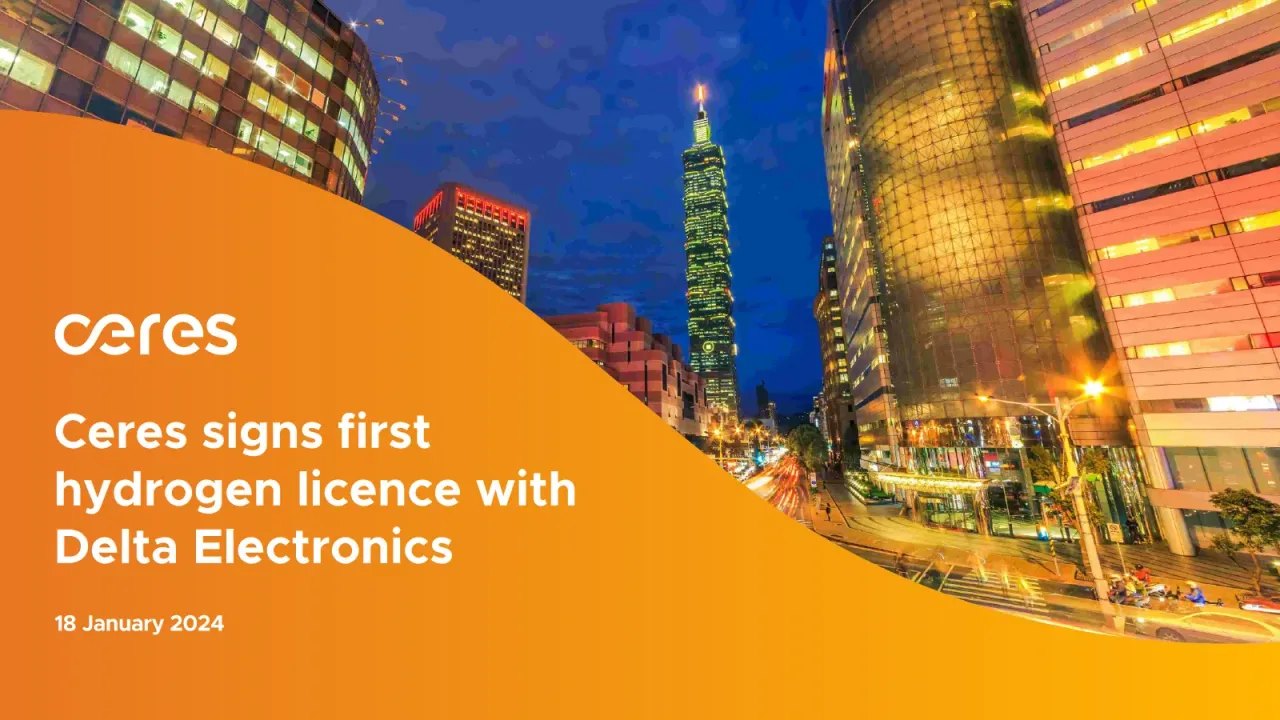
0:00 Good afternoon, and welcome to the CERES POWER HOLDINGS PLC Investor Presentation. This is recorded short update meeting. Today, investors will be in listen only mode. Questions are encouraged, can be submitted at any time via the Q and A tab situated on the right hand corner of your screen. Just click Q and A, type in your question and press send. Company may not be in a position to answer every question received during the meeting itself. However, the company can review all questions submitted and publish responses where it's appropriate to do so. Before we begin, I'd like to submit the following poll. I'd now like to hand you over to Phil Cordless, CEO. Good afternoon, sir. Good afternoon. Good afternoon, everybody. And I'm pleased to be joined today by Tony Cochrane, our chief commercial officer, and also Eric Lakin, our our CFO. So it's great pleasure to talk to you today about a new license partner for CERES as we signed our first combined SOEC for green hydrogen and SOFC license with Delta Electronics in in Taiwan.
0:58 So let's just go into a little bit more detail on that. So this is a long term collaboration as most of our our partnerships are, and this is for sell and stack production. So this is a manufacturing license. The agreement itself is worth an initial 43,000,000 in stage revenues, and that includes the technology transfer and the manufacturing license. In addition to that, there may also be some hardware provision as well. The technology instruction and factory construction will actually start immediately. I was obviously with Delta the past few days. And, actually, they've already got the the factory shell ready to go, which is quite interesting.
1:48 It's over over three three stories because land is at a premium in in Taiwan. And we're probably gonna start the technology transfer next week, really. And it's quite rapid as well. So initial production is expected to start by the end of twenty twenty six. And, you know, Taiwan is a a powerhouse of manufacturing. When you go there, it's it's incredible to see. You know, you've got all the the semiconductor fabs and the Delta's capability in terms of of manufacturing. So we're really excited about this this partnership. I'm gonna say a few words about the financial implications before I hand over to to Tony who'll who'll give you more insight into Delta themselves and the partnership.
2:35 So as I mentioned, the total value of transaction is 43,000,000 technology transfer. So it's high margin license revenue for us and engineering services over three years. Of the 43,000,000, approximately half of that is expected to be recognized as revenue this year. And what that will mean is already we'll have line of sight to contract approximately 40,000,000 this year. So around double the revenue that we did last year at this early stage in January. So we're looking at a very strong start and probably a very, very strong 2024. As I mentioned, there's upside of additional revenue from StackSupply over the three year period.
3:21 And then as always, royalty streams are baked into the agreements following the production launch and the commercial stage from what's already contracted as the royalty fee. So that's the financial implications of the deal. I'm gonna hand over to Tony to say say some more about the partnership. Thank you, Phil, and good afternoon. I don't know how familiar Delta is in terms of a household name, but Delta is a very reputable company in the business to business world, especially in the markets such as data centers and clean energy and efficiency of devices, globally.
4:06 They they produce solutions for a number of markets. And, of course, one of their core competencies is their ability to manufacture at scale in some of the, low cost regions of the world, such as Taiwan, Thailand, China. And, they have about 80,000 employees, distributed worldwide. Obviously, there's a strong footprint in the Taiwan and and regional area, but their facilities span the globe, Europe, US, all across Asia. And their sales channels are are are very strong into all of those markets. They they've very diversified company, but if you look at their portfolio of products, it's very focused around solutions for smart buildings, energy infrastructure, grid balancing, efficient energy storage, efficient energy conversion, which aligns quite well with the type of business that they're investing in now.
5:05 They also have a culture of very strong decarbonization, low carbon type technology investments. And, that is part of the DNA of the company, which is very well well aligned with some of the values that CERES brings to the table as well. Specifically though, why why does Delta make such a strong partner for CERES and for the deployment commercialization and scaling of our technology? Well, they have some of the same ingredients that we found in some of our other key partners. So first of all, they have a global footprint, good channels to market in the types of markets where our technology is most suitable. They have a a portfolio of products that complement ourselves and stacks, meaning they do power conversion devices at very high efficiency and very low cost.
6:00 In fact, if any of you are running this, this video on your laptops, there's a good chance that your laptop is being powered by a Delta power converter inside. Ladies and gentlemen, just check that we can hear Tony there. I like we just lost him for a moment. Bear with me one second. We've lost Tony, I can take over the slide. Please, if you would, Phil, and we'll just come back in. We should confirm he's back through.
6:45 Okay. So, you know, Delta's aim is to to be a leader in Taiwan's energy transition. Taiwan's energy mix actually needs to be cleaned up as well. They have quite a high high constituents of coal in their energy mix. But also when when you you see see these big semiconductor fabs as well, there's a there's a lot of power that has to be built just just to service that part of their economy as well. Delta's gonna integrate our technology into a variety of their products, and that's Tony what was just talking about. They're obviously big in the ICT sector. You know, they supply people like Microsoft. They do charges for Tesla, etcetera. And this technology is very synergistic on the fuel cell side in terms of power applications.
7:35 They're targeting customers worldwide, you know, a myriad of sectors, and that's why it's an SOFC and an SOEC license, decarbonization of chemicals, energy, transportation, steel, and more. And they have very strong relationships with some of the big industrial groups in in Taiwan as well. I was there, as I mentioned, just yesterday, actually, and they've, you know, they're establishing a net zero science laboratory. That means they've already laid foundations, which I saw for actually electrolyzer testing at Tainan. And they've got a very sophisticated infrastructure set up there already, ready to go on this as well. And their energy solutions will support the estimated global demand of hydrogen, which we've talked about many times before, which is 223,000,000 tons in 2030 and six hundred '30 six thirty million tons by 2050.
8:33 And I think this is another example where if you look at the demand for hydrogen and green hydrogen, you know, it far out outweighs the the current capacity or even the current small handful of players in the industry. And that really plays to CERES strength as a licensing model because you should expect more more new entrants such as we're enabling with Delta to come in particularly with the CERES technology. And I think we're uniquely positioned in the industry to enable new entrants to come into this sector. In terms of evolution of royalties, obviously, it's just starting now, but it's gonna be quite a quick build. But, obviously, we have two factories coming up on stream this year with Bosch and Doosan nearing completion.
9:29 And Delta will be hopefully completed by the end of twenty six. So that's consistent with our our our business model in terms of the royalty progression. So in summary, it's our first dual license partner, which is fantastic considering that we've met you know, we made the decision to invest in electrolysis just over about three years ago. So it's quite rapid progress that we've made, and this is a big endorsement of that strategy. You know, they bring strong capability in one of the world's leading centers for high volume technology manufacturing. I think the Taiwanese are are famous for that. And they've they've got this global footprint, as Tony mentioned. They've got facilities and people in China, in Thailand, in Taiwan, in The US.
10:19 It's a significant partnership for us in terms of its monetary value of 43,000,000. And, you know, we couldn't start '24 any better, really. It puts us in a really strong position for the for the year ahead, and we we've got a growing and strong pipeline for both s o e c and s o f c. So we're we're delighted to to announce this partnership today. And I think with that, we can probably go to the q and a. Fantastic, Phil. Thank you very much, and thank you to the team. Ladies and gentlemen, do please continue to submit your questions just using that q and a tab tab situated on the right hand corner of your screen. But just while the team take a few moments to review those questions submitted today, I'd like to remind you, recording the presentation along with a copy of the slides and the published Q and A can be accessed via your investor dashboard. As you can see, we received a number of questions throughout today's presentation. I'd now like to hand you over to Elizabeth Scout, Director of Corporate Communications to host the Q and A. Elizabeth, if I may just ask you to read out the question where appropriate to do so, direct it to the team, and I'll pick up from you at the end. Yep. That's great. And thanks to the team. Hi, Tony. Are you are you back with us now? I just I believe so. Yeah. Brilliant. We can hear you. So perhaps I could direct the first one to you. Good questions come through asking, will Delta focus more on SOFC or SOEC, and which will they start with initially? Could you could you explain that for us? Thanks.
11:39 Yeah. The the contract isn't prescriptive on focus. It's it's flexible and so will the factory be. It will be able to produce to to supply either markets. Our expectation though is the fuel cell opportunity will come first, but the SOEC, electrolyzer opportunity, is understood by them as a bigger market opportunity, but it may take a little bit longer to scale in that market because of some of the proof points and some of the more conservative industry attributes. So my expectation is that the fuel cell market will will will be provisioned first, But there's no there's no prescriptive contractual obligations to do it in that way. Great. Thanks, Tony. And, Eric, perhaps I could come to you this question here in terms of how high will the royalties be percentage wise or is an absolute per per megawatts?
12:33 Could you just explain that for us? Yeah. Sure. So the the license rate we've signed with Delta is very similar and consistent with that with Bosch and Doosan. So the the royalty rate, the guidance we've given previously is in the range 50 to $100. You could now say that's 50 to £100 with with inflation. It's in that range. We won't give details, obviously, for commercial confidentiality, and it and it depends whether it can vary whether it's fuel cell or electrolyzer and some volume breaks as well. And so you've actually apply that multiple, so the sort of pounds per kilowatt by the future capacity. And that is that is set capacity that's sold on a commercial basis from from 2027.
13:25 Great. Thanks. And and perhaps a follow-up to that, Eric, if I may. Of the the half of the 43,000,000 that we we spoke about being recognized in 2024, what proportion is licensing revenue and what is engineering revenue? Yeah. So I won't give the exact breakdown, but the majority is licensing revenue. And of the of the 43,000,000, if that is you get of the license revenue, there's a significant element which is upfront, so technology transfer. There's an ongoing element which is what we call development license. It's recognized over time over the three year development period, '24 to '26, the same with engineering services. So I saw the question around the the phasing.
14:10 So what we've said is the of the 43,000,000 around half, we expect to be recognized this year. And the balance we expect to be recognized roughly evenly in 2025 and 2026. And that is the the and again, the majority of that residual is is license development license fees with a small element paying engineering services. Great. Thank you. And there's a couple of questions here which are around IP, if I can come back to you to Tony. But firstly, someone says congratulations guys on a great start to 2024. So thank you. And the question around IP is kind of how certain we are that our IP is protected and you know, partnering directly with the tiny Taiwanese company, are we confident that that we're protecting IP? And how how do we do that?
14:59 Could you pick that up for us, Tony? Yeah. Sure. Obviously, we provision IP very carefully and judiciously. We have very strong contractual provisions, but they don't in of themselves, fully protect you. There are some supply chain protections, on some of the materials and ingredients that go into the parts, which allow us some control of the IP and misuse thereof. And, of course, we don't share how we design or why we design our products. We deliver a design, and all the insight and knowledge of the design itself is something that CERES and CERES alone retains. And that is in of itself also quite a strong IP protection mechanism.
15:46 And then the the last tool is partner selection is important, and we tend to pick partners who have a lot to lose outside of their domestic region. In other words, because Delta has a very strong global footprint and business all over the world, obviously, if there's a misuse of our IP, we have recourse, in a number of other regions other than perhaps the regions that you might be concerned about. So it's a multilayer process for us, and, we think about that long and hard as we choose our partners and how we deliver the technology. Fantastic. Thank you. There's lots of great questions coming through, so I'm gonna try and do them justice. There's there's one here, Tony, perhaps for you asking, will Delta build electrolyzers on their own or would they just produce for other companies?
16:42 I guess, what aspects of the hydrogen value chain would they be looking to capture is another way to put it perhaps. Yeah. So so Delta, it's a very deep value chain. The electrolyzer module is a component a set of components that go goes around the cells and stacks. And Delta's ambition is to produce the the module itself, so so more than just the stacks rather than just a component supplier. And the reason for that is they have a lot of complementary product lines. So they do power conversion devices. They do thermal management systems. They do controls. And their intention is to have a very high portion of the value as a result of those complementary product lines. So they'll be their target is to deliver electrolyzers and ancillary components to a site system integrator in the market.
17:35 Great. Thank you very much. And and and look, there's there's loads of questions coming through. So I think we should just address it head on. Perhaps I can come to you, Phil, regarding the Weichai Bosch deal for China. Mark asked an interesting question. He says, sort of considering the speed at which this deal has concluded, why is the Weichai Bosch deal taking so long to bring to fruition? And still on the table? Perhaps you can just pick that up for us. I can comment on the speed. Look. Two way deals are a lot easier than three way deals. And, also, I think Delta's appetite is is very strong to get going on this strategically as well.
18:23 So I think, yeah, the the contracting of of the three way deal, obviously, was quite quite involved and took a long time. Look. We're not gonna give an update today on on the Bosch Weichai relationships. I mean, I look. I've in Taiwan. I've also been in China as well. One thing I can say is our relationship with with both our our our key partners in Bosch and Weichai remains very strong. And and, obviously, we're we're looking at moving forward with our our China strategy as well. This does not interfere with what we're gonna do in China, I think, long term. This is a standalone deal, and I think you gotta you gotta think about this in terms of, as I mentioned earlier, a very strong partner both in terms of their product lines and also in terms of their manufacturing capability and also with a very interesting home market, but with a global a global view as well. So think of this as a separate deal rather than how it interacts with with the China strategy.
19:29 Great. Thank you. And, Tony, perhaps I could come to you, and there's a good question here. Should we consider the Delta deal to be wholly around stacks production, you you know, know, for fuel cell and electrolysis? Or or will Delta also be making ready to use products, supplying stacks to others to make systems? How's how's that gonna work? Yeah. So they have they have an option to do both, to both integrate stacks into their own product lines and also to supply stacks to third parties for for perhaps a global demand for stacks into other system integrators. The way the way the factories reward you tend they tend to reward scale.
20:17 And so that optionality was quite deliberate because the bigger fact the factory you build and the more capable a manufacturer you are, you can find multiple channels for that stack product. And Delta understands that very well. They're motivated to not only scale their own business, but perhaps offer others an opportunity to procure stacks from them and, and and add other product lines to this capital investment in the in the factory. So I I believe both will happen, but the first step will most likely be a delta focused step with their own product, their own electrolyzers, their own fuel cell systems. And as they scale, they they will likely make stacks available to others under the appropriate commercial terms.
21:04 Fantastic. And you may all have comments to make on on this question, but perhaps I could come to Phil first. With existing partners, Bosch, Doosan, and Delta, how much capacity do we expect that we can start to capture in in royalty terms by by 2030? Could we could we expand a little bit on sort of that ambition, I guess? Yeah. Look. I mean, it depends whether you're talking in fuel cell terms or electrolyzer terms, but, you know, we we're looking at multi gigawatts by by 2030. And most partners start off with with building blocks and then hopefully scale from that point. If if if you're gonna make an investment like this, the license fee is obviously significant to us, but it's actually only a a small part of the total investment that goes into the into the building of a business, a whole new line of business. So most of our partners have that kind of ambition.
22:09 And I think if you think about, you some know, projections out there that we're gonna need about 300 gigawatts of electrolyzers every year from from now to 2050 to hit the targets that are out there, you know, even even having multi gigawatts under license by 2030 is is pretty pretty small market share. I mean, we believe in electrolysis, which is new for us, you know, we're one of only probably three or four credible SOEC players. So we expect to have, you know, market share of, you know, 30% would not be unreasonable, and that's the way we think about this. Fantastic. Thanks. And there's quite a long question here, which I'll I'll try to do justice to.
22:58 Kenneth says, on a wider scale, CERES has reacted today in the market like a biotech with a successful drug trial. But CERES tech and use cases are not uncorrelated in commercial terms. The more licenses or plants CERES's adds values and reduce the risks for all our partners. You agree? And how does this manifest itself for existing and for potential new licensees? Maybe I can comment on that. Look. I 2023 was a very frustrating year for us. And that's because the wider technology sector was down because of interest rates. And then the hydrogen sector was also down because of some frustration around delays into final investment decisions and these kind of things.
23:51 And we've often traded in line with a basket of stocks. So people think of us like a hydrogen production company. We're not. We're a technology business, and I don't think that we're fully recognized or rewarded for that. And I think, you know, we've seen fairly negative views on what we're doing recently despite the fact that we won the McGrawis award last year, despite the fact that we've just stood up, you know, world class electrolyzer technology. So when we actually do actually deliver what we say we're gonna deliver, I think you you see this this reaction. A bit like a biotech is an interesting point, but I think it's just a reflection that company is, in my opinion, undervalued right now. I mean, we're at a share price that we were at before we had the investments of Weichai and the investments of Bosch, and we've stood up two factories already.
24:44 And we've got the collaboration with Shell, and now we've got the collaboration with Delta. And we're gonna add more partners, and I think CERES is gonna surprise people again and again. So the reaction today is, for me, is very pleasing. I think, unfortunately, UK stocks were a record low discount compared to US stocks. And I think I think the market's not quite functioning as it should at the moment. And I think as long as we continue to deliver and interest rates start to come down and we deliver on what we said, the the the share price should get back to a sensible level where it was. Great. Thanks, Phil. And you picked up an interesting point there mentioning our our relationship with Shell. There is a question here saying, we affected in any way by this sort of market announcements that Shell has put out around pulling out of hydrogen?
25:40 Perhaps you could just touch on that briefly. We obviously have an ongoing relationship with Shell. I'm not quite sure that Shell said they're pulling out of hydrogen. I think where we're focused very clearly, and I I think this is why I'm confident we've got the right strategy is what we're focused on is industrial decarbonization. And if we do nothing else, we have to replace gray hydrogen with green hydrogen. And and then when you think about industrial decarbonization, fuels in the future, steel, ammonia production, even if you just green hydrogen as a pot a feedstock, then then that's gonna be necessary for these industries to decarbonize. And I think that that's the area that Shell's interested in, and that's that's our primary focus.
26:30 And that's where this technology has a 25% OpEx and CapEx advantage compared to everything else. And And that's why you're gonna see more and more interest and more and more deals in SOEC in the in the coming months and years. Great. And there's perhaps a couple of quick ones for you, Eric, if I may come to you. Quick one, was there ever a question or discussion of Delta either investing in CERES stock or CERES investing in any type of joint venture? No, this is a straightforward, but well, more bilateral license deal. So no no no joint venture or separate entity needed nor nor investment in in CERES stock. So no no no no plans for that. And I don't know if you can comment a following follow-up question. Is is the 43,000,000 actually US dollars, I'm assuming, or Taiwanese dollars?
27:30 Yeah. No. It's convert it's it's pound sterling. And also I can add that it's the the pricing and fees are set in sterling. So there's also no currency risk for us on that either. Brilliant. So there's just a few questions as well. If I could come back to you, Tony, just really in terms of the outlook. Another person congratulating us us on today's deal, but also saying, you know, are you able to share a a sort of forward view on on the pipeline and what else might be, you know, in in in discussions for either solo kind of SOEC or or SOFC deals. Yeah. Look. I'll I'll build on what Phil said, but I can't say a lot more than has been said already in that, you know, this isn't if you look at our forecast and you look at our communications, this isn't the last deal of the year.
28:26 We have ambitions to add to the licensee portfolio that we have. And even, you know, within a year, there's there's obviously confidence that that that will happen. What I can speak to though is that the the industry has really woken up to solid oxide electrolyzers as an enabler of some of the financial decisions that were falling apart with other technologies. And what I mean by that is, you know, the the industry got a bad, a little bit of a a bad signal by a lot of these FIDs falling apart because of incremental risk or or increased financing costs. And what the technology like solid oxide electrolyzers do is they bring those investments back into play.
29:14 And I think the industry has woken up to that recognizing that solid oxide technology, especially for industrial hydrogen, green hydrogen, is really the only viable tool going forward. And therefore, you know, the interest by by Delta is indicative of what I believe a market interest in solid oxide electrolyzer technology. And we're, of course, one of the preeminent players in that sector, and there aren't many. And as Phil said, our ambition is to have 25, 30% market share of of of those opportunities, and that creates huge demand for our technology. And so we're in opportunity rich space right now. Fantastic. There have been an awful lot of questions come through. I think some of them are overlapping with many of the ones that we've answered already. So if I haven't answered your specific question, I'm sorry. We will publish answers to all the questions that have been submitted after today's webcast. Perhaps I could just close out by coming back to you, Phil. There's one question here that's just asking about whether the board is concerned about hostile takeover bids given the reduced share price right now. You know, how are you feeling about the position of the the business and the outlook? That'd be great if you could close out on that. Thanks. We're not overly concerned because I think we've got two strong strategic shareholders in Bosch and Weichai, which I I think would make, you know, a hostile kind of action very difficult.
30:44 I I think, think, you know, as a board, we're concerned with valuation in general, I think, because I think that we don't feel that the company is is appropriately valued at this point. But, also, you know, I've I've learned this over ten years as CEO. You can't look at your share price every day. You just gotta deliver the business. And I think that today's announcement hopefully restores some of people's faith in in CERES in terms of our you know, the strategy that we have is very different from everybody else. You know? The the the margins that we we get from these kind of deals is is industry leading. And and what what we are unable to do again is play in multiple markets, multiple geographies simultaneously by leveraging partnerships.
31:38 So I think as long as we continue to deliver on that, the you we know, will be rewarded for that and the value of the company will grow. And and as ex executives, that's our job is to grow the value of the company. Fantastic. Thank you very much indeed. Elizabeth, is that the final question I think you wanted to run through? Yes. Thanks very much. We'll get to all the other questions on in writing. Thanks. That's great. Thanks for covering those off. And as Elizabeth said, the the team will run through all the questions submitted. Perhaps before redirecting investors to provide you their feedback, which are particularly important to the company. I could just ask you just for a few closing final comments, and then I'll redirect investors to give you their feedback. Sure. So, look, in in conclusion, we're very excited with this partnership.
32:26 We really like the Delta management team. We we like their strategy and their capabilities, so they're a really good fit for us. We're delighted to have a strong start to 2024. 2024 will be a record breaking year for revenues already because we'll double last year's revenue, and we'll build from there. And it's only, you know, week three of the year, and we're working very hard on the commercial pipeline. Now that we've added electrolysis on top of fuel cell, you know, we're staring at a whole new suite of opportunities, And I think our reputation is growing. So we're not reliant necessarily on the FIDs and some of the things that are slowing down or frustrating the rest of the industry. So I think you have to start to think about CERES slightly differently from some of the the pure pure play hedging stocks out there. And I think that we're gonna have a very good 2024.
33:23 Fantastic, Phil. Thank you. Thank you for joining this afternoon. Sure. Thank you very much, and thank you to the to to the the team team as well. Could I please ask investors not to close the session as you'll now be redirected to provide your feedback in order the team can better understand your views and expectations? This will only take a few moments to complete, and that's greatly valued by the company. On behalf of the team of CERES POWER HOLDINGS PLC, we'd like to thank you for attending today's presentation. That concludes today's session and good afternoon to you all.
Follow Ceres Power Holdings PLC into a list and get an email when it puts out news.
CFO at CERES POWER HOLDINGS PLC
CEO at CERES POWER HOLDINGS PLC
Commercial Director at CERES POWER HOLDINGS PLC
Director of Corporate Communications at CERES POWER HOLDINGS PLC
IR at CERES POWER HOLDINGS PLC