Transcript
Automated transcript · Written by software from the replay's audio. It can mishear names and figures; the replay is the record.
0:09 Hello, my name is Anthony Moro. I am the CEO of American Eagle Gold. We're a junior exploration company. We have 2 main assets. One's called the Golden Gate asset. It's located in Nevada. It's in one of the richest districts in the entire world to be looking for gold on the Cortez trend, just south of Gold Rush, which has 50 million ounces. The key to our success and future success is our geologist, his name is Mark Bradley. He helped make the discovery right next door and he works for our team. We're going to touch on how important it is to have great people. We just recently auctioned a property called NAC. It's in the Babayan Copper District in central BC. We're very excited about it. We're going to start drilling there in mid-year this year. And what we see the potential for is another Totoga, another Alpala, an underground higher-grade copper gold large porphyry deposit.
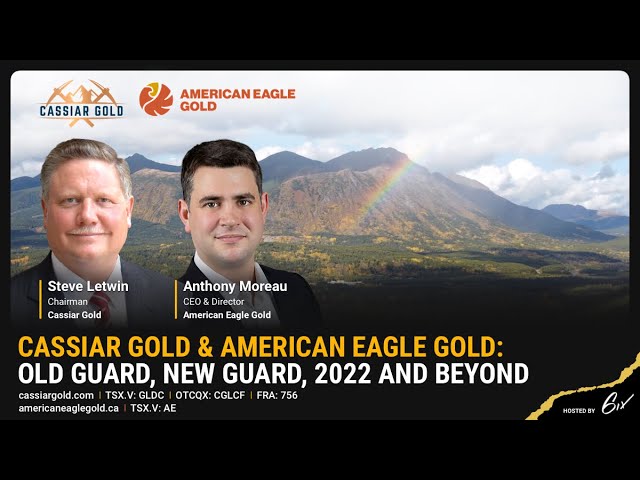
1:04 So we're well on our way with that. We have 2 great assets. What we're going to do here is something a little bit different than what you've probably seen. A lot of times you see webinars, people are going through the presentations. I know with COVID happening and people doing these online presentations for the last 2 years. It's getting a little static, a little bit boring. So we're trying to change it up a bit, getting exposure. It's all about having interesting material out there. And that's why we're doing this format. So With me right now, who I have is Stephen Letwin. Steve Letwin's a dear friend of mine. I worked with him for 10 years. And I thought instead of talking about American Eagle Gold, I thought we'd have a candid conversation between 2 friends, 2 former colleagues about the junior mining industry and about our companies. Both Steve and I work together as well.
1:51 We helped to run 2 junior mining companies and both of them have assets in BC. So there's a lot of correlation between both of our work experiences and our current projects. So let me give a quick introduction to Steve and how we're gonna do this is, I'm gonna talk to Steve. People know about me, a lot of it's the American Eagle Gold followers and with us right now, we also have the Cassiari Gold followers. So I've obviously just introduced myself, but Steve's the star of the show. So Steve Letwin, he worked at IAMGOLD. He was a CEO for 10 years. We started his career, he did an undergrad at McMaster. He started his career in Toronto at Procter & Gamble. Following that, he went to Doan Petroleum. He worked under the tutelage of the legend, Jack Gallagher. He learned a lot of his skills from him. From there, he went to TransCanada Pipeline, he was the COO there, he's an EVP of Enbridge Pipelines.
2:40 Then he ran IAMGOLD, a mid-tier gold producing company, producing over 1 million ounces, And he ran that for 10 years. And that's where I worked with Steve and met him, became friends with him. And I learned a lot from Steve. He built a great culture at the company, extremely generous and very successful at IAMGOLD and helped drive the big Cote purchase, which is a mine that's going to be going to production mid next year. Since he left IAMGOLD, he's been doing a lot of things. He's on the board of Frontier Lithium, but he's also the chairman of a company called Casiar Gold. And Casiar Gold, if you haven't heard of it, I'd be surprised. It's one of the hottest stocks out there. Since September, it's gone from 35 cents and recently hit $1.30. Right now it's trading at $1.15.
3:27 And I believe that's just the beginning. There's a lot of upside for Cassiar. And Steve's gonna talk a bit about that story. So that's my introduction to Steve. And just want to add one more thing. Not only is Steve great on the business side, but he really does give back. He's an honorary colonel. He volunteered for UNICEF, United Way, big supporter of the young mining professionals, an all-around great guy. And I think the real key here is the people. And when you invest in a company, you got to trust the people that are running the companies. So this gives you, the listeners, an opportunity to really understand and get to know the leaders in myself and Steve Ledwin, they're trying to move these ships forward and deliver value for our shareholders at American Eagle and Casio, which Steve helps to run. So Steve, Thank you very much for jumping on this 6th webinar.
4:19 Tony, it's my pleasure and thank you for your kind words. You know, Tony and I met, as you said, I guess it's now 12 years ago. I got a call from the receptionist that there was this young guy waiting in the lobby with a Starbucks coffee for me and I never met him before in my life, but he had done some homework and realized that I like Starbucks coffee So sure enough I went out there and luckily, you know, luckily I didn't have anything booked And here's this young guy full of piss and vinegar ready to work and I thought, give him credit. He did some homework, he bought me a coffee and the rest is history. Very entrepreneurial. Tony, I have nothing but great things to say about him. High energy, very, very strong in terms of his business sense, very intelligent, and I have every confidence American Eagle is going to shoot the lights out. And he's just done a great job there. So Tony, congratulations.
5:23 I want to just tell you that Casiar and Tony and I've talked about this many times, you know, really fits with the 3 key ingredients for success. And it doesn't matter which business you're talking about, but it's people, making sure you have the right people in the right slots, jurisdiction, making sure that the jurisdiction is going to be friendly for exploration and development. And then the property itself. And does the property have the characteristics that will lead to economic development? And, you know, I always had a saying, whether or not it was in the oil and gas business or whether it's in the mining business, you have to be able to show investors the path to NPV.
6:10 If you can't do that, then you're not going to get a lot of traction with the share price or with investors coming into the stock. And at Casiar, we have that 60,000 hectares in northeast BC. It's a huge land play. And as my boss, my mentor and my good friend Fred Mannix, who's just a fantastically successful businessman in Western Canada, in Canada itself. He said to me many times, Steve, don't lose control of the whip. And what he meant by that is that, look, the best way you're going to be able to drive value is to make sure that you can keep control of the asset and move it forward. And at Casio, we've done that.
7:00 And Marco Rock is just an outstanding president CEO highly driven We have some fantastic people David Reese who you've heard about Shirley Anthony who joined us a number of months ago on the marketing side I can't say enough about what Shirley's been able to do, getting the name out there. And on the technical side, we've got people like Orhei Monroy from Hong Kong, very successful businessman worldwide, Michael Witt, Tyler Rice, the list goes on and on. But on the technical side, nothing but the best, world-class people helping us analyze the property and put a program in place. Now, do you wanna say something to, I don't know what the format is? Yeah, no, Steve, I'll touch on that. Thanks for getting into there. So you touched on the, there's 3 main parts of the stool. You have the people, you have the jurisdiction and you have the property, which obviously Cassiar has, we believe American Eagle Gold has. And let's start first off with the people. So when we started our company, American Eagle Gold, we're located in Nevada, we're in a world-class jurisdiction, Cortez trended, it's the future of Newmont and Barrick's future growth.
8:19 But like a Lamborghini, if you don't have eyesight, that Lamborghini doesn't do any value. So you need that geologist, that person that is not only just a geologist, but has a history of success making discoveries. So Mark Bradley, he won the 2014 Thayer Lindsay Award, Prospector of the Year, the PDAC Award. So we'll bring that to you. So who you have as a technical advisor is a legend, Douglas Kerwin. And Douglas actually won the Thayer Lindsay Award in 2004, 10 years before Mark Bradley. So how did you manage to attract Doug Kerwin, Steve Robertson, David Reese, James Maxwell to your company? Because I believe that's one of the big reasons for your turnaround and your recent success?
9:04 It's all about relationships. And my thanks goes out to Orne Monroy, as I mentioned, at Emerging Markets, Marco, Michael Wood. These individuals were absolutely instrumental in introducing the property to Doug Kirwan, to James Maxwell, to David Reese and others who have joined the team. And I'm not hopefully exaggerating, but Doug Kirwan fell in love with this property. He's absolutely enamoured with it. He sees a lot of similarities to other major deposits around the world that he has experience with. David Rees has done nothing but spectacular work around the technical side. Steve Robertson, as you know, had great success and continues to have great success in British Columbia. Balanced, very, very thoughtful businessman, brings a lot to the table. James Maxwell, unbelievable experience, not only on the geological side but on the engineering side. So we are blessed with world class technical help that really has driven the program that we've seen, which I think we hit 4 out of 10 times in terms of the top intercepts in North America in the last year. So the drilling results have been just really robust,
10:35 positive, and has helped drive the stock, obviously. So you're located in BC. Let's touch on the jurisdiction. Our mandate as a company, it's the people, but also it's the jurisdiction. So I personally believe there's really 3 places to be located in the world. It's Australia third, and Canada and the US kind of tied for first. Nevada specifically in North America and anywhere in Canada really is great. Cause as you know, Steve, it's one thing
11:04 trying to make a discovery. It's a lot of work, a lot of money, a lot of effort. It's the next thing, losing that discovery for privatization by a country. Now, can you maybe Give us some light on why you decided that you wanted an asset in BC and whether you would only focus on these safe jurisdictions or you think maybe you would go overseas to West Africa. Well, as you know, I spent a lot of time in West Africa. I spent a lot of time in South America. I spent a lot of time in South America. I spent a lot of time in Asia. I have nothing against any of those continents countries but obviously risk is a factor and where you want to develop a deposit And I think it's intuitive that British Columbia, which is a very, very friendly mining jurisdiction as a province, has been extremely positive with respect to getting our permits. Like we're looking at
12:05 160 kilometers of property access roads. We're looking at a 30 person camp that's in place that's fully permitted. We have permits already in place and in hand for all the exploration that we need to do. We have a 300 ton a day mill that needs some work but can be put in operation very quickly. And we have 500,000 tons of tailings from previous drilling and production that's occurred, averaging grades between 1 and 1.25 grams a ton. And you know this from me in the past, infrastructure access is everything. We're not building $50 million roads to nowhere. We're already on a highway. We have a power line that goes through the property.
12:52 The deposit's open in every direction. It's perfect for building a very economically attractive mine. And in terms of overburden, which can really eat your lunches, you know, we literally have no overburden in North Casio. It's 15 kilometers of very high grade bulk tonnage
13:14 that can be mined extremely easily and economically. So do I have a preference of British Columbia, Canada over West Africa? Of course I do because security, infrastructure, etc. Is much much less costly, much more attractive for the reasons that we all know. Yeah, thanks for bringing up the part about infrastructure. You're right. You can be located in Canada, but you can also be in the middle of the Arctic, not close to any roads, et cetera, and you're kind of out of luck. And again, that's what we were focusing on with American Eagle Gold. We're right next to the Cortez facility that Barrick runs, pretty much attached to them, access to road, people, water, et cetera, and the same thing with NAC.
13:59 The old logging area, so everything's clear, and permits are important. You have 2 permitted areas on your property. You know, when we do our drilling in June at NAC looking for that underground copper gold porphyry, we're going to be staying at the logging camp nearby which helps expedite those permits. So just as important as infrastructure, which helps you get your permits in the end. And I think without mentioning Chris Stewart's name, who's been on the board for some time, just outstanding guy, you know, new CEO of Minto, who is in the North. He understands the mining business like the back of his hand. He's been very helpful. And when we did the acquisition of Cassiar back in 2019, you know, he was instrumental in driving that along with my brother, who is chairman.
14:46 And I have to say, I have to give a shout out to my brother who is past chairman. Without him, we wouldn't even be sitting here talking. Great leadership to get us into Cassiar, combining with Sheep Creek. Again, great leadership, great people. To your point, Tony, if you've got the right people, it's going to drive the investment the right way.
15:08 So tell me about this, Steve. When you guys started as Margo Resources, you're a tungsten exploration company, lead, lead and zinc. And then in January 2019, you made the purchase of Casio from Wild Sky. And it was fortuitous timing for you, Steve. January 2019, I think gold was around $1,280. As you and I know, we were at IM Gold for 7 years from 2012 to 2019. Gold did a sideways trade averaging about $1,300. Right after you made that purchase, gold went up. It went to nearly $2,100 in less than a year. Tell us how you made that change and how you came across Casio because it really is a great opportunity and a great property. Well, Tony, there's one guy that we've got to put out there that you and I all know and you work beside and I am gold, his name is Vincent Sun. And if Vincent Sun is listening, he's over in China right now.
16:02 We owe our deep thanks to him. I worked a lot and I spent 3 years in Hong Kong working for 5 Hong Kong billionaires. I set up an office in Beijing for Enbridge. I have a very strong connection with China, Hong Kong and with Vincent's help and assistance and the relationship we developed with WildSky. These are great people. We still have a lot of WildSky ownership. We were able to talk to them about the fact that they had put a lot of money in the cash yard in 2007, 2008, 2009, did a lot of drilling, put a lot of infrastructure in place, and then to your point, gold went sideways, and there was fatigue in terms of putting new money in.
16:50 Call it good luck or good management, but the opportunity came up. My relationships with the Chinese, Vincent Sun's relationship with Wild Sky, my brother's leadership, Chris Stewart's leadership, Rob Dirkert's leadership, Doug Foster, people that were on the board. We were at the right place at the right time and We're so grateful. I'm forever grateful to those people for being the catalyst for the discussions to combine it. And I can't forget about Tyler Rice, who's been with me since day 1 on Margo. Just outstanding. And Then you combine that with the new management team, Marco Rock, who's just been a great, great catalyst for change and development, bringing Shirley Anthony in and the technical team you've already talked about. We've transformed the company dramatically in the last couple of years and in a very positive way.
17:53 Yeah, when you guys purchased Castiar, you had over 1.04 million ounces of gold at 1.5 grams per ton in situ value, well over $1.3 billion. It's funny that no one else had it, but I was always wondering how you guys got it. Was there a shoe to drop? But then when we made the purchase of NAC, what I realized is there's a lot of great assets out there. A lot of people get afraid. They see previous people had it, maybe it's not worth anything. But quite frankly, a lot of these great projects, these great properties have been owned by 5, 6 different people. It's about having the right geologist in place. And when we purchased NAC, like all of our decisions, it was data driven. And what we had there, they had a lot of data, they had 18,000 meters of drilling there. They had geophysics, geochem, the drilling as I mentioned, but none of the data was ever digitized, no 1 ever interpreted it. And what we
18:44 did is re-reinterpreted and we actually compared everything. And when you look at data sets of Geochem and Geophysics, which we eventually saw a giant geophysical signature, if you have 3 coinciding anomalies, that's a sign of potential success. We had 5. So we just went right ahead and we didn't care what our stock price was at the time because we believe that there was a lot of upside at our property and we made that acquisition. I see a lot of parallels with what happened at Casio. You saw a great opportunity with Casio when you're at Margo. Your stock was trading at around 8 cents at the time but it was an opportunity you couldn't pass up and you went and took the risk and made that acquisition. And now your shareholders are really benefiting. So I want to congratulate you on that leadership. Well, I have never, I mean, Tony, thank you for that. You know, you do learn from people you work for. I did work for the great Jack Gallagher.
19:36 I worked for Pat Daniel at Enbridge, a fantastic leader. And you know, all of those leaders had big skin in the game. And I can tell you one thing, I've been involved with Casio now for 8 years. I've never sold 1 chair. I'm the largest independent shareholder of Casio. And I'm proud of it. My brother was a big holder. So you gotta have skin in the game. And when you have skin in the game, like I do, like others do on the board management team, you wanna add value because you've got your own money in. And I'm very proud of that. It was the same at IAMGOLD.
20:18 It was the same at Enbridge. You've got to demonstrate to investors that you walk the talk. And I know you do that as well. I know your management team and board does that. And investors look hard at that. We're not just all talk, we put our own money in. There's been a lot of buying done by insiders at Casio because they see great potential. And I know that's the case with your company as well. Now, Steve, a smart man once told me that the best fertilizer is really the footsteps of the farmer. Now, we have a lot of listeners here. Some people follow CastSayer. Some people follow American Eagle Gould. So let's take them on a bit of a visual journey. So first of all, for us, when I went down to Golden Gate, you go down there, and you put your foot on the sand, you're really in the desert.
21:08 But what you look when you look north is you see this giant complex. You see Gold Rush. You see all the barrack properties just north. And how far we are from Gold Rush is the same distance as walking from the Empire State Building to the World Trade Center. I know we've been in New York together. So when you're down there and you really understand how close you are to the infrastructure, to these giant mines, it really does get you excited. So I really try and take people on that same journey. Now, for Casier, you guys have 60,000 acres, you've only explored around 1% of your whole property.
21:40 Now take people on a little visual journey of what it's like there, 200 kilometers north of Red Crest when you go down there, because I know you go down quite a bit. Well, as you know, I'm a huge, I learned that from my father, and my brother knows this. You know, we grew up on a farm in Southern Ontario, a small, really cash farm that was, we were in partnership with a doctor from Buffalo with a much larger farm. But my dad always used to say, you got to walk the property to understand the property. So made 47 trips to West Africa when I was at Iron Gold, made over 60 trips to South America. And with respect to Cass Yard, we do the same thing. You've got to walk the property. And one thing I will tell you about this property is that It's very accessible.
22:32 It's about a 5.5 hour drive from Whitehorse. You can drive there easily given the road connections that we have. So we're not flying in, helicoptering in. We're not in any kind of danger with attacks from people in Northeast BC. And you know, let's remind ourselves again, British Columbia is one of the best mining jurisdictions,
23:00 not just in Canada, in the world, in the world. So we are blessed with a great property, great access, and you're absolutely right, we walk that property all the time. And we're always looking for opportunities when we walk it. We've got a great Northern exposure with the bulk tonnage, over 1Moz, as you said, and then the South side where Doug Kirwan's really excited in Table Mountain, some fantastic narrow vein opportunities where we've produced 15 to 20 gram a ton gold in the past, about 500,000 houses. Just great expansion opportunity. Yeah, that's great. And especially with Taurus, with the bulk tonnage and then the high grade and the south, you guys have a huge opportunity.
23:51 Now a question I have for you and maybe some advice is one thing having a great geologist, a great property, the next step is really trying to get that exposure. You can sell, you know, dollar ounce, sorry, you can sell a gold at the top of Mount Everest for a dollar an ounce, but if no one's around, you're not gonna sell any. Sometimes I feel like kind of batting my head against the wall because I think we have a great property and a great company, but it's about getting that marketing exposure, have people learn about you. Now, you guys did the CastCR purchase in January 2019. That was 3 years ago. It really took until September 2021 to really start having people know that you guys are out there. From September 2021 till now, you guys have more than tripled in size. So what is your secret sauce to finally getting that recognition? Because you guys had a great property for a long time and nobody seemed to know. I feel like we're kind of in that spot right now.
24:45 Well, I'm gonna give credit where credit is due. It's the people that came into the company. Marco Rock, Shirley Anthony, the technical people we've already talked about, my brother Jim who was a partner in a marketing company in Eastern Canada. Without the changes that we made, and we needed to make them because we needed people that were going to be able to communicate the story in a much more effective and efficient manner than we had been doing it in the past. And I put my hand up as somebody that, you know, I was CEO of Ion Gold and Ion Gold came first. And my brother was instrumental in making sure that we got that that young management team in place and one of the titles on this is old guard and versus new guard your new guard Tony I'm old guard and we brought new garden I mean I'm hopefully not sounding like I didn't know what we were doing, but the energy that came with Marco and Shirley, with the people that Jorge Monroy bought, Michael Wood,
25:59 that brought into the company the James Maxwell's, the David Reese's, you know, what I would call the new guard into the company was like new blood. And as I say, I like to give credit where credit is due. The change in this company had nothing to do with me. It had to do with the people that we brought in at the time of the Casio purchase. And they were absolutely instrumental in getting the message out in a very clean, transparent way. And the drilling results obviously were very robust, very positive and complemented the message. So my hat's off to the new team. So we formed the company working at IM Gold for a long time, with you working at M&A.
26:51 We wanted to create a company, we wanted to make a discovery. And I don't lie to investors. Investors ask us if we're planning to produce someday. And quite frankly, Steve, I would say it's Probably not. We have smart geologists. Our job is an exploration company. We want to make a world-class discovery, create a liquidity event, and a chance for our investors to make a lot of money, create shareholder value, and exit. So being a CEO of IAMGOLD, a major mining producer, What kind of things were you looking for when you guys looked at junior mining companies? What was attractive? Were there certain milestones they had to have, certain amount of gold resources in the ground? And can you explain that? STEVE DEL GAETA Very similar to Cote, which is transformational for Iron Gold. Looked at the size of the land position, looked at the access with respect to infrastructure, looked at the history of drilling with Casiar.
27:47 There was absolutely a huge amount of core that hadn't been assayed. There was a lot of money that had gone into the deposit that hadn't been crystallized in the form of assays and we knew we had a huge inventory of opportunity. And if that inventory happened to turn out positive, then we had ourselves a great value add opportunity to acquire it. And to the credit of WildSky, they saw the opportunity that was there with us. A new team, able to raise money, able to do the exploration follow-up that they hadn't been able to do. And again, easy access, virtually no overburden, 1 million ounces that we thought for sure was verifiable and more.
28:38 I firmly believe that the bulk tonnage side, the North Casio side has upwards of 3 million ounces. In terms of the South at Table Mountain, I don't have the expertise obviously, you know Doug Kerwin's forgotten more about mining than I know and When Doug somebody had done Kerwin who has the respect of everybody in the world in the geological world When he gets excited like he has been about Table Mountain, it just gives me goosebumps, because it tells me there's a lot of upside there. And it has a proven history, upwards of 500,000 ounces mined in the past at very high grade. This didn't escape us. So you put all that together, Tony, and the acquisition that was made, the combination that was made really with WildSky was a win for WildSky and a win for Margo at the time to create the new Casio.
29:36 Thanks, Steve. Now, taking a step back, you're formerly CEO and president of IAMGOLD, major mining producer, and now you're the chairman of Casio gold, a high-flying junior gold exploration company. Tell us the difference of going from a major miner to a exploration company, and what kind of skills you took from being at a miner, what challenges you had, what you've learned so far. Well, The first thing you have to realise with a junior is that you're not going to get the attention that you're looking for unless you've got outstanding drill results. There's no substitute for grade. We know that from our days at IAMGOLD.
30:22 When we started to see the drill results come in at Cote, it was transformational for IAMGOLD. It's no different here. You know, I'm chairman of the company and my job as chairman is to make sure the board is well populated with great people. We've done that and to make sure that the CEO and CFO And the management team has the tools they need to move the project ahead And so my job has changed quite a bit. I'm not on the front line, but I'm there to help I'm a conduit for Marco for Shirley You know for Tyler for the team to put all the pieces together and again we've got Steve Robertson on the board, Chris Stewart on the board, and others that have great experience, bring that to the table. Great advice from David, great advice from James, from Doug, et cetera, that drive us in the right direction. So I think we have all the ingredients there for success.
31:25 I think we're seeing that and, you know, news at 11, our next drilling program, which I think is going to be more robust than last year, will start putting the icing on the cake. And our job is to create a property in a jurisdiction with the right people that is attractive, probably for others of bigger market cap to maybe see that, invest in it, and bring it forward as an economically attractive mine. Are you taking it 1 step at a time in terms of your strategy, whether you want to position yourself for takeover or eventually become a producer? Because you're in a unique situation where you were working for a producer. So what's your take on that? I've seen so many juniors who maybe get in over their heads, get over their skis.
32:17 And I guess I learned the lesson that you need to be big to be able to build a mine of any size or consequence. You need a balance sheet. You don't want to be putting your investors in harm's way by stretching your balance sheet. Cash is everything. And you never want to run out of cash, obviously, and put your investors in a squeeze. We will be extraordinarily careful about making sure we don't get we don't drink too much of our own whiskey. You've heard me say that before. We're going to get the help we need to move this mine in the right direction for our shareholders. The shareholders are everything to me. I'm a huge shareholder.
33:05 We're not gonna do anything that materially dilutes value. And we're gonna make sure we have the right support financially to be able to bring this mine forward.
33:16 Yeah, that makes a lot of sense. Look, when you look at the, even the major mining companies out there, it's hard for them to even build a mine on time and on budget. So you want to stay in your own lane. You want to do what you do well with the Casey Gladwells, the Mark Bradleys, the skills that we have, which is to find that giant deposit and position yourself for success and shareholder value, which is eventually a takeover, and find that 3, 5, 10 million ounce deposit that I think American Eagle Gold and your company will also have in cashier gold. So Steve, a couple more questions for you. Long-term, where do you think the price of gold is going? I know a lot of people get these questions, but I'm just interested in your answer. Yeah, and when you answer that, and you mentioned the name, I wanna just reinforce Casey Gladwin, who put us through a very rigorous drilling program last year.
34:09 He's moved on, or is moving on. I just want to give a shout out to him. He was outstanding. On your question on gold price. I mean you and I've lived this When I started that I am gold You know gold went from 1100 dollars an ounce to 2000 dollars an ounce And You know there was euphoria all over the place and then it dropped back down you remember this I do December 15 2015 it dropped to 1057 dollars and This comes back to my point about a balance sheet You've got to have a strong balance sheet and gold is very unpredictable.
34:51 I'm like Rick Rule right now, who I have a lot of time for. I have a positive outlook for commodities, especially gold and silver, copper. I think these commodities are extremely undervalued right now. I think juniors are trading at unbelievable discounts. Mid-tiers are trading at 50, 60 percent discount to net asset value. It's insanely cheap. So to answer your question, I think gold, given the fact that we continue to print money, the world debt levels are beyond belief. I don't need to tell people on the line what that looks like. But you take a look at the US, it's printed 5 trillion dollars in the last 2 years It's it's mind-boggling.
35:36 So I think Fiat currencies are under pressure. I think gold has been a very, you know for 3,500 years It's been a great backstop for that. I think it will continue. Crypto's out there as a competitive investment for probably the younger generation. That's not to be overlooked. But gold, I think, is gonna hold its own, and I think Gold has the potential to go up through $1,900 towards $2,000. But just let me say it again, you can't count on it. We've all seen it go the other way. You've got to have the balance sheet to withstand this volatility and stay at the table. And if you can stay at the table in the gold business and be there for when you're gonna have the runs that we've seen in the past, shareholders will make good money.
36:29 Yeah, Our company, we always have a plan. Always leave yourself 12 months of working capital and you're backwards a plan in from there. You wanna make sure you stay alive and you keep on exploring. I thought it interesting you brought up crypto. My take on the price of gold, I can't see it staying down for much longer, especially when you see the general market going up the way it is. You got to figure people have to diversify. And like you said, gold's been around for over 3,500 years. And it only makes sense to take some of that money out of the market off the table and put it in some safe assets like gold. And then now once you combine cryptocurrency, just the infrastructure behind it, which is blockchain, and you put it into gold, and all of a sudden, if someone buys now, it's a gold that is their gold. And now you have the ability to pay for a cab with gold and actually spend that gold.
37:16 So once gold starts to have that functionality, I really do believe gold can start going up the same way that we've seen Ethereum and those cryptocurrencies going up. So long story short, I'm very bullish on gold. I think $2,500, $3,000 isn't too long on the horizon. It's easy to see that as being a big hurdle to pass right now, but as you know, things just change overnight. Gold went from $1,300 to $2,100, 45% increase in just a year. So you can easily see that again. And 50% increase from where we are right now is around 2,700 bucks. So I'm very confident long-term. Now, Steve, we've taken almost 40 minutes here. We have a couple of Q&A questions, which we've told the crowd that they're welcome to ask. I believe we just have 5. So do you mind if we just lightning through them? And we can answer them all.
38:07 OK, so the first question was about the price of gold. We answered that. So Harvey Matthews, you have your answer. Jeremy asked, what's your expert opinion? What do you think major mining companies are looking for in junior exploration companies? You touched on that. So Steve, thanks for answering that question ahead of time. So Tom, what is a 12-18 month plan for Casio to drill out a resource of 2 million plus ounces and sell the company or there is no or. So I guess to shorten that, Steve, what's the 18 month plan for Casio right now? We're gonna have a much more aggressive drilling program based on the results from this past year, which were outstanding.
38:52 So we've got some step-out drilling to do, additional step-out drilling to do in the bulk tonnage area. We have endless opportunities at Table Mountain, which is South Casio. So, you know, depending on what availability we have from our financing, you know, we drilled about 11,000 to 12,000m last year. I know Marco and the team would like to see that at a minimum doubled or higher. We've got all the challenges that you have and others with labour, with drilling opportunities, in terms of contract drilling opportunities, But we think we've got a good handle on that. And so I would just say, we take it 1 step at a time and we're not out there, I would say, trying to sell ourselves.
39:43 We have attracted a lot of attention. There are a lot of interested parties in Casio without breaching confidentiality. We have gotten the attention of some pretty large players because they're seeing the results. And we're in the best jurisdiction in the world with great infrastructure, why wouldn't they be looking at it? So are we going out there and aggressively trying to form partnerships? I would say We definitely are out there, but our major focus is to add value for our shareholders through the drill bit. And that's going to be our big focus in 2022. Thanks, Steve. The next question is from Eric Langlois. That's actually for me. So I'll say the question, then I'll give the answer. You asked what the strategy is for 2022 for American Eagle Goals. So just touching what Steve said, it's one thing doing the marketing, it's all about the results. And as you saw with Castier, they're hitting great results. So they combine that with marketing and people really start to pay attention. They're buying the stock, stock goes up. So our plan, we went public in May, our plan has always been to drill at our property at Golden Gate. And we started drilling in December. It took a bit of a break for the holidays, But we're drilling. We're 350 meters in the ground.
41:02 And very soon, we're hoping that we're gonna get into lower plate rocks, the carbonates, where these Carlin type mineralizations like Gold Rush next door tend to be. So very soon, we hope to be providing updates. And after that, we'll be sending assays out. And as you know, Steve, these assays are very backed up. So by the time you send them it's about an 8 to 12 week wait to get your assays. I don't know how how you are with that but we're seeing a lot of backup especially in the Nevada area. Yeah, seeing the same thing. And as well we don't want to be a one-trick pony. We want to diversify ourselves. And that's why we went after NAC. It was a data-driven decision. It was helped by a geologist who helped to find Grasper, which by the way, is the biggest, most profitable mine in the entire world. We raised 1 million and a half dollars and we'll be drilling in June. So right now we're working on our permitting for NAC. And that kind of leads us to the next question. I guess that's for both of us and specifically on the First Nations in BC.
42:00 And Sean asked this, so how are the First Nations issues? So I'll answer it 1st, Steve. First Nations for us, it's all about engagement, being up front and doing it early. We optioned this property off an individual and he's been very close with the First Nations there. And like with all of our companies under our group, we like to consult, we like to engage, be honest and let them know our plans. So we have no issues so far and Steve, do you have any comments that I know you guys are doing a lot of work on the ESG sign? Well, 2 things. The guy that hired me at Dome, Rob Dirkut, also was on our board. He did a fantastic job recruiting key people. He's since left the board. But I have nothing but thanks to Rob.
42:46 And he worked very diligently with Tyler Rice, who is a BC resident. And I don't think there's anybody better at developing First Nation relationships than Tyler Rice. He's got the philosophy that you've got to walk the property. We're in constant communication with the First Nations. And look, you know this as well as I do, if you don't have trust, you don't have anything. And in order to gain trust, in order to develop trust, communication is key, and you've got to do what you say you're gonna do. Tyler Rice is absolutely outstanding at that, And Rod Durkitt did a phenomenal job for us, recruiting people that were like-minded. So again, a great combination.
43:38 We have now Steve Robertson on the board who has just enormous experience with this. And you know, We also, you and I, did a lot of work with Metagami First Nations, flying post at Kote, 7 years of good work with Chief Chad in putting an IBA in place. This wouldn't be anybody's first rodeo. And right at the top of the list for us is the relationship with First Nations. It's important, it's critical, it's just good business and I'm very, very pleased about the relationships that we have. Well Steve, it sounds like you're doing a good job and I never had any doubt. It looks like all the questions are answered. So I'm going to wrap it up. So do you have anything last parting comments you want to make to the crowd, the Casio followers, the American Eagle Gold followers before we let you go? Well, I think American Eagle's in great shape. You've done a great job and you've got a great team and you're making great progress.
44:39 And as far as CASSIER goes, I couldn't be happier with the direction, the leadership, the technical support we're getting right across the board. And we have a lot of people to thank. I'm gonna apologize if I forgot somebody, but I couldn't be happier, Tony. And I really wanna thank you for giving me the opportunity to talk about it today. Yeah, thanks a lot, Steve. So just to sum everything up, I want to thank Steven Letwin, chairman of Castier Gold for joining us, trade on the TSX Venture, GLDC. It's a high flying company. They've had a lot of recent success. They're doing very well. And I work for American Eagle Gold, the CEO. It's a trade on the TSX Venture on AE. Steve, again, is a friend, a former colleague. And the reason why we wanted to chat, we wanted to give people some relevant expertise and conversation on the mining industry as well as the parallels between our 2 companies.
45:37 The most important things of a company, a junior exploration company, I believe American Eagle Gold, and I'm sure Steve believes at Cassiar, is the people, the property and the location. And with American Eagle Gold and Casio, we have all of them. Both of our main assets are located in BC. There's drilling happening. There's a lot of future news to be coming out. So thank you very much for everyone for attending. And Steve, I'm sure you're the same way. If people have any questions, they want to follow up, you can find our emails. Please feel free to contact. I always have time for current and potential investors. And Steve, I know you do too, correct? All the time. So thank you very much everyone and Steve thank you very much. American Eagle, Casio Gold signing out.
46:23 Thanks everybody.