Haki Vesikallio
Investor Relations
Replay available
Hiab (Helsinki:HIAB) Q1 2026 earnings call, held 2026-04-24. Watch the replay and read the transcript on 6ix.
On 6ix: 6ix.com/event/cargotec-corporation-0mgh-q1-2026-earnings-call
Automated transcript · Written by software from the replay's audio. It can mishear names and figures; the replay is the record.
0:00 Welcome to High App's First Quarter twenty twenty six Results Call. My name is Aki Vesikalio. I'm from the Investor Relations team. Today's results will be presented by CEO, Scott Phillips and CFO, Mikko Puarlakka. As a reminder, please pay attention to the disclaimer in the presentation as we will be making forward looking statements. Before handing over to Scott and Micko, let's take a look at the highlights of the quarter. Book to bill was positive in all three geographical areas. Our sales were still impacted by low order intake in The U. S. During the previous three quarters. However, our comparable operating profit margin increased sequentially to 13.5%, and we continued to deliver strong cash flow.
0:53 The new operating model announced in January was successfully implemented in the beginning of April. We also specified our outlook for full year comparable operating profit margin from above 13% to above 13.5 Let's then view today's agenda. First, Scott will present the group level topics. Mikko will go through reporting segments, financials in more detail and the outlook. After Mikko, Scott will join the stage for key takeaways before the Q and A session. With that, over to you, Scott. Thank you, Aki.
1:44 And greetings, everyone, and a warm welcome to our first earnings report for 2026. I would like to start out sharing three developments highlighting our execution of our profitable growth strategy. So during the third quarter earnings report, as you'll recall, we shared our plans to reduce our costs by EUR 20,000,000 within this year as a result of the increased uncertainty that has led to a more challenging demand environment in The U. S. As well as the overall development of the order backlog. Consequently, we have announced plans during the quarter to evolve our organizational structure and our operating model targeting to create three positive outcomes. Number one, to evolve to further clarity on our end to end accountability through further decentralization by reducing layers of complexity within our overall organizational design.
2:37 That should help us to attend to a few issues that occasionally come to light in terms of suboptimal customer support. And then third, overall, it allow us and enable us to reduce our fixed cost in line with our plans, which should create much more improvement in our value creation resiliency. So core to our strategy is our aim to lead the sustainability transition for on road load handling industry. So I'm really pleased to share the second development here in the execution of our strategy and that's the fact that we have validation in our science based targets to achieve our commitment to be net zero by 2050.
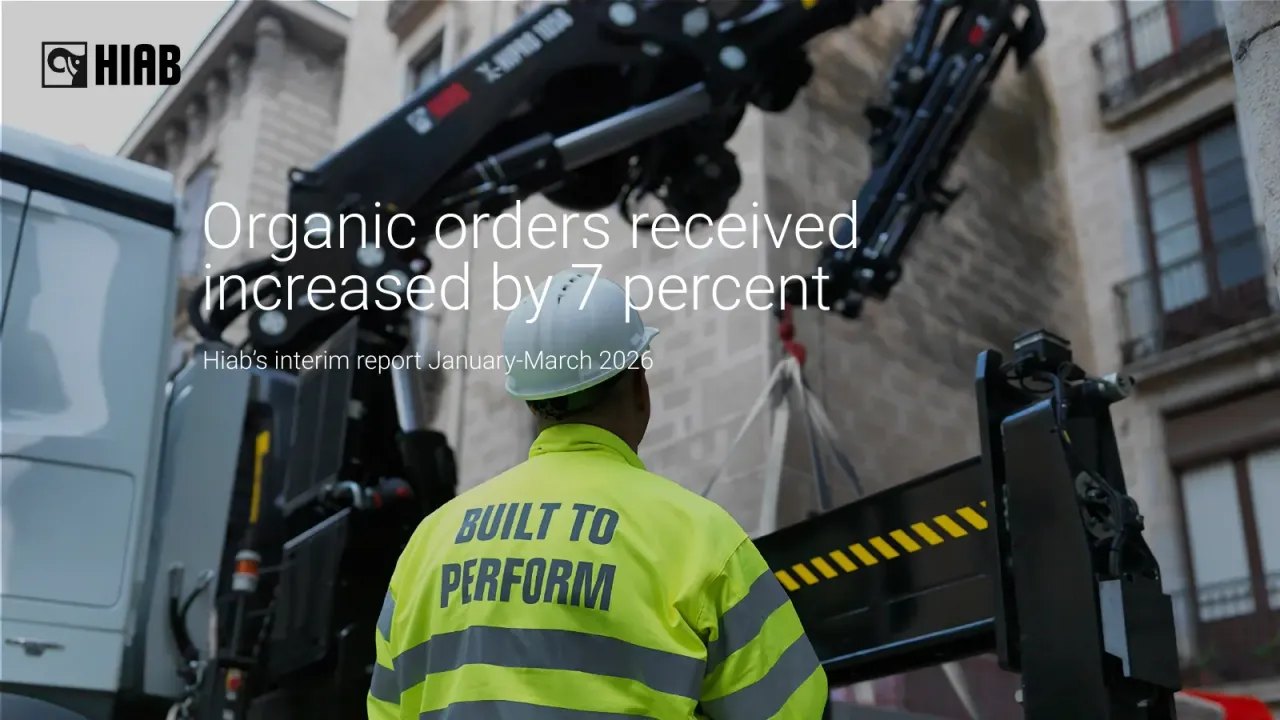
3:23 The third development I would like to share with PRIDE is another example of a key outcome based innovation co created with our distribution partner MiXA together with key customers in Spain aiming to optimize productivity for dump over column lift tippers by developing a new Dell brand lightweight liftgate. So another great example of our focus on developing new innovations together with our customers and our partners that's purpose built to solve their our customers' most challenging problems. So let's get into the headline results of our group financials for the quarter. So starting off with our order intake development, I'm pleased to see that our organic order intake increased by 7% in constant currencies versus the comparison period.
4:11 In actual exchange rates, order intake reached a level of $4.00 €2,000,000 or €419,000,000 in constant currencies for an 11% positive variance. ING contributed EUR15 million in the quarter, so in line with our business plan. And all regions contributed a solidly positive book to bill increasing our backlog sequentially. Now unlike prior periods, we didn't get the advantage of large lumpy orders as we've myself and Mikko and Aki have talked about in the past, but rather resulting from a number of increased activities that manifested in smaller order intake or mid sized order intake. So no real large orders of note to report within the period.
4:58 So overall, a good start to the year despite the uncertainty in the macro environment. So let me turn your attention to the regional breakdown of our order intake profile for the quarter. Now as you can see from the table, we had a growth in all regions with the exception of Asia Pacific. Europe, Middle East And Africa increasing from $2.00 €3,000,000 to $2.00 €7,000,000 or two percentage points The Americas grew by 15% from €145,000,000 to €166,000,000 And Asia remained relatively flat at 29,000,000 compared to €30,000,000 in the comparison period. Now Europe continues to show signs of steady demand growth, which we do see in all businesses, but most notably our lifting solutions.
5:47 The growth in The Americas was primarily driven by ING acquisition, but at the same time, we certainly did not see further declines in The U. S. Overall, the environment remains highly uncertain with ongoing trade tensions in The U. S. And heightened geopolitical tensions in The Middle East. So let's turn our attention to the revenue results for the quarter. Our revenues were down seven percent year over year due to the million lower order book we started the period with. Now in line with our expectations that revenues were on the level of EUR383 million. As you can see on the table on the left hand side, our rolling twelve month revenues are now converging towards our order intake level of prior periods at €1,528,000,000 Now our share of services and actual exchange rates increased a percentage point due to the decline in equipment sales.
6:42 However, as Miko will explain, we had a nice increase in service sales in constant currencies. And ING contributed $13,000,000 in sales or 3%. And currencies overall had a negative impact of 4% on group results. Now geographically, our share of sales were impacted by the positive order intake development in the second half of twenty twenty five in Europe, while The Americas was negatively impacted by the decline in The U. S, but partially offset by ING. Now in addition to the increase in Europe, our Asia Pacific region was also slightly up improving to EUR26 million or 7% year over year. And I'm pleased to see the development of our Echo portfolio sales as they increased by 23% to €176,000,000 or 46% of sales overall.
7:32 Now with our year over year decline in sales, our comparable operating profit was negatively impacted, so I'll guide you through the numbers. For the period, we delivered EUR 52,000,000 on sales of EUR $383,000,000, which is 22% decline versus the comparison period, but all in all a good start to the year. On a relative basis, the group was on a level of 13.5 versus 16% last year. Now the factors most impacting comparability were lower sales in The U. S, lower indirect cost affecting gross profit and lower fixed cost affecting operating profit. Now consequently, our operative return on capital employed declined due to the reduction of profit, items affecting comparability and the ING acquisition.
8:18 Now Mika will further guide you through the bridge. Now wrapping up on our quarterly check-in for how we are performing versus our long range targets. Our last twelve months our ten year CAGR is now at 5% versus our long range targets of 16% comparable operating profit, our last twelve months is at 13% and versus our long range target of greater than 25%, we're in line at 27% albeit a decline sequentially for the factors that I shared earlier. So with that, I would like to turn the stage over to Mikko to share with you results for the reporting segments. Thank you, Scott, and good morning also from my side.
9:12 Let's start first with the equipment segment's performance in quarter one. So the equipment orders were €284,000,000 during the quarter. This is 10% increase year on year. But if we exclude the currency impact, the growth would have been 14%, so in constant currencies. Lifting equipment grew very nicely. Growth came mainly from Americas, like elaborated already by Scott, very much driven by the ING cranes acquisitions. The delivery equipment orders were flat year on year. I would say that taking into account the market situation in The U. S. And the fact that we did not book any major key account or defense orders during the quarter, I would say that the equipment segment performed well in terms of orders during quarter one.
10:15 Sales were €266,000,000 This is minus 9% year on year. And again, if we exclude the currency impact, the decline would have been minus 6%. Lifting equipment actually grew in all three geographies and the decline in sales is coming solely from our delivery equipment, especially in The U. S. Market. The U. S. Decline is very much due to the past quarter's below one book to bill caused by the volatile tariff environment and the delayed decision making by The U. S. Customers. Equipment comparable operating profit was €32,000,000 or the margin 12.1%.
11:03 And the biggest driver for the lower profitability was the decline in the delivery equipment sales in The U. S. Like I mentioned earlier, equipment profitability was very much impacted by the lower sales as can be seen in the bridge on the right hand side. Lower sales affected gross profit margin as the gross profit margin includes also fixed production overheads, so the factory overheads. We had a slight positive impact coming from the lower SG and A costs, But I would say that the cost savings from the early announced €20,000,000 cost savings program are not yet visible in our quarter one results.
11:59 Then let's have a look on service performance. And I would say that currencies had significant impact on services orders and sales during quarter one. Service orders were 119,000,000 with constant currencies. Actually, service orders would have grown 4%. Sales was €117,000,000 and again with constant currencies growth would be plus 5%. So in absolute terms and in constant currency services, quarter one revenues would be €123,000,000 Really nice development in our recurring services like spare parts and maintenance, those sales grew in quarter one.
12:50 However, installation services sales declined. So I would say that the recurring services growth was able to offset really nicely both the currency headwinds as well as the decline in the installation services. The number of connected equipment and maintenance contracts also continued to grow in quarter one. So really nice performance in executing also the services strategy. Services profitability was stable at €28,000,000 or the margin 23.6%. If we look the services bridge on the right hand side, services sales growth would have been actually €6,000,000 with constant currencies instead of the €1,000,000 decline as we have reported.
13:50 Recurring services growth very much offsetting the decline in installation services and then the negative FX impact that mainly coming from the weaker U. S. Dollars offsets the volume growth. Next, let's have a look on High total financials. The overall High Up profitability decline came from equipment volumes as you were able to see from the previous bridges. Lower volumes affected gross profit margin, as the gross profit includes fixed production overheads. Our SG and A costs were stable in constant currencies.
14:35 Like mentioned, the cost savings program effects are not yet visible in quarter one. Those start to be more visible in the second half of this year. Currencies had a notable impact on quarter one profitability, mostly stemming from the weaker U. S. Dollar. We booked €11,000,000 restructuring costs during quarter one as items affecting comparability. So this is below the comparable operating profit. These items affecting comparability, they are related to the ongoing €20,000,000 cost savings program, headcount reduction, including also the ZEPRO Daylift production move from Sweden to Poland.
15:25 And our quarter one tax rate was 26%. Our cash generation continued on a very good level, in total €75,000,000 in quarter one. The cash conversion was really high 186%. Our inventories decreased slightly, but I would say that the main contribution to our net to our cash flow was coming from the net working capital, like accounts receivable decline and the VAT receivables collections. So those were the main contributors to quarter one cash flow. High up has a very, very strong balance sheet with the net cash of €219,000,000 at the end of March.
16:16 Our gearing was stable at minus 23%. And thinking the target to keep our gearing below the 50% threshold. This would allow us to raise more than €700,000,000 debt. So really strong balance sheet to execute inorganic growth strategy. We paid the €75,000,000 dividend in April 2. So this is not yet the dividend payment is not yet visible in our quarter one numbers. And then on the right hand side chart, you can see that we have only one major debt item, that's the €150,000,000 bond, which is maturing in quarter three this year.
17:09 And today we have also revised or specified our outlook for the 2026 based on a very good start for the year. So we estimate that the comparable operating profit margin for this year exceeds 13.5%. This is up from the earlier above 13% what we announced in February. The key assumptions behind this outlook are more or less unchanged what we said in February. We expect EMEA to continue to grow, USA not further declining from the previous quarters.
17:54 However, the customer decision making continues to be still slow and difficult to predict. 2026 has started with €114,000,000 lower order book. Also the March 26 order book was almost €40,000,000 lower than what we had a year ago. We have factored in the outlook also the €20,000,000 cost savings materializing in 2026, as mentioned, mainly effective from second half onwards. And then our group admin underlying costs would be more or less on 2025 level, plus then approximately €5,000,000 investments in process and systems development, mostly in the second half this year.
18:45 So with those words, then I would hand word the back to Scott, please. Thank you, Mikko. So just closing with a few key takeaways summarizing the quarter. I'd say first and foremost, we certainly continue to see a gradual recovery in lifting equipment in Europe, Middle East, Africa, which is great to see. Our delivery equipment market in The U. S. Is expected to be in a cyclical trough. Third key takeaway is we are on track to achieve our EUR 20,000,000 lower cost level in 2026 versus the prior year. We continue to nicely execute on our profitable growth strategy with a keen focus on where we can take advantage of opportunistic growth.
19:39 As Miko mentioned, our strong cash flow and balance sheet position us nicely to catalyze growth in the coming periods. And we're really pleased to see the solid good start to the year in 2026. So with that, I'll turn it back over to Haki. Thank you, Scott. Thank you, Mikko. With that, we are ready to start the Q and A session. The next question comes from Antti Kanzanen from SEB. Please go ahead. Good morning, and thanks for taking my questions. And I'll start with a bit of a long winding one on The U. S. Demand. I mean backing out kind of your Americas orders, the FX impacts and the acquisition impact, it still looks quite good organic order growth for the quarter.
20:44 Then again, if we look at kind of the quarter, you flagged increased geopolitical uncertainties. There was a bit of a back and forth on the Section two thirty two tariffs and things like that. So how would you kind of describe the demand environment that you saw on the first quarter? Did you start to see a gradual recovery in some sense? Or is it kind of the heightened uncertainties adding kind of an extra layer of slower decision making versus what you kind of saw going into the quarter? Morning, Antti, and thank you for the question. Just starting that one off. In The U. S, I think one of the key factors to note is that there was a bigger impact towards the second half of Q1 last year impacting both of our at scale delivery solutions business within The U.
21:34 S. So we're coming off of, I'd call it a relatively low comp. So therefore, I'd say that was a driver in terms of the positive variance that you see slightly in The U. S. Year over year. But on the other hand, I'd say from the combination of still the factors that existed prior to the trade tensions and then subsequent to the trade tensions and even with the geopolitical unrest notwithstanding, we are seeing a bit of stability albeit characterized and Miko as well that the decision making is still on a similar level in terms of customers being cautious. Having said that, I think it boded quite nicely for us in the quarter that similar to what we saw here in EMEA, the composition of the order profile in the period was more skewed towards smaller midsize type orders. So the overall activity level was quite strong and I'd characterize the sales funnel within the quarter also nicely positive variance compared to last year.
22:38 Having said that, we still have same level of uncertainty we have the added added variable of geopolitical unrest. So therefore, we're trying to stay quite balanced in terms of managing expectations that which is why we made the note of where we think we're in a situation where we don't see it imminently getting worse and so therefore I think there's a potential to be stable to slightly improving and certainly you see that supported nicely in some of the reports from the truck OEMs. And then as has been noted in some of the analyst reports, there would be a bit of a lag in terms of the impact for our business compared to what you see at the truck OEM. So the factors at least are lining up to be I think skewed more positive versus negative.
23:28 All right. And then specifically on the changes on the Section two thirty two tariffs start of April. What's your analysis on are there any impacts on your clients in terms of truck prices or truck costs? And also what's the direct impact to yours specifically? Yes. The impact to the change in the tariff code certainly has a negative impact from the customer perspective in that the cost level goes up somewhat. And so we've run through all the analytics and the math and we've revised our price model vis a vis the surcharge as a consequence. So our customers will certainly see that. I don't see it at a level where there would be an eminent negative impact compared to the current demand environment, but certainly an additional factor to consider on behalf of our customers in terms of deploying the budgeted capital within the year. And then as we have highlighted in some of the past periods, one of the key changes that we did see in The U. S. Was a tendency to move away from providing longer term view of demand and capital allocation and rather going to more shorter demand horizons, if you will, in terms of quarter by quarter or biannual, if you will. So we still see that trend continuing.
24:48 Sure. And then kind of talking about pricing and surcharges, how much would you say that The U. S. Orders in Q1 benefited from pricing in terms of year over year basis? The U. S. Orders benefited approximately EUR 10,000,000 from the surcharges during quarter one. All right. That's very clear. And then just a housekeeping question on the savings program on the €20,000,000 So would I model it correctly if I kind of add a full run rate impact for Q4. So it's a little bit of a benefit on Q3 and then in a similar fashion first half of next year as well on a year over year basis.
25:36 Yes. I'd say that's about right. Yes. Yes. Alright. Thanks so much. Yeah. The next question comes from Panu Leidenbachy from Danske Bank. Please go ahead. Hi, thanks for taking my questions. I would have two questions around the guidance. So firstly, what kind of triggered the upgrade? I mean, is it that you have now more visibility towards the end of the year? Or was Q1 or what do you see in the market better than you were expecting? And then the second one is kind of what kind of what are you expecting for The U. S. Market for the rest of the year in your guidance assumptions? Do you want to take the first part?
26:22 I'll take Yes. The second So basically, what triggered the specified new outlook is that we had, of course, a solid start for the year. And we have now basically three months better visibility for the year. We don't see in customers' behavior at the moment any change. So that those are the basically the elements which basically made us to slightly specify the outlook from above 13% to 13 above 13.5%. Yes. And just adding one more that one, Panu, is also the view that Europe continues on the positive glide path that we've seen.
27:11 So better visibility to the order book now as we have an additional three months coverage, positive variance to the start of the year versus expectation or plan and then the continued good development in Europe and offset of course by a more or less stable situation in The U. S. You had the second part of your question was with regards to The U. S. Demand, yes? So in terms of The U. S. Demand just to reiterate prior comments that we certainly see the similar factors coming into the year that we did for the second half of last year where you had the environment where there was already a bit of a slower level of decision making or let's say a longer time horizon to deploy capital based on changes in the cost levels and the inability of our customers to know, let's say upon the time of taking possession of the equipment, what their forward looking cost curves would look like. So then naturally you would if you could delay the decision making until you had better visibility there.
28:22 We see that continuing within the year. Having said that, we did see a bit of recovery of course in the delivery solution business in The U. S. And activity level bodes well as the composition of the order intake was again rather than being skewed towards a few lumpy key account orders, but rather a number of small to midsize orders. So the key account orders are also still in the pipeline. So overall we see a situation where we feel a bit more comfortable given that we still have a lack of coverage to the end of the year, which then will further clarify potentially in line with our Q2 earnings report.
29:09 But for now given those three factors that I talked about earlier and this U. S. Situation that we think is on quite a stable level or we don't see it eminently declining supported by the data that we're seeing with the truck OEMs, key factor for us to be able to bump up the outlook for the year slightly. Okay. Thank you. My final question is on the European market. So it continues to recover, but could you kind of tell a bit more like which segments are looking better for you? And what about Construction, which I understood has been still slow, but do you see any pickup there? For us, the quick answer on the construction side is not yet.
29:58 But what we do see is we see a pickup on special logistics, a bit of infrastructure, a little bit of retail last mile, but significantly of course in our waste and recycling segment somewhat offset by a slight decline in the defense logistics as it's a consequence of timing of fulfilling past very large orders that were won in the past and then the fulfillment schedule is starting to wind down a bit. So overall picture with exception of construction is all moving somewhat in the positive direction and somewhat steady. We're not seeing big swings period over period or sequentially within the quarter, but rather nice steady improvement.
30:49 All right. Thank you. The next question comes from Michael Doppel from Nordea. Please go ahead. Yes. Thank you. Good morning, everybody. Just following up on the EMEA question there. Any specific countries you would like to flag here that are looking particularly strong where you're seeing some kind of improvement maybe some early signs into Q2? Any specifics you could add there? Yes. If you think about our demand environment in Europe, it very much follows along with the countries that have the highest or the most at scale GDPs and those were certainly the countries that had the most positive variance for us within the Europe, Middle East, Africa region.
31:46 So of course, UK, France, Germany, Benelux, France, Spain, all were nicely positive. Okay. No, that's clear. And then also coming back what you mentioned on defense. How would you describe the pipeline there currently? And also maybe a specification, did you book any orders there in Q1? And then the pipeline and then potential how you see it going forward? Mikael, was your question concerning Middle East or because the line was a bit different? Sorry, no. On Defense, on Defense, yes. I was asking, did you book any orders related to that segment in Q1? And also, how would you describe the pipeline and potential here going forward?
32:38 Yes, quick answer, yes, we did. Albeit I'd say overall there was a slight negative variance on the defense orders from the comparison period. Pipeline looks really healthy and as we've called out in the past, it's challenging to call the timing of converting the orders. Harmony, Frank, the team are doing a great job managing the pipeline and we feel really good about how we're positioned to convert the pipeline. The question is around the timing. The defense orders were roughly 4% of the total order intake in quarter one. So as we have said earlier, they are a bit lumpier than the kind of typical commercial orders. So from quarter to quarter, it might fluctuate fluctuate a bit. But like Scott said, solid pipeline and something to come most probably later this year.
33:32 So yes. Okay. No, that's fair. And then just finally on the M and A. I think you mentioned the SEK 700,000,000 firepower here. How would you describe the pipeline? I mean which regions would you say are most active right now and what are the key hurdles to get the deal done? Yes. So let me start. I'll take that question. Pipeline is quite active as we have consistently called out in the past. Of course, it's always all a matter of timing. Our focus is in line with our focus segments. Similarly from a geographic perspective, I'd say there's an active pipeline of course both in both of our core markets both within Europe as well as The Americas and of course that's a critical area of focus for us. At the same time, we continue to look for opportunities to help us scale quicker in regions where we're subscale. And so we still like the APAC region and are investing a lot of time and expense in analyzing, understanding the opportunities in that part of the world. And similarly, we still see opportunities in Latin America as well.
34:56 Okay. And then just to follow-up on what would you say are kind of the key hurdles to get the deals done? Is it just that evaluation question more or something else that's kind of what are the kind of the key kind of things being discussed? Yeah, yeah. Sorry for just to give you a bit of context and around the history. So the first key factor was just needing to work our way through the merger and then the demerger process as we were certainly constrained for good reasons to take actions during those years. So post completion of the demerger then the key constraint really has just been a matter of timing of working the processes.
35:59 The next question comes from Antti Kanzanen from SEB. Please go ahead. Thanks for taking my follow-up, which would be on The U. S. Distributor. So Scott, maybe could you talk a little bit about where you are with this kind of a growth strategy, adding the distributor network or expanding the distributor network in The U. S. And expanding geographically? And what type of revenue potential should we think about from these actions in the next, let's say, twelve to twenty four months? I mean, if the demand in The U. S. Is starting to bottom out, I guess, the fact that you have a wider distributor network today than, let's say, a year ago would add a little bit of a bigger potential for you going forward? Yes.
36:46 Thank you very much for the follow-up question, Antti. I'd love to provide some color on this follow-up. So quite pleased with where we are relative executing on our growth strategy in North America vis a vis activating a hybrid model whereas in the past we were almost entirely direct with the exception of our Princeton branded truck mounted forklifts. So over the past two years, we've activated 16 new dealers. Of course, very much back end loaded towards that time period. So great companies at scale for the first time it gives us real coverage in all 48 contiguous United States and so that's a key milestone for us.
37:33 And then I'd say number two and I couldn't emphasize this one enough that the quality and capability within these dealers is extremely good and proud that they've elected to work together with us as real partners and they're going to certainly help our overall growth strategy as well as to develop the overall HEAP brand in The U. S. Now having said that, we're in the mode of developing and going through the training and activating the dealers And so that's a bit of a step by step process. Hard to exactly characterize the amount of positive variance certainly within this year, but we expect some positive variance to our order intake development in The U. S. As a consequence.
38:19 And over the time series if I think about '27, '28 and beyond then that should steadily pick up. We believe that will end up somewhere around 20 to 22 distributors overall. So we still are in the process also of adding new dealers in areas where either we're undercovered and or we're looking for the capability be it for a lifting solution or a delivery solution as some of our dealers are quite specialized and others are more generalist covering the whole portfolio. Is there any way for me to kind of compare from revenue potential wise, say, 20 to 22 distributors versus your prior direct model? Kind of how much does it expand the addressable market?
39:14 Or how much kind of a dollar revenue potential would it give you down the road when all are fully activated and selling your equipment? Difficult. On the spot, no, probably I can but however, as we work progress through subsequent periods And of course, as we certainly have touch points with all of you that cover our business, we certainly would be able to start to give better and better color on just that point. All right. Looking forward to that. Thank you. There are no more questions at this time. So I hand the conference back to the speakers.
40:01 Okay. Thank you for the telephone conference questions. We have at least one question from the iPad. This one is related to the Germany infrastructure package. Did we see any impact in the quarter? How would you characterize the situation or the stimulus money from the Germany infrastructure package? Is it visibility better, the same or worse than in the beginning of the year? Well, certainly better visibility compared to the beginning of the year. Timing wise, I'd say too early yet, but we do anticipate having nice opportunities in the future and we're starting to get visibility in the opportunity funnel. Great. How about then the supply chain? Do we see any constraints especially in the hydraulics or electronics?
40:52 Think this must be related to the Middle East situation. Honestly, a great question and gives me an opportunity to put the spotlight for a second on our supply chain teams. I think they've done a great job both in terms of our factories and in collaboration with our sourcing team. So really pleased to share that no impact. Now that picture of course looks a lot like the duck on top of the water, but of course below the surface there's a lot of activity behind the scenes both internal to HEAP but also in our partner network vis a vis our suppliers as well as the logistic shipping companies. But overall no negative impact within the quarter, but a lot of organizational bandwidth has been redirected to make sure that we secure and stabilize the overall supply chain.
41:46 Indeed. And then the next one here is that, do we see any potential considering new trade agreements between Europe and South America Or then potentially how about India? Do we see any potential there? Will this lead to high ups new equipment products and service units in the medium term impacting sales year on year growth rate in these regions? Any color you could Yeah, we haven't seen yet any impact at this point as a consequence of the new trade agreements. However, I would say that markets such as India are a great example of those that we are constantly pulsing and checking for what's the right opportunity for us to better participate in the market.
42:33 Is that an import opportunity or is it a produced local opportunity? And certainly I anticipate that markets such as this will play a key and ever increasingly important role in the future of our business. Okay, thanks. And I think we have still some more questions from the telephone line. So let's turn back to the moderator. The next question comes from Michael Doppel from Nordea. Please go ahead. Yes, thank you. Just very briefly a question around your service business. Just could you talk a bit about how you see the environment there, the dynamics there? I mean, where are we currently on the spare parts capture rate?
43:20 And how do you see the kind of overall growth here going forward? Yes. Thanks for the question, Mikael. In terms of the services business, what I would still say is that Mikael and his team are progressively working towards better and better partnership training and development of how to one, make sure that as a result of having new or current activated connected units that that gives us great control then over the installed base, which is the first key factor and that's why that's one of the critical KPIs that we track relentlessly each period.
44:07 Then that enables to have the dialogue of converting the management of the assets in the installed base wrapped around ProCare contracts that we do both for direct as well as through indirect. And we know that we have a significantly different outcome of capture rate and revenue per unit on those units that are captured in ProCare and the good news is that our net promoter score and feedback from the customers are on a significantly higher level as well. So the team is doing a good job getting better and better control of the overall installed base, but it'll take time as given the top line split between what we sell direct versus indirect.
44:52 The biggest opportunity for us is to continue to increase the share of capture on the indirect sales side and so a lot of good progress is being made there. Overall in terms of the capture rate versus what we shared in 2024, we continue to step by step make good improvements sequentially and throughout each period. The limiting factor so far potentially and this is a bit of opinion as it's quite variable is then around the utilization rates of the equipment and we have seen a lot of variability through the period where some periods, some geographies is up and some within the same geographies may be down and that might have a bit of a factor if I think about the past two years.
45:39 Moving forward, our expectation is that given the age of the installed base, the replacement rate should continue to increase and at the same time the level of service events or the frequency of the service events should get ever slightly increasing as well, which bodes well for our recurring revenue business. So overall good progress there. When we come back on our Capital Markets Day, we will give a lot more color on how we're progressing relative to the three KPIs that we shared in 'twenty four as well as the overall capture rate. And I'd say the last comment I would add is I think I did share in either Q3 or even in February in the Q4 earnings, our share of recurring revenue is now on quite a good level at around 75%, 76% level.
46:35 All right. That's great color. Thank you very much. Yeah. The next question comes from Tom Skogman from DNB Carnegie. Please go ahead. Yes. Good morning. I know you have sensors installed in your equipment. Can you open up a bit what you see how customers are using the equipment sequentially year on year and between different geographies, what can you read about your customers from this? Yes. Hey, good morning, Tom. We get quite a lot of data driven insights off of our connected equipment and really pleased by the fact that we are able to provide condition based monitoring services so we can see any number of data points from the amount of how they're being utilized, the time under load, the type of loads, whether it's overload, under load, time and idle, even if an operator has not buckled the seat belt and attended to some of the basic requirements around safe operations.
47:45 So a whole host of variables that we're able to see relative to most of the units that we have connected. And then quite pleased to tell you that at least before the end of the year, you'll start to also see quite a nice uptick in connected units in our tail of business as well. But what do you see in customer activity like in The U. S. Where we have this kind of both kind of uncertain demand situation? Do you see positive signs in how customer equipment is used for instance? Sorry, now I understand a little better than what you're getting there, Tom. So in terms of utilization, we see quite a lot of variability.
48:31 I'd say overall, we don't see any real negative or positive trends, but some periods utilization or activity levels are up and then in the next period it might be down. So overall I'd call it quite stable. I'd say it's same roughly applies here in Europe as well. In some periods it's trending more positive and then in another period, will trend slightly negative. All right. And then about your M and A pipeline, do you have any targets you would like to share? How many companies you would like to acquire this year? Or how much sales you would like to add in through an M and A in one year or three year period or so?
49:18 Yes. I mean, I'll stick to my same answer as before. I think that given we're a business configured of six divisions and a number of business units, I would love to get to a steady state where we're able to do a bolt on at least one per year per division per business unit. And similarly, if you think about then the composition of our business managing one or two more transformative or let's say business unit or division size acquisitions per year would be a great steady state to get to. But to go from where we are to that steady state then it's going to take some time as we now are what nine months or so into being able to now action opportunities that we weren't we were constrained to action until we completed the demerger.
50:16 So we'll also share a lot more color on that as we progress towards our next Capital Markets Day. And when is the next Capital Markets Day? We haven't set the date yet, but we will share that as soon as we do. But it's for already this year you plan to have it for? We will learn. Yes. My sense is it's likely be in '27. Yes. Not yet decided then. Yes. Yes. And perhaps a bit more on this service sales target. You have €700,000,000 as a target. I realize this downturn probably was a bit steeper and longer than you expected. But just on a general level, how do you feel about this? Because I mean that would really demand exceptional sales CAGR to reach that number.
51:12 Yes. You're exactly right. There is that element if you think about the especially on the nonrecurring revenue piece, there is a significant element there of when does the equipment demand recover relative to the way we modeled the demand curve in Q4 'twenty three when we established the current strategy period. So a lot will be understood depending upon how the balance of this year and the beginning of twenty twenty seven plays out of course. But of course, one should still if we think the quarter one service development, so sales up by 5% with constant currencies.
51:57 At the same time, we saw a decline in the installation services. So if the installation services, I. E, new equipment sales, then attached with the installation sales would improve, then that would, of course, have had in this quarter a nice further addition to service revenues. Yes. And then finally, these new U. S. Distributors, do they wish that you would expand your product portfolio to some certain direction? I think at this point too early to tell. They're still in the mode of getting themselves up and running on understanding the full scope of the portfolio that they're responsible for how to work within our processes and systems and with the support staff that's available to them.
52:54 But I am confident that as we look forward, they will certainly and frequently share insights where they see that we have opportunities to fill gaps within the portfolio. But at this point I'd say it's too early. Okay. Thank you. The next question comes from Antti Kanzanen from SEB. Please go ahead. Yes. Hi, thanks. Just a quick follow-up on The U. S. Order side. I mean, I just wanted to get a reminder, like last year, your Americas orders declined by 14% on a euro basis, but I'm sure that there was a pricing contributor on a positive side. So how much the volumes last year declined? Or how much your pricing was up with the surcharges and all of that during 2025?
53:49 The surcharge impact, if I recall correctly, was something like between 20,000,030 million euros for last year. Yes. A bit less than €30,000,000 around 25,000,000 Okay. Yes. Do you have any view kind of how much the volumes are currently the order volumes are below, let's say, what you booked on 24,000,000 which was kind of the previous peak? Yes. You mean in The U. S? In U. S, just trying to kind of think about that if there's a recovery on the market, what is kind of the upside in terms of your order intake given that your prices are quite much higher now than they were a few years back?
54:35 Of course, it's good to remember that these surcharges are something which I mean, they change all the time as tariffs change. So of course depends on the tariff landscape, whether one can use that as a, let's say, permanent price increase or we have communicated to the customers that the tariffs will if the tariffs change then the surcharge will change. Correct. But all in all last year roughly that €25,000,000 let's say impact in the order intake. It's a bit difficult to because there are so many different products in The U. S. Market. There are day lifts, loader cranes, truck mounted forklifts.
55:21 So one cannot count those together. It's like calculating apples and bananas together. So from that point of view, it's a bit difficult to say the kind of volume impact. Sure. I mean, it's a simplification, but it seems like the pricing had a mid single digit impact, and then that would kind of suggest almost 20% down on volume. Correct. Overall, the right way to think about it. Overall, it's the biggest impact is coming from the customers' overall demand there, the pricing having a quite small impact. Absolutely. Thank you.
56:09 There are no more questions at this time. So I hand the conference back to the speakers. Yes. Let's still take a couple of questions from the iPad. So firstly on the services, so do we always nowadays offer a service agreement when we sell a new piece of equipment and what is our hit ratio with the service agreements with new equipment sales? Quick answer to that is that's certainly our expectation that it's one of our key strengths. And certainly if I think about the 50 or 60 customer visits or customer meetings I have a year, that's usually the first topic of conversation is services and the availability of the services, proximity to installed base and the high need to secure uptime as most of our customers are understanding that they're paying a premium on the margin in order to secure the service outcomes that they need to keep them going.
57:12 So therefore it's critical for us to offer the services concurrent with the opportunity to sell a new piece of equipment. The hit rate or let's say the attachment rate of the service contract varies depending upon region. So I would kind of come back to Mikko's comment earlier. It's a bit it's not a great metric if you just aggregate it all together and say here's our percentage of attachment because it's much higher in certain areas depending upon how we're configured with our own organization and the personnel that we have, but it varies. I'd say that overall I can say that this one of the key opportunities for us to continue to not only drive our services business, but more importantly a key factor for us to increase our Net Promoter Score customer satisfaction.
58:09 The teams are working quite diligently together and with our partners to ensure that we feel like we have all the tools, processes and capability and training in order to not only offer the services but then most importantly to execute successfully and delivering against those service contracts. Then we have two more questions. These I think these are quite quick ones. The first one is on the M and A. Any preferences in geographical regions? I think you, Scott, already mentioned that we like EMEA, Americas, our key regions, but we also seek for opportunities in the APAC region. So that was the answer already. And then the final one, which one of you remembers the numbers? Large proportion is The U. S. Out of our Americas sales? Of course, we provide on an annual basis the North American sales, but we don't split The U. S. Separately.
59:06 But of course, it's a significant share out of Americas and also on the North American side. Yes. I don't remember now the exact percentage, but it's I would say U. S. Is the majority of the Americas revenues. Exactly. Yes. A very high percentage. Yes. And of course, for this year, the rest of The Americas is somewhat higher due to the ING acquisition impact. So the Brazil market is proportionally higher than last year. Yes. Okay. That then concludes our Q and A session. Thanks for the great questions and for the great answers. We will be back with our second quarter results in July 22, so stay tuned.
59:56 Thank you. Thank you. Thank you.
Follow Hiab Oyj into a list and get an email when it puts out news.
Investor Relations
Chief Executive Officer
Chief Financial Officer
Analyst, SEB
Analyst, Danske Bank
Analyst, Nordia
Analyst, DNB Carnegie