Kiran Morzaria
CEO at CADENCE MINERALS PLC
Replay available
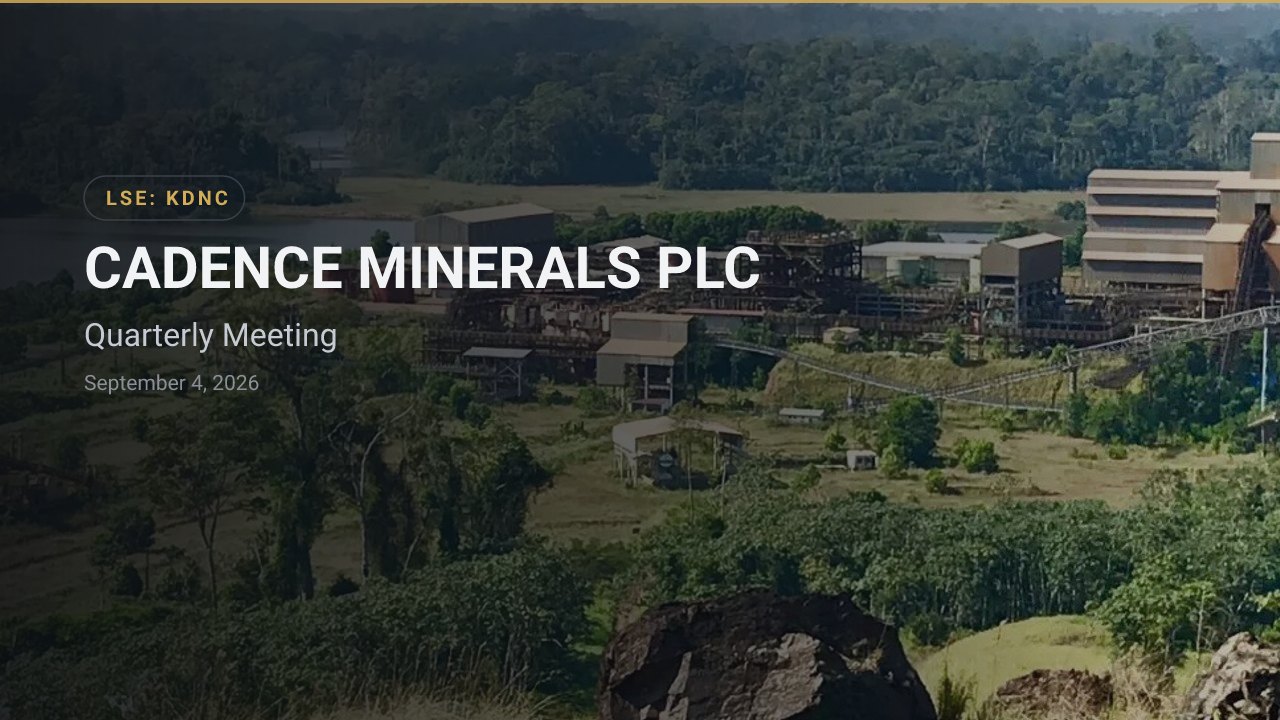
Quarterly Meeting hosted by Cadence Minerals (LSE:KDNC) on Investor Meet Company. Replay available.
On 6ix: 6ix.com/event/cadence-minerals-plc-kdnc-quarterly-meeting
Automated transcript · Written by software from the replay's audio. It can mishear names and figures; the replay is the record.
0:00 Good morning. Welcome to the KDNC Minerals PLC investor presentation. That was recorded presentation. Investors will be in listen only mode. Questions are encouraged and could be submitted at any time via the Q and A tab situated on the right hand corner of your screen. Please just simply type in your questions and press send. Before we begin, I'd like to submit the following poll. I'd like to hand you over to Kieran Mozaria, our CEO. Good morning, sir. Good morning. And good morning to all those that are attending this q and a and presentation on CADENCE. So I I think what I'm probably intend to do here today is go through the presentation, try and make it a bit focused very much on Azteca and the progress that's been made there to date, And also a bit more, you know, expand that out to a bit how important actually Azteca is to the larger asset as a whole and the potential that exists there as we get closer to production at Azteca.
1:01 So the usual cautionary statements there. I think we all know what Cadence is. It's same listed. We fundamentally have two assets, the Amapa Arnold project, within it, the Azteca plant and project, and the Mexico lithium project formerly owned owned by Gangfeng, and we have a 3030% JV on certain areas. The latter is under arbitration, international arbitration. And, of course, we are progressing with the development of Astecca and the map up. And that's our strategy with it is to it's a stage development approach, go through the near term cash flow with Astecca, and from that, fund the definitive feasibility study that then allows us to expand and look for long term growth on the Amaparayan ore project.
1:59 So when we look at the overall, you know, why we think it's a to what's a good idea or we think at Cadence has a good opportunity for a rerate. I I think a lot of projects when we look at development projects in terms of reserve reserves and raw resources or DFS, there's often this funding gap and there's no revenue. And we have an opportunity fairly unique with the development of the Astecca project, and that will provide us with revenue. And as I said just just a minute ago, that allows us to derisk the strategy, The low cap the low CapEx, which we've now expanded spent on the project, allows us to bring us into revenue, derisk the strategy in terms of not going to shareholders for DFS funding, and that then allowing us to progress the project and bring it into product the large project into production.
2:59 So a bit about the Iron App and Map Iron Ore project. So as you can gather, Ammapa is our cornerstone investment. We have just over 36% of the asset, but it's not simply for those often when you're looking at new app the resources and reserves. It's early stage. It's even if it's got a PFS, you still have to go to DFS. You still have to prove it in on a conceptual basis. But a map of really it's simply not just a mineral resource or simply not just a mineral reserve or a proposed mine. It's a previously operating integrated iron ore project. And in Brazil and around the world, having integrated iron ore project is not unique, but it's rare.
3:46 It has, obviously, the established mine that we've seen beforehand. It has processing facilities, although need to be refurbished refurbished. It has a 194 kilometer railway, and it has its own export pool. And the plot this whole system operated at scale. It started around 700,000 tons, reaching 6,100,000 tons of iron ore concentrate in 2012. So when we look at that whole project as a whole, it is fairly rare in terms of iron ore to have that integrated ownership in one one go, which also then means that we deliver a lower cost. And emission you know, and in addition to the resources and reserve is the reserves and the mine plan for fifteen years, there is additional potential around under our JVs and, obviously, on top of that, around the area around the railway corridor on areas that we don't currently own, but without the railway corridor and port, they don't they're not really economic.
4:55 And as you can see, the economics that we've just talked about is, you know, actually really good when we look at the free onboard cash cost of $27. Certainly, in the lower half of costs of around the world, I would probably put that closer to the bottom quartile. NPV of maybe 2,000,000,000, IRR 56. You've seen these figures beforehand. But I suppose one of the things that led us in into looking at us tech was firstly, we could see our licensing process progressing, but also often projects get stuck in this moat. And that moat is where you have a great asset, great projects still, you know, you know, owned by a junior mining company or, in our case, invested into into this asset, but still by a junior junior company with a smaller market cap.
5:48 The market understands that, well, that's quite a moat, a hill to climb to develop this asset. So, you know, instead of, you know, waiting for that funding gap and we we we we weren't performing well in terms of share price, we then we saw that although a map had substantial published potential, as you can see from these figures, the practical routines operation was one that was long and required dilution. So we with licensing, we could see in the background progressing. We made a clear strategic decision. So rather than wait to invite finance the entire development, we prioritized the smaller plant for Ice Techa. So it was a a map of first operating stage. In September 2025, we agreed its funding structure.
6:39 By December, we had a 4,600,000 US dollar funding agreement with an off taker, and we've executed that in January. A MAPPA, and let's be clear here, it is the whole mine processing plant tank storage facility. Got its pre preliminary environmental environmental license. That is a key gate hurdle in Brazil by the local environmental authority. In May, again, we got an installation license allowing us to start the installation of the Azteca plant. And, technically, if we had the capital, we could have actually started the installation of the mine the the whole plant and the mine, but, obviously, our focus and the capital that we had allowed us just to do the Azteca.
7:30 The contractors were then were then mobilized, refurbishment began, and physical completion advanced. I mean, we've gone from 48% in July, and we stand here today at mechanically complete and a 100% refurbished. Now we've submitted our LO application that occurred a was it a week ago? Sorry. I've lost track of time. It was in Brazil. We now move into commissioning. And once we get that LO, we can we can start start commercial production.
8:07 Sorry. This is sorry. I should have gone through this a bit more, but you can go through this another time. That is the potential of the areas around in terms of resources. So I've sort of gone through the near term catalyst of the s s stack at plant restart start. We are now mechanically completion is achieved. All the eight plant systems that are done, and now we go through the commissioning phase. So for us, we have effectively a cold commissioning, which will start next next week, which is running the plant effectively without anything going any through through checking the systems, work together in an integrated bid basis, making sure there are cutoffs, say, if the spirals get clogged up, how does that ultimately cut cut off the screen?
8:57 It's basically a integrated commissioning first part of integrated commissioning. Well, then after that, run water and some ore that is well, it's previously mined ore that is sitting just in front of the screen, and that will then be the cold and the cold commissioning complete cold and wet commissioning complete. After that, we'll call that is is is basically hot commissioning. That does require a site visit and from CEMA, which we also anticipate to happen in the next couple of weeks. That hot commissioning will mean that we will start running ore. We'll be mining ore, running ore through the plant. It's not a full commercial production, and that will be to fine tune recovery systems. So adjust the gates on the spirals, how quickly the magnetic drums are rotating to ensure maximized recovery.
9:55 So it's that it it's that system of getting it to an optimal, you know, optimal recovery rates, making sure the time storage facilities are working properly, and we'll run that about eight hours a day, three to four days a week, maybe more. And that material that's recovered will then be stockpiled and waiting for the grant of the LO. Once the LO is granted, we can then move into the full commercial operations, which will be a twenty four seven process twenty four seven process. And, yeah, looking to hit that target of around the 400,000 tons per annum once we get to that point. So we're very much we're now there. I mean, we now, next week, as I said, go through the commissioning all the way through to hot commissioning over the next couple of weeks and after that, the yellow.
10:55 So, yeah, we are there. I mean, it's, you know, it's really I'm actually really happy. You know, yes, we're four days delayed, October 31. If sometimes deliveries take a bit longer, but, you know, that all got the soft start actually arrived yesterday and was installed, and that was the final final extra item that need to be done. You can actually see there some images of Azteca from when we started. For those that maybe don't know so much about what this plant is actually doing in terms of a flow sheet, I I don't know if you can see the red dots, but just just to the just to the below the the the crane, there is effectively the screen. That's where you load the material, then that's taken up a conveyor at the end of this sort of there's a square building on the left hand side.
11:52 That conveyor puts it through a screen, but, well, a vibrating screen down to two mil. That allows all the material to drop below to the below into a distribution circuit, and all organic waste comes off that and and any other waste material. That goes on to magnetic magnetic drums. Those magnetic drums are permanent magnet magnets and will recover around 10 to 15% material. Then that gets distributed onto a bank of spirals, and and those spirals are effectively gravimetric separation where you get the dense material going on to the inside of the spiral, and on the outside, you get the light material. And then then, effectively, you get a constraint. We mix the magnetic set. The one once that's all gone through, we you know, as long as we can feed it around the 48% material, that should give us a 65% pellet feed concentration con.
12:57 So, yeah, these these are before and after. That sits as where where we are as of well, those pictures as of last week. You can see, obviously, it's nice and shiny and new. We're desperate to get it dirty and put some material that material material through. And you you can see there the screen
13:19 and actually the whole plant much better there. You can see the screen in the foreground and on the left hand side, the spirals. And the bottom right hand side, there there's our operations director, Jay Milton, and and he's just standing beside those one bank of spirals. There are around 38 of them there.
13:42 So yeah. So what is the Astecca gonna do? Well, we know we're gonna the idea is as I said beforehand. 380,400,000 tons per annum, about three hundred and four four hundred thousand tons per annum at 65%. The we'll update the financials as we get closer to production and first shipment comes out just because the straight formers is impacting shipping cost costs both mainly on bunker fuel prices, so outside of our control. Iron was held up okay. It's come off a bit, So we certainly would would once once we get to production full production, I think that's a fair point to give give out what we we expect to start seeing for in terms of revenue.
14:29 But even under the sort of worst case scenarios that we have in our modeling, that still has enough money to fund the definitive feasibility study over the next over the next year. So yeah. Yeah. And this is the flow sheet, which I think we've just gone through. Actually, these are all pictures that also shows before and after what the secondary screen looked like and the magnetic separators. They are in a very different state and ready to go.
15:02 Yeah. You know, in in summary, we we still believe we're undervalued. The nav comes from the NPV of the overall just, the NPV of the project as the MAPPA project discounted back towards our ownership and and a typical risk rating. Our bridge to growth is now the Astec restate restart, and we believe that this restart is is is really important, not only because it's showing revenue and free cash flow to the project, But more importantly, it shows that we're able to, you know, achieve those licensing milestones, build a team, show that we can execute in this environment, and therefore, derisk the overall project, not just for investors, but for the local community, the potential lenders, potential finances of the larger project, and any potential strategic partners.
16:16 So while although though while although it's a small project relative to the rest of the mapper, I think it has an outsized impact on how people around the world will interpret and view of, you know, the MAPPA iron ore project and its future. And I just wanna sort of end relatively quickly on a video that I took just just recently to to really show the the scale of of what we're we're talking about. Believe it or not, I've I've zoomed in here only on on on the a MAPPA a whole MAPPA plant. That's the infrastructure that we talk that's part of the infrastructure we talk about. That is the processing plant. That is a primary, secondary, tertiary crusher, homogenation homogenation pits, spirals, chugging, which we won't be using those going forward, froth flotation plant, ball mills, the much larger project and, you
17:22 know, fairly complex and and certainly wouldn't take three months to refurbish. But that then zooms in to, obviously, as tech as it stands today. And, yes, although it's small, it does have an outsized impact on, I believe, the whole overall project. The material that we just passed on the bottom right hand side is actually the material that will be feeding into the plant. So, yeah, it's I'm you know, it it's been a a year of transformation for CADENCE and the AMAPA project, and we're seeing ongoing support across the communities and in addition to that at local government level, at civil service level.
18:13 And that's actually, you know, the efficiency that they've worked at, and they've been able to get our get through our installation lice well, our preliminary license, our installation license, and and and hopefully soon, the operational license has meant that we've been able to progress this rapidly. It does help that it's a smaller project. If it was the larger MAPPA project, that would have you know, the operating license if we could if if we were building that would take much longer because of the complexity. But we are really pleased with the progress, and now we just look forward to going through that commissioning stage and and eventually into commercial production of the LO and commercial production. Those are our focus and gate items that we're looking to do over the next, you know, over the next month.
19:02 Alright. I I think I've finished there. I I'm done and dusted. So questions. Perfect. Thank you, Kieran, for updating investors today. Could I please remind investors to submit your questions just by using the Q and A tab situated on the right hand corner of your screen? And for reference, recording of today's presentation will be available in the Investor Me company platform shortly after the meeting has ended. Kieran, as you can see, we have received a number of questions during today's presentation. If I could just hand back to you to read out the questions and give responses where appropriate to do so, and I'll pick up from you at the end. Yeah. So I've got the the pre submitted questions. I I can't see the if there were any ones that have been added. Sorry.
19:49 Maybe that's just my view that I've got. So what I will do is I will go through I've got about, you know, five questions submitted here and deal with those individually. So the let me just bring them up. Apologies.
20:10 Okay. So the first question, have there been any offers to buy the MINEs outright? Obviously, we we we own two assets. I'm gonna take this as you mean the project. So look. We don't negotiate transactions in public. If we receive a firm proposal that requires disclosure, shareholders will be informed. Until then, our focus is the execution of the map of and the stack of projects because stronger projects ultimately bring create stronger negotiating positions and and better value. Okay. I hope that answers that one.
20:57 So question two. Given that similar share issuance resolutions have twice been withdrawn following significant opposition, how does the board believe it is reflecting shareholder sentiment? What assurances can the board provide that it fully appreciates existing shareholders' growing concern over repeated dilution, particularly while the share price remains at depressed levels. Okay. So look. We understand the concern, and the resolutions were withdrawn because shareholders opposed them. That's the board responding effectively to shareholder actions. We then listen to shareholders, and we put out the rationale for the rack you know, the rationale for the for the proposed placings in both cases.
21:44 And and that that you know, once we did that, shareholders approved those the this application of preemption rights. You know, listening to shareholders doesn't necessarily make funding requirements disappear. I mean, our responsibility is to balance dilution against capital required to advance and protect the value of assets. So, you know, if we didn't have to deal with the bridge and the tailing storage facilities, then we we wouldn't be seeking this this funding. But we felt that, particularly the bridge, it was a significant risk that I didn't want to be in a situation coming to shareholders because we haven't raised the capital for a bridge that there had been an accident on the bridge, which I felt there was a risk that could occur even if, you know, even though we're putting you know, we material was being brought over carefully.
22:43 That would have been I I done irreparable damage to social licensing licensing and would have, you know, probably meant a hiatus in the project for a while as you resolve those issues and and stopped, you know, moving to material. So I would rather so by explaining it more clearly, accept that that communication could have been better, we then pass those resolutions. On top of which, like we had did beforehand the last time, we would offer that where, you know, any placing we're going to offer a proportion as long as people are willing to subscribe to that up to 25% of, the placing to, current shareholders through effectively what we did last year, a wrap or something similar.
23:36 Why don't we do an open offer? Well, the cost of that the cost of that is restrictive. Again, we've highlighted those points while a wrap is relatively simple and actually is a fairly low cost way of raising capital. So how are we dealing with those concerns? Well, we're offering it to shareholders and, you know, explaining it to shareholders why we need it. So we judge it on the amount being raised, the issue price, the specific use of funds, and also the alternatives available. We considered loans, but we didn't want or we didn't want to be know, that you could see the type of returns that if we got a loan or off take, people would expect because that's what we're when we put our money into our stacker because some of it is gone in as as a part of the off take agreement, the internal rates of return that we're expecting of I I think at the top line, it was 70 or 80%, and I'd rather not burden shareholders with with that sort of return expectation on other people. So equity felt the the most appropriate way to move forward.
24:49 So was what the next question, what was the NPV of the seven Sonorica concessions rather than the whole of them? I think that's what you're trying to get to. So pretty simple, and I'm I'm sorry. It's gonna be a bit legalistic. The snore the snore concessions are subject to the international arbitration. And valuation will form part of that process, and that's done through detailed evidence and expert analysis. And it's inappropriate and potentially predicial to a cadence position to publish or speculate the value at this stage. There are historic project level fillet figures that have been published by Vaca Nora, which has our mind schedule in it and when our areas get mined.
25:44 So, you know, that can be utilized as a guidance and adjust for adjusted for lithium pricing, I suppose, and and inflation. But, otherwise, I don't really want to go into much more detail than that. Think the yep. The last question I've got here was pre submitted ones. How will KDNC funding of the bridge, road, and TSF works be treated? So I think shareholders assume that this will be treated as an equity interest, so increasing our equity interest into the project. So taking it above the 36.2% into the set 37% area.
26:32 So that that's what we we shall assume because that's the standard way that we invest into the project unless we agree otherwise. That's the pre submitted questions answered. A few less, which I which I suppose is good that we're hopefully covering all of the questions that shareholders want to ask. As I said, I can't see any any others. Were there any others? Sorry. Hi, Kieran. Yes. If I may just jump back in there. On the right hand side of your screen, you should have a small blue button that says chat. Yes. Sorry. Click on that for me and then hit on q and a. You'll just see there's live questions in there. Thank you, sir. Okay. Right. Right. Okay. So I'm going to these ones. Okay.
27:19 Regarding this one, I'll click that one. So what are the regulatory requirements? First step is hot commissioning. Are these requirements separate from the LO licenses? So what timelines and charges expected? Yeah. It it I I think I just said it it is it it is just an inspection. It's nothing I don't expect any challenges in relation to that. So that's why I said we would I expect to be hot commissioning fairly soon after, if not immediately after cold commissioning and wet commissioning is complete. So it's separate to the yellow. In fact, the the thing is that we the legislation in the MAPA didn't have this concept of the two, while other legislations around Brazil do have a concept of this interim phase.
28:10 So we we said that for you to review the operating license, you need to see that it'll work. So we need to, you know, carry out this commissioning phase. So, you know, I I'm having discussions with Samar, and they, you know, they suggested this effectively this interim process where they'll they'll they'll carry a visit. And I don't see any issues because they're we've complied with all the yellow requirements anyway. And so yeah. No. I don't anticipate any challenges, and I've said I I believe that we'll be cold hot commissioning within the next couple of weeks. Is management speaking to to current mine operators?
28:56 Are there any synergies to be realized? So we have, obviously, our joint venture agreements with the MAPA Minerals, what it's called now. I've met with and we on an operational basis, we're talking to them for synergies, whether that be sharing some of the support facilities, you know, and even there's a possibility, but we won't know that. Maybe them helping us on some of the bridge work as well. So we're yeah. We are. The synergies in terms of the larger joint ventures that we already have, they've existed for a very long time. They do need to be updated, and we do have to go through that process.
29:42 But that joint venture in essence means that because of the way that these these JVs were structured historically and they still exist, the gold on any gold in our areas is to their benefit, net of transport or all the rest of it. And any iron ore on their areas pre you know, but before you know, that's unmined is also to our benefit. So although we don't quote it, historically, there's about another 153,000,000 tons of iron ore on their mine and friable and friable and friable friable and friable. But that needs to be drilled up and proven. It's historic drilling, so we need to be some confirmation. We don't intend to do that at the moment. It's not part of the DFS.
30:28 But, yes, so there are obviously day to day synergies that are occurring, and the larger overall synergies is to look at those JVs, bring them up to date, but that shouldn't make any difference to the way that we operate and our MPVs, etcetera. Given to approve the authorities specific to fund additional bridge road, CSFX, and what why has the board not? I've I've been away, frankly. We haven't determined the timeline and or pricing of any of the raises yet, and it'll be appropriate for me to talk about it right now. So yeah. There's a question about investment assessment and realized investment sense when it comes to equity raises. I dealt by dealt that already in the, I think, question two or question three.
31:26 You know, basically saying whereby investors have rejected this application preemptive rights. I think also dealt with that where, you know, explanations and clear use of funds. It and, obviously, the opportunity, which we will continue to do going forward, is going to be will sorry. When we put that forward, the ship shareholders strongly approve that with a 90% approval or thereabouts for a this application preemption rights. So the where was the Hispereum money deployed? Well, fundamentally, a mapper. What what we did is we did the due diligence. There was some due diligence that was carried out.
32:13 That was site visits, review of data, drill logs, and all the rest of it. But after those costs, we determined that it we didn't believe that it was worth investing in, And then we deploy we did well. We we decided that we'd get better returns for investing in a mapper, and that's where, fundamentally, that capital went of all the the delta between what was raised and what was done on the due diligence so that that difference was then invested into Mapper. What is the lead time to get operating license? I'm not gonna give an exact timeline to that, but suffice to say that we are in con constant con conversation.
33:02 We LOs have been submitted. They will need to quickly review those and carry out site inspection, and that will be the trigger for the LO trigger for the drop of the LO. So I'm now losing track here. When another question about the timeline for the pricing. Again, no formal discussions have begun and and or pricing. So once that does occur, shareholders will be notified. When do you anticipate full production and shipping starting? Well, full production will be after the LO is granted, and then it will take about one and a half months to accumulate the the first shift around the 45,000 tons depending on how much we got from the hot commissioning. But let's just call it one and a half months from LO will be the first ship. And and and and therefore the first revenue, which you get about 90% or thereabouts prepaid once you deliver that product on the ship.
34:21 Is it correct to assume that hot commission visit from SEMA would just be a subset of the LO approval process? No. It's it's no. It's clear that the they may use it, but it it it is just as I said, there's no reg in in in a map part. There is no there wasn't a regulatory system in between having your installation license, your operating license, and carrying out some commissioning. So they'll certainly use it as evidence, but they'll still need to do a quick site visit once hot commissioning is complete. So that and and I and I think hot commissioning will be, like, you know, maybe a week or something like that. Really depends on how quickly we can fine tune and ensuring that we're getting the proper product and no issues occur.
35:08 You know, it is a refurbished plant. It's not brand spanking new. So this commissioning process irons out any of those issues that should iron and issue should that should occur. Do you have a view of what will it cost to bring the whole MAPPA project back online? Yep. We have a prefeasibility study. The prefeasibility study was published, gosh, a bit bit more than a year ago, twenty twenty twenty four, and that had a total project cost of around 377,000,000 US dollars, of which around 200 would be on the plant. What we saw there is that overall image of earlier on the plant and the mine.
35:58 The remaining well, around the 50,000,000 would be for the railway, the 194 kilometer railway, and the remaining would be on our port and the rehabilitation of that. Now that sounds like a lot of money, but if we were to look at just a plant of this size producing a Doctor grade comparable around the world of 5,500,000 tons, just the plant would be in the order of 600,000,000. So we're at a third of that for the plant, so it's a very low capital intensive project and a low CFR sorry. A low FOB price. Where are we else?
36:47 Not this module. Does yeah. So does the 36% ownership of MAPPA increase if we pay for PVH PVA bridge repairs? Yes. It does at the same percentage points as it always has done, and I think I I asked that in one of the one of the pre submitted question. I've done that one. Sorry. I'm just going through this. Done that one. What has happened with the archaeological permitting? Is there any approval still outstanding? So the yep. Well remembered and and well spotted. So the archaeological permitting what what hap had happened is, unfortunately, previous owners had damaged some archaeological sites.
37:41 We have entered in and the the documents have been league have been approved legally. They just have to be executed into attack with Ifan is the federal in archaeological authority. What will that mean? Well, the attack is is sort of a settlement. So we're we're we're settling on up on behalf of well, not on behalf as a result of damages can caused by previous owners. And what does that settlement mean? Well, that's there's no cash up front, and it's a relatively it it's a small outlay over a period of time, which will be including publishing a a book on the archaeologicals archaeology of the area and the map of and the map of state more widely, and a small exhibition as in, you know, effectively a small expedition an ongoing exhibition of the archaeology of the area in Cerro Del Naveel, which is just to the Northwest of Petabarque De La Paris. So those those two effectively are the the settlement obligations.
38:53 And, yep, they've all been agreed. I believe they are just being ready to be executed. So, yeah, it again, as far as we're concerned, it's done. It was a part of the precondition of getting the LO done, so it's done. That is not a constraint as far as I'm aware on the LO. Delete. Okay. I don't need that one. Is the equity partner making proportional investments in development? So I I think you're talking about Indosynos. So that is the equity partner into the amount of project. Well, the JV agreement that was established in two thousand eight eighteen is is effectively we are investing into the Amapa project.
39:42 They had already, by the acquisition of a of a loan that existed to the Amapa project, have a vectoring contributed their equity. That loan is somewhere in the region of $50,000,000, which is in our JV JV company, And we've been contributing up to we can contribute up to 49% of the asset. The reason only 49% is primarily because we're an investment company, and to be able to go over that would mean a reverse takeover. So they have already contributed to the the the the way that we've been doing is this in is an earning. And that earning, you know, we've gone to 16,000,000 to get to the 36%.
40:29 And then after this well, for a while now, it's for every percentage point, it's it's a million dollars. Oh, I seem to have lost a few there. Anyway, look, I I I think we've answered pretty well all the questions I could. And, yeah, we're thank you very much for taking the time to, again, review the Amapa project and more critically, the Astecca project coming up. And we really look forward to getting this asset back into production as soon as possible and reporting to you guys that we're in production moving this asset in moving this asset forward.
41:18 For now, let's start focusing on what will be the much larger project, which is the the 5,500,000 ton per annum 2,000,000,000 NPV project, which is at the core of of of the MAPPA project. This is a stepping stone, shows exactly, as I've tried to say beforehand, showing exactly how we can derisk this project, how we can get our licensing, show to stakeholders, investors, potential funders, lenders that we can bring the project in in a MAPPA into production, which, as I said, derisks it for a lot of people in terms of our stages going forward. Perfect.
42:03 Thank you, Kieran. Could I please ask investors not to close the session? As you'll now be automatically redirected to provide your feedback, which help the company better understand your views and expectations. On behalf of the management team of CADENCE MINERALS PLC, we would like to thank you for attending today's presentation, and good morning to you.
Follow Cadence Minerals PLC into a list and get an email when it puts out news.
CEO at CADENCE MINERALS PLC