Replay available
Butcherbird Manganese - looking past the stage 1 start up operation
Join us for a great event!
- Company
- Element 25 Limited (ASX:E25)
- Date
- Thu, Dec 3, 2020, 7:00 PM ET
- Replay
- Watch the replay on this page · 34 min
On 6ix: 6ix.com/event/butcherbird-manganese-looking-past-the-stage-1-start-up-operation
Replay
Transcript
Automated transcript · Written by software from the replay's audio. It can mishear names and figures; the replay is the record.
0:11 Hi, everyone. Thank you for joining Element 25's live Investment 6. Butcherbird Manganese looking past the stage 1 startup operation. I've got managing director Justin Brown with us today. He's going to walk you through a company presentation and after that we will be accepting questions. As a reminder, you can submit your questions in a Q&A panel on the right hand side of the screen at any point during the presentation. Without further ado, I'm gonna hand it over to Justin. Thanks, Jane, and good morning to everybody. Thank you for your patience. We had some delays with the release of our updated PFS report, which you saw go live yesterday. I guess what I'm gonna talk about today is what happens past stage 1, as Jane suggested. So I'll walk through some of the background slides. Those that are familiar with the story will have seen them before, but then I'm going to sort of talk to you about the fact that that's very much a stepping stone to a future which involves a steep growth path for the business. You know, we have a huge resource and there's lots of opportunities there.
1:16 So I guess by way of background, we've currently got 132 million shares on issue, having fully funded stage 1 of the project, a market cap of just under $200 million and an EV of about 175. We've still got a pretty tight register, top 20 hold just over 50%. You can see from the share price chart that the work we've been doing since the release of our PFS announcement in May has been well received by the market, taking us from a much lower share price to about $1.46 at the close before we went into the trading halt to release the PFS. So looking really good from that point of view. I think there's good reason for that support in the market. I think we've got a great story going forward.
2:03 You can see the slide in front of you now is the owners team that are delivering this project. Those familiar with the story would recognise that Sven is an addition to that team. He's our mine manager. He's gonna oversee the implementation delivery operation of the project on site. So that's a big step forward in terms of staffing. There's a lot of people coming on board behind him to form the operations team and they're all very invested in the success of this project. I guess the story starts with a world-class manganese resource. We have Australia's largest onshore manganese resource. The only sort of, I guess, direct competitor is Groote Eiland, which is obviously owned by South 32. Manganese itself is an interesting metal.
2:51 Its main story is in steel. So about 95%, a little over 95% of manganese goes into steel. It's an important agent for hardening and strengthening steels. Generally speaking, the proportional percentage of manganese in steel has been increasing as time goes by, as people demand higher specifications in their steels. So growth is healthy, it grows in line with steel consumption, which obviously is an index for economic activity. So no concerns there on the demand side. There's an interesting new market developing, which is batteries. Those of you who follow the battery story would have noted Elon Musk's recent announcement that they're looking to move towards a high, what we call a high manganese cathode composition up to about 70% manganese.
3:37 There's other operators talking in similar language. I think most people realise that with the electrification ambitions that the world has with EVs and not just EV storage as well, you kind of can't do it with just nickel and cobalt. You need a high manganese cathode to make it happen because manganese is the one metal that's available in sufficient volumes to allow that transition to take place. So we think that that battery segment is a really important segment going forward. Quite small today, but generally speaking, industry expects an inflection point around about 2025. And by 2030, I think you'll see that manganese demand from batteries going gangbusters, and we have plans to be part of that story as well. Butcherbird sits about 130km south of the town of Newman, which is a big iron ore mining town in Western Australia.
4:28 We've got a 260 million tonne JORC resource delineated. Out of that we've drilled out about 50 million tonnes in inferred indicator, which is the basis for the reserves that we have. 100% owned, unencumbered. Obviously, WA is a recognised mining investment jurisdiction and ranked number 1 in the recent Fraser Institute survey. This thing is super simple, geologically speaking, it outcrops, you can walk across it and see it sticking out of the ground. And economically, it makes really good sense to develop it, which is what we're doing. If I zoom in on the granted mining lease, all native title agreements in place, all past release access agreements in place, so we're good to go. We're just waiting for some statutory approvals from the government. But you can see there that The mining lease contains around about 100 million tonnes of that global resource. We've drilled out about half of that to measure indicated to form the reserve.
5:23 We have a bitumen highway, which is about 1.2 kilometres from where we intend to start mining. We also have a gas pipeline going through the project, which doesn't play a role in the current stage 1 development, but is likely to play a really important role in future development by way of cheap energy. So watch this space on that front. Infrastructure is fantastic, really basic and simple development story. The geology is as simple as it gets. It's above the water table. We don't have to drill and blast, it's free dig. There's no strip effectively. I think life of mine's about 0.3 to 1. It's really, you mine the whole body and you process it. So it's from a geological sort of day-to-day grade control perspective, it's a really, really simple story, and therefore low risk and low cost as well.
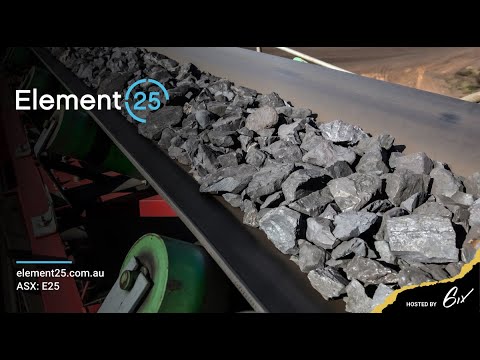
6:15 So I guess the journey for us has been one of how do we get this project going? How do we get into cash flows? How do we get started? We sort of settled on a really simple process that we unlocked over the course of the last 12 months. It's basically the geology at Butchbury is such that we have bands of manganese, which are effectively the material that's economically interesting. In between those bands, it's basically clays and shales that are not economically interesting. So what we needed to figure out was how do we separate the 2? And we settled on this really simple flow sheet. And that is basically we screen out the material when we mine it, about 40% of the clays, or 40% of the mass disappears in the form of fines and clays. We then put it through a washing machine, we remove any remaining clays, then we use an optical ore sorter that does the final separation of any remaining gangue material from the black manganese that forms a concentrate.
7:11 That's what we ship out to our off-take partners. There's only about half a dozen key bits of equipment here. They're all off the shelf. There's no custom build. It's really basic stuff, and that's why we've been able to deliver this project in a timeframe which is really unusual for a mining story in Western Australia or anywhere, because we haven't had to sort of get the engineers working for months on end to unlock the story. This stuff is all kind of ready to go. It produces a median grade concentrate, 33% roughly, very attractive impurity profile, very low FOS, high silica, which is important for those making silica manganese, they need that, and iron to manganese ratios in the desirable range. So really, really sort of straightforward.
7:59 We also have some impurities that are at such low levels that they actually attract some interest from premium markets. So we're looking at a premium on the run of the mill manganese price because of those low levels of impurities, and that obviously further bolsters the economics of what we're doing as well. This just gives you a sense of where we're at. I mean, we're taking delivery of equipment, the detail engineering is done. This is all the 3D sort of rendering of that work. All those key bits of equipment, you see the log washer, the ore sorters, the crushers are either in Fremantle or arriving in the next few days. And so we're kind of ready to go. So we're in full swing development mode. And you'll see more announcements in the next sort of few weeks about taking delivery of equipment, approvals, mobilisation, construction commencing. Those of you that watch Twitter would have seen we've posted photos regularly of key bits of kit either getting on ships, getting unloaded at Fremantle, and you'll see that transition into kit being on trucks going up to site shortly.
9:08 So, I guess we're on time and on budget for delivery of a Q1 commissioning. We're mobilising in the next few days. Everything, the mining lease is granted. It's kind of all ready to go. So we're just waiting on a couple of key permits, which we expect to land in the next week. And then we're in full swing construction mode. I guess talking now about what happens beyond that, stage one's kind of almost bedded down now and will be in production in Q1 2021. But what happens after that? And I think the purpose of the updated PFS released yesterday was to kind of give you a taste of where the potential is to take this project. So, what we showed was Stage 1, okay, we know what that looks like. We're gonna produce about 360,370,000 tonnes of manganese concentrate a year. We've got an offtake agreement in place with OM Holdings or key terms agreed and just finalising the detail on the definitive documents.
10:04 So that's going to happen. That's going to make good money, modest capital, which is fully funded. So that's kind of in the bank. So what happens after that? The thing is, I guess, with stage 1, we're only utilising 20% of the global resource. So there's no sense in standing still on that. We need to look at what happens after that. We've got a whole 80% of our resource available to us for development. So what we did was said, okay, once we get that up and running in Q1 next year, we should look immediately to an expansion to at least double the production. And that's what a 2 times base case scenario looks like. And you can see that the economics are compelling. We jumped to the NPV of 926 million, pre-tax, IRRs outstanding 342%. And then the thing is, why stop there?
10:50 So we haven't made a decision to go 3 times, but we just want to give you a sense of what that would look like. So 3 times the base case is north of 1 billion dollars, which is the envy of resource companies around the state. And I think that you'll see that we will push for that, whether that happens in 1 bite or 2 bites, I can't tell you for certain, we haven't made those decisions, but even at a 3 times base case, just on the reserve, we have a 15 year mine life and there's still 80% of the resource to exploit and we've got outstanding economics. So you are gonna see growth in this project. That's the key message. And then beyond the 3 times base case, okay, this concentrate that we're producing, those of you that have followed E25 for a while, will know that we've done a heck of a lot of work on high purity manganese. So we've done the work on leaching it, we've done the work on purifying it. The battery demand side of things is about to go crazy in 2025, if everybody is to be believed.
11:48 We can produce that product that the market needs. It's in a tier 1 jurisdiction. The supply chain transparency that people are looking for is there. The ethical production that people are looking for is there and we can fill that demand. So I think you're going to see in the coming sort of 6 months or so, a lot more noise made about the high purity manganese for batteries. There's a lot of work going on in WA to bring a cathode manufacturing facility here and we fully intend to be the manganese part of that story. So watch this space. This thing's gonna grow. So don't think we're sitting pat on stage 1, look forward to the future and news about how we're gonna grow the business. So what did we, I guess since May, we obviously took the NPV from 283 million to 583 million.
12:38 Some of you might wonder how we did that. We did reduce the discount rate on the NPV from 8 to 5. That was a big step. We felt that was more reflective of the current global economic environment. Obviously your discount rate is your risk-free rate. Interest rates are currently sub 1% and Fife seemed more reflective of that risk-free rate. Exchange rate's gone the opposite. There's a small sort of reduction in NPV on the exchange rate changes. We've changed it from a 65 cent exchange rate in the first 2 years, and then we went to 70 flat. We just made it 70 flat all the way through on this one. OPEX, we've had some reductions. CAPEX, some reduction, some savings. Plant throughput, we've optimised, so that increases our revenue on the same capital cost, recovery has increased, and we've identified and negotiated with our offtake partners these price premia, there's some attributes of Butcherbird ore that are unusual, and they have a certain sort of boutique demand for certain types of steel. And we've been able to sort of work through that, and we've captured a pretty big uplift in price premium that we expect to receive through developing that market.
13:48 So that takes us to an amazing $583 million stage 1 MPV. And then of course, beyond that, there's the growth that we talked about as well. We're already planning for growth. So this is a engineering schematic that shows you in the dark black lines, the detailed engineering for stage 1, but you can see ghosted alongside that we've already made way for stage 2. So this isn't just an idle idea. This is something that we're very much planning for and it's going to happen. So I think you can see the intent by the fact that we've already integrated into our engineering design for stage 1. So this stuff will be basically produced. It'll form a black lump concentrate bulk material on site that then gets hauled up to Port Hedland in quad bulk road trains and then goes out through the Utah Point facility which is an established ship loading facility which is very familiar with manganese. They already happily ship manganese out. So we'll fit in well there and there's no issue with capacity.
14:56 That's all going to be pretty straightforward. So I suppose The message of this slide is that we are very much on track for delivery of stage 1 and Q1 next year. And just like I said, waiting on a couple of final approvals and we'll be mobilising kit onto site. Then, what do we do once this is in steady state? The key is here, early ordering of key equipment material for stage 2, and then fast tracking development of that expansion. And we see realistically by Q1, 2021, we can have that stage 2 up and running. So, you know, this thing's gonna be, it's gonna be a busy time for us, but I think the returns are compelling and we're gonna get on with it. Just a little bit of markets.
15:42 For those that are unfamiliar with manganese, manganese demand grows year on year, almost every year apart from a few blips with things like GFCs etc. That's because steel consumption grows and you need manganese for steel. The key point on this slide is that there's a number of different manganese alloys that go into steel is silica manganese, high carbon ferromagnese, medium and low carbon ferromagnese and then manganese metal. Silica manganese is the biggest consumption or biggest growth segment. That's the segment that our material fits perfectly into because of its high silica content. So we're not just in the growing market, but we're in the highest segment, highest growth segment of that growing market. So demand side looks really healthy from that point of view. And then from a pricing point of view, you know, manganese is volatile, it jumps around.
16:31 It's the 19th quartile cost producers from South Africa, they track ore about 1000 kilometres from the Kalahari Basin to put on the ships, they turn on and turn off and so the market reacts to that. But overall, our all in sustaining costs is well positioned against the broader price cycle. So we make really, you know, amazing profits in the good times, slightly diminished profits in the lean times, but we're well placed to ride those out and stay in the market for the long term. So yeah, I guess this is this is just a summary slide, really. So stage 1 feed was happened. We're in project execution mode now. We'll be exporting concentrated in Q1 of next year. As the PFS outlined yesterday, there's a big expansion story that's happening in the background.
17:20 Ultimately, we see that leading us to a downstream processing high purity manganese processing plant producing EMM and high purity manganese sulphate for batteries. And then beyond that, look, this resource is huge. We've got almost infinite opportunity to do specialty manganese products like potassium permanganate and so forth. So look, that's down the track, but I think you'll see a long term growth story out of this project. And the plan is really to be clean, low cost, ethical, be a go-to for these manganese products as the world becomes more conscious of carbon intensity, ethical production, environmentally friendly production, etc. We're perfectly placed to fit into that. And we want to be globally significant. And I think we have all the ingredients that we need to achieve that. So that's our story.
18:11 I think investors are going to benefit from that over the longer term. And I look forward to bringing further updates to you as we progress. Thank you very much. So I guess we'll move to Q&A now as Jane indicated. I'm happy to take questions that you may have. Thank you very much, Justin. And everyone, as a reminder, you can submit questions using Q&A tab on the right-hand side. We did have a few questions come in, so let's hop right to it. First question is from Matt. And actually, we did have a few questions coming in from email that are quite similar as well. It says, is there any update on the OMH offtake agreement? And when the exclusivity period ends on December 11th, will other potential offtake partners be named at that stage?
19:00 I fully expect the discussions with OMH are going really well. It takes a little bit of time to bed down the details of these discussions. I don't have any expectation that our offtake partner will be anyone other than I'm holding. So yes, there will be updates coming. Great. Our next question is from email from Ash. Justin, you previously mentioned that you felt Element 25 would be an attractive takeover target as production grew nearer. Can you reveal to us whether there's in fact any takeover interest from other players? Would you consider an offer to be acquired at all in the future? So I wouldn't be able to comment directly on any discussions that might be happening in the background. We would be obliged to disclose any of that through the ASX platform. So I can't comment directly on anything like that.
19:49 But look, no, I'm not I'm not looking for a takeover as an outcome here. I think we have all the ingredients for and the right team to grow a fantastic, globally significant manganese business. Obviously, there's potential for it, but I'm not going out looking for it. I think there's more value for shareholders in building this project and expanding into the segments I talked about. Perfect. Now, the next question is from Andrew. What do you see as the biggest threat to achieving some of the plans because they do sound rather ambitious? Yeah, look, I think the simplicity of the project is a surprise to everybody. There isn't a lot that can go wrong other than a really major global economic downturn. I think, as long as the people making steel that need manganese, we're really well located in terms of where the demand for manganese is. We're much closer to the Southeast Asian markets than the other producers in Africa and in South America. So I think without a major global recession, I think we're looking really good.
20:57 Excellent. So will there be more capital raising in the future? And if so, what are you going to use it for? Good question. So we've, interestingly, we've had money offered to us and we've declined to take it up. We are very, very much attuned to not diluting our shareholders. I'm a shareholder myself, and if you look at the history of the company, we've been very frugal with issuing stock, and we would only do it for a really good reason. The only reason we've sort of come up with is that if we could accelerate our high-grade chemical battery business by raising capital so that we don't have to, we could develop that in parallel with the concentrate business. That's probably the only reason we would do it. We're not intending to at this stage but there are some discussions in the background. If you saw that happen it would only because we wanted to turbocharge that battery manganese side of things. And, you know, look, we're getting some interesting discussions coming out with battery makers who suggest that the timing could be just right for doing that. So watch this space. But no, short term answer is no intention to issue shares.
22:01 Great. And from Lien, what sort of capital will you need to produce EMM? I can't give you a figure, but it's a it's a hydrometallurgical plant you're talking about. So it's in the hundreds of millions of dollars. It's not in the tens. You know, we haven't done all the work we need to do to give you an actual number, so I can't say, but it's, they're not simple plants. You know, if I said to you 100 million bucks as a sort of entry level manganese sulfate plant, that might be there or thereabouts, but you know, it's not as, it's certainly not the low capital we're looking at for the concentrate business. Here's a question from Stuart. He's assuming that the funding of the stage 2 expansion at least will be fully funded from the base case production and free cash flows. Is that correct?
22:48 Yes, it depends a little bit on timing. So it depends on how aggressive we want to be. So if we, we certainly could do it that way, but there's also potential to bring that expansion forward with some debt funding, for example. And, you know, we wouldn't necessarily look at equity funding. I think that would be again dilutive and unnecessary. But if there were some favourable terms around debt, you might take on some debt to bring that commissioning on stage 2 forward a little bit. But there is certainly the option of funding out of cash flows as well. Next question is from Dave and sorry if you answered this already, but is there any intent to pay dividends to reward shareholders in the long term? Look, I think yes, in the long term. I wouldn't be counting on that in the next 12 to 24 months, though. We're looking at growth here. And look, at some point, the board will consider starting a dividend policy, but I don't, I wouldn't expect it sort of in the next little while. I think We've got other things to deploy our capital on.
23:48 But yeah, long-term for sure. I think investor returns through dividends is a fantastic way to reward shareholders. Here's a question from Ash. You talked a little bit about the Manganese price. Can you talk about your confidence level and how the price would possibly move in the future? Could we be looking at it returning to the levels we assumed during the stage 1 PFS? So I think the short answer is yes, but I think it's also worth qualifying that because this year has been really volatile for manganese. I mean, COVID has kind of made a mess of everything. I think a lot of market observers are expecting previously unseen levels of stimulus.
24:35 I think that has to happen. And if that happens, then obviously infrastructure will probably get a big slice of it. And that means steel consumption will get a big slice of it. So that means that's good for manganese, right? So I think the macro is really bullish for manganese, but we're not out of the woods yet with COVID and I think there's some uncertainty around that as well. So we've been pretty conservative in our pricing assumptions, but remembering that we also have these interesting impurity profiles that make us potentially more attractive than others. So I think we're going to enjoy price resilience that other producers potentially can't rely on. Great, thank you. The next question asks, What is the rock type and what kind of ore deposit is it? So in simple terms, it's, the protolith is a marine manganese shale.
25:28 It's about 1.7 billion years old. It's a regional geological feature. Then what's happened is we've had some uplift through faulting and folding, and those folded and folded blocks have been subjected to weathering. So it's a supergene deposit where the manganese carbonates have been oxidised to manganese, sorry, oxidised to manganese oxide species. So it's basically a manganese oxide supergene deposit, if that's enough detail for you. Feel free to ask for more if you'd like more detail. Yeah, the next question asks, what are the mineral reserves in the cut-off grade? So the cut-off grade in ground is actually 7% and the reserves of just over 50 million tonnes at 10% contain manganese.
26:20 Great, Thanks Justin. Our next question is from James. How much magnesium PPM do you need in assays to develop interest in ground. Yeah. OK. So it's that's not a simple question. Normally with these super gene manganese deposits, people find them with outcrops. So you basically find these black outcrops of manganese oxide. And rock chips will often guide you as to what potentially is economic. And it's quite common to get, not in PPM, but in percentage terms, up to sort of 30 and 40% in these outcrops. And then that sort of guides your exploration efforts. You know, you need, ultimately the economic manganese oxide these days is above 30% manganese contained. Really, there is a significant amount of material traded below that in the 25 to 30% range. But for us, we need broadly above 30%. So you'd be looking for that in outcrop. And then the drilling that you would follow up with would tell you whether that is that occurrence is in sufficient volumes to be economically interesting.
27:27 Right. Thanks, Justin. Our next question is asking about the ore sorting process you went through a little bit. What's your level of confidence in that ore sorting process because it seems to be a new approach and quite key to the success of a project. Can you provide some examples of this process having succeeded somewhere else before? Yeah, so there's just from the one manufacturer that we're getting our all sorts from Steiner, which is a German manufacturer. These numbers aren't right at the top of my mind, but I think for example, they've got about 150 units deployed in mining globally, and that's doubled in the last 18 months to 24 months. So manganese, sorry, all sorting in manganese is not hugely widespread, but it's certainly used in a few places. It's used in gold, it's used in sorting of waste stockpiles in nickel and other sulphide deposits. It's not new, so that's not a correct term.
28:23 The ore sorting technology has developed a lot over the last few years and they have a number of sensors. So they have induction, XRT, laser, optical, I think there's about 7 or 8 different sensors you can look at. So we've done extensive test work on our material. Really the exercise for what we need to do is about as easy as it gets for an ore sorter in that we're just trying to simply sort black manganese material from red, white, yellow shell material. So based on colour, it's a really easy thing for the ore sorter to do. So my level of confidence is very high, and I don't have any concerns about that part of the process. That's great. The next one's from Chris. In the PFS on the mining side, the ramp up to higher production is higher utilization of mining equipments, but are there other parts of the operation that can also be expanded simply by working extra shifts?
29:16 Yeah, so there is headroom in the all-sorter throughput capacity, there's headroom in the log washer. Probably the bottleneck at the moment in the plant is the crusher. You would need to put in a second crusher or a bigger crusher to ramp up. I think that's almost certain. The mining equipment is pretty straightforward because we're starting up on just 2 and 1 day shift only. So for doubling capacity, you would go 2 and 1 day shift and night shift. And then for 3 or 1, for 3 times, sorry, you'd go to continuous production with the same fleet. So that's really straightforward. For the processing equipment, you would need to double, you know, look, we could probably squeeze a bit more out of train 1. So, you know, we're talking about a nominal throughput of sort of 70 odd thousand tonnes. You can probably get that up to 390, potentially 400, but to go beyond that, you're gonna have to replicate the train. So that's kind of just the fundamental sort of limitations of it.
30:15 The next question is from David. Any thoughts on a scaled pilot plan for the downstream processing? Yep, lots of thoughts about it, lots of discussions about it, planning for it. It almost certainly will happen. Great. Next question is from Paul. He'd like to know any signs of institutional investors in the register? That's a delicate question. Yes, we do have some small institutional involvement in the register, And we've had some really strong interest from institutions. I think that you'll see them transition into the register over time. It's you know, it's institutions are a double-edged sword, they come in hard and they exit hard as well. So, you know, it's a balancing act between who you get on and managing those relationships. So, look, they'll be involved in the story going forward. If you want to raise $100 million, you can't do it without institutional investors. So watch this space.
31:14 Great. Our last question is from Shane. Shane says, Justin, you seem analogous to Fortescue as a simple querying operation and giving your large board and management ownership position in E25 shares. Can we anticipate a Fortescue like dividend payout ratios? We could only hope. Look, I don't have as much of it as Twiggy has of his, so I'm envious of him, but certainly I'm motivated to build the business and look, dividends is gonna be part of the story in future years for sure. So, I see the analogy, we can only hope we get that big. Great. Oh, we've got an extra question coming in here from Craig. What announcements do you anticipate before Christmas And will we receive final permits from prior to Christmas?
32:06 So on the permitting side, I think almost certainly, but I don't control everything around permitting. We definitely want to mobilise before Christmas. So permitting is key to that. So you'll see announcements around that. We're drilling out the ball field as we speak, so you'll see announcements around that. We're also in discussions with various offtake partners for stage 2, so You may well see announcements around that as well. So there's lots going on in the background and some of those things I hope will land before Christmas, certainly. Awesome, sounds like there's a lot to look forward to. We do have more questions coming in. Andrew would like to know, do you think funding for expansion can come from the government at all through the Northern Infrastructure Fund?
32:54 I don't see a role for the North Australia Infrastructure Fund in the expansion case because the capital requirements are so modest. But we're certainly in discussion with them about the bigger story on the high purity manganese and they have had in the past quite strong interest. So I don't think it's unrealistic to see them involved in funding of the larger high purity expansion case. Great. I do believe that was our final question. Well, thank you very much, Justin, for the presentation, the update, and answering all of our questions. And thank you, everyone, that joined today and submitted your questions. If you did not get your question answered or you thought of 1 afterwards, please stick around. We've got a short survey where you can leave your details so that the E25 team can follow up with you directly. You can also find more information on their website at www.element25.com.au, which is on screen here. And as always, this webinar was recorded and it'll be available as a recording on six.com.
33:52 Now, Justin, I'll pass it back over to you for the final word. I just wanna say thank you all for tuning in. Thank you for your support over the last 12 months. It's been an interesting year for us and a fantastically successful one. I hope to be bringing you
Follow Element 25 Limited into a list and get an email when it puts out news.
Latest news releases
- ASX:E25 — U.S.A. HPMSM Project Update · Thu, Oct 29, 2026
- ASX:E25 — U.S.A. HPMSM Project Update · Thu, Oct 29, 2026