Shawn Wilson
Chief Executive Officer
Replay available
Builddirect.com Technologies (TSXV:BILD) Q2 2026 earnings call, held 2026-08-26. Watch the replay and read the transcript on 6ix.
On 6ix: 6ix.com/event/builddirectcom-technologies-inc-bild-q2-2026-earnings-call
Automated transcript · Written by software from the replay's audio. It can mishear names and figures; the replay is the record.
0:00 Quarter twenty twenty six financial results conference call. My name is Bob Chen, and I'll be moderating today's call. On the call today are Sean Wilson, chief executive officer Carrie Biggs, chief financial officer and Jay Allen, President, Digital and Commercial.
0:20 Before we begin, I would like to remind everyone that today's presentation contains forward looking statements within the meaning of applicable Canadian securities laws, including statements regarding the company's growth strategies, acquisition plans, integration objectives, margin targets, business outlook. These statements based on management's current expectations and assumptions are subject to known and unknown risks and uncertainties that could cause actual results to differ materially. Please refer to advisories on slide two of today's presentation and to the risk factors described in the company's continuous disclosure filings available on SEDAR plus The company undertakes no obligation to update forward looking statements except as required by law. If you have any questions during the call, please send them in using the Zoom q and a function at the bottom of your screen or email them to [email protected].
1:07 We'll address these questions during the q and a session. A replay of this call will be available approximately twenty four hours after the conclusion of this conference call and will be posted on the Investor Relations section of our website at ir.builddirect.com. With that, I'll turn the call over to BuildDirect CEO, Sean Wilson. Sean?
1:28 Great. Thanks, Bob. Good afternoon, everyone. We appreciate you joining us. The second quarter was a strong quarter for BuildDirect and strong in the way we've been telling the market to measure. We grew. We stayed disciplined, generated cash while doing it. Revenue increased 16% year over year to 19,700,000. Gross profit increased 14 to 7,700,000 with the gross margin holding at 39.2% despite the mix shift that comes with the the acquisitions. We reported net loss of $190,000 adjusted EBITDA of 390,000 and a positive operating cash flow of $450,000 Just as important as the shape of the quarter against the first quarter. Q1 was soft, as we said at the time. In Q2, our revenue increased 34% sequentially, well ahead of the normal seasonal lift. Adjusted EBITDA swung from negative point $34,000,000 to positive point $39,000,000.
2:18 The net loss narrowed from 1.8 to point two. Net rebound reflects the contribution of the business we acquired and reflects the execution across locations we already owned. Alright. I won't be straightforward about the composition of our growth because straightforward is how we wanna be measured. Buyer businesses contributed roughly 3,400,000 in the second quarter revenue. Excluding acquisitions, same store revenue declined about 4%. Soft demand is real across the flooring industry. We're not gonna pretend otherwise. But our answer, a soft market is not hope. It's the two engines you see this quarter, buying great businesses well and running everything we owned with, increased discipline. I'll now turn the call over to Carey, who will discuss our q two and first half, 2026 financial results. Great. Thank you, Sean, and good afternoon to everyone on the call.
3:08 Starting with consolidated second quarter of twenty twenty six, revenue was $19,700,000 up 16,600,000
3:18 from $16,900,000 in Q2 of twenty twenty five. Gross profit was $7,700,000 up 14.7% from prior year and gross margin was down slightly 70 basis points to 39.2%. Decline reflects acquisition mix rather than pricing erosion. Both segments maintained pricing discipline overall. Adjusted EBITDA was 390,000 compared to 600,000 a year ago for the same quarter reflecting business and sales mix and softer legacy business demand. I would note the 1,080,000 bargain purchase gain on TOA is a non cash item which you'll see in our P and L and excluded from adjusted EBITDA along with restructuring and other items detailed in the reconciliation in our MD and A for EBITDA.
4:16 Operating cash flow was positive 450,000 for the quarter through two integrations and cash at June 30 was 4,100,000. So just talking first half of twenty six, Overall revenue was 34,300,000, up 7.2% from 31,900,000 in the first half of twenty five. Gross profit was 13,600,000 for the first half of twenty six at a 39.6% gross margin. Adjusted EBITDA for the first half was 60,000 mainly driven by the soft first quarter which Sean noted, which had negative adjusted EBITDA of 340,000. But again recovered positive for for q two.
5:08 On to the the segment segment level. By segment for q two twenty twenty six, ecommerce revenue grew was at actually 4,500,000 for the quarter, up 22.8% year over year driven by the Grain acquisition which closed in February. Excluding Grain, e commerce revenue declined approximately 12% on a same store basis reflecting softer demand and lower quality inbound lead flow during the quarter. Gross margin remained very strong 48.3%, our highest margin segment, while adjusted EBITDA was flat in the quarter versus a positive point zero three for the overall first half.
5:57 Moving on to the next slide, for the ProCenters, q two twenty twenty six ProCentre revenue was 15,200,000, up 14.9% representing 77% of consolidated revenue overall for the business. If we exclude Tile of America TOA, same store pro center revenue declined roughly 2% primarily reflecting softness in our Michigan locations.
6:26 Pro center gross margin was 36.5% for the quarter and segment adjusted EBITDA grew to $1,550,000 in the second quarter and $2,170,000 overall for the first half as noted earlier. Finally, on the balance sheet and liquidity side, cash ended the quarter 4,100,000 down from 8,200,000 at year end primarily reflecting the deliberate deployment of capital into the TOA acquisition and related working capital, again partially offset by positive operating cash flow. Total acquisition cash outlays for the first half of the year were approximately 4,500,000 across the two transactions that we've noted.
7:12 Our revolving credit facility was drawn to 4,800,000 at quarter end compared to 3,600,000 at year end reflecting acquisition related working capital as well as the timing of certain quarter end working capital payments. And finally, total assets increased 9,000,000 to 47,200,000 largely reflecting the acquired businesses and associated working capital that came along with them. Our focus, in the second half is working capital optimization across our inventory and payables, a disciplined capital deployment, and maintaining appropriate liquidity to support the ongoing needs of the business. So appreciate the time. With that, I'll, hand it back over to Sean. Okay. Great. That brings me to what's why I think is the most important story this quarter. The acquisition platform is working. We closed two acquisitions in the first half, Grain Custom Wood in February, added premium custom hardwood in national big box marketplace channels to our cover segment, demand sources we did not previously reach, but filled to logistics infrastructure that we already owned.
8:19 Tile Atlas of America in May, chatted three established profitable tile showrooms in Tampa, Sarasota, and Fort Myers, and anchored in a Florida cluster alongside our current existing operations there. And look. We we bought them well. TOA was acquired far below the fair value of net assets, roughly 78¢ paid per dollar of net assets producing a 1,080,000 bargain purchase gain, which to be clear, we exclude from the adjusted EBITDA. Grain required only a modest working capital true up in the quarter, and both were funded from operating cash flow in our revolving facility on their last equity raise. This is the model profitable flooring businesses bought with discipline folded into a shared infrastructure all made better on our platform. Looking further out, we see a long runway of highly accretive growth. The flooring industry is large, fragmented, and full of succession driven sellers, exactly the condition the conditions rather the consolidator is built for.
9:16 As a recent acquisition season, we are approaching a meaningful annualized revenue milestone and believe the same playbook that got us here scales well, well beyond it. Jay will now take us through our acquisition playbook and the Grain and TOA case studies. Thanks, Sean. Good afternoon, everyone. On the next three slides, I'll walk through how we're applying our acquisition strategy and practice, what we're looking for, how we're underwriting the transactions, and how we're integrating each of the businesses onto our BuildDirect platform. We're targeting profitable specialty flooring retailers and distributors with strong local customer relationships and established operating economics.
10:07 These are often founder family owned businesses that are facing a succession decision. So the opportunity can include both physical showroom networks and ecommerce or marketplace type platforms. Price discipline is central to our strategy. Tile Outlets of America is a really good example of this. We paid approximately 3,900,000 for preliminary net identifiable assets valued at approximately 5,000,000 or about 78¢ for each dollar of net assets acquired. So that resulted in a $1,000,000 noncash bargain purchase gain.
10:53 Our acquisitions are are funded prudently using available cash, operating cash flow, and our revolving credit facility. We're underwriting each based on its existing cash flows and asset value with the expectation that it will be accretive, not on any assumptions that the market needs to recover. Once a transaction closes, we apply a standard integration playbook using common systems and reporting, consolidating purchasing, aligning our merchandising, and sharing back office resources. Our goal is to add acquired revenue while keeping corporate overhead largely stable.
11:41 Regional density also matters. Flustering location locations allows us to share inventory, management resources, and freight lanes. As our purchasing volume grows, we also expect to create opportunities for improved profit margins across our platform.
12:03 Grain Custom Wood is a good illustration of the ecommerce side of this strategy. We acquired Grain on February 2. The business added premium custom hardwood products and access to national big box marketplace channels. This is customer demand that we did not previously reach directly. Grain is a capital light addition because its orders can be fulfilled through warehouse and logistics infrastructure that BuildDirect already operates. It also diversifies our ecommerce segment beyond demand generated through builddirect.com and paid search marketing.
12:47 Grain contributed approximately 1,300,000 of second quarter revenue. Based on our internal operating results, it was accretive to the ecommerce segment during the first half. The business was onboarded on the BuildDirect systems and fulfillment processes during the first quarter of ownership. We've also seen improved gross margins as fulfillment and purchasing have moved onto our logistics network and supplier programs. Overall, I think Grain demonstrates how we can add new products and sales channels and leverage the infrastructure we already have in place.
13:29 Tile outlets demonstrates the showroom side of this strategy. We completed the Tile outlets acquisition on May 12, adding three established Florida locations in Tampa, Sarasota, and Fort Myers. The approximately 3,900,000 cash purchase brought us roughly 5,400,000 of inventory together with the showroom operations and their associated lease arrangements. TOA contributed approximately 2,200,000 of revenue during the roughly seven weeks between the acquisition date and quarter end. Based on our internal operating data, its gross margin was approximately 46% compared with 36.5% for the overall ProCenters segment in the quarter.
14:17 So that made TOA margin accretive to the segment from the outset.
14:24 Integration is now underway. We're moving systems, reporting, and merchandising, and purchasing onto our ProCenters platform, and we're connecting the three showrooms with our existing Florida operations. As purchasing is consolidated on the BuildDirect supplier programs, management is targeting an improvement in TOA's gross margin from approximately 46% towards 50%.
14:51 That's a forward looking management target, not guidance, and it depends on purchasing integration, products mix, and volumes. So I think this shows that we have two different businesses businesses we acquired, but they demonstrated the same underlying model by profitable flooring businesses with discipline, integrate them into the shared infrastructure, and use the combined platform to create operating leverage for the business. With that, I'll turn it back to Sean to discuss our long term outlook.
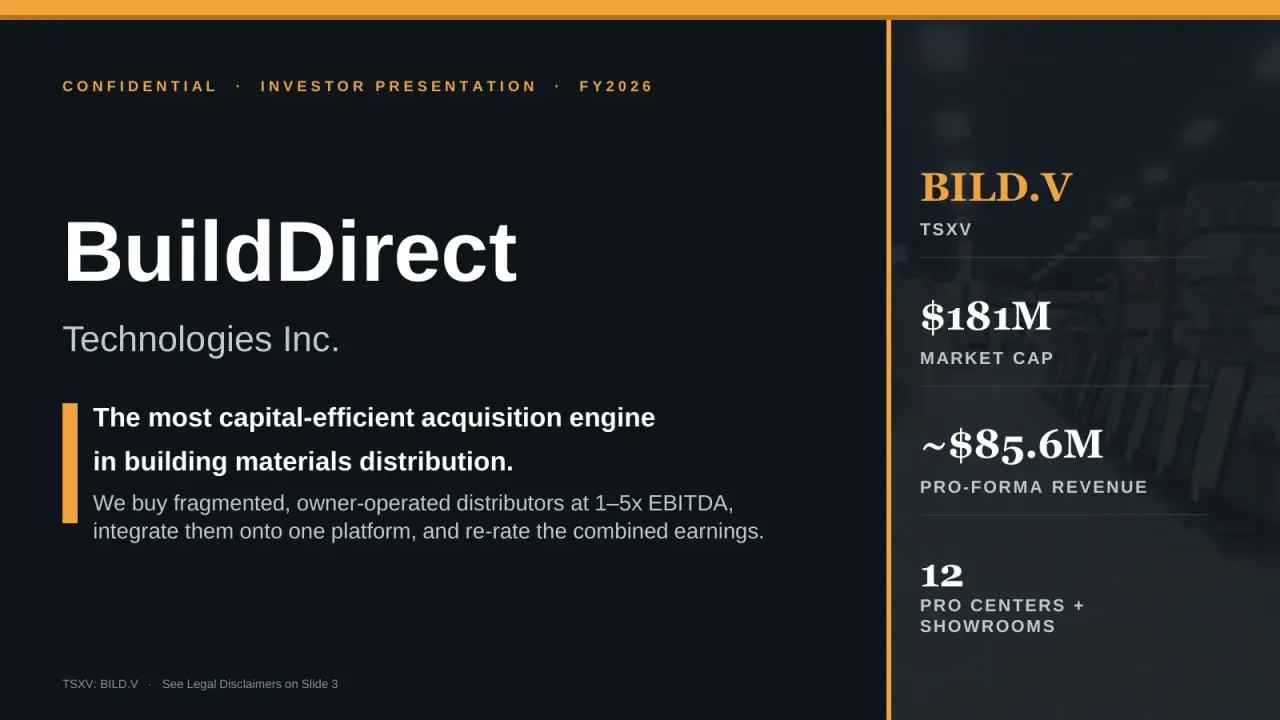
15:25 Okay. Great. Let me close on how we think about the path in here because the the quarter matters less than the pattern. The framework we manage is pretty simple. We buy profitable frame businesses at one to two times post synergy EBITDA, largely backed by inventory and hard assets. We'd run acquired locations toward 12 to fifteen percent four wall EBITDA over ownership period, and we hold carpet costs largely flat with acquired revenue lands. So operating leverage, not financial engineering, is what compounds. Those management targets are not the so mentioned targets, not guidance. The assumptions behind them are put in today's materials. Our priority for the balance of 2026 are the ones on the slide, integrate what we bought, rebuild the organic demand engine, and stay disciplined on the next acquisition.
16:11 We maintain regular ongoing discussions with potential partners
16:15 that will update the market if and when there's a definitive transaction to announce. I wanna thank our teams across every location, including the people who joined us from Grain and Tile Allets of America this year for a quarter that shows that this platform can do. And, with that, Bob, let's open it up for any questions.
16:35 Thank you, Sean. We'll now begin the q and a session. For those who, have not submitted their questions, please submit them using the Zoom q and a function at the bottom of your screen, or you can send email to [email protected].
16:58 So the first question we have here, your previous acquisitions were smaller single store or ecommerce acquisitions, but TOA was a sizable high quality business you purchased at a bargain price. Are there other acquisitions like TOA's quality and size in the funnel? Absolutely. And I've commented on this in the in the past. TOA acquisition is a good is a good indication of what's, what's out there. The part that I would just think about a bit more basically, except for the Grain acquisition, which was obviously more of a marketplace with a great opportunity. We saw a leverage. You know, if you buy one one of these locations or five, the economics are relatively the same. Intuitively, it's a bit, you know, it's a bit, easier to process a handful at a time versus one at a time. That's really more of our target base. So when you think about what we find at the sweet spot, it's, you know, 20 to $40,000,000 companies with anywhere from three to, you know, five or six locations, that are clustered as the ideal target. And as I mentioned, you know, right now for a while, there's,
18:05 we'll run out of out of time before there's a a lack of targets in that in that range. And, yeah, very, very, very much, the case. Another question we have here, can you expand on the TOA margin target?
18:29 Kind of a vague question. Anything else involved on that one or just, you referring to, like, just the bridge upper? Yeah. It's, what can you expect? Can you expand on the TOA margin target? Okay. I'm gonna assume I'm gonna assume the the questions pertaining to where margins are now and and where they're, you know, we're forecasted to go. Jay, do wanna take that one? Probably a mix of Sure. A few assortment items along with the pricing and product line structure, things like that. That's a yes. That's exactly how I would interpret it, and that's how I would explain it. I think there's a couple of things going on. One is we were able to take advantage of some pricing opportunities and increase margins pretty much right out of the gate. We continue to see some opportunities there.
19:25 The second big piece in my mind is the is our supply chain and utilizing our supply chain to both bring in BuildDirect core items into that business and then also optimize how they're bringing product in as well and gain some margin opportunities there. I think those are really the two big pieces we see working for us.
19:55 K. Great. Alright, Bob. Anything else?
20:08 How is the how is the m and a progressing on the pipeline versus last quarter? Is it about the same, or is there an increasing pipeline? Yeah. Same with that. The so our play is to buy, integrate, and then continue on. And so we we don't, you know, obviously, comment on on things aside from we're constantly maintaining and and talking to, to partners. We also don't plan on just sitting on our on our hands. So one thing I could say, the Grain acquisition and integration, went very well. You know, it was obviously wrapped up and finished before we bought.
20:48 The, the next one, Tile Atlas, which that one is, you know, likely to be on the tail end of of, of any kind of, you know, remaining integration work. There's there's obviously always, improvement ideas and opportunities. And those carry both ways, I should mention. Like, we buy great businesses with great team members that have really great ideas. And so we find synergies that we kinda identify going into the business. But then, candidly, in both cases, we found things that, frankly, they were doing much better than, than our core was. We then started pulling back through. So that that's, like, a continuous synergy process that will get you know, like, just kinda keeps on rolling. But when it comes to integration, our teams will be relatively free, to process, the next one from a bandwidth perspective, and our intent is to keep, keep the machine keep the pattern rolling.
21:42 Next question. What is the state of the flooring industry today versus even twelve months ago, and how does this impact the m and a landscape? Yeah. I would say just, you know, I'll kind of address that one. You guys could fill in any details if you like. But, you know, I would say, so first off, the overall industry, you know, looked in a really bad year. It's a bit off and a really great year. It's a bit of a tailwind. It doesn't have wild swings like other categories, like cabinets, roofing, siding, do, and that's mainly because flooring is highly concentrated with residential remodeling, which is why it's, in my opinion, a great a great industry for a strategic roll up. Lot of stability there. You do have swings in some in some spots. So, like, for example, in new home construction,
22:30 that that is what it is. Housing turnover, when it increases, it's a tailwind to the industry. People are moving. They change floors, sell their house, and then people change floor when they buy houses. So you definitely don't see a lot of that happening right now. And, look, we get asked what's our our forward view on what rates are gonna do. I don't know. Who knows? Not something we think about or waste time with. You know, we just focus on what we can control, and right now, it's not thought causing that big of an issue. It's if anything, just having us focus on commercial, flooring opportunities more so than onboarding just net new builders, for sure. When it comes to, do we what's wasn't doing to the industry, I would say fatigue. So you have a lot of, a lot of folks you talk to.
23:18 You know, they wrote out the COVID time, the PPP funding, all these great programs and, you know, a lot of volumes and the real estate, you know, appreciated quite a bit on the commercial side. So building they bought for a million dollars, now we're five. And, the noise with the tariffs and, you know, housing turnover, so on and so forth, you know, we we perceive it definitely has caused, just fatigue and, like, a desire to transition for those who might have been on the fence other otherwise. That was part of our thesis kinda going after this this, this play a few years back. I mean, no. Didn't think it'd be be this hectic on the tariff side. Like, for example, the new ones that were announced with, with Canada. But, I say if anything, it just caused a bit of fatigue there, which is fine for us. We're well equipped to to, work through process and then, and compete in that kind of environment, and, it definitely build build forward for sure.
24:16 So that's my thoughts there. I don't think we have any more questions. So that concludes today's q and a session. I'll now turn the call back to Sean for any final remarks before we end this conference call. I just wanna thank everyone for joining, following the story, your support. And as I've, said a few times, we're just getting started. It's gonna be a great, great play. We, we're having a a blast doing it. So take care all, and we'll see you next time. Thank you, Sean. This concludes BuildDirect's q two twenty twenty six conference call. A replay will be available on the company's investor relations website. Thank you, everyone.
Follow Builddirect.com Technologies Inc into a list and get an email when it puts out news.
Chief Executive Officer
Chief Financial Officer
President, Digital and Commercial