Harry Baker
CEO at BORDERS & SOUTHERN PETROLEUM PLC
Replay available
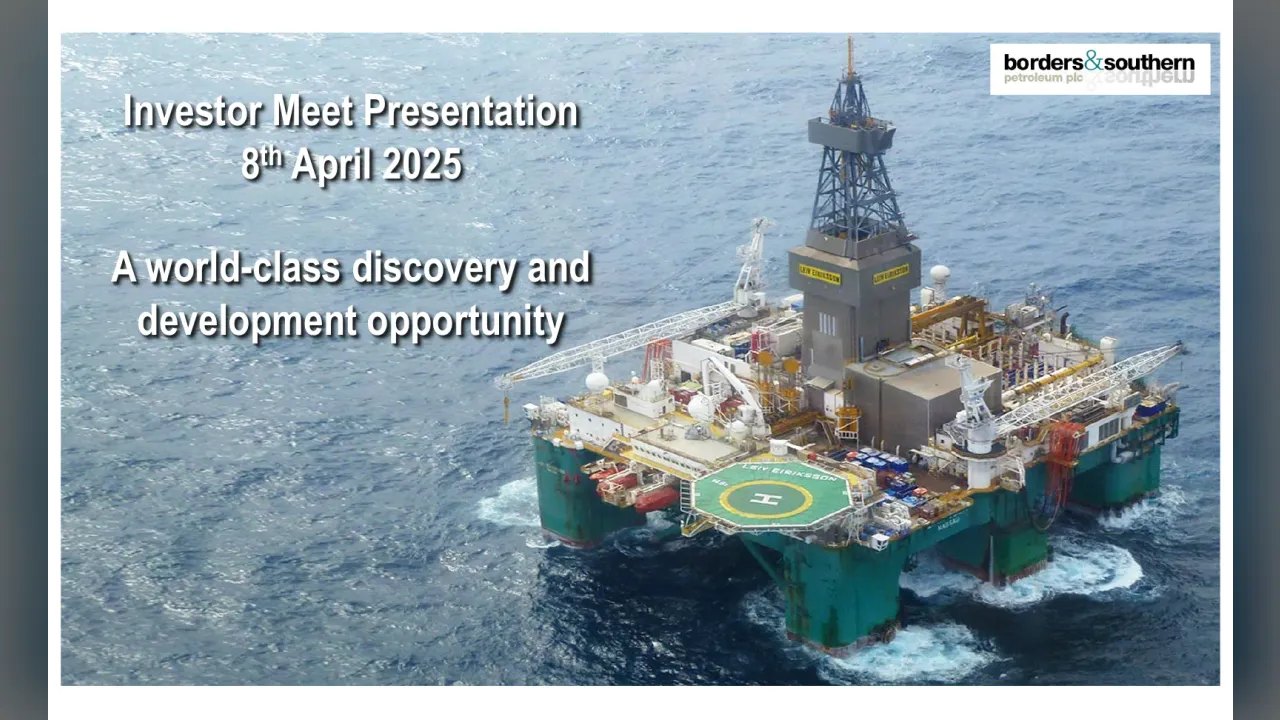
Investor Presentation hosted by Borders & Southern Petroleum (LSE:BOR) on Investor Meet Company, held 2025-04-08.
On 6ix: 6ix.com/event/borders-and-southern-petroleum-plc-bor-investor-presentation
Automated transcript · Written by software from the replay's audio. It can mishear names and figures; the replay is the record.
0:01 Good morning, ladies and gentlemen, and welcome to the BORDERS and SOUTHERN PETROLEUM PLC investor presentation. Throughout this recorded presentation, investors will be in listen only mode. Questions are encouraged. They can be submitted at any time via the q and a tab that's just situated on the right hand corner of your screen. Please just simply type in your questions and press send. The company may not be in a position to answer every question it receives during the meeting itself. However, the company can review all questions submitted today, we'll publish those responses where it's appropriate to do so on the Investor Meet company platform. And before we begin, we would just like
0:32 to submit the following poll. And if you'd give that your kind attention, I'm sure the company would be most grateful. And I would now like to hand you over to CEO, Harry Baker. Harry, good morning, sir. Good morning. Thank you all for joining us for what is our first ever investor meet presentation. It's not going to be the last. We look forward to keeping investors and the market fully updated on all of our progress. Since joining the company on the first of March last year, I've endeavored to improve communications with the market and specifically with investors. And we really look forward to continuing this initiative. To that end, we've done other things like improve the website and increase the content on the website.
1:18 This is your company as investors and we feel that we noted previous criticism of the communications and the company has made a real effort to improve that over the course of the last year. And we really look forward to being as open as possible in the coming months. To that end also, I'd recommend any interested investors to come to our AGM in June, where we can physically meet in person and answer any questions you have and look forward to meeting as many of you as possible there. You will recognize this disclaimer page and I'm sure you can read that at your own leisure. So this is a snapshot of the company of the leadership and the board. But before we get into that, I'd really like to talk about why we're doing this presentation and why we're doing it now and what message we're attempting to get across.
2:14 I just think The Falklands are about to become really exciting. And that share price chart on the bottom right shows really the sort of the market reaction to anticipated news coming up in The Falklands. The Falklands has always been an evocative area of the world for The UK investor base, and the much anticipated FID of Sea Lion is going to attract huge investor and importantly industry interest to the region. And so this presentation serves as a refresher to those who would like a reminder of our story and an introduction to those who were coming to look at this story and this basin and this part of the world for the first time. I'm joined here today by Peter Fleming, our CFO, and Bruce Farah, our subsurface manager.
3:05 These guys are from a big oil background, and what you're gonna see over the coming pages is an explanation of an asset base that is really compelling and a project that has had $300,000,000 of back costs spent on it and has been interpreted to the highest industry standard. There are multiple company makers in our portfolio, and we look forward to introducing you to them as we move forward through the presentation. About me, I was an investor in the BORDERS IPO. I've been in and around the company since its inception. I played an integral role in the many fundraisings that the company has done initially to shoot seismic and then ultimately to go and drill the wells. And BORDERS and SOUTHERN has been under my skin the whole way through, and I have a real passion for this project and I'm really privileged to be in a position where hopefully I can help move this story forward significantly over the coming months.
4:05 On the board, top right, the new name on there is Doctor. Sean Guest. Sean is the CEO of Valeura Energy. He's an exploration geologist by training and Valeura Energy is one of the top performing companies on the TSX in I think three out of the last five years. Sean has spent his life in industry. He is a deal maker and having his added horsepower to the board is extremely helpful when we sit across the table from potential partners. And it's not just his knowledge of how to do deals and how to navigate through the tricky world of farm ins and farm outs that he brings. He also brings an extensive black book of contacts contacts, many of whom are already being extremely helpful with us as we look to move this project forward.
4:57 We have a very supportive shareholder register, and we are very grateful for the longevity of most of them, many of them, and for the support that we have. Our top 10 shareholders own just under 60% of this company, and our top three own over 30%. And that actually that strong register puts us in a really good position when we're talking to potential partners. Our recent funding ensures that we're funded to the end of twenty twenty six, and I think that's crucial. We've extended our license recently for a two for for further two years starting on the January 1, and being fully funded for this period allows us to do the right deal, not just the first deal, and I think that's crucial.
5:49 We will come on to that later on, and that will come up again. The key points, the project summary, again, this will be a reminder for for many of you. The Falklands is a great place to be. And whenever there's activity in The Falklands, historically, the equity market has stood up and taken real notice. Last time around, there were five ways to play in The Falklands. You have BORDERS in Southern, Rockhopper, Desire, Falkland Oil and Gas, and Argos. And, you know, one look at the historic share price charts just shows how well those companies performed whenever there was a rig in the basin. Now we've got the prospect of a development in the North Falklands, renewed interest in the South Falkland Basin, and there are only two ways to play it in London. You've got BORDERS and SOUTHERN and ROCKCOPER, and we are in good and constant communications with our partners in the North. And we do expect to see huge interest in both the North and the South as we go forward.
6:56 So again, this is a brief slide of the looking at the snapshot of the opportunity. I draw your attention to the fiscal regime. We read a lot in the press at the moment about the North Sea and what is happening to the North Sea. A 9% royalty and a 26% corporation tax mocks us as a really benign fiscal environment and it's a sign that the Falklands government is very serious about the development of the hydrocarbons industry. And we are really pleased to have a great relationship with people onshore in the islands and that relationship starts at the top. So Andrea Claussen has just been elected as the chief executive of the Falkland Islands legislative assembly and we have a really good relationship with her.
7:44 And only last week when she ascended to her post, she reiterated what the one of the central pillars of her leadership will be the development of the hydrocarbons industry. I think that's really important. We've got a supportive government and a supportive country that will encourage the development of the hydrocarbons industry. In Darwin, we have a significant condensate discovery with a large liquids resource. And development of Darwin has a total project payback of two years at $60 a barrel, one year at $90 a barrel, and we have enormous running room in the rest of the portfolio. And part of this presentation will go on to outline that running room and why we are so excited by it and what is proving attractive to potential partners as they look at us and consider coming in to get involved in our company.
8:40 Bruce and Peter will go into that in more detail later. But I just and we'll go in again further detail down the road, but that cartoon on the right will come up again. And I think that is something I'd love the investor base to really understand is that in Darwin, we have a really good project that is verified time and again by everyone that looks at it. In and around and beneath Darwin, there's another 1,300,000,000 barrels of liquids recoverable. And if you're trying to package something up for the industry to come and look at, what you've got here is a near term development and then huge running room. And our investment bank are marketing us as Guyana too, and we'll outline further on in the presentation just why we think we have the potential to be make a major impact in answering the problem that the industry currently has, which is essentially solar panels aren't gonna pay the dividends going forward.
9:44 US Shale is running out of running room with the Permian handling over 20,000,000 barrels of water a day at the moment and the sweet spots have gone. The industry is looking for projects and we've got a project that we believe and the conversations we're having at the moment show that we're in the right ballpark. We believe the industry has a problem and we think we can be part of the solution. So moving on to the overview of where we are and apologies to those who know us intimately. This is a basic reminder to people who may not be so familiar with the story. We're in the Falkland Islands. We're in the South Falkland Basin. We're about a 145 kilometers due south of the Falkland Islands.
10:31 We have 40 blocks comprising 10,000 square kilometers, and we revel in holding a 100% of this acreage. So we have plenty of flexibility to do, as I said earlier, the right deals with industry partners. Our Darwin discovery has an independently assessed liquid resource of 462,000,000 barrels, recoverable. And I'm not gonna embarrass anyone here by pretending to be technical, but Bruce will do all that. But because of the reservoir properties of Darwin and the nature of the hydrocarbons, we can develop this resource with a small number of wells in a modular fashion, and this provides us with optionality on the development options.
11:16 So we can small we can start small and expand upwards, thereby increasing the range of companies that can get involved with us. A buccaneering player can come on board or we've got a project that can be attractive to the very biggest companies in the world.
11:33 I talked about that cartoon on the right hand side, and this is probably a better picture of it than on the previous slide. Just having that amount of prospectivity in and around an existing discovery is not something you find everywhere in the world. And the seismic we have is of the highest quality and the interpretation has been done both internally and externally verifies that we've got an extremely exciting project here.
12:00 The farm out is probably something that most people will want to ask about, and we're very limited as to what we can say there. Later in the presentation, we'll touch again on industry trends and what we're seeing. We recently appointed a large investment bank to manage our farm out process, and they're the same team of individuals that completed some of the largest deals for the majors in 2024. So the same guys who are working day in, day out with the majors are the people that are working on our file, and we're really pleased with how that process is going, and we anticipate further new entrants into the into the the opportunity driven largely by Sea Lion and industry curiosity as to the Falkland Islands. The development in the North is definitely helpful to us in the South.
12:55 Investment bank is a potentially strange move from the outside looking in for a small aim listed E and P company. Ordinarily, a company of our size couldn't afford the monthly retainer of one of the largest investment banks in this space. Such is their confidence in our project and in the changing industry appetite for projects such as ours, the investment bank have taken us on on a success case only basis. So we have no monthly retainer for their services, and I think that's a strong signal from them that they think they can sell this project, sell it well, and sell it quickly.
13:39 My last slide is gonna come later on, and I'd like to introduce Bruce to take us through a bit more technical detail on why we have such confidence in what we've discovered already. Thanks, Harry. I'd like to just start off on the Darwin discovery and just refresh everyone's memory of what we've got here. Darwin is comprised of two robust tilted fault blocks. Now these are the type of structures that were drilled in the Nor Northern North Sea in the very early days, effectively the low hanging fruit. They're very obvious. The map that you're looking at, the colorful map at the top of the slide there is the top Darwin Reservoir map.
14:27 Now the actual reservoir itself is an action aged, shallow marine sandstone that basically bordered the margin of a developing ocean back in the early Cretaceous. The, the actual reservoir itself is a, a shelf or bar or barrier bar. Now these type of fasces are excellent in terms of deliverability. So they're very simple homogeneous reservoirs. And you can see that in the well log there on that slide of the Darwin East Reservoir. That's about 84 meter gross interval for that reservoir interval, but you can see it's a nice big blocky chunky interval. Now if you refer to the two seismic sections, these cut north south across both of the, tilted fault blocks.
15:21 You'll note that I've indicated there where the flat spots are on that seismic data. Now these are these flat spots indicate where
15:30 the hydrocarbon water contact, exist. And the reason why we can see it so clearly is because of the blocky nature of that really good quality reservoir. Now I'll obliterate the sci fi now by putting an overlay on top of it. That's actually the sand into it. That's the action sand package. Over at Darwin East, as I said, it's about 84 meters in gross thickness. On the top of Darwin West, it gets up to just about 300 meters thickness. So that's if you think about that, that's just shallow of the height of the shard. If I just throw the hydrocarbons and the fluids now into that, what you're looking at there is that's the red area where the trapped hydrocarbons are and the blue is the water wet sandstone.
16:21 And on that slide, you can see where it says ACTS. That is, if we refer back to the map, that is the, amplitude conformance to structure, which is basically looking at where the hydrocarbon water contact is. And that shows up very clearly. This is textbook, imaging of this. And that's why we feel very confident about the hydrocarbon volume calculations and as our independent assessment carried out as well. Now I'd like if you refer to the scale bar on that slide, that five kilometers, the the actual length
16:57 from the Western End of Darwin West to the Eastern End of Darwin East is about 17 kilometers. So in terms of reference, that's basically the distance from the end of Heathrow Airport to Hyde Park Corner. So that's just a visualization of how large this field is. So that laterally extensive reservoir, homogeneous reservoir over a large area, that basically gives us the ability to exploit this reservoir with a limited number of wells. So the full field development, you could develop that whole area with just three production wells on both of the structures and two gas injectors on both of the structures.
17:42 So you could develop the whole field with just 10 wells. As Harry mentioned earlier, the independent resource assessment for the Darwin field is about 462,000,000 barrels of liquids. And those liquids are represented there by that little picture of that single malt whiskey colored fluid, which is, the condensate that we recovered from the wireline sampling that we did when we drilled the Darwin East well. So the actual fluid itself behaves very much more like a light oil than anything else. Now in terms of how we exploit these reservoir, these type of reservoirs, we basically it's called a gas recycling project.
18:28 So the production wells bring the hydrocarbons to surface. We separate out the gas and the liquids, the condensate, and then we pump the dry gas back down into the reservoir. So as I said, we could develop this with 10 wells, but what we're going to do is for for economies of scale, we're gonna look at a phase development, which Peter will run you through the economics now. Thanks, Bruce. As Bruce pointed out, the Darwin discovery is very good technically, but it's also very good financially and commercially for two main reasons. First reason, as Bruce just pointed out, because it's so good technically, we don't need to drill very many wells, three wells in this particular instance, in this particular case, to get a high level of production of 26,000 to 30,000 barrels a day, which is a lot of production from a small number of wells. You don't see that very often around the world. The other reason why economics are very good is because of the fiscal terms as Harry pointed out, which means importantly, I think for me, I think payback is a really good measure of how profitable the project is, and here we're talking about one to two years, and that allows you to sort of think after those one or two years about what you want to do. Do you want to expand and draw other prospects around Darwin and increase production, or do you want to give money back to shareholders or a combination of two? But I think the important thing is there that you're not taking a long term view of oil prices or the industry, you're taking a one or two year view because
19:58 you get your money back half that period of time. I think that's really important. As I mentioned, after you've got payback, you have a lot of cash flow to invest back into the project, and there are a whole lot of different options you can choose from drilling extra wells in Darwin East and getting more production in Darwin East or going across to Darwin West. And the bottom slide shows up to 70,000 barrels a day full field, which is extraordinary amount of production from one discovery. Before I talk about the well costs, I'd just like to draw your attention back to that near field exploration upside. As Harry talked about, that, the the prospect map in the top right hand corner of that slide, around Darwin well, around and below Darwin, we've got about 1,300,000,000 barrels of recoverable liquids.
20:51 So if we add in the liquids, volumes associated with Darwin, we've got about 2,000,000,000 barrels of prospectivity in what we would classify our shelf or play area. Now those targets are either laterally equivalent to Darwin, which is the Morgan and Covington structure, or they're stratigraphically deeper than Darwin, which is the Stuart, Stokes, and Sullivan targets. They sit about 700 meters below that Darwin target level. That lower level is more the traditional Spring Hill play that has been targeted over successfully over in the, Magalenes Malvinas Basin. So as I said, if we drill deeper underneath Darwin East, about 700 meters, we would tag that Stokes play.
21:41 Now Stokes and Sullivan, they're effectively the same stratigraphic interval, but that package is thinning as we move, over to the towards the west. The Sullivan target, as you can see, you know, you don't have to you you know, a a young child can see identify the the the similarities between the Darwin Reservoir and that Sullivan package. So when we carry out all of our wonderful trips with our rock physics modeling, our assessment is that deeper package is giving exactly the same expression as the Darwin hydrocarbon charged interval. So we feel very confident that that package will work, is hydrocarbon charged. Of course, there's
22:26 other risks. There could be reservoir issues, etcetera, etcetera, but we feel very confident it is charged with hydrocarbons. And when you think about the way that hydrocarbons have migrated into that Darwin target, they had to have come through these target levels to get up to Darwin. So we believe that they are hydrocarbon bearing. If we deepened a well, as I said, 700 meters underneath Darwin East and tagged Stokes, if Stokes worked, in terms of the additional volumes that we will get from Stuart, Stokes, and Sullivan, would add another 600,000,000 barrels to that resource that we've already discovered at Darwin. Now another interesting, point about just those five targets, the Darwin structures and then Stuart, Stokes, and Sullivan, is we believe they're gas condensates.
23:16 But the the gas that would be remaining, once you've done your liquid stripping, there's about 10 TCF of gas there. So that's a pretty significant gas resource within a small area, which is attractive to certain part part parties. So looking at the well costs, first of all, if we just start off with a single well we got most multitude of well options that we could drill here. But if we just look at the single well cost option, which is to drill, core, and test on Darwin East, if we target Darwin East again, it's about 150,000,000. Now this is on a 100% basis with no rig sharing. Now of that 150,000,000, about 40%, 45% of that is the rig mode, demode.
24:03 So you will see that if there is any possibility of rig sharing going forward, that will significantly reduce those costs. There are additional rig savings even if it's not the same rig, if we were sharing, say, facility, facilities such as helicopters, accommodation, etcetera, etcetera, there will be cost savings in there. Now to deepen the Darwin East well down to the Stokes level to drill and test Stokes is about 25,000,000. Additionally, what we could do if we drill two wells, we could do that, and then we could go over and do drill Darwin West. But we have the option as well where we could drill and target Darwin East with just three wells, And the idea would be that we would maintain those wells as the future producers, as Peter alluded to, as the phase development. So we drill two producers and one gas injector.
25:01 So what we looked at previously was our what we would classify as our low risk targets, the low hanging fruit. Now what we're looking at are our mid and high case targets. If we start with the our mid case targets, which are the action slope fans. So these fans are effectively the lateral equivalent. They're slightly younger because what happened is there's that sandy shelf. There's been a drop in base level, which is when the sea level drops, and the sands are being eroded and shedded off the shelf, breaking down onto the slope. So we've got a series of fans sitting down on the slope, very similar to the fans that have been targeted all the way around the Atlantic margin. So that's the Jubilee Field there. That mahogany in one well was the Jubilee Field discovery.
25:51 There's about just under two and a half billion barrels of liquids potential within those fans. If we look at the on the right hand side of the screen, these are the fold belt plays. Now we see these as higher risk, but they're massive. That Fitzroy target has a closing area of about a 144 square kilometers, so it's vast. But the risk over on in those foldback plays is is the reservoir risk. If you look at in the middle of the slide where it says Stebbing, the Stebbing well targeted two intervals. That upper interval, that that brighter amplitude package, those reds and blacks in the heart of that fold. Now the well did find wet hydrocarbons, which means that it's not just dry gas.
26:37 There's the potential for liquid hydrocarbons as well within that package when we drilled the well. But the reservoir was too silted. It wasn't a very good reservoir. It it was charged, but it wasn't a very good reservoir. The well failed to get into that deeper package you can see down there, those parallel line intervals. And that is the interval that we would target on anything that was drawn from those fell belt plays. That's the upper Cretaceous lower tertiary target package. But as I said, they're higher risk, and we've concentrated our efforts on the low hanging fruit. This is a slide that has only recently been added to our website. It's a full detail of all of our prospects inventory from Darwin at the top all the way down through the whole portfolio.
27:30 As you can see, there's nearly 9,000,000,000 barrels of liquids here, 9.4 TCF of gas. This chimes with this is the answer to or part of the answer to the industry problem of getting projects onto balance sheets of sufficient size and scale to attract the biggest players in the
27:47 industry. This is a really good prospect inventory. Until about a month ago, it had never seen the light of day. And this is part of our initiative to open our doors a bit more so that people can see just exactly what we've got and what we're marketing to the industry.
28:10 This slide is I prefer to look forwards rather than backwards, but I think this slide goes some way to answering that question that if the project is this good, why hasn't it been farmed out already? And that is a valid question, and it is often leveled at us in the chat rooms and around the place. And
28:30 if you look at this slide, you can see a number of things. You can see across the top what BORDERS have been doing in the background and then in the bottom, there's a chart where it's the oil price versus historical events. Darwin was discovered just before the Saudi policy of opening the taps to have crash US shale. And through that period, you've had the waxing and waning of industry appetite for what was perceived as deepwater exploration and the backdrop, which we can't hide from, of the politics throughout the whole period. Now our belief is that industry appetite is improving every day at the moment for projects such as this, and the politically agnostic congregation is growing.
29:23 More companies are prioritizing projects over politics, and we're to see that trend continue going forward over the coming months. Global exploration CapEx is predicted to rise over the coming years. And our exciting portfolio of projects is going to keep us and our partners of whatever size and scale they may be busy for the foreseeable future. So hopefully this slide goes some way to explaining why we haven't achieved the nirvana of a
29:56 farmer yet. I think there were brief windows during that time when possibly a deal could or should have been done. But by and large, over that period, it's quite easy to understand why the industry was looking elsewhere, be it away from the deep water onto the onshore US or whatever it might be. We believe and would Mac have written a piece this week or last week talking about even US companies are beginning to look overseas now
30:25 and to look at the deepwater for more projects. So we think the future is super exciting, and, you know, we look forward to updating you further as we move forward. Here is just a bit of a snapshot that it's not just us drinking our own bathwater and thinking about improving industry conditions.
30:47 Through the last reporting season, you could hear out of the mouths of the cheap executives themselves. You heard what BP had to say, Equinor talking about restating their targets back to pre COVID levels and increasing those targets and hitting those targets by 2030. There is a real recognition within the industry that and to sort of use the phrase again, solar panels are not going to pay their dividends towards the back end of this decade and into the next. And oil and gas is going to be around
31:17 for longer and the industry is recognizing that and the industry is pivoting back towards projects like ours. And you've seen this actually physically as well rather than just in the newspapers. So if you look at that Atlantic margin, so there's a huge amount of activity offshore South Africa, offshore Namibia, up to Guyana, down to Uruguay, and we very much feel like the next cab off the rank for the industry. There is again, and it's know, our our investment bank taking on our project for no retainer is is a sign of this. The big companies are back out barrel hunting, and we've got a project or a combination of projects that will be really attractive for them. So expect to see more deepwater stuff, expect to see more offshore activity from the industry because you're hearing out of the mouths of the chief executives of those companies themselves.
32:16 So in a summary, and I don't want to reiterate what we've been saying too much, but that liquid in the middle is 46 to 48 degree API. It's a very transportable, very valuable liquid. We've got lots of it. We've got very, very high quality seismic so that us and our partners can really interpret what we've got in the rest of the portfolio. We've got a phased development project that pays its chucks out its own body weight in cash in two years at $60 a barrel, breakeven at $40 a barrel, 9,000,000,000 barrels, 10 TCF of gas,
32:52 unbelievably attractive fiscal regimes when compared to the rest of the world, the industry hunting for barrels, having the appetite for projects like this. And I think crucially, we're fully funded through the end of twenty twenty six. So we may not do the first deal. We certainly intend to do the right deal. And I think that's where we should leave it and head over to any questions that you may have. Perfect. Harry, Bruce, Peter, if I may just jump back in there. Thank you very much indeed for your presentation this morning. Ladies and gentlemen, please do continue to submit your questions just by using the q and a tab that's situated on the right hand corner of your screen. But just while the team take a few moments just to review those questions that have been submitted already, I'd just like to remind you that a recording of this presentation along with a copy of the slides and the published q and a can all be accessed via your investor dashboard.
33:43 Guys, as you can see there, we have received a number of questions, and thank you to all of those on the call for taking the time to submit their questions. But, Nick, at this point, sir, if I may just hand over to you to chair the q and a with the team. If And I pick up from you at the end, that would be great. Thank you. Brilliant. Thanks, Joe. We'll start with the pre submitted questions. With the data room being open for some time and no takers to date, do you not think it would be more beneficial for the company to raise funds to drill an appraisal well on the Darwin East discovery and perform a well test to confirm flow rates and extensive discovery on their own prior to accepting any potential offer from interested parties, as surely this would help erase any concerns a partner might have and result in much more favorable terms being tabled for existing shareholders on a proven success case. I think in an ideal world, we'd have a test result on Darwin, but that would have involved having testing kit on a on an exploration well in the South in the Frontier Basin.
34:45 And, you know, an aim listed company doesn't have the resources to take that kind of gamble. So, yes, in an ideal world, a test result would be great. However, we are seeing in our conversations with our industry counterparts that there doesn't seem to be a huge amount of questioning about whether this will flow. The questioning is how much it will flow. So we've got a brilliant asset, and I think the days of in the current market that we're in of being able to do something so desperately dilutive to get a test result, those days have gone. We are very careful about stewarding dilution. And I think our partners are showing sufficient confidence in the project that we wouldn't be looking to go down that route. And I'd also chip in to say that from a technical perspective, I don't know how many people out there are very technical, but did when we did our wireline testing, we did effectively mini DSTs across, four intervals across the reservoir.
35:49 And our drawdowns were between one and ten PSI, which is, you know, very, very good. It just shows up the reservoir quality.
35:57 So and and we could see about 200 meters into the reservoir with those little tests. So from a technical perspective, given the the data from the well and you can see from the seismic data, you know, we don't have any issues. We know this will flow. You know, as a technical person, away from the sort of the financial side of things, I have no I have absolute confidence this would flow like anything.
36:21 Thank you. Thanks. How do you see the current market uncertainty affecting your negotiations? I think the current uncertainty is a temporary thing. I think the industry has a bigger problem, which is barrels on the balance sheet and dividends towards the back end of this decade and into the next decade. And that realization that the world needs hydrocarbons and will need it for longer is not gonna be affected by a short term blip with that's affected by geopolitics rather than fundamentals of supply and demand.
36:59 And it is those fundamentals that we expect to come back to the fore as the conversation continues, but essentially the world will need a lot more hydrocarbons towards the end of twenty the 2020s and into 2030s than the current industry hoppers have available. Do you have any communications with other Falkland Islands interested parties, for example, Navitas Petroleum and Rockhopper Exploration, or have you had? Relations with Rockhopper are at an all time high in terms of I think Sam Moody has done a fantastic job there, and he and I are in regular touch. And he's been extremely helpful to me in learning how to switch from the finance side to the industry side and the nuances of dealing with The Falklands.
37:52 We have had recent conversations with Navitas, which would imply that relations are good, and we look to working with them in whatever way we can, be it on an onshore capacity or an offshore capacity.
38:06 Is the water depth not an issue?
38:10 I love this slide. Thank you, Bruce. We genuinely believe that where Darwin sits is well within the compass of what the industry is currently doing. Nothing needs to be invented or or designed to develop Darwin. This project is I think in 2012, it would have been called deep water. I don't think that term ultra deepwater, I don't think that term applies now. We've got anything to add, Bruce. No. That's fine. I mean, I can see on the the slide that hopefully, you can see on the screen that, you know, these days, they're pushing out well beyond 3,000 meters in terms of, you know, exploration at Shell Turitella FPSO is operating in 2,900 meters in the Gulf Of Mexico. So 2,000 meters water is still deep water, but, you know, any of the technology used for this development is off the shelf technology.
39:05 Nothing has to be reinvented. Are the weather conditions not too severe?
39:14 No, they're absolutely not. Those of us who've been involved in BORDERS and SOUTHERN and a lot of investors have been with us for the duration will remember that way back when BORDERS and SOUTHERN shot their first three d seismic campaign going into a Southern Hemisphere winter. In fact, in the last South Falkland Basin drilling campaign, I think less than four days were lost to weather. So you can operate here all year round in all weather conditions. And they actually, this is thank you, Bruce, pulling this up. If you look at the top right, you can see our met ocean conditions. We're very much akin to the North North Sea, certainly more benign than West Of Shetland. We are where we are is well within the compass of what the industry can do.
40:07 And The Falklands cope with two drilling campaigns? Bruce, I'll let you to handle this one. Yes. One of it depends on well, first of all, if it's a share campaign, then that's no issue because we'll be using the same vessel. If it's two different vessels, it depends on the type of vessels. For example, if we were to use our ideal vessel is a DP-seventy, but if we used a large drillship, very much you can load up pretty much all your kit and equipment onto that drillship, and it doesn't really need a lot of resupply from shore. Whereas if we had a d if we had a DP semi and a different semi in the North, then it can be managed.
40:52 And there are as we said earlier, there are savings that can be help both parties in terms of the helicopter support that we would both need, supply vessels, accommodation, flights. We tend to fly fixed wing aircraft from The UK with crew members on board. So there's a lot of savings that can occur. It's not to say there are challenges, but it's just a logistical challenge that can be managed. I'd like to just add to that. The same team that drilled the last two wells when we were last down there are still part of the company. So we still have our drilling manager, and the chapsey beside of me managed the drilling campaign from London. So The Falklands, as an area, we do believe that there is room for expansion in the onshore facilities.
41:41 We do believe two campaigns could work concurrently. I would imagine a combination of campaigns would be attractive from a cost saving perspective to all players in The Falklands. Can you explain why SP Angel and BORDERS and SOUTHERN have parted ways as nomads to the company after only twenty eight months and twenty days? Nomad seems to change on a quite regular basis. Is this just my perception, or is this normal practice? I have absolutely no criticism of SP Angel. What we have done since I joined the company is a general refresh, and hopefully, that's coming across in our communications, but it's also happened across our advisers.
42:27 I've worked in oil and gas financings for twenty five years and our new nomad and our new joint brokers have both got a huge passion for moving their share price forward. And it's absolutely no criticism of SP Angel. It is normal, and it well, I've worked in this industry for a long time. I felt that I wanted the passion of new eyes on this project and new people to go and push this forward. It's not about what what what this is about is getting more people familiar with this story because we're gonna be seeing BORDERS in Southern, we're gonna be seeing the Falkland Islands, we're gonna be seeing oil and gas in the news, and I want that to translate into investor appetite.
43:17 And in our new joint brokers, I think we've got the right team to really go and push this message forward. You did a $1,500,000 raise in October, which seemed to be enough to cover you until the farm out was achieved, why have you raised another 1,860,000 just a few months later? Historically, the company has over recent years raised two years money at every opportunity. And this is this was my decision, and the board agreed with me that back in October, we were staring at a funding wall, and the market was penalizing BORDERS and SOUTHERN as it was approaching the end of its funded period. However, simultaneously, we could see the catalysts that would, we felt, drive the share price, and that meant raising two years money at this at that time would have been unnecessary dilutive at the very low price. So we went away and, felt that we would be able to have the opportunity to raise money at a higher price.
44:20 Moving into this year, our share price was extremely strong in the first quarter and that afforded us the opportunity to defensively raise enough capital to fund us to the end of twenty twenty six because we felt vulnerable to, opportunistic approaches from industry parties who saw us potentially as unfunded. And those opportunistic approaches might have been either in the equity market or via an industry approach with an unfavorable farm in. So by funding ourselves to the end of twenty twenty six, we have the balance sheet to look the industry in the eye and do the right deal. On the original well in 2012, what testing did you do on the well?
45:07 Why are you confident it will flow commercially? Well, I think we've we've already answered that question. But, just for example, we we tested we did formation testing across the whole reservoir interval. So we're very confident in that, the continuity of the hydrocarbon column. As I said, we carried out four mini DSTs across the whole interval as well, and we recovered 14 gas condensate samples. And as you can see on the screen, and I've talked about earlier, that is just a sample that was recovered from one of those gas condensate samples. So in terms of the data we've recovered from the well, the seismic data and those mini DSDs, we feel very confident that the any well test on here would would would flow very well.
45:59 Gaffney Klein and Associates published an independent evaluation back in 2018. You hope this would stimulate fresh interest in securing partners. Why hasn't it happened to date? I I had tried to address that with that slide of share price performance sorry, not share price, industry performance since the discovery was made. Look, I think there probably were windows when a deal could have happened. But by and large, for the duration of that period, starting with the Saudi oil price crash all the way through to things like COVID and, you know, all those black swan events that happened, I think the industry was more focused on US shale. I think The US onshore was a great contraction of global capital into that US onshore.
46:49 I think now the stars are more in alignment for us to be able to get a partner. I think the the the industry appetite is changing. And now more than ever, you know, we are we are more confident right now today than I think we've ever been. Last year, hired a new energy financial adviser who relaunched the farm out process. Who are they? What are they costing? How is it how is that progressing? They are a top tier US investment bank, one of the biggest names in the sector. They are, I think, doing progressing extremely well. We have more interactions with potential partners simultaneously than I think BORDERS has ever had.
47:37 And, we are not paying them a monthly retainer as outlined earlier. They are success case only, and the same team of individuals that managed, I think, the largest deals in q four twenty twenty four are working on our file. So we're very, very happy with who we've got, and we're happy with how things are going. And next round, I think you've answered pretty much, but I'll just give it to you. Why do you think you can achieve a farm out and the development of the assets now when your company has not managed to do this in the past? I think we've covered that. I'd just like to reiterate our optimism that, you know, the world changes, markets change, and our market has materially changed.
48:22 You know, it's it's a fishing analogy. Last week, the fish weren't biting. This week, they are. What do you see as the catalyst over the next twelve months? I think we've got a number of internal and external catalysts, and we can't get away from the fact that FID and sea lion is a game changer for us as well. It really will bring equity market interest, but much more importantly for the project, industry interest will focus. Shell in the two thousands had a slogan that they were fast followers. It was a celebration of the fact that they would allow someone else to go into a basin and then charge in after them. And that's what we've seen going on. That's what we saw in Namibia. I think it's what we're about to see in Uruguay as well.
49:10 This is a place where the fast followers are about to come in and we're again super excited by what we're seeing. Question from Dominic S, those are all the pre submitted ones. You mentioned the anticipated FID for C LAN being a catalyst for BORDERS. How do you see the latest tariff wars and subsequent oil price drop affecting Navitas funding and likely FID for CLAM? It's a great question. It's not for me to comment on Navitas' development of Sea Lion. All I know from our conversations with them and with people on the islands that at the moment, it's all guns blazing. And, you know, we are very excited to see Navitas move forward with Sea Lion. It's brilliant for the islands and the islanders and for the industry in the Falklands.
50:02 Further question from Dominic S. Do you have any assurances from the FIG that the fiscal environment won't change like we've seen with the windfall tax in the North Sea? We have a great relationship with FIG, and we've had no indication thus far of any change in the fiscal regime. 26% tax, 9% royalty compares very favorably with virtually, what, 78, 79% tax in the North Sea. We are in one of the most benign areas in the world from a fiscal perspective, and that is a recognition of their desire to develop a hydrocarbons industry. Question from Sukman G. What is the dollar per barrel breakeven price and at what Brent crude dollar per barrel would this project be viable for a potential farming partner?
50:57 Peter? The breakeven price is $40 a barrel. You know, that's that's quite obviously very low compared to what current prices, but, know, people are gonna be looking at their own price projections, forward curves, but it's, you know, $60 a barrel, it's it will pay itself in two years' time, so that's pretty competitive around the world, to be honest. I don't think the economics will be a problem for anyone coming into this project. Peter. Further question from Dominic S, whilst I appreciate that you can't comment on farm out negotiations, is a rig share agreement with Navitas a possibility, or do you borders require a higher spec rig for deepwater? I'll start, and I'll allow Bruce to finish on this one. Yes. A rig share with Navitas is a distinct possibility.
51:49 As we mentioned earlier, the combined cost savings of all the ancillary support elements of a drilling campaign are a great benefit to both of us. And we and Navitas, I believe, have identified rigs that could perform both jobs. Bruce? No. That's about I think covered everything there, really. Okay. Thanks. Another one from. Has three d seismics been done and over what area stroke fields? Yeah. So, basically, all of those targets I showed you today are all covered by three d data. If you look at the image on the middle of the screen there, where the block the block outline is in blue, and that gray area is the three d seismic.
52:37 So when we shot our three d we we originally had a two d data grid that covered the whole of the block, and we used that two d data to focus in our three d data to target the sweet spot area, and that's what we've covered in the three d data. Question from Matt L. Is there any hope to revisit stabbing in the future? I think the low hanging fruit in our portfolio is what attracts us most right now. And certainly, the conversations we have with industry partners would point towards focusing activity around what we've already discovered. But elsewhere in the portfolio, the prospects add up to around 9,000,000,000 barrels. One day, Stowe will be drilled again.
53:27 But in the near term, we're focusing on the low hanging fruit. Further question from Sutman G. For Darwin, what is the porosity and permeability? The average porosity at Darwin is about 21%, 21.5%. The permeability is about three thirty five millidarcities. That's the average permeability. Further question from What is your timeline target to secure a farm in? We want to secure the best farm in, not just a farm in. So it's about getting as many parties up the knowledge curve simultaneously. So our feeling is that there are companies that have enough information to make a proposal, but we are seeing new entrants at various levels.
54:26 And the investment bank's job is to manage that process to develop some form of competitive tension so that we can deliver the best deal for our shareholders. A further question from Matt L. Are you confident that the farm in will be achieved within the current financial funding window? We are very excited by where we currently sit. I'm not able to give any projected timings or, you know, aspirational timings. We wanna do the best deal we can, and we wanna get it done as expediently as possible. I would envisage that a potential partner would want to crack on when there's activity down in the Falklands. So that would encourage us that things would happen within a sensible time frame.
55:20 And the last question we have is from Dominic S, which I think you also pretty much answered. You mentioned that you might not do the first deal, but do you have a rough time scale as to when you'd like to secure a deal by? About ten years ago, but I've only been in the job for a year, so now we can push things. I I I really it's about getting the right partner, the right deal, and what I mean, if if I am learning as I've come to this job, you know, I've worked in finance for twenty five years. This is my first go through on this side of the fence. And I think it it really takes different companies, different time spans to get up that knowledge curve. You know, if you're talking to an Exxon, it can be, you know, any eighteen months, it can be two years. If you're talking to a buccaneering, you know, entrepreneurial type, they can get there much faster.
56:15 Our job is to get the right partner and the right deal for our shareholders, and we're looking forward to getting that done as soon as possible. That's all the questions we've had. Perfect. Sorry, Harry. If I may just jump back in there. Thank you very much guys for being so generous of your time there and addressing all of those questions that came in for investors. And of course, if there are any further questions that do come through, we'll make these available to you immediately after the presentation has ended. But Harry, perhaps before really just looking to redirect those on the call to provide you with their feedback, which I know is particularly important to yourself and the company, if I could please just ask you for a few closing comments just to wrap up with, that'd be great. Absolutely. Thank you. Hopefully, we've managed to convey our not only our enthusiasm for the project, but also our belief that this time it's gonna happen.
57:06 We have a world class project. We have a brilliant asset in Darwin. We have the same team that discovered it. We have the same team that drilled it. Nobody else understands this project like we do. Our job is now is to educate the market, educate investors, educate potential farming partners that we have here a project that is going to be producing hydrocarbons for decades. And at the moment, we've got a 100% of it, and we are thrilled to have it, and we're super excited by what the future holds. Perfect, Harry. That's great. And thank you once again for updating investors this morning. Could I please ask investors not to close this session? It shall now be automatically redirected for the opportunity to provide your feedback in order the management team can really better understand your views and expectations.
57:56 This will only take a few moments to complete, but I'm sure it'll be greatly valued by the company. On behalf of the management team of BORDERS and SOUTHERN PETROLEUM PLC, we would like to thank you for attending today's presentation. That now concludes today's session. So good morning to you all.
Follow Borders & Southern Petroleum PLC into a list and get an email when it puts out news.
CEO at BORDERS & SOUTHERN PETROLEUM PLC
Subsurface Manager at BORDERS & SOUTHERN PETROLEUM PLC
Finance Director at BORDERS & SOUTHERN PETROLEUM PLC