Francis Richer de la Fleche
Vice President, FP&A and Investor Relations
Replay available
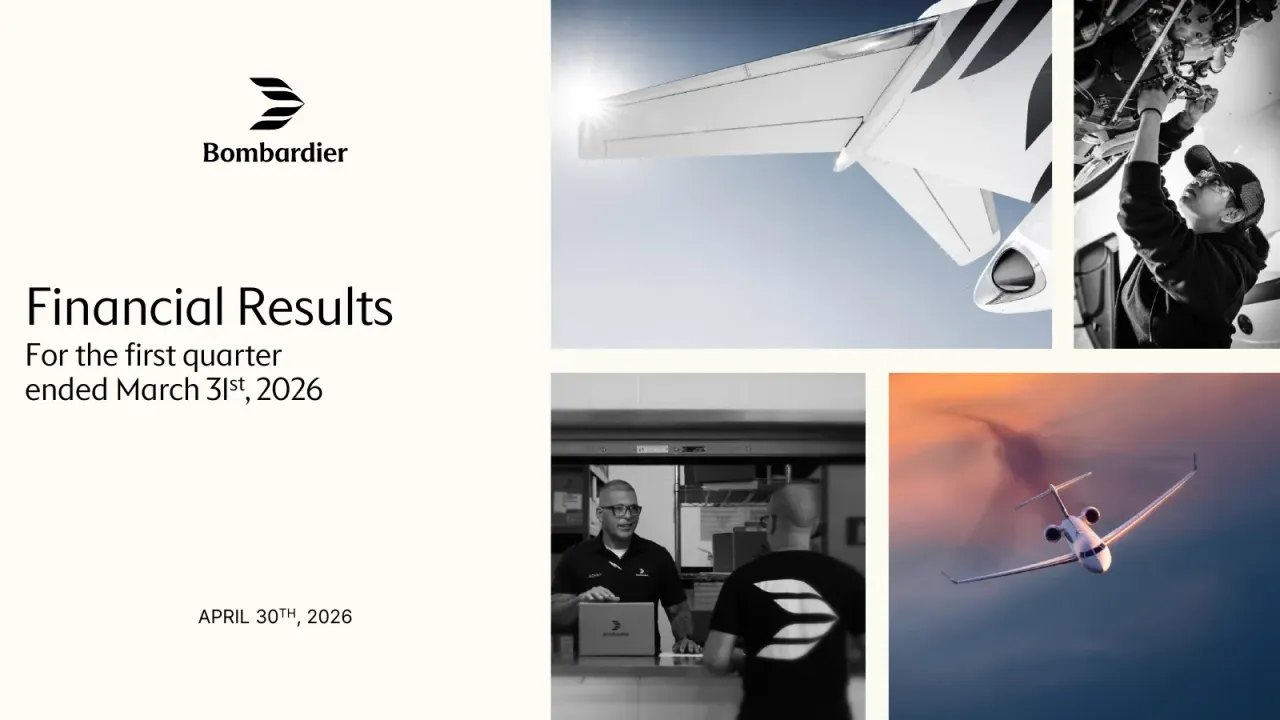
Bombardier (TSX:BBD.A) Q1 2026 earnings call, held 2026-04-30. Watch the replay and read the transcript on 6ix.
On 6ix: 6ix.com/event/bombardier-inc-bbda-q1-2026-earnings-call
Automated transcript · Written by software from the replay's audio. It can mishear names and figures; the replay is the record.
4:02 Good morning, ladies and gentlemen, and welcome to the Bombardier Inc. First Quarter twenty twenty six Earnings Conference Call. Please be advised that this call is being recorded. At this time, I would like to turn the discussion over to Mr. Francis Richie de la Fleche, Vice President, FP and A and Investor Relations for Bombardier. Please go ahead, Mr. Richer de la Fleche. Good morning, everyone, and welcome to Bombardier's earnings call of 2026. I wish to remind you that during the course of this call, we may make projections or other forward looking statements regarding future events or the financial performance of the corporation. There are risks that actual events or results may differ materially from these statements. For additional information on forward looking statements and underlying assumptions, please refer to the MD and A. I'm making this cautionary statement on behalf of each speaker on this call.
4:53 With me today is our President and Chief Executive Officer, Eric Martel and our Executive Vice President and Chief Financial Officer, Bart DeMoskey, to review our operations and financial results for the first quarter ended 03/31/2026. I would now like to turn over the discussion to Eric. Good morning everyone and thank you for joining us today. I want to start by thanking our Bombardier team members all around the world. Your focus, your discipline and your commitment to our customers is really what continues to make strong results possible. The first quarter of twenty twenty six was a very strong start to the year for Bombardier.
5:39 We delivered unprecedented positive free cash flow for a first quarter and at the same time, we saw exceptional momentum on orders that gives us again and again trust in our strategy, in our people and in our products. Most importantly, our performance on free cash flow this quarter gives us confidence that we will exceed the upper end of what we previously guided. Bart and I will both come back to this in more detail as we move through the call this morning. Even though we had a very strong start of the year, there were also some operational realities which impacted us.
6:26 In Q1, we faced a supplier snag that temporarily slowed us down operationally. As a result, some deliveries did not land in time for the quarter. This challenge has now been resolved and we expect to progressively catch up over the coming quarters as we move through the year. What matters most is that our diversification, especially in services help offset some of the lost revenue and margin from this headwind. This resilience in our business model reinforces our confidence as we look ahead. Now going deeper into the first quarter results. Revenue increased 5% year over year to approximately $1,600,000,000 driven by continued strength in services, which grew to $717,000,000 representing 25% year over year growth.
7:31 Adjusted EBITDA reached two forty six million dollars with a 15.4% margin reflecting the impact from delivery timing and mix, but more importantly, it keeps us on track with our plan for the year with positive momentum building over the next few quarters. Adjusted net income reached $189,000,000 up 177% year over year and adjusted EPS rose $1.81 nearly tripling versus the same period of last year. As I mentioned when we started the call, free cash flow is a particularly important highlight this quarter. We generated $360,000,000 of free cash flow in the quarter.
8:21 To put that in perspective, it represents a $664,000,000 year over year improvement and marks the strongest first quarter free cash flow in nearly two decades for Bombardier. We remain firmly focused on our debt reduction journey. Earlier this month, S and P revised our outlook to positive and our net leverage is now down to approximately 1.8 times. In this quarter alone, we repaid $750,000,000 of debt and just this morning we have announced the repayment of another 150,000,000 which was due in December 2026. It's clear we have set ourselves up for meaningful and consistent success through our strong operational execution, improved working capital discipline and proactive debt management.
9:21 That said, this quarter over performance is also driven by how well our global aircraft are doing on the market. The Global 8,000 is selling as fast as it flies and I don't need to remind you that it's the fastest civil aircraft in the world, but I will. Demand across our product remains strong and our backlog has generated a spike of progress payments in Q1, which also contributed to our great start on free cash flow. The backlog reached $20,300,000,000 as at quarter end increasing by $2,800,000,000 versus the end of twenty twenty five. It is up 16% since the start of the year and 43% on a year over year basis.
10:14 Finally, we achieved a unit book to bill of 3.6 in Q1 supported by broad based demand and strong orders across all platforms. This level of backlog provides strong visibility for future financial performance, support margin durability and position us well for sustained growth. And as I look at the start of Q2, the broader market environment remained positive. Overall market conditions remain favorable for Business Aviation and we do have the right product in that market. Customer engagement continues to be strong across regions and demands remain supported by fleet modernization needs, higher utilization trend and a clear preference for high performance aircraft, reliable platforms backed by a strong service capabilities.
11:10 Importantly, while we continue to operate in a very dynamic geopolitical environment, our performance this quarter demonstrates the resilience and diversification of our business with balanced contribution from the entire team. When it comes to order, our first quarter performance was supported by a strong customer demand I mentioned across our portfolio, including continued momentum from large high volume customer. Fleet operator were a meaningful contributor to our order momentum this quarter, reinforcing our diversification strategy. And the value extends well beyond the initial aircraft sale, fleet demand drives recurring aftermarket services over the life of the aircraft, business we earn every day through reliable performance, strong execution and the depth of our service offering.
12:09 It's important to note that while fleet transactions brought a meaningful contribution, our book to bill was approaching two for traditional customer, which for a first quarter is not insignificant. This is an excellent start of the year on all fronts. As I mentioned, we continue to see very strong customer interest in the Global eight thousand, which has been recognized as the industry flagship and continue to perform exceptionally well, supporting both deliveries and service revenue over the life cycle of the aircraft. Our financial position remained very strong with liquidity at over $2,000,000,000 This balance sheet strength gives us flexibility as we continue to invest in growth, service our customer and allocate capital in a disciplined way.
13:00 Based on our strong start of the year and our confidence in execution, we are increasing our full year 2026 free cash flow guidance. We now expect free cash flow of over a billion dollar in 2026 while reaffirming guidance on all other financial metrics. It also reinforce our conviction that Bombardier is now a consistent and resilient cash generating business. We continue to be resilient and proactive in navigating the geopolitical and supply chain landscape. Certain issues persist, but as you see in the results, we have built this into our reality and my team and I are very active in ensuring parts are available.
13:45 Clearly, we'd like to produce more and we've taken steps to address our footprint and capacity as you know. We continue to hyper focus on what we control and meet our short term commitment. The entire team is aligned on growing responsibly, maintaining our bottom line and not over arcing on the pace that our supply chain can sustain. In summary, Q1 twenty twenty six shows that we entered the year with strong momentum, with discipline and confidence. We delivered exceptional free cash flow and outstanding service performance and a robust backlog. Our strategy is working, our teams are executing and we are well positioned for the remainder of 2026.
14:40 That, I'll turn it over to Bart to walk through the financial results in more detail. Thank you, Eric, and good morning, everyone. We certainly started 2026 with exceptional momentum, delivering a very strong first quarter. All of our metrics were ahead of our budget with free cash flow being the standout metric this quarter. On these calls, we've become accustomed to highlighting how Bombardier is reaching new heights and today is no exception as this is the strongest first quarter free cash flow performance in nearly two decades. And better yet, there were no one time items in this cash performance, rather it reflects the structural improvements we have made to our business and the discipline we've embedded across our sales and operations.
15:31 On the back of this strong performance, we are pleased to revise our full year free cash flow guidance upward and I will walk you through that in more detail shortly. Looking at some of our other achievements this quarter, our backlog reached an impressive 20,300,000,000 at quarter end, increasing by 2,800,000,000 sequentially and supported by a robust unit book to bill of 3.6 times. Demand remains strong across our customer base and product portfolio, particularly for our industry flagship Global eight thousand. Our services business to continue to grow at a fast pace, seeing a strong 25% year over year increase. Our balance sheet also continued to rapidly improve.
16:18 In this quarter alone, we repaid $750,000,000 of debt and finished the quarter with a net leverage ratio of 1.8 times. Positive momentum has continued in April with S and P Global Ratings changing our outlook to positive on April 14 and we announced earlier this morning the early redemption of our $150,000,000 Canadian debenture representing just under 110,000,000 US. When we put it all together, we will have repaid $860,000,000 of debt by the end of Q2, resulting in annual interest savings of more than 52,000,000. With that, let's take a closer look at the Q1 results. For the quarter, consolidated revenues grew 5% year over year to nearly 1,600,000,000.
17:10 Aircraft manufacturing and other revenues were $975,000,000, down 47,000,000 year over year. Total deliveries in the quarter were 24 aircraft compared with 23 in the same period last year with two additional medium aircraft and one fewer large aircraft. As Eric mentioned, we experienced a supplier snag which affected our deliveries by a handful of aircraft, but which is now resolved. This was offset by a better performance in services and shows the benefit of our revenue diversification strategy which helped mitigate the overall impact to our Q1 results. And speaking of the services business, this business continued to perform exceptionally well with revenues up 25% year over year to $617,000,000.
18:01 Once again adding to its track record of consistent and robust growth. And we are well positioned for another strong year in aftermarket in 2026. Turning now to profitability, adjusted EBITDA for the quarter was CAD246 million compared to CAD248 million in the first quarter of twenty twenty five. Adjusted EBITDA margin was 15.4%, down about 90 basis points year over year. Our gross margin was slightly higher than last year seeing a 10 basis points improvement. Below gross margin, our spending to support future services and defense growth was up a bit, resulting in higher SG and A as a percentage of revenues and increased R and D spending.
18:49 The resulting Q1 margin decline was in line with our expectations entering the year and we continue to expect full year margins to be similar to last year. Shifting to our other profitability metrics, adjusted EBIT for the quarter was 167,000,000 compared to 177,000,000 in the first quarter of last year. Adjusted net income was another standout metric this quarter totaling 189,000,000 up 178% year over year. This strong increase reflects higher underlying earnings and the continued benefit of our significant tax attributes as profitability builds. As a result, adjusted earnings per share increased substantially to $1.81 for the quarter compared with $0.61 in the first quarter of twenty five.
19:43 Now turning to cash flow, our performance in the quarter was exceptionally strong. We generated $360,000,000 of free cash flow representing a $664,000,000 improvement year over year. This is the strongest first quarter free cash flow performance in nearly two decades. Strong performance in the quarter was driven by growth in customer advances of nearly 1,100,000,000 reflecting both strong order activity, as well as customer progress payments for orders which were already in our backlog. This was partially offset by $670,000,000 of inventory investments to support higher delivery activity in the second half of the year, as well as a 126,000,000 decrease in other liabilities, which includes incentive plan payments following a very strong 2025 financial performance.
20:39 Other uses of cash in the quarter came from 33,000,000 in CapEx spend and net cash interest of 74,000,000. Now I'll finish my remarks by providing some additional color on our outlook for the rest of the year. Today, we've announced that we are revising our full year 2026 free cash flow guidance upwards. We now expect to generate more than 1,000,000,000 in free cash flow this year compared with our prior guidance range of 600,000,000 to 1,000,000,000. This upward revision reflects our strong Q1 free cash flow performance as well as our expectations of a continued constructive demand environment. We are also reaffirming our guidance across all other guided metrics.
21:26 Our delivery profile will remain heavily skewed to the second half and Q4 in particular. Looking at the second quarter specifically, we expect similar deliveries and profitability to last year, as well as year over year improvement in free cash flow. Regarding CapEx, as we noted on our previous call, we plan to continue making incremental investments in 2026 across our product portfolio and facilities to support growth, while still expecting CapEx to remain close to the $300,000,000 level. So to conclude, as we look to the remainder of the year, we are certainly encouraged by the momentum in the business and believe we are well positioned for the period ahead.
22:12 By staying focused on what we can control and executing with disciplined proactive management, we are confident in our ability to deliver on our commitments. Thank you very much. With that, I'll conclude and turn it back over to Francis to begin the q and a. Thanks Bart. I'd like to remind you that Bombardier Investor Relations team is available following the call and in the coming days to answer any questions you may have. For the question period, please limit yourself to one question and one follow-up. With that, we will open it up for questions. Operator? Thank you, sir. Ladies and gentlemen, if you do have any questions at this time, please press star followed by one on your touch tone phone. You will hear a prompt acknowledging your request. And should you decide to withdraw from the process, please press star followed by 2.
23:01 And as mentioned, out of consideration for time allotted and other callers on the line, we ask that you please limit yourself to one question and one follow-up. Thank you. Please go ahead and press star 1 now should you have questions. First, we will hear from Fadi Shamu at BMO Capital Markets. Please go ahead, Fadi. Okay. Thank you. Question about capital allocation. So very strong performance. Congrats on that this quarter. But I was wondering, with the balance sheet in such better shape, are you seeing an opportunity to reprice debt, to retire debt, and ultimately drive that cost of debt lower?
23:51 And secondly, how are you thinking about investment opportunities going forward with, you know, having kind of more headroom to think about investments? And I think there are opportunities potentially for you in defense and other areas. Are you seeing a pipeline of opportunities that you can direct kind of this cash flow towards investment in that or considering maybe some distribution to shareholders at some point? I'm just trying to kind of understand how you're thinking about the framework's capital allocation and to what then if there is an opportunity for improving the cost of debt.
24:43 Yeah. Thank you, Fadi, and and good morning. It's Bart here. I'll I'll start with the question you had on capital allocation towards the balance sheet and debt, and then Eric will follow-up on the the the more strategic side of capital allocation. So on the debt front, yeah, we're we're obviously very pleased with the progress to date and the free cash flow we produced. We're in an excellent position to continue to work away on the balance sheet retiring more debt. We do have a bond maturing in 2029 which is callable. That's a $750,000,000 bond and so we're in the position to continue to absolutely retire debt or refinance.
25:28 So there are options available to us. And and so you should expect us to continue to to work away. We're sitting at the end of the year with 2,000,000,000 of sorry. At the end of the quarter with 2,000,000,000 of of liquidity and and 1,650,000,000 of that being, cash on hand. That is well in excess of our targeted, liquidity, requirements. So as we looked or or done in the past, when we have excess cash available on the balance sheet, we will look to deploy it first towards debt retirement and then towards other investments. You mentioned as well with with, you know, the rates on our trading bonds today being, you know, considerably below the average coupon rate on our on on those bonds, we will have opportunities in the future as well to refinance at lower rates and continue to drive down, interest expense. So that is absolutely one of our ways to deploy capital and you should expect to see us continue to do that. I'll turn it over to Eric for the other part of the question. Thanks Bart. So good morning, Fadi.
26:36 This is a great question and one that clearly Bart and I discuss almost every day. Capital allocation is clearly on top of our agenda. And I think we've proven to be very disciplined. Bart just mentioned we're going to continue to be opportunistic and, you know, reduce debt, our interest rates at the same time. So this is clearly something we're going to continue to do. At the same time, we need to think about how do we grow the business, how do we keep leadership, you know, in our portfolio, what are the required investment. And again, I think we've proven as a team to do what I call smart investment. You know, the 3,500 was an amazing success.
27:25 The Global eight thousand is and we're going to continue to maintain that leadership, you know, on all the product platform that we have that are already performing extremely well. So at the same time, you know, we always said very with transparency that we will consider to do, you know, disciplined M and A and fields like, you know, in fields like services, maybe defense, so and that's how we're going to be thinking about that. So there will be no surprises, but I think we're going to be like we do for the rest of our business executing, making sure we create value for the shareholder. Thank you. Thank you, Fadi. Next question is from Benoit Poirier at Desjardins.
28:16 Yes. So congrats, Eric and Bart, and to the team for the strong results. Obviously, free cash flow came as a nice surprise. And even once you strip out the fleet operators, we calculate about $1,900,000,000 So any color you could provide to explain the strong free cash flow in Q1? With respect to the $1,000,000,000 free cash flow target this year, what does it imply in terms of book to bill for the remainder of the year? Thank you. Yeah. Thank you, Benoit, and and good morning. Yeah. This certainly was a very strong free cash flow quarter. You know, we were up over 660,000,000 relative to the same period last year. So strong order activity you mentioned is is certainly one of the backdrops to it, And we continue to see strong activity here in q two, so we're expecting a positive free cash flow quarter in the second quarter as well.
29:21 We're continuing to be able to attract very high or at least budget initial payments on new aircraft sales as as we as we move forward. We've also worked very hard to profile the progress payments that our customers make throughout the build cycle of their aircraft. So that it's those progress payments are much more balanced across the quarters. So it's one of the things that's taken a little while to really get in place, but you're starting to see as are we obviously, the benefits of of that type of profile and that's definitely helped us in the first quarter as well. And and as well in addition to that, you know, we continue to pay down debt, produce more free cash flow or cash flow as as a result, and and that's helping us with our profile.
30:15 Okay. And when just in terms of follow-up, obviously, reached a new record level. Could could you maybe provide an update on the supply chain environment, whether you've seen some improvement and your ability to raise production in order to meet the strong demand environment? So good morning Benoit, it's Eric here. Know clearly I think we've made great progress on the supply chain aspect. Know I think I said it earlier, we got hit by a one time event, you know, that affected our delivery in Q1, which we fixed the issue with our supplier since then and we're back in flying, you know, on that program, so we're very confident about the remaining.
31:03 But, know, we've seen improvement. I've mentioned, I think at the last call, you know, engines supplier, but clearly right now, we are starting to have nice traction with the engine supplier, at least a quarter or two quarter in a row where they delivered what they were committed to deliver. So that traction is important and gives us hope right now that we're going to be able to do whatever we said we were going to do this year. So this is great progress. Still a few challenge out there that we are working hard at and, you know, with our supply chain team, and we're trying to work this issue as early as possible, as you know it's been I think how we've been handling this for years now and with success.
31:51 So I think I would qualify right now supply chain as improving, stabilizing and having better traction. Okay, thank you very much, JD. Next question will be from James McDerrigle at RBC Capital Markets. Please go ahead. Hey, thanks for having me on. My first one here, just wanted to ask on the services results came in really strong. I know you had the acquisition, but anything to call out there in terms of the quarter and just any color you can provide on how we should be thinking about growth during the rest of the year? I think James, if I qualify, this has been our growth path. Q1 was very, very strong.
32:39 And when I look forward, we anticipated that. That's what we've been saying that we will continue to see our Services business growing and growing. Q1 was clearly outstanding. We foresee very similar growth through the year. We are ambitious. We are pushing very hard everything. Our project, as you know, we're building, adding capacity in our service center, which has been very key in our strategy over the last few years. You have to be in the region to serve your customer, and they'll come to you if you're there. So it's a very simple strategy, but it works. And, you know, the other thing also is, despite everything going on right now, you know, the war with Iran and Ukraine, we see, you know, still growth in flying hours, which again, for us, fleet is growing, the hours are growing.
33:38 I don't know, was just looking at the number. We've seen on our platform, if you think of the global, Q1 over Q1, 8% more flying hours since last year, 6% more flying hours on the Challenger. So those are, for us, leading indicator that leads us to believe that work will come our way in a more consistent fashion. So the work is there. It's our job after to go capture it and make sure we get our fair share, And that share has been, as you know, quite a bit increasing. We remain very bullish on our service business. We're happy with what we achieved in Q1 and we foresee that growth to carry on. And then I just wanted to follow-up on the margin question again.
34:27 Obviously, your guide implies a pretty meaningful step up in the back half. So can you help us frame Q2 margins more specifically? And then are you able to quantify the supply chain drag that's still embedded in the first half that you expect to reclaim in HQ? And I'll turn it over after that. Thank you. Yes. Thanks, James. Thank you for the question. It's Bart here. On on the margin, we we typically don't comment, you know, in advance quarter over quarter, but I will address margins for the year. We we we had a good margin in the first quarter. You know, it was over 15%. So we're we're quite pleased with where we landed. To give it a little bit of context, we did mention the supply chain snag that's now been resolved caused us to miss a few deliveries.
35:19 We would have had obviously higher EBITDA and EBITDA margin as a result of that. So we'll recover that throughout the year. It's why we're so confident in achieving our guidance for the year. So we're not concerned about hitting our EBITDA margin targets for the year whatsoever. Next question will be from Konark Gupta at Scotiabank. Please go ahead. Good morning, gents. Maybe supply chain to follow-up here. I think last year, you guys were seeing, you know, maybe more issues, a little bit more issues on the engine side, which seems to be resolving gradually now.
36:14 The Q1 snag doesn't appear to be engine specific. So any color there would be appreciated. Can you remind like, you know, impact of supply chain issues, which are continuing on margins. That going to be, you know, a little bit less than last year? I think last year you had about 150 basis point of margin dilution. So good morning, Gupte. So the short answer to that is that, yes, we are seeing, as I mentioned earlier, better traction on the engine suppliers. So they basically delivered everything they said in Q1 that they were going to deliver, which gives us confidence for the remaining of the year, as most of these deliveries will happen later in the year. So this is a great news.
37:10 And, you know, the quality snag we had, the issue we had in Q1 that prevented us of flying, did not come from an engine. So it was another issue that we sort out, we're back and we're flying, and those airplanes give us confidence that will happen in the remaining of the year. So we're catching up very nicely right now. So that's the thing. So in terms of the disruption, we are anticipating less disruption this year, you know, to last year in terms of the financial impact, so that's also still what we believe as of today after one quarter. Yeah. And Conarch, just to follow-up on that and James' question prior, in terms of timing as to when we'll start to see some of those benefits, You know, Eric on our last call had talked about, given some, you know, pretty precise details about the improvement we saw in the lateness to line, of parts, over last year. And it really, the supply chain really came to a much more normalized position right at the end of the year.
38:21 So if you think of how that flows into our results going forward, you know, it takes 10 to, you know, call it sixteen months or twelve to eighteen months to build and deliver an aircraft. So we'll start to see benefit towards the fourth quarter of this year. Those will be the the first time we'll be delivering planes that we'll started to see a benefit from the improved supply chain. And and then then we'll have some, some stronger, impacts beginning in in 2027. So that's roughly the timeline. It won't it's not gonna be recovered overnight. It will take probably the better part of a of a couple of years for for it to fully throw flow through to our financials. That's really great color, Eric and Bob. Thanks.
39:06 And if I can follow-up on the defense side, maybe. I I think you guys had seen a lot of momentum lately. Clearly, last year was a pretty good year. Maybe eventually you will have to relook at your targets for the long term, but what do you expect for this year on the defense side? And would we see any capital requirements as you kind of develop these products or partner on some of the prospects? I mean, NATO is talking about selecting you guys and SOB for surveillance system now. So any opportunity to, you know, maybe spend more capital toward this, and what kind of, you know, earnings contributions are you expecting this year? Thanks.
39:54 So this is a great question. So the reality right now is there is a lot of momentum on the sales side. So and, you know, there's a tendency that industry thinks to happen a bit later in the year, but, you know, I had myself quite a few meeting with our teams, you know, traveling through the world and meeting people that are getting ready right now to make their decision on which airplane they will select. So we should see clearly in the remaining of the year some nice order to continue to fill our backlog. So the momentum is very impressive. We are building a good backlog right now. Last year, we're at about 1.5 on defense.
40:41 We are expecting similar, if not better, this year. So we had no deliveries in the first quarter, but the deliveries are coming starting soon, and we're very enthusiastic about the defense business. In regards to investing also, we are being opportunistic. Know, as you know, the people in the defense world are looking for solution and I think Bombardier has always showed us being creative, helping them to get what they want in a timely fashion. So we are doing that. And if you look at the opportunity, you've heard about NATO looking at AWACS last week.
41:27 We're partnering with both SAB and L3 ARIES on the AEW and C aircraft solution. You know, both are on the global 5,500, so so some of them are are waiting on on on some decision, but things are really looking promising in that in that field. Great, Eric. All the best for that. Thank you. Thank you. Next question will be from Cameron Doerksen at National Bank. Please go ahead. Yeah, thanks. Just wanted to ask about the order activity, obviously, strong in Q1. Can you maybe just talk about what you're seeing, I guess, in April? You mentioned it still looks quite strong.
42:12 And have you seen any impact, I guess, from guess all the disruption we've seen in The Middle East? Has that had any impact on, I guess, customer conversations around orders? So I would say right now, there's a fair level of activity around the world. North America being strong, actually Canada being extremely strong. You know, with the luxury tax removal, we've seen great momentum in the country. US remained very solid. I think the only area right now, for obvious reason, where I would say things are a little bit on the pause, is in The Middle East. So I think I wouldn't say it's completely stopped. You know, there's still discussion happening and moving forward, but we've seen things slowing down a little bit in the conversations we already started. And actually, even despite what's going on, there's new conversation actually coming up and starting.
43:10 So I think, you know, we don't know what's going to happen in The Middle East in the short term, but yes, things are paused, but the rest of the world is actually doing fairly well and clearly led by North America. Okay. That's helpful color. I guess in that context, I mean, you talked a bit about, I guess, some of the supply chain restrictions that might prevent you from significantly increasing production rates. But I guess, what's the desire given your backlog now over $20,000,000,000 I mean, what's the desire to increase production? Because at some point, the customers don't want to wait many years to get their aircraft. So as we look ahead to 2027, 2028, I mean, what kind of production increase would you consider taking? Yeah.
43:57 I think it's a great question that we are also debating internally, as you would imagine. Clearly, I think on the 3500, we're aiming that way, and we have the capability the supply chain will follow. On other program and you're right, some people there was a bit of a reeducation to happen on the with the customer base because, you know, it's not, you know, the situation where people were showing up at the door and we had an airplane ready the next day. Those days are over, and no other OEM either can offer that. So people are thinking of purchasing the plane way before. I think, you know, that we've seen that shift over the years. We're talking to people with airplane in '28, '29, and so far, it's been great, and you know, time is progressing, we're maintaining this.
44:47 The conversation about rate is an important one. You know, we need, first of all, to say, Is the supply chain capable of doing that? And follow. So that's question number one. And again, you know, there's benefit on pricing if we have a longer backlog at some point, so we have to measure all of that and balance the pros and cons. And do we want to stress more the supply chain than it is today and be able to do that? So we're having those discussions, but I have to say that we haven't seen a slowdown, and I think, obviously, with the quarter we just had in sales, despite the fact that, you know, we're talking about a two to three years waiting time right now, but the question is how far can we go? So that's all in play right now internally, and we're having those conversations as we actually, right now.
45:44 Great. No, I appreciate it. Thanks. Thank you. Next question is from Myles Walton at Wolfe Research. Please go ahead. Hey, good morning. You have Lou Raffetto on for Myles. Good morning. Maybe, Barb, could you just speak to the R and D tax credit benefits? So I think in the quarter, you had a similar sized benefit to last year. Just what are the expectations for the rest of the year? And I don't know if you have any profile we could think about for the quarters as well? Yes. Good morning, Louis. Thanks for the question. Yes. Q1, obviously, as you mentioned and highlighted, tax credits were similar to 2025, they're actually just a little bit less.
46:32 We do have very large pools of accumulated R and D tax credits are about 1,000,000,000. So this will be a benefit that we'll continue to see in the coming years. We've been recognizing these for the the past few years and the trigger, for us to begin recognizing them was to become a positive net income. That happened just a few years ago, so that coincides with the timing of starting to utilize these credits. We do follow a very as you can imagine, working with our accounting team and our outside auditors, we do follow a very structured process to evaluate, the the credits and to assess how much will be released, each period in the future. It's tied directly to, you know, forecast of of future earnings and earnings growth.
47:24 So you should expect to see a consistent pattern in the total amount of of credits used each year. And as we grow our our EBITDA, obviously, it'll it'll rise correspondingly. So there's no trick to it. It's simple math and following a very structured and controlled process to release the credits. Okay. Great. Thank you, Bart. And then maybe just how do we think about the transition from the Global 7,500 to Global 8,000? At what point is the 7,500 done and sort of move forward to the 8,000? Yes. So now it's completely done. Since January 1, we are only delivering Global 8,000. So it went very smooth. As you know, we certified the plane in Canada first in The U. S. And in Europe, all according to our plan.
48:16 So we've produced the last 7,500 last year, and it's been a very, very smooth transition throughout the first quarter. The other piece also where we have a quite a bit of momentum is, as you know, we have a 200 plus installed base of 7,500 flying out there. And the customer have the possibility to buy our service vaulted in service to upgrade their 75 to become an 8,000. So a lot of customers have elected to do that, which preserve their value of the plane. So we have a lot going on at the service center right now in that regards.
49:02 You've seen some announcement of fleet operator recently that did that. So we're very enthusiastic about also that momentum. Great. Thank you very much, Eric. Thank you. Next question is from Tim James at TD Cowen. Please go ahead. Thanks very much. Good morning. My first question, just want to return to sort of production capacity and thinking forward. You've called out obviously supply chain here as an important consideration when thinking about raising production rates. But could you just kind of refresh us on what your internal capability is to raise production?
49:47 What you feel your capacity is today without sort of taking on additional investment or fixed costs and maybe talking about it by Challenger and Global separately, maybe what ultimate production capacity is that you have today? Well you know on the Challenger, we're building capacity right now. We've announced it in January and that's progressing very well. You know, we have had significant demand on the Challenger, know, long term demand also, as you know, with fleet operators. So we feel very confident, because the fleet operator are all buying the 3,500 these days, and that's visibility for us, probably for the next ten years. So that's helpful to make a decision that, you know, you want to make for the long run. So we're feeling pretty good about the Challenger piece. To your question on the Global, we have today, you know, we are producing quite a few Global every year.
50:49 We have the ability up to a certain level that I would not disclose to continue to increase, you know, and produce a bit more on the global. At some point, you're raising the right question. Do we want to make do we see this as being a long term view? And do we are we willing to even increase capacity and invest to do that? So that's gonna be a question we're debating and analyzing today, at the same time that we're looking at the supply chain. So there is a certain level of that we're gonna have to probably invest, and there's a certain level where investment may be very minimal. So that's what we are assessing at this stage. Okay. Thank you. My next question on free cash flow. Great to hear your commentary around free cash flow, Bart.
51:39 I'm just wondering then should we think going forward that the seasonality around free cash flow over the course of a year has come down fairly significantly from what it's been historically. And maybe not to suggest this year's Q1 because I know it was obviously a heavy order quarter. So maybe that's not a good indicator. But if we look back historically at free cash flow seasonality, it's probably certainly smooth from that and that's the way we should think about it in the future? Yes, definitely James. You're right, we've worked very hard to, I'll say, alter the, the free cash flow profile, by by modifying progress payment timing.
52:29 That will smooth out the profile. The one area that that our customers tend to control a little bit more of is the pace of activity in Q4 and for obvious reasons, we have we have customers who who prefer to take their delivery of their their aircrafts in Q4 and it also tends to be a very strong sales quarter for us typically. So with incremental deliveries comes incremental cash flows, we're always gonna be in a position I think where there'll be some seasonality, but we have muted that through our efforts and I'd say today that you know, we're very close to that point where, you know, the book to bill of one, we're probably structurally now, breakeven or in a free cash flow position in every quarter of the year.
53:17 I would add BBD, Bart, if you allow me, there is, you know, four sources of cash for our company, for of inflow. One is services, which I really like because it's very regular, you know, we pretty much get the same thing, you know, quarter over quarter. So you know, it's growing. So it's very stable in terms of cash flow source. I think the one that has been to the opposite has been our deliveries, you know, because of the supply chain issues, you know, and few other reason, you know, our cash flow at delivery is coming in Q4 mainly, so that's been a challenge. So as we fix our supply chain issue, I guess, you know, we should anticipate eventually that we're gonna have a more regular delivery profile.
54:11 And the other two sources of cash flow, one is we have control, is the PDP, the progress payment. So that's why Bart was alluding to that. You know, we're trying to definitely help rebalancing our years right now with PDP. And then the other one that is more market related is the initial payment. So if we have a very strong quarter, then as we just did, then you know, of course, the initial payment will help that quarter. So this one is more market related and so we have a bit of a mix here, but as we can stabilize delivery, I think we'll have a more constant profile. Okay, that's great. Those are really helpful comments. Thank you. Welcome. And our last question will be from Ron Epstein at Bank of America. Please go ahead.
55:01 Hi. This is Alex Preston on for Ron this morning. Good morning. Good morning. I just wanted to touch back on defense, but maybe Canada more specifically, right? Since the last call, it seems like there's sort of even increased momentum to buy domestic, Canada taking a leading role. I'm just curious what color you can provide on program activity there, maybe potential impacts on this prioritization. And earlier, you mentioned potential appetite for defense investments, sort of any early color on focus areas there might be really helpful. Yes. Clearly, but you've seen probably the industrial policy that Canada is focusing on to buy more local and support its industry as much as possible.
55:50 That's a positive sign for the Canadian aerospace industry and defense, which we're part of. And I think there's definitely all kind of conversation happening with a lot of government, but including Canada. AEW is definitely a discussion. You saw that they bought evacuation airplanes last year, early in the year. So there's other conversation. AEW is definitely one of them. We're not in the fighter business, but of course, heard about fighters a lot these days. So I guess, when I look at it globally and characterize it, NATO, we sold also successfully late last year, our L3 Iris platform to South Korea, working with our partner. SAB has been successful also in Europe with France, with other a lot is getting a lot of attention right now to also look at other possibilities.
56:50 So across the board, and Canada is not any different, people are considering to accelerate their purchase, their spending, which is a very positive trend for all of us. Great. Thank you for the color. Appreciate it. Thank you. This time, I would like to turn the call back over to Eric Markel, President and Chief Executive Officer for closing remarks. So thank you, everyone, for joining us today. Our start of the year clearly demonstrate the momentum we have built and the discipline with which we are executing our plan. Exceptional free cash flow, strong services performance and a growing backlog all prove the resilience of our business and the effectiveness of our strategy.
57:38 We are all well positioned for the second half of the year with a strong balance sheet and sustained customer demand. Thank you for your continued interest in Bombardier. We look forward to continuing the discussion later today at our Annual General Meeting of Shareholders. Thank you. Thank you, sir. Ladies and gentlemen, this does indeed conclude your conference call for today. Once again, thank you for attending. And at this time, we ask that you please disconnect your lines. Enjoy the rest of
Follow Bombardier Inc. into a list and get an email when it puts out news.
Vice President, FP&A and Investor Relations
President and Chief Executive Officer
Executive Vice President and Chief Financial Officer
Analyst, BMO Capital Markets
Analyst, Desjardins
Analyst, RBC Capital Markets
Analyst, Scotiabank
Analyst, National Bank of Canada
Analyst, Wolfe Research
Analyst, TD Cowen
Analyst, Bank of America (on behalf of Ron Epstein)