Transcript
Automated transcript · Written by software from the replay's audio. It can mishear names and figures; the replay is the record.
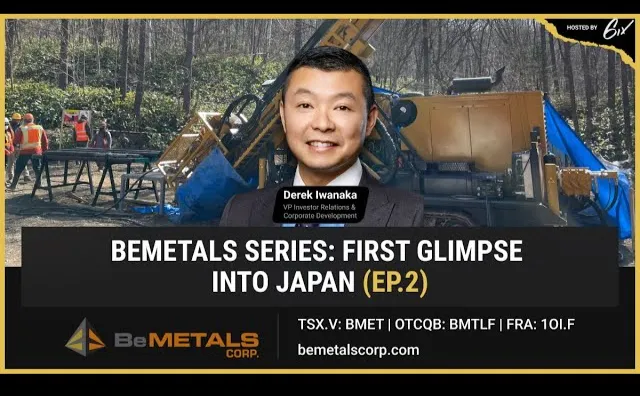
0:08 Hello, everyone, and welcome to today's episode of B Metals Monthly Update Series, hosted by 6. I'm pleased to introduce our speaker for today, Derek Iwanaka, Vice President of Investor Relations and Corporate Development at B Metals. Derek's going to walk us through the presentation that he has up here and after we're going to enter into a live Q&A session. If you want to ask any questions feel free to do so using the Q&A tab found on the right hand side of your screen and as always today's event is being recorded and is going to be available on six.com in the coming days. Without further ado, Derek, I wanna pass things over to you and get us
0:39 started. Thanks, Cam, and thanks to 6 for hosting today's webinar. It's gonna be really casual today. I am still pretty jet lagged and just got in from Japan less than 48 hours ago. So the trip is still fresh in my head. And I wanted to update our investors in our audience and just just anybody who's following along with us, how my trip went. And spent 9 days in Japan, and I have a little pictorial presentation for you, and if anybody has any questions then, I'd be very happy to answer them. There may be forward-looking statements, but most of this is really just going to be a recap of my trip to Japan.
1:26 As most of you probably know, I'm here in Vancouver, headquartered in the Vancouver office, but we do have projects in Idaho just south of us. And then in Zambia, we have our copper exploration project. Today, we really want to focus on our Kazan gold projects in Japan.
1:50 And there we go. So these are the main projects I want to focus on here. These are our 3 projects in Hokkaido. We went to the Kato project first. That's kind of our main one. That's where we're drilling as we speak. But there is some exploration programs going on at our Konamoi project up to the north here and at Todoroki kind of to the southwest, just really just west of Sapporo, which is the capital of Hokkaido. So this is my first trip to Japan since COVID started and as some of you probably know Japan was basically shut off completely from the rest of the world since COVID started so from March 2020 the country just completely shut down and essentially no foreigners were allowed into the country unless they had a couple very very good exceptions or very particular exceptions, I guess you could say.
2:53 You either had a work visa in Japan, you had a spouse or some family member that you needed to visit, say it was a funeral or somebody was sick or something that was some sort of exceptional circumstances. And it was quite difficult to get into the country. And then as of October 11th, they essentially started to remove or basically moved almost all of the COVID-related restrictions to get in the country. And so that was the 11th and I got in there 4 days later. So I arrived and I left here on the 15th and arrived on the 16th of October. And as customary, arriving in Japan, you have to be welcome with some sort of Nintendo paraphernalia.
3:43 So yeah, that was the first thing pretty much I was greeted with. And hopped on the train, which is a high speed train that goes from Narita Airport that takes you to Tokyo so hopped on the train and quickly got into town. From town I got to the Haneda Airport which is the actual city airport in Tokyo. A lot of people think Narita is actually kind of in Tokyo, but it is actually not. It's a good hours away from Tokyo, actually. So Haneda is actually the airport. It's become kind of their domestic airport, but it does still take international flights. But it's more or less used as their domestic hub. And it was, you know, it was reasonably busy there, but not too crazy.
4:33 And the first project, so I flew into Asahi Kawa Airport which is more or less near the middle of Kaido and then a couple hour drive to Kamishihodo and immediately went up to our Kanto project where we're drilling as we speak. This is pretty much what it looks like. I think I took this photo just over a week ago now today and drilling is going quite well. Weather is still good. We probably will start to see some snowfall here in the coming weeks, if not another month or so, but we will be able to continue drilling and the drillers there are doing a fantastic job.
5:21 It was really nice to actually see them, meet them first face to face and see just how the drilling actually is going. And it's not your typical drilling actually, because
5:33 of the terrain that we're dealing with here. It's actually a fairly complicated process but the guys here did a great job of running me through it and It seems to be working. We've been able to penetrate into the zones and deliver some great results so far. And hopefully we'll have another set of results before the end of the year.
5:57 From the Kato project, we wanted to go up to our Konamai project area which is quite close to Mombetsu. Mombetsu is kind of the northern part of Hokkaido and really beautiful terrain. What was interesting about this this kind of road trip was you really got to see rural Japan. That's not something I'm used to and probably a lot of people who've even visited or even thought of Japan never really thought that you'd see this type of rural area. You go out of Tokyo and there's still a lot of cities around the Tokyo area, but when you're in Hokkaido, it gets pretty rural. And so this is kind of the mountainside that we were driving through.
6:47 On our way to Mombetsu, we stopped off at the historic Konamai mine. And Konamai, our Konamai project does sit on part of the tenements of the old historic Konamai mine, but essentially our project we call Kona mine is not the historic mine. It's just close by to it. So the, the, the photo on the left hand side there, that's just a monument that depicts that the mine closed over 30 years ago and they were just celebrating the closing of the mine. I think it's actually closer to 50 years now that it's been closed. And in the middle here, we have the old smokestack from the smelter that was there. And then on the right here on the top, that's actually the portal to one of the adits that would have been at the Kona Mine mine.
7:40 And then on the bottom right hand side here, we have what was probably either an open pit and there was nobody actually on site to actually explain it to us. So we weren't sure if this was actually an open pit here or quarry, but what we could see, and it's might be difficult, but there's kind of a cement structure towards the top right-hand side. And that appears to be a portal also to access one of the veins there. And the Konamai Mine, the historic one, produced some 2.3 million to 3 million ounces of gold, very high grade. We went to the Kona Mine Museum and we brought the curator a piece of our Todoroki project, just a small sample, and it was running about 10 grands per ton.
8:34 If you put that into perspective, the average grade of a mine today is about 1g per tonne. So our sample was about 10g per tonne and he came out with a piece of rock that was taken out of the Kodama mine. It was running 200g per ton and 5,000g per ton Silver. So he kind of put us in our place. So it was just really interesting and exciting to actually see that there is such a rich history of mining in Japan and particularly very close to our project. And what was nice to see was the way that their veins are actually going towards, was actually right towards our property. So that was actually very encouraging to see. After we visited Konamai, we headed up to Mount Asai-dake.
9:23 Asai-dake is right in the middle of Hokkaido. It's the tallest mountain in all of Hokkaido. It's difficult probably in this photo to see, but you can probably see a little bit of steam or might look like clouds at the moment, but they're actually fumaroles. So those are kind of like little mini geysers that are spewing out steam coming up. So I'll have a little closer look at it and hopefully you can see from this photo here. This is Ryan in the foreground here. He was my guide and the geologist. And you can see these fumaroles are spewing out steam and what was really interesting to see was if you go up closer to it you can see the sulfur that's coming out of it and it's kind of running just like a vein And if you could kind of imagine that same kind of setting, say millions of years ago, where you had some sort of heat source coming out from below, bringing up metals or some minerals, in our case at Kona Mai it would have been gold, and and depositing it there. And then obviously after millions of years later, they'd be covered over.
10:41 But we got to watch kind of a deposit forming right before our eyes. In this case, it was sulfur that was coming out over there. But you could really, after seeing this, you could really kind of imagine what it would be like with millions of years ago, where you'd have probably hotter, a hotter source of heat that was coming up, but it would have been driving up metals in our case. So really interesting to see. And I'm gonna put together a video of our trip And those will be posted on our social media channels and also posted on our website when they're ready. So those should be really cool to see, I think in the coming months. And then we visit the historic Todoroki mine.
11:30 That's where our Todoroki project is. So we, both of our products here, both Konamai and our Todaoki projects are either right next to or on the properties of historic mines. In this case, the Todaoki mine was one of the oldest mines in all of Hokkaido. And it was kind of cool when we were driving up to our mine site, we saw this monument that was sitting outside and it's a horse that's drawing or pulling a cart with some ore on it. And there's a little pictorial on the right, there's an explanation of what went on at the Tararoki mine. So it was really cool to see the history of the Tararoki mine. And then we actually went to the project area.
12:22 This picture or this map is an aerial view of some of the veins that are on our property. The red ones would be, those red small lines would be actual veins that were mined up until, I guess, 1980s. And then some of these samples here, you can see we grabbed some samples from some of the, either close to some of the old adits or just on the road, actually going up to the adits, but they were running close to 10gps. And this, the top 1 here was about 9.43gps Gold, but also another 442.5gps Silver.
13:08 And all the samples per tonne Gold, but also another 442.5g per tonne Silver. And all the samples that we took there last year were running between 9 and 41g per tonne. So it was really interesting to see the project firsthand and you can get a better glimpse of what it would look like kind of in the canyon that, So there's a river that's running through this, kind of like a small canyon. And to the left, there would have been mine workings and to the right, there would have been mine workings as well, or there is still some still in place. But that river that's running in through is where at some point, some alluvial miners or gold panners would have been panning for gold in that river.
13:54 And because they were able to find gold in the river, they went upriver to find the source of that. And that's how this mine was discovered. So this river is cutting right through the veins, essentially. And it's kind of the classic mine discovery scenario where you had some old school prospector that would have been you know looking for gold in the river and able to trace it back and you would have probably found some sort of outcrop and you could see some spots where you could actually see a little bit outcropping And so I took a few pictures. Oh, sorry, before that, I just want to show this map. This is a topographical map. The blue here is actually that river that you were just seeing.
14:42 And then on the top here, you have these red past historic veins, and also down here. So when I said it was to the left and to the right, this left would be the top part. And when the right side of that picture would have been on the, this bottom vein. So the river is cutting right through those veins. And that's why you would have found gold in the river. And we did some samples taken from the river as well. And those were also writing pretty high grade gold. So I think there's some really good exploration potential here And hopefully we're going to be able to drill that sometime early in next year. Just a few photos I took. This one was, the left one was actually at the Toto-Oki Mine entrance.
15:30 The one in the middle here, a little bit tough to see, it's probably a little small, but that's actually the old adit entrance. And you can kind of see some timbers here that are keeping the walls in place. So yeah, it was interesting to see this. This would have been, well, mine over 50 years ago, it could have been as early as the turn of the century. So early 1900s, this could have been mine. So old working, still in place. The right photo here, also kind of tough to see. And I think when we did the video, it'll give this much better justice as to what it looks like.
16:08 But this right-hand side was actually the open, the top part of one of the veins. And if you could look downwards, it basically goes down about 50 meters deep. So they would have been mining this thing. It was probably 3 meters wide, but in depth it was going at least 50 meters down. So that would have been a very high grade mine chute that they would have developed in mind. And then I wrapped up the trip going through Sapporo. And this is just a glimpse into what it looks like at night in Sapporo on the right hand side here. And that was the famous Susu Kino kind of entertainment district in Sapporo.
16:57 You know, overall, what did I get out of this trip? I mean, other than getting the video footage, which is going to be really important for some of our marketing materials and also, I think, for PR materials later on. But what I got a first-hand glimpse into was things in Japan. There is a recession that's still going on. You can see it when you go around the countryside. The yen has become incredibly weak. If you check any of the charts, the yen has dropped against pretty much all major currencies. So that's made things a bit cheaper for us for doing work in Japan. So that's been quite favorable. What was actually quite evident was there is definitely a very aging society in Japan. And probably people have read about that. But when you actually see it in front of your eyes, And you can see that when we talked to some of the people in these small towns where our projects are, they were very happy and open to us.
17:54 And they were happy that we were doing exploration work. They were happy that foreigners were actually in the country doing exploration work. And I spoke to the curator at the Kono My Mind Museum and he was so excited to hear that we were there and that if we made a discovery he said that it would be so terrific for the people
18:16 not only close to the towns but just for Japan in general. So, you know, overall, I'd say it was a really exciting trip. It left me feeling much more, I guess, motivated and just engaged again that Japan is open for business and that mining is a possibility here at some point if we are able to make a discovery. So I guess that was kind of all I wanted to review today. It was really just a pictorial of my trip. In the coming weeks here, in terms of news flow, I can see that we should have some news coming out of our Zambian project. Japan, like I said, hopefully we'll have maybe one more set of results coming from Japan, but if not, that might slip into next year.
19:07 And that's about it for today. And if anybody has any questions, I'd be more than happy to answer them. Looks like an awesome trip, Derek. Yeah, I'd like to remind everyone in the audience that if you have any questions, feel free to ask them in the Q&A tab on the right hand side of your screen.
19:25 And the first question is, Derek, you know, what's the general support for gold mining look like in Japan? Japan? Yeah, so we didn't, unfortunately, we didn't get to interview any of the kind of politicians while we were there, but from the people that we spoke to, like just, you know, I spoke to one of the guys that was working at one of the restaurants, and we spoke to the curator at the MIME Museum. And, you know, they were really encouraged that we were there. They were happy. I mean, generally, Japan is kind of known for being a little bit anti-foreigner. But I would have to say that they're quite happy to see us there. They were, I think, very supportive if we were to find a discovery in any of our project areas that the people in the surrounding areas and they're not big cities, I think that they would be exceptionally happy to have any kind of new business that would be drawing hopefully younger people back to the area and having good paying jobs because that seems to be a bit of a problem in these rural areas in Japan.
20:36 You have basically the young people that are leaving the rural areas that, you know, either they would have been farming or fishing or something of that nature and moving to the cities to have much better, higher paying jobs. And so there's kind of this drain of all the younger people from these rural areas and into the cities. Right. Absolutely. Another question has come in. When are you going to have more drilling results from Cato? So, yeah, as I said, I think we should have one more set of results coming out before the end of the year, but it may slip into the new year. But hopefully we'll see some before year end. Absolutely. And I mean, just I mean, on top of that, just there's a follow up question sort of to that point.
21:25 And you've touched on it. But what other news flow can be expected throughout the rest of 2022? And you know, maybe what catalysts are you looking forward to in 2023? Hopefully we'll have at least one more set of results coming out of Japan. We should have some news coming from Zambia as well. I think we're starting up the drill program there. That's going to be core drilling. So we previously we've been doing air core drilling there in Zambia and following up on some anomalies that we discovered last year and during this year's program. So hopefully we'll have some news out there maybe by next week from Zambia and then Idaho we're just wrapping up our electromagnetic survey so hopefully we'll have some results from that in the next possibly the next couple weeks I hope before year end anyways we can release some results from that too.
22:18 So yeah those would be probably the main things on the horizon. Absolutely. You touched on it, you had a curator that you're speaking to, You've already talked about the general sentiments, I suppose, with mining in Japan. But were there any other locals that you met that were especially excited or interested? And not necessarily just in gold mining, but in B metals? You yourself being there and operating there? Yeah, I mean, I think that, you know, where we are at our Kato project, for example, the local town is called Kami-Shihoto. It's really just a 10 minute drive away from our project. And it was really nice to see, cause we drove from the town up to our projects. It's like a 10 minute drive.
23:13 There's power lines that go almost all the way up to the project area and pave roads to almost up to the project area as well. So it goes actually, there's a pave road and then there's kind of a tarred or kind of a gravel road, but it actually goes right up to the drill pad. So there's all this infrastructure there. There was a past mining operation that was also on the property, but it's closed down. And so you can just see there's not a lot of kind of business activity in the area. And so when we spoke to some of the locals, you kind of just see that they would like to see more business coming into the town. Obviously you'd have to be doing it in an environmentally friendly way.
24:07 And it's a pretty area to be in, but I think that if we had an underground mine, you could easily do that fairly safely and employ a number of people in the area which you could see that they could use the employment. Right, absolutely. Well, listen, Derek, that looks like all the questions we received for today. So before we wrap up, I'd like to remind the audience that today is being recorded. It's going to be available online on demand in the coming days and that I'd like to hand things back to you if you have any closing remarks. No, Thank you very much. Thanks for your time if you checked it out. Feel free to email me. There's my contact details right on this slide. And if anybody has any questions or comments, I'd be really, really excited to hear what comments you might have. You know, for our next webinar, we won't be doing 1 for about another month unless we have some news.
25:08 But yeah, if there's any ideas or any questions, please shoot them my way and I will address them as soon as I can. Thanks again for joining us.