Transcript
Automated transcript · Written by software from the replay's audio. It can mishear names and figures; the replay is the record.
0:08 Well, hello, everyone, and welcome to B Metals Live Summit today, hosted by 6. I'm pleased to introduce our speakers today. We have John Wilton, President and CEO, Derek Iwanaka, Vice President, Investor Relations and Corporate Development at B Metals. We're also joined by mining analysts, Simon Beardsmore and John Mayer of CP Angel in the UK. Our presenters are gonna walk us through a company presentation and then we will be taking questions live. So as a reminder, feel free to submit your questions at any time on the Q&A panel on the right hand side of the screen, and we'll try to get
0:39 to them after the presentation. And as always, this event is being recorded and will be available to watch afterwards on SIX.com. But without any further ado, I'll hand it over to you, John, to kick us off. Thanks very much, Dasha. And welcome,
0:53 everyone, to what we think is our fourth webinar of B Metals. So what we'd like to do is give you an update on the company today, really focusing on our recent core drilling results from the end of last year in the Zambian copper belt. Firstly, I'll just advance a few slides here
1:17 through the necessary disclaimer. And then I'll pass over to Derek, who will give you the outline of today's proceedings and the introductions to our friends from SP Angel. Thanks, John. I'll just go through the outline for today's webinar. Thankfully, we are joined by Simon and John from the UK. So thank you both for joining us. They are going to be walking through a little bit about metals in general, since obviously that's why we're all here. And of course, John will go through the
1:51 team background just to give everybody a little bit of a refresher or for those who are new, a little bit of an introduction. And then, of course, the crux of today's presentation is going to be about our news releases a couple of weeks ago, which were from Zambia. And we will give a little update on what's going on with our current projects in Japan and in Idaho, and then a little bit of guidance as to what we're going to be doing for this year. And then if anybody has any questions at the end, we'll be happy to answer them. Back to you, John. Thanks a lot, Derek. You know, As many of you will be aware already, about 18 months ago, we opened up the strategy of B metals that was initially focused on base metals to include a gold strategy.
2:43 And you know, In April, May last year, we concluded a transaction that led to us acquiring our 1st gold projects, which are really exciting portfolio of 5 exploration properties in Japan. So that we will recap on our webinar today, but I'll hand over now to John Mayer of SP Angel to give his sort of overview and thoughts on the current market for really gold, focusing on gold and copper going forward. Thank you John, thank you for the invitation to be here. We can talk for hours about why people should be investing in certain of these metals.
3:31 Gold prices are rising this week, They're particularly strong. There's been a bit more trading activity in gold ETFs where there's been enormous investment in gold over the last decade. 99 million ounces of investment in fact into gold ETFs, most of which are physically backed. If if even a fraction of that money had gone into gold explorers and gold miners, then they would all be multiples higher than where they are now. But notwithstanding that, gold prices are rising largely because inflation is so very high at the moment. In fact, inflation is ahead of many people's expectations, certainly ahead of the expectations of Federal Reserve policymakers and the Bank of England, and no doubt a few other central banks at the moment.
4:30 And Yes, that's going to cause a rise in interest rates, probably sooner rather than later, but central banks can't afford to raise interest rates too far, particularly the US and also probably the Bank of England and definitely the Bank of Japan, because governments have such high borrowing rates that if they raise underlying government interest rates too high, then the nation simply won't be able to afford to repay the cost of that debt, let alone repaying the principal. So in fact I think I think the government's quite happy for inflation to help to inflate that debt away. I think that's something we've got to live with for a little while, particularly driven by very high energy costs, not just oil but very high gas costs in Europe which are affecting things.
5:24 And of course what we need to mention is the elephant in the room which is the Ukrainian situation and Whilst we hope there won't be any conflict there, it is causing a great deal of concern, particularly in Eastern Europe. NATO is moving more troops into strategic areas along the along the Eastern European borders, into Poland and other neighbouring countries. There's a lot of help going into the Ukraine and Russia has extraordinary numbers of troops amassed on the Ukrainian border. So we hope that nothing bad is gonna happen over there.
6:01 Some of Putin's strategy has been outed by the Pentagon and by NATO officials, which is good and hopefully that reduces the threat. There is also the threat that if Putin goes into the Ukraine that China also goes into Taiwan and it would be very difficult to for the West to to act on both both fronts, shall we say. So there is a great deal of risk in the global economy now and that is feeding into gold prices And I think that's why I'm sure that's why prices are creeping higher. And it wouldn't surprise me at all if gold prices broke through 2000 dollars an ounce by by the year end, just on the back of slow gold price appreciation. I mean, this time of the year is generally normally a little bit slow for gold.
6:49 So it's it tells us that there's a certain amount of robust buying going on to see the price is moving higher. If if I mentioned silver very briefly, Yes, silver has a new lease of life. I mean, it died off a bit when people stopped using traditional film in their cameras. But so much silver is now used in photovoltaic cells or solar cells. And so many more solar farms are being built, particularly in the US and China these days, that there's quite a lot of use or demand for silver for that on top of its normal industrial use. So silver is very much an industrial metal. Copper, of course, which is critical to the global economy and key to be metals, really is so important for the connection of wind farms, not just connecting electric vehicles that people are buying, but particularly the new grid infrastructure for bringing power from offshore wind farms into land. So we continue to add up the amounts of copper being used in the world and the amounts that will be used.
8:04 And these are extraordinary numbers. And there simply are not enough copper mines to cover the demand as we see it. And the demand is pretty much everyone else sees it as well. So That's one of the reasons why we are so into backing companies like B.E. Metals in finding the next generation of copper mines. And last but not least, zinc. Well, the zinc prices are strong because quite a number of zinc smelters in Europe are shut or closing because of very high gas prices. I think a bit of that's been going on in China as well. So zinc is an unsettled market market at the moment. And I think that's enough for me. Back to you, John. Great. Thanks. Thanks very much, John, for that background.
8:49 And I think your comments on gold and copper are very pertinent to B metals, especially bearing in mind in the copper space, you know, the paucity of good quality copper exploration properties. And in general, in the last decades, the fact that the copper discovery rate has been dropping and what has been discovered typically tends to be at lower grades with some notable exceptions that we'll probably touch upon later in this webinar. So for anyone new on the on the call today, and hopefully there are there are a few specifically out of potentially the UK and Europe, this is the sort of core, core director team and advisory team for Bmetals.
9:38 The company we founded about 3.5 years ago. It was founded by Clive Johnson, Tom Garrigan, Roger Richet and myself. Many of you will be aware of Clive Johnson and his team, the way Clive has kept that team together and the real exceptional delivery to investors through 2 companies, mainly B Gold,
10:04 Bima Gold and obviously an ongoing story at B2 Gold. And approximately 2 years ago, now Mark Connolly joined us. He's probably well known to many people if you're connecting from the London arena and also in North America. Mark was the former managing director of Papignon Resources that brought the Focola project in Mali to B2Gold And subsequently B2 have really developed that into a true world-class gold producer. My own background and the relationship initially with the team at B2 Gold came around through my early work as a geologist by background.
10:55 And with a very good friend and colleague, we led the team that discovered what became the Ochicotto gold mine in Namibia, which, again, a bit of a common theme here, B2 put into a very successful and a very lucrative high margin gold producer in Namibia. I was involved with that project from the very first drill hole, The discovery holes, we built 2 million ounces in resources, did a lot of foundation technical work on mining, metallurgy and other areas of the mining sort of business. It was then sold out of what was then a South African company to a company called Oryx, added value through drilling and further expansion of the resources and ultimately vended that property to B2Gold.
11:43 Prior to joining B Metals, I ran exploration and new business in Africa for Antofagasta PLC, the large Chilean copper producer. And during that time, did a lot of external economic geology work, bringing in Richard Salito. And when we started B Metals, Richard Salitto, based out of London, kindly agreed to join us as an economic geologist technical advisor. Someone we can truly say world-renowned reputation in copper exploration, specifically for free coppers and also a vast experience in gold and other base metal exploration across the world.
12:30 On our more advanced properties that we have in the current portfolio and the more advanced opportunities that we look at, I spend a lot of my time working very closely with Dennis Sansbury, who has also been part of the Bima Gold B2 team for many decades, mining engineer by background. And we worked together very closely, as I said, on these more advanced opportunities. So Derek, some time ago, put together some metrics for us there on the sort of delivery in terms of resources discovered, you know, the ability of raising funding and really putting mines into operation and profitable production. And I think because of a longstanding early relationship with some of the members of John's SP Angel team, specifically Simon Beardsmore, you know, I'll just hand over to Simon briefly to give a little bit of background on his
13:34 early relationships with some of the, what would have been then the Beamer Gold team. Thank you, John. Yes, to perhaps take it slightly the other way round, the first association that I've had with certain members of this team, and notably Tom Garragan, Clive Johnson, and at some, remove Dick Sillitoe, goes back to the point at which Bima Gold came up with the Kupol discovery in eastern Russia in Chukotka. That ultimately was widely believed to be one of the reasons that Kinross took over Bima Gold for something in excess of 3 billion dollars. But I'd just say the Kupol deposit in Russia, in the time that I've been involved in this industry, is one of the most spectacular deposits that I've seen and been fortunate enough to go over there with Tom and Clive at that time.
14:41 Interestingly enough, Dick Sillitoe, who John has talked about, has a very major reputation amongst consulting geologists. In the, just to put the context, I said Matt Kupo, Dick Sillito was doing his PhD at the School of Mines at the time I did my first degree, so I'm not quite as experienced in this business as Dick, but I would say, as I say, that that particular deposit was one of the most spectacular I've seen. And I do remember getting stranded in Chukotka with Tom
15:20 and George Johnson, who helped build that mine. We got stranded in a very out of the way place for 2 or 3 days. And it was one of the more interesting chats we've had the opportunity to have in, as I say, quite a long career in this business. So with that, I think probably enough of the reminiscing and back to the business of the presentation. Very good. And I think Derek was fortunate or unfortunate enough to be involved in that experience as well. Indeed. So just to recap in the sort of the overall value creation of the team here, this graphic I think very nicely shows that value creation of the Bima Gold team, as Simon just touched upon, culminating in that acquisition by Kinross in about 2007.
16:15 The team then getting together, forming B2Gold, taking that through a number of development projects. We keep the picture of Ochi Kato in there that kind of gives some hint to my early involvement on that project. And I think important for my sort of experience and now that experience I can impart into B Metals was that some of the decisions we made in the early exploration days, the phases of resource expansion and evaluation, and how they ultimately panned out in the in the successful development of Occicutto. And, you know, we certainly see B Metals being the third company to come out of that similar stable of cornerstone investors, directors, and with that huge wealth of experience and guidance in the team, really our flagship projects at this point in time being the gold exploration in Japan, which is a real new exciting opportunity for us. And we'll touch upon that after the Zambian copper results.
17:28 So as I mentioned in about April last year, on the back of the acquisition of the Kazan Gold Projects in Japan, for the first time, B2 became a direct shareholder in B Metals, obviously cementing that relationship that was already strong and bringing in a really excellent strategic, very strong technical, and potentially financial partner into B Metals. Our current portfolio of projects has a wide geographical spread. We founded the company with one of my former Antofagasta PLC exploration properties in northwest Zambia. That's really the focus of today's webinar.
18:15 We then added the more advanced South Mountain project under an option agreement in Idaho in the USA. That's a high-grade zinc polymetallic project near Boise in Idaho. And as I mentioned more recently, we've added the Kazan Gold Project in Japan. The reason for that spread, and I think this is something that companies who really want to develop will find increasingly the requirement, is that we're driven by the geology, prospectivity and opportunities. Very difficult these days to stay in 1 region or potentially even in one time zone. And it sort of fits the culture of our common directors and principals as well in that both Bema and B2Gold have a wide geographical spread.
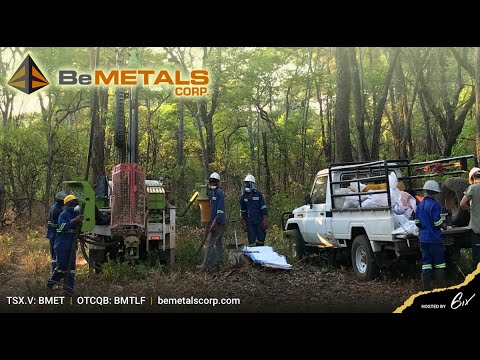
19:06 And we successfully in Bmetals managed to manage those projects very carefully and attentively by having good local teams. So, you know, during the time of the pandemic certainly our exploration projects in Zambia and in Idaho were not affected by the pandemic situation but they have had some impact on our ability to get drilling in Japan, which we think will change very shortly here. So to focus on our results in Zambia, This is a drone footage view of one of our early drill rigs in this northwestern area of Zambia. We're on the edge of what we call in Zambia a dambo terrain, which are main drainages, quite long-standing drainages, notorious throughout the exploration history of Zambia, of generating what are known as false positive anomalies.
20:10 So you do get concentration of copper associated with these almost peat bog type situations. But we've found ways over the years to get over those sort of false positive targets and drill the related copper mineralization. So we're out here in the northwestern part of Zambia. The overall methodology here is quite similar in a way to how we discovered the Ochicotto gold deposit in Namibia. We're dealing with exploration through what we call a covered terrain.
20:44 At Ochicotto, the bedrock mineralization and host rocks were completely covered by 10 to 15 meters of calcrete cover. So we used geophysics to sense through that calcrete cover in what we thought was a prolific terrain. And then we followed up with shallow and ultimately core drilling, following up on those geophysical domains. Here we have the remnants of the old Kalahari Desert, which provides about 25 metres on average of sand cover, masking the bedrock geology and mineralisation. We are in a terrain, the Central African Copper Belt is very prolific and in general terms on the higher grade side in terms of global copper terrains. We're looking for a style of mineralization known as sediment-hosted copper, which is the second most important in terms of tons of copper produced after the porphyry coppers throughout the world.
21:42 And obviously more recently, it's been really sort of put back on the map with the great discovery of Dave Bradgeon and others of Ivanhoe with the Kamoa Kukula discoveries in extensions of the Central African Copper Belt up in the DRC. We have known mines relatively close to our project here, namely the Sentinel Mine of 1st Quantum, and we'll touch a little bit more on some detail, but there are some other projects, exploration projects in this part of the world. And I think John may have had some exposure to this part of the world, having his boots on the ground out here in the past years.
22:36 I just have to turn off your, I think you're muted there, John. Sorry. Yes, I drove around the Copper Belt with one of my clients about 3 years ago, starting off in Lusaka, which is to the bottom right of that of the map of Zambia. They're very easy to drive straight up the country. Do have to dodge a number of trucks on the way. And there are a couple of roadblocks because they're looking for for bad people who are coming out of the Congo. But not much of that. Not. I mean, it's quite easy to get around in a hire car. In fact, surprisingly easy. So you go straight up to Conkola And then you go through a variety of towns that have been built around copper mines.
23:21 And you don't stay at the the Royal Sulwasey Hotel, which is very lovely. That's the last stop just beyond Kanshansi before you get to to Sentinel. Then it's well worth it's well worth staying there. And then it's about 4 hours to get to Sentinel, mainly on paved road, which is good quality. Then you're off road going through Sentinel. You have to go through the checkpoints because they clearly need to manage who's coming and going from that mining complex because it's a seriously large complex run by 1st Quantum these days. And then you're really off-road driving through villages as you go further further east and whilst that makes getting around a little bit slower the good thing is that there's been relatively little exploration done in this end of the Lofilian arc which is what the geologists call it in recent years or in fact over over any years. And very interesting to see that Anglo-American are further down the Lithuanian arc on the map here.
24:30 So what that says is that B metals and a couple of other companies that we're working with are also in that in that space between the Anglo exploration and Sentinel and 1st quantum bit and find central. In fact, it was found by a junior mining company that was snapped up pretty fast. They they they defined a few hundred million tons of ore. And in fact, that's that's expanded to something over 1 billion tons now. Great grading. What, 5, 1 percent copper? And these things get snapped up really fast. In my experience, the the geology is particularly interesting, and I think I'll leave it to John to talk more about the the structural settings and what's so important about that, and why we're hopeful that there might be potential for hydrocarbon replacement or just accumulations of copper at certain stratospheric junctions.
25:33 Thanks, John. Yeah, I think important to mention here now, as we go into the sort of geology and the explanation of our recent drilling results is that also in 2021, the early part, we were really pleased to bring Jogmech, the Japanese state entity, in as a technical and funding partner on this exploration property. That was a good endorsement of the work that we've done on the project to date. They funded $1.5 million of exploration, money in the ground exploration expenditure. And now we're pro rata funding going forward. Important as well, number of other major companies operating in Zambia.
26:20 Barrick producing out of the Lemoina mine, 1st Quantum, obviously from Sentinel, but also from Constanche. That was really one of their projects that really gave them a global foundation. And Rio Tinto exploring through various projects throughout the Zambian Copper Belt.
26:45 So this slide is really a timeline of how we've evolved this project. One thing that's probably important to bring in mind here is that we're exploring under that covered terrain. So what that means is that what we're saying is that the low hanging fruit And a lot of these globally important productive terrains has been taken effectively. So the initial discoveries in the Zambian copper belts in relatively modern times were made in the very early 1900s and were related to things like initially just outcropping malachite mineralization. That then the understanding of what's called copper clearings. So where you have large amounts of copper very close to surface that stunts the growth of the larger trees. And you actually get a flower often that grows in the middle of those copper clearings, copper flower, as it's called. You see some classic examples of that in the early days in Zambia and over in the DRC.
27:48 Then a really huge phase of soil sampling that led to a number of discoveries that, you know, the major discoveries of the deposits we know well in the Zambian Copper Belt. Here what we're doing is we're underneath that relatively thin sand cover. If these things have been exposed by residual soils or obviously outcropping, they would have been, you know, the deposits would have been discovered many decades ago.
28:15 Importantly, we have discovered mineralization underneath that thin sand cover. We're seeing often chalcopyrite, the common copper sulfide associated with a mineral called kyanite. That relationship we see most evident in the Sentinel deposit of first quantums relatively close to us about 130 K's away. And you can see that a number of prospects on the properties were getting really meaningful results of widths in the order of 5 meters true widths running at about 0.5% copper
28:54 and on occasion seeing narrower samples in certain geological environments where we're seeing higher grade copper mineralization.
29:05 Important as well is that we have a relationship here with 2 companies that are also our joint venture partners, 2 private companies. 1 company being called Penguini Mineral Resources. Penguini is where we gave the name to this project. Pengeni, I understand, means soil. And we've had a very long standing and constructive relationship with Pengeni. They also are important to us in that they provide the interaction between us and the community relations in the area. There actually are no settlements at all on the Pangeni property, but there are local chiefs nearby and those relationships get managed very, very appropriately by Pangeni and ourselves.
29:56 And that's been very beneficial to the project.
30:00 And also our technical partners on this project, who has a private company called Copper Cross Zambia, and people that I've worked with through many decades. In fact, some of the principals of that company, We worked with us as consultants on the very early days of the discovery of the Ochoa-Koto deposit in Namibia as well. So keep close to the people that you had success with. And we're trying to redeploy that expertise over many decades into this exploration in Zambia. So our recent news release really related to the expiration of these prospects, specifically the call holds related to the D prospect and to the Q target.
30:54 These are the results related to the D prospect. What we can see now is over several phases of drilling, We're building out and expanding the footprint of the mineralization below that sand cover, whole D7C1, D7C2 specifically, giving us grades similar to deposits of this nature in what we would call the domes region of the Zambian Copper Belt, mines like Sentinel and Lamuana,
31:27 which is also a basement hosted mineralization. And having been out in Zambia for the last 2 weeks, reviewing this core and putting together all our exploration results with our field teams in Kutri in the Copper Belt, we're starting to get a better understanding of the relationships of this mineralization to alterations such as the kyanite and the albite alteration, and also seeing some zonation from chalcopyranite to boronite in certain areas. And these are the things we use as geologists to vector us towards where we think the higher grade cores and extensions to this mineralization might be. Which appears to be at this point to the west and southwest from where we've drilled.
32:15 The way we design this exploration, it's done on a large scale. Those lines of shallow air core drilling, punching holes through the sand cover to get bedrock geology and geochemistry. You know, those holes are at least 400 metres apart. We need to make a deposit work in this part of the world. It probably needs to be on this side of mineralization, large open pitable deposit. So we design our exploration with that sort of discovery success in mind. In terms of the area near the Southwest Prospect and the Kew Target in Pacific, this has really been a bit of a game changer in a way for this exploration of this property.
33:02 As it's the first time we've seen indications of copper mineralization hosted on what we're interpreting to be contangin sediments. So the mineralization we drilled prior to this Q3C1 hole, we would probably classify as what we call basement hosted mineralization, similar to the Luana deposit and mine of Barrick. But the mineralization we are now finding in what we interpret to be Katangan host rocks, really exciting in that it shows that we have both the basement and Katangan rocks,
33:40 you know, present on this property with the correct structural settings important for this style of mineralization. I recently put together this slide to give you to give everyone a better sense for this, quite some quite complex geological ideas to put over here. But in general, the central portion of this slide, what we're seeing is a simplified stratigraphic column. So really the column of rocks that we find the various copper deposits of the Central African copper belt developed in. And you can see that deposits that are very topical, you know, these days, like the great discovery and development project of Ivanhoe, Kamoa, Kukula, sitting up on what we call a glacial diamictite that's known locally in Zambia as the Grand Conglomerate
34:34 and you know, very large, very high grade deposit. Then we have a number of other deposits. Frontier, which is just over the border in the DRC near Indola. Sentinel, the one we've talked about, which is about 130 kilometers from from Pengeni itself. And then we shouldn't forget the deposits of what we would call the classical copper belt. So on that map over on the eastern side, some of the first mines, big mines put into production in Zambia, mines like Konkola and Mufalira, which Mufalira being a large deposit, you can see over 300 million tons, over 3% copper, Konkola, almost 900 million tons again at these super high grades.
35:23 So that's the interest. And there's no reason those are aging assets of today with old mine infrastructure. Therefore, they have a relatively high cost structure. But if you found one of those deposits today, you would obviously have made a tier 1 discovery. And the identification, these are some pictures on the left that I took of some of the rocks we recently drilled on Plengene that I took just last week. Silt stones and sandstones, those sandstones having a mineral in called felspar. And those are the type of rocks that we would associate with the Katangon, probably the lower Rhone type facies. And that's where some of those giant deposits are located in other areas of the of the Copper Belt.
36:12 So really quite encouraging results and I think what we're seeing now is that as our understanding of the model for how these great deposits are formed. We need to find the correct fertile structures in conjunction with the correct stratigraphic sequence. And we're seeing now strong evidence for both of these. And importantly, we're drilling copper mineralization under that sand cover on the Pengeni project. And this bodes really well for future successful exploration, where you can truly say you can find giant copper deposits in this part of the world. So I think that sort of summarizes where we are with the results, the drilling results from Pengeni and I'll leave it to John now if he's got any final comments on how he sees our Zambian copper exploration at Pengeni.
37:09 Well we we're sure that further discoveries are going to be made. We can we can see that the the sandstone metasediments, they've come under different names, have been carrying copper mineralization, presumably picking up that copper mineralization through high salinity in fluids that have dissolved, evaporites in the foot wall structures and that sort of thing. And in some cases, maybe hydrocarbons have been involved as well as has been in the DRC where you get very, very high concentrations of copper. We've certainly seen that at certain deposits over the years.
37:55 And I think if we it's if it's like a detective story, If you follow the clues and the trails for long enough, you are almost certainly going to find a concentration of copper at the end of it all. It's highly unlikely that that copper would have been eroded away in the area where the metals are looking because of because there's a bit of sand cover. And we can see where the copper is. So it's it's about following the trail, finding a shift in the in the geological structure. Either there's a chemical shift that's caused the copper to be concentrated and dropped out in that area or there's a or there's just a physical shift where the pressure has changed and that often also leads to a deposition of a mineral deposit.
38:50 Not just copper, we see that particularly with gold. So this is the sort of thing that we look out for. We've got great confidence in the geological team of BE Metals, and they've got good access to experience in the DRC and cop about with some of the world's great greatest geologists who've discovered a few things in the past as well. And Let's face it, Zambia hasn't had that much exploration over the last 30 years. If we go back in time, the Zambia did nationalize its entire copper industry at one point. And thankfully, the Zambians see that as a mistake and not something they will ever want to do again. And they're much more pragmatic. The guy running Zambia is is what is he's an accountant from PwC, so he understands the way the world works.
39:46 Everything is seems to be on an even keel. There's good confidence in the region. And that's why we see BHP, Rio Tinto and Anglo American coming back in. And Anglo are focusing their efforts around Midnight Sun, which is not so far away from here. First Quantum, who had drifted away from Zambia for a while, have come back in strength and are certainly helping a few of the junior explorers get going at the moment. So they are friendly competitors. But they're friendly because they're looking for junior companies to make discoveries and then to snap those companies up. They we know that the majors are not particularly brilliant at making discoveries themselves. It seems that it seems that the geologists who succeed are the entrepreneurial guys within the junior companies. And that's why we're here supporting them.
40:40 Very good. Thanks. Thanks, John. So, as I mentioned earlier, We'll just give a very brief update on the other projects in the company this this this webinar was to focus on our on our copper interesting copper results in in Zambia As as many of you may be aware we're 1 of 3 companies only really exploring the very prolific copper terrain in Japan. Ourselves as B Metals with the support of B2 Gold. And In fact, B2 Gold were the supporters of the private company that we acquired during last year. A company called Japan Gold that have an early stage exploration alliance with Barrick and Irving Resources that have Newmont as a significant shareholder.
41:35 And that sort of portfolio of major companies that are backing those juniors exploring in Zambia, probably testament already to what's the perceived potential value of the gold's prospectivity in Japan. This is one of the main drivers of the interest and the value in the terrains in Japan, completely different geologically to what we were just talking about in Zambia. Those are very old rocks and the mineralization itself being around 500 million years old in general. Here we're dealing with very young rocks and very even younger gold mineralization. Sort of exemplified by the Hishikari gold mine, a true world-class discovery and is produced in excess of 8 million ounces of gold.
42:31 We have 3 projects up on a Kaido to down on Kushu So that will allow us going forward to have run the year news flow You know because of the snow conditions up on Kato nonetheless, we are getting ourselves ready to start drilling at Kato And we have bought a new drill rig, which is at site. And now we're just waiting for the ability to get our own drillers into Japan and start that drilling on the mineralization in Kato, which already has significant drill intercepts. In that interim period, we have a team of 5 people in Japan based in Tokyo. We have been doing with our field teams some surface work reconnaissance work This is an example from one of our other properties called Toda Roki on the western side of Hokkaido a small mining I'm small mine did exist here up until basically World War 2 produce the record show it produced in excess of 400,000 ounces And at that time many of the gold operations in Japan went into into care maintenance and stopped producing But some excellent results we're getting you know widths over 2.5 meters up to towards 10 grams a ton gold.
43:58 And we think we're very close here to be able to identify some really good drill targets for drilling in the next phase of exploration work in Japan. And as I mentioned, our flagship Kato project, one of the projects that Dick Slitto worked on for the Japanese government in the 1990s, and the one that he liked the best of all the projects he saw in Japan at that time. Really significant drilled intersections, and we're really excited to be getting back there and hopefully being able to start to drill that project in the coming months with the easing of the COVID pandemic.
44:48 A quick update on our South Manning project as I mentioned earlier this was a project we really liked because it was a high-grade underground past producer. Since we've been involved on the project We've built a very good relationship with our project team, staffed by our partners on this project, a Idaho and company called Thunder Mountain Gold. All the agents are based in Boise, Idaho. We're on private land. You know, many of the permits are in place in the event of a decision to go ahead with a startup mining operation here. And really what we've been able to do in the dark green is double the size of the mineral resource since we got involved on this project, mainly through drilling from underground, the underground development.
45:41 And what we've done at the end of this year, and we'll be doing more of later this year, is looking to further expand that mineral resource to get it over the 2 million ton target, where we believe we can get a startup mining operation in in place, given given good technical results. We've improved the metallurgical test work by doing a good phase of metallurgical test work with Lakefield during last year. And that panel there gives you an indication of the widths and the grades, the true polymetallic nature of this mineralization. Currently, we're looking at potentially testing some grand geophysical techniques that may also help us to trace this pyrrhotite dominant sulfide mineralization down at depth. Pyrrhotite, a common sulphide associated with this mineralisation, that should be relatively easy to map through both electromagnetic and magnetic techniques to depth.
46:49 In terms of where we are capital structure, the big change here in recent times was the 19% investment as a strategic cornerstone from B to gold. We have started to see some interest from some of the institutional large institutions in the general B metal story, especially on the back of our, you know, relatively recent acquisition of the gold properties and the exciting upside potential on those going forward. We're in a good cash position at the moment that will take us certainly into the middle of this year, if not further, depending on the cash requirement on those drill results, results driven sort of success going forward and the related budgets to that.
47:39 And I think importantly, in terms of the value proposition, the strengthening and cementing of that relationship with B2Gold means that we are getting further exposure to a pipeline of potential projects of interest to us in B metals that don't meet the high threshold in terms of scale of B2Gold, but might be very value accretive for B Metals. And we're always searching through new projects and proposals that come our way. And we're currently sort of on our radar looking for a more advanced gold project that could have a fairly short lead time to turn us into a producer of gold, which fits the culture of the company and our collective team experience.
48:33 So I'll just probably pass over to John Mayer again, just to sort of recap on this final slide. But I think what we can hopefully show you through this is that we're well positioned now to see good growth in the company, a good time at current levels for people to new investors to come in to the company and for current investors, you know, I think you will see there's a good path on many prongs here and related to a number of commodities for us to add value going forward now into 2022. John, I'll hold on to you if you pass on to you if you've got any final comments there. When? Well, Yeah, if anyone's interested, feel free to contact us or go on to our website for our research.
49:22 Simon Beardsmore has written a very good note on B metals. We write about junior mining companies on a very regular basis. And if anybody's interested in signing up to our daily morning note on the mining sector, please ask away. We're also covering the renewable energy space to a certain degree, really because we're so very interested in the evolution of the market for the battery metals. Copper is absolutely at the top of the list there. And certainly the London or UK based institutions are very keen to buy into any discovery in copper that is going. But of course, as we know, as every geologist knows, there are hard yards that have to be done before the discoveries are made. And the great thing is to see B metals methodically working through everything that needs to be done to be discovering copper on the drilling that is done and I think to be edging ever closer to that elusive discovery that is what we're all after.
50:35 Thanks very much, John. And I'll just leave it to Derek now to have a final word and provide our sort of contact details. And I'd like to thank everyone for their input into this webinar and look forward to working with you all again in the future. We are happy to answer any questions. Thanks John. Yeah I mean I wish every webinar went like this. I see the trading is up 10% at the moment So I guess we'll have to continue to do these. I guess right now we could probably turn it over to Dasha. I think she has some questions in the queue. So we can, I guess, let those rip? Absolutely, yeah. If you do have a question, feel free to submit them now, but we're going to jump right into the attendee questions here.
51:23 John is based in Zambia and he's asking, having worked at Sentinel in the commissioning period, we found a lot of challenges processing ore that contains carbonaceous shale. How much is being found in your drilling program? And when are you likely to start some laboratory testing of the ore if you have not already started? Yep, very good question. Always great to speak to people based out on the Zambian copper belt. I think, you know, of one of all the countries I've worked in over the years, what's often forgot is the depth of experience in mining and especially metallurgy that's available in Zambia and many other aspects through that hundred years or more of history of mining in Zambia.
52:12 We found some small amounts of carbon or graphite in some of our drilling. We certainly haven't seen the graphitic shis type environment that you have there at Sentinel at this point in time. Our mineralization seems to have different hosts at this point. But one thing we're very aware, and we know that's obviously very sensitive for a number of copper projects, is that sort of oxide transition into sulfide. But in general terms, we're not seeing too much in the way of copper oxide mineralization. Most of ours appears to be relatively clean copper as chalcopyrite, at least at this point in time.
53:01 Thank you. And how does Copper rank within your portfolio? Yeah, I think at this point in time, you know, we give a fairly even rating. You know, I can say that obviously, for some of the reasons that John mentioned, copper is very topical at the moment and going forward that's likely to be quite a strategic metal. But I think for the size of the company that we are, the way we set up and our background, we feel very comfortable in being able to take these projects forward within the B Metals umbrella. And obviously, at a point in time, once we start to get real traction, possibly on our gold exploration in Japan, if that starts to look like going towards resource building phases. We can look at other ways of spinning out assets from 1 from the other that generally creates a value creative event for investors in any event. But for now, we feel very comfortable and we have the experience to take this sort of multi-commodity portfolio forward within Bmetals, certainly.
54:08 Thank you. Katambi is asking, is your license still within the first 4 years of the 10-year tenure or has it been renewed before? It has been renewed. It's in its various cycles of renewal. We have a good relationship with our Zambian partners and we're within the time constraints of the normal license situation in Zambia for large scale exploration licenses. Great. And when do you expect to start drilling in all 3 jurisdictions, Japan, Zambia and Idaho? That would be a good thing to be doing. I think Derek, we were, I think there was a point with the exception, obviously Japan was new but we were certainly drilling on 2 continents and effectively we'd like to be drilling on 3.
55:00 You know, I think we'll be probably doing more air core drilling at Pengeni after the end of the rainy season. And obviously, we want to really get that drilling going in Japan as a priority as soon as the COVID, last bit of the COVID situation allows. So we might be a bit of a staggered sort of drilling, but I could foresee a time at some point next year where we'll be drilling on all 3 projects. Great, Thank you. Raz is asking, for South Mountain, will you release the essays for the holes completed, or do you intend to release them altogether when the program is complete? I think we'll probably release those when the program is complete. We're gonna look at a phase potentially of exploring some geophysical techniques that may help us to target, as I mentioned, that mineralization at depth.
55:57 And then it will be a question of correlating those results from the surface drilling when we've got more information down at those depths, which is the deepest intersections that we've seen of South Mountain mineralization, deepest intersections that anyone's done at South Mountain today. Great. Terrence is asking if there's a PDF accessible. I have made the presentation available for download under the handouts tab, so make sure to download it before we close out. And our last question here is, what are the upcoming catalysts for B Metals? I think the main upcoming catalyst for B-Metals is getting that drilling going in Japan. A lot of excitement, both within the company and with investors and new investors about getting that project rolling.
56:48 But, you know, nonetheless, the Pengeni project continues to motivate itself. And for all the reasons we've just discussed and and John and his team has given further, further input to, you know, the the copper exploration in Zambia will still remain a potentially very valuable asset to the company. Great. Thank you. Well, that is all the time we have for today. So I just wanted to thank you all for presenting and also taking us through the Q&A, but also thank you so much for everyone who attended and asked questions. If you do think of another question after the summit, feel free to reach out directly to B-Metals. Their contact is on the slide here. You can also find more information on their website, bmetalscorp.com. But before I close out, I'll just pass it back to you, John, if you have any final remarks.
57:35 No, thanks to everyone, specifically the SP Angel team. Our first webinar together, but that was really very good. Thank you very much for that. And to any new potential investors, I am normally based in the UK, so I'm often traveling through London, although I spend a lot of my time in Vancouver, obviously, and out at the projects. So easy to get together now that we're getting back to a world where face-to-face meetings are certainly back on track in this part of the world. So thanks everyone for your time. Darsha, thanks very much to you and the 6 team for putting this together.