Sophie Lang
Head of Investor Relations
Replay available
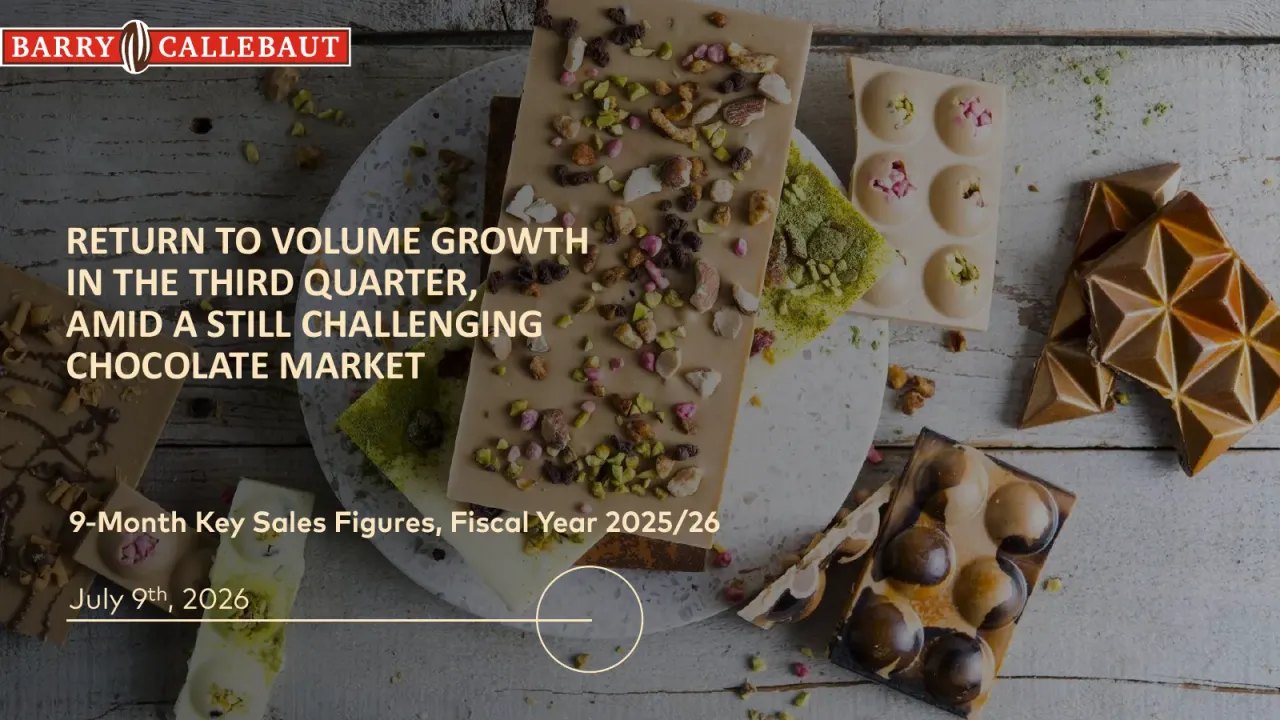
Barry Callebaut (SIX Swiss: BARN) Q3 2026 earnings call, held 2026-07-09. Watch the replay and read the transcript on 6ix.
On 6ix: 6ix.com/event/barry-callebaut-ag-0qo7-q3-2026-earnings-call
Automated transcript · Written by software from the replay's audio. It can mishear names and figures; the replay is the record.
0:00 Hello, and welcome everyone to the Barry Callebaut Group nine months key sales figures fiscal year twenty twenty five twenty six. My name is Becky, and I will be your operator today. I
0:25 will now hand over to your host, Sophie Lang, Head of Investor Relations, to begin. Please go ahead. Good morning, everyone. Welcome to Barry Callebaut's nine month key sales figures conference call for 2025 to 2026. I'm Sophie Lang, Head of Investor Relations, and today's meeting will be hosted by our CEO, Ivan Shimako, and our CFO, Peter Van Aster. As usual, at the end of our presentation, we'll have a short Q and A session for analysts and investors.
0:52 Before we start, please take note of the disclaimer on Slide two. I'd also like to remind you that the webcast and conference call are being recorded. And with that, I will hand you over to our CEO. Thank you, Marco. Thanks, Sofia, and good morning, everyone. And thank you, of course, for joining us for our nine month trading update. I will start with some key messages followed by an update on our focus for growth action plan and strategic priorities and then Peter will take you through our sales performance in more detail and afterwards come back at the end of the presentation. Let me start with a brief overview of the key messages. While key sales volumes decreased for the nine months, the group has returned to positive volume growth in the third quarter for the first time in more than two years. This was supported by elevated demand in our global cocoa business following the sharp correction in cocoa product prices earlier in the year alongside a low base of comparison.
1:44 Our global chocolate business also returned to growth in Q3 supported by strong momentum in EMEA and early progress in restoring service levels in North America. And while we are encouraged by our return to growth, the chocolate market remains challenging overall as Peter will elaborate on later in the presentation. And our improvement at Barry Callebaut will be gradual. We still have a lot of work ahead of us. And that is why we launched our Focus for Growth action plan last month: to strengthen our fundamentals I will come back to this a moment. Taking all of this into account, we now expect full year volumes to decrease by around minus 1% while maintaining our profitability and our leverage guidance. Before going into the details of the nine months performance, let me start with a reminder of our Focus for Growth action plan and first reiterating our ambition.
2:36 At Barry Callebaut, we are already the global leader in cocoa and chocolate with a uniquely integrated business model and leading capabilities in R and D and sustainability. And our ambition is to build on a strong foundation through two clear, deliberate shifts. First, we are evolving towards a more solutions oriented business, scaling targeted specialties in attractive, faster growing segments where we can differentiate and create more value for our customers. Second, we are focused on protecting and strengthening our core volume base, while shifting more decisively towards premium segments and accelerating the growth of our important gourmet business. Delivering on this ambition will be underpinned by a strong customer centric culture that will provide talent and increased empowerment of our regional teams.
3:28 Now let's turn to the action plan itself. We are accelerating five key enablers that are critical to restore our fundamentals and stepping up execution across the business. The enablers span the entire value chain and are all anchored in a clear, customer centric approach and supported by digital capabilities. And in parallel, we are prioritizing five selected growth priorities where we see the greatest potential for value creation:
3:52 global accounts, regional food manufacturers, gourmet, specialties and cocoa powder. And this disciplined approach ensures that we allocate our resources where they have the highest impact, ultimately driving attractive financial performance and results for our shareholders. But we have significant work ahead of us to fully restore our fundamentals. I'm happy that we are starting to see early signs of progress in a number of key areas. In footprint and quality, we are implementing selective network enhancements and importantly, we have recorded zero critical quality incidents on product recalls year to date. In planning, we are strengthening our sales and operations planning processes with new demand planning tools and with new planning forums that focus on gourmet and specialties.
4:43 Our early steps are starting to translate into improved reliability with old time in full or OTIF in North America a key focus area, up six percentage points versus the same time last year. And in our core customer processes, simplification efforts are underway, reflected in a meaningful improvement in customer response times of close to 20% year to date. And while these are encouragingly early trends, I want to be very clear: this is really just the beginning. Restoring our fundamentals will require sustained execution and continued discipline for the months and year to come. Now turning to our five growth priorities, where we are taking action to drive commercial progress.
5:30 First, on global accounts. We have formed a dedicated team reporting directly to Lee and the objective is to unlock the full potential of our largest global customers with clearer growth plans for each account as we move into our new fiscal year. Second, for our regional food manufacturers. We now have a much clearer view of the growth opportunities by region and this is helping us to prioritize our commercial focus and ensure that planned investments are directly linked to the markets where we see the highest potential. Third, in Gourmet, we continue to double down and invest. We are preparing for the launch of new innovation next fiscal year, supported by a strong commercial campaign while also securing safety stocks for key SKUs, a key core SKU list actually, to support future growth.
6:23 And then fourth in specialties, we are addressing capacity in selected focus sites and working to integrate these offerings more deeply into our core business and commercial processes. And finally, in cocoa powder, we are taking action to unlock premium powder capacity and accelerate sales efforts in higher value segments. So across all these five priorities, while still early steps, we are moving from strategy into execution and the common denominator across the five is focus: focused market segments in regional food manufacturers focused core set of SKUs reducing capacity in gourmet focused in specialties with focus of around four to five core specialties by region and a focus in cocoa powder on premiumization.
7:11 Since the launch of Focus for Growth last month, we've also taken two concrete steps to move closer to our customer and strengthen execution in our regions. First, we are refining our global chocolate regional setup with the Middle East and North Africa and Southeast And West Africa clusters transitioning to the CEE or Central And Eastern European region. Historically these clusters were part of Alaya and the move to CEE reflects closer geographic proximity, a stronger alignment in customer preferences and consumer habits as well as supply chain interconnectedness and commercial go to market approach. And this will allow us to be more responsive to local market dynamics and better serve our customers in these clusters. And as a result, on the 09/01/2026, our EMEA region will be renamed Asia Pacific or APAC and the Currency E Region will become Cinia.
8:03 Second, we are evolving selected functional capabilities and teams to be closer to regional business execution. So selected teams within functions such as customer supply and development, finance and HR that are closely linked to regional execution will start to report directly into the regions while obviously continuing to be anchored in strong global functional expertise and alignment where that really matters. This is about empowering our regions to act faster and with greater accountability while continuing to benefit from the global scale that we have. We're also shifting towards a more horizontal way of working and bringing teams together across regions and functions to drive impact.
8:49 Now, let me hand over to Peter to talk more about the Nagal's performance. Thank you, Hain and good morning everyone. Before turning into numbers, let me start with a brief update on the market environment. Cocoa bean prices have increased in recent weeks and especially this week, but overall remain in line with our expectations. Looking at supply, the current crop, which is now coming to an end, is expected to result in a significant surplus, marking the second consecutive year of service. As a result, the industry is entering the twenty twenty six-twenty twenty seven growth cycle well stocked and with more than ten months of price cover. At the same time, the market is closely monitoring the development of El Nino for twenty sixtwenty seven, which has been confirmed as a strong event by the UN.
9:40 Typically El Nino is associated with below trend cocoa production while La Nina tends to support above trend crops. However, this is not a hard rule as the impact really depends on how El Nino influences regional weather patterns and ultimately crop development.
9:57 Generally El Nino associated weather risks are higher than normal rainfall in Ecuador and higher than normal temperatures in West Africa. These weather dynamics are therefore key and we're closely tracking developments with our teams on the ground. Importantly, based on what we see today, we do not expect a repeat of the extreme market conditions experienced in twenty twenty three-twenty twenty four even in the case of a strong El Nino influence because the context today is fundamentally different.
10:27 At that time, in twenty twenty three, twenty twenty four, El Nino coincided with the main crop and marked the third consecutive year of deficit. In contrast, today, we're coming from a position of a strong surplus with ample cocoa stocks entering the new crop year. In addition, we're significantly better positioned to manage this volatility potential volatility at Barry Callebaut than we were two years ago. We strengthened our resilience through greater origin diversification, increased sourcing flexibility and enhanced beam blending capabilities as well as several financial measures including the letter of credit and borrowing base facility that we've talked about in previous conversations. Now turning to the end consumer environment.
11:13 Main message is that chocolate market remains challenging. In the most recent quarter, Nielsen data showed a decline in market volumes of minus 4.4% with a 9% year on year increase in
11:26 pricing. So while overall consumption remains under pressure, the rate of decline is easing with some early indications of stabilization. From a demand perspective, we continue to see that also through our forward bookings. As you know, we contract several months in advance with our customers and we've seen our customers more willing to book further in advance again, which is a positive signal.
11:50 So while average market pricing remains approximately 9% above last year, absolute price levels per kilogram have started to come down in recent months as you can see on the right hand side of this chart. Category pricing typically shows some seasonality with higher promotion intensity around Easter followed by a normalization after that. What we've observed this year is a more pronounced decline in net pricing over recent months, partly driven by increased Easter campaigns with price adjustments occurring somewhat faster than in a typical seasonal pattern.
12:24 Overall, we are seeing early signs of moving into the right direction, but it will take time for the markets to recover progressively. Moving now to our nine month performance. In the third quarter, BC Group volumes returned to positive growth for the first time in more than two years. This was primarily driven by a strong demand in global cocoa, following the cocoa market correction earlier in the year and reduced cocoa product prices.
12:54 Cocoa powder saw particularly strong momentum in Latin America and Asia supported by some customer restocking while the business also benefited from one off cocoa butter opportunities. At the same time, global chocolate returned to growth in the quarter driven by a second consecutive quarter of double digit growth in EMEA and early progress in restoring service levels in North America.
13:19 It is however important to put this Q3 performance into some context. As just discussed, both customer and end consumer demand are only gradually recovering and are recovering at BC, as Hen has also mentioned, will take some time. As such, the 5.7% growth in the third quarter should not just be extrapolated. The recovery of our absolute volumes will be gradual and as we recently outlined with the focus for growth plan, we expect volume growth in the range of 1% to 3% over the next twelve to eighteen months.
13:54 Let me go into the nine month numbers in more detail now. Overall, the Group saw a volume decrease for the first nine months of the year of minus 2.8%, turning positive in Q3 as just discussed. Looking at the left of this chart by segments, food manufacturers were impacted over the year by declining market dynamics with our customers adapting behaviors in context of high prices and we also saw supply disruption in North America earlier this year, returning to growth in Q3.
14:27 Gourmet volumes were temporarily pressured by a high price list in a sharply declining bean price environment. And global cocoa over the year declined as a result of negative market demands with a very strong bounce back in Q3 as we just discussed. Moving to the right hand of the chart, global chocolate.
14:47 These volumes on global truckload declined by 2.3% for the nine months, ahead of the 5.6% decline on the market as per Nielsen. Western Europe saw a 2.5% volume decline as demand continued to be impacted by market dynamics related to pricing. Central And Eastern Europe declined slightly by 0.7% over the year, significantly better than the markets as local and regional accounts saw continued momentum.
15:14 North America went down over the nine months by 7.6% impacted by the declining markets as well as, as you know, network supply disruption in the first half of the year. Importantly, North America turned positive in Q3 and has seen monthly improvements as the business rebuilds inventories and meets growing customer orders.
15:36 Latin America decreased by 1.2%. We were really impacted there by phasing effects in the third quarter, yet still well ahead of the market. Finally, volumes in EMEA grew by a strong plus 10%, driven by market share gains in China, continued momentum with key customers in India and additional business secured in Australia.
16:02 And before handing over to Hain, let me also briefly cover the recent euro bonds buyback, which has been an important step in our ongoing journey to deleverage and reduce the financing costs. During the quarter, we completed a total bond buyback of EUR849 million across three majorities: EUR400 million of the two twenty eight bonds, euros 99 of the two twenty nine bonds and €350,000,000 of the two thirty one bonds.
16:32 We are using available liquidity to reduce growth debt, optimize our maturity profile and lower our finance cost in the future. This transaction comes with an upfront cost of around million which will be recognized in the net financial items in this fiscal year but importantly of course will reduce our cost of financing in the years to come. Taking the mobile buyback into account, we now expect a net finance cost of around CHF $330,000,000 for this fiscal year. And let me now hand back to Henri for the guidance section. Thanks, Peter. Moving on to the outlook for this fiscal year. Following a stronger than expected Q3, we have updated our volume outlook for the year. We expect around a minus one percent decrease and this is at the upper end of the -one percent to -three percent range that we have previously guided for.
17:24 At the same time, we are maintaining our guidance for a mid teens decrease in EBIT on the recurring basis in local currencies and I will talk more
17:32 about that on the next slide. Given the CHF 15,000,000 expected up for the cost for the recent loan buyback that Peter just shared, we now expect to recover around half of the absolute decrease in EBIT at the profit before tax level.
17:47 We also reiterated our deleverage ambition for net debt over EBITDA recurring to be below three times and this assumes a $3,000 coco bean price. Now today, as you may have noted, prices are more around the $4,000 level and assuming stable bean prices from at this level where we are today, we expect leverage to be around three times.
18:12 So we are maintaining our profit guidance as the stronger volume development in Q3 is offset by a number of headwinds. Let me share three. First, as we shared at the top here, we are taking short term actions to prioritize growth and market share and this is particularly relevant for Gourmet where we are making commercial investments as we work through the temporary dynamics created by our own cocoa position and we talked about that in particular at the end of Q2.
18:43 Second, we indicated at the half year as well that cocoa profitability would normalize in the second half following an exceptionally strong first half. And while our cocoa business delivered strong volume growth in the third quarter, supported by elevated demand following the cocoa market correction, the profit contribution from these additional volumes is well expected to increase at the same rate given that normalization.
19:08 Third, as Peter outlined, the recent bond buyback will result in an incremental cost of around CHF 15,000,000 in profit before tax this year while generating benefits obviously through lower financing costs in the future. We have incorporated these headwinds into our guidance and at the same time we see a few additional risks which we are monitoring very closely. The geopolitical situation in The Middle East remains uncertain as we've seen this morning and could result in additional costs for supply chain disruptions and that takes time to price through.
19:43 While market conditions overall are gradually improving, the operating environment does remain challenging as we see signs of financial pressure across parts of the European customer base. In addition, in Turkey, an important market for us and a priority market for us, we are closely monitoring developments in hyperinflationary environments
20:04 and potential implications for us going forward. So overall, we reiterate our guidance while recognizing that the external environment remains dynamic with some uncertainties. And with that, thanks for listening, and I will now hand back to the moderator for Q and A.
20:22 Thank you. We will now begin our Q and A session. We ask today that you limit yourself with two questions. You to ask a question, press star followed by one on your telephone keypad. If you feel your question has been answered or for any reason you would like to remove yourself from the queue, press star followed by two. Our
20:49 first question comes from Johan Ifert from UBS. Your line is now open. Please go ahead. Good morning, and thanks for taking my questions. First one would be, please, an early view into 2027, what do you currently observe or what do you expect from your customers? I mean, do you expect customers to lower price points to materially step up promotions?
21:16 Or do you expect customers to use the lower bean price to repair margins just because the retro would be so important for your volume prospects? That be question number one. And question number two, if I may zoom in a little in Gourmet, can you tell us what is happening currently on the market shares on competitive dynamics? And also if you're still pursuing your own direct online shop initiatives? Thanks a lot. Thanks, Jorn. Let me talk a little bit about the customer behavior and particularly around pricing. So what we're seeing globally is that in the third quarter, seen generally, we've seen prices come down in the market with the exception of North America where prices have still increased. And that's of course a very important market for us. And what you may have seen or spotted is that with increasing prices in North America, the chocolate confectionery market boiling wise in North America is under more pressure than what we would see elsewhere in the world.
22:20 So in general, there is a correlation obviously between pricing and volume developments and that's what we're seeing in the third quarter, even stronger than probably before. Now with the decrease in prices that we're seeing across the globe and we have, as you can see in our revenue, our prices have gone down double digit and this is something that we expect as well for Q4. We expect that reduction in pricing for the fourth quarter and that could probably roll into the next fiscal year as well.
22:58 With those developments, we would expect volumes to recover a bit. The current market is still single digit down mid single digit down overall. So there's still definitely room for improvement. We see customers investing at this point. We see customers investing in innovation. We see customers investing in media. We see customers investing in promotion overall. So that's a good development and we've highlighted that as well during the Focus for Growth presentation. So we're seeing that from important big customers, whether it's Mars, whether it's Hershey, they are coming up with new things, exciting things that will help the category I think to grow that's a positive sign.
23:43 We're also seeing that around our future bookings portfolio by the end of Q3 is 30% higher than last we year at the same time of year. Just for your information, by February that was only 17% higher. So there is increasing confidence from that number. You can see increasing confidence from customers that volumes might recover in the future. So it's a bit of a longer explanation but hopefully that paves the landscape a bit for you. Look, maybe one more remark by the way. It's important that I think we talked about this with focus for growth.
24:30 The total confectionary categories, as we mentioned measured by Nielsen, is down. As a company, Barry Callebaut, we're also increasingly exposed to adjacent categories, so think of categories like ice cream. There we see more positive developments, right? So it's very important not just to look at the chocolate confectionery market. You need to get a feel for where we operate and also our volumes. It's important to look at the biscuit category, the ice cream category,
25:00 top of chocolate categories. I think that probably gives a better reflection. So let me leave it there. Then on Gourmet, as we've signaled before, we had a loan position that has of course had an impact on our profitability but also kept pricing at a relatively
25:23 high level. We have invested in that in the third quarter but only towards the end. We feel that with changed price list, which tends for us to be collected every half year. So we've just issued a new price list for the July 1. And we believe there's a lot of reason besides accident based, of course, for customers now to start stocking a bit. And we're seeing some early indications on that. And therefore, overall, we're quite confident on our projected growth in fourth quarter that you can calculate given the guidance of minus 1% per year and the growth we played in the third quarter that should be around 4.5% or so in terms of volume. So gourmet should play a good role.
26:12 So coming from a decline, we expect the fourth quarter to be slightly positive there. Thank you very much. Thank you. Our next question comes from Alex Sloane from Barclays. Your line is now open. Please go ahead. Yes. Hi. Good morning all. Thanks for taking the questions. The first one would just be around the cocoa bean price and the leverage guidance. So obviously, you're not changing. If I understood correctly, you're not changing the leverage guidance for the year. You're still working off kind of the medium term assumption of GBP 3,000 per tonne bean price. Obviously, are above that level today. So I mean does that imply that you don't necessarily see the current cocoa bean price as sustainable?
27:09 Or is there kind of more balance sheet flexibility to kind of absorb this higher price? And is that sustainable also into next year? Or if prices stay here, does the kind of normal rule of thumb still apply? That would be the first one, please. And then the second one, just actually, just to go back to Gourmet, if that's all right. Mean good to hear it's coming back to volume growth in Q4 on these new prices. Are the new prices kind of in line with what you were expecting and thinking about back in April, just thinking about kind of the potential recovery in profitability in Gourmet next year, which I think you had kind of talked about, like your friend, the sort of issues in Gourmet profitability being temporary in nature.
28:01 Is that still the case? Can we still assume gourmet profitability recovers next year as sort of pricing COGS better align? Thank you. Thanks a lot, Alex. Let me probably start with question two and then I'll hand over for bean price and the impact on leverage to Peter. Coming on Gourmet and the new prices, yes, I would say the new price list does reflect what we have in mind. It will, given elapse of the long position, it will result in a higher profitability for us. Now that's all factored in, by the way, in our guidance. And therefore, that will also have a positive impact as expected in the new fiscal year, of course, without further external disturbances and so forth. But in itself, yes, that should return to levels that we feel is more in line with historic averages.
29:01 At the same time, as I said before, we're not doing this for volume for volume, but where we lost some share and where we feel that we need to make a step in our way to create customer intimacy but also to start selling solutions including specialties and so forth, we will of course be competitive. We're not alone in the market and yes, we want to make sure that we are the supplier of choice. Now with that said, overall answer is yes. We do see improvement in the fourth quarter volume wise, profitability wise and we expect that to roll in the next year as well. On leverage and Peter? So leverage and reprice, we go one by one. On leverage, we're indeed confirming our balance for August around three. There's a few points to mention there. First of all, we're in the low harvest cycle, so there's no level of B MIND going on. Secondly, rule of thumb is likely still valid, as we said before, 6070%, but of course there's a short term and a mid term effect. We are protected somewhat more in the short term because of our letter of credit, for instance, as an example.
30:17 So that's one reason why we are not going to see immediately that impact. Because also overall, as we discussed in previous calls, we have a better protection not only because of the financing that we've done but also because of our procurement agility, buying from different sources, buying at different moments and being able to keep especially our open futures lower, which means that there are less impacts than there is a sudden increase in the bean price. On the reinvest itself, net yes, we stay around 3 at even today's bean prices for August. On the bean price itself, we've seen quite a spike linked and driven by some speculative activity around the individual impact, potential impact on the sector and some articles that have appeared over the course of the last two weeks.
31:07 Again, are in the low part of the crop season and that's often where we see a lot of market volatility and market moving fast in function of the direction. We are in that context also carefully watching the Q2 twenty twenty six grinding data coming now soon when expectation is that will increase, but that demand is going to take time to recover. So that's something to keep an eye on. And as I mentioned in my part of the presentation, we do not expect a repeat of the extreme market conditions we see in 'twenty three, 'twenty four. Industry is well covered. We have strong surplus and we might as well stop. So that's why we believe we're in a very different situation than previous calls. Thank you.
31:58 Thank you. Our next question comes from Ed Hocken from JPMorgan. Your line is now open. Please go ahead. Morning all. Thank you for taking my questions. My first question, in the press release, you noted on restocking in cocoa. Are you seeing restocking more broadly in chocolate as well? Conscious that it's been a period of quite low cocoa prices during the quarter. So have you been seeing customers taking the opportunity to to restocking on chocolate at lower price points? And whether more broadly you could, help quantify what magnitude of support to your group volumes in the quarter, restocking may have contributed?
32:50 And then my second question, please. And it may be a bit premature, but you've given already guardrails on on 2027. So I wanted to come back on those guardrails for 2027, clearly still pointing to one to 3% volumes over the next twelve to eighteen months, but wanted to come back on EBIT and PBT, you know, the magnitude of some of the blocks that we should be considering in the EBIT bridge for 2027 as gourmet profitability recovers? You've had supply disruption costs over the last couple of years, disruption costs in your OpEx that should be phasing out. So any more clarity on how we should be thinking about the quantum of EBIT and PBT improvement in fiscal year twenty twenty seven, please?
33:41 Thanks, Ed. And I'll do the first question and hand over to Peter for the second question. On restocking, just a few words. First of all, I want to dissect it a little bit. You talk about chocolate, but let me just give a bit the landscape. The overall growth in Q3 was, of course, primarily driven by an elevated amount in global cocoa, so that's 18% As the cocoa market correction earlier in the year, we reduced the cocoa product prices. And cocoa powder saw particularly strong momentum in the quarter in Latin America and Asia and that was supported, we believe, by some customer restocking. So that's happening in cocoa to some extent and in some regions.
34:29 But the power business overall also benefited from one off cocoa butter opportunities. And as I said before, the base comparison on cocoa was a bit lower for this particular quarter. So that's cocoa. So there might be some restocking taking place in certain regions, but I wouldn't want to make it a too big of a theme. Then on chocolate, the growth in the quarter of 3.2%. And also here, I think we need to go a little bit in detail. So we saw a second consecutive quarter double digit growth in EMEA. That was 14% in Q3 and that is as a result of higher demand in China for us, market share gains in India where the business continues to drive double digit growth for already quite a long time, so really strong business overall there.
35:20 And we secured some additional business in Australia because of a just a more commercial drive there. So that's an important part of the overall growth. I also talked about improved service levels in North America. Just by setting up service levels, so I talked about 6% earlier on, that will us to get back to levels where we need to be. In fact, it's still not where I want to be. I think there's more for us to do. But overall that helps us in driving a positive volume. We are increasingly exposed to some categories outside of chocolate that are, I would say, better placed. We're seeing we saw an enhanced demand in ice cream overall, at least better than what I would say in chocolate compression area. We'll not give particular numbers on ice cream, but it was certainly a better picture and that benefits our specialties and some of our business there.
36:18 And then finally, as I mentioned, by the end of May, our future booking portfolio was at a level around 30% higher than at the same time last year. And it was also higher than what we saw by the end of February. That suggests there could be some customer restocking. Now I'm a bit elaborate but the reason I am is because I don't want to sort of point it all to a restocking. It's not. It's a much more nuanced view and there might be some of that happening but certainly not the overall driver for the chocolate growth. All right. And your second question, Ed, on '27, profit. Obviously, we will come back on that as per the right time in Berlin as the full year results.
37:05 But it's obviously a good question. Main message I want to bring is we need to be a bit balanced on that because there are different components playing in different directions. First of all, the volume that we talked about already that we expect to be between modestly up between 13% leads to obviously the market, which today is at minus 4.4%. And secondly, also the service levels for us that are improving but still have some way to go. With that or next to that, we will see some of those things that you're mentioning in chocolate, especially some margin recovery on the group end side after the investments we had to make and we made this year. Not expecting a full repeat of that and some of the disruption costs as we improve service levels and stabilize should also get better.
37:57 On the other hand, and we have talked about it before, we've seen exceptional results in cocoa linked to the pressing margins and supported by the absolutely crazy volatility that we see into the markets. So there will be some normalization. We're seeing it happening already right now in this half year and in Q4. So you have to balance that out versus the chocolate margin side with normalization on the cocoa side. And the final, also important element is on the deleveraging agenda and therefore the reduction of the financing costs. We do expect a significant reduction of the financing costs also next year, which is great. Now that also means that there's less pass on supporting EBIT.
38:44 So EBIT will mechanically go down because of the reduction of the financing costs next year. That obviously does not make a negative on the profit before tax. But it's something to keep into account when you look at your EBIT line and there's a mechanical negative impact of the lowering financing cost. I hope that it clarifies a bit and also we will come back with a lot more detail in due course. Our next question comes from John Cox from Kepler Cheuvreux. Congratulations for the figures, which were probably better than most of us expected. Just on the sort of volume outlook for FY 2027, if you're already growing above 3% in chocolate, which is, you know, everybody thought that that business would remain under pressure, you know, with your big customers maybe still having to refill their their own factories because of lower capacity utilization.
39:48 It looks like maybe some other players are coming in and already ordering. You know, why shouldn't we expect top line growth next year to actually be 3% and maybe more in terms of volume. You know, what what do you see that maybe we don't or, you know, anything any sort of color you can provide on that would be would be useful. And then just to come back to profit before tax this year, you were mentioning that there's an extra 15,000,000 on the financing. It will be about $330,000,000 this year, that net financials line. But you're also saying at the PBT line, it wouldn't be, you know, it wouldn't be as bad as that mid teen decline you're gonna see in your EBIT recurring in constant currencies.
40:38 I I struggle to get there when I'm looking around my figures. I still see a pretty substantial decline in PBT because of that financing line. And maybe as an add, if I can, any early indication of what that net financial line will look like in FY '27? Thank you. Thank you, John. I'll go for the first question and hand over to Peter for the second one, and probably add some comments there. So I mean, first of all, you're right. So what we've indicated for twelve to eighteen months was a volume of around 1% to 3% that is slightly below the medium term guidance of 2% to 4% in the focus for growth plan.
41:26 Yeah, we're obviously happy that we have a return to growth right now so that's good and that's for all the reasons that I just mentioned on previous questions, so I will go back onto that. But what it leads to, the growth in Q3 as well as the implied growth for Q4 is a higher base for where to grow. And if you take that higher base and if you then think about the overall chocolate confection category, which is still negative mid single digit, I mean North America around by the 7%. Are that means we really again, we're offsetting that with growth in adjacent categories that are looking better, but they're not in growth yet. So it means for us better service levels, it means for us taking marked share gains and it means for us some effect of, as I said, on restocking because of the huge portfolio increase.
42:24 So look, definitely I don't want to give the groovy view here, but I'm very keen or very well about overall to set realistic expectations. And I feel that the guidance that we've given there for the next year based on the I think in combination with a higher base that we will be getting to towards the end of this year is the right guidance for us to play with. Now in addition, as I said, we will continue to and that's a bit of a basic boring message but I think it's super important for us that we continue to focus on making the company better. Laser focus on restoring fundamentals, making sure that I'm happy with the progress we've made in North America, but there's absolutely more to do, making sure that quality remains at the level where we are and in fact that we truly embed in our operations much more sustainably than what we did. Continuing with the approach of more differentiated sourcing, not just for West Africa but as you know we're creating flexibility there also that comes with investments and R and D and so forth.
43:41 We really need to make this investment company. I'm super excited about that. I think the opportunity out there is very significant for us, but I want be quite realistic about the sequential progress that we're making and therefore the volume outlook for next year. John, on your second part on the EBIT and then PBT and how it relates, yes, we are well, let's start with EBIT. We are, as you heard Hen say, we are maintaining our mid teen down EBIT guidance for the full year because of the short term impact of some of those actions to prioritize growth and stabilize because of the mix, because of the COCO normalization and because of some additional risks that we're still facing regarding Middle East and hybrid inflation.
44:32 So that's how we maintain the EBIT guidance. Now PPT for this year will also still be declining, however less. Now the recovery on PBT depends on maybe that's why your question is coming from if you look at absolute level, the decline on PBT will be significantly lower, about half versus what we see in absolute decline in EBIT simply because our finance costs will go down significantly year on year. It does not necessarily mean that percentage wise, it's a slower decline because, of course, you're looking at it as an absolute amount of a smaller base. But essentially we will be recovering about half of the absolute loss on EBIT on the PPT line.
45:20 For next year, yes, I'm not going to guide very specifically on PPT. Obviously, we'll come back to that. The only thing I can say beyond what I gave in the answer to Ed about the moving parts on EBIT is that we will be reducing further our finance costs for next year. It will go below €300,000,000 for the full year, but we'll come back to that at a later stage. I wanted to just have a little add. You talked about how actually other categories are doing better than chocolate. Can you just give us a rough split? Is it still something like 70% chocolate, 30% other as confectionery, whether it's biscuits, ice cream, you know, you'd use it in other applications as well? No. I think I think we're we're obviously we're obviously look.
46:12 If if I can't give you an exact split here, to be very honest, between the different test, please. But, I think for us, adjacent categories, as I said, ice cream, biscuit categories, bakery overall is larger than what you just suggested. That's not 20 or 30%. That's you know, that that would definitely be be more. So 64, do you say? No. I think it's around half. Oh, okay. Thanks. Well, I can come back later on with a more precise number, so let's hold this. But because I again, sometimes the the the category lines are blurred a bit, but we're definitely more we're definitely more exposed to than top of confectionery, again, than the number that you stated.
47:13 Thank you. Our next question comes from David Rue from Morgan Stanley. Your line is now open. Please go ahead. Good morning, Haile and Peter. Two questions from my side. Just coming back to the guidance and at the risk of laboring on the point, could you perhaps unpack in more detail why the upgrade to volume guide for FY 2026 did not drop through to an EBIT upgrade? I mean given the fact that Barry runs a cost plus model, this would suggest there's additional price investments somewhere in the business that you had not anticipated, I guess, in June when you last confirmed the guidance or there's some under recovery of costs. So any additional color on those contributing factors would be appreciated.
48:03 And then just a more sort of broader question. I mean, we look at the business on a PBT per tonne basis, I think we're probably sort of 30% to 40% below 2019. I mean, do you think we are now in an environment where possibility per ton for the business will be structurally lower than it was prior to the pandemic? Or are you fairly confident that you can return to those levels, if not exceed those in coming years? Thanks very much. Thanks, David. A few comments on the guidance overall. So let me start and Peter will ask where you see fit. We are maintaining our corporate guidance indeed for mid teens decrease in EBIT.
48:49 And the volume development that we've seen in Q3 is actually offset by a number of headwinds. So it might be a bit repetitive because we talked about it before. But first of all, as we shared at the half year, we are taking some short term actions to prioritize our growth and our market share. And that's mainly relevant for Gourmet where we are making some commercial investments as we work through the temporary dynamics that are created by the long growth position. As you may have noticed, I mean Gourmet overall is not yet into growth. We expect that to happen in Q4. But what it means is that the mix, the overall mix in sales is not yet contributing to the extent that we would like. And that's something that will evolve and that will improve for sure over time.
49:39 But it's not yet at the historic average. Secondly, we indicated that at half year the cocoa profitability would normalize in the second half and that's actually what's happening. And as I mentioned, yes, we had significant cocoa volumes, but they do not provide sort of that same level of profitability. So very important on processing margins, etcetera, where we have seen a very significant profitability in the first half as well as in the second half of 'twenty five. We're not seeing that anniversary in the second half of this year. Third, and we talked about this, the recent loan buyback, so I'm not going to repeat that one. And then fourth, we did incur significant extra fuel costs in the last couple of last months and that we saw it easing again.
50:34 Obviously, very curious to see what's going to happen in next couple of weeks. It's on European countries and I saw this morning the latest in Northern Europe, for example, prices are up again per liter to €2.5 levels. So that of course leads for us to quite some additional costs. And even if we would pass on some of that, as you called out, some of that will come with a time lag because you have existing contracts and the situation is so volatile that we would have to swallow part of that for the short term. Obviously that, again, on the longer term, feel that we're well protected there. I also talked about Turkey. We're seeing an important market for us although volume wise it's probably around two percentage of our total.
51:24 But an important market for us overall and with strong hyperinflationary environment there, it means that we need to apply hyperinflation accounting and that leads to charges in the P and L and that would continue at a very high level that we've seen in some parts in Q3. So look, we want to be realistic here. We want to make sure that we do the right thing for the company and strengthen the company overall. That leads me to the second question that you asked, is the possibility for Taunton in the longer term and they are much more optimistic. I feel that with the measures that we are taking, first of all to drive the mix much more positively and do that really intentionally.
52:11 So that for me is super important. We talked about focus for growth and about premiumization and the internal shift in that direction. If I now look at the capital expenditure program, if I look at the resource program, digital investments to connect to chefs and buyers, if I look at all of that, I'm very convinced that we have very clear prioritization on the gourmet and on the most profitable areas. Secondly, we talked about top 10 countries. We didn't only choose the top 10 countries and the priority countries based on volume alone, we also had profitability considerations in there as well. And then finally, it's the investments behind specialties and so forth. So I feel that whilst it has to go quarter by quarter, I'm optimistic on the return to much higher profitability levels that could be there, the same level as Pico and Peter.
53:07 Yes, maybe just to complement on that, also when we look back at some of the drivers of why we saw this depressing or lowering net PVD before per tonne. Obviously, there's a volume element and a market element, impact on cost absorption. We've talked about that. We expect the market to gradually go back to growth, our own volumes to go back to growth next year. That of course is going to help that. We've also been making some both commercial investments but also some cost investments to stabilize the network, which again, is not a miracle thing that suddenly by August that will turn around, but it will gradually improve. So that's another reason why this is not going to be sticky over the midterm. And there's a few other elements there. We've been talking about the Middle East impact, some of the financing costs that were mostly passed on but not about 100% that we'll be reversing.
54:03 So all of that together is what Hain said about the focus we have at focus for growth will bring those maybe deeper toll levels back up. That's very clear, thank you very much. Thank you. Our next question comes from Mateo Lindau from Vontobel. Your line is now open, please go ahead. Yes, good morning everyone. Thank you for taking my questions. I've got two. Could you remind us quickly of your net working capital sensitivity to a GBP 100 change in bean price? And second on outsourcing and your customer relationships, do you have any update on your key account relationships? And is there any large contract at the risk in the short term?
54:50 I'll start with the second one and then Peter will turn to working capital in relation to the bean price. So on outsourcing, I just want to reiterate what we said before. We feel that overall that will bottom out for our largest accounts by next year. We've seen in sourcing over the last years and again we are quite confident that after 2027 that we will go back to a growth pattern here. But some of them have made those in sourcing decisions obviously created by category declines and therefore utilization of factories and so forth. So it's a fairly logical response but at the same time, what we're doing is we're innovating fast at the moment and I come back to that previous question from David.
55:46 Our plan with innovation, with all the things that we're doing, we feel that we could reverse that trend and conversations with customers confirm that. But again, I want to be realistic for this year as well as next year. We don't comment on particular individual deals, Matteo, so I want to be careful there. But I would say I'm very satisfied with the recent progress that we are making our not only with our global accounts but actually also with the large regional accounts. Yes, we should buy receiving volume growth, right? So there is a I can definitely see an increased confidence with our larger customers in our performance, in our quality performance, I think in our service.
56:36 And those are really, they are those are the best indicators for future success. That's where the focus is. And on the net working capital, so the impact, the rule of thumb that we talked about is CHF60 million to CHF70 million impact on working capital up and down for every £100 change in the bean price. It's somewhat lower than some of the numbers that we called for the winter earlier in previous calls, simply because we have gotten better in flexible lending, flexible sourcing, low inventories, which allows to have less open futures structurally. But especially also, as I mentioned earlier, in the short term, it doesn't necessarily mean the 60,000,000 or it doesn't mean the 60,000,000 to 70,000,000 because we are protected, for instance, by the debt level of credit or sometimes our payment terms.
57:27 Our next question comes from Antoine Prabaut from Bank of America. Your line is now open. Please go ahead. Good morning. Hi, good morning, Peter. Two questions for me, please. First, I mean, in Global Cocoa, I mean, last year, you discontinued some contracts in liquor and better. I had to focus more on powder because of the kind of better return, better use of your balance sheet. Now, mean, it sounded you did some better again. I mean, first, could you split up maybe the growth for other versus better, please? And I mean, why are going back into better with this bit of a one off? Or is it kind of like a change in trends? Is it because you have less pressure on your balance sheet? I mean, yes, just trying to understand a bit more here.
58:18 And the second question, so on the growing price investments, I mean, considering cocoa prices going up again, was this really needed to do some, let's say, bigger investment in July and so on to be more competitive? Or by nature of cocoa price going up again, you would already somewhat be more competitive? Hans. The power growth versus power growth, so I'll hand over to Peter first and then I'll add some words to that as well as on the prices. Yes. So the growth in cocoa, first of all, has been exceptional for the quarter. We talked about that at length. But both for the quarter as structurally the growth in cocoa is driven mainly by powder. It's also the strategic priority that we have and that will continue like that.
59:09 Liquor butter is more opportunistic and we did last year come back in essentially, it's a margin question, right? If we can do profitable deals, we will not step away from it. And as you've seen the market environment changing, the pricing going up, we have seen some one off opportunities this quarter which has helped also the quarter sales for OCO. But we continue to look at it in the same way. It's not a strategic as Powder. We look at the margin and also we take into account the working capital impact. Agreed. And I think I wanted to add, Anvil, that in the plan, the focus for growth plan, we talked about cocoa powders and about premiumization opportunities, investments that we're doing in that space. That's not in the butter area as such and we've seen that come down over the last couple of years and we will continue on that strategic shift.
1:00:05 Just to amplify what Peter says. On Gourmet, Peter? Because that is the assessment. Right? Oh, it goes sorry. It was yeah. I'm I'm I wasn't sure I fully got the question on the on the on the prices, but maybe you can just can you ask me an estimate once again? Yeah. No. I mean, it's just like you were doing price reinvestments for for Gourmet as you flagged for July and so on. But considering, like, recent months, cocoa prices have going up a lot again. Like, how needed were this kind of, like, price reinvestment compared to just by nature to markets, probably, I mean, prices going up there? I see what you mean. Yeah.
1:00:52 So look, we've seen a sharp, obviously, decline in Coke prices. But as I said, we tend to all the price listed business in our group name. We have prices approximately every half year, at least for our main markets, North America and Europe. There's new price lists as for the July 1 that reflects that market reality when we set the prices for a number of countries one or two months ago. But please remember, we contract that business already quite a bit before that. So the very latest moves in the cocoa market are not always immediately reflected in these price lists. But that shouldn't also impact us financially to that extent because again, these are very long contracting periods. And we are actually flexing our hedging there to avoid the situations that we've had this year with very long positions where we need to compete with companies that are much shorter. So I think we've become more flexible but I want to caution a bit that on Gourmet in itself that our pricing to customers will reflect the daily reality of the cocoa market.
1:02:04 Wouldn't happen. Understood. Thanks a lot. Thank you. Our next question comes from Samantha Derbyshire from Goldman Sachs. Your line is now open. Please go ahead. Hi. Good morning. Just want to say thank you for the detail around the cocoa market and underlying retail market trends as well. That's super helpful for us. I have two questions like everyone else. The first is kind of, you know, we kind of touched on the non chocolate confectionery categories that you sell into. But I think what we started to see as cocoa prices were going up was that, you know, some customers were maybe choosing other flavors beyond chocolate that were perhaps cheaper for them to use. I'm just curious to see whether you've seen any shifting demands there with people coming back to chocolate flavors and kind of pushing that chocolate innovation again now that it's potentially a better return to them. And then the second question is, you've mentioned the improving service levels in North America and you quantified that.
1:03:08 Can you give a bit more color about the other regions as well? I think Western Europe was an issue as well, so it would be good to get an update there. Thank you. Thanks, Hans. I mean, first of all, on chocolate, there's a flavor. Actually, we're very bullish about that. We're seeing we're not seeing that effect as you mentioned. We're not seeing consumers moving away from that flavor. And the interesting thing is if you take a little bit of distance from it, there's already quite a bit of flex that our customers can offer. We have of course the traditional cocoa butter solutions. At the same time, there are compound solutions that have grown substantially also for us. Within the compound solutions or the coco coating solutions, we have offered a real premium solution there. Cocoa Max Innovation is on the way there. Super coating solutions are on the way so the customers can play with that and we have become a lot more flexible and importantly that is not a negative in our profitability mix.
1:04:16 As you may recall from the Focus on Growth program and I said, what we want to offer is everything chocolatey. So we're saying cocoa butter, yes, that may be traditional, but we also want to be the absolute leader in cocoa coating solutions in both the premium side as well as what the customer needs as well as in coco replacement opportunities. We see a particular positive response to our Joviva solution that is a replacement based on sunflower. And that's small in itself, but the increase, I would say, is meaningful. And that's particularly happening in Western Europe. So we will keep you of course updated on that soon as when it becomes much more meaningful for the total portfolio, but this is something that we're absolutely pursuing. So if you look at all of that, it comes at different price points and therefore we feel that chocolate is as relevant overall as ever and it is the preferred flavor for consumers whether that's in ice cream, whether that's in fillings and so forth and inclusions in bakery.
1:05:32 I'm very positive about that. I got actually very excited, so I forgot your second question. Yes. On Western Europe, look, think, as I said, North America was under pressure. We saw increasing prices still in North America and that was was it a question on the market or was it a question on our performance on service? It was the service levels. Yes. So the reason for calling out North America on service levels was mainly because that's where we had seen the biggest decline and also because North America is at a single market, The U. S. Is at a single market, it's our most important market and therefore it was absolutely critical to restore service levels there first.
1:06:22 We were also reading from some quality incidents in the St. Hyacinth factory that happened by the end of last year. Again, we were very keen to prioritize and put focus and therefore we talked about North America. If you look in Europe, service levels there are also at a higher level than what they were before. We wouldn't talk about the same level of improvement but again it wasn't as bad as North America was. Our service levels in Asia Pacific, what we call the new region, are at a significantly higher level. So I feel much more positive there. But again, is improving, but overall at a higher level than North America.
1:07:13 I'm very encouraged by the way that all the progress that we're making in the focus on our gourmet business. We talked about a core range of SKUs reducing some of that complexity. Our gourmet business being produced primarily in Belgium, the Callebaut brand and France on the Decarco Barney composition. If we focus there on the high runners, bring that clarity on what is really important for us, see the organization responding to that very fast and therefore inventory levels that were at a very low point by the end of last fiscal year will be at a much more healthy level towards the end of this fiscal year. So I'm really encouraged by that purpose. That's really helpful color. Thank you.
1:08:03 Thank you. Our next question comes from Tom Sykes from Deutsche Bank. Your line is now open. Please go ahead. Yes. Morning, everybody, and thanks again for the detail, probably the longest Q3 call you'll ever want to give. But just firstly, it's a little bit difficult to disaggregate perhaps what you're saying to the organization versus saying to the market. Appreciate that volumes have improved, but you're trying to push through some fundamental changes to the business, and so you're sounding cautious. But if we take it from the point that you last spoke, would you say that your caution over market growth has at all changed either for for better or worse?
1:08:51 Maybe it's possible to disaggregate a little bit the growth outlook in Gourmet, by sort of type of customer or region. Is it is it the smallest customers that you're having the most problems with? Because you obviously say there's some contract backing there. And is that in any particular region at all? And then just finally, quickly, you you did mention something about EBIT down. It wasn't clear whether that was meant to be an intentional forecast or not. But if you did grow volumes at 1% to 3%, knowing what you know about your finance costs, I appreciate it's the focus on PBT.
1:09:38 But do you think at 1% to 3%, your EBIT would be down? Or is that just not something to read into, please? Thanks a lot, Todd. And I mean, interestingly, as you say, this is a I hope you think of it. We'd see if your questions are adding you're adding quite a bit of that time to it. So but but but but it's my pleasure, of course. And, Tom, as you said, you know, since the last time I spoke, I I guess that was during our fireside chat that we had at the virtual conference. So thank you, by the way, still for that one. But hey, a few things. First of all, have we changed our view on the category overall and with the volume growth that we're now seeing, are we more bullish on the overall growth of the category? The answer is I haven't changed.
1:10:33 As I said, we were a mid single digit decline I when we spoke last and that's really still where we are. What is relatively new, or latest information and that's why I talked about it today, was that prices were still increasing in The US overall and we saw a higher than global average volume decline in North America, which we were able to withstand. So that is something that I was keen to get across today and that's a result of, again, higher service levels us playing in other categories than chocolate confectionery alone. And in The U. S, we're particularly exposed to ice cream, for example, and we're having a very healthy specialties business there. So I feel that that's a positive message that I want to give, but there's no change to our perception of global market.
1:11:27 So that's number one. Then secondly on Gourmet, I talked about insourcing and outsourcing but in general we see that regional customers as well as private label are growing faster in developed regions, so in Europe as in North America. I don't think that's a surprise for you, but I just wanted to call it out. And our focus, as you know, with the market segments that we've chosen in focus for growth, I feel that we are well positioned to benefit from that. At the same time, we believe that in the medium term, working with our global accounts more intensively on innovation, on working together on consumer insights and driving the right platform, something that I particularly enjoy by the way, that will give us a longer term base that I'm very excited about but I substitute all the volume developments on those accounts for the near future, for us in particular.
1:12:41 Then on the region, we saw very healthy growth in APAC and whilst the category in APAC is actually down, so it's not up, but I think we are positioned in a couple of markets where we're also putting priority that are some exceptions. So I feel good about India. I feel good about our China business at the moment. I think that will continue to grow for a bit. That's partially because of the comparable but also how we're positioned. So that's good. And we are playing increasingly in that premium sector and within the country the premiumization is still happening. While the overall category is having some headwind, premiumization is helping us. Finally, on your question on EBIT, told you, you asked it a few times in different ways during the fireside set on guidance for 2027 on EBIT. I have to be honest, I'm not yet in a position to provide guidance on EBIT for 'twenty seven.
1:13:46 We talked about volume growth of 1% to 3%. We will come back with guidance, of course, at the beginning of September. That's what we will do. But, you know, I just want to leave it at the moment where we are. You know, I feel that we will continue to deleverage and that will, as Peter talked about, that will lead to reduction in financing cost. So that will of course help our PBT overall versus the EBIT equation. But maybe Peter, you want to add a few words to that? Yes. Just to complete, I mean, are confirming indeed or talking still about 1% to 3% volume growth. It does not mean that EBIT will go down next year because that was quite a question.
1:14:32 I just mentioned in my answer a little bit more that there is a balanced mix of elements with a core normalization and finance costs impacting EBIT negatively, but of course, volume and chocolate margin and some cost softening will help on the other way. Yes. So I mean, clearly, I don't want to point towards an even increase, Toler, absolutely not. But I just want to say, I'll stick to what Peter said in his bridge earlier and a precise guidance, I don't want to get into that with the number today. Thank you very much. Thanks for all your answers. Much appreciated. All right. Thanks a lot, Paul. I think that concludes the overall looking here.
1:15:19 Thanks, everyone, for joining. As said, it was a lengthy call, but thanks a lot for your interest in the company. It's always much appreciated, and I look forward to engage with you in a number of sessions in the weeks and months to come. For those, I wish you a very good summer holiday. Thank you. Bye bye. Thank you all. This concludes today's call. Thank you for joining us. You may now disconnect your lines.
Follow Barry Callebaut AG into a list and get an email when it puts out news.
Head of Investor Relations
CEO
CFO
at UBS
at Barclays
at JPMorgan
at Kepler Cheuvreux
at Morgan Stanley
at Vontobel
at Bank of America
at Goldman Sachs