Gary Kramer
president and chief executive officer at BBSI
Replay available
Barrett Business Services (NASDAQ:BBSI) Q2 2026 earnings call, held 2026-08-05. Watch the replay and read the transcript on 6ix.
On 6ix: 6ix.com/event/barrett-business-services-inc-bbsi-q2-2026-earnings-call
Automated transcript · Written by software from the replay's audio. It can mishear names and figures; the replay is the record.
0:00 Remarks during today's conference call will include forward looking statements. These statements, along with other information presented that does not reflect historical facts, are subject to a number of risks and uncertainties. Actual results may differ materially from those implied by these forward looking statements. Please refer to the company's recent earnings release and to the company's quarterly and annual reports filed with the Securities and Exchange Commission for more information about the risks and uncertainties that could cause actual results to differ from those expressed or implied by the forward looking statements.
0:40 I would like to remind everyone that this call will be available for replay through September 5 starting at eight p. M. ET tonight. A webcast replay will also be available via the link provided in today's press release as well as available on the company's website at www.bbsi.com. Now I'd like to turn the call over to the president and chief executive officer of BBSI, Mr. Gary Kramer. Sir, please go ahead. Thank you, and good afternoon, everyone, and thank you for joining the call. We delivered another quarter of top line growth and solid profitability. While revenue came in slightly below our expectations, we added more new business than anticipated.
1:30 This strong top of the funnel momentum was partially offset by ongoing macro and geopolitical headwinds, which continue to constrain our existing clients' ability to grow their own workforces. Moving to our financial results in worksite employees. During the quarter, our gross billings increased 2.6% over the prior year. While this came in slightly below expectations, our go to market strategies are driving positive momentum at the top of the funnel. Q2 new client acquisitions were up 17% year over year and we exceeded our internal expectations for both new clients and new worksite employees for client additions. Additionally, we continue to see strong client retention, a direct testament to the high value work our teams provide every day.
2:19 The result of all these efforts or what I refer to as controllable growth is that we added approximately 4,500 worksite employees year over year from net new clients. That said, our overall growth was tempered by broader client workforce reductions. As a reminder, macroeconomic uncertainty led many of our clients to reduce headcount starting in Q3 of last year. That trend persisted in Q4 and then moderated in Q1. Unfortunately, that trend resumed in Q2. However, while we have seen further workforce reductions, we expect the rate of decline to moderate in the back half of the year as we have easier year over year compares. To summarize, despite workforce reductions within our existing client base, strong sales volume and strong retention allowed us to achieve an increase of 1% in total worksite employees for the quarter.
3:16 Turning to our staffing operations. Our staffing business declined by 18% over the prior year quarter. Our new business outpaced our runoff business. However, our existing clients reduced their staffing demand and remained reluctant to place orders amid macroeconomic uncertainty. In response, we continue to leverage our recruiting expertise for our PEO clients successfully placing 157 applicants during the quarter, a 35% increase over the prior year quarter. Turning to the field operational updates. We're very pleased with our entrance into new markets with our asset light model. These folks continue to gain traction and consistency and added approximately 400 new WSEs in the quarter.
4:03 We continue to hire locally to support our existing operations while we continue to expand into new markets. We anticipate converting three additional locations to traditional branches later this year. Regarding product updates, we continued to execute on the sale and service of BBSI benefits, our health insurance offering. We had a great start to the year and our momentum continued into the second quarter as we added around 70 clients and over 2,000 participants to our various benefits plans during the quarter. We have achieved operational consistency and continue to invest to improve the sale and service of BBSI benefits. Our value proposition resonates well and we are having success with small and large clients in white and blue collar industries in every state we operate and with a diverse distribution channel.
4:56 Next, I'd like to shift to our twenty twenty six IT product objectives. I've previously mentioned that we've been investing in our tech stack on the product side to service and support our clients better. We have been rounding out the employee lifecycle, which is from when an employee is hired to when the employee retires and everywhere in between. Over the last couple of years, we've launched an applicant tracking system, a BBSI benefits offering, an employee file cabinet, a learning management system, and a performance management module. We have been successfully rolling these products out to our existing clients and utilizing in our new sales efforts. Ultimately, these products will result in increased sales and better client retention, and we are excited to bring these products to market.
5:46 Regarding the California workers' compensation environment and the effect on our margin, We've been saying for several years that the California workers' compensation market was nearing an inflection point as loss cost trends consistently outpaced premium rates. We now believe that turning point has arrived with insurers pushing rate for the first time in more than a decade. As a result, we've characterized 2026 as a transition year and provided a wider than usual range for gross margin at the start of the year. The encouraging news is that we're getting rate and those rate increases are more than offsetting our cost inflation. The downside is simply timing. Because our clients renew monthly, those pricing improvements roll in gradually rather than all at once.
6:37 As a result, we continue to expect 2026 to represent the low watermark for gross margin with margins improving in 2027 as more of our clients renew at higher rates. Next, I would like to shift to our view of the remainder of the year. We've had consecutive quarters of solid momentum. While we expect our clients to continue growing at a rate below historical norms, we expect that rate of impact from low client hiring to moderate in the second half of the year. We believe BBSI is well suited to navigate macroeconomic and geopolitical uncertainties. In challenging times small businesses are better off in a PEO relationship and can benefit from our scale and our expertise.
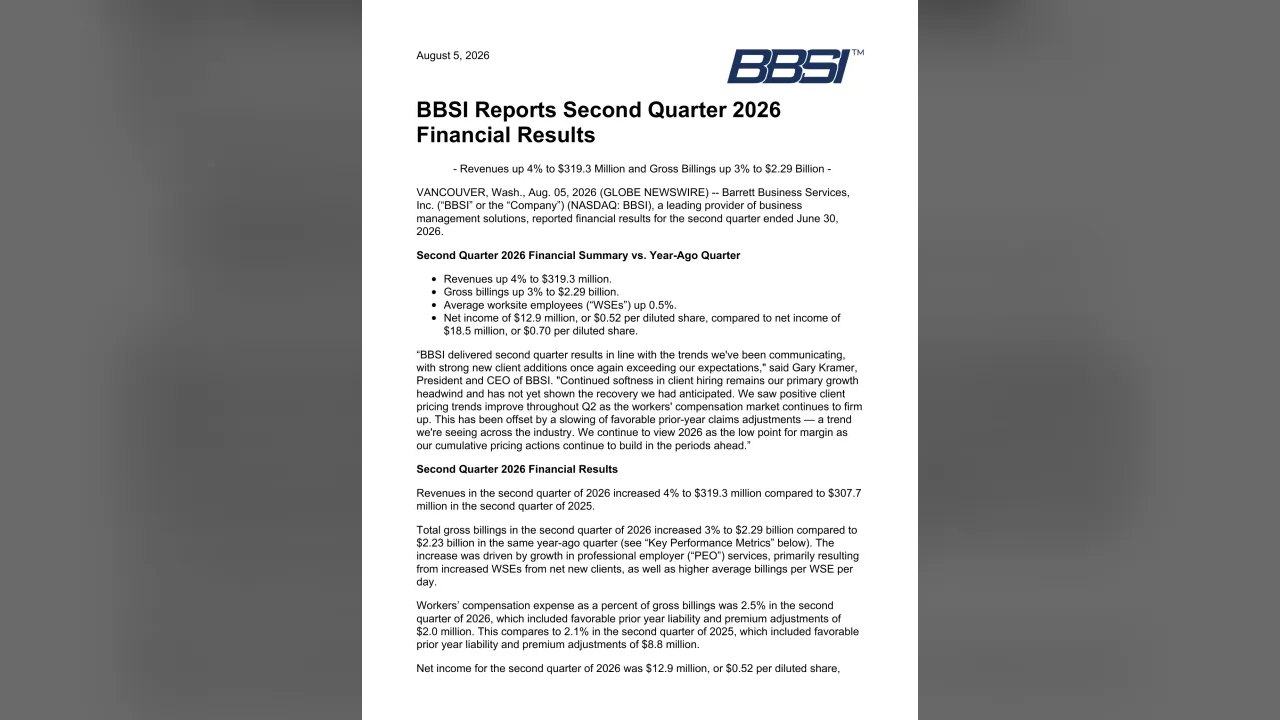
7:24 We remain steadfast in aligning our insurance pricing to our insurance costs. At the same time, we are maintaining strict expense discipline while continuing to invest in the business throughout this transition. We have consistently achieved strong controllable growth by focusing on the needs of our clients and by adding new clients, a focus that we will maintain. We have more products to sell and more folks selling. Our consistent execution, differentiated service model and strong relationships position us to continue driving sustainable growth through 2026 and beyond. Now I'm going to turn the call over to Anthony for his prepared remarks. Thanks, Gary, and hello, everyone. Diving into our performance for the quarter, gross billings increased 2.6% to $2,290,000,000 in Q2 twenty twenty six versus $2,230,000,000 in Q2 twenty twenty five.
8:21 PEO gross billings increased 2.8% in the quarter to $2,280,000,000 while staffing revenues declined 18% to $14,000,000 in the quarter. Our PEO worksite employees grew by 1% in the quarter, which as Gary noted was driven by strong controllable growth, partially offset by year over year client workforce reductions. Average billing per WSE per day increased 2.2% in the quarter, which was driven by continued rising wages, partially offset by lower overtime and hours worked per WSE. Looking at year over year PEO gross billings growth by region for Q2, Southern And Northern California were flat, Mountain grew by 2%, East Coast grew by 16%, the Pacific Northwest grew by 3% and our asset light markets grew by 73%.
9:20 A few comments on regional performance. Southern And Northern California, our two largest markets, beat expectations for new client adds, but experienced flat growth in the quarter primarily due to year over year client workforce reductions. The net result was that Northern California improved slightly from last quarter, while Southern California saw slower growth. The East Coast continued to stand out, delivering its twenty first consecutive quarter of double digit growth, supported by strong controllable growth. The Pacific Northwest region had its second consecutive quarter of growth as solid net client adds more than offset softer client hiring activity. Turning to margin and profitability. During the second quarter, we renewed our fully insured workers' compensation policies, which were effective as of 07/01/2026.
10:13 As we have emphasized in recent quarters, the California workers' compensation market has shifted towards rate increases due to industry wide higher average claim costs driven largely by increased litigation and cumulative trauma claims. As a reminder, the California Insurance Commissioner approved an average 8.7% premium rate increase in 2025 and recently announced a 6.6% additional increase effective September 2026. Against that backdrop, we once again renewed on favorable terms, including only a modest rate increase, no downside risk for future adverse claim development and continued participation in favorable claim development through return premium.
10:59 Looking at our historical workers' compensation policies, they continued to perform well, resulting in favorable adjustments for prior year claims. In Q2 twenty twenty six, we recognized favorable prior year liability and premium adjustments of $2,000,000 compared to favorable adjustments of $8,800,000 in the second quarter of twenty twenty five. Smaller favorable adjustments in the current year primarily reflect the industry wide increase in claims costs and the fact that those higher cost expectations are incorporated into our actuarial estimates. Turning to pricing for our workers' compensation product, we have continued to execute on our pricing strategy in this more favorable environment and we were able to once again increase our pricing each month in the second quarter.
11:46 We have now established an eight month trend of increased pricing, first in a decade. As a reminder, the previous period of declining workers' compensation pricing resulted in margin compression in recent years as cost trends stabilized or increased, but market prices continued to fall. While workers compensation claims costs are expected to continue increasing in the near term, we expect the pricing actions we've implemented to more than offset those cost increases over As pricing impacts are recognized as clients renew throughout the year, there is a natural lag before those higher prices are fully reflected in our results. We therefore expect gross margins to remain under pressure for the remainder of 2026 before improving in 2027 and beyond.
12:39 Moving to our operating costs and overall profitability, we continue to exercise disciplined cost control. And in Q2, SG and A decreased approximately 2%, driven primarily by employee related expenses. We continue to expect full year SG and A growth to be lower than gross billings growth and in line with prior year SG and A growth. Moving to investment income, our investment portfolios earned $1,900,000 in the second quarter, down approximately $400,000 from the prior year due to lower average interest rates and lower average investment balances as we continue to use excess cash to fuel our stock buyback program. Our investment portfolio continues to be managed conservatively with an average quality of investment at AA.
13:28 The combined impact of these activities resulted in net income per diluted share in the second quarter of $0.52 compared to $0.70 per diluted share in the year ago quarter. Turning to our balance sheet, we remain in a strong position with $68,000,000 of unrestricted cash and investments at June 30 and no debt. We continued our approach to capital allocation, making investments back into the company through product enhancement and geographic expansion and distributing excess capital to our shareholders through our dividend and stock buyback plan. Under our $100,000,000 August 2025 repurchase program, BBSI repurchased $15,000,000 of shares in the second quarter at an average price of $30.92 per share with $40,000,000 remaining available under the program at quarter end.
14:20 The company also paid $1,900,000 in dividends in the quarter and reaffirmed its dividend for the following quarter. This brings total capital return to shareholders in the last six months to over $39,000,000 Now turning to our outlook for the full year. We are narrowing our outlook to reflect our year to date results and to adopt a prudent stance given the current macroeconomic and geopolitical uncertainties, which have created clear headwinds for our clients' ability to grow their workforces. We now expect gross billings to increase between 34% for the year compared to our prior 3% to 5% outlook. And we additionally expect average WSE growth to increase between 23% compared to our prior 2% to 4% range.
15:07 We expect gross margin as a percentage of gross billings to be between 2.72.75% compared to our prior range of 2.7% to 2.85%. This primarily reflects the transitioning rate and cost environment of the California workers' comp market. Finally, we continue to expect our effective annual tax rate normalized for the one time tax charge in Q1 to be between 2627%.
15:36 I will now turn the call back to the operator for questions. Thank you. Ladies and gentlemen, we will now begin the question and answer session. Should you have a question, please press the star followed by the one on your touch tone phone. You will hear a prompt that your hand has been raised. Should you wish to decline from the polling process, please press the star followed by the two. If you are using a speakerphone, please lift the handset before pressing any keys. One moment, please, for your first question. Your first question comes from Chris with CJS Securities. Please go ahead. Hey. Good afternoon, guys. Thanks for taking a couple.
16:22 Maybe we'll start on the workers' comp side. So how should we look at the additional 6.6% rate in California in September? Is it in reality, is that just kind of make the prior December increase more
16:39 parallel and more of a certainty for everyone? Not necessarily the 6.6% is going be felt, you know, for quite a while. I know there was a lag with the original, you know, eight plus percent increase that was put through. Just any thoughts there? Hey Chris, it's Kramer. So just in general the regulatory agency gives a guide for what they think the rate should be and that's the rate guide. Ultimately it comes down to the different insurance carriers for what they want to charge. So you get the freedom and the flexibility to charge what you think it's worth. So in general it's a very good sign that we see the commissioner raising rates multiple years in a row but more importantly it's a better sign that we see in the market. Anthony mentioned it in his remarks, in the market we were able to get rate eight months in a row. So we're pretty comfortable that we can call the bottom now and say that we are seeing this rate environment lift up.
17:53 Got it. That makes perfect sense. Obviously workers' comp is kind of the key piece on gross margins. Are there one or two other things that we should be focused on or that's really going to drive the boat?
18:14 I mean, volume is one thing, right? So we had strong client adds, we had strong client retention. Unfortunately, was offset by our clients reducing their workforce again. So you have less volume coming in than we expected, but not by a lot of like a 100 basis points for the year. So that's one thing, but predominantly it's going to be workers comp that's driving the margin. If you just think of workers comp, we've been talking about this for a while now, right? So we've been seeing workers' comp rates come down, claims go up, and what we've seen more in California over the last three years was not only claims go up, but you had what they call post term CT claims, right? So somebody is no longer at an employee, somebody's no longer an employee and they file a post termination claim and it's cumulative trauma that they were doing an action for a while and they've got all of these things that are built up into it and they come in litigated. When they're litigated they're more expensive in the industry seeing something like two and a half X more of these claims than it did three years ago.
19:17 So you have claims driving this behavior and when claims drive the behavior then the industry reacts with and the rates are going up for premiums for what they charge, So cause and effect. And then that also then translates down to, alright, if you take these trends and put it into your actuarial models,
19:38 you're going to reproject your prior years and what you're seeing in the industry on your reprojection of the prior years is the ultimates are going up, which means the changes in estimates are going to be decreasing. So you'll see if you look at the market you'll see the changes in estimates for prior years for workers comp is slowing down this year from all these activities. So you know we see where this is going, we've played this game before, we think we're well positioned. As part of the well positioned, you know we renewed our insurance and reinsurance tower and we look at you know how much more we have to pay to the market and then we also look at how much more we're charging our clients. So we're able to charge our clients more now and get spread in this year but where we will get more spread is in next year because we will be on a rate on rate environment for where we're charging our clients a rate increase in '26 and a rate increase in '27.
20:39 So you get to a compounding rate on rate, which is why we feel comfortable that our '26 gross margin is the low watermark and '27 is going to be higher. Got it. That makes perfect sense. I will leave it there. Thanks, Kermer. Thank you. Your next question comes from Jeff with Roth Capital Partners. Please go ahead. Thanks. Good afternoon, Tammy and Anthony. I wanted to drill down a bit on the benefits side.
21:18 What's been your experience? We're seven months through the year now, the renewals, the higher rate environment, the balancing of claims costs versus rate? Could you give us a little more look under the hood there? Yeah, just to kind of go back to oneone, so for oneone we renewed 93% of our clients on benefits. 4% of them we kept as a PEO client, but we placed their business other where we've got some we got some processes that we can act as the agent and we can if the the risk doesn't fit or they can get a better price we can still be the agent and place that business elsewhere. And for that we did 4%. So on a call it net PEO basis, we kept 97% of our business for oneone.
22:09 And then we're continuing to stack in Q1 and Q2. We had a really good Q2 on the benefit side. We added, I think it was like 70 clients and a couple thousand more participants to the plan. And if I look at the pipeline, we've got a pretty robust pipeline looking out ahead.
22:27 Regarding your question about how's the book running, the book's running as expected. I think the industry in general has elevated costs on the medical side. I think you're going be looking at another double digit year for rate increases. We haven't got our numbers yet as far as working with our carrier partners. We don't have our numbers yet so you know when you're looking at trend in this space trend is looking at it's going to be another double digit year trend increase and that's kind of what you're reading all over the Wall Street Journal, CNBC and everywhere else. Yes, certainly a tough rate environment out there. On the renewal on the workers' fully insured workers' comp program, is there any administrative cost savings on that renewal? And what how should we think about adjustments to prior year claims for the next couple of quarters? And should we see that improve?
23:23 Should we see that also bottom along with margins?
23:28 As far as the structure, we're paying a little more in rate, but we're charging our clients more so we're getting a little spread on that. But the structure itself has not changed materially. We like the structure, it's to the fact of if things develop poorly that's why we bought the insurance, if things develop favorably then we get money back and we think that that's a good deal for all parties and a good deal for our shareholders. So that's the structure has not changed. There's no change in the administrative costs of that. And then as you think of the changes in estimates in prior years, you're seeing the industry slow down as these cost trends break as these cost trends go into the models and start to get developed.
24:14 You're seeing these changes in estimates slow down and we experienced that for BBSI in Q1 and Q2. So I don't think I think it's still trends, but it doesn't go to zero. Great. And then you said you're transitioning three additional asset light models to two branches. What kind timeframe should we expect that to occur?
24:42 Yeah, it's going to be a lot of that's out of our control as far as we're looking for real estate now. We're close on some, we're farther on others. So we've got three branches that are prone in position or three markets that are prone in position to turn into branches. That'll be back half of the year. It may drip into Q1, but we've got three that are doing well and we're going to invest more in. I'll hand it over. Thank you. Your next question comes from Mark with Sidoti. Please go ahead. Hey. Good afternoon. Good afternoon. Wanted to see if we had a chance to go over some of the benefits of the new business wins. And then maybe you could talk a little bit about the renewal rate. I mean, I know certainly given the challenging environment that's out there, but it certainly seems as though between the new business wins and sort of what you're seeing there. You seem to be in a position of gaining market share in a challenging environment. So maybe talk a little bit about renewal rates that you're seeing there and how that might be pacing.
25:55 For the new business, we had a really good Q2. We had the best June we've ever had in our history as far as clients and WSEs in June. And July is not done, but July looks like it's going to be a better July than the prior two years for July as far as WSEs we added. So we're getting a lot of good traction in the market. We've spent a lot of time and energy, a lot of time on technology, lot of time on marketing, lot of time on our go to market. And we're continuing to invest in that and we're continuing to invest in that more this year and more to come next year for our salespeople, right? So we hire good folks, we give them good training, we give them good tools and then we kind of get out of their way and guide them along the way. So we've got that refined fairly well now that we have consistent predictability
26:50 in our unit counts for what we're bringing on. And then for what we're bringing on, we're very still comfortable being a blue collar PEO but we are seeing more white collar business and we saw more white collar in the second quarter than we've seen in any other quarter. So we're bringing on doctors, insurance brokers, dentists, CPAs, all those types of businesses that now that we have the tech stack and we have the health insurance, where we're more competitive in that vertical now. And do you get the sense of maybe what the driving forces are that maybe when you're adding on the white collar side,
27:42 what kind of stands out and kind of maybe what the catalyst is? Maybe not just from the competitive advantage standpoint, but maybe the potential for greater turnover going forward? Would say say you have a larger account and they have a consultant or they have you know some sort of intermediary that puts together their go to market strategy for how they're going to market to say a PEO or non PEO. They put together an RFP and that RFP has check boxes and you know before we were not able to check all those boxes. We may have not had the health insurance, we may have not had performance management, we may have not had an HRIS, but now we're able to check all those boxes and go to the next stage.
28:29 And when we go to the next stage, you have all these different boxes that we've checked but I have that local team and that local team really is the differentiator for us. It's you know these tools allow them to get in the door but it's that local team that really is the value prop and really does the positioning and the closing and the servicing. Excellent. Thank you very much. Thank you. Your next question comes from Vincent with Barrington Research. Please go ahead. Yes. Gary, to be clear, are you assuming that controllable growth continues at the current pace for the balance of the year?
29:26 For our gross billings and WSCs, yes. So we're we've had consistent we're stacking consistent years now of controllable growth and I think we've we've got that dialed in very well. Don't get me wrong, we're not going to be comfortable and sit on our hands here. We're going to keep refining it and keep working harder and give them more product and doing more things. We're not just going to sit here and rest on the laurels, but we feel really good on the controllable growth, you know, from clients we add WOCs they have and clients we retain in WOCs they have. The headwind that we have now is our clients have been shrinking, right? So this started back in Q3 of last year into Q4, kind of subsided in Q1, it resurrected in Q2. But when we look at the back half of the year for Q3 and Q4, we're going be going against softer comps as far as same customer sales. So we feel comfortable that Q3 and Q4 are going to be better growth because we're going against the comp, if that makes sense.
30:26 Yes, it does. And how are the new metros such as Dallas and Chicago ramping relative to what you've seen historically at new branches? They're doing really well. Both of those, and we're going have a couple more that come online towards the back half of this year. We like to invest in winners and we've got winners in these spots and we're going to give them the resources to make them more formidable and more powerful. So we definitely are slow to make the investment, but when somebody proves that they can do it, we give them all the way to BBSI behind them. On the staffing side, what should we be assuming in terms of our modeling, flattish or slight growth there?
31:19 So we're starting obviously at a lower point so far, Vince. Sequentially, there's a seasonality to staffing, so we'll see sequential growth in Q3. And really, we are seeing, as Gary mentioned in his remarks, if you kind of look through the numbers into the composition of staffing, we're seeing some positive signs. So we brought on more new business than we lost. So we're building that book organically. Unfortunately, we're seeing kind of the same effect in the staffing book as we started to see now, which is our existing customers', orders have gone down. So within that, there's net negative volume. So the signs are positive there. We're projecting sequential growth into Q3. But still halfway through the year, it'll be more than double digit year over year growth for the year year over year decline, I mean, for the year.
32:10 And one last one for me. This client weakness in terms of headcount, are there any particular industries or anything you can point to that's causing this? We're feeling it, you know, our book skews heavy blue gray, so we're feeling it more in the construction space than anywhere else. We're feeling it almost in every geography now as well. So you know it was you know it was just say California in q three and q four. Now we're seeing it in other geographies around the country. Thanks for the color. Thanks.
33:03 Thank you. At this time, this concludes our question and answer session. I would now like to turn the call back over to Mr. Kramer for closing remarks. Sure. Just want say thanks to all the BBSI professionals for another great quarter. I appreciate all your hard work and look forward to the rest of the year. Ladies and gentlemen, this concludes today's conference call. Thank you for participating. You may now disconnect.
Follow Barrett Business Services, Inc. into a list and get an email when it puts out news.
president and chief executive officer at BBSI