Replay available
Aya Gold & Silver (TSX:AYA) Q1 2026 Earnings Call
Aya Gold & Silver (TSX:AYA) Q1 2026 earnings call, held 2026-05-14. Watch the replay and read the transcript on 6ix.
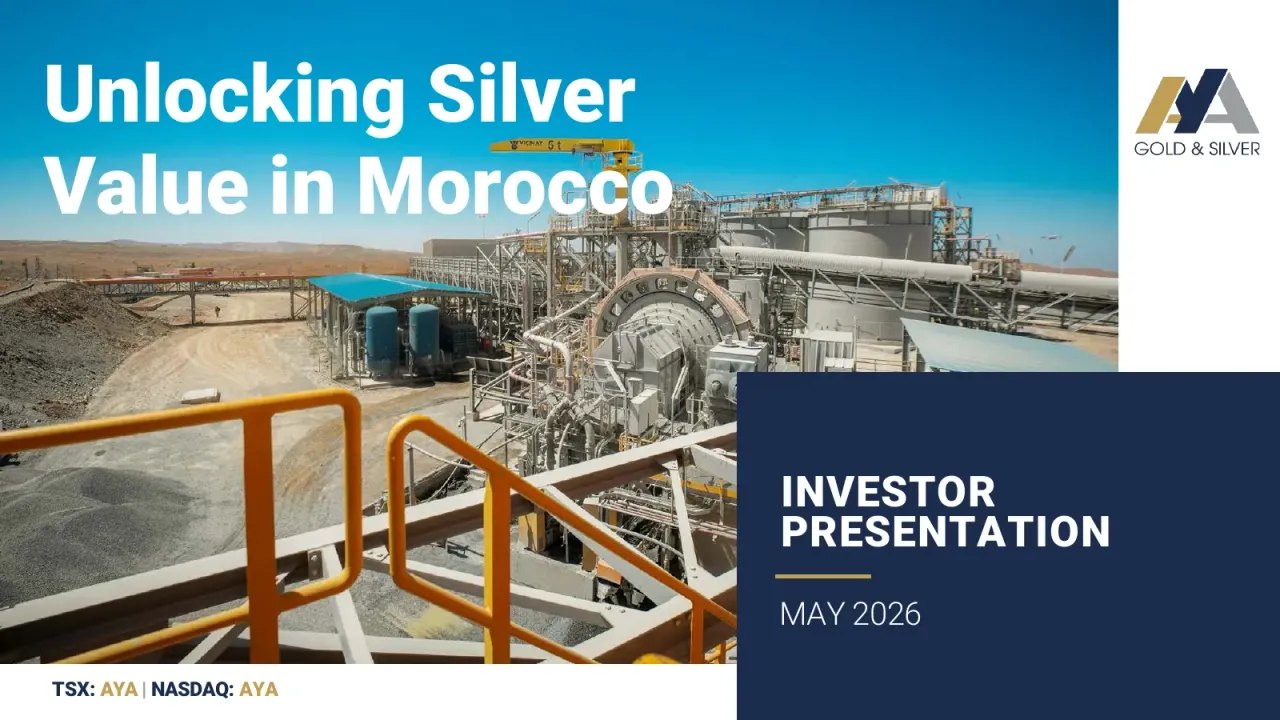
- Company
- Aya Gold & Silver Inc. (TSX:AYA)
- Period
- Q1 2026 earnings call
- Date
- Thu, May 14, 2026, 10:00 AM ET
- Replay
- Watch the replay on this page · 50 min
- Results news release
- Aya Gold & Silver Reports Q1-2026 Results with Record Revenue and Cash Flow · Thu, May 14, 2026
On 6ix: 6ix.com/event/aya-gold-and-silver-inc-aya-q1-2026-earnings-call
Replay
Transcript
Automated transcript · Written by software from the replay's audio. It can mishear names and figures; the replay is the record.
0:01 Good morning, everyone. I will now turn the call over to Elizabeth Hemmowy, Aya Gold and Silver's Director of Corporate and Financial Communications. Please go ahead. Thank you, operator, and welcome to everyone who has joined Aya's first quarter twenty twenty six earnings conference call. Here with me today, I have Benoit Lassalle, President and CEO, Pipou Lombry Tostrach, Chief Financial Officer, Elias Delaes, Chief Legal and Sustainability Officer, Rafael Bourdoin, Vice President of Operations and David Lalonde, Vice President of Exploration. We will be referring to a presentation on this conference call, which is available via the webcast and is also posted on our website. As we will be making forward looking statements during the call, please refer to the cautionary notes included in the presentation, news release and MD and A, as well as the risk factors included in our annual information form.
0:57 Technical information in this presentation has been reviewed and approved by Rafael Bourdoin, Aya's Vice President of Operations and David Lalonde, Aya's Vice President of Exploration, both of whom are Aya's qualified persons as defined under National Instruments 40 three-one 101 Standards of Disclosure for Mineral Projects. I would also like to remind everyone that our presentation will be followed by a Q and A session. With that, I would now like to turn the call over to Benoit Assad. Thank you, Isabelle. Good morning, everyone. Thank you for assisting this Q1 twenty twenty six conference call. Let me summarize the quarter before we get through the presentation. I think it's we need to summarize this as Q1 is an exceptional quarter for Aya.
1:50 It's an exceptional quarter knowing that Q1 is always the most difficult quarter for the company as we are at 2,200 meter above sea level in the mountains with lots of snow and rain and wind. So this year, due to the fact that we lost five days of operation due to weather related situation, we still delivered an outstanding quarter. Aya delivered record revenue, record cash flow, expanding margin, rising silver price and lower cash costs. So we have a very strong Q1. And when you compare it to Q4 of last year with Q1 of this year, on a per day basis, the production per day is very similar, approaching 15,000 ounces.
2:45 The reason the production is a little bit lower in Q1 is due to the fact that we lost an equivalent of about five days of production. But when you look at the highlights, it's record revenue of $117,000,000 It's record cash flow of $17,000,000 It's a record net income after tax of $49,000,000 It's a cash balance at the end of the quarter of unrestricted cash of $172,000,000 It's a production of almost 1,500,000 ounces for the quarter with record mining rates, really strong quarter. And as we have a record mining rates, we've also increased our stockpiles.
3:34 So taking you to our presentation that we use, showing you some graphics, if we go to Page four after the forward looking statement, you see exactly what I just said. The record revenue in Q1 twenty twenty six at 117,000,000 compared that to last year at $34,000,000 The net income of $49,000,000 compared to last year of $7,000,000 with an EPS of $33 fully diluted, dollars $34.33 dollars $0.33 sorry, diluted and $34 on a non diluted basis. And when you look at Q1 of operating cash flow this year at $70,000,000 compared to last year, dollars 8,000,000.
4:24 So very strong quarter. You see it on the right hand side. We'll show you the production profile has increased from Q1 twenty twenty five, where we produced 1,000,000 ounces of silver to Q1 of twenty twenty six, where we're at 1,490,000 ounces. Of course, a little bit lower than Q4 of last year because Q4 of last year had no weather related event, whereas Q1 of this year had approximately five days of weather related events. Moving on to the page to Page five of the presentation. Very interesting on the left hand side, the quarterly mining tonnage. You know, we've always been saying that the mining has to follow the plant. The plant is is the plant's production profile has been 30% to 40% above nameplate capacity, but the mine also needs to follow the plant. And the mine is actually now exceeding the plant. So you see on the left hand side, last year, we were running at 2,200 ton a day.
5:36 In Q4, we were at 4,200 ton a day. And now by Q1, this quarter, we were running at 4,600 ton a day. So absolutely stellar performance from the mine, from the open pit and from the underground mine. The grade is also steady and improving. So we're pleased with the outcome of the mining and the grade and the throughput. And then on the right hand side, you look at the plant. Well, in Q4, the plant was running at 3,800 ton a day. In Q1, the plant's running as well and it's not sometimes higher, but as indicated because of the lost days. And if some of you have followed the weather in Morocco, it was extremely rare, like they had two times the historical average rainfall and snowfall in all of Morocco. I was there two weeks ago and the week before that, there was snow in Marrakech, which is absolutely rare.
6:43 So this is in one way, it was a little bit difficult on the actual production, but we now have more than fifteen months of inventory of water at site and the rivers are still running. So being a little difficult on the production was a great situation for water management and for us and for all the country. Now all the water reservoirs have been filled as some of the reservoirs that have not seen water in many, many, many years are now full. So the water situation globally for the country was extremely good. Moving on to Slide number six, a quick word on Boumazin.
7:29 You know at Boumazin, we are reclaiming the pyrite. The operation is going extremely well. We produced 127,000 ounces of silver and seventeen fifty seven ounces of gold, a little bit lower than what we wanted it to be, again, weather related because, of course, the bad weather of Gunda was also weather related in at Boumazin. And the other situation with Boumazin is because we are exporting the pyrite tonnage, the ports in Morocco were shut down for one month because of weather, because of floods. So, of course, that's why, you know, the silver equivalent sold is when you look at Page six, you see the silver equivalent produced of 227,000 ounces and only 50,000 ounces sold. One reason, exporting is, you know, we produce it, we ship it to port, and then it stayed there because we could not ship it just because of very, very difficult weather.
8:39 All of that is behind us. It's probably now going to rain next time in November or December. It's all behind us. But the reality was that even at Boumazim, it's we were a little bit affected, especially on the shipment of the concentrate to Asia. But the Boumazim project is really an add on to Gunda. It's minimal CapEx, very, very low cash cost. It's positive cash flow. The grade reconciliation is actually better. We have the gold grade is a little bit better. The silver grade is better than what we had in our model. So globally, it's a very profitable project and which is at the same time an ESG project because we're cleaning all of historical waste that was left there for many, many years. So it's still going on and it's accelerating now in Q2, Q3 and Q4. We are accelerating the reclamation of the Boumediene Pyrite.
9:48 Going to Page seven of the presentation, this, again, coming back to last quarter, this is the most important slide. The one on the left is the margin. Look at the margins from Q1 twenty twenty five to Q1 twenty twenty six. We were working with a $12 margin in Q1 last year and staying at $12 in Q2 of last year and then margins started going up to $20 in Q3 and then you saw to about $40 in Q4 and now margins right now are like $63 in Q1 of twenty twenty six. And obviously, you are following the silver price and we're seeing that this is very, very it's a very strong silver price at the moment and our costs are stable.
10:41 We are not affected greatly by the war and the increase in fuel price. We are. Cyanide went up a little bit. We're going to see that in Q2, but it's marginal. The main reason is our electricity is from the grid and it's solar and wind. So like most companies are affected because they need to generate their own power at Gundair and it will be the same at Boumazin, the power is solar and wind. So we do not expect cost to increase more than maybe $1 an ounce if they do if they increase by that much. And the reason is really because of the source of energy. On the right hand side, you see the growth of revenue.
11:27 And obviously, as I said, Q1 is at US117 million dollars revenue with a net income after tax of $49,000,000 This is a very strong performance of revenue increasing. Of course, it's due to the silver price, as we understand what the production profile is. But the silver price is was extremely good in Q1. Our highest selling unit or selling price in Q1 at one point, we were able to sell close to $120 an ounce. So it's showing and now the average of $82 as we speak right now, the silver price is higher than the average of Q1 twenty twenty six. And the net income, well, net income after tax of 49,000,000 with an EPS of $33 Very and taking us to Page eight, a very strong balance sheet. We finished the quarter with $172,000,000 in the bank. And on top of that, we have the restricted cash that we have for the EBRD loan of $16,000,000 So when you look at this, it's a very, very strong cash position, a strong balance sheet, only one debt with EBRD, which is now below $100,000,000
12:57 and which we could pay, but it's a very good and not so expensive loan with EBRD. So there's no point in pushing the repayment of that debt. When you look at cash from operation at $70,000,000 our capital expenditure program is 4,000,000 The exploration and evaluation exploration mainly is $14,000,000 We had a very good quarter on exploration, and I'll talk about the drilling. But so all in all, when you look at this with an $18 cash cost and all the capital expenditure behind us, it's a very, very profitable quarter. Moving to Page nine, which is our guidance.
13:47 So our guidance is was presented to you at the beginning of twenty twenty six. We are maintaining our guidance. We though we are a little bit below where we wanted to be in our production guidance, we knew that Q1 is always a little bit weaker than the rest of the year because of seasonality. And we knew that. So that was part of our planning and we're very comfortable with our guidance of 6,200,000 to 6,800,000 ounces. This is Goodyear production between five point two million and five point eight million. The Boumadinho at 1,000,000 ounces of silver equivalent, we're very comfortable with that. Now when you look at Azbunir cash costs at $21.50 I understand that we were at 18,000,000 this quarter, but it's a question of the strip ratio.
14:41 And we know that over time, we're going to be a little bit higher than this. So we're comfortable to say that the on the guidance of $21.50 is where it should be. The VUMADIM cash cost at $10.10 in Q4, it was six In Q1 of this year, it's more like $11 We're very close. We are also going to ramp up on quantity. And in ramping up on quantity, obviously, the cash cost per ounce will come down a little bit. On the sustaining and growth capital, sustaining is about $0.518000000 and growth capital is 18,000,000 for a total of 36,000,000 The main growth capital is really we're pushing the ramp down all the way down to the granite so that we can go and reach those lower levels where we see high grade silver.
15:35 And on the exploration expenditure, well, the budget is 60,000,000 As you know, as a company, we plan to drill close to 240,000 meters this year. This is ongoing. We have always between fourteen and eighteen drills starting. David has a team of almost 400 people in exploration, including all the drillers. So it's a large program, but we need that program to convert the resource at Boumazim from inferred to measured and indicated for the feasibility study of next year. Taking you to slide number 10. Where are we going this year? What are the priorities?
16:23 Well, look, is a top priority. We're very happy and very in an extremely good position that we can do Bumadzim with no outside debt, no equity financing. We have the money available to push on Bumazin. So we are pushing on the feasibility study, which we want to be ready for next year 2027 and also the updated PEA, which will be ready by the end of June, beginning of July. And so we have we are stepping up on every aspect. I always say every chapter of the study, make it water, PSF, energy, flow sheet, logistics, every chapter is being worked on.
17:17 And as soon as it's ready, it's being executed. So the feasibility study is ongoing. We are we have identified the contractors for the open pit. We have identified the contractors for the flow sheet where we will be going into detailed engineering shortly. I mean, we are working with our partners on logistics. All of that is moving towards completion of the feasibility next year and beginning of construction. On the drilling front at Boumazun, we drilled in 2020 in Q1, obviously, 42,000 meters. And you know this was the ramp up plus it was the one month of Ramadan, which we during Ramadan, sometimes we do not drill as much, and we do have a week off at the end of Ramadan.
18:12 So for Q1, we've drilled 42,000 meters. We're stepping up there because the objective is 180,000 meters for the main structure and an additional 20,000 meters on the regional plate. So that is being done, and we will be delivering on that. At Zuguldaher, the plan is, well, just be more efficient, control your costs, make sure that we maximize our revenue, that the mining is very precise, that there's no dilution. And the key thing at $80 or $90 silver is let's not leave an ounce behind and sterilize those ounces.
18:59 We take it out. If it's between fifty and eighty gram per ton, we stockpile it. We don't you know, we expense it. It's in the cash cost, but we stockpile it. And if it is between 80 and, you know, the deposit grade, we put it through, we have a stockpile and then we put it through the plant. So it's extremely important for us to maximize what we're mining, the ounces that we're mining and that's why we're running way above 4,000 tons per day and controlling costs. We've also been working on the tailings facility because originally the tailings was planned for 2,800 ton a day. We're now running close to 4,000 ton a day. So we've decided to do the first phase of the tailings construction to increase the tailings capacity, and that will be done at this summer. We will be all done over the summer.
19:58 So when you look on Page 11, where we are, we have Zgundar that will be producing life of mine, 6,000,000 ounces a year, life of mine cash cost at $16 AISC around $19 life of mine, extremely profitable, and that is only from one structure. You will see sure in the coming weeks, some more exploration results coming out of Gundair because of course, as Gundair, we would like to increase the life of mine from eleven years, hopefully to fifteen years and if possible, even increase the throughput. Our development asset, Boumazim, well, is the PEA is being reviewed. The resource update will come with the PEA.
20:43 As of the end of twenty twenty four, we were looking at four fifty million ounces of silver equivalent. That will be updated because we've drilled more than one year as the structure. So that will be updated and it will be included in the new PEA. But on the right hand side to me, that's the most important strategic view of AYA is we are currently a 6,000,000 ounce producer at $19 all in life of mine as Gunde. We will add to that by 2029 thirty seven million ounces of silver production equivalent at an all in cost of $14 making us a 43,000,000 ounce producer, of course, silver equivalent.
21:39 And that will have an average ASIC when you look at 20 or 19 for Zuguntaer and 14 for Bumadin, you're looking at mid teens for an ASIC. Depending what silver price you want to assume, you can do the math. On top of that, Aya is a major exploration play. We have two districts. We have the Boumazim District and we have the Zugundar District. So not only do you have two projects, you have two mines. You have the Zugundar Mine and you have the Boumazin In development mine, you have the Boumazin Regional Play. And that is an extremely large play. We have 800 square kilometers.
22:26 We will be drilling there 20,000 meters on the regional play. Of course, the 180 on the main zone that is infill, though we are finding new zones. You saw in the last press release, we had identified new zones, but we will be pushing the drilling on the main zone, of course, up to 180,000 meters. And on the exploration on the regional, as we he's telling the team, as soon as you have another structure where you want to really drill it out, just come back to the committee and to the management committee, and we will give you more budget. So Boumanzin as an exploration play is very unique. It's got big systems. The main zone is over 5.4 kilometer.
23:14 You have also SCRM, which is an eight kilometer long structure. I mean, we have very, very, very strong zone. TZ is a parallel zone and it's also 5.4 kilometer long. So Bumadrin is a major regional play. And Gundeer, well, Gundeer is we've done a lot of work. We've done a lot of geological work. We've used AI. We have many targets. We have new theories and new geological concept behind Gundair that we're going to be testing this year. So it is also a very interesting geological play. So in Aya, you have all the geological upside of a major, major exploration company drilling 230,000,240,000 ounces 240,000 meters of exploration drilling coming in 2026.
24:11 And then you have the production coming from Gundai and you have the development at Boumantou. So again, to conclude and to go into the Q and A period, very strong quarter and our weakest quarter as planned. We are pleased with the production. We are confirming our guidance and we look forward to a stronger Q2 and much stronger Q4 and Q5 to close the year again. And based on the silver price, it should be an extremely profitable year. So thank you, and I will turn it back to the operator for the Q and A period.
24:57 Thank Our first question comes from the line of Larry Liu with CIBC. Your line is open. Hi, thanks for taking my question. I guess I'll start off asking about the severe weather conditions. So, Ben, what can you tell us, you know, what are some of the precautionary measures now that a team has taken? I know you mentioned that this is a very rare event. Are there any precautionary measures you've taken to prevent any further impact to your current operations? And I guess second part of that question is your stockpile did increase by 44% or fifteen months' worth of production.
25:43 Is there an optimal, you know, kind of size of stockpile you're looking for? Or should we start to see it gradually decline as the milling throughput comes back up again? Yes. Thank you for your question. I'll pass it over to Ralph who was at site for all of that period and will tell you what we have done to mitigate the risk of weather related events and what it does to our production profile, which is only in Q1 by the way, because after that, it's sunshine for the rest of the year. So we're in the mountain and as a good mountain climates when it rained the pours. So that essentially results into stickiness of the ore and decreases throughput of the crushing circuit.
26:31 To catch up, and it's something we've been working on for a while to increase the crushing throughput, which is the actual bottleneck in the plant. We did in Q1, 3,633 ton per day on average in Q1. And as soon as sunshine came back in April, we're back on track at 4,000 right there in April. So the worst is behind us for the rest of the year essentially. But to answer your question, to mitigate that, we gave a small contract to a contractor, a crushing contractor that is up in operation now, a bit as a contingency for weather and also to help debottleneck the plant a bit from the crushing side. So, this contractor will stay there as long as we need it. And we're also contemplating to increase our own crushing capacity within the Grundeer plant, and that's something under study that we should be able to make decision on that soon. But bottom line is we have a contractor that helps us out since maybe a bit less than a month now that can compensate for a bit lower crushing capacity to make sure the plants remain saturated.
27:54 And the stockpile? Oh, yes, sorry. So the stockpile, set about 300,000 tons right now. It's close to three months' worth of production. It's a buffer that I'm personally comfortable with. We've been really pushing over the last year to bring the open pit to steady state. Now we're producing comfortably over 3,000 ton per day in the open pit with peaks much above that. It gives us time to do the pushback if we want to later on this year. It gives us time to shut down upper levels in the underground that will be mined in the open pit. So it's a flexibility that we always believe in that helped us out in many ways. So to answer your question, 300,000 tons is probably where we want to be.
28:46 It gives us the flexibility we need for future pushback and the flexibility to maximize, again, the ore recovery by the open pit. So now that we've reached this capacity and this flexibility, we will look to continue optimizing the underground development, especially on the sublevels. So we can focus now more our efforts into the lower levels and keep stockpile around 300,000. I wouldn't be surprised we see it go down a bit through the year, which is fine. That's where it's there. Sounds good. So, to push back into open pit towards the end of the year.
29:37 Perfect. Sounds good. Thanks, Rafael. I guess, you know, kind of shifting gears away from the Zaguner now and walking back to Bumidine, you know, this quarter, there was some commercialization of the pyrite concentrate. We see the cost come in at $11.86 per ounce of silver equivalent. How should we look at it? I know it excludes mining, but how does that compare to your PA, for example? And would this be a good read through in terms of costs we should see within the feasibility study coming up? Well, for the current pyrites reclaim, we essentially dig a pyrites stockpile, we crush it, and we send it in trucks. So our costs are really low. Our costs will remain for the rest of the operation, but it's tough to make a parallel with that with our future Boumaden project. It has nothing to do this is a small project.
30:30 It's going to be reclaimed for the next two years. It gives good cash flow. It's a good exercise to start building a small operating team at Boumazin and to have more presence on our Boumazin site as we go from PA to feasibility to construction. But one is not comparable with another. Got you. Sounds good. All right. I think that's all the questions I have today. Thanks, Rafael, and thanks, Benoit and team for taking my question. Thank you. Thank you. Thank you. Our next question comes from Justin Chan with SCP Resource Finance. Your line is open. Hi, guys. Yes, congrats on a good quarter. Thanks for the update. My first one is just on, I guess, on the mine plan for the rest of the year.
31:16 I guess, compared to Q1, how should we think about strip for the open pit? And then I saw the underground really pushed tons quite hard. Do you expect that to continue? Or I think you were foreshadowing, maybe you're shifting more to development and into the lower level. So should we expect tons mined to come down a little bit from that high pace in Q1 of the underground? Hi, Justin. Yeah, good question. Actually, it's we've been as you all know, we've been pushing tonnage both in the underground, the open pit. We had we really wanted to bring back the stockpile, we deserve, show everybody we could have a good throughput at Gundar, both in the open pit, in the underground, in the plant, and I think those discussions are behind us now. So we have full team on the ground. The open pit has showed it can deliver.
32:06 Now the open pit is wide open. We have room to work. So first for your strip ratio, we expect the long term strip ratio to be what we published in our latest 40 three-one 101. So this strip ratio of nine, it's temporary. We will have months at eight or nine like we have now, and we will have months at 20 like we had in the past. Overall, it's between thirteen and sixteen. This is what we expect on the longer term. Can you hear me, Justin? Yeah, can hear you well. Thanks, Rod. Okay. And so, for the underground, absolutely. We've been, you know, we've been at a rate of over 1,500 ton per day on the ground. And we have some of these levels that we want to shut them down because we want to increase the maximum ore recovery through the open pit.
33:00 So to answer your question, yes, there will be a shift in focus in Q2 moving on for the rest of the year to accelerate the ramp down and to transfer some of this production power into stope development and sublevel development. We're comfortable at the underground rate at around 1,000 ton per day is something we're comfortable with because the open pit is well established now. So you can expect moving on to have the rate of underground to slightly decrease 1,000 to to 1,300 ton per day is probably the sweet spot we need to really focus on those sublevels for which we also know we have pretty good grades going down.
33:50 Okay, gotcha. Thanks, Ralph. That's great color. And on the plant, do you think you'll keep the mobile crushers around even when it gets dry? And what would your throughput potential be, if that's the case? So again, we what we publish in our feasibility is above 3,600 this year, and three thousand eight and fifty next year. Internally, we're trying to beat that. We have like our best days right now are around 4,300 ton per day. Those are punctual, like best daily performance. I think, Justin, 3,800 is probably where we'll be comfortably at in the near future.
34:38 And that will like, we're really pushing this plant, as you know, main plate is 2,700. Now we're near 4,000. It's difficult for me to speculate above that, because we need to go bottleneck after bottleneck. I think there's a bit of juice left in the plant, but we need extra crushing capacity for that. So 3,800 is probably where we would be. Some good months above that, some bad months around that. But to answer your question, 3,800, including the mobile crusher that we'll keep as long as we need. Okay, perfect. Thanks. And I'm not sure who's the best person to ask this question to, but on Brumadin, I guess, the ounces that weren't sold this quarter, do you expect to sell them in Q2? Or should that become spread through the rest of the year?
35:30 And also, just given the world being pretty short of sulfur, will there be any noticeable increase in payability, do you think, for Q2 and Q3? Or is it too early to say that? Hi, Justin. It's Hugo. Yes, for sales of BoomAgyn, it's not that the clients don't want it. I think we get called every week and as I say, we get more material, so especially with what's happening in the sulfur market today. So we are logistics by trucks, we're learning it, so it's going to be spread out throughout the year. And we're trying to modify things a little bit to send larger shipments. And so that on that, I think it's going to be put it is going be through the year, but the 1,000,000 ounces of silver equivalent is still what we're on track to do. And in terms of payability, it's not going to change because it's because it's old material has been there for a long time that this the sulfur quantity is a lot less than fresh rock from from Boumediene.
36:25 And so the payabilities aren't gonna and the volumes are small on the 200 to 240,000 tons total. And so that we've agreed on a price and on a contract for with our traders. And so that's not going to change throughout the throughout that stockpile. So Justin, if I can add on payability, the payability is changing on the bigger project. Yes, because that has 45% sulfur. As you go said, the tailings is a bit more in that. So it's got very good gold and silver content. Pyrite is a bit tired, so it's not changing on the small project, but on the bigger project, it is changing in an important way. Yeah, absolutely. Okay, thanks very much. That's really helpful color. Thank you, Rohan. Thanks, Benoit. And thanks, overall. I'll stay off the line.
37:18 Thanks, Justin. Thank you. Our next question comes from Mike Kozak with Cantor Fitzgerald. Your line is open. Good morning, Benoit and team. A few questions from me. First one, Q1, it was the fourth quarter in a row where unit costs at Segundo on a per ton basis have trended down. Mean, I a portion of that is obviously more and more open pit material. But I mean, they can settle in around $80 a ton in Q1. You were north of $100 a ton a few quarters ago. Is that $80 a ton a good number going forward? Do you think it's going to continue trending down? Or where do you expect to settle out? I can comment a bit on the ounce unit cost. Our costs have been going down, and we're happy about that.
38:03 Throughput has been going up, and production has been stabilizing in the open pit in the underground. Now, a lot of that unit cost saving comes from the underground unit cost per ton, as well as the open pit unit cost per ton. And we've also had gains in the plant as we process more throughput and stabilizer sonar consumption. So we've been winning on all fronts, including site services and surface and utilities as we're toward being more mature operation, and we're happy to see that. Now that being said, there is a lot of cost fluctuation at Gundair based on the open pit strip ratio, as you can imagine. So depending on the sequencing, we have months this quarter's strip ratio was around nine, which is quite exceptional.
38:55 The overall strip ratio of the open pit gets better through the life of mine. And again, we've made that quite clear in our latest '40 three-one hundred one, but it will increase slightly this year, towards especially towards the end of the year, we'll have a bit higher strip ratio in the open pit. And I expect our strip ratio for the year to sit between thirteen and sixteen. So, we'll continue to improve our overall cost, but inherently, the open pit will be more expensive in terms of cost per ton, because we'll converge more toward the 13 to 16 strip ratio as opposed to nine. And let's not forget, underground, we need to develop new stopes. Now we have lower levels around 1925 that are operating that costs are good.
39:44 But on the long term, the underground costs of the Gundar mine will slowly creep up as we go deeper and deeper, which is also normal and captured in our projections. Okay, thank you. That's good color. Secondly, what do you expect your average now that the if you're making so much money, what do you expect your average income tax expense rate to be this year? You go? Yeah. So, income tax rate, so I think five years ago, the government of Morocco, when we were back at 20%, had put out a new law and said that it was an increase to 35% in 2026, or thirty five percent. Then during COVID, they added a five percent COVID tax, which got converted into a 5% solidarity tax, which is supposed to be temporary. Okay, it's been three years now and going on a fourth year of that tax being in existence. We are one of 187 companies in Morocco that pay that tax rate.
40:50 Everybody else that makes less than 100,000,000 dirhams of profit pays 20%. We know there's the World Cup coming, I think the government, like all governments, needs money. But more and more, we're starting to see companies like ourselves and within the 127 that are saying, hey, 40% income tax is simply not competitive. And so, would expect that '27 moving on at least that 5% falls away, and then we'll see what happens with the additional tax rate. But yeah, it's our biggest cost today. Yeah, got it. And then one more, if you don't mind. Cash, obviously building at fast pace. Do you have any options available to you to accelerate repayment of the remaining EBRD debt?
41:36 Yeah, so we, we if we want to repay, like all debt, we have a prepayment penalties, we do have a slight out is that we can do cash weeks out of the country back to head office and, and, and we have a cash week of 30%. And with that comes no prepayment. So we have to do that at specific timings when we pay and when we repay capital in January and July. So assuming things continue like this, I think we're going to be using that option to cash money out of the country and then force a cash leave and prepay something like that. That's the expectation. But capital cost and cash has to keep going up. But assuming it does, I think that's an option we'll use. Okay, very good. That's helpful. That's it for me.
42:23 I'll jump back in queue. Thanks. Thank you. Our next question comes from Eric Windmill with Scotiabank. Your line is open. Hi everyone. Thanks for taking my question today. Just wanted to ask quickly about the tailings. I think you're increasing capacity there. Can you just remind us how long that's going to get you? How much runway you'll have once that expansion is done? Sure. So the first phase was obviously a short one to keep capital costs throughout the initial construction. Phase two is our biggest raise. So we have well, we have about two years and a half of storage unit. Obviously, went down because throughput went up quite a bit.
43:12 So we have over two years and a half, after which we have another phase planned. Okay, great. Thank you very much. And maybe just on the Bumadine, so you're coming out with a new PEA, you said sort of May, June, or June, July timeframe. Any views on CapEx there as we expect meaningful changes from the last study you put out? Well, Ralph is with us today and he's in charge of the team that's overseeing the Humazun study. So I guess it's the right time to ask him. So in the PA, we had a CapEx with a healthy contingency for that level of the study.
43:57 And at that point, as we're advancing through this updated PA and also the feasibility study, we will have some extra costs as we define and detail the project, but we'll also reduce the contingency as the project is well defined. So, now, said that we don't expect capital to go higher than the PEA or sit in the same range. Okay, great. That's really helpful. Appreciate it. Just one more on Ziginder as well. So you're looking to increase the crushing capacity there. Any updates in terms of ordering of long lead time items or critical path items we should be looking at or any updates on the status, please?
44:44 Well, the good news is we already have the process unit, the cone crusher, we have it. So that's a relief. And once we decide to go ahead with that expansion, we're probably looking to a nine month expansion. So, yeah, it's something that can be done within probably within a year. And it's not really important because in the meantime, we have the crushing contractor then bridge that gap. Okay. Fantastic. That's very helpful. I appreciate the added color. I'll hop back in the queue. Cheers. Ladies and gentlemen, that concludes our Q and A period. I would now like to turn the call back over to Benoit for closing remarks.
45:31 Thank you, operator. Thank you for all the questions. Look, what is coming for us now, as I mentioned it, we'll have some exploration results coming. In the next few weeks. We'll have a Boumazil exploration press release in the next week or two. We'll have the same as Goudaere. We also are looking at in country consolidation of ground because Morocco is very interesting. It's got fantastic geology and we have a first mover advantage and we will we are taking advantage of this. So you can expect some more news from us. You can we will be on the road for the coming two months meeting some of our shareholders in United States and in Europe.
46:25 As you're fully aware, we started trading a week ago on or ten days ago on NASDAQ. It's going extremely well. We're getting a lot of positive feedback. So we're really pleased with the NASDAQ listing. So globally, and again, I will close on this, you have AYA is a company that is in Morocco, focusing in Morocco, where the geology is exceptional. You can see it on our discovery costs. There were some slides that were put together by a competitor recently on discovery costs, and we have the lowest discovery costs in our industry because of the geology, the jurisdiction is probably one of the best in the world with the permitting, with the employees, with the people.
47:19 You know, we are in a country that does not just tolerate mining, but in a country where mining is part of their strategic plan and they want it to be very successful. And you have we have a team at AYA now, which has milled many, many mines and has shown geological expertise. So you have a very strong growth profile with Boumazin being developed and starting to be built in the next few quarters towards a 37,000,000 ounces of annual production of silver equivalent coming at Boumazin, which is just from only one structure. So you have beautiful growth profile in the company. You have core assets with two districts, the Boumazin District and the Zwunder District.
48:11 And you have a company that will spend $60,000,000 in exploration drilling over 200,000 meters and over 230,000 meters this year. So major geological upside, strong cash flow, great core assets in one of the best jurisdiction in the world. So look, we will be coming back to follow Morocco in the World Cup of soccer or what they call football because they have an amazing team and that will be the topic of all the news flow coming out of Morocco for the next couple of months. So again, thank you so much for participating in this conference call. We look forward to seeing you at the Q2 call. And for many of you, we will be seeing you in all the conferences that are starting next week in Vegas and continuing to London the week after and on and on for the rest till the Rick Rule Conference in July in Boca Raton. And then we should take a few weeks off for the summer. So thank you very much. We'll see you in the coming weeks. And otherwise, we'll see you at the Q2 conference call in August. Thank you.
49:31 Thank you for your participation. You may now disconnect. Everyone, have a great day.
Follow Aya Gold & Silver Inc. into a list and get an email when it puts out news.
Latest news releases
- TSX:AYA — Aya Gold & Silver Enters Into an Agreement to Sell Azegour to Sama Resources · Thu, Nov 5, 2026
- TSX:AYA — Aya Gold & Silver Drill Results Confirm High-Grade Continuity at Boumadine; New Permits Secured · Wed, Nov 4, 2026
Companies on this call
More from Aya Gold & Silver Inc.
- Aug 14, 2026 Aya Gold & Silver (TSX:AYA) Q2 2026 Earnings Call
- May 14, 2026 Aya Gold & Silver (TSX:AYA) Q1 2026 Earnings Call
- Mar 31, 2026 Aya Gold & Silver (TSX:AYA) Q4 2025 Earnings Call
- Nov 11, 2025 Aya Gold & Silver (TSX:AYA) Q3 2025 Earnings Call
- Aug 14, 2025 Aya Gold & Silver (TSX:AYA) Q2 2025 Earnings Call
- May 13, 2025 Aya Gold & Silver (TSX:AYA) Q1 2025 Earnings Call