Erin McMahon
CMO and Head of Investor Relations
Replay available
Axe Compute (NASDAQ:AGPU) Q2 2026 earnings call, held 2026-08-17. Watch the replay and read the transcript on 6ix.
On 6ix: 6ix.com/event/axe-compute-inc-agpu-q2-2026-earnings-call
Automated transcript · Written by software from the replay's audio. It can mishear names and figures; the replay is the record.
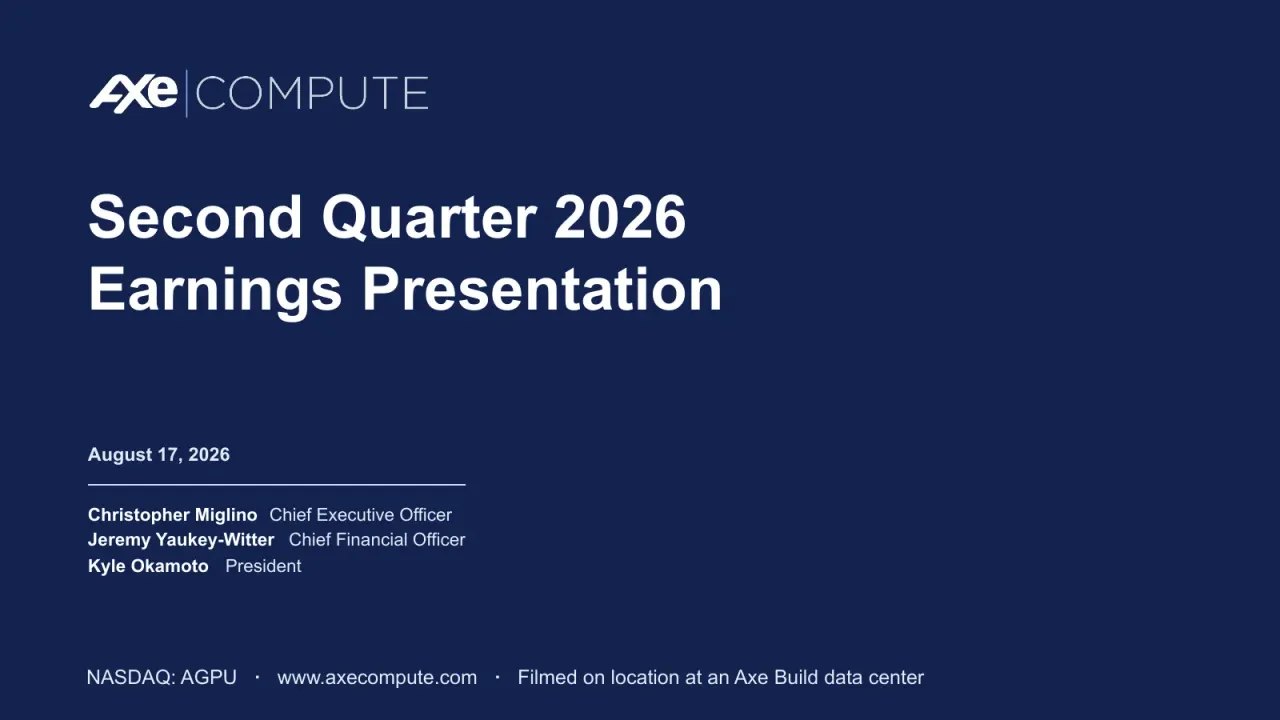
0:00 Good morning, and welcome to Axe Compute's Q2 twenty twenty six Earnings Call and Business Update. I'm Erin McMahon, CMO and Head of Investor Relations at Axe Compute. Joining me today are Christopher Maglino, Chief Executive Officer Jeremy Yaki Witter, Chief Financial Officer and Kyle Ogamoto, President. Today, we're hosting the call live from Columbus, Georgia, home to a data center that is the site of our two ks B300 cluster build we announced back in April that is set to go live in the coming weeks.
0:40 Before we begin, today's remarks include forward looking statements as referenced on Slide two. This presentation contains forward looking statements within the meaning of Safe Harbor provisions of the Private Securities Litigation Reform Act of 1995, including statements regarding signed contracted value, anticipated customer prepayments, deployment timing, annualized run rate, expected margins and profitability, financing structures, potential future contract signings and future performance. These statements are subject to uncertainties that could cause actual results to differ materially, including those described in the Risk Factors section of Axe Compute's most recent annual report on Form 10 ks and subsequent quarterly reports on Form 10 Q filed with the U. S. Securities and Exchange Commission.
1:33 Readers are cautioned not to place undue reliance on forward looking statements, which speak only as of the date of this presentation. Axe Compute undertakes no obligation to update them except as required by law. Financial figures. Quarterly financial figures presented are as reported in the Form 10 Q filed on 08/14/2026. Annualized run rate means annualized monthly recurring revenue upon full deployment of signed contracts. Total contract value, or TCV, is an operating metric representing the aggregate estimated contractual spend under signed customer contracts. ARR and TCV are operating metrics and may not represent revenue recognized in a particular period as separately determined in accordance with U. S. GAAP.
2:25 Signed contracts are subject to deployment, customer acceptance and other risks described in our SEC filings illustrated steady state economics are modeled, derived, blended across signed build contracts and do not constitute guidance.
2:41 Non GAAP measures. This presentation includes adjusted EBITDA, which is a non GAAP financial measure. The company defines adjusted EBITDA as net income loss adjusted to exclude interest expense, income net income tax expense benefit depreciation and amortization stock based compensation expense, fair value adjustments on digital assets. Adjusted EBITDA is not a substitute for net income loss or any other measure of financial performance prepared in accordance with U. S. GAAP and may not be comparable to similarly titled measures used by other companies. Management believes adjusted EBITDA is useful to investors because it provides supplemental measure of the company's core operating performance by excluding the effects of capital structure decisions, such as interest expense and fair value changes related to digital asset holdings, noncash charges such as depreciation, amortization and stock based compensation and tax impacts that can vary significantly between periods across companies.
3:50 Management uses adjusted EBITDA to evaluate the company's performance, compare performance across periods and assist in the allocation of resources. Investors are cautioned that adjusted EBITDA has limitations and is an analytical tool and should not be considered in isolation or as a substitute for analysis of the company's results as reported under U. S. GAAP. A reconciliation of adjusted EBITDA to the most direct comparable U. S. GAAP financial measures is included in this presentation. To the extent that the company provides forward looking adjusted EBITDA guidance connection with this release or related earnings call, a reconciliation of such forward looking non GAAP measures to the most direct comparable U. S. GAAP measure may not be available without unreasonable effort due to an inherent difficulty in forecasting and quantifying certain amounts, including but not limited to fair value adjustments on digital asset holdings, stock based compensation expense and other noncash or nonrecurring items and the timing and magnitude of which may be significant.
5:02 No offer or solicitation. This presentation is for informational purposes only and does not constitute an offer to sell or a solicitation of an offer to buy any securities of Axe Compute or any of its affiliates. No securities are being offered or sold in any jurisdiction where such offer or sale would be unlawful. Third party information. Certain information contained in this presentation has been obtained from third party sources. While Axe Compute believes such information to be reliable, it has not independently verified the accuracy or completeness of such information and makes no representation or warranty expressed or implied as to its accuracy or completeness.
5:47 Please review these statements alongside our SEC filings available via investors.axecompute.com. With that, I'll hand it to our CEO, Christopher Maglino. Good morning, everybody. I'm Chris Maglino, I'm the CEO of Axe Compute. We're here in Georgia. I'm excited to be here. We're getting ready to launch a very large cluster. And for those that are new to the Axe Compute story, Axe Compute is an AI infrastructure platform with two growth engines. Build is our primary engine, which is part of what you're looking at here. We design, deploy, own and operate dedicated GPU clusters for enterprises.
6:33 Then we have AxeSS. AxeSS is the complementary recurring stream, fast access to GPU capacity across many different locations across the world. Think of it like a top of the funnel where we meet companies that are interested in GPUs immediately and then as they grow we can help them we can grow with them. What the market sees for Axe is a new AI infrastructure company. But what the market doesn't realize is that we've been in this business for the past couple of years and our sales team has been selling to the off takers for that entire time. And our supply team has been talking to data centers and engaging with power owners that entire time as well. So while it seems like we're a new kid on the block that has all of a sudden signed all of these transactions, this has been an overnight success that's been in the making for the last two years.
7:34 Before we get into the quarter, I want to spend a couple of minutes on the market we're operating in, because it's the single most important piece of context for everything that Jeremy and Kyle will be walking through later. It's no surprise that we're in the early innings of generation build out of compute. You can't turn on the news without seeing some kind of news about data centers, the growth of data centers, the amount of money that's being attributed to data centers. In fact, McKinsey says that through 2030, they're just going to be spending around $6,700,000,000,000 which I think is a low number even at this point. Of that about $5,200,000,000,000 is attributed specifically to AI capable capacity.
8:24 So I want to be clear what that second number means. It's not a forecast of AI software revenue for like OpenAI or Anthropics, but AI spending on infrastructure. So it's the capital that's required for the physical, the power, the shells, the racks, the GPUs, and that's the market that we're in. That's the market that Axe Compute Inc. So the second thing that we want to point out is the shape of the demand, not just the size. So customers are not asking for generic cloud. They're asking for dedicated capacity. They don't want to just be in a shared location with a lot of people. They want to own a cluster like the one that you see behind me, and they want to own that and be able to engage with it on their own without anybody else interacting with them.
9:21 They'll do that on a long term basis as well. So that will enable us to sign five ten year transactions. And they want a partner that can help them grow into that space. They want a partner that can help them acquire all the equipment, plan the network, design the network, deploy the network and work with the appropriate data centers to get the right power and to get the right building ready for their compute needs. So that's where our build program comes in. And we help these off takers do exactly that. We help them do everything that's necessary to get live inside the data center and then we partner with the right data centers to execute.
10:08 So not all data centers are made alike and we do what we can to make sure that we have the right partners that are helping our clients. So when you hear the numbers, we're about to walk through more than $3,000,000,000 in signed contracts, dollars $696,000,000 in expected annual run rate when we're at full deployment and more than $05,000,000,000 in customer prepayments. I'd encourage you to read them against the backdrop of massive demand. So we're not creating demand. The we're converting market where demand structurally exceeds the supply that's out there. So we're signing all these transactions on a take or pay basis with multi year contracts.
10:59 So with that context, let's turn to what happened this quarter. We had an amazing quarter. If we could accomplish what we did this quarter, every quarter, everybody on this phone call would be beyond ecstatic. As you can see, we're getting ready to launch the first cluster that we talked about a long time ago. This was the first deal that we told everybody about. This is getting ready to go live and it's a beautiful piece of art that's there. Many, many hours of work have gone into bringing this to fruition. But we've really done an amazing job at signing around $3,000,000,000 close to $3,000,000,000 worth of additional agreements when we had anticipated that for the quarter we would be happy to sign an additional $1,000,000,000 worth of transactions.
11:58 So it far exceeded what we had projected. It really did. We really thought that it would be a little bit of a slower ramp. But I'll let you know I'm going to let Kyle talk a little bit more about the pipeline in a little bit, but you'll see that this momentum
12:17 has not stopped at all. So now we went from signing all these transactions, doing all these deals, getting all of the ARR set up for next year. So like next year when these are all deployed, again, $696,000,000 in ARR once they get deployed. Now we're in dual mode. We're in the execution mode. The team is working on putting these together and getting them up and running and managing them, making sure that we have all of the appropriate staff in place to manage these for our clients. So we're really excited about where we sit today from the momentum that we had this quarter. One question we get a lot all the time basically is how are our margin on these build projects?
13:07 So we wanted to give you a slide that would give investors some insight into what that looks like. These are forward looking, but this is our modeling. It gives the best shot of as to where we believe them to be. And we think investors can take a look at these and can utilize them to help them model going forward. As you can see, the gross margins are between 2844% and the EBITDA margins are 62% to 76. So if you apply those against the $3,000,000,000 in announced transactions, you can see that the economics that we're going to be experiencing in 2027 are significant.
13:55 The only other question we get more than the question about the margins on these deals that we're doing is how are we going to fund these projects. So I wanted to walk you through a little bit about how these projects are being funded and how we're working to fund these projects. So you can see that each project has a down payment from the customer. Customer puts anywhere from 20% to 45% of the project costs down upfront. What we then do is we have the ability to go out and seek project financing for that revenue stream. Now when you have a A credit A plus S and P credit client and that client is we're looking for financing for that revenue stream, there's a lot of lenders that are willing to lend against that, especially those lenders that understand the GPU market, which you can see from the news, there's a lot of them. There's a lot of them that have come up, a lot of them that are executing, a lot of them that are investing into the space.
15:15 Our goal is to get that prepayment, find the project financing for each project similar to what happened here, off balance sheet, we don't need to raise capital against it and then execute and deploy the cluster itself. So we think that when people understand that we can get these projects financed in this fashion that's very favorable for the public company. And in the instances where we are looking to invest equity into these transactions, we could do so at a point when the stock is at a price where we deem it to be a good location to actually do a transaction if we wanted to. Otherwise, we can sit back and do project financings against each of these projects and leveraging the good credit of the clients that are building these things with us.
16:20 We have two really big announcements today. The first is that we received the first prepayment of $317,000,000 plus for
16:31 our cluster that we're expanding. And then we've signed an agreement for an additional 55 megawatts over the course of a number of different locations with U. S. Technologies. So we're excited about both of these things. I think these will give you an idea of where the business is going. And in order to talk a little bit more about our partnership with Duos, we've asked the CEO of Duos, Doug Rucker, be with us here today so that we can give you a little bit of an insight of what our expansion will look like into that 55 megawatts. One of the most important things in building data centers is having a good partner.
17:18 And I'm here with Doug Recker from Duos Technologies, who has been a fantastic partner for us. Doug, Thank you for having me. Thanks for being here. And I have to say that very glad that we are doing business with Duos. You guys have literally been an amazing partner in this process. So wanted to thank you for that. I think today, we're excited to announce that we've signed a deal to do an additional 55 megawatts over multiple locations with Duos. So we appreciate that support. Great partnership. We're looking forward to it. I mean, if this location, where we are today, is any indication of how everything else is going to go, I feel very confident in your hands that you will get everything done. So I appreciate your support.
18:12 I mean, what you've accomplished here since we got going is just incredible. It's incredible what we've done under, what, forty five days. If you could literally take the camera and walk around the facility, it's amazing how fast we've implemented this project. And it's kind of a testament of how we work as a company, right? We'll tell you we can do it and we'll deliver. Now we're not going to tell you we're going do 100 megs in three weeks, right? We're not going to say that. But as you can see from our product, this is all under forty five days. Yes. So it's important to, like I think a lot of people that watch this that are very interested in the data center space, but they don't understand all the components that go in and are involved in this process.
19:02 Right? So there's the data center owner, which is you guys, and you're the also the, you know, the operator of the building. And then there's there's all this stuff that we have to get in here, and and that's our role, right, is to get this stuff in here, get it up and running, manage it, manage the install, manage the process. But tell the people that are watching what how your business works, what you guys do and how that results for you guys because you guys are also a public company. It's DUOT, Duos Technologies. So explain how that works so that everybody understands. Sure. So what's great about our business is we've actually been in the business over thirty years, myself, built many data centers, large data centers, and even the modular approach, right? So what we're doing now in our partnership with Axe and what our business model is, is basically deploying modularly.
19:57 So what we'll do is we'll find a facility like this, where there's the building and there's fiber to it, and we'll bring our modular approach to that, which basically is we build our e houses, our chiller plants, everything modules, we'll build it off-site and deliver it, and then we can plug it in in a matter of sixty days, ninety days, even quicker sometimes if you look at this environment. So we've really mastered that approach. We've been doing it for about nine years. Now we're really just focused on basically the five to 25, 30 megawatt range. We're not going go out and build 100 megawatt in one day. We'll do it modularly, and we'll build with the client, kind of like what we're doing with you. So and you guys, when you built this core here, you got everything ready for the next expansion?
20:42 Exactly right. And that's going back to the modular approach, right? So we built a 10 megawatt, but we do the main infrastructure outside to be able to expand. So then we bring another 10 megawatt in of clusters, and we bring that in modular with our e houses and our and our chiller plant and our electrical plant. All that plant and everything is done, and we build it and drop them as we go. So this is going to be interesting when we go to the expansion that's starting right now is how loud it's going to be in here. It's going be a whole different world for everybody that's working in here, It is going to be screaming loud in here. So I think they're going to charge us a little actually for putting that one together. But it is just amazing, isn't it, just to see that a great partnership works in several ways, right? We're the infrastructure side of this house, right? Without the infrastructure, you don't have the operating side. You are the operating partner, and to work together and how we worked in this program together has been amazing. So the communication is key. You guys are masters at what you do, and we're good at what we do. You put those two minds together, and it's unbelievable, and hence, see what's going on now. And I think another exciting thing that we're doing together, and this is, we put this information out today, is our participation with Duos in owning the data centers. So if there's anybody that you want to own
22:12 a data center with,
22:15 it's Doug and his team. And so what we're bringing capital through SPV that is being invested into new buildings, new structures where we know that there's power, we know that we can get natural gas if it's going to be And off the so in these megawatts that we've signed up, we're also participating in the ownership along with Doug. That enables Doug to go a lot further in developing a lot more data centers with less capital, allows us to create an SPV that owns the that participates in financing the buildings, so Doug can build more data centers without having to raise a lot of additional capital. Equity, yes. So it's a perfect partnership. And what that allows us to do is to grow quickly as well.
23:10 So what we're also good at, which we need to talk about, is the infrastructure side on the purchasing. So the key to building at this speed is to make sure that you're ordering the right equipment and getting it in time. And we have a whole other division, the infrastructure division of our business, and that's what we do. So we'll buy our UPSs, our e houses well in advance. We'll buy our generators, and we basically work them in parallel. So with the partnership, that allows us to assets buy now, so when we are ready for the actual build, we do the LEGO blocks immediately, and we're in in one hundred and twenty days, ninety days, sixty days, you know, depending on what the build looks like. When you come in at the 20 megawatt, 30 megawatt range, which is our sweet spot, the 10 to 30, you're actually in a good place. You can deploy quick, you can do it right, you're environmentally friendly, and also you're good for the community. And we can move quicker at that scale.
24:02 Yeah, and it doesn't require this two year build. That's right. Like a lot of stuff that we're looking at now will be deployed by the end of the year into That's the beginning of the first correct. So speed that what's key for your business and key for our business is revenue. So when we procure this product, we want it installed. We want that thing producing revenue. And this is key to our business and your business. We have to get it out. We need that revenue to come in. You've got to everybody wants to be in the data center business right now. Everybody. I get calls all the time. People want to be in the data center business. The first thing I say to them is, I know somebody that's in the data center business, and it is not as easy as you think. It is this is a very complex building process. What you what I've seen happen here is unbelievable.
24:51 Again, if you don't know what you're doing, you're losing your you're losing. It is not going to happen. This is if there's any business where you need to know every detail, it's this business. Sure. And also in this business, you see this, it looks great, and anybody can put a cabinet in and plug power to it. It's actually after it's up is where the expertise needs to come in. They need to be able to manage the facility, know what you're doing. Anybody can build. It's after the build is what is the most important part of the business. Well, again, Doug, I really appreciate the partnership. To with you, and we're looking forward to the future partnership with you. Right. Thank much. Appreciate it. Thank you.
25:39 I'd like to turn the call over to Jeremy. Jeremy is going to give us a breakdown of the financials for the quarter. Jeremy, take it away. Thank you, Chris. I'll start by covering the second quarter results. Then we'll walk through the timeline for when the signed book is expected to translate to recognized revenue. Revenue for the second quarter was $3,200,000 our first full quarter of compute revenue, up from 35,000 in Q1. Bear in mind that all of our compute revenue this quarter came from the access model. Build revenue has not yet started. That begins to go live. Net loss was $17,200,000 driven by $13,100,000 of losses on digital assets, primarily unrealized fair value changes on our Aether holdings that flow through the income statement each period as the token's market price moves.
26:35 We generated $17,400,000 of positive operating cash flow for the first half of twenty twenty six, primarily driven by customer prepayments, which totaled 60,800,000 at June 30. Both figures reflect the strength of our take or pay prepay first contract structure. On the balance sheet, we ended the quarter with $21,900,000 in cash, up from $6,900,000 at the end of Q1. Our digital assets, primarily comprising the EASA token, together with the current portion of our digital asset receivable, totaled approximately $18,800,000 at quarter end. During the quarter, we also made a number of prepayments to third party compute suppliers to reserve compute for signed customer contracts, spanning terms of up to three years, which are reported on the balance sheet as compute prepayments.
27:26 Contract liabilities dominate the other side of the balance sheet as of June 30, including $33,600,000 expected to be recognized as revenue within twelve months and another twenty seven point one million dollars of long term contract liabilities. As a reminder, these contract liabilities represent prepayments made by customers to us in connection with executed contracts for Compute. That brings me to adjusted EBITDA, which we're introducing this quarter. We believe adjusted EBITDA serves as a meaningful performance measure for investors to evaluate our operating performance and to compare the financial results between periods. I want to be specific about what that metric does and doesn't exclude. Adjusted EBITDA adds back interest, income taxes, depreciation, amortization, as well as stock based compensation, standard EBITDA add backs.
28:18 It also excludes the unrealized non cash fair value adjustment on our digital assets, dollars 11,800,000 of the $13,100,000 loss on digital assets this quarter. What it does not exclude is the realized portion about $1,300,000 including ATH we actually used to pay for compute that we sold to customers. On that basis, adjusted EBITDA was approximately negative $4,900,000 for the quarter, about $900,000 of that amount related to our legacy drug discovery service segment. The takeaway, net loss this quarter is dominated by a non cash change in the fair value of our digital asset holdings, which are subject to notable volatility. Adjusted EBITDA strips out that valuation adjustment and the other add backs noted, which management believes do not directly reflect our ongoing operating performance.
29:13 Now, with the second quarter review, let's turn to the quarters ahead and look at when our signed book is expected to begin recognizing revenue. Our business model involves both short and long term contracts with customers. Certain contracts, particularly under our access model, commence service delivery as quickly as forty eight hours after contract execution, while others, particularly under our build model, don't reach ready for service milestones until about four months from contract signing. To model these contracts together,
29:45 we utilize operating metrics including monthly run rate and annualized run rate. A contract only enters our run rate once it's deployed and billing, not when it's signed. And that's the story that this slide tells. Through the end of Q2, we had signed $317,000,000 in total contract value. Our first full quarter of Compute Services, including the $260,000,000 landmark contract we announced in April. Since then, in the first half of Q3, that's about six weeks, we've had an incremental $2,900,000,000 comprising the three build contracts announced in July. Year to date, through August, that's more than $3,200,000,000 in total contract value in under eight months. Here's what that means for run rate. Our exit run rate leaving Q2 was 37,000,000 annualized.
30:34 As the April cluster goes live in Q3, that climbs to roughly 139,000,000, including further growth to date under our access model. And once the full signed book is deployed, spanning Q4 into Q1 of next year, we expect an annualized run rate north of $696,000,000 Q2 is just the start of the ramp. Now that I've given you a glimpse of what's to come, Kyle will show you what's actually going to be deployed behind these numbers.
31:04 Signing contracts is only half the story. Delivering them at this scale is the other half. And that's where Axe earned its margin and returns value to shareholders. Every cluster starts with NVIDIA's best silicon: eight B300 GPUs per node, two eighty eight gigabytes of HBM3E memory on every single one. For our largest builds, we go further, the GB300, NVL72, 72 GPUs and 36 gray CPUs fused into one rack scale Oh,
35:51 every Adjusted EBITDA.
37:58 Per node, 200 Every cluster starts with NVIDIA electricians,
45:06 plumbers, it's definitely a very large effort. So we're going to walk through that today. As I mentioned, all of these computers and chips are all connected together. So the way they do that is each pod or grouping of computers are all connected to an InfiniBand leaf architecture. So it's a spine leaf architecture. These are the leaf switches to that. That. Do that. Then ultimately those are all interconnected together. And That allows each and every single GPU on this network to talk to each other as if they were physically connected to each other.
45:51 It's about 6.4 terabits per second of communication between those GPUs, which is quite a lot of bandwidth. In addition to that, over here, we have high speed storage. Forgive the background noise, as I mentioned. This high speed storage is provided by our partner Weka, who's been a great partner. They have their signature purple facade here on these plates. This high speed storage is connected to each and every single one of these GPUs. So we can move very, very large amounts of data. This cluster is supporting over 20 petabytes of data, which is a lot of different iPhones. I can't do that math right now. But basically, it allows all of the GPUs in here to talk to this high speed storage across that network that I mentioned before on both the North South basis.
46:45 So now I'm going to walk you guys over to another part of the data center. We're walking through cold aisle containments right now that are being built, And you'll see a very similar infrastructure. You'll see all of the different servers of the Blackwell V300s, all connected to the leaf architecture, all connected to the spine architecture. And over here, you'll see a bunch of management nodes. These allow us to do different things from automated provisioning, advanced monitoring, security hardening, setting up VPN, managing different applications for our clients like Kubernetes or Slurm, etcetera. You'll see more purple boxes over here for even more high speed storage. And ultimately, behind all of the cabling activities that's going on right now, you'll see some more traditional servers here, right? You'll see the Dell boxes here that we're using for some of our bridges and some of our management capabilities.
47:40 And ultimately, what these components do, they each play their role, right? So there's UFM nodes, there's OOB connectivity for different management capabilities. All of this ties together with what we call an NVIDIA reference architecture or NVIDIA reference design, right? So full NVIDIA switching throughout, full NVIDIA GPUs throughout with accoutrements that allow us to add ancillary services to our clients. And that's basically it. So thank you guys for coming with us to Columbus, Georgia. We've got a lot of work to do from containment aisle finishing up tomorrow to all of the cabling happening now to get this cluster live as soon as possible. We look forward to the next one, as you can see behind me, and we fully intend to expand. And this is the space that we are expanding this cluster into.
48:29 So it will be one contiguous single spine architecture, three times the size. So while the cluster that I mentioned is already quite large and quite powerful, it will triple up in the next few months. Now let's shift gears to what's coming ahead. As of this month, we are tracking $5,900,000,000 in active qualified pipeline, 98 open opportunities across our sales organization. That's nearly double the size of our current signed book. And every week, it keeps growing as momentum continues to accelerate. By dollar value, roughly two thirds of that demand is for Blackwell class GPUs or Vera Rubins. We're talking about B200s, B300s, GV300s and of course the latest Vera Rubin chipset.
49:15 Our customers aren't asking for yesterday's hardware. They're asking for the newest, fastest, most powerful silicon NVIDIA makes to really power their businesses for the future, not just for the current needs. Also worth noting, clients understand that securing AI infrastructure on a long term basis is a vital and strategic imperative for their business, which aligns nicely with our equipment ownership model and long term data center investments. And keep watching this space. We're already fielding significant early demand for NVIDIA's Vera Rubin, the next architecture, ahead of volume shipments. So our customers are already planning generations ahead and so are we. A pipeline this size really isn't a hope, right? It's a queue. And our job for the rest of this year and beyond is pretty simple, convert that queue, contract that queue and turn up additional clusters for our clients.
50:09 So that's really the way we've converted the $3,000,000,000 that you just heard about. And as Chris has said to me multiple times, there's many more ahead. Shifting gears to the organization. None of contracts, the technology, the pipeline means anything without the people who build it, which are the most important part of Axe Compute. So let's talk about the team a little bit. Right now, we are actively adding more than 20 people to this organization, And every one of those hires is funded by a contract we've already signed. On deployment and operations, we're increasing our data center engineers, cluster commissioning specialists, our 20 fourseven operations staff, all in advance of standing up these clusters going live this quarter and next. And that's all under dedicated VP level deployment leadership.
50:58 On the infrastructure engineering side, we're adding GPU, CPU, network fabric, storage specialists, the people who really make five, fifteen and thirty megawatt AI factories actually work across both our U. S. And European footprint. On customer support and commercial operations, we're really enhancing our technical account teams, our program management organization and broadening our enterprise coverage behind those signed contracts and that multibillion dollar pipeline. And behind our next objective, an additional $2,000,000,000 in new signings before the end of the year. Our philosophy is pretty simple. We don't staff up on hope. We scale fast to deliver on commitments, locked and loaded, and we hire experienced talent that can really deliver and execute on enterprise grade support, while still providing customers the choices that they deserve.
51:49 Headcount follows committed revenue on a very disciplined and success basis. That discipline is pretty much what turns a hot pipeline into a durable profitable company, and it's exactly where and why we're built to deliver on everything that you've just heard. I'll now pass it back to Chris to close this out. Thanks. So where do we go from here? Our objective is an additional $2,000,000,000 in signed contracts before the end of twenty twenty six. And as you can see from what Kyle just presented, I don't think we're going to have a problem hitting that number. We're well on our way. And if things keep going the way that they did in this last quarter, we should exceed that goal. So we're excited about that.
52:36 Then just to summarize the quarter. This is the first quarter that we had revenue from the Compute business. And you're just going to see that acceleration continue to kick in as we bring more clusters live. So as this cluster goes live, you're going to start to see around $20,000,000 $21,000,000 a quarter just from this location come in. And then as we bring on the other clusters into the end of Q4 and the beginning of Q1, you'll start to see us grow up to the $696,000,000 in ARR for the year. So our job for the balance of this year is to continue to sign more agreements, but also to make sure that we have the infrastructure in place to deploy really solid amazing clusters globally.
53:33 So we appreciate you being with us here today to hear our story. We're excited about where we are. We're working really hard. And we're we think that we find ourselves in a really positive place. So thank you for being here and spending the time with us. We look forward to continuing to have you as an investor. And if you're new to our story, we continue we look forward to you having you join us on this journey. So thank you very much.
Follow Axe Compute Inc. into a list and get an email when it puts out news.
CMO and Head of Investor Relations
Chief Executive Officer
Chief Executive Officer, Duos Technologies
Chief Financial Officer
President