Henrique Marques
Analyst, Goldman Sachs
Replay available
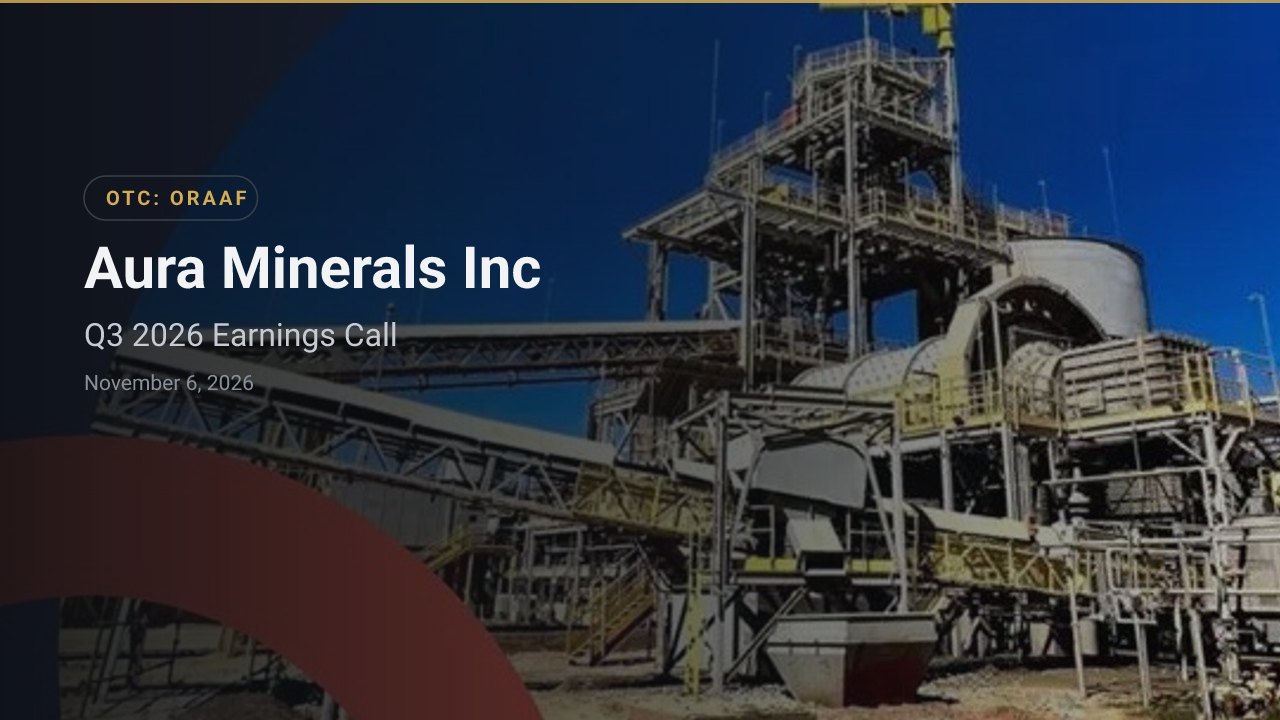
Aura Minerals (NASDAQ:AUGO) Q3 2026 earnings call, held 2026-11-06. Watch the replay and read the transcript on 6ix.
On 6ix: 6ix.com/event/aura-minerals-inc-oraaf-q3-2026-earnings-call
Automated transcript · Written by software from the replay's audio. It can mishear names and figures; the replay is the record.
0:00 Good morning ladies and gentlemen, welcome to the third quarter 2026 earnings call. This conference is being recorded and the replay will be available at the company's website at eurominerals.com slash investidores. The presentation will also be available for download. This call is also available in Portuguese. To access, you can press the globe icon on the lower right side of your Zoom screen and then choose to enter the Portuguese room. After that, select Mute Originate Audio. We would like to inform that all attendees will be only listening to the conference during the presentation and then we will start the question and answer sections when further instructions will be provided.
1:06 Before proceeding, we would like to clarify that any statements that may be made during this conference call regarding the company's business prospects, operational and financial projections and goals are the beliefs and assumptions of our Executive Board and the current information available to the company. These statements may involve risks and uncertainties as they relate to future events and therefore depend on circumstances that may or may not occur. Investors should be aware of events related to the macroeconomic scenario and industry and other factors that could cause results to differ materially from those expressed in the respective forward-looking statements.
1:55 Present at this conference we have Rodrigo Barbosa, President and CAO, Kleber Cardoso, CFO and Glauber Luvizotto, COO. Now I turn the conference over to Rodrigo Barbosa. You may begin the conference.
2:15 Thank you very much for all participating in this earnings call for the third quarter. Good morning all. And before I get started, just a quick reminder that you have here in your screen, scan the QR code. We have our Aura Day happening in New York at NASDAQ on October 30th afternoon. We'll have an important updates about how we are running the operations. We're gonna have important updates about the turnaround on MSG, how we are developing Era Dourada. Then we are also thinking and doing now this year a zero-based budget. We're going to walk you through how we are planning the budget also for next year. There's also the transition of the mine fleeting sources that we recently announced. So there will be several updates, including important advancements, exploration that we would like to share with the market on October 30th. So please put in your agenda and if you have availability, be there with us. That will be an important opportunity to have a more broad conversation and deep conversation about how Aura is performing and how we will perform on the next three to five years.
3:30 Let's get started. If I could put the first slide in terms of the production and results. As a quick summary, and as we all do at the same time, same structure, I'm going to go through the main results and how major events that happened during the third quarter, and then Kleber is going to go more in detail about our results and cash flows. So as we disclose to the market, we had an important Improvement in operations as I mentioned in the last quarter. First and second quarter was the weaker of the year and we could see that production was pushed towards the second semester. So this is an important improvement on Q3 and we project another improvement to Q4. So we should continue to grow in terms of production as we are now reaching higher grades or higher productivity.
4:22 in most of our mines. So we reached the production of 96,000 gold equivalent ounces. This is a 27% increase compared to the last quarter. I'm gonna walk you through mine by mine the two slides ahead so we can understand what is going on and project what can happen on the fourth quarter. So when we see the nine month, it's 253,000 ounces gold equivalent that we reiterate our guidance. to be between 340 and 390,000 ounces until the end of the year. This higher production means also the record high, slightly above the first quarter of this year's $386 million in revenues, another 15% improvement quarter by quarter. That also translated and EBITDA, $237 million.
5:17 When we see the last 12 months, the last nine months of EBITDA, it's $677 million. This is already above what we performed the full year of 25. And if you look at the last 12 months, it's $886 million. Understanding that in the fourth quarter, we should have an improvement in terms of our production. In terms of our in-sustaining cash costs, we are now at 19%. 153 Now we start to have improvements on MSG. There are also improvements that I'm going to walk you through that's going to happen on the other operations. So although if you compare to the guidance of this year, you're going to see that we are above the guidance, but the improvements that we see happening in the fourth quarter give us a comfortable zone to meet the guidance for the full year in terms of our in-sustaining cash costs. Recurring free cash flow is strong, $124 million.
6:14 and many more. Thank you. Develop Greenfield Projects, Invest in Exploration to Extend Life of Mine, and do M&As while keeping an important dividend yield and low leverage. So this is another quarter that we show the market that this is possible due to the very high return, the strong cash flows we have from our operations. We also declared another strong dividend, $0.72 per share. And when we add that with the $10 million of buyback that happened during Q3, it's a yield of 4% on the last 12 months. We continue to be one of the highest dividend yield in the industry while we are growing.
7:09 Additional important events, and I'm going to have a slide about this. I don't want to give details now, but at another project, On time, on budget, developing according to the plan. Kleber also, we raised additional $200 million of syndicated loan that happened during this quarter and improved our cash position above $400 million. We also announced the mine fleet in sources that will provide us an important opportunity to continue to reduce are all in sustaining cash costs and control inflation bravely. The inflation, as we will walk you through the industry, all in sustaining cash costs is going up. We are going up slightly, but yet way below the average of the industry, which put us in the first semester of this year as on the first quartile in terms of all in sustaining cash costs. Important event also is capital world with investors.
8:08 continued to buy more shares on Aura during the third quarter and reached recently about 10% of all the capital structure of Aura. So now they have 10.2% of the Aura shares. Next slide. In terms of safety, we had no lost time incident during quarters, a very important another quarter without any lost time incident. I always mentioned that it's important to combine, always not important to combine, but strong results comes along with also strong Incidents and low incidence level. Important also that as we are implementing artificial intelligence all over our company, there's also important improvements that we are doing on safety standards going through artificial intelligence so that we gather more information and start acting way above when we predictively So we can predict when and where the next event can happen or incident can happen and prevent that.
9:14 So that's all the team is working on to have these advanced tools so that we can improve even further our safety standards. In terms of stability of structures, all of them has been gone through due diligence and inspections and all of that are under the safety levels. and according to the Brazilian regulations and all the international regulations. On the left side of this slide, I would highlight the continuous growth that we've been growing since Q3 25th, actually since Q2 25th on the last 12 months. So now we are performing 335,000 ounces of production on the last 12 months, as you can see record high production on Q3. while we continue to see improvements that's happening on a Q4 that will replace the Q4 last year with 82,000 ounces with a stronger so that will continue to be important upward trends in terms of production for our minerals.
10:13 And when we go mind by mind, we had a going from the bottom to the upper important improvement in Aranjo Azul. We could see that the higher grades would come during the second semester. Management's also working. In higher throughput so improving also the plant the combination of higher grades and better performance lead us to a higher production and small part of this is also unfortunately due to the lower gold prices than in the higher copper price so that conversion happens and then it's favorable but most of the improvement comes from productivity and grades Apoena, we saw a slight improvement on Q3, and again, Q4 is the quarter that we're going to have a very strong production on Apoena. In Arenas Azul, we should continue to see small improvements for Q4. Apoena will see a significant improvement in terms of production on Q4. This is just about grades that we are already reaching on the pit that we're going to go through the plant. Minossa, as I mentioned to the investors on last quarter, we had some challenges on piling and stacking.
11:28 during Q2 that we know that the lag, it's a leaching pattern, so the lag of why you stack and produce happens to have 30, 40, 60 days, so we knew that the production would decrease during Q3, and now we know that's going to increase during Q4 because all the challenges has been overcome, and now we are stacking as we projected even a little bit above our projected, so that will result in an improved Production on Q4. Almas, we knew also that we were hitting lower grades. The mind plan is not, as I mentioned, gold. We are now sometimes in very thin veins or straight veins, and grades goes up, grades goes down.
12:14 So it's normal for you to have stronger and weaker quarter. What cannot be is not predictable, right? So we know that the Q3 would be weaker, and now we know that Q4 can also be slightly better than Q3. Borborema? That's how, again, we hit strong grades now. So now we have already implemented two new filters, de-bottlenecking the plants. So we should continue to see strong production in Borborema during Q4. MSG, the turnaround is still going on, but it's important to see the first signs of what we were talking about the gain in productivity and gain in production once you invert the top down to bottom up and put more and develop more on the ground.
13:06 So we are now starting to have a small percentage of ore coming from underground on the methodology bottom up. So that improves the grades of the plant. And then you on Q4 will gradually improve because then we mix low grade that is on the top as an open pit. with a higher grade underground and as we go and turn around as we advance on the development of the underground tunnels we will be more gradually to more and more increase the underground ore which will increase average grades to the clad and also management has been doing Significant cost savings, cost restructurings, and also the bottlenecking the plant so that we can gain even more efficiency for next year, putting us in the position to be able to produce close to 80,000 ounces and close to $2,000 per ounce of in-sustaining cash costs.
14:10 So in terms of all-win sustaining cash costs, we had a slightly decrease from Q2 to Q3 that came mostly by MSG that showed some significant improvements. Also, Aranjo Azul going through higher grades. If it were not the MSG, all-win sustaining cash costs would be at 1,673. which is already the first quartile in the industry, although yet we see room to improve. When we look at the next quarter, we will have improvement in MSG, Aranjo Azul will continue to perform well, we will see a significant improvement in Apoena, good improvement in Minossa, Almas slight improvement due to the higher grades, Borborema stable to the fourth quarter, perhaps lower cash cost as well, So we will see fourth quarter coming down in terms of how we're sustaining cash costs, putting us on the comfort position to meet the guidance, perhaps closer to the top end of the guidance, but yet in the guidance. And I would also highlight that When we projected the guidance, the exchange rate was different than what happened during the nine months.
15:23 For Brazil, that's more important. It was 5.5, while the performance was close to 5. Now we are back to 5.5. So only this is $80 per ounce in terms of unsustaining cash costs. If we were... and the same exchange rate of their budget. So during the fourth quarter, we have improvements in grades, improvements in performance and also a better exchange rate in Brazil. Era Dorada, we already reached over 13% of physical progress. The earth moving of the operational plateau is completed. We started the civil works and as we can see on the picture in the middle, the CIL tanks start to be built. On the right side, all the infrastructure for cooling the underground as we are advancing on the underground, it will be more and more important gradually to improve The infrastructure and also cooling machines in order to keep the temperature low. This is a geothermal area that has and we are pumping already water out of the underground while cooling so that we created the right environment for everybody to work. On the left side, on the pictures, we continue to have a very strong support from the community.
16:50 It's now over 1500 hours of dialogue with the community members, constant dialogue, open table with each of them. We have a Era Dourada house at the main city that people can come and make questions. So it's a full transparency project. We're hiring local people. We're motivating new suppliers to form, we think, very close to the operations. And while we are investing on the purified water to provide them first municipality in Guatemala to have access to purified water will be the communities around Aradourada once we finish the investment along next year, then we'll be able to provide purified water to the communities. and the Geothermal Plant. We continue to advance on the engineering.
17:38 We are now looking for potential partners to invest in geothermal with us that can bring the know-how and operate and do the partnership with water. So this project will be fully sustainable with renewable energy. Renewable Water, and also a very strong community relations and focusing on hiring and training local people. We now have 795 people employed as of September, 89% are Guatemalan, understanding that during the construction sometimes you have a very specialized skills, do it for the underground development and also for building the plants, and that we should increase, gradually increase this percentage hiring local people.
18:29 MSG, again, a very important first quarter with just the beginning of the results of the turnaround. We already generated $24 million on EBITDA. and we continue to do advanced development on the underground activities so that we now can gradually invert top down to bottom up and mix more high grade from underground instead of a low grade that is on the top. So we'll see improvements going to the Q4 and of course major improvements going to come during 2017. We will go through in more detail on our day. Please participate and go directly there in New York or see the video or see the live video that we will walk you through.
19:23 Major achievements happening also in safety standards. So there'll be important updates in the exploration. So please attend that we can walk you through what's going on in MSG that can become vary and has the potential and will become a very important mine for our aminers from 27 and so on. With that, I turn the floor to Kleber to walk you through all the financial results.
19:52 Thank you, Rodrigo. Good morning, everyone. We're going to start, as we always do, with a summary of the main financial KPIs for the reporting quarter, for the previous quarters and accumulated last 12 months at the end of each reporting period. Starting with the net revenues, we're reporting net revenues of $306 billion is a record high that we're reporting for a single quarter. That's driven by the increase of production that Rodrigo was showing. And when we look into the last 12 months, our revenues are exceeding $1.4 billion. and we see there has been a steady progress quarter over quarter aligned with our growth story. When we go to Adjust EBITDA, it's a similar story. We're reporting a strong EBITDA, $237 million at this quarter, also driven by the increase in production.
20:49 The last 12 months now, it's $886 million and is already the 13th increase in a row of our last 12 months EBITDA, again, consistent with our growth story. Moving to the bottom of the page, in terms of net income, our net income this quarter, $135 million, coming down from previous quarter. But that's mainly because on the previous quarter, we had no cash, no recurring gain related to the gold hedges because of the decrease of gold prices during the second quarter. If we exclude that non-cash gain, which was much smaller this quarter, I'm going to show later, we see also an increase in net income.
21:37 On the bottom of the page, we see we're coming from $97 million. Adjusted net income on Q2 to $120 million now on Q3, consistent with what we see increasing EBITDA. And in terms of cash and debt, we remain in a very comfortable position in terms of cash and balance sheets. Our net debt basically stable throughout the quarter ending close to $180 million by the end of Q3. Our financial leverage also basically stable in a couple of quarters already at 0.2 times net debt over EBITDA. And we see a significant improvements in our cash balance and cash position now close to $420 million at the end of the quarter.
22:24 With the proceeds of the syndicated loan that we closed in September, $200 million, and now we're in a good position to continue funding the growth of the company, especially Era Dourada from now on. Now looking at the main items that explain the adjusted net income in the quarter. Out of the $237 million that was the highlights, we saw It was very strong in terms of production. Barborema is our lowest cash cost as well, so contributing with $7 million in EBITDA.
23:09 Aranza Azul, also a very strong performance on Q3, combined with favorable corporate prices, adding another $60 million. Always also coming strong, Almas and Minoza for $135 million. And we highlight as well as Rodrigo mentioned, MSG already reporting $24 million EBITDA in the quarter is still in the turnaround phase. Moving to the next items we see depreciation amortization 30 million dollars basically consistent with our expectation if we compare to same period of last year there is a important increase but that's mainly related to the growth of the company so the same period of last year we didn't have MSG, Borborema was not in commercial production yet so not depreciating so that explains the increase in depreciation Financial expenses, we would highlight, as I mentioned before, the no cash gain with the market-to-market of the gold hedge. It was much smaller this quarter, it was only $13 million.
24:14 And we had realized losses with gold hedges. We paid $34 million for the gold colors that were settled and paid during Q3. From now on, if you take November, from November 26 to June 2028, we still have about 141,000 ounces in gold colors that is going to expire remotely now until mid of 2028. Income tax expense is pretty much consistent with the results of our operations. Then we had some smaller items in other incoming provisions. bringing the net income to $135 million. And then here on the right side of the page, the conciliation that we always show excluding some non-cash items, mainly the unrealized gain, in this case, OE for the gold hedges, bringing our adjusted net income to $121 million at the end of the quarter.
25:09 And now here we have all the details that explains the change in cash position throughout the quarter. So we see on the left side of the page, we start with $248 million in cash at the beginning of the quarter. On this left half of the page is what we call the recurring free cash flow to firm, which is a free cash flow to firm generated by the six minus in production, not including the investment for growth. Not including what we paid for the hedges, we show $158 million on the top of these pages. Those six miners that generated $158 million in recurring free cash flow. Deducting $34 million that we paid in hedges comes to the $124 million recurring free cash flow that we're reporting, although the realized losses we had is including the recurring free cash flow.
26:06 We remind you that it expires in the middle of 2028, so that's going to go away after 2028. Then here in the middle of the page, we see investment for growth $63 million, mainly expansion of CapEx and now mainly is sketching up, ramping up the investments, cash out investments in Era Dourada. And to the right side is more the financial like items, mainly the proceeds, net proceeds from that. We received $200 million from the syndicated loan and some debt amortization. So we have net proceeds of $182 million. Dividends and share repurchase, $71 million in Q3. And then Rodrigo highlighted at the beginning, if you take the $158 million recurring free cash flow that was generated for the quarter that paid both for the losses with the hedges, also the dividends and share buybacks and also paid entirely for the expansion of CapEx we had in the quarter.
27:14 So with this we end the presentation and I'll answer your questions. Thank you. We are going to start the question and answer section for investors and analysts. If you wish to ask a question, please press the button Reaction and then click on Raise Hand. If your question has already been answered, you can leave the queue by clicking on Put Hand Down. Our first question comes from Mr. Marcelo Arazi from BTG Pactual. Mr. Marcelo, you may proceed.
28:04 Hi guys, thanks for the space here. Two questions on my side. So the first one on Era Dourada, it was very nice to see that the project has been Thank you very much. which remains a major concern for a few investors that we normally talk to. And if I could make a second one about the fleet insourcing announcement, So a few questions here as well. So how quickly should these benefits materialize next year? What are the main risks associated with bringing those operations in-house?
29:01 And what was actually the final trigger for Aura to decide and make this change? Thank you, guys.
29:09 Thank you, Marcelo. I can start answering here a little quick and then I'll ask Glauber. that can give you more details about next steps in Era Dourada and also how he sees the insource of the mine fleet upcoming on the next year with the potential also savings. The geothermal plant is something that will come along the next few years. We will not start construction anytime soon. We still need to partner and find the right partner and do the right feasibility study engineering. So that will probably go into production after two or three years of operations.
29:56 In the meanwhile, we have other alternatives to supply and the power. And if we were mentioning about the potential high temperature underground, Glauber can also walk you through That's not usual conditions to have the few other mines in the world that run actually even in the worst conditions. It's a matter of calculating and do the proper underground infrastructure, pumping hot water and also bringing a cool air down. But Glauber can walk you through more on the day of this situation, plus what he sees coming up in the next 12 months.
30:44 Good morning. As Rodrigo said, we are in terms of construction and preparation of the mine that we call the pre-operation. We are on track for that. It's a lot of challenges from the hydrothermal water, but we have the support from the The specialists and also a very robust plan to offset that point. Right now, everything that we found is as we expected, but we are still, we are just in the beginning. Also, we are pumping the water because the key point is we should pump the water in advance.
31:30 We should... Go down with the table water to make sure that the moment that we assess that region, there is no more hot water in that region and the rocks have had time to refresh. So it's what we are doing right now. So the pumps are under construction and we are using some old, the wells are under preparation. We are using some old ones. We are being able to reduce the table water and doing all the mining development on time. But in parallel, all the infrastructure that we have, like the refrigeration plant and all the other stuff, it's already on site, under commission.
32:17 And I think that the main milestone in the next 12 months from the construction side We have the main equipment to arrive on site, the mill and all the other equipment. And also put the mining development in the run rate. So we are considering, right now we have a contractor doing the underground development. We are considering as well to have part of the work made by us. So we already bought some equipment that are on time to be delivered in the end of this month and beginning of the next month.
33:02 And we have also some contingence plan to bring to the region some experts because the main point is find people with experience in the underground that there isn't much in Guatemala But we are considering, we are doing a task force to train and prepare people and have some experts to, mainly in this beginning, to put the mine on track. And the other question from the insurers, the key point is that we are seeing a lot of adjustment in the cost when we We went to the market to make an assessment about the price and cost to do that primary, to do that by contractor.
33:55 The costs are being significantly higher than we are practicing. And also we feel that we are prepared to, considering the maturity that we have in the operations, we are prepared to assume this is another possibility Part of the work. But the process right now, we are in the transition to creating the company that will assume all the assets from the contractor. We have the gate to be approved on CAD. Once we have that in the beginning of next year, it should be fully aura. Right now we are in the transition phase. Everything is going well.
34:42 We expected to be more efficient, mainly doing the property maintenance to make sure that we have the reliability in the fleet. So I think that we can increase the productivity from the equipment and we can also see the impact in our cost. So for next year, In terms of a win cost, we have seen some reduction in the three mines, but most part of the disembourse for the equity that we are paying will be next year. Once we face it, in accordance with you, we are advancing in the contract that we did. So it's going on track.
35:34 Thank you.
35:35 Thank you, Glauber. Thank you, Rodrigo. Very complete answer. Our next question comes from Mr. Lawson Winder from Bank of America Securities Mr. Lawson, you may proceed
35:52 Thanks very much, Natasha. And hello, Rodrigo and team. Thanks for the presentation today. Nice quarter. If I could ask about MSG, I think that would be a very helpful place to start, particularly in thinking about the growth trajectory into 2026. So what specifically changed underground at MSG during Q3 in development meters, stope availability, mining flexibility? and then what still needs to be completed before you consider the turnaround finished. And then all-in sustaining costs were, well, I mean, very high in the quarter. What's your latest thinking on where all-in sustaining costs can go on a run rate basis for MSG?
36:37 Well, I'll let Glauber to answer, but we see always sustaining cash costs going close to $2,000 per house and production at $80,000 per year, probably next year. But Glauber can go into details how he sees the progress on Q3 and project to you what can expect in Q4 and most important, next year.
37:06 Yeah, the key point there is the performance in mining development. So we have a combination of two things. So when we assume MSG is a backlog in mining development, in mining preparation, and we also decide to do the change in the mining method that require much more development in advance to go to the bottom of the panel and start to mine bottom up. We're still in preparation, so we have some areas in production already, but not fully capacity in the underground mining. It will take, I think, four or five months more to have the mine fully prepared and the reserve released in the time that is required.
37:59 In parallel, a bunch of change has been made, so we are improving the quality in the method that we mine, reduce dilution, increase mining recovery, and also review all the contracts with significant reduction in our costs. We can't see right now how those changes will reflect because we are not in the in the full capacity. So I can say that we are spending more in development proportionally with what we are producing. So once we increase production, we do not keep the same level of mine development because once we achieve the stabilization in the mine, we can back for the normal profile of mine development.
38:58 but we are be able to feed the plant with more ore from the underground because right now almost 50% of the ore came from some lower grade stockpiles from the surface because we are preparing the mine but once we are putting much more room of mine in the plant with better grades the production will increase and also we will be able to stabilize the mining development in the underground and the combination of those can give us the production close to the 80,000 ounces per year and the cash cost or the all-in sustained cost should reduce significantly.
39:42 And again, an hour a day will provide a full detail on what is being done in MSG including all the physical measurements, the speed, how we are. The savings, Glauber mentioned, we have important savings that can go in a few areas, 30, 40%. So I think it will be important to invite everybody to be there and see. We also bring the manager of MSG so that we can interact directly also with him.
40:16 Yeah, fantastic. I mean, it's nice to see MSG improving substantially in Q3. If I could ask one more question, it would probably be on the reserve and resource update and your expectations around that globally for the entire firm, whether you anticipate replacing reserves this year, Mind. But then just particularly with respect to Apawena and Minosa, your two really short mine lives, are you starting to see the potential to drive material expansion in mine life there?
40:49 We will share what we've been finding during the hour a day. Apoena, yes, there are several. Now we are open more. We are focusing a lot on the near mine. We open a little bit, 20 kilometers, 30 kilometers, so finding very interesting interceptions that we are now finalizing all the results and be able to publish them then before the hour a day. Honduras it's still an unknown so this is where Minas is where we are less optimistic about extending life of mine but Apuena yes there will be important improvements we believe okay that's very helpful thank you thank you Rodrigo and thank you Glauber our next question comes from Mr. Rabih Nizami from National Bank of Canada please Mr. Rabih you may proceed Rob, if you're talking, I think you are on mute.
42:00 Yeah, maybe he has some connection problems. Let's go to the next one and then we'll still reserve a room for him. Our next question comes from Mr. Matheus Moreira from . Please, Mr. Matheus, you may proceed.
42:21 Yeah, well, thank you. Good morning, everyone. Thank you, Rodrigo and team for taking my questions. Two on my side. First on CapEx, I mean, it caught our attention here that you're tracking well below your growth CapEx guidance for this year with a little bit over $130 million this birth year to date. Well, the Low range of your guidance is of $260 million, right? So I'm just wondering, how should we think of these CapEx for the fourth quarter specifically? Do you still expect to reach your guidance? Or should we see some spill out towards 2027? And does this somehow impact your timeline for Ferreira Dourada? That's my first question. And then I ask my second one.
43:04 Okay, there's no, no, nothing is going different from the schedule, but Kleber can walk you through why you see this capex lower than the guidance of the year so far.
43:18 Yeah, Matheus, at the expansion of CAPEX, we have opportunities to be closer to the low end of the guidance or even below. That's mainly because that's actually good news. It's a negotiation that has been done with providers of equipment, for example, for the project. So we're negotiating lower down payments, so that improves our cash position at the moment. But then in terms of whatever we don't spend this year, to your question, yes, that would move to 2027. The capex for the project itself wouldn't change. It's just a matter of having more working capital, like, let's say, now in 2026, because of these negotiations that we're doing in the country.
44:08 Great. That's very clear, Kleber. Thanks for that. Maybe, if I may, a second quick question on MSG as actually a follow-up. I mean, it was encouraging to see the operational performance in the quarter, right, which was much better than we were expecting. Still, I believe, far from the operational conditions Aura wants to achieve, but definitely on track. I noticed that your production improved materially quarter on quarter also because of higher throughput rates and this in turn was also benefited by some material you recovered from the east pile, right? So I'm just wondering if you could provide more details on this stockpile, how big it is, what are the average grades and when do you expect it to run out?
44:55 I think you also mentioned a bit in the beginning that As underground mining activities improves, you will rely less on these stockpiles, right? But I just wanted to get a sense on how big and how relevant this stockpile can be. Thank you.
45:13 Glauber, go ahead.
45:16 The stockpile is not the most relevant part of the plan to recover the production. So it's just to complement or to keep the plant fully feed. Once we weren't able to feed with more ore from the underground mine. But the focus is mainly to put the mine in operation, to bottleneck the mine and get some reserves released in advance to make sure that we can feed the plant with room of mine that is the highest grade that we have. Because the stockpile is in marginal ore that Thank you very much, Rodrigo and Glauber.
46:27 Our next question comes from Mr. Habib Nizami from National Bank of Canada. Mr. Habib, you may proceed.
46:37 Thanks, Sasha. Can you hear me now?
46:39 Yes, loud and clear.
46:41 Okay, thanks, Dean, for taking my questions and apologies for that audio issue earlier. So a couple of my questions have been answered, but I'll move on to a few more. So on the CapEx run rate, you already answered that, but specifically looking at AeroGorada, how do you expect the cadence of CapEx spend of that asset to proceed into Q4 and into next year? I'll let you answer that first, and then we'll move on to the next one.
47:08 Yeah, Kleber, go ahead.
47:12 Sorry, Robby, can you repeat the question?
47:15 How do you expect this to increase on Q4 and then next year?
47:21 Yeah, so in Q4, you should see an important increase. So that's normal. If you look at Barborema and Almas, it was the same. The first few years and first quarter is much lower than ramping up as you start hiring people and capitalizing pre-operational expenses and also receiving the equipment. So in Q4 is expected to have a significant increase. So we are expecting to move towards the low end of our expansion capital for this year. and then for 2027 we expect to expand the models to complete the project so we're expecting to to to to complete our budget so there'll be no see if there is a saving in 26 that's going to become additional companies in 27. okay thank you for that and then um
48:16 On Borborema, should we still expect an expansion study and a board decision by year-end? What's your meaning there on engineering, water supply, anything else there to talk about in terms of timing?
48:30 Glauber, if you want to answer, go ahead.
48:33 Yeah, we are finalizing the study, so we expect to publish it to the end of this year. Yeah, the main point is make sure that we have the best arrangement for the plant and how can we do the position and the expansion without impacting the production that is in the run rate. And also the water, we have some alternatives. We are just finalizing the trade-offs that we have between the options and the costs of each one and the risks for each other. Yeah, we should be ready to publish it to the end of this year.
49:15 And then in the meanwhile, as we do with all our minds, as you see almost rebuilt, then we started generating cash, then we started doing more exploration. And we are doing the same with Borborema. We started generating cash last year. We started doing more investment exploration, geophysical, rounds, drills. And there is important and interesting information that we will share during our day in Borborema ahead of the feasibility study.
49:52 Thank you for that. Just in the short term, I'm looking at the strip pressure of Borborema in Q3 at 4.6. Is there any guidance you can give us at this time with respect to how that evolves into Q4 and into next year?
50:10 Yeah, we operate in the beginning. Once the mine was open, when we assumed, so they have the best work that they did. The strip rate was lower, but we should run much more close to what was the Q3. But it's a little bit higher for next year once we should achieve the average strip rate for the mine. So it shouldn't be that low as it was in the first semester of this year, but it should be close to what we have in the Q3 and what we expect for Q3. before and next year or more.
50:55 Thank you, Glauber. I'll just ask one quick one and then I'll sign off. Kleber, you discussed FX rates a bit with your guidance being set at 5.5 and recently that's turned more in your favor. Could you just comment on fuel prices as well going forward? How does that affect your costs and what should we think about going into Q4 next year? And with that, I'll sign off. Thank you.
51:22 Go ahead, Kleber.
51:24 Yeah, so FIIL is impacting us like everyone else, you know, but it's not a significant portion of our costs. It's, depending on the operation, can be between 5% or 8% of the cost matrix. So it's not negligible, but it's not that high. So FX, for example, Rodrigo was commenting also, The average for the year is being close to 5 reais and 10 cents and our guidance was for 550, for example, last year as well. So, in fact, has been the main impact. But yes, we're feeling some cost pressure, but that has not been the main impact in our numbers.
52:16 Gotcha, thank you very much for taking my questions and I'll see you at Aura Day in December. Thank you. Our next question comes from Mr. Guilherme Nippis from Shispe Inc. Hi guys, can you hear me?
52:37 Yes.
52:40 Thank you for the opportunity. I have two questions here as well. My first one is on capital allocation. Now with the balance sheet carrying very low leverage and of course there are Are you guys still looking at copper and gold opportunities or for now you're holding and seeing what happens next? And how do you see the mix of M&A and cash returns for shareholders as well? and my second one is on the mining fleet and sourcing. If you guys also see other potential initiatives to reduce costs and all in and as you already did with the mining fleet at Apoena, Almazen, Boboran. Those are my two questions, thank you.
53:35 In terms of M&As, we continue to see opportunities, we continue to invest time understanding what are the interesting M&As to do, invest time trying to do transactions, so M&A continue to be an important Part of the story, we know very much how to get up to 600 or more thousand ounces of gold equivalent within the mines that we have or the mines that are going to develop. But we aim to be at 1 million ounces and that will happen only if we continue to pursue M&A. and we will continue to see alternatives and it's gold and copper right we are not looking other alternatives whoever invest in order wants to be exposed to gold and copper and in the Americas right we are not looking alternatives in Africa, Asia or Australia so we prefer Americas gold and copper and examples are projects at Borborema, Era Dourada, Greenfield that we can develop or projects that are running like MSG that we see an angle to optimize operations.
54:42 and your second question was about the opportunity to reduce cost. We are always looking how to reduce the cost. We are always looking how to improve our operations. That's one of the reasons that yet we are, we came from a few years ago on third quartile in the industry. Now we are first quartile in this, in terms of our in-sustaining cash costs. And we do see opportunities next year, yes, for the mine in-source fleeting. We are also doing Thank you, Rodrigo. Our next question comes from Mr. Henrique Marques from Goldman Sachs.
55:41 You may proceed, Mr. Henrique.
55:45 Hi, everyone. Thank you for taking my question. Just, I wanted to understand, Rodrigo, what is your priorities as we enter 2027? I believe Era Dourada will definitely be the top one for you, but I wanted to know, like, how do you plan to spend I know each one of them has its own next stage, next phase. So just wanted to understand what really is the priority for you after Era Dourada. And if I may add one more question, just regarding the all-in sustaining cash costs of Apoena. I mean, it was really high this quarter and I think it was mostly related to the Nasdaq Apex. So I just want to understand if this was more of a one-off or is something that we should still see for a while and if this was already expected to happen at this moment. Thank you.
56:46 Okay, so in terms of priorities, as you mentioned, First priority is construction of El Adorado on time, on budget, together with the turnaround of MSG, to be able to produce 80,000 houses at $2,000 in sustaining cash costs. Then, of course, there's always optimizations on improvements going to operations, but I would highlight then, it's continue to invest in exploration, expand the life of mine, So that we can increase resources and reserves. That's very interesting, significant potential for us to continue to do so. And then M&As, right? We know very much how to get to 600,000 houses and now we want to be able to achieve 1 million houses. So I invest A significant part of my time prospecting and talking, understanding what would be the potential M&As to do.
57:45 We don't have a target. I want to do an M&A next year. But we do want to continue to grow through M&As. So in the end, it's the same strategy that we had five years ago. Investing in Greenfield project to increase production, to invest in life of mine, increase resource and reserves, and continue to grow through M&A. That's what we've been doing in the last five years, and that's what we'll continue to do in the next three to five years. And then you asked about wind. Apoena, this quarter was much higher than the last quarter, but we think what we projected, what happened this quarter is that we significantly advanced at the Nasdaq pit, while we didn't reach the high-grade for the full quarter. And now we are there already.
58:42 So the stripping ratio has mostly been done. So we're going to see higher production and higher grades coming in on the fourth quarter. So we will see a reduction on the owing sustaining cash costs for the fourth quarter. And for next year, we will put on the guidance as we have it probably in January, February.
59:04 Awesome. Thank you so much. Our next question comes from Mr. Graham Tanaka. Please, Mr. Tanaka from Tanaka Capital. Please, Mr. Tanaka, you may proceed.
59:27 Mr. Tanaka, if you're talking, you are on mute. I don't think we hear him. Very well. So with that, I will conclude our earnings call. Just a quick wrap up. Aura is walking the talk. We are growing production. We have produced 95,000 ounces. This year we'll be on the target 340 and 390. So we are developing greenfield project at Adorada that is coming, moving according to the plan. We are doing also important investment exploration that I invite you again to be in already so that we can walk you through more in the details of what is going on exploration.
1:00:21 When we continue to look alternatives for lowering or sustaining cash costs, which we are already in the first quarter, but we are not happy. We see opportunities to continue to decrease our own sustaining cash costs while we continue to see M&A. Again, thank you very much. Ah, and I didn't say important thing, right? Doing all of that, paying dividends, significant dividends to our shareholders, 4% dividend yield together with the share buyback while we are doing all these investments in exploration, expansion, and improvements, maintaining the low net debt to EBITDA level. Again, It will be an important day, Aura Day, November 30th, New York, NASDAQ.
1:01:08 Please be able to attend there, so we will be able to guide you in more detail what is going on in Aura. I appreciate it. Thank you. Aura's conference is now closed. We thank you for your participation and wish you a nice day.
Follow Aura Minerals Inc. into a list and get an email when it puts out news.
Analyst, Goldman Sachs
Analyst
Analyst, National Bank of Canada
COO
CFO
Analyst
President and CEO
Analyst, BTG Pactual
Analyst, Bank of America Securities