Max Colbert
Investor Relations Manager
Replay available
AST SpaceMobile (NASDAQ:ASTS) Q2 2026 earnings call, held 2026-08-10. Watch the replay and read the transcript on 6ix.
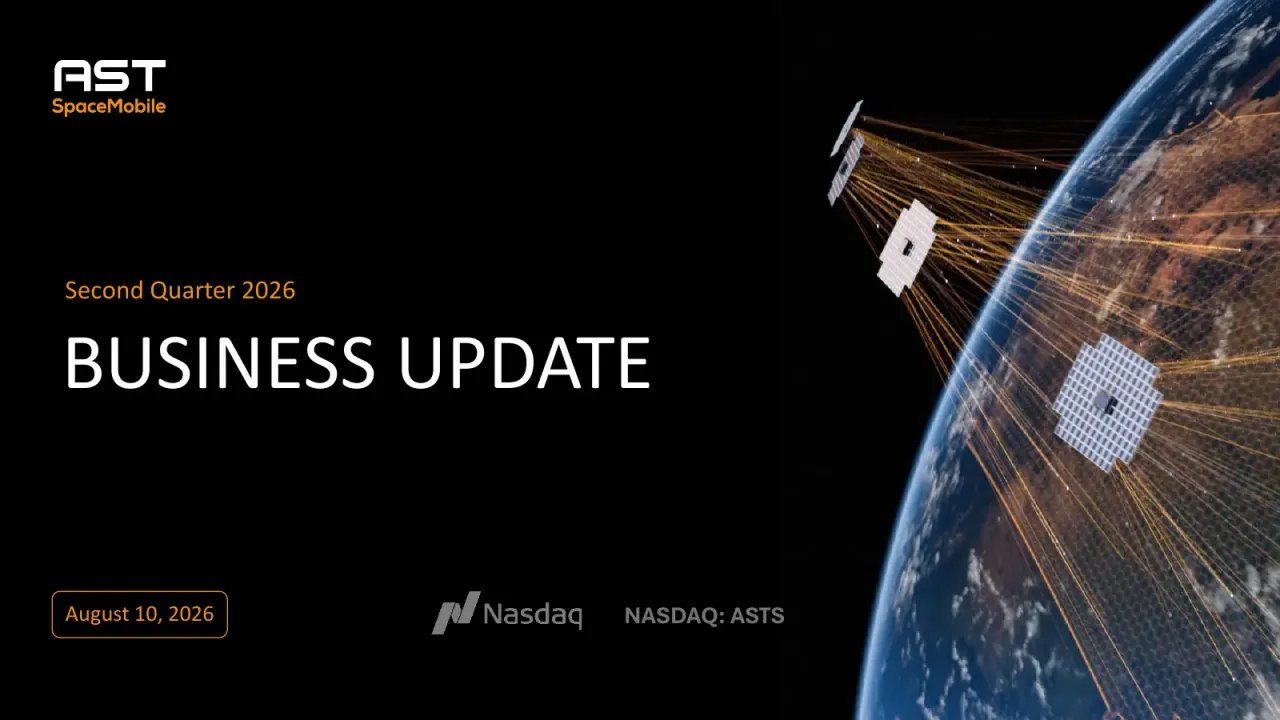
On 6ix: 6ix.com/event/ast-spacemobile-inc-asts-q2-2026-earnings-call
Automated transcript · Written by software from the replay's audio. It can mishear names and figures; the replay is the record.
0:00 Good day, and thank you for standing by. Welcome to AST SpaceMobile Second Quarter twenty twenty six Business Update. Please be advised that today's call is being recorded. I will now turn the conference over to Max Colbert, Investor Relations Manager of AST SpaceMobile. Thank you. You may begin. Thank you, and good afternoon, everyone. Today, I'm also joined by Chairman and CEO, Abel Avalon President, Scott Wisniewski and CFO and Chief Legal Officer, Andy Johnson. Let me refer you to Slide two of the presentation, which contains our Safe Harbor disclaimer. During today's call, we may make certain forward looking statements. These statements are based on current expectations and assumptions, and as a result, are subject to risks and uncertainties. Many factors could cause actual events to differ materially from the forward looking statements on this call.
0:47 For more information about these risks and uncertainties, please refer to the risk factors section of AST SpaceMobile's annual report on Form 10 ks for the year ending 12/31/2025 with the Securities and Exchange Commission and other documents filed by AST SpaceMobile with the SEC from time to time. Also, after our initial remarks, we'll be starting our Q and A section with questions submitted in advance by our shareholders. For those of you who may be new to our company and mission, there are nearly 6,000,000,000 mobile phones today around the world, but many of us still experience gaps in coverage as we live, work, and travel. Additionally, there are billions of people without cellular broadband and who remain unconnected to the global economy. The markets we are pursuing at AST SpaceMobile are massive, and the problem we are solving is important and touches nearly all of us.
1:36 In this backdrop, AST SpaceMobile is building the first and only global cellular broadband network in space to operate directly with everyday unmodified mobile phones, supported by our extensive IP and patent portfolio. It is now my pleasure to pass this over to Chairman and CEO, Abel Avalon, who will go through our activity since our last public update. Thank you, Max. Our execution in 2026 continue to reinforce what we have believed since we created AST SpaceMobile and invented the space based cellular broadband market. That combining differentiated technology, deep partnership with leading mobile network operators and integration position us to define the future of direct to device cellular broadband.
2:21 Our space based direct to device network will be the first of its kind to leverage low band and mid band spectrum with broadband speeds and native cellular application combining a feature set and technology stack that put us in a category of one. From the beginning, we designed our network architecture alongside existing mobile network operators, not as a replacement of them rather than requiring operators to rebuild their infrastructure, our architecture and technology extends and complement their existing terrestrial network into space, allowing us to integrate efficiently while evolving alongside future 3GPP standards. To put these concepts simply, we're building the direct to device network of the future today in partnership with not in competition with mobile network operators.
3:14 This new layer of connectivity that we are creating is not just for addressing gaps in terrestrial network, but it's to create a seamless connectivity experience wherever you live, work and travel anywhere on the planet. Spectrum is another area where we believe we have significant competitive advantage. Through a combination of low band spectrum contributed by our MNO partners and the spectrum we directly control, we're building access to the broader spectrum portfolio in the industry with satellite technology capable of tuning approximately eleven fifty megahertz for low band and mid band and in the future C band tunable spectrum globally. In The United States alone, we are on the path to approximately 100 megahertz of spectrum from a combination of MNO partner provided spectrum and our own access at the spectrum, which will be a lead that is difficult for others to match.
4:13 In particular, we're combining our over 3,900 patents and patent pending claims intellectual property and a very large face arrays with our spectrum access. This provide greater network capacity, better coverage and significant flexibility as demands grow. We are confident that our comprehensive spectrum strategy is the winning one, giving us a tech needed to increase subscriber capacity and bring services to target market with our partner MNOs. Direct to device cellular broadband is establishing itself as a new additional connectivity layer. Our differentiated in orbit technology and a scale of direct to device cellular broadband network serve as a resilient and reliable source of an additional and new connectivity layer serving commercial MNO partners and government agencies alike.
5:09 Incremental to delivering direct to device cellular broadband connectivity, our total addressable market is rapidly expanding. We see several growth opportunity across government communications and non communications opportunities, including radar, emergency response, Internet of Things, AI edge compute and other advanced connectivity solutions. We see these markets are beneficiaries of our space based direct to device network. We recently received an award pending government approvals and final agreements with long time partner Rakuten regarding selection for participation in the Low Earth Orbit Sun Infrastructure Development Project or GLEO in Japan, designing to address the Japanese and Asian markets with a total expected value of up to approximately US1 billion dollars in non dilutive, non debt government capital.
6:06 This follow continued work with FirstNet emergency and first responder networks in United States. We partner AT and T and recent announcement with multiple government through partners like Vodafone and Rakuten. Our partner first strategy position us as the partner of choice for direct to device cellular broadband among mobile network operators. Our commercial ecosystem is growing with over 60 MNO partners who cover over 3,000,000,000 subscribers globally, including key partners like AT and T, Verizon, Vodafone, Rakuten, FTC Group, Bell Canada and Telus. We are on the cusp of commercial deployment and we prepare to scale our Space Mobile service to everyday modified smartphones.
6:54 With certain spacecraft in orbit and approximately 20,000 square feet of combined aperture hardware and approximately 50 gateways globally that are in various stages of completion, installation and planning and we prepare for better service with key MNO partners in selected markets globally. In The United States, we have deployed over 3,000 low band cellular cells. We expect to deploy the remaining cells this year to light up the roughly 5,600 cellular cells that cover The United States. On network deployment, Bluebird 14 to 16 are undergoing final testing as their manufacturing assembly is nearly completed. The recent launch of Bluebird 11 to 13 demonstrate our ability to rapidly and repeatedly build, launch and deploy the largest phase array in low end orbit using advanced composting material for lighter and even bigger satellites.
7:52 Our largest newest fully composted bluebird satellites are operating as expected. We prepare them for their communication and non communication missions for government and MNO applications. Our ASIC chip is now in full production and we are expecting to nearly double the peak data speed of 98.9 megabit per second achieved using our on orbit Block one Blue Bird satellites. As a reminder, our ASIC is designed to support up to 10 gigahertz of processing bandwidth per satellite, which is nearly 10 times improvement from our in orbit Block one bluebird satellites. Over time, we expect further gain of up to additional 10 times improvement in user experience through AI enabled spectrum management.
8:41 Turning to manufacturing, one in various stages of production and assembly through Blue Bird 46, which is in line with the number of spacecraft required for continuous coverage in key markets. A detailed cadence of our deployment plan is shown the company quarterly presentation found on our IR website. We continue to leverage our 95% vertically integrated manufacturing strategy to move at the pace and precision needed to scale a constellation of the largest satellites in LEO, at a scale unprecedented in loaded orbits. We currently have over 500,000 square feet of manufacturing and operations space globally, including our dedicated micro production facility to help accelerate satellite production as we ramp up into our target cadence of six fully assembled satellites per month.
9:38 We recently on build plan for additional 400,000 square feet of manufacturing and production space in Midland, Texas. We prepare to further scale production for United States government and our extended TAM of commercial applications. We've been our global manufacturing and operations footprint will exceed 1,000,000 square feet of manufacturing capability with over 900,000 square feet residing in The United States once completed. We are proud to be manufacturing the largest satellites in LEO here in The United States and in Texas where bigger is better. In summary, AST SpaceMobile is executing across every critical dimension of our business. We had expanded our commercial partner ecosystem now with over 60 MNOs partners globally who collectively cover over 3,000,000,000 subscribers.
10:29 Our comprehensive spectrum start continued to strengthen across our satellite technology capable of tuning to approximately eleven fifty megahertz of tunable spectrum with shared MNO spectrum and control MNO spectrum totaling approximately 100 megahertz access in The U. S. And over 60 megahertz access globally. As an early indicator of success from our expanding total addressable market of opportunities, we increased our revenue backlog to approximately $1,300,000,000 in aggregated contracted revenue. Agreement with partners and contracts award with U. S. Hormann. These opportunities are supported by our robust balance sheet of more than $3,700,000,000 making us well positioned to lead the commercialization of the space based cellular broadband and create a significant long term value for our shareholders.
11:26 And with that, I will hand it over to Scott. Thank you, Abel. Since our last investor update call, AST SpaceMobile has continued to make great progress in our commercialization efforts. I would like to take you through some of that progress across our MNO and government customers and put in context the business opportunity ahead of us, which only continues to increase at breathtaking speed. In the commercial ecosystem, we are viewed as the partner of choice for direct to device with mobile network operators as evidenced by the ecosystem we have built with now over 60 MNO partners globally who collectively cover over 3,000,000,000 subscribers. Network deployment in key markets with strategic partners is well underway and our challenge is how to balance deployment of our cellular broadband service into the next set of markets beyond The U. S, Canada, Europe, Japan, Saudi Arabia and The U. S. Government.
12:22 We are balancing this today with active engagement with more than 20 mobile network operators across over 50 country markets. We are developing these markets together with our partners with an increasingly scaled and programmatic effort with services that are designed to be turned on as bluebirds come online. These efforts are going to manifest themselves not only in more market announcements with our partners, but also importantly progress in the delivery and setup of about 50 gateways across 20 markets. In fact, in Europe you're already starting to see this infrastructure in action as we recently announced network integration and testing activities across several European countries with Vodafone, Orange, Telefonica, Vodafone Ukraine and Deutsche Telekom. Meanwhile, the regulatory backdrop also continues to support our commercialization efforts and provide a window into how we expect the business to develop.
13:15 While The U. S. Was an early leader on the regulatory front with full commercial service approvals delivered earlier this year, we are seeing good progress internationally in The UK, Japan, Brazil, and other countries. Meanwhile, we have seen multiple countries provide commercial authorization to use our MSS spectrum assets, specifically in the S Band outside The United States. Altogether, these are strong signs of scaling our global cellular broadband network. More spectrum lanes of traffic for our network means more subscribers and better services when paired with our unique technology. Meanwhile, the U. S. Government customer has been a major focus for us and we see great progress this quarter, both in terms of revenue capture and building the backlog.
14:03 We drove revenue against several existing contracts and received three new contract awards. Our U. S. Government partners view our InOrbit technology as unique, strategic, innovative and flexible with communications and non communications capabilities. We have foreshadowed the trend of small development contracts becoming larger contracts ahead of still larger operationalization of the capabilities through programs of record. Today, you can see that trend as we are announcing three new contract awards with funded near term value of over $100,000,000 in total expected during 2026 and 2027. We plan to talk more about these awards publicly soon, but they represent near term capabilities have been in development with the U. S.
14:49 Department of War for years and leverage our unique in orbit technology to solve large strategic needs. In general, the backdrop and size of the Golden Dome opportunity coupled with the Arsenal of Freedom Initiative remains very strong for companies that have unique capabilities that can be deployed in the near term and can move fast. Now taking a step back, I want to take a moment to discuss the large addressable markets for the company beyond direct device. We see the opportunity to leverage our unique platform that we have created to dramatically expand the company's total addressable market, leveraging our differentiated technology, deep intellectual property portfolio, vertically integrated manufacturing, and of course the comprehensive spectrum strategy.
15:37 In part, this is now possible because of maturity of the business and our fortified balance sheet, utilizing the same spacecraft design and ground based gateways that we're already scaling today. We believe each of these new additional end markets could ultimately become multi billion dollar annual plus revenue opportunities for AST SpaceMobile. In the government and defense market, firstly, we've seen early traction around non communications including radar. Our spacecraft are uniquely positioned to provide some of these services given the size of the array aperture, the frequencies we serve and our ability to deploy quickly a global capability for an order of magnitude lower cost than historically possible. This application is a majority of our U.
16:23 S. Government revenue to date. Secondly, and this will sound familiar, We have the ability to provide secure communications directly to low profile, low power devices. This means regular 3GPP devices, but also custom designed handsets, existing radios, headsets, wearables, and drones. This will be with a technology that is already showing broadband speeds over a 100 megabits per second to extremely low profile and sized devices. These applications will be new to the war fighter and greatly simplify and improve communications for them in the years to come. Each of these capabilities can be served with the same in orbit network of AST SpaceMobile spacecraft, a combined capability that addresses the strategic needs of the US government customer for decades to come.
17:14 And apart from defense, we also see a few more funded comms opportunities. First, we are seeing a trend with large countries or regional bodies looking to replicate owned in orbit resilient communications. This is born from a desire to have increased operational control of communications over their territory. Given the AST SpaceMobile architecture of landing traffic in country, we are uniquely positioned to serve this need and to add additional layers for this demand with the Japan J. Leo preliminary award falling into this category. Second, federal emergency and backup is another market taking shape, which you can see from our announcement with Vodafone Ireland, but it has been long planned both in The U. S. With FirstNet and in Japan. The 700 megahertz band in particular is viewed as a federal resiliency frequency and thus is an attractive match network.
18:06 This capability could be used broadly for first responders and also as a large scale backup during periods of network outage with Spain and Australia offering some notable recent outages that are driving political need for action. Thirdly, IoT or Internet of Things is an attractive market for cellular and satellite operators, which positions us well to provide a unified service across both broadband and narrowband applications. With our controlled MSS frequencies combined with extremely low cost devices, this is another attractive use of our existing in orbit network. One final network I wanted to highlight today is space based AI edge compute. As companies are starting to think about how to service this market in a big way, one of the key elements is the ability to deploy and control large structures in space, which is what we do.
18:58 This is significant power to orbit at meaningful scale and with competitive costs. This provides clear costs and scale advantages for supplying power and compute in space. What you will see from us in the near term is stretching from a bent pipe network and building additional edge computing capabilities valuable to those networks. In total, all of these markets represent an expansion of our incredibly strong core direct to device total addressable market into new large markets, primarily on a funded basis, leveraging the incredible platform we have built. Closing out with a quick discussion on Q2 revenue, we achieved over $30,000,000 in revenue during the quarter, more than doubling our Q1 revenue. This was driven by a combination of milestone achievements under our U. S. Government contracts and commercial infrastructure for our mobile network operator partners.
19:49 Our commercial and government efforts to date serve as important milestones in our roadmap to much larger opportunities, each with potentially billions of dollars in revenue per year as we scale our business. In Q2 specifically, we delivered against 13 gateways to seven customers across five continents. And we remain confident in our ability to achieve our full year 2026 revenue goals and are reiterating our guidance of 150 to 200,000,000 supported by contracted programs already underway together with our existing commercial and government pipeline. Altogether, we're very pleased with the progress we've made across the business. Commercial readiness continues to advance. Government demand continues to expand, our deployment roadmap remains on track and our operational capabilities continue to scale.
20:37 These milestones reinforce our confidence as we prepare for commercial service and position AST SpaceMobile for meaningful long term growth. I'm now happy to pass the call over to Andy to walk through our financial update. Thanks Scott, and good afternoon everyone. During the second quarter of twenty twenty six, we maintained focus by further fortifying our capital position, executing on our commercial objectives, accelerating our manufacturing cadence, leveraging our growing footprint in Texas and beyond and expanding our total addressable market or TAM for additional applications including U. S. Government secure communications and non communications, radar emergency response, Internet of Things, AI edge compute and other advanced connectivity applications.
21:29 Revenue in Q2 came in consistent with our internal plans. As I've previously noted, we expect revenue to build sequentially each quarter during 2026 with contributions from both commercial revenue, primarily gateway sales revenue and U. S. Government contracts. I am pleased to confirm that we remain on track to meet our full year 2026 revenue guidance of 150,000,000 to $200,000,000 With respect to manufacturing, Bluebirds 14 to 16 are ready to ship shortly, while Bluebirds 17 to Bluebird 46 are in various stages of production and assembly as we continue scaling our production capabilities, building the largest phase arrays in low earth orbit.
22:15 Our manufacturing progress positions us well to support our current network deployment plan, targeting approximately 45 Bluebird satellites in orbit by early twenty twenty seven. The strength of our balance sheet further bolstered with last month's convertible debt offering positions us not only to complete the full build out and launch of a constellation of over 100 Bluebird satellites to provide worldwide space mobile service and deploy our controlled spectrum bands on a global basis, but also to pursue an expanding universe of growth initiatives and secure additional access to orbit for our space based cellular broadband network, including partnerships and or acquisitions to further vertically integrate our business and mitigate risks associated with third party launch providers.
23:10 Our intentional focus on investing in the growth of our operations led to higher adjusted operating expenses Q2 twenty twenty six as compared to Q1 consistent with our expectations as previously communicated during our first quarter twenty twenty six earnings call in May. Now moving to the operating and capital metrics slide, let's review the key metrics for the second quarter in a bit more detail. On the first chart for the second quarter of twenty twenty six, we incurred non GAAP adjusted operating expenses of $119,100,000 versus $91,200,000 in the first quarter. Non GAAP adjusted operating expenses exclude non cash operating costs proceeds in connection with our Bluebird seven loss.
24:04 The quarter over quarter increase of $27,900,000 resulted primarily from an $11,900,000 increase in adjusted cost of revenues due to higher revenue in the quarter, together with a 12,300,000 increase in adjusted engineering service costs, a $3,100,000 increase in adjusted general and administrative costs, and a $600,000 increase in R and D costs. Our Q2 twenty twenty six adjusted operating expenses excluding adjusted cost of revenues were $95,900,000 compared to $79,800,000 in Q1 of twenty twenty six. This amount was near the high end of the 85,000,000 to $95,000,000 guidance for Q2 adjusted operating expenses that I previously provided.
24:58 The primary drivers of the increase versus the prior quarter were growth in our workforce, including contractors and consultants, our expanded production facilities, other professional fees and critical investments relating to artificial intelligence. Turning towards the second chart on this slide, our capital expenditures for the second quarter of twenty twenty six were approximately $610,000,000 versus approximately $257,000,000 for the first quarter. This figure was made up primarily of payments made in connection with multiple launch contracts, capitalized direct materials and labor for our Bluebird satellites with the balance relating to facility and production equipment expenditures.
25:44 This amount for the quarter was just below the midpoint of the guidance of $575,000,000 to $650,000,000 that I provided during our last earnings call, which assumed a significant launch payment in Q2 that was originally scheduled to be paid in the first quarter. For the third quarter of twenty twenty six, we estimate that our adjusted operating expenses excluding adjusted cost of revenues will increase to the range of approximately $105,000,000 to $115,000,000 as we continue to absorb the full quarter of cost of our expanded workforce and continue growing talent across our organization to scale our efforts to address our expanding TAM, as well as pursue the monetization of our L and S band spectrum usage rights.
26:32 For the full year of 2026, we expect adjusted OpEx excluding adjusted cost of revenues to average approximately $100,000,000 per quarter or $400,000,000 total for the year. Consistent with average quarterly CapEx spend during the first half of twenty twenty six, we expect our capital expenditures in Q3 of twenty twenty six to be in the range of approximately $350,000,000 to $425,000,000 primarily driven by timing of launch payments, which as I previously explained and evidenced by the first half of this year, do vary from quarter to quarter. Importantly, our continued spend on growth related CapEx reflects our increasing satellite production and our active orbital launch plans.
27:21 We continue to estimate that the average capital costs, including direct materials and launch costs for our constellation of over 90 Bluebird satellites will fall in the range of approximately $21,000,000 to $23,000,000 per satellite, excluding certain initial satellites that are used to validate performance and operations. Our cost per satellite estimates are subject to fluctuations based on dynamic geopolitical factors that could impact our costs. And as a reminder, changes in our adjusted operating expenses and capital expenditures as I've just described could be delayed or may not be realized due to a variety of factors. Turning to revenue. In the second quarter, we recognized revenue of $31,500,000 primarily driven by commercial gateway deliveries and various U. S. Government service milestone achievements.
28:16 Our revenue increased sequentially and year over year in the second quarter as we expected due to the timing of gateway deployment to our commercial customers and the timing of completion of certain government contract milestones. With respect to commercial revenue generation, we believe we can enable continuous SpaceMobile service across key markets such as The United States, Europe, Japan and other strategic markets with the launch and operation of approximately 45 to 60 Bluebird satellites and additional strategic worldwide markets with the launch and operation of approximately nine Bluebird satellites. Further, as we continue to launch and deploy our Constellation, we will continue to support U. S. Government applications currently ongoing and accelerating as our Constellation grows.
29:06 As we reiterated in our Q1 twenty twenty six earnings call, we expect to generate full year 2026 revenue in the range of 150,000,000 to $200,000,000 We manage the top line with a focus on full year performance given the quarterly variability inherent to our business, including the timing of contract signings, equipment sales and milestone achievements. As a way to be helpful and for the avoidance of doubt, we expect revenue in each quarter to continue to grow sequentially, but will likely be weighted towards the fourth quarter. As a result, we believe our revenue performance is best evaluated on a full year basis. We expect revenue to continue to be driven by gateway deliveries, achievement of contracted milestones for the U. S. Government, MNO consulting services with potential upside related to the recognition of initial commercial service revenue.
30:02 The achievement of our revenue plan remains subject to several contingencies including the successful launch and deployment of our Bluebird satellites related to U. S. Government applications and those contractual milestone achievements, critical gateway equipment sales to our MNO partners in support of their anticipated commercialization efforts of SpaceMobile service and service revenues in connection with the activation of our commercial service provided by our existing and planned deployed and operational satellites. Now turning to the balance sheet. With this backdrop in July, we executed a convertible debt transaction for 1,150,000,000 aggregate principal amount of 1.625% convertible senior notes due in 2034.
30:50 As part of the transaction, we purchased a capped call hedge to increase the effective conversion price to $149.20 per share, a price well above our all time high trading price. This financing allows us to pursue an expanding universe of growth opportunities, further continue vertical integration efforts and secure additional access to Orbit for our space based cellular network. The notes have our lowest coupon ever at 1.625% providing cost efficient capital with effective dilution of less than 2%. Finally, on the final chart on this slide, on a pro form a basis inclusive of that $1,150,000,000 in gross proceeds from the convertible notes offering, our cash, cash equivalents and restricted cash as of 06/30/2026 was over $3,700,000,000 In closing, we are making progress on all fronts and accomplishing our near term objectives.
31:53 The hard work across the organization continues with revenue building on plan for 2026, satellite manufacturing increasing to support our orbital launch campaign and increasing applications within our rapidly expanding TAM. We look forward to sharing additional achievements with you during Q3 and throughout the second half of twenty twenty six. Thank you for your continued support as we continue the hard work of connecting the unconnected at AST SpaceMobile. And with that, this completes the presentation component of our business update call and I'll pass it back to Scott. Thank you, Andy. Before we go to the queue of analyst questions, we'd like to address a few of the questions submitted by our investors. Operator, could you please start us off with the first question?
32:41 David from New Jersey asks, how should investors think about the expected timing of meaningful government revenue? And could you expand some more on the radar capabilities of the Constellation? Thank you, David. As we said in our remarks, we're making good progress on these contracts, including over $100,000,000 of contract awards in the last couple months. So consistent with how we've always talked about it, these are of initial phases as we scale up the opportunity and the government wants to see perform against that. And of course we're really uniquely able to perform given the size of our satellite, our technology, the fact that we're in orbit, the fact that we're vertically integrated. And what we're seeing is that this opportunity is going to start scaling up into a recurring multi billion dollar a year opportunity starting in 2027.
33:31 Leedon from New Zealand how does ASTS' ownership of spectrum assets affect the company? Thank you, Leiden, for the question. Well, spectrum is like fuel for our business. But of course, also how efficient is the machine to utilize that fuel is super important. So it's the combination of the very large phase array, supported by over 3,600 patent pending claims, a very large face array, the power of that face array and access to MNO partner spectrum and our own spectrum is what it make that fuel really be very efficient in terms of creating additional lines of revenue to our government.
34:18 As Scott presented in the in our brief today, I mean, this is allowing us to actually scale up into a multitude of new applications that create a multiplication of our TAM, our current TAM from D2D to seven more new applications that really multiply the addressable TAM that we have today. So ownership for spectrum is super strategic for us. We were the first company in direct to device that start this trend of direct to device operators to own spectrum, but we had the largest combined spectrum access, when you combine our MNO partners' spectrum plus our own spectrum in addition to a very large phased array with a lot of power that create that fuel, that create multiple lines for lines of capabilities for our company.
35:24 Kevin from Vancouver asked, What kind of demand drivers are you seeing to trigger the massive 400,000 square feet of manufacturing expansion in Texas? How many Blue Birds per month are you aiming to produce? Well, we're currently getting to six per month. We want to expand that in order to be able to supply enough capacity for our government and no government applications. And so with the additional 400,000 square feet of manufacturing, we would be close to 1,000,000 square feet of manufacturing facility. We want to continue expanding our capability of producing them to even larger satellites that allow us to support communications, radar, GPS, AI, cloud computing, IoT, and other very strategic applications that we have. And that's why we are investing very efficiently in extending our capability of manufacturing in Texas close to a million square feet of manufacturing.
36:35 Leden from New Zealand asks, does ASTS believe other countries will come forward with their own FirstNet or J LEO programs that ASTS can support? Thank you, Leeden. Yeah, we see the J LEO project as a real proof point for how countries, large countries are thinking about their own infrastructure. This is infrastructure they can control and get access to and we think that, we see others thinking about it. So this is a trend that's gonna play out we think multiple times in the coming years. And this is really a new layer of communications that gives governments and nations access to capabilities that they access and can control. And in particular, the 700 megahertz band is one that we've put on the satellite in order to be able to address opportunities like this, both in The US and Europe and in other places like Latin America as well.
37:32 And with that, I'd like to thank our shareholders for submitting those questions. Operator, let's open up the call to analyst questions now. Thank you. We will now be conducting a question and answer session. Session. Thank you. Our first question comes from the line of Greg Pendy with Clear Street. Please proceed with your question.
38:26 Sure. Thanks for taking my question. Can you kind of share with us on the Racodon JV? I know it's in advanced discussions. But what stood out to get you guys to this stage given it was pretty competitive with some other bidders out there? What do you think you offer to the table that really kind of moved you guys along in that process? Thank you, Greg, for the question. Well, we are the only platform that has demonstrated and is delivering today broadband capability. That's that is one key factor.
39:12 The other one is the architecture that we offer allow nations and regulatory bodies to basically keep all the data and all the management of the infrastructure on the ground. And third, the partnership with Rakuten over many years that we have with them as a leading Japanese company that have been partnered with us for many years. So but fundamentally, we have the only platform that can deliver broadband that is in operations and that have demonstrated the ability to basically deliver seamless connectivity between terrestrial and space on a scalable basis.
40:07 Great, that's very helpful. And is there any way you can kind of give us an idea? I know you don't break it out, so if you don't want to do that, but the backlog growing nicely to 1,300,000,000 how much of that it might be government? I would say, it's a minority of it is government. The ads primarily government, but the overall backlog, a minority of it is government. But I would say that we expect that one to scale in the near term most significantly. Got it. Thanks. Very helpful. Thanks a lot. Thank you. Our next question comes from the line of Mike Crawford with B. Riley Securities. Please proceed with your question.
40:55 Thank you. Of these first 46 Bluebirds that you have under partial states of construction now, how many of these are already have or are targeted to have L band or S band connectivity installed on the microns? And then how should we think of the spectrum mix of a full 90 satellite constellation? Mike. I mean, we are producing roughly at a rate of six per month in terms of microns. We are on micron 46. We're starting the production of the mid band capability later this year for start launching very early in 2027 the urban capability. So, the current microbes are low band systems.
41:49 Thank you, Habel. And then, third, my second question is, how does this potential U. S. MNO joint venture affect your discrete agreements with AT and T and Verizon and as well as with T Mobile that you don't have an agreement with? Thanks, Mike. Well, our existing agreements are not affected. And frankly, as we said, when this was announced, the joint venture frankly frees up a third and fourth customer for us in The United States. So we were happy and supportive of it. Ultimately we are carrier right? Our network is good for all operators. We have strong partners and those partners are important to us but as markets grow and mature, we expect to be available to all operators. So this is really consistent with the strategy we put forward two years ago when Verizon joined with AT and T to support us. And going forward with the joint venture, we look forward to partnering with them as well.
42:54 But existing agreements and the lead we have in the market for delivering cellular broadband that's unaffected. All right. Thank you, Scott. Thank you. Our next question comes from the line of Colin Canfield with Cantor Fitzgerald. Please proceed with your question. Hey, thanks for the question. As we put into the building blocks on revenue for 2027, just rough numbers here, it seems like there's probably 100 to $200,000,000 of gateway support, 100 to $200,000,000 of government U. Government support and maybe $100,000,000 of international government support. As we think about the upside to that framework, can you just maybe refresh investors on how to think about rev rec for commercial service? And essentially, what are you hearing from commercial operators about pushing revenue or allowing AST to recognize revenue with a partial deployment of Constellation?
43:46 Thanks. Hey, Colin. I mean, first of all, we're hearing from operators that they want the service now. And so we are pushing extremely hard. You've seen our comments on beta, getting that out the door to demonstrate skilled capabilities and then start rolling out commercial service with as little as 45 satellites in orbit. So we're racing towards that with our strategic partners, really as many partners as we can simultaneously race towards that with. Yeah, rev rec will begin. I don't wanna commit to anything but generally speaking, revenue recognition should begin for commercial service when commercial service begins, right? So when that happens next year, that'll start being recognized. The other components of revenue, would say you're generally accurate, gateway is in excess of a $100,000,000 as we continue to grow that.
44:38 Government revenue, we hope will greatly exceed your number, but that's still being played out now and we'll have more announcements in the near term on that. And commercial services revenue of course is what we're all playing for. And we're very excited and expect that to ramp quickly once we get going. Got it. Got it. And then for the international government opportunities, if you could just maybe talk about the market structure that you expect in Germany as well as the rest of Europe. Maybe how do you think about customer appetite to multi source supply chains? And if they're not multi sourcing, what milestones do you think it takes them to secure their supply chain? And specifically, we're talking about Iris. Thanks. Well, I think, Colin, there's a lot there, of course, because there's a lot of different markets. But what we can do in the defense market, which is comms and non communication services with a very unique technology in Orbit, is attractive to a lot of parties.
45:39 And we see the trend playing out in other sectors that are perhaps less strategic capabilities where international governments are placing bets around services. And we think over time, those governments will turn their attention to larger scaled services like what we can do because having that capability is a very powerful thing. And you see that obviously with the J. LEO preliminary award. So I would say this is a trend to watch for us over time. I won't speak to individual markets, but certainly Europe and NATO and you can see how it's playing out through the MSS process in Europe with them prioritizing certain types of providers who have European operations, etcetera. So those are all trends we're positioning ourselves around and it starts with our tech, but also it's very important as Bell said, that we have good partners like with Rakuten in Japan and Vodafone in Europe, and that really facilitates our access to the opportunities in a way you don't see elsewhere.
46:39 That's great. Thank you. Thank you. Our next question comes from the line of Michael Funk with Bank of America. Please proceed with your question. Yes, good evening. Thank you for the questions guys. So first, ex Blue Origin, how many launches do you have contracted for the remainder of 2026 and 2027? And is the stackability on those vehicles? We have 10 launches booked with two different providers and we're targeting a cadence of every month or two on average. Beyond that, we've been providing disclosure about two months in advance as we get launched down selected.
47:24 I think with Blue Origin, I think we're all watching that. We were sad to see what happened in May, but they've made tremendous progress to date and both turning around the pad and getting resolution recently on the root cause for the anomaly. And so they're targeting this year, we're not betting on that necessarily. We'll be happy if they do it, but we're not betting on that in our numbers. And with a mix of launches, we think we can get to early twenty twenty seven for our initial 45 satellites. That was great. Thank you for that. And then on build cost per satellite, can you tell me where you are today and where you see that trend over the next twelve months? Yes, the cost per satellite, Michael, is the question.
48:14 That's correct. I'll go ahead. Yes. We've been consistent now for several quarters that we are falling between 21,000,000 and 23,000,000 per satellite. And that includes launch, that includes our direct labor and so forth. And we track that each quarter and roll it up. So that's consistent. I think that that is over the life of a constellation. So some of the initial satellites may exceed, but over time in our planning and so forth, that range holds up for the first constellation. And then we continue to look at ways to take cost out as we continue to engage with launch providers and acquire more launches, the economics scale better in that way. So over time, we'd hope to bring that cost down, but that's been consistent in that 21 to 23 range currently and over the life of the 90 satellites, we feel good with that number.
49:14 Okay, great. Hey, thank you guys. Thank you. Our next question comes from the line of Chris Scholl with UBS. Please proceed with your question. Great, thank you. You mentioned the expanding TAM and you cited AI edge computing, federal emergency and IoT. Can you just help us better understand what needs to be done operationally to tap into some of these markets? And any rough sense on the timeline there? And as you think about targeting these areas, how should we think about funding needs? Will you continue to be opportunistic? Or do you have much of what you need for the foreseeable future? Thank you. Yes. Chris, I mean, all these opportunities are basically on the back of the architecture we have, which is basically fundamentally the largest capacity to generate power in space and the largest gain, antenna gain for a spacecraft.
50:15 So basically, are piggybacking in the space architecture we have and also in the gateway architecture we have. In AI compute, we are starting to add that capability into our satellites. We mentioned that we're on satellite 46 in production. Now, we're starting to add the compute capability on satellite 47, 48, so later in the year, we integrated to our system. IoT, radar, emergency, and dedicated constellations or specialized constellations like the one in Japan, they're already part of the architecture as we have it. So, are incremental opportunities basically taking advantage of what we have built on our intellectual property.
51:15 Great. And if I can just fit in one more. You mentioned the path to 100 megahertz of spectrum in The U. S. And 60 megahertz globally. Can you just clarify how much you have access FERNANDEZ:] to today? And what are the alternatives you have for securing those additional airwaves to reach these levels? Yes. I mean, we can tune our between low band and mid band, we had around close to 1,200 megahertz of capacity that we can tune our satellites. We can do these per country. And in addition to that, also, can tune our own and control MSS spectrum. So the 100 megahertz of spectrum is roughly what you see from our acquisition of spectrum through Ligado plus access to spectrum of our M and O partners here in The United States.
52:06 Overseas is on a country by country basis. As you know, we had a joint venture in Europe with Vodafone. 21 of the top 25 operators in Europe have indicated they want to partner with us in accessing that capacity. So, when we talk about a spectrum, we're talking about the collection of our own spectrum and the spectrum that the MNOs make available to our satellites. Okay, great. Thank you. Thank you. Our next question comes from the line of Louie DiPalma with William Blair. Please proceed with your question. Good evening, Abel, Scott and Andy. On prior calls, you discussed the target for 2027 revenue to approach $1,000,000,000 And given the different puts and takes and the backlog of $1,300,000,000 now, how should we think of modeling next year's revenue and beyond? Thanks.
53:13 Hey, Louie. So the principles there were based on a full year, first full year of commercial service. So we still, nothing's changed on our expectation and our goal of reaching, approaching a billion of revenue in our first year of commercial service. So next year, the way to think about it is still a really strong opportunity in government that could contribute to probably as much as half of that. Still good infrastructure revenue like we have this year. And then as commercial service comes online ramping into the balance of that. So we still feel really good about that number. It's just a question of when kick it off and when we hit the run rate.
54:00 Great. Thanks Scott. And you discussed the beta trials. What is the timing in terms of when consumers will be able to trial your network? I know that you don't want to speak on behalf of your carrier partners, but have they given any sense on when the generic AT and T and Verizon customers will be able to test out the service? And related to that, if there are like 25 satellites in orbit from a general location in The United States, what percentage of the day will a satellite be overhead such that consumers will be able to connect to your network?
54:53 Thanks, Louis. So getting the capability ready for consumers is something that we're targeting for later in 2026. How we go to market with that, how we use that, of course, like you said, we're gonna defer to our partners and we'll be announcements on that in the right way but we're very focused on enabling that. And there's a lot that you can do separate and apart from the space. So those two are kind of separate. And so while we've historically said 25 satellites is the right way to think about it, we have great flexibility there on how we do beta. So for us, it's all about racing forward towards putting satellites in the air and then racing towards getting a scaled beta available. Because of course the steps from a scaled beta to commercial services is pretty quick. It's just a function of satellites in orbit.
55:42 And in terms of our about 25 satellites, like you said, that's, you know, there's a lot of variance there but think about it as about half the day coverage. Great. Thanks Scott. Thanks everyone. Thank you. Our next question comes from the line of Brian Kraft with Deutsche Bank. Please proceed with your question. Hi, good afternoon. I guess I wanted to ask you just on the JV. How do you expect to work with the JV in The U. S? Do you expect the fifty-fifty revenue share model to still be the revenue model for you with the JV? And separately, are you in talks with T Mobile or Deutsche Telekom over partnerships given that you're conducting integration and testing with Deutsche Telekom and obviously they're the parent company of T Mobile.
56:40 Anything you could share on that would be great. Thank you. Hey, Brian. Listen, we expect to be working with all operators in United States and all major operators in Europe. And we did announce 60 mobile operators around the globe with access to around 3,000,000,000 devices on a global basis. So, as it relates specifically to The United States, we, as Scott explained it, we plan to keep the contracts that we have with our current partners the way they are and expanding the relationship into all of them both through the JV and directly with each one of them.
57:31 Okay. Thank you very much, Raul. Thank you. Our next question comes from the line of Chris Quilty with Quilty Analytics. Please proceed with your question. Thank you. We just finally got visibility on the upper C band. And I was wondering, is that upper C band kind of a reference design in your current ASIC? Or is that going to have to be Rev. Two when that spectrum becomes available at the end of the decade? Chris, no, we are working that C band is already built into our ASIC architecture. And, we're working on a third generation that will include both the L band, MSS, mid band and C band.
58:23 So a question on the chip will be a single chip, but does it still or do you still need to have different satellite designs because of the antenna requirements in order to support the multiple bands? Or is there a way to collapse FERNANDEZ:] that in the No, no. We're keeping different phase arrays per block of spectrum. So you have the low band, the mid band, and in the future, the C band is being also being incorporated to satellites. Got it. And a follow-up, you didn't answer David's question from earlier about the government radar applications and maybe I'll just ask is that are we talking active or passive applications?
59:12 And is this using your spectrum or government spectrum? The rate application in The United States is using government spectrum that take advantage of our very large phase array and the sensitivity of the satellites, which is a capability that is already built and in orbit for the government. And with that L band spectrum already designed in? Our major application is for radar is in the lower bands. Okay. Great. Thank you very much. Thank you. Our next question comes from the line of Scott Searle with Roth Capital. Please proceed with your question.
59:59 Hey, good afternoon. Thanks for taking the questions. I wanted to follow-up on the Dedicated Constellation front. The J. LEO opportunity seems very exciting. I'm wondering if you could address a little bit the architectural approach in terms of how much commonality and you can leverage existing infrastructure from gateways and otherwise, as you build out that constellation. And as part of that, I think Japan has committed $1,000,000,000 in capital. What is the capital requirement from the AST standpoint? And then you've hinted at other opportunities globally. I'm wondering if you could provide some color in terms of other opportunities that are percolating either from a regional perspective or maybe the number of opportunities. Thanks. Scott, the satellites flag Japanese are basically identical than the rest of the constellation.
1:00:52 And the way that this is planned is as they are black, as Japanese satellites, they can be used anywhere in the world using the same architecture of gateways and the rest of the American constellation, vast majority of the satellites. So, this represents roughly half on the investment on those satellites, in capital that is non dilutive and non debt, for global usage of these satellites, but with a flag, a Japanese satellite for that subset of satellites. Great. And any other opportunities that are percolating that you can address in terms of number opportunities or potential timeline for other similar types of dedicated sovereign constellations?
1:01:44 Thanks. Hey, Scott. Yeah, we don't want to comment on that, but there are other discussions with other parties. Frankly, if you think about it, having communications capabilities that are resilient and in your control, I don't know why a G20 country wouldn't want this kind of capability given the price. So I think that we see this as an attractive place for us to continue to build out our network and partner in the way that we've been very good at it. You see this playing out a little bit, I think in the earth observation arena, but as it relates to comms and our other capabilities, which is a much bigger opportunity and much more strategic, I think you're gonna see a lot of this over time because I just don't understand why a major country wouldn't want this capability.
1:02:37 Great. Thanks so much. Thank you. And we have reached the end of the question and answer session. I would now like to turn the floor back over to Max Holberg for closing remarks. Thank you, operator. We want to thank all of our shareholders and research analysts for joining the call. We really appreciate it and have a great rest of your week. Thank you. And this concludes today's conference and you may disconnect your lines at this time. We thank you for your participation.
Follow Ast SpaceMobile, Inc. into a list and get an email when it puts out news.
Investor Relations Manager
Chairman and CEO
President
CFO and Chief Legal Officer
Analyst, ClearStreet
Analyst, B. Riley Securities
Analyst, Bank of America
Analyst, UBS
Analyst, William Blair
Analyst, Quilty Analytics
Analyst, Roth Capital